
TimeGhost History
Published 8 Sep 2021The Surrealist Movement is born this season with unsurprising eccentric drama. Salvador Dali will one day be a part of it, but for now he is still in art school and has actually only just come out of prison. Also this season, a crime which sees police chasing America’s first ever “Public Enemy No. 1”
(more…)
September 9, 2021
Did Freudian Psychology Create Modern Art? | B2W: ZEITGEIST! I E.25 Harvest 1924
Comments Off on Did Freudian Psychology Create Modern Art? | B2W: ZEITGEIST! I E.25 Harvest 1924
September 8, 2021
Making Hitler Transgender? – Early Operations of the CIA – WW2 – Spies & Ties 08
World War Two
Published 7 Sep 2021World War Two gave birth to a new American centralised intelligence agency: The OSS (Office of Strategic Services). Led by “Wild Bill” Donovan, it is the cradle of many outrageous plans, spy stories, and gadgets.
(more…)
Comments Off on Making Hitler Transgender? – Early Operations of the CIA – WW2 – Spies & Ties 08
QotD: Wine Ratings
… to the average Frenchman “wine” means “French wine.” And in a country where truckers buy splits of Bordeaux at highway rest-stops, golfers chug Burgundy, not Bud, and a glass of red costs less than a medium Coke, face it, they drink a lot more and know what they like.
But Americans, the kind who don’t collect vintage-chart flash-cards, are faced with a paralyzing array of choices. They can resolve never to venture beyond the few, usually well-advertised, brands they know. Or they can check the ratings. Not just Parker’s. Numbers from Wine Spectator, Wine Enthusiast and Wine & Spirits all appear on the shelf-talkers. And what’s wrong with that? Doesn’t knowing that SOMEONE considered it a Best Buy make you feel a little less in-the-dark when coughing up $15-$20 for an unfamiliar bottle?
Perhaps your local movie critic weeps over female bonding, while your tastes run more to female bondage. At least you can read his opinion, even as you take it through a filter. You won’t agree with all wine critics, either, but that’s no reason to knock the whole concept.
In the best of worlds, you would always have a trusted œno-professional or wine-geek friend help you. Otherwise, letting someone else plough through the business of comparing hundreds of wines for you makes sense, even if the result is rating an artistic creation with a number. Not perfect, but certainly helpful.
Jennifer “Chotzi” Rosen, “The Rating Game”, Rocky Mountain News, 2002-07-02.
Comments Off on QotD: Wine Ratings
September 7, 2021
L. Neil Smith, 12 May 1946 – 27 August 2021
From what might be the penultimate issue of the Libertarian Enterprise, Neil’s daughter Rylla Smith says farewell to her father:

Lester Neil Smith III, novelist and political commentator, gunsmith and musician, visionary and futurist, passed away on Friday, August 27th at Poudre Valley Hospital after a lengthy battle with heart and kidney disease. He was 75 years old.
A long-time resident of Fort Collins, Colorado, Neil was born on May 12th, 1946 at Mercy Hospital in Denver, Colorado to Maj. Lester N. Smith II and Marie L. Coveleskie Smith.
Neil, known in the world of science fiction as L. Neil Smith or, affectionately, “El Neil”, is survived by his beloved wife, Cathy L.Z. Smith, his daughter, Rylla C. Smith, his brother Roger L. Smith, his nephews Nolan and Travis, and his aunt, Barbara Ohlwiler, as well as countless friends and brothers-in-arms. He was preceded in death by his mother and father.
Neil’s life was one spent perpetually looking forward — toward the future of freedom, of technology, of the continuation of the evolution of the human body, mind, and spirit, and toward the endless sea of stars. As a child, he wanted to be a marine biologist, to discover the unknown in the depths of the seas; this translated naturally in his young adulthood to a thirst for knowledge of the far greater unknown beyond the shores of this world.
Neil had an avid interest in the politics of personal liberty and always stood for what he believed to be right. He had a passion for friendly debate and never shied away from speaking his mind.
In the late 1970s, he wrote the first of his many novels, The Probability Broach, which began a long and prolific career in the burgeoning world of liberty-oriented science fiction, and was the creator of the Prometheus Award, as well as the recipient of the 2016 Special Prometheus Award for Lifetime Achievement.
Memorial services will be held in Fort Collins, Colorado on a date yet to be determined; for more information, please follow Neil’s memorial page on EverLoved.com or contact Rylla Smith at ryllacat@gmail.com.
“And yet, what is bravery but the capacity to reject our fears, ignore and supress them, then go on to do whatever it is we are afraid to do.” — L. Neil Smith
Comments Off on L. Neil Smith, 12 May 1946 – 27 August 2021
Fallen Flag — the New York, New Haven & Hartford Railroad

Around the beginning of the 20th century, New York investors led by J. P. Morgan gained control, and in 1903 installed Charles S. Mellen as President. Charles Francis Murphy’s New York Contracting and Trucking company was awarded a $6 million contract in 1904 to build rail lines in the Bronx for the New York, New Haven, and Hartford Railroad. An executive at the railroad said the contract was awarded to avoid friction with New York City’s Tammany Hall political machine. In response to this contract, the New York State Legislature amended the city’s charter so that franchise-awarding power was removed from the city council and given to the Board of Estimate and Apportionment, which only recently became defunct in 1989. Morgan and Mellen achieved a complete monopoly of transportation in southern New England, purchasing other railroads and steamship and trolley lines. More than 100 independent railroads eventually became part of the system before and during these years, reaching 2,131 miles at its 1929 peak. Substantial improvements to the system were made during the Mellen years, including electrification between New York and New Haven. […] Morgan and Mellen went further and attempted to acquire or neutralize competition from other railroads in New England, including the New York Central’s Boston and Albany Railroad, the Rutland Railroad, the Maine Central Railroad, and the Boston and Maine Railroad. But the Morgan-Mellen expansion left the company overextended and financially weak.
In 1914, 21 directors and ex-directors of the railroad were indicted for “conspiracy to monopolize interstate commerce by acquiring the control of practically all the transportation facilities of New England.”
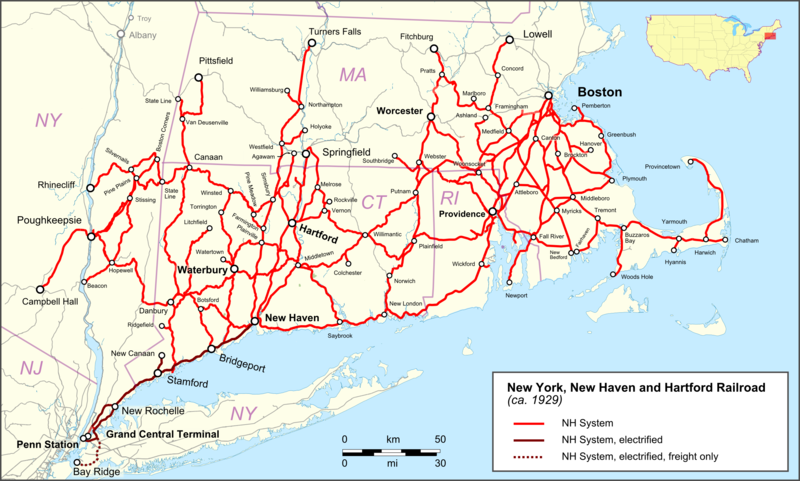
J.W. Swanberg carries on the story of the railroad’s woes during and after the First World War:
The New Haven was a financial powerhouse at the start of the 20th century, but from 1903 to 1913, the road was driven to near bankruptcy under President Charles S. Mellen and financier J.P. Morgan. One gain in this period, though, was control of the Central New England Railway, which included the Hudson River bridge at Poughkeepsie, N.Y., and the link to Maybrook and nearby Campbell Hall. This was New Haven’s gateway to the west, also served by trunk lines Erie; New York, Ontario & Western; and bridge lines Lehigh & Hudson River and Lehigh & New England.
World War I government control and the Roaring 1920s boom times saved the New Haven, but not enough to survive the Great Depression, and bankruptcy came in 1935. World War II traffic allowed recovery and rebuilding, but soon all was lost by mismanagement and bankruptcy came again in 1961. The postwar New Haven faced not only highway and airline competition but also the almost total erosion of New England’s heavy industrial base. Just a shell of the once-mighty railroad was forced into a reluctant Penn Central on Jan. 1, 1969.
One of the line’s claim to fame was the early electrification program the New Haven embarked on in 1907:
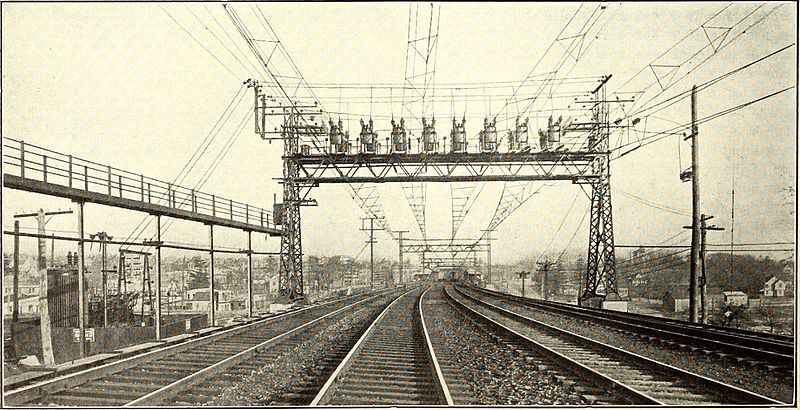
“View of Typical Sectionalizing Bridge, Auto-Transformer Installation and Cable Runway May 2, 1914.”
Photo and original caption from Electric Railway Journal via Wikimedia Commons.
The New York, New Haven and Hartford Railroad pioneered electrification of main line railroads using high-voltage, alternating current, single-phase overhead catenary. It electrified its mainline between Stamford, Connecticut, and Woodlawn, New York, in 1907, and extended the electrification to New Haven, Connecticut, in 1914. While single-phase AC railroad electrification has become commonplace, the New Haven’s system was unprecedented at the time of construction. The significance of this electrification was recognized in 1982 by its designation as a National Historic Engineering Landmark by the American Society of Mechanical Engineers (ASME).
[…]
The New Haven’s system was extended across the Hell Gate Bridge to the New York Connecting Railroad upon the line’s construction. The system of electrification was an extension of the New Haven’s revised 11/22 kV autotransformer architecture. The original electrification extended from the New Haven’s main line, across the Hell Gate Bridge, to the Bay Ridge yard. The line south of Bowery Bay Junction was de-electrified in the 1950s. The line between New Rochelle and the Harold Interlocking was transferred to Amtrak in 1976 upon dissolution of Penn Central. The electrification system continued to be controlled as a portion of the ex-New Haven system until the 1987 conversion to 60 Hz operation.
When the New Haven main line was converted by Metro-North to 60 Hz operation, the Amtrak Hell Gate line was also converted, but as an isolated system powered from the Van Nest substation. Control of the catenary system was transferred from Cos Cob to the Load Dispatcher at New York Penn Station. Although conversion occurred subsequent to the PRR-era electrification, Amtrak substation numbers 45-47 were assigned for consistency with the rest of the PRR numbering scheme.

New Haven dual-power diesel-electric FL9 locomotive 2011 with train #138, a NYC – Pittsfield train, at South Norwalk, CT on October 13, 1968. The stub of the former branch to the docks is in the foreground.
Photo by Roger Puta via Wikimedia Commons.
Comments Off on Fallen Flag — the New York, New Haven & Hartford Railroad
September 6, 2021
Arms for the Taliban
Mark Steyn points out an absolutely unbelievable statistic about the military equipment windfall the US military presented to the Taliban in their rush for the exits out of Afghanistan (in bold, below):

Denyse O’Leary, whom I always read with great interest in our Comments section, chides me for diagnosing our present woes but not proposing solutions.
That ought to be easy. In Afghanistan what needed to be done is almost as old as man. As Victor David Hanson pointed out to Tucker, “This is the greatest loss of military equipment in the history of warfare by one power.”
He’s right. Because US government is so drunkenly profligate, the numbers sound blah-blah to jaded American ears. But $85-90 billion is larger than the annual military budget for every nation around the world except the US and China. For those partial to the International Jewish Conspiracy theory of history, what America has just given the Taliban is equivalent to 85 per cent of all the military aid Washington has given Israel since 1948. The Taliban now possess more Black Hawk helicopters than almost all America’s allies; they own near to a tenth of all Humvees on the planet. That’s aside from less obvious items, such as over 160,000 radios and over 16,000 night-vision goggles that will come in mighty handy for wiping out the remnants of resistance in the Panjshir Valley.
The “solution” to this is to do what every army has known to do down through the millennia: a retreat means not just preventing your men from falling into the hands of the enemy but also their weapons – including, if necessary, your allies’ weapons. As many readers will know, at the beginning of July 1940, just a week after France threw in the towel and signed its armistice with Germany, the Royal Navy attacked and disabled the French fleet, then the largest and most powerful in Continental Europe.
The British priority was to prevent the ships falling into the hands of Germany and Italy, who would put them to very good use. In a few days of urgent negotiation, the French commander resisted London’s “suggestion” that he either place the fleet under British command or take it to the French West Indies. So the Royal Navy struck and over 1,300 French sailors were killed.
But the Germans didn’t get hold of France’s most powerful battleships — and the following day, when the French ambassador complained about it to FDR during Washington’s Fourth of July observances, the President said he would have done exactly the same.
Yet Roosevelt’s successor did not do the same — in far more propitious circumstances and on a timeline created by the commander-in-chief and his advisors.Is the Pentagon total crap? Yes, but, like so many other rackets in Washington, it works for its principal beneficiaries: the defense contractors made over two trillion bucks off the Afghan war, so a mere eighty-five billions’ worth of materiel winding up with the goatherds is way below the lobbyists’ pay grade. The official position of America’s National Security Advisor, Jake Sullivan (a fetching twelve-year-old lad whose pressers give the vague feeling he’s auditioning for the Dancing Boys of Kandahar), has conceded:
We don’t have a complete picture, obviously, of where every article of defense materials has gone, but certainly a fair amount of it has fallen into the hands of the Taliban.
Functioning armies know how many pencils they have. As I said, I take it as read that Thoroughly Modern Milley and the Chiefs of Staff are total crap — all ribbons and no chest, the self-garlanded buffoons of a way of war that has not worked for decades: I see David Horowitz and Daniel Greenfield are calling for the Joint Chiefs to be court-martialed, which is the very least one would expect for gifting a Nato-level military to one’s enemies. But the fact that every commander on the ground went along without apparent objection suggests that Milley-style degeneracy runs very deep in the US military.
Comments Off on Arms for the Taliban
QotD: Torturing the English language for “antiracist” ends
Orwell had Kendi’s number: “The appropriate noises are coming out of his larynx, but his brain is not involved as it would be if he were choosing his words for himself. If the speech he is making is one that he is accustomed to make over and over again, he may be almost unconscious of what he is saying, as one is when one utters the responses in church. And this reduced state of consciousness, if not indispensable, is at any rate favourable to political conformity.” And that conformity is proven by the gawking, moneyed, largely white, Atlantic subscribers hanging on every one of this lightweight’s meaningless words — as if they really were in church.
The most dedicated abusers of the English language, of course, are the alphabet people. They have long since abandoned any pretense at speaking English and instead bombard us with new words: “cisheteropatriarchy”, “homonormativity”, “fraysexuality”, “neutrois”, “transmasculine”, “transmisogynoir”, and on and on. To give you a sense of the completely abstract bullshit involved here, take a style guide given out to journalists by trans activists, instructing them on how to cover transgender questions. (I’m wondering how Orwell would respond if given such a sheet of words he can and cannot use. Let’s just say: not like reporters for the Washington Post.) Here’s the guide’s definition of “gender nonconforming”: “[it] refers to gender presentations outside typical gendered expectations. Note that gender nonconforming is not a synonym for non-binary. While many non-binary people are gender nonconforming, many gender nonconforming people are also cisgender.”
This is a kind of bewildering, private language. But the whole point of the guide is to make it our public language, to force other people to use these invented words, to make the entire society learn and repeat the equivalent of their own post-modern sanskrit. This is our contemporary version of what Orwell went on to describe as “newspeak” in Nineteen Eighty-Four: a vocabulary designed to make certain ideas literally unthinkable because woke language has banished them from use. Repeat the words “structural racism” and “white supremacy” and “cisheteropatriarchy” often enough, and people come to believe these things exist unquestioningly. Talk about the LGBTQIA2S+ community and eventually, people will believe it exists (spoiler alert: it doesn’t).
Andrew Sullivan, “Our Politics and the English Language”, The Weekly Dish, 2021-06-04.
Comments Off on QotD: Torturing the English language for “antiracist” ends
September 5, 2021
This War is Three Years Old – WW2 – 158 – September 4, 1942
World War Two
Published 4 Sep 2021As the war turns three there is is no slacking in the fighting. Erwin Rommel launches another Axis attack in North Africa, but it is foiled in only days, though the Axis are advancing in the Caucasus as well as on Stalingrad, where the fight for the suburbs is now beginning. They’re also advancing in the South Pacific, as the Japanese fight their way along the Kokoda Trail.
(more…)
Comments Off on This War is Three Years Old – WW2 – 158 – September 4, 1942
September 4, 2021
QotD: Modern childhood
So much for the roving pack of kids each block boasted during Mintz’s childhood, and my own. “The empty lot has disappeared,” he quips. “And we are so concerned with legal liability that if kids do find one, you’d better be sure you’ll get a call from the police.”
Beth Hawkins, “Safe Child Syndrome: Protecting kids to death”, City Pages, Volume 26 – Issue 1267 (posted to the old blog, 2005-03-31).
Comments Off on QotD: Modern childhood
September 3, 2021
QotD: Drama critics
It’s a second-rate job, folks. Being a drama critic on Broadway wouldn’t keep a decent mind occupied 10% of the time. So you don’t even get second-raters. You get the dregs, the stage-struck but untalented neurotic who eventually drifts into criticism as a means of clinging peripherally to the arts. And most of your cruel critics come this way: they are getting their own back.
William Goldman, The Season: A Candid Look at Broadway, 1969.
Comments Off on QotD: Drama critics
September 2, 2021
Road to WWII: A Basic Causal Analysis
Thersites the Historian
Published 19 Nov 2019This video is a primer for undergraduates in broad history survey courses that will hopefully help make sense of the interwar years between World War I and World War II.
Patreon link: https://www.patreon.com/thersites
PayPal link: paypal.me/thersites
Twitter link: https://twitter.com/ThersitesAthens
Minds.com link: https://www.minds.com/ThersitestheHis…
Steemit/dtube link: https://steemit.com/@thersites/feed
BitChute: https://www.bitchute.com/channel/jbyg…
Backup Channel: https://www.youtube.com/channel/UCUrD…

Comments Off on Road to WWII: A Basic Causal Analysis
Charles Stross predicts that Elon Musk will become a multi-trillionaire
Charles Stross isn’t exactly a fan of Musk’s, but he outlines why he thinks Musk is on a potentially multi-trillion dollar path:

Elon Musk at the 2015 Tesla Motors annual meeting.
Photo by Steve Jurvetson via Wikimedia Commons.
So, I’m going to talk about Elon Musk again, everybody’s least favourite eccentric billionaire asshole and poster child for the Thomas Edison effect — get out in front of a bunch of faceless, hard-working engineers and wave that orchestra conductor’s baton, while providing direction. Because I think he may be on course to become a multi-trillionaire — and it has nothing to do with cryptocurrency, NFTs, or colonizing Mars.
This we know: Musk has goals (some of them risible, some of them much more pragmatic), and within the limits of his world-view — I’m pretty sure he grew up reading the same right-wing near-future American SF yarns as me — he’s fairly predictable. Reportedly he sat down some time around 2000 and made a list of the challenges facing humanity within his anticipated lifetime: roll out solar power, get cars off gasoline, colonize Mars, it’s all there. Emperor of Mars is merely his most-publicized, most outrageous end goal. Everything then feeds into achieving the means to get there. But there are lots of sunk costs to pay for: getting to Mars ain’t cheap, and he can’t count on a government paying his bills (well, not every time). So each step needs to cover its costs.
What will pay for Starship, the mammoth actually-getting-ready-to-fly vehicle that was originally called the “Mars Colony Transporter”?
Starship is gargantuan. Fully fuelled on the pad it will weigh 5000 tons. In fully reusable mode it can put 100-150 tons of cargo into orbit — significantly more than a Saturn V or an Energiya, previously the largest launchers ever built. In expendable mode it can lift 250 tons, more than half the mass of the ISS, which was assembled over 20 years from a seemingly endless series of launches of 10-20 ton modules.
Seemingly even crazier, the Starship system is designed for one hour flight turnaround times, comparable to a refueling stop for a long-haul airliner. The mechazilla tower designed to catch descending stages in the last moments of flight and re-stack them on the pad is quite without precedent in the space sector, and yet they’re prototyping the thing. Why would you even do that? Well, it makes no sense if you’re still thinking of this in traditional space launch terms, so let’s stop doing that. Instead it seems to me that SpaceX are trying to achieve something unprecedented with Starship. If it works …
There are no commercial payloads that require a launcher in the 100 ton class, and precious few science missions. Currently the only clear-cut mission is Starship HLS, which NASA are drooling for — a derivative of Starship optimized for transporting cargo and crew to the Moon. (It loses the aerodynamic fins and the heat shield, because it’s not coming back to Earth: it gets other modifications to turn it into a Moon truck with a payload in the 100-200 ton range, which is what you need if you’re serious about running a Moon base on the scale of McMurdo station.)
Musk has trailed using early Starship flights to lift Starlink clusters — upgrading from the 60 satellites a Falcon 9 can deliver to something over 200 in one shot. But that’s a very limited market
As they say, read the whole thing.
Comments Off on Charles Stross predicts that Elon Musk will become a multi-trillionaire
Tank Chats #122 | Sherman 105 | The Tank Museum
The Tank Museum
Published 9 Apr 2021The Tank Museum’s Historian David Fletcher presents a Tank Chat on the only M4 variant of Sherman in The Tank Museum’s collection. This particular example is armed with the 105mm millimetre howitzer, designed for firing High Explosive in a close support role. Join David to find out more.
(more…)
Comments Off on Tank Chats #122 | Sherman 105 | The Tank Museum
September 1, 2021
Larry Elder’s campaign for governor hit with accusations of “white supremacism”
In City Journal, Heather Mac Donald looks at the recent hysterical attacks on gubernatorial hopeful Larry Elder based on the notion that he is somehow a kind of stalking horse for white supremacists:
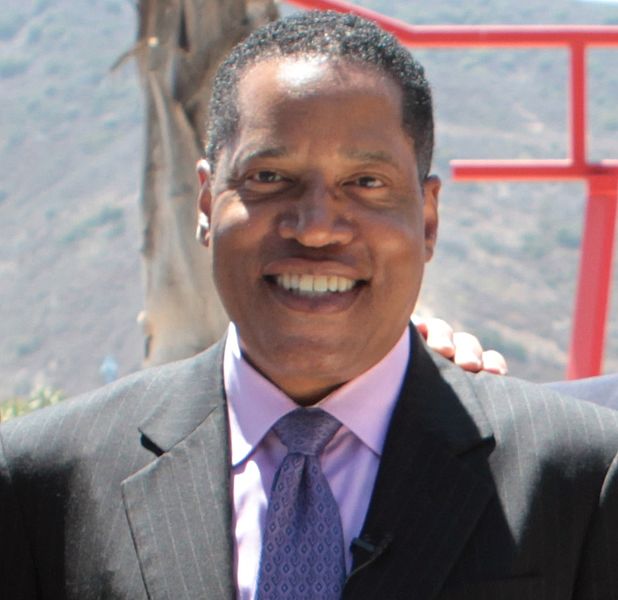
Larry Elder at Camp Pendleton for the ceremony presenting the Congressional Gold Medal posthumously to his father, Staff Sergeant Randolph Elder, U.S.M.C., 16 August, 2013.
US Government photo in the public domain via Wikimedia Commons.
The possibility that Larry Elder may win California’s recall election against Governor Gavin Newsom is generating acute anxiety in the mainstream media and among the activist Left. Elder’s foes are responding with their favored means of destruction: by playing the race card. Never mind that the nationally syndicated talk show host is black. A series of opinion columns and editorials have accused him of being a white supremacist, or at the very least a shill for other white supremacists. Elect Elder and California will reinstate Jim Crow, state senator Sydney Kamlager, a Democrat from Los Angeles, has warned.
The media have focused particularly on Elder’s views about crime and policing. The self-described “Sage from South-Central” maintains that criminals, not the police, are the biggest threat in the black community. According to Elder, the false narrative about lethal police racism has only led to more black homicide deaths. “When you reduce the possibility of a bad guy getting caught, getting convicted and getting incarcerated, guess what? Crime goes up,” he said recently at a campaign event in Orange County.
Elder also rejects the charge that white civilians are gunning down blacks, as LeBron James maintained in a tweet during the George Floyd riots: “We are literally hunted everyday, every time we step outside the comfort of our homes.” Elder has a different take. If a “young black man is eight times more likely to be killed by another young black man than [by] a young white man,” Elder told the Orange County Republicans, then “systemic racism is not the problem.”
Such statements are anathema to the establishment Left, deeply invested as it is in the idea that blacks have little agency in the face of ubiquitous white racism. Few subjects are more taboo in elite discourse than the elevated rate of crime among blacks, as it suggests cultural pathologies that — at the very least — complicate the victim narrative. To the Left, black crime is little more than a racist fiction. Los Angeles Times columnist Jean Guerrero claims that the crime statistics Elder has cited “over the decades to support his views and policy proposals are misleading, if not outright false, casting Black people as unusually crime-prone.” Black people are not “more inclined toward violent crimes,” nor do blacks “disproportionately victimize whites,” Guerrero wrote, citing Columbia law professor Jeffrey Fagan and other criminal experts. (Fagan was the plaintiff’s expert in a trilogy of lawsuits against the New York Police Department in the 2010s.) Fellow Times columnist Erika Smith sneered that Elder “keeps trotting out statistics that purport to show that Black people are particularly prone to murdering one another.”
Unfortunately for Elder’s critics, the statistics showing vastly disproportionate rates of black crime and victimization come from some of the Left’s favorite sources. CDC data show that in 2015, for example, the homicide victimization rate for blacks aged 10–34 (37.5 per 100,000) was 13 times the rate for whites (2.9 per 100,000). That disparity is undoubtedly much greater now, given the record-breaking increase in homicides since the George Floyd riots — an increase disproportionately affecting blacks.
Those black victims of homicide are not being killed by cops or whites. They are being killed by other blacks. In Los Angeles, blacks this year have committed 46 percent of homicides whose offender is known, even though they are just 9 percent of the Los Angeles population. Whites make up 28 percent of the Los Angeles population but have committed 4 percent of homicides, mostly involving domestic violence. These data, reported by the Los Angeles Times, mean that a black Angeleno is 35 times more likely to commit a homicide than a white Angeleno. Homicide data are the gold standard for crime statistics. Alas for Jeffrey Fagan and the Los Angeles Times‘s other experts, the statistical conclusion that blacks are “more inclined toward violent crimes” is indisputable.
Comments Off on Larry Elder’s campaign for governor hit with accusations of “white supremacism”
August 31, 2021
Spy Affair that Started the Cold War
The Cold War
Published 3 Aug 2019Our series on the history of the Cold War period continues with a documentary on Gouzenko affair — a spy thriller that provoked the beginning of the Cold War.
Consider supporting us on Patreon: https://www.patreon.com/thecoldwar

Comments Off on Spy Affair that Started the Cold War


