
The Tank Museum
Published 19 Nov 2021Our Patreons have already enjoyed Early Access and AD free viewing of our weekly YouTube video! Consider becoming a Patreon Supporter today: https://www.patreon.com/tankmuseum
David Fletcher is back with another Tank Chat on the M24 Chaffee. Learn all about this American light tank and how it was used at the end of the Second World War and in post-WW2 conflicts.
(more…)
February 26, 2022
Tank Chats #140 | M24 Chaffee | The Tank Museum
Comments Off on Tank Chats #140 | M24 Chaffee | The Tank Museum
February 25, 2022
Tsar Vlad begins the next stage in rebuilding the Russian empire
Niall Ferguson from The Spectator:
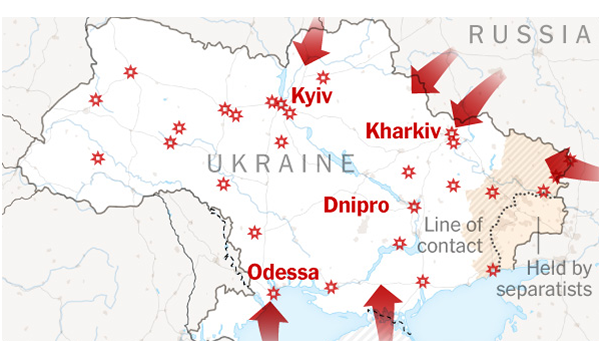
“War:, in Prussian military theorist Carl von Clausewitz’s most famous dictum, “is nothing but a continuation of politics with the admixture of other means.” A generation of Democrats — the American variety, but also European Christian and Social Democrats — have sought to ignore that truth. Appalled by the violence of war, they have vainly searched for alternatives to waging it. When Vladimir Putin ordered the annexation of Crimea in 2014, Barack Obama responded with economic sanctions. When Putin intervened in the Syrian civil war, they tried indignant speeches.
When it became clear that Putin intended a further and larger military incursion into Ukraine, Joe Biden and his national security team opted for sanctions once again. If Putin invaded Ukraine, they said, Russia would face “crippling” or “devastating” economic and financial penalties. When these threats did not deter Putin, they tried a new tactic, publishing intelligence on the likely timing and nature of the Russian assault. Cheerleaders for the administration thought this brilliant and original. It was, in reality, a species of magical thinking, as if stating publicly when Putin was going to invade would make him less likely to do so.
Those who dread war approach diplomacy the wrong way, as if it is an alternative to war. This gives rise to the delusion that, so long as talks are continuing, war is being averted. But unless you are prepared ultimately to resort to force yourself, negotiations are merely a postponement of the other side’s aggression. They will avert war only if you concede peacefully what the aggressor is prepared to take by force.
Putin decided on war against Ukraine some time ago, probably in July when he published a lengthy essay, “On the Historical Unity of the Russians and Ukrainians”, in which he argued tendentiously that Ukrainian independence was an unsustainable historical anomaly. This made it perfectly clear that he was contemplating a takeover of the country. Even before Putin’s essay appeared, Russia had deployed around 100,000 troops close to Ukraine’s northern, eastern and southern borders. The response of the United States and the European Union was to make clear that Ukraine was a very long way indeed from either Nato or EU membership, confirming to Putin that no one would fight on Ukraine’s side if he went ahead with his planned war of subjugation.
Over the past few months, Putin has used diplomacy in the classical fashion, seeking to gain his objectives at the lowest possible cost while at the same time carefully preparing for an invasion. Western leaders have achieved nothing more than to remain united in saying they will impose sanctions if he invades. But a Russian invasion of Ukraine beyond the Donbas will create an entirely new situation. Politicians on both sides of the Atlantic may express a common outrage, but it will not take long for their unity to be eroded by the altered reality and their fundamentally divergent interests. The US does not need Russia’s natural gas. At least in the short run, Europe does.
Arthur Chrenkoff offers what he calls “disjointed thoughts at a tragic time”:
Putin is invading Ukraine – not just sending “peacekeepers” into the breakaway pro-Russia regions in the east of the country – in order to “denazify” and “demilitarise” the country. The former is an outrageous slur in a long communist tradition from Stalin to today’s Western left of smearing anyone they don’t like and agree with as a Nazi. Ukraine is as Nazi as Australia or Greece, or Russia for that matter. “Demilitarisation” is the more pertinent excuse. What Putin wants is a cordon sanitaire separating Russia from the West (which now includes Poland and the Baltic states). His vision for Ukraine is a pro-Russia puppet state or at least a neutral and impotent non-entity. According to Putin, Russia’s got a legitimate security interest in not being bordered by hostile (read pro-Western) states. Why this should trump Ukraine’s (or any other country’s) legitimate security interest in its own security, territorial sovereignty and the choice of international friends is unknown, except that might makes right and Russia fancies itself as a special case on the basis of its past great power status.
No country has an obligation to send it troops to fight a conventional war with Russia in Ukraine. But countries have moral obligation to offer any and all assistance to the people of Ukraine, including military equipment, as they defend themselves against unprovoked aggression. Countries also have moral obligation to punish Putin and Russia with utmost severity, including – if only they had the guts – complete economic and trade sanctions. Not a drop of Russian oil or a cubic foot of its gas. Let Putin swim in his unsold carbohydrates. Sadly that won’t happen because the Western European governments have, despite numerous warnings, made themselves energy dependent on imports from Russia. Shutting down coal, closing nuclear power plants and praying to the sun and the wind are now coming home to roost.
At First Things before the invasion began, George Weigel explained what was being obscured by Russian propaganda and western media complaisance:
For months now, the world press has described Russian troop deployments along Ukraine’s borders as spearheads of a possible invasion. The truth, however, is that Russia invaded Ukraine seven years ago, when it annexed Crimea and Russian “little green men” ignited a war in eastern Ukraine that has taken over 14,000 lives and displaced over a million people. Whatever the current military developments, a Russian invasion of Ukraine has not been “imminent”; the invasion is ongoing.
That fact has been obscured by a massive Russian propaganda and disinformation campaign. So some truth-telling is imperative.
The first fact: This is a Russian crisis, not a “Ukraine crisis”. What is typically called the “Ukraine crisis” is entirely of Russian autocrat Vladimir Putin’s making. Ukraine did not create this crisis. The United States did not create it, and neither did NATO. The North Atlantic Treaty Organization, which is, was, and always will be a defensive alliance, is no more a threat to Russian national security than NATO is to Botswana’s national security. The claim that NATO threatens Russia is a Big Lie that obfuscates the security realities in central and eastern Europe: Former Soviet satellites (Poland, the Czech Republic, Slovakia, Hungary, Romania, Bulgaria) and the Baltic states (Lithuania, Latvia, Estonia) joined NATO because they fear Russia, not because they intend to invade Russia. The same rationale explains Ukraine’s NATO application.
The second fact: This artificially created crisis, aimed at Ukraine’s destabilization and subjugation, is one expression of Putin’s determination to reverse history’s verdict in the Cold War. Putin has been quite clear about this for twenty years, and only fools or those peering through the ideologically befogged lenses of the new “national conservatism” fail to grasp what is afoot here. Putin, the old KGB apparatchik, is bent on overturning the victory of imperfect democracies over pluperfect tyrannies in the Revolution of 1989 and the Soviet crack-up of 1991. That grand strategic goal is at the cold heart of the recently announced alliance of purpose between Putin’s kleptocratic regime in Russia and Xi Jinping’s genocidal regime in China — an announcement these two wicked men made just before the Winter Olympics. Putin and Xi want nothing less than a fundamental re-ordering of world affairs in which their oppressive regimes call the tune. In the tyrants’ bid for global hegemony, Ukraine and Taiwan are in the role played by Austria and Czechoslovakia in the late 1930s: If they fall to the tyrant-regimes, others will follow.
At Samizdata, Perry de Havilland notes that not every single thing that happens in the wider world is linked to or directed by American action:
Yes, the United States is the richest and most powerful nation on earth and it has been since World War II. And yes, it has interfered under presidents of all stripes for good or ill in a great many places, in pursuit of its perceived geopolitical interests, sometimes benignly, other times with a breathtaking lack of judgement.
But just as the leaders of that great nation have often overestimated the USA’s ability to impose its will in far away lands, many people in many places similarly overestimate America’s involvement everywhere. They largely deny that local people have agency, oblivious to the fact people everywhere are capable of organising politically in ways not directed and driven from an agency in Langley, Virginia. As a friend of mine who was deeply involved in the 2014 Maidan revolt in Kyiv said to me once:
“Woah! I’ve just heard we’re all CIA puppets on Washington’s payroll. There must have been an oversight as me and my friends never got a penny. You know people in America, so can you get me an address to apply for that lovely CIA money I’m apparently due?”
He was of course joking, but Maidan was a golden example of how something overwhelmingly driven and executed by Ukrainians, in Ukraine, in response to Ukrainian political and social pressures becoming intolerable, was nevertheless written off as CIA mischief-making.And whilst that was pushed hard by Russia when their pet oligarch was deposed, its entirely possible Putin himself believes it too. It is actually more supportive of his worldview than the notion it really happened because millions of Ukrainians loathed Putin, his Ukrainian’s puppet in Kyiv, and the malign influence of Russia generally.
But so many people seek a simpler world, a bipolar one in which everything is down to the Big Actors (with America still the biggest at the moment). Understanding that and feeding into it grants profound insight into Russian (and to some extent Chinese) propaganda. Add to that the rightly shattered confidence in Western institutions the last two years has wrought, and it is not surprising otherwise discerning folk fall for it.
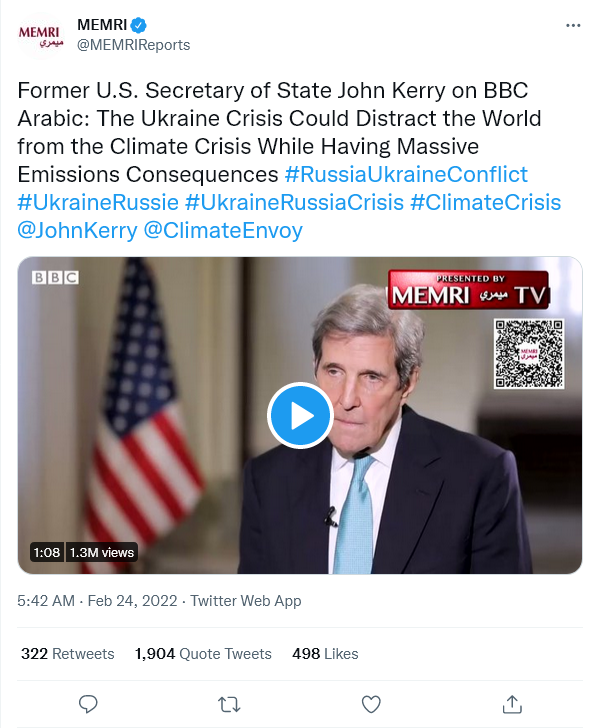
And with bombs dropping and people being killed in Ukraine, John Kerry keeps his laser focus on the important issue — climate change:
Comments Off on Tsar Vlad begins the next stage in rebuilding the Russian empire
February 24, 2022
The underlying struggle of our time — the “physicals” versus the “virtuals”
Kim du Toit linked to this post by N.S. Lyons at The Upheaval, which postulates that the real issue in western society is really a conflict between the laptop class and the working class:
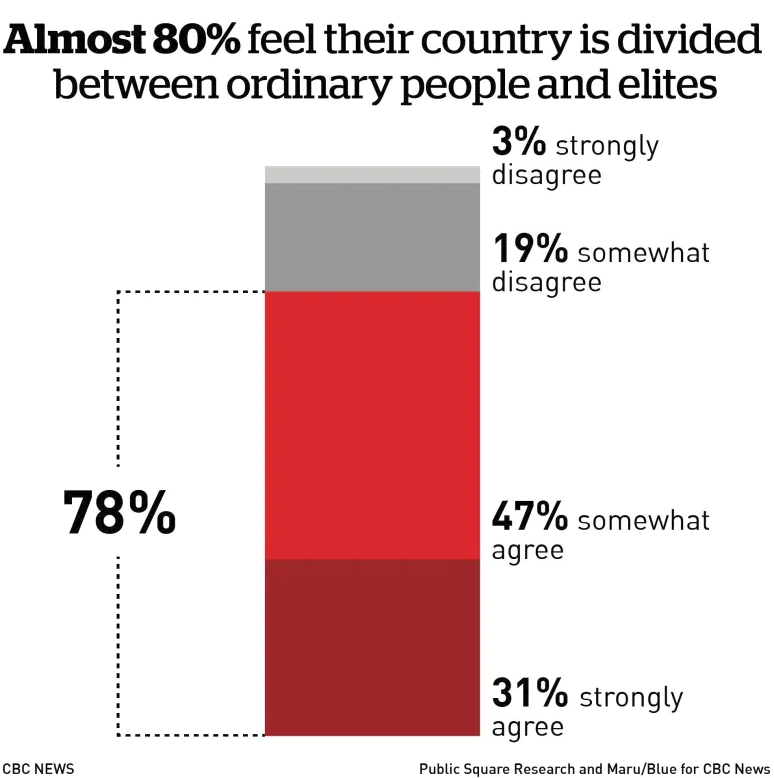
… I noted how from the perspective of those with the most wealth and power, as well as the technocratic managers and the intelligentsia (our “priestly class, keepers of the Gnosis [Knowledge]”), digital technology and global networks seem to have created “an unprecedented opportunity for Theory to wrest control from recalcitrant nature, for liquid narrative to triumph over mundanely static reality, and for all the corrupt traditional bonds of the world to be severed, its atoms reconfigured in a more correct and desirable manner.”
In this mostly subconscious vision of “Luxury Gnosticism“, the “middle and lower classes can then be sold dispossession and disembodiment as liberation, while those as yet ‘essential’ working classes who still cling distastefully to the physical world can mostly be ignored until the day they can be successfully automated out of existence.”
I also quoted a passage from the late Christopher Lasch’s book The Revolt of the Elites that is worth repeating here:
The thinking classes are fatally removed from the physical side of life… Their only relation to productive labor is that of consumers. They have no experience of making anything substantial or enduring. They live in a world of abstractions and images, a simulated world that consists of computerized models of reality – “hyperreality”, as it’s been called – as distinguished from the palatable, immediate, physical reality inhabited by ordinary men and women. Their belief in “social construction of reality” – the central dogma of postmodernist thought – reflects the experience of living in an artificial environment from which everything that resists human control (unavoidably, everything familiar and reassuring as well) has been rigorously excluded. Control has become their obsession. In their drive to insulate themselves against risk and contingency – against the unpredictable hazards that afflict human life – the thinking classes have seceded not just from the common world around them but from reality itself.
So let’s consider this using the protests as a lens, and vice versa.
To simplify, let’s first identify and categorize two classes of people in society, who we could say tend to navigate and interact with the world in fundamentally different ways.
The first is a class that has been a part of human civilization for a really long time. These are the people who work primarily in the real, physical world. Maybe they work directly with their hands, like a carpenter, or a mechanic, or a farmer. Or maybe they are only a step away: they own or manage a business where they organize and direct employees who work with their hands, and buy or sell or move things around in the real world. Like a transport logistics company, maybe. This class necessarily works in a physical location, or they own or operate physical assets that are central to their trade.
The second class is different. It is, relatively speaking, a new civilizational innovation (at least in numbering more than a handful of people). This group is the “thinking classes” Lasch was writing about above. They don’t interact much with the physical world directly; they are handlers of knowledge. They work with information, which might be digital or analog, numerical or narrative. But in all cases it exists at a level of abstraction from the real world. Manipulation and distribution of this information can influence the real world, but only through informational chains that pass directives to agents that can themselves act in the physical world – a bit like a software program that sends commands to a robot arm on an assembly line. To facilitate this, they build and manage abstract institutions and systems of organizational communication as a means of control. Individuals in this class usually occupy middle links in these informational chains, in which neither the inputs nor outputs of their role has any direct relationship with or impact on the physical world. They are informational middlemen. This class can therefore do their job almost entirely from a laptop, by email or a virtual Zoom meeting, and has recently realized they don’t even need to be sitting in an office cubicle while they do it.
For our purposes here, let’s call these two classes the Physicals and the Virtuals, respectively.
Comments Off on The underlying struggle of our time — the “physicals” versus the “virtuals”
February 23, 2022
From Shell Shock to PTSD – Understanding the Trauma of War – WW2 Special
World War Two
Published 22 Feb 2022Humanity has spent millennia developing ever more efficient ways to kill. This reaches its apogee in WWI and WWII, the most terrible conflicts in human history. Broken bodies bring with them broken minds. The trauma of war brings with it the mysteries of shell shock, war neurosis and PTSD.
(more…)
Comments Off on From Shell Shock to PTSD – Understanding the Trauma of War – WW2 Special
February 22, 2022
QotD: Architecture’s crisis of confidence
Architecture is suffering a crisis of confidence. More and more mainstream figures in the field are admitting that the profession has lost its way. […] Frank Gehry, the world’s most famous architect, recently said that “98% of everything that is built and designed today is pure sh*t. There’s no sense of design, no respect for humanity or for anything else.” Architectural thought-leaders seconded and thirded him. And he’s since been fourthed by another.
Last year, recognizing general public’s low opinion of architects, the American Institute of Architects (AIA), the trade organization for the profession, launched an effort to “reposition” the industry by hiring marketing and brand-identity firms.
And now The New York Times, the ultimate arbiter of elite opinion, recently published an op-ed that declared, “For too long, our profession [architecture] has flatly dismissed the general public’s take on our work, even as we talk about making that work more relevant with worthy ideas like sustainability, smart growth and ‘resilience planning’.” The authors are not kooks on the fringe but architect Steven Bingler and Martin C. Pedersen, former executive editor of Metropolis magazine, both of them very much in the establishment.
The authors observe that self-congratulatory, insulated architects are “increasingly incapable … of creating artful, harmonious work that resonates with a broad swath of the general population, the very people we are, at least theoretically, meant to serve.” Bingler and Pedersen note that this has been a problem for over forty years (my emphasis), and that things are even worse today.
Justin Shubow, “Architecture Continues To Implode: More Insiders Admit The Profession Is Failing”, Forbes, 2015-01-06.
Comments Off on QotD: Architecture’s crisis of confidence
February 21, 2022
D-Day – The Biggest Trick in History – WW2 Special
World War Two
Published 17 Feb 2022It’s 1943, the preparations for D-Day have already begun: deceive the Wehrmacht. Here at TimeGhost, we have begun to prepare our D-Day for 2023, and we want you to join us! Find out how in the pinned comment.
(more…)
Comments Off on D-Day – The Biggest Trick in History – WW2 Special
OSS Flying Dragon: A Silent Poisoned Dart Gun
Forgotten Weapons
Published 7 Apr 2018The OSS experimented with a lot of … unorthodox weapons during World War Two, and one of their overarching goals was a weapon with a 100 yard lethal range but without flash or noise. To this end they experimented with a number of suppressed firearms as well as weird stuff like various crossbow designs, silenced dart gun pistol conversions, and in this case a CO2 powered dart gun. It was code-named the Flying Dragon, and first mentioned in documents in 1943. In the summer of 1945, 15 were manufactured, and 12 of these remained in OSS stocks at the end of the war.
In July 1945 testing, the Flying Dragon was found the be the second-quietest option (the William Tell crossbow was quieter, at 66 decibels to the Dragon’s 69 decibels). However, the testing board noted that a simple suppressed .22 pistol was pretty much just as good, and quite a lot cheaper (and more reliable, I would expect). The problem with a dart gun like this one is that if it is not reliably lethal, the whole point of it being silenced is lost. Anyone shot by that big dart and not killed by it (which would require a pretty significant muzzle velocity) will immediately start making a heck of a lot of noise. OSS investigated options for poison on the darts to give the weapon the necessary lethality, but was unable to find a suitable solution. This led to discussion of using a small hypodermic syringe as a projectile, an even less practical idea — but this was the freewheeling OSS, where such things were not uncommon to consider.
http://www.patreon.com/ForgottenWeapons
Cool Forgotten Weapons merch! http://shop.bbtv.com/collections/forg…
If you enjoy Forgotten Weapons, check out its sister channel, InRangeTV! http://www.youtube.com/InRangeTVShow
Contact:
Forgotten Weapons
6281 N Oracle #36270
Tucson, AZ 85704

Comments Off on OSS Flying Dragon: A Silent Poisoned Dart Gun
February 20, 2022
Can the Red Army Capture Hitler? – 182 – February 19, 1943
World War Two
Published 19 Feb 2022The Red Army liberates both Rostov and Kharkov this week, but their advancing spearheads are close to an even bigger prize, Adolf Hitler himself. It is the Axis, however, who are both advancing and consolidating in Tunisia, and gearing up for new offensive actions next week.
(more…)
Comments Off on Can the Red Army Capture Hitler? – 182 – February 19, 1943
February 18, 2022
Battle of Iwo Jima 1945 – Day by Day
Real Time History
Published 17 Feb 2022Support Real Time History on Patreon: https://patreon.com/realtimehistory
The battle of Iwo Jima in 1945 was one of the most brutal battles of the WW2 Pacific Campaign. The small volcanic island of Iwo Jima had an important strategic position for the US military. But the Japanese Army had learned how to defend in previous hard fought battles on other islands like Guam, Peleliu or Guadalcanal.
Special thanks to Project’44 co-created by Nathan Kehler and Drew Hannen from the Canadian Research and Mapping Association (CRMA). Check out their Iwo Jima map: http://iwojimamap.com/
» THANK YOU TO OUR CO-PRODUCERS
John Ozment, James Darcangelo, Jacob Carter Landt, Thomas Brendan, Kurt Gillies, Scott Deederly, John Belland, Adam Smith, Taylor Allen, Rustem Sharipov, Christoph Wolf, Simen Røste, Marcus Bondura, Ramon Rijkhoek, Theodore Patrick Shannon, Philip Schoffman, Avi Woolf,» OUR PODCAST
https://realtimehistory.net/podcast – interviews with historians and background info for the show.» BIBLIOGRAPHY
Akikusa Tsuruji, 17-sai no Iōtō (Tokyo: Bungei Shunjū, 2006)
Allen, Robert E, The First Battalion of the 28th Marines on Iwo Jima: A Day-by-Day History from Personal Accounts and Official Reports, with Complete Muster Rolls, (Jefferson, NC: McFarland & Company, Inc. Publishers, 1999)
Leckie, Robert, The Battle of Iwo Jima, (New York: Random House, 1967)
NHK Shuzaihan, Iōjima Gyokusaisen: Seikanshatachi ga kataru shinjitsu, (Tokyo: NHK Shuppan, 2007)
Rottman, Gordon L & Wright, Derrick, Hell in the Pacific: The Battle of Iwo Jima, (Oxford: Osprey Publishing, 2008)
Sandberg, Walter, The Battle of Iwo Jima: A Resource Bibliography and Documentary Anthology, (Jefferson, NC: McFarland & Company, Inc. Publishers, 2005)
United States Fleet, Headquarters of the Commander in Chief, Navy Department, “Amphibious Operations, Capture of Iwo Jima: 16 February to 16 March 1945” COMINCH P-0012, (17 July 1945)» OUR STORE
Website: https://realtimehistory.net» OTHER PROJECTS
16 DAYS IN BERLIN: https://realtimehistory.net/16-days-i…
RHINELAND 45: https://realtimehistory.net/rhineland45
THE GREAT WAR: https://youtube.com/thegreatwar»CREDITS
Presented by: Jesse Alexander
Written by: Mark Newton, Jesse Alexander
Director: Toni Steller & Florian Wittig
Director of Photography: Toni Steller
Sound: Above Zero
Editing: Toni Steller
Motion Design: Toni Steller, Philipp Appelt
Mixing, Mastering & Sound Design: http://above-zero.com
Maps: Project ’44 https://www.project44.ca/
Research by: Mark Newton
Fact checking: Mark NewtonChannel Design: Battlefield Design
Contains licensed material by getty images
All rights reserved – Real Time History GmbH 2022
From the comments:
Real Time History
8 hours ago
Support Real Time History on Patreon: https://patreon.com/realtimehistoryWe hope you liked this surprise episode. Special thanks to Project ’44 and the Canadian Research and Mapping Association for their help with this episode. Their map (http://iwojimamap.com/) was the inspiration for this Iwo Jima documentary. We wanted to try out if we could hook their map data to our motion graphics. Iwo Jima was the perfect test case since it was geographically a limited campaign. As you saw, our idea was a success and we will build on what we learned here for our upcoming Napoleon project.
Comments Off on Battle of Iwo Jima 1945 – Day by Day
February 17, 2022
Tank Chats #139 | M9 Half Track | The Tank Museum
The Tank Museum
Published 5 Nov 2021Our Patreons have already enjoyed Early Access and AD free viewing of our weekly YouTube video! Consider becoming a Patreon Supporter today: https://www.patreon.com/tankmuseum
Discover how and why this hybrid of a wheeled and tracked vehicle was created during WW2 with Historian David Fletcher.
00:00 – Intro
00:32 – What is the M9 Half Track
05:23 – Features of M9 Half Track
(more…)
Comments Off on Tank Chats #139 | M9 Half Track | The Tank Museum
February 16, 2022
QotD: The fall of Kabul was “a margin call”
Kabul was a margin call. From now on, America may well be obliged to “pay cash”, viz., deploy combat capable formations of sufficient size to engage and win if we want anyone to take us seriously. A token “speedbump” force or a promise of “over the horizon” support — which is the majority of what the U.S. military now does — isn’t going to reassure any friends or deter any adversaries. At least not anyone who is paying attention.
Our adversaries will be emboldened. It is not so much that America’s military reputation has been irretrievably damaged, but the lessons that the Vietnamese, the Hmong, and now the Afghans have learned so painfully cannot fail to be appreciated by us or by the wider world. It appears that America (not the military, but America herself) has lost her stomach for a real fight. Americans taught the world the same lesson about the British Empire during the Revolutionary War (although Britain recovered enough to build her “second empire”), it would be foolish to fail to now see ourselves through that particular historical prism.
Garri Benjamin Hendell, “The Day After Kabul”, The Angry Staff Officer, 2021-11-02.
Comments Off on QotD: The fall of Kabul was “a margin call”
February 15, 2022
Total War on Valentine’s Day – WW2 – Reading Comments
World War Two
Published 14 Feb 2022Another installment of Across the Airwaves, where we highlight some of the best viewer comments under our videos. It’s Valentine’s Day and we’re feeling pretty romantic, so Indy and Spartacus will be reading comments that are all about love, humanity, and relationships.
(more…)
Comments Off on Total War on Valentine’s Day – WW2 – Reading Comments
February 14, 2022
Why SpaceX Cares About Dirt
Practical Engineering
Published 2 Nov 2021Why do structures big and small sink into the ground, and what can we do to stop it?
Before the so-called Starbase supported crazy test launches of the Starship spaceflight program, it was just a pile of dirt. After nearly two years, they hauled most of that soil back off the site for disposal. It might seem like a curious way to start a construction project, but foundations are critically important. Building that giant dirt pile was a clever way to prevent these facilities from sinking into the ground over time.
Practical Engineering is a YouTube channel about infrastructure and the human-made world around us. It is hosted, written, and produced by Grady Hillhouse. We have new videos posted regularly, so please subscribe for updates. If you enjoyed the video, hit that ‘like’ button, give us a comment, or watch another of our videos!
CONNECT WITH ME
____________________________________
Website: http://practical.engineering
Twitter: https://twitter.com/HillhouseGrady
Instagram: https://www.instagram.com/practicalen…
Reddit: https://www.reddit.com/r/PracticalEng…
Patreon: http://patreon.com/PracticalEngineeringSPONSORSHIP INQUIRIES
____________________________________
Please email my agent at practicalengineering@standard.tvDISCLAIMER
____________________________________
This is not engineering advice. Everything here is for informational and entertainment purposes only. Contact an engineer licensed to practice in your area if you need professional advice or services. All non-licensed clips used for fair use commentary, criticism, and educational purposes.SPECIAL THANKS
____________________________________
This video is sponsored by Morning Brew.
Stock video and imagery provided by Getty Images, Shutterstock, and Videoblocks.
Tonic and Energy by Elexive is licensed under a Creative Commons Attribution License
Source: https://www.youtube.com/watch?v=U6fBP…
Producer/Writer/Host: Grady Hillhouse
Assistant Producer: Wesley Crump

Comments Off on Why SpaceX Cares About Dirt
February 13, 2022
Victory at Guadalcanal – WW2 – 181 – February 12, 1943
World War Two
Published 12 Feb 2022Operation KE, the Japanese evacuation of Guadalcanal, concludes this week and the campaign has been a big loss for the Japanese. The Axis forces are also withdrawing — and the Red Army advancing — in the Donbas and the Caucasus, closing in on both Kharkov and Rostov. And a front that’s been quiet for a while, the Burma front, begins heating up again with an Allied advance out of India.
(more…)
Comments Off on Victory at Guadalcanal – WW2 – 181 – February 12, 1943
QotD: Marx’s labour theory of value gets tenure
At last, we know the answer to the question almost no one was asking: What happens when Karl Marx’s labor theory of value gets tenure?
The labor theory of value is very popular on the Left, probably because it makes no sense. Marx — who never labored once in his entire life — proposed that “labor” has inherent value, that “if we disregard the use-value of commodities, they have only one property left, that of being products of labor.”
I assure you it sounds even stupider in the original German.
The short version is that “labor” determines a product’s value, not the competitive marketplace.
It’s a crackpot theory, easily demolished.
Take the example of a skilled pastry chef and … me.
Give a few dollars worth of flour, sugar, butter, etc., to that chef and after a couple of hours of his labors, he can sell you a gorgeous and tasty cake that you would be happy to pay a lot of money to buy.
I don’t bake and have no interest in baking. Let me labor on those same ingredients for the same two hours, and you’ll get a hot mess worth less than the value of the ingredients that went into it.
(Apologies: This is not my example, but I can’t find an online resource listing the original author. [I first encountered this in a Robert Heinlein novel, but he may have been paraphrasing someone else])
It’s not the “labor,” it’s the results.
Now we’re supposed to apply this same thinking to grading English papers.
We’re supposed to accept that one student’s craptaculently-written essay has the same value as another student’s beautifully written paper because they both put the same amount of labor into writing them.
What Inoue wants college instructors to do is apply crackpot Marxist theory to those who will be disadvantaged the most if they aren’t taught proper English.
Stephen Green, “Fight ‘White Language Supremacy,’ Prof Will Grade on ‘Labor’ Not Results”, Vodkapundity, 2021-11-10.
Comments Off on QotD: Marx’s labour theory of value gets tenure


