Published on 14 Oct 2014
President Obama is sending thousands of U.S. troops to West Africa to fight the deadly Ebola virus. Their mission will be to construct treatment centers and provide medical training to health-care workers in the local communities.
But is it really a good idea to send soldiers to provide this sort of aid?
Here are 3 reasons why militarizing humanitarian aid is a very bad idea
October 14, 2014
Reason.tv – 3 Reasons the US MILITARY Should NOT Fight Ebola
October 13, 2014
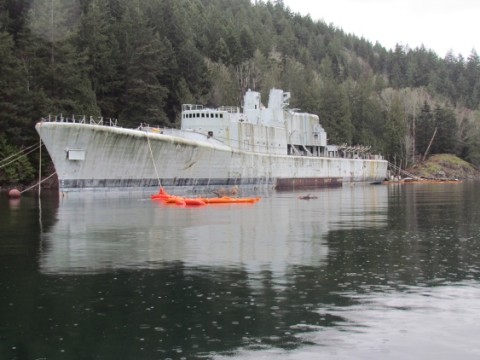
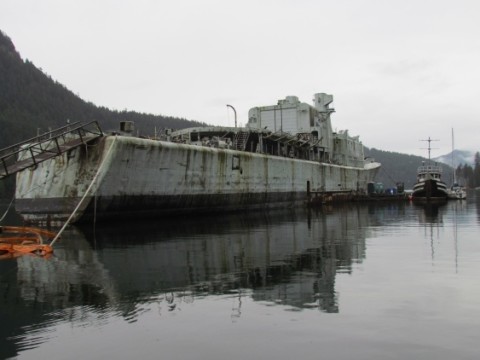
The Royal Navy’s “weirdest” ship
David Axe on what he describes as the weirdest ship in the Royal Navy:

Royal Fleet Auxiliary vessel RFA Argus pictured supporting Operation Herrick in Afghanistan (via Wikipedia)
The British Royal Navy is deploying the auxiliary ship RFA Argus to Sierra Leone in West Africa in order to help health officials contain the deadly Ebola virus.
If you’ve never heard of Argus, you’re not alone. She’s an odd, obscure vessel — an ungainly combination of helicopter carrier, hospital ship and training platform.
But you’ve probably seen Argus, even if you didn’t realize it. The 33-year-old vessel played a major role in the 2013 zombie movie World War Z, as the floating headquarters of the U.N.
[…]
The 575-foot-long Argus launched in 1981 as a civilian container ship. In 1982, the Royal Navy chartered the vessel to support the Falklands War … and subsequently bought her to function as an aviation training ship, launching and landing helicopters.
Argus’ long flight deck features an odd, interrupted layout, with a structure — including the exhaust stack — rising out of the deck near the stern.
Weirdly, the deck’s imperfect arrangement is actually an asset in the training role. Student aviators on Argus must get comfortable landing in close proximity to obstacles, which helps prepare them for flying from the comparatively tiny decks of frigates and other smaller ships.
Statistical sleight-of-hand on the dangers of texting while driving
Philip N. Cohen casts a skeptical eye at the frequently cited statistic on the dangers of texting, especially to teenage drivers. It’s another “epidemic” of bad statistics and panic-mongering headlines:
Recently, [author and journalist Matt] Richtel tweeted a link to this old news article that claims texting causes more fatal accidents for teenagers than alcohol. The article says some researcher estimates “more than 3,000 annual teen deaths from texting,” but there is no reference to a study or any source for the data used to make the estimate. As I previously noted, that’s not plausible.
In fact, 2,823 teens teens died in motor vehicle accidents in 2012 (only 2,228 of whom were vehicle occupants). So, my math gets me 7.7 teens per day dying in motor vehicle accidents, regardless of the cause. I’m no Pulitzer Prize-winning New York Times journalist, but I reckon that makes this giant factoid on Richtel’s website wrong, which doesn’t bode well for the book.
In fact, I suspect the 11-per-day meme comes from Mother Jones (or whoever someone there got it from) doing the math wrong on that Newsday number of 3,000 per year and calling it “nearly a dozen” (3,000 is 8.2 per day). And if you Google around looking for this 11-per-day statistic, you find sites like textinganddrivingsafety.com, which, like Richtel does in his website video, attributes the statistic to the “Institute for Highway Safety.” I think they mean the Insurance Institute for Highway Safety, which is the source I used for the 2,823 number above. (The fact that he gets the name wrong suggests he got the statistic second-hand.) IIHS has an extensive page of facts on distracted driving, which doesn’t have any fact like this (they actually express skepticism about inflated claims of cell phone effects).
[…]
I generally oppose scare-mongering manipulations of data that take advantage of common ignorance. The people selling mobile-phone panic don’t dwell on the fact that the roads are getting safer and safer, and just let you go on assuming they’re getting more and more dangerous. I reviewed all that here, showing the increase in mobile phone subscriptions relative to the decline in traffic accidents, injuries, and deaths.
That doesn’t mean texting and driving isn’t dangerous. I’m sure it is. Cell phone bans may be a good idea, although the evidence that they save lives is mixed. But the overall situation is surely more complicated than the TEXTING-WHILE-DRIVING EPIDEMIC suggests. The whole story doesn’t seem right — how can phones be so dangerous, and growing more and more pervasive, while accidents and injuries fall? At the very least, a powerful part of the explanation is being left out. (I wonder if phones displace other distractions, like eating and putting on make-up; or if some people drive more cautiously while they’re using their phones, to compensate for their distraction; or if distracted phone users were simply the worst drivers already.)
October 12, 2014
The unique challenges to UAVs in the Canadian Arctic
Ben Makuch looks at the severe environment of Canada’s Arctic and how UAV design is constrained by those conditions:
The rotary-wing UAV tested, and its view from the sky. Image: DRDC
“A lot of these systems — UAVs particularly, and rotor-wing (that is to say helicopters or quadrotors) — are even more sensitive. They require a good understanding of what they’re heading in. And by heading, that’s kind of the direction you’re facing,” said Monckton.
And because of those difficulties, finding headings for aerial drones in the Arctic requires stronger GPS systems to establish a “line segment” of locational data, ripped, according to Monckton, from a “crown” of satellites hovering on top of Earth.
In terms of weather conditions, the extreme sub-zero temperatures is devastating on a UAV when you mix in fog or clouds. While crisp cool air with clear skies provides excellent flying conditions, once you mix in ice fog, it becomes a major risk to small UAVs.
“The biggest risk in the Arctic is structural icing,” said Monckton who explained that water in the clouds is so cool that when “you strike it, it actually crystallizes on contact.”
At CFS Alert, the Multi-Agent Tactical Sentry (MATS) UGV travels through rough Arctic terrain during an autonomous path-following test without the use of GPS. The Canadian Armed Forces Joint Arctic Experiment (CAFJAE) 2014 tests autonomous technology for Arctic conditions and explores its potential for future concepts of military operations through experiments carried out August 2014 at Canadian Forces Station Alert, Nunavut. CAF and Defence Research and Development Canada’s (DRDC) JAE work will benefit multiple government partners and centers around a fictitious satellite crash with hazard identification, telecommunication and other search and rescue tasks. Image: DRDC
Unsurprisingly, the wings of a drone being enveloped in ice presents “a major impediment to general unmanned air operations,” Monckton said. In part, because “UAVs are too small to carry standard deicing equipment [as used] on a commercial aircraft. So that’s a major problem.”
For the project, DRDC took a previously manned helicopter and modified it into an unmanned vehicle. They had help from Calgary-based Meggit Canada for the project, a defence and security contractor also responsible for this armed training hexicopter.
As for ground drones, or unmanned ground vehicles, Monckton said weather and temperature were an afterthought. The real challenge, was the actual terrain.
“The arctic has a really peculiar surface,” said Monckton, adding that the high Arctic offers mostly marshlands, rocky outcrops, or elevated permafrost that produces spiky formations. “So the UGV was kind of going between easy riding on sloppy stuff and then getting pounded to pieces on the rough frost boils.”
October 8, 2014
Something is wrong when your “data adjustment” is to literally double the reported numbers
In Forbes, Trevor Butterworth looks at an odd data analysis piece where the “fix” for a discrepancy in reported drinks per capita is to just assume everyone under-reported and to double that number:
“Think you drink a lot? This chart will tell you.”
The chart, reproduced below breaks down the distribution of drinkers into deciles, and ends with the startling conclusion that 24 million American adults — 10 percent of the adult population over 18 — consume a staggering 74 drinks a week.
The source for this figure is “Paying the Tab,” by Phillip J. Cook, which was published in 2007. If we look at the section where he arrives at this calculation, and go to the footnote, we find that he used data from 2001-2002 from NESARC, the National Institute on Alcohol Abuse and Alcoholism, which had a representative sample of 43,093 adults over the age of 18. But following this footnote, we find that Cook corrected these data for under-reporting by multiplying the number of drinks each respondent claimed they had drunk by 1.97 in order to comport with the previous year’s sales data for alcohol in the US. Why? It turns out that alcohol sales in the US in 2000 were double what NESARC’s respondents — a nationally representative sample, remember — claimed to have drunk.
While the mills of US dietary research rely on the great National Health and Nutrition Examination Survey to digest our diets and come up with numbers, we know, thanks to the recent work of Edward Archer, that recall-based survey data are highly unreliable: we misremember what we ate, we misjudge by how much; we lie. Were we to live on what we tell academics we eat, life for almost two thirds of Americans would be biologically implausible.
But Cook, who is trying to show that distribution is uneven, ends up trying to solve an apparent recall problem by creating an aggregate multiplier to plug the sales data gap. And the problem is that this requires us to believe that every drinker misremembered by a factor of almost two. This might not much of a stretch for moderate drinkers; but did everyone who drank, say, four or eight drinks per week systematically forget that they actually had eight or sixteen? That seems like a stretch.
We are also required to believe that just as those who drank consumed significantly more than they were willing to admit, those who claimed to be consistently teetotal never touched a drop. And, we must also forget that those who aren’t supposed to be drinking at all are also younger than 18, and their absence from Cook’s data may well constitute a greater error.
Pakistan’s public health emergency
The number of reported cases of polio is now the highest it has been for more than a decade, and at least some of the blame has to go to the CIA for using health workers as a cover for some of their covert operations.
As world health officials struggle to respond to the Ebola epidemic, Pakistan has passed a grim milestone in its efforts to combat another major global health crisis: the fight against polio.
Over the weekend, Pakistan logged its 200th new polio case of 2014, the nation’s highest transmission rate in more than a dozen years. The spread has alarmed Pakistani and international health experts and is prompting fresh doubt about the country’s ability to combat this or future disease outbreaks.
By Tuesday, the number of new polio cases in Pakistan stood at 202, and officials are bracing for potentially dozens of other cases by year’s end. Pakistan now accounts for 80 percent of global cases and is one of only three countries at risk of exporting the disease outside its borders, according to the World Health Organization.
[…]
In far-flung areas of the country, some parents and religious leaders are skeptical of the vaccine, requiring considerable face-to-face outreach by vaccination teams.
But the Pakistani Taliban and other Islamist militants have waged a brutal campaign against those teams, killing more than 50 health workers and security officials since 2012. The attacks began after it was discovered that the CIA had used a vaccination campaign to gain information about Osama bin Laden’s whereabouts.
October 2, 2014
The Aral Sea, Uzbek cotton, forced labour, and the clothing industry
As reported the other day, what was once the world’s fourth largest lake, the Aral Sea, has almost completely dried up due to Soviet water diversion projects of the late 1950s and early 1960s:
In the early 1960s, the Soviet government decided the two rivers that fed the Aral Sea, the Amu Darya in the south and the Syr Darya in the east, would be diverted to irrigate the desert, in an attempt to grow rice, melons, cereals, and cotton.
This was part of the Soviet plan for cotton, or “white gold”, to become a major export. This temporarily succeeded, and in 1988, Uzbekistan was the world’s largest exporter of cotton.
The Soviet government made a deliberate choice to sacrifice the Aral Sea to create a vast new cotton-growing region in Uzbekistan. It was clearly quite successful, depending on how you choose to measure success.
The disappearance of the lake was no surprise to the Soviets; they expected it to happen long before. As early as 1964, Aleksandr Asarin at the Hydroproject Institute pointed out that the lake was doomed, explaining, “It was part of the five-year plans, approved by the council of ministers and the Politburo. Nobody on a lower level would dare to say a word contradicting those plans, even if it was the fate of the Aral Sea.”
The reaction to the predictions varied. Some Soviet experts apparently considered the Aral to be “nature’s error”, and a Soviet engineer said in 1968, “it is obvious to everyone that the evaporation of the Aral Sea is inevitable.”
The drying-out of the Aral was not just bad news for the fishermen of the region: it was a full-blown environmental disaster, as the former lake bottom was heavily polluted:
The receding sea has left huge plains covered with salt and toxic chemicals – the results of weapons testing, industrial projects, and pesticides and fertilizer runoff – which are picked up and carried away by the wind as toxic dust and spread to the surrounding area. The land around the Aral Sea is heavily polluted, and the people living in the area are suffering from a lack of fresh water and health problems, including high rates of certain forms of cancer and lung diseases. Respiratory illnesses, including tuberculosis (most of which is drug resistant) and cancer, digestive disorders, anaemia, and infectious diseases are common ailments in the region. Liver, kidney, and eye problems can also be attributed to the toxic dust storms. Health concerns associated with the region are a cause for an unusually high fatality rate amongst vulnerable parts of the population. The child mortality rate is 75 in every 1,000 newborns and maternity death is 12 in every 1,000 women. Crops in the region are destroyed by salt being deposited onto the land. Vast salt plains exposed by the shrinking Aral have produced dust storms, making regional winters colder and summers hotter.
The Aral Sea fishing industry, which in its heyday had employed some 40,000 and reportedly produced one-sixth of the Soviet Union’s entire fish catch, has been devastated, and former fishing towns along the original shores have become ship graveyards. The town of Moynaq in Uzbekistan had a thriving harbor and fishing industry that employed about 30,000 people; now it lies miles from the shore. Fishing boats lie scattered on the dry land that was once covered by water; many have been there for 20 years.

“Waterfront” of Aralsk, Kazakhstan, formerly on the banks of the Aral Sea. Photo taken Spring 2003 by Staecker. (Via Wikipedia)
So, tragic as all this is, what does it have to do with the clothing industry? The Guardian‘s Tansy Hoskins points out that due to the murky supply chains, it’s almost impossible to find out where the cotton used by many international clothing firms actually originates, and the Uzbek cotton fields are worked by forced labour:
The harvest of Uzbek cotton is taking place right now — it started on the 5 September and is expected to last until the end of October. The harvest itself is also a horror story, on top of the environmental devastation, this is cotton picked using forced labour. Every year hundreds of thousands of people are systematically sent to work in the fields by the government.
Under pressure from campaigners, in 2012, Uzbek authorities banned the use of child labour in the cotton harvest, but it is a ban that is routinely flouted. In 2013 there were 11 deaths during the harvest (pdf), including a six year old child, Amirbek Rakhmatov, who accompanied his mother to the fields and suffocated after falling asleep on a cotton truck.
Campaigners have also managed to get 153 fashion brands to sign a pledge to never knowingly use Uzbek cotton. Anti-Slavery International have worked on this fashion campaign but acknowledge that despite successes there is still a long way to go.
“Not knowingly using Uzbek cotton and actually ensuring that you don’t use Uzbek cotton are two completely different things,” explains Jakub Sobik, press officer at Anti-Slavery International.
One major problem that Sobik points out is that much of the Uzbek cotton crop now ends up in Bangladesh and China — key suppliers for European brands. “Whilst it is very hard to trace the cotton back to where it comes from because the supply chain is so subcontracted and deregulated, brands have a responsibility to ensure that slave picked cotton is not polluting their own supply chain.”
October 1, 2014
The Aral Sea almost completely dried out in August
Enjoli Liston reports on the former body of water in the Guardian:

The Aral Sea in 2000 on the left and 2014 on the right. Photograph: Atlas Photo Archive/NASA
A large section of the Aral Sea has completely dried up for the first time in modern history, according to Nasa.
Images from the US space agency’s Terra satellite released last week show that the eastern basin of the Central Asian inland sea — which stretched across Kazakhstan and Uzbekistan and was once the fourth largest in the world — was totally parched in August. Images taken in 2000 show an extensive body of water covering the same area.
“This is the first time the eastern basin has completely dried in modern times,” Philip Micklin, a geographer emeritus from Western Michigan University told Nasa. “And it is likely the first time it has completely dried in 600 years, since Medieval desiccation associated with diversion of Amu Darya to the Caspian Sea.”
Note that this isn’t primarily due to climate change, although it is a man-made environmental disaster:
In the 1950s, two of the region’s major rivers — the Amu Darya and and the Syr Darya — were diverted by the Soviet government to provide irrigation for cotton production in Uzbekistan and Turkmenistan, starving the Aral. It has been diminishing ever since, with the sea level dropping 16 metres between 1960 and 1996, according to the World Bank. Water levels are believed to be down to less than 10 per cent of what they were five decades ago.
Wikimedia has a dramatic illustration of the diminishing border of the Aral Sea between 1960 and 2008:
QotD: Primitive belief systems and “sorcerism”
Many primitive societies believe that maleficent spirits cause all sorts of human misfortune that in the modern West we have learned to attribute to natural causes — cattle dying, crops failing, disease, drought, that sort of thing. A few societies have developed a more peculiar form of supernaturalism, in which evil spirits recede into the background and all misfortune is caused by the action of maleficent human sorcerers who must be found and rooted out to end the harm.
A society like that may be a grim, paranoid place with everyone constantly on the hunt for sorcerers — but a sorcerer can be punished or killed more easily than a spirit or a blind force of nature. Therein lies the perverse appeal of this sort of belief system, what I’ll call “sorcerism” — you may not be able to stop your cattle from dying, but at least you can find the bastard who did it and hurt him until you feel better. Maybe you can even prevent the next cattle-death. You are not powerless.
English needs, I think, a word for “beliefs which are motivated by the terror of being powerless against large threats”. I think I tripped over this in an odd place today, and it makes me wonder if our society may be talking itself into a belief system not essentially different from sorcerism.
Eric S. Raymond, “Heavy weather and bad juju”, Armed and Dangerous, 2011-02-03.
September 23, 2014
This is what a genuinely ethical oil divestment plan for universities would look like
Megan McArdle explains why universities are not in a particularly righteous position when they push for divesting out of fossil fuels:
I understand that universities are exploring sustainability. Just the same, they consume huge amounts of fossil fuels: To heat and cool their buildings. To power their labs and computer networks. Maintenance and landscaping. Cooking all that food. Lighting all those rooms. Every year, they put on many large events to which people fly or drive long distances. Their students travel to and from their premises multiple times a year, rarely on foot. Their faculty fly to do research or attend conferences; many of my friends in academics have much better frequent-flier status than I could ever dream of. Their admissions officers fly hither and yon to recruit students. Their teams fly or drive to games. But you get the idea. The point is that the fossil-fuel consumption of every university in the country dwarfs the impact of their investments on climate change.
[…]
If divestment activists were serious about making a difference, setting an example, and drawing the full weight of America’s moral opprobrium onto the makers and consumers of fossil fuels, they’d be pushing a University Agenda that looked more like this:
- Require administrators, faculty, sports teams and other student groups to travel exclusively by boat and rail, except for “last mile” journeys.
- Cease construction of new buildings on campus.
- Stop air conditioning buildings, except for laboratories and archives that require climate control. Keep the heat no higher than 60 degrees in winter.
- Put strict caps on power consumption by students, keeping it to enough electricity to power one computer and one study lamp. Remove power outlets from classrooms, except for one at the front for the teacher.
- Ban meat from campus eateries and require full-time students to be on a meal plan.
- Remove all parking spots from campus.
- Stop operating campus shuttles, except for disabled students.
- Divest the endowment from fossil-fuel companies, if it makes you feel better.
Why has No. 8 jumped to No. 1? Because it’s easy. Because a group of students pushing endowment divestiture can shut down a public meeting and be rewarded with the opportunity to hold a teach-in; a group of students pushing a faculty flying ban and the end of campus parking would find the powers that be considerably more unfriendly. Not to mention their fellow students. Or, for that matter, their fellow activists, few of whom are actually ready to commit to never in their lives traveling out of America’s pitiful passenger rail network.
September 22, 2014
Reason.tv – Matt Ridley on How Fossil Fuels are Greening the Planet
Published on 13 Mar 2013
Matt Ridley, author of The Red Queen, Genome, The Rational Optimist and other books, dropped by Reason‘s studio in Los Angeles last month to talk about a curious global trend that is just starting to receive attention. Over the past three decades, our planet has gotten greener!
Even stranger, the greening of the planet in recent decades appears to be happening because of, not despite, our reliance on fossil fuels. While environmentalists often talk about how bad stuff like CO2 causes bad things to happen like global warming, it turns out that the plants aren’t complaining.
September 18, 2014
The Cosmos reboot “flatter[s] the sensibilities of the I Love Science Sexually camp”
I didn’t watch the original Cosmos TV series, but I’ve heard retrospective rave reviews of the original show. I also haven’t watched any of the reboot, but Ace has, and he’s not impressed at all:
More Tyson “quotes” that serve no purpose except to stroke his own ego while he simultaneously strokes the egos of his fanbois and fangurlz.
I was taken aback by the first episode of the Cosmos reboot. That episode also contained, get this, a generally dishonest accounting of a mad monk named Giordani Bruno who challenged the prevailing theory that the sun was singular in the heavens in its possession of a planetary system.
That story was fable-ized — stripped of the complicated reality of truth, turned into a simplistic Aesop Fable for children — in order to flatter the sensibilities of the I Love Science Sexually camp while insulting anyone of even a mild religious disposition.
This is quite jackass, if you assume that the show’s creators actually wanted to evangelize for science among those who had come to distrust science. The show began by making things up in order to denigrate those who distrust science — certainly not evangelizing them to join Team Science at all.
[…]
But this approach does make sense if one assumes their stated motivations for the show (evangelize for science among the “science pagans,” if you will) were not their real motivations.
It makes sense if you assume their actual motivation was to tell the Science Flock that They’re Awesome and that the people who do not believe in The God Science are apes and monkeys.
Neil DeGrasse Tyson’s position grants him power; it also imposes on him responsibility. I would never myself have nominated what is essentially a planetarium manager as Head of Science of the Western World; but the I Love Science Sexually brigade, the fanbois and fangurlz, did, so this is what we have.
By Tyson’s own lights, is he actually popularizing science, or is making science look rather shabby and stupid by confusing actual science with its sorta-lookalike, “Science”?
I think the latter. He doesn’t seem to be talking about science; he’s talking about “Science,” which is not an intellectual discipline, but a tribal signifier and I Win Button for stupid internet political arguments.
Update:
Let us all bow our heads in reason. pic.twitter.com/QNX42Byn2r
— Sean Davis (@seanmdav) September 17, 2014
Update the second: Sean Davis wonders “Why Is Wikipedia Deleting All References To Neil Tyson’s Fabrication?”
Judging by many of the responses to the three pieces I wrote detailing Neil Tyson’s history of fabricating quotes and embellishing stories (part 1, part 2, and part 3), you’d think I had defamed somebody’s god. It turns out that fanatical cultists do not appreciate being shown evidence that the object of their worship may not, in fact, be infallible.
Which brings us to Wikipedia. Oh, Wikipedia. After I published my piece about Neil Tyson’s fabrication of the George W. Bush quote, several users edited Neil Tyson’s wiki page to include details of the quote fabrication controversy. The fact-loving, evidence-weighing, ever-objective editors of the online encyclopedia did not appreciate the inclusion of the evidence of Tyson’s fabrication. Not at all.
According to a review of the edit history of Tyson’s page, one long-time Wikipedia editor deleted an entire pending section summarizing the issue of Tyson’s fabricated quotes. Another editor attempted to insert a brief mention of Tyson’s fabrication of the George W. Bush quote. That mention was also deleted. When it was reinserted, it was deleted yet again by an editor who describes himself as a childless progressive and an apostle of Daily Kos (h/t @kerpen). Here are just a few of that user’s political ramblings, in case you were curious about the motivation behind the scrubbing of Tyson’s wiki.
Literally every single mention of Tyson’s history of fabricating quotes has been removed from Tyson’s Wikipedia page.
September 17, 2014
SpaceX and Boeing get NASA funding for 2017 deadline
In Ars Technica, John Timmer reports on the NASA decision to fund two of the three competitors for manned launches to the ISS:
Today, NASA administrator Charles Bolden announced that there were two winners in the campaign to become the first company to launch astronauts to low-Earth orbit: Boeing and SpaceX. The two will receive contracts that total $6.8 billion dollars to have hardware ready for a 2017 certification — a process that will include one crewed flight to the International Space Station (ISS).
In announcing the plan, Bolden quoted President Obama in saying, “The greatest nation on earth should not be dependent on any other nation to get to space.” And he promoted the commercial crew program as a clear way of ending a reliance on Russian launch vehicles to get to the ISS. But Bolden and others at the press conference were also looking beyond that; several speakers, including Kennedy Space Center Director Bob Cabana and astronaut Mike Fincke, mentioned that the ultimate goal is Mars.
To that end, Bolden emphasized that NASA is still doing its own vehicle and rocket development. The Orion crew capsule, intended to be suitable for missions deeper into the Solar System, recently underwent a splashdown test in the Pacific. Its first test flight aboard a Delta IV rocket is scheduled for this December. Work on the Space Launch System, a heavy lift vehicle that can transport the additional hardware needed for deep space missions, was also mentioned.
September 16, 2014
When the “best nutrition advice” is a big, fat lie
Rob Lyons charts the way our governments and healthcare experts got onboard the anti-fat dietary express, to our long-lasting dietary harm:
… in recent years, the advice to eat a low-fat diet has increasingly been called into question. Despite cutting down on fatty foods, the populations of many Western countries have become fatter. If heart-disease mortality has maintained a steady decline, cases of type-2 diabetes have shot up in recent years. Maybe these changes were in spite of the advice to avoid fat. Maybe they were caused by that advice.
The most notable figure in providing the intellectual ammunition to challenge existing health advice has been the US science writer, Gary Taubes. His 2007 book, Good Calories, Bad Calories, became a bestseller, despite containing long discussions on some fairly complex issues to do with biochemistry, nutrition and medicine. The book’s success triggered a heated debate about what really makes us fat and causes chronic disease.
The move to first discussing and then actively encouraging a low-fat diet was largely due to the work of Dr. Ancel Keys, who is to the low-fat diet movement what Karl Marx is to Communism. His energy, drive, and political savvy helped get the US government and the majority of health experts onboard and pushing his advice. A significant problem with this is that Keys’ advocacy was not statistically backed by even his own data. He drew strong conclusions from tiny, unrepresentative samples, yet managed to persuade most doubters that he was right. A more statistically rigorous analysis might well show that the obesity crisis has actually been driven by the crusading health advisors who have been pushing the low-fat diet all this time … or, as I termed it, “our Woody Allen moment“.
Rob Lyons discussed this with Nina Teicholz, author of the book The Big Fat Surprise:
Once the politically astute Keys had packed the nutrition committee of the AHA and got its backing for the advice to avoid saturated fat, the war on meat and dairy could begin. But a major turning point came in 1977 when the Senate Select Committee on Nutrition, led by Democratic senator George McGovern, held hearings on the issue. The result was a set of guidelines, Dietary Goals for the United States [PDF], which promoted the consumption of ‘complex’ carbohydrates, and reductions in the consumption of fat in general and saturated fat in particular.
By 1980, this report had been worked up into government-backed guidelines — around the same time that obesity appears to have taken off in the US. The McGovern Report inspired all the familiar diet advice around the world that we’ve had ever since, and led to major changes in what food manufacturers offered. Out went fat, though unsaturated fat and hydrogenated oils were deemed less bad than saturated fat, so vegetable oils and margarines became more popular. In came more carbohydrate and more sugar, to give those cardboard-like low-fat ‘treats’ some modicum of flavour.
Yet two recent reviews of the evidence around saturated fat — one led by Ronald Krauss, the other by Rajiv Chowdhury — suggest that saturated fat is not the villain it has been painted as. (The latter paper, in particular, sparked outrage.) As for fat in general, Teicholz tells me: ‘There was no effort until very late in the game to provide evidence for the low-fat diet. It was just assumed that that was reasonable because of the caloric benefit you would see from restricting fat.’
Teicholz also debunks the wonderful reputation of the Mediterranean Diet (“a rose-tinted version of reality tailored to the anti-meat prejudices of American researchers”), points out the role of the olive oil industry in pushing the diet (“Swooning researchers were literally wined and dined into going along with promoting the benefits of olive oil”), and points out that we can’t even blame most of the obesity problem on “Big Food”:
Which leads us to an important third point made by Teicholz: that the blame for our current dietary problems cannot solely, or even mainly, be placed at the door of big food corporations. Teicholz writes about how she discovered that ‘the mistakes of nutrition science could not be primarily pinned on the nefarious interests of Big Food. The source of our misguided dietary advice was in some ways more disturbing, since it seems to have been driven by experts at some of our most trusted institutions working towards what they believed to be the public good.’ Once public-health bureaucracies enshrined the dogma that fat is bad for us, ‘the normally self-correcting mechanism of science, which involves constantly challenging one’s own beliefs, was disabled’.
The war on dietary fat is a terrifying example of what happens when politics and bureaucracy mixes with science: provisional conclusions become laws of nature; resources are piled into the official position, creating material as well as intellectual reasons to continue to support it; and any criticism is suppressed or dismissed. As the war on sugar gets into full swing, a reading of The Big Fat Surprise might provide some much-needed humility.
QotD: The real value of work
People without meaningful work and copious free time don’t write symphonies or create great works of art. They don’t live a life of the mind. They drink too much, or get in fights, or watch a lot of internet porn, or commit crimes. They don’t contribute to the economy or culture, as a rule. They just…exist. And it goes on like that, sometimes for generations.
Labor is the fate of all humankind. Always has been. We work to live. Work gives shape and meaning to our lives. It’s not just the income we derive from it; it’s the knowledge that we are able to function as adults in the wider world, and provide for ourselves and our families. It’s feeling the satisfaction of having contributed something to the maintenance of civilization, even if it means we haul trash away or keep the grass mowed. It’s all honorable work, necessary work, and not something to be ashamed of.
It’s not an outrage, it’s just the way things are. To try and embitter people about that, to make them feel that the natural order of things is unfair, is just to do an enormous amount of harm to the very people you’re claiming to want to help.
Monty, “We’re now living in a post-labor Utopia. Have you heard about this?”, Ace of Spades HQ, 2014-02-06