
… it is a matter of common experience that members of the middle classes are far better able to derive benefits from the system than the lower classes. They complain where the lower orders swear, and bureaucrats are aware that articulacy is a more dangerous enemy than assaults on staff can ever be.
The interesting question of why the NHS should continue to hold the affection of the British people, when it is at best mediocre in its performance and frequently unpleasant to deal with, is one that should be of interest to all political scientists. The answer is not pleasing to those who believe in human rationality.
The affection represents the triumph of rhetoric over reality. This rhetoric contains an implicit historiography, in which the pre-NHS era is akin to that of jahiliyya, the era of ignorance before the advent of Muhammad, in Islamic historiography: in short, that there was no healthcare for most of the population before the NHS. This historiography has for decades been continuously and successfully insinuated into the minds of the population. It has been Britain’s pale imitation of totalitarian propaganda. Intentionally or not, Boris Johnson recently reinforced the mythological status of the NHS. And when, in the present crisis, retired doctors such as I were asked to return to work if they were able, it was to help the NHS. This was like asking a soldier to lay down his life for the sake of the Ministry of Defence. It says something about the credulity of the public that the response to slogans like “protect the NHS” was dull compliance, rather than outraged demands as to why it wasn’t protecting us.
I suspect also that the sheer unpleasantness of the NHS is reassuring to the British population. It evokes the Dunkirk spirit: we are all stranded on the beach of illness together. And if we cannot all live in luxury, we can at least all die in squalor. Justice is served.
Theodore Dalrymple, “Empire of conformists”, The Critic, 2020-04-29.
August 1, 2025
July 30, 2025
“The worst thing that can happen to a good cause is, not to be skilfully attacked, but to be ineptly defended”
On Substack, Johann Kurtz provides a great example of Bastiat’s insight (quoted in the title), as debaters ineptly defend the whole notion of masculinity, particularly how boys are victimized for being boys:
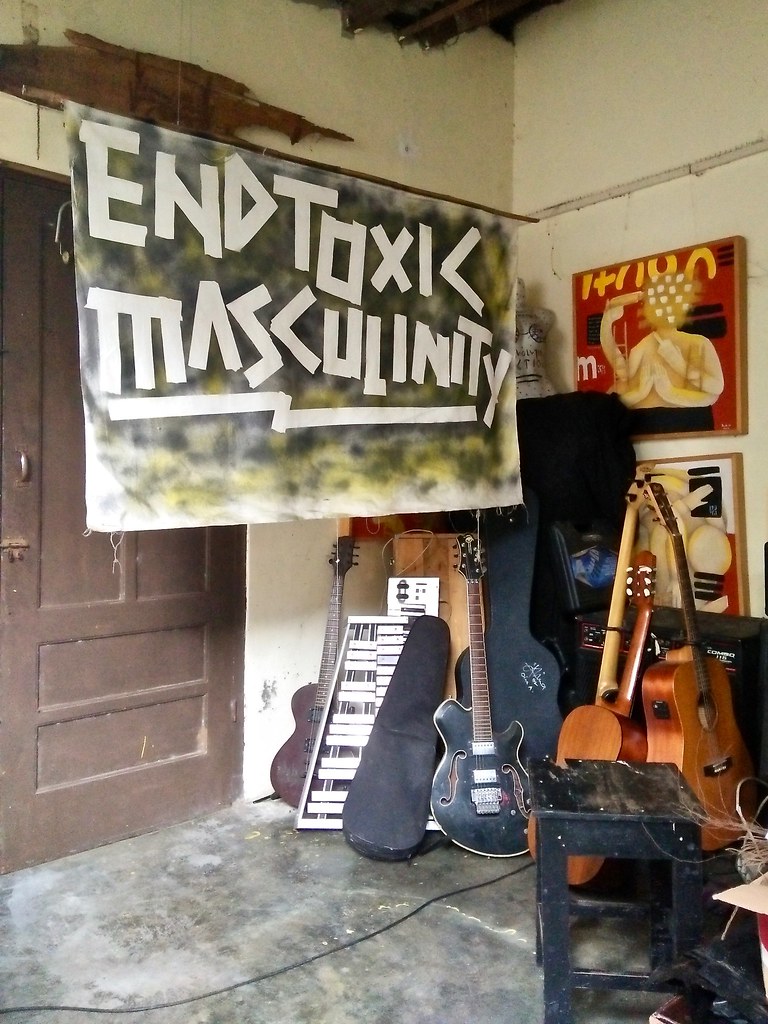
“End Toxic Masculinity” by labnusantara is licensed under CC BY-NC-ND 2.0


We’re failing our boys.
Two-thirds of young men feel that “no one really knows” them. Their real wages have been falling since the 1970s. They’re dropping out of education and the workforce in growing numbers. They die deaths of despair at almost three times the rate of women. Even their physical strength is collapsing.
Terrible solutions are proposed. No matter how much traditional masculinity is undermined, powerful voices continue to insist that the real problem is that it hasn’t been destroyed altogether. “Only then will boys be happy”.
My thesis for this series is that there is a need to defend true masculinity on its own terms, not on the implicit terms of progressives who either don’t understand it or actively hate it.
Take, for example, this debate at the Oxford Union on traditional masculinity. The opening argument of the opposition — who are supposed to be defending traditional masculinity — starts with asserting the need for a “contemporary and inclusive” masculinity which is accessible to anyone “of any race, sexuality, or other identity“.
The best defence that this speaker can mount on this anaemic foundation is an argument that masculinity is useful for activism and community building like the “Movember Foundation”. After this slightly pathetic case she goes back to conceding “being forced to conform to a set of expectations is uncomfortable and even dangerous. We should allow people to access the gender expressions that make them feel like their truest self.”
The next speaker for the defence of traditional masculinity continues the grovelling: “In 2019, you know, we should not be honouring and obeying men — those times have gone.” This talk is a little better — you get the sense that he actually likes men, and notes that it’s overwhelmingly men who die in wars and dangerous jobs — before collapsing back at the end: “We should look at new ways of being a man. I would love to get more men involved in teaching, in nursing — make it ‘cool to care’. I’ve been around Scandinavia talking to stay-at-home dads … These are progressive, beautiful men.”
The final speaker — who, again, is supposed to be defending traditional masculinity — takes the stage and begins: “Some of the most beautiful moments I’ve watched in young men’s lives are when we’re alone in a room — and maybe a brother who’s been struggling with his sexuality comes out in front of a hundred other brothers, and he’s crying, and his other brothers are crying with him“. You can imagine the rest.
None of this has anything to do with traditional masculinity. In this series I will advocate for the cultivation in boys of all of the aspects of masculinity that these “advocates” were afraid to defend: strength, aggression, dominance, stoicism, and risk-taking.
July 27, 2025
“[T]he wonderful warm kind progressives, the Maple Leaf edition of “‘hate has no home here'”
Chris Bray looks at the kind of people who supported the lockdowns during the pandemic and heartily condemned those lesser folks whose careers and livelihoods were threatened and how they hope for examples to be made of the “leaders” of the Freedom Convoy back in 2022:
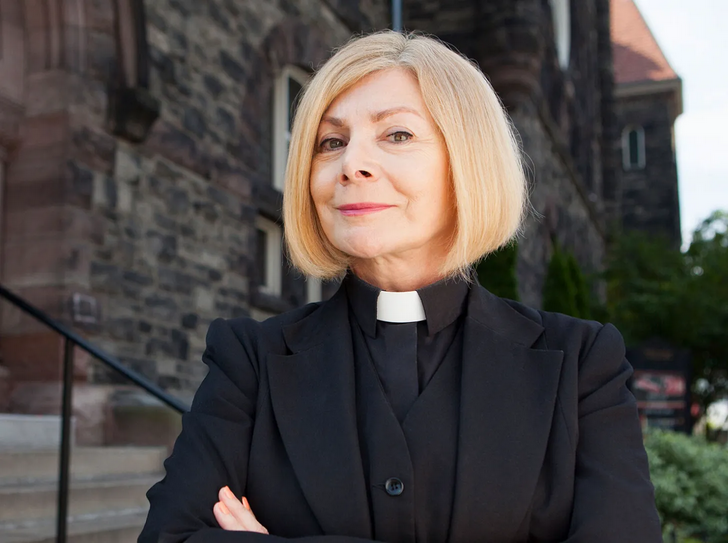
Let’s start with a comparison to the good people in Canada, the wonderful warm kind progressives, the Maple Leaf edition of “hate has no home here”. Cheri DiNovo is, let me put this very gently, an instantly recognizable social type, “one of Canada’s best-known and most ardent queer ministers and an Ontario politician who would help pass some of the province’s most integral LGBTQ2S+ policy”. You already know her by her facial expression:
slay, girlboss
As the leaders of the Freedom Convoy face sentencing in court, DiNovo has this to say about their monstrous cruelty:
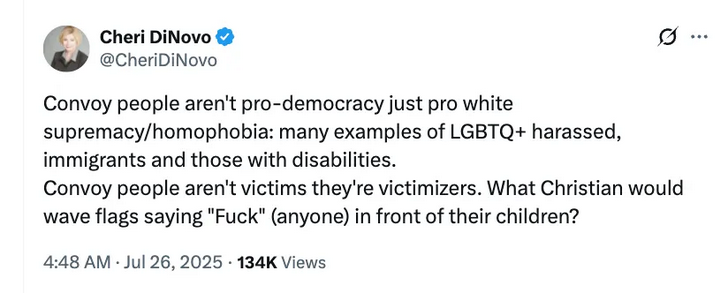
The Freedom Convoy: white supremacist homophobes who harassed and brutalized LGBTQ+ people and immigrants and the disabled, lashing out in a stunning wave of public cruelty. It was like a NUREMBERG RALLY with trucks, obviously. Here, look at some of the monstrous acts of public brutality committed at this mass expression of hate and rage:
YOU KNOW WHO ELSE DANCED TOGETHER THINK ABOUT IT
Rupa Subramanya, a journalist who uses the old and mostly forgotten technique of talking to people, wandered the crowds in Ottawa (in her own neighborhood) and reported that Freedom Convoy protesters mostly talked about their desire to recover a sense of hope. Their grievances were clear, thoroughly explained, and entirely defensible. Here’s a sample paragraph, a discussion with one of the VICIOUS WHITE SUPREMACISTS:
Kamal Pannu, 33, is a Sikh immigrant and trucker from Montreal. He doesn’t believe in vaccinations; he believes in natural immunity. He had joined the convoy because the Covid restrictions in the surrounding province of Quebec had become too much to bear. He said that he and his wife used to do their grocery shopping at Costco, until the government decreed that the unvaxxed would be barred from big-box stores. Since then, their monthly grocery bill had jumped by $200. “Before,” he said, “we didn’t look at the price of what we were buying. Now, we sometimes put items back because we don’t have that much money.”
See this clearly against Cheri DiNovo’s framing, and remember it:
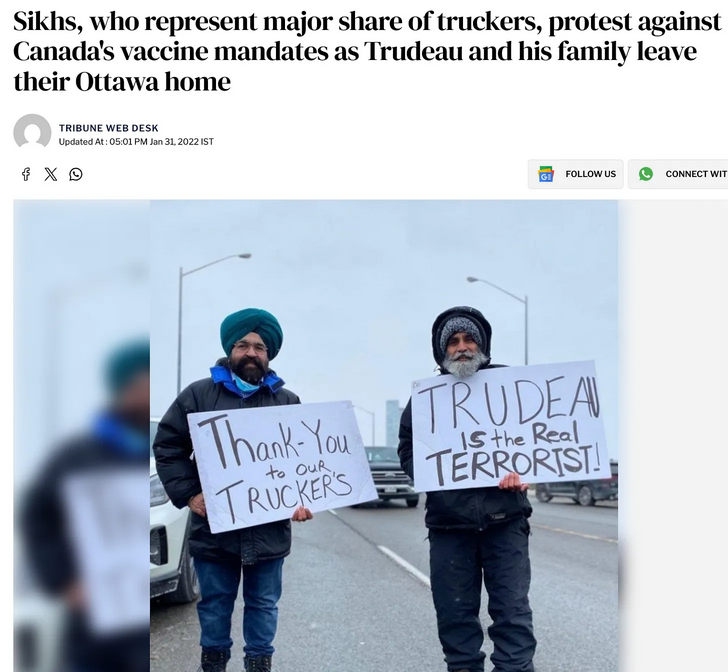
The white supremacist protesters who hate immigrants; for example, Kamal Pannu, a Sikh immigrant and trucker.
In fact, Sikhs make up a substantial share of the trucking industry in Canada, and so had a significant presence at the Freedom Convoy:
See the WHITE SUPREMACISTS saying that they HATE IMMIGRANTS!?!?!? Because Cheri DiNovo does. She thinks categorically: good people who support the Liberal Party, Literally Adolf Hitler who doesn’t. She has no capacity for seeing the thing itself, as it was on the ground, in physical reality. Literally nothing, no evidence or substance of any kind, could ever have prevented her from saying that a protest against Justin Trudeau’s government was white supremacist and homophobic. She’s out of her fucking mind. She has no connection to any form of reality, at all, in any way, ever. She doesn’t see anything. She doesn’t know anything. She’s ignorant noise and infinite sanctimony, with a pair of legs to carry it around.
This is “left” politics in the Anglosphere. Symbol symbol symbol, you NAZI! It doesn’t connect. It’s all chanting and performance and status-signaling, and it never leaves the house. It left reality behind ten years ago, and now it’s out there sailing past Pluto. For adherents of the Manichean religion of wokeism, categorical thinking covers all bases. People who don’t get mRNA injections are misogynistic racist bigots, obviously.

Update: Fixed broken link.
July 25, 2025
Autism, then and now
At Psychobabble, Hannah Spier traces the rise of autism from its first formal definition to something that 1 in 36 kids is diagnosed with:
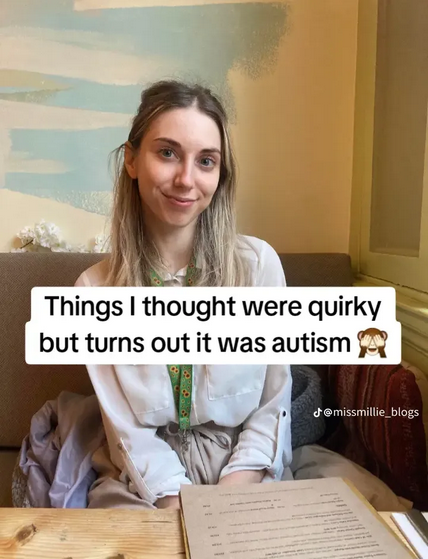
When Leo Kanner first defined autism in 1943, it was estimated that 4 to 5 children per 10,000 were affected. Today, the CDC puts that number at 1 in 36, almost one child in every classroom. If any other medical condition, blindness, epilepsy or paralysis showed a spike like this, it would trigger a pandemic-level outcry. But with autism, we see at best a curious murmuring as to what this is, and at worst, a growing chorus of people insisting, they too, belong in the group.
From experts, instead of raised alarms or calls for serious public health investigation (as would be expected for any other childhood disorder) we get calls for inclusivity and a self-congratulatory attitude toward their advancement in diagnostic understanding and tools. Another example of ideological capture of psychiatry by cultural sentiment.
Characters like Sheldon Cooper and Sherlock Holmes have helped turn the image of autism into a badge of honour. It means you’re socially odd, intellectually superior, and emotionally detached in an edgy and endearing way. For many, especially mothers with narcissistic tendencies hungry for a narrative of exceptionalism, this offered a seductive reframing of their child’s misbehaviour and non-conformity as evidence of giftedness. She could thus become the one who gave birth to the quirky but special genius. She alone saw the hidden brilliance beneath the “weird” behaviour. She became the martyr and the insider to an elite subculture. It’s Munchausen by proxy, 2025 edition.
People with narcissism and psychopathic traits exploit wherever they can, we know this. And yet again, psychiatry, the ones who should be the best at recognizing these, made it easy pickings by flinging the diagnostic gates wide open. Longtime readers will recognize the pattern: I’ve written before about the diagnostic creep in trauma, expanding definitions that blur the line between disorder and ordinary variation. The same diagnostic creep has unfolded here. Autism, once narrowly defined, was steadily loosened through each revision of the DSM.
The Great Diagnostic Expansion
Originally, Kanner’s autism was unmistakable: nonverbal children, socially disconnected, cognitively impaired, often with seizures. These were not quirky introverts. These were children who required full-time care and specialized schooling. In the DSM-III of the 1980s, it was called infantile autism. The criteria required clear onset before 30 months, marked language delays, gross deficits in social interaction, and repetitive behaviours. These were developmental dysfunctions, not misunderstood personalities. And neither clinicians nor parents had a problem naming them as such.
Then came the DSM-III-R in 1987, which introduced pervasive developmental disorder not otherwise specified (PDD-NOS) and broadened the field significantly. Suddenly, language delay and intellectual disability were no longer central. Subclinical cases were included. Asperger’s Syndrome followed in the DSM-IV in 1994, adding high-IQ individuals with no language delays but poor social functioning. A child who spoke on time but didn’t understand jokes, had poor eye contact, and rigid routines was now also autistic.
But the most dramatic change came with DSM-5 in 2013. The subtypes were eliminated. Autism became one spectrum. The criteria were thinned down to two domains: social communication difficulties and restrictive, repetitive behaviours. A person needed to meet just six out of twelve traits, spread across these two clusters. Language and cognitive delay? Optional. Even the requirement for early onset was removed. A diagnosis could now be given based on historical symptoms. Questionnaires like the Autism Spectrum Quotient (AQ) are so broad and subjective they can be easily gamed. This made it possible for 30-year-olds to recall feeling “socially overwhelmed” in school and not liking itchy clothing to receive the same diagnosis as a nonverbal child requiring lifelong care.
The diagnostic category has become a black hole, pulling in people with no clinical resemblance, collapsing distinction into sameness. From what I’ve observed, three distinct autism “patients” now account for much of the increased prevalence, none of whom would have qualified under the original criteria.
July 21, 2025
“Normal”? Dude, that’s extremist right-wing hate speech!
The Bone Writer on the huge increase in young people “identifying” as something other than what unreconstructed cavemen used to call “normal”:
Walk through any high school, scroll through TikTok, or attend a freshman orientation, and you’ll see the new hierarchy of modern identity:
- Straight white male? Bottom rung.
- Bisexual nonbinary neurodivergent? Stunning and brave.
- Confused, anxious, fluid? You’re seen. You’re valid.
- Rooted, stable, and clear? YOU must be dangerous.
It’s not just a cultural shift anymore. It’s a cultural mutation. A slow but total dislocation from reality.
We are no longer celebrating the diversity of life. We are celebrating the diversity of escape routes from it.
Identity as a Compass? No … It’s Identity as Camouflage
There was a time when “identity” meant something integrated, a clear expression of who you are, shaped by your values, your upbringing, your nature.
Now, identity is:
- A product
- A protest
- A mask
It’s often less about expressing truth and more about shielding from judgment.
And nowhere is that clearer than in the explosion of LGBT+ self-identification, especially among the young.
The Numbers Don’t Lie but No One Wants to Look at Them
In 2012, Gallup found ~3.5% of Americans identified as LGBT.
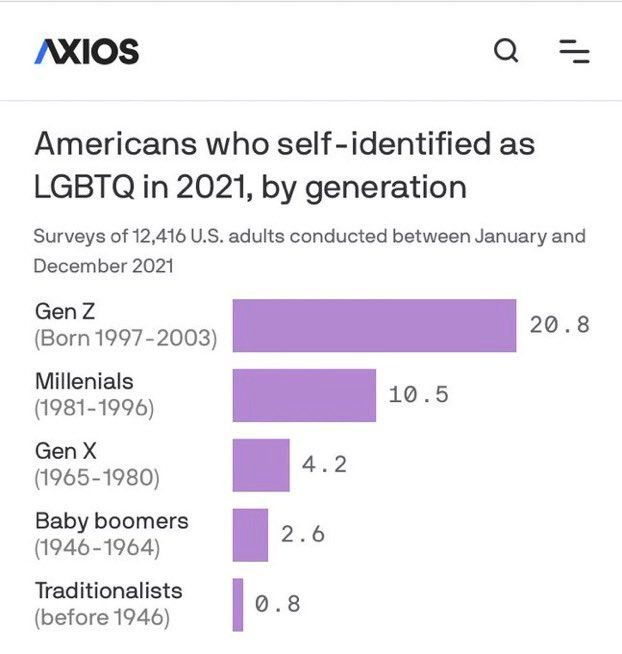
By 2021? Over 20% of Gen Z now identify somewhere on the spectrum.
Among Gen Z women, bisexual identity has grown by over 400%.
Do you really believe this is all “just visibility”? Do you really think the human genome changed this much in 10 years?
Of course not.
What changed was the culture. And culture now rewards deviation and punishes normativity.
Reported by Axios in 2021

July 14, 2025
The “War of the Sexes” is over … men now expected to surrender and go back to doing what women want
The more I read about the state of male-female interactions on the dating scene (such as it is), the more grateful I am that I’m decades out of that killing ground. Male survivors have clearly decided that the risks are far greater than the potential relationship rewards and individually withdrawn in large enough numbers that the “dating scene” is a shadow of what it once was in the pre-swipe-left era. Janice Fiamengo responds to a “men, come back!” plea from Rachel Drucker in the New York Times:
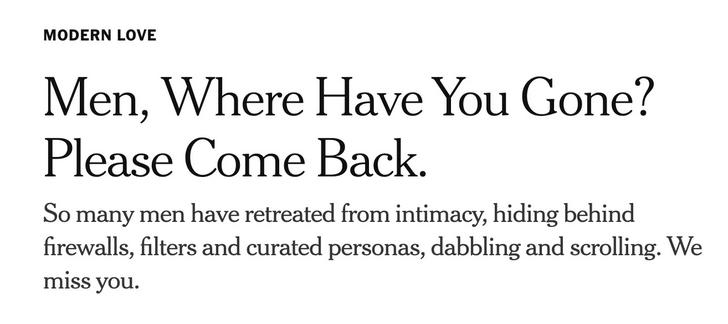
The question of where men have gone, in the title of Rachel Drucker’s New York Times op/ed, is surely disingenuous. Drucker thinks she knows: men have disappeared into social media posting, digital lurking, uncommitted sexting, and porn. Allegedly afraid of emotional intimacy, they are no longer “showing up” for women. Drucker addresses men directly, diagnosing their feelings: “You’ve retreated — not into malice, but into something softer and harder all at once: Avoidance. Exhaustion. Disrepair.”
Well, maybe. Maybe not.
Drucker’s article is part social lament, part personal ad, and like many statements by modern women about men, it is notable for its presumption. Drucker seems to think she can call off the sex war simply by saying she’s had enough. Men were never supposed to stop being available to women. Drucker mourns a lost time when men “asked questions and waited for the answers”, when they “listened — really listened — when a woman spoke”. It doesn’t seem to occur that men have been listening and have heard women’s messages, loud and clear.
Drucker goes so far as to express nostalgia for a time of male sexual pursuit, when having a woman on one’s arm was a way for a man to prove himself and impress other men. “It wasn’t always healthy”, she says in one of her many massive understatements (ignoring the barrage of condemnation leveled against such men) “but it meant that men had to show up and put in some effort”.
Drucker produces no evidence of men’s lack of effort, and it is not clear that her personal anecdotes — all culled, it seems, from her monied Chicago milieu — are representative. I know many men, including young men, who are still willing to pursue romantic relationships with women; many put in a lot of time and thought. But it does ring true that at least some portion of men are far more wary than in previous eras, unwilling to risk the potential hell of divorce or of a false accusation in a culture that believes women and belittles men.
Some men have simply come to the conclusion that modern women aren’t, in general, all that likable — neither marriage material nor viable candidates for motherhood.
As far as female pronouncements about men go, Drucker’s piece is not the worst. It does not hector or accuse (at least, not much), and Drucker expresses some genuine liking for men. But it’s not clear how much that is worth when she is so oblivious to men’s points of view and unaware that at least some of the onus for re-engaging men must fall on women. Drucker’s blind spots and unearned certainty turn her wistful dirge into a tone-deaf commentary on contemporary sexual politics.
The article begins with a restaurant, where Drucker notes the absence of men. There are women together, doing what women do, but almost no coupled men. And in her own life, Drucker notes, there has been retreat. It isn’t just her, she’s sure: it’s a collective act in which men are removing themselves from women’s lives, no longer “trying to connect”.
Drucker is part of the problem, though she doesn’t seem to recognize it. She admits that she “spent over a decade” working for Playboy and more hardcore sites to get men addicted to digital pornography. Part of her job was “to understand exactly what it took to get a man to pay for content he could easily find for free”. She does not seem to regret this work or recognize its damage; on the contrary, she exults that it helped her understand men’s deepest selves.
Her characterization is simplistic and contemptuous: “We knew what worked”, she boasts. “It wasn’t intimacy. It wasn’t mutuality. It was access to stimulation — clean, fast and frictionless. In that world, there’s no need for conversation. No effort. No curiosity. No reciprocity.”
If this is what men fundamentally are to Drucker — sex bots without emotion or desire for reciprocity — why is she so disappointed that they are no longer around?
June 30, 2025
QotD: Britons and their NHS
I have to run a gamut of procedures to do so and face a receptionist who treats me as a fraud trying to get something to which I am not entitled, and I have no practitioner whom I can call my doctor. The NHS has crowded out private competition, and the nearest private doctor is 25 miles away. Suffice it to say that, if I want to see a doctor, it is easier, quicker and more pleasant for me to go to France than to the health centre about 300 yards from my house in England.
I cannot in all honesty say, however, that my health has suffered in any measurable way as a result of this unpleasantness, because my health is good and I am not a doctor-botherer. But it does reveal something about Britain that is not true in France: in our dealings with the NHS, we are a nation of paupers who must accept what we are given by grace and favour of the system. It may be good or it may be bad, but we have to accept it.
Furthermore, under the NHS doctors themselves are becoming ever less members of a liberal profession and ever more executors of orders from on high, with little leeway to consider whether these orders are good or bad in the case of the individual case before them.
This is a problem in all systems in which a third party pays for patients’ treatment, but it is particularly acute in a highly-centralised and dirigiste system such as the NHS, in which uniformity is the goal, even if it be uniformity of error. And increasingly, it creates an atmosphere of technical, managerial and ethical conformity.
Theodore Dalrymple, “Empire of conformists”, The Critic, 2020-04-29.
June 23, 2025
How Sex in War Breeds Boys – W2W 33
TimeGhost History
Published 22 Jun 2025That prolonged war triggers an increase in male baby births had been ordered since at least 250 years. This “returning soldier effect” happens again during WW2 and right after. How this happens is a mystery, but research in the past decades might provide some answers.
(more…)
June 22, 2025
QotD: “Autism stolen valor”
The very concept that anyone would ever claim to be autistic as a status move would have seemed incomprehensibly bizarre to me when I was growing up.
I get it, though. In the intervening decades, somehow a lot of people have developed the notion that anybody above the middle range of IQ must be autistic-spectrum.
It’s not true. I’ve met enough autists, brights and super-brights to know differently. I’ve read a fair bit of the literature on psychometrics and MBD syndromes. And I’ve been a guest for faculty tea at the Institute for Advanced Study, which is very illuminating if you’re even a little bit observant about people.
Here’s what I think I know:
Many autists are seriously damaged and non-functional, to the point where they need to be institutionalized or have semi-institutional special care. Few people outside the mental-health profession know this. The “autists” we encounter in daily life are a selected high-functioning group.
HFAs (high functioning autists) have one advantage over average-IQ neurotypicals: they can really concentrate on things that aren’t social-status games or sexual maneuvers.
Average-IQ neurotypicals can only just barely manage that, so it’s difficult for them to compete with HFAs in fields where you have to be able to concentrate for long periods in order to do decent work.
Like, say, writing software. The upper reaches of software engineering are stiff with HFAs. This has become well known.
This doesn’t mean your typical HFA is actually brighter than a median average-IQ neurotypical. In fact, if you put a whole bunch of HFAs through a psychometric battery you’ll find their average IQ is lower than for neurotypicals, not higher.
HFA is actually a drag on general intelligence that HFAs overcome by being obsessive — grinding really hard on intelligent-people stuff.
The result is that HFAs as a population excel over average-IQ neurotypicals, compete fairly evenly with bright neurotypicals, but top out lower than super-bright neurotypicals do.
This is hard to notice because there are so few super-brights that many people never meet one at all. Very few people have observed enough super-brights to make valid generalizations about them. And of the few people who have a large enough observational sample, still fewer are themselves bright enough to comprehend what they see.
But I have been to faculty tea at the IAS. (I had been an invited speaker that day.)
Most of my friends and peers are people in the tippy-top end of the HFA cohort. Top 1% software engineers and people like that. So at the IAS, people-watching a bunch of Nobel laureates and people bright enough to work with Nobel laureates day-to-day, my jaw dropped open.
Because compared to who I usually hang out with, these people are mostly *normal*. Neurotypical. As near as I can tell, the people in the crowd showing HFA tells are the slow ones.
Imagine if you can being so natively intelligent that even though your brain is constantly trying to distract you into playing monkey socio-sexual status games, you can still think rings around 99.9% of the people in the world.
That’s what actual super-brights are like. They’re not brain-damaged. They’re not obsessive or compulsive or neurotic. They don’t have sensory disabilities. And they leave high-functioning autists in their dust.
Because I know this, I find the concept of people faking being autists amusing. They think they’re positioning themselves as the superior, smartest people. They are hilariously wrong.
Eric S. Raymond, Twitter, 2024-05-27.
June 10, 2025
The limits of female empathy
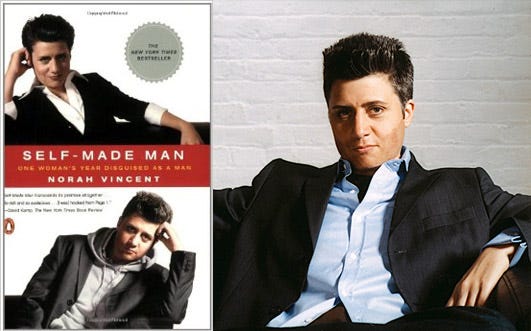
Janice Fiamengo discusses the 2006 book Self-Made Man: One Woman’s Year Disguised As A Man by journalist Norah Vincent. Intended as a kind of exposé of male privilege, her investigations turned into something rather different than she originally intended:
Many men are lonely. Many don’t like the work they do. Many are unhappily married. They struggle with an at-times overwhelming sex drive. Their encounters with women, romantic or otherwise, often involve rejection and contradictory tests of their masculinity. They are the objects of blame and bigotry in their societies, yet are expected to remain stoic and put women’s needs first.
It’s a strange world in which the above observations — by a woman — are seen as outstanding insights, but it’s the one we’re in.
In 2006, American journalist Norah Vincent published Self-Made Man: One Woman’s Year Disguised As A Man, an under-cover adventure in which the author, a mannish lesbian with big feet, spent close to 18 months periodically disguised as a man named Ned, notching up about 150 episodes in drag.
With breasts flattened, fake stubble on her chin, and a stuffed jock strap in her pants, having hired a tutor to teach her how to pitch her voice low and move like a man, she set out to “infiltrate exclusive all-male environments and if possible learn their secrets” (p. 18). She joined a bowling league, went on dates, did sales calls, spent some weeks at a monastery, and attended a Robert Bly-influenced men’s wilderness retreat.
Expecting to learn something about male power, she found instead “the hidden pain of masculinity and my own sex’s symbiotic role in it” (p. 254). The planned exposé became a feminist mea culpa.
The book got a lot of attention when it was published, and many men expressed gratitude and appreciation for the empathy and insight in Vincent’s work.
Reading the many accolades, I felt sadness, tenderness, and amazement. Wasn’t this a bit much? Was it really so remarkable that a woman could develop sympathy for the opposite sex?
Most men are so unaccustomed to any empathy from a woman, even when it’s mixed with patronizing descriptions and questionable conclusions, that they respond as if to heroism. The woman who cares, even within circumscribed limits, is catapulted into the company of the saints.
Imagine the reaction if a man had masqueraded as a woman for a year or more, and then pretended to understand women (even sympathetically) using a shop-worn ideological framework? Imagine a white person putting on blackface in order to become an expert, even a well-intentioned one, on the need for black self-improvement? There would be howls of outrage and indignant rebuttals, especially by members of the impersonated group.
Not in Vincent’s case. So rare is a woman’s attempt to understand male experiences that she doesn’t need to be consistently sympathetic or accurate.
Even when someone goes beyond temporary male drag, there is a palpable surprise that mens’ lives are not a well-watered garden of male privilege:
Today, of course, there is still always a reason to look away from men’s pain. Feminist-inclined men and women routinely “bathe in male tears“. They claim that discussing men’s issues is misogynistic, and ask “Can White Men Finally Stop Complaining?” No wonder it seems that the only time men can be heard is when women speak for them.
Notably, women who “transition” to male through hormone treatments and surgery are often shocked by the indifference and unkindness they encounter in public, where men are not eager to help and women expect deference. Zander Keig wrote as a trans man in “Crossing the Divide” of a pronounced sense of aloneness: “No one, outside of family and close friends, is paying any attention to my well-being”.
June 9, 2025
Parenting style choice – “small people who do not yet know very much or … pets who can talk”
I always felt that my son was a person, and did my best to treat him that way while still being his father. I think that was the correct choice, although clearly a lot of other parents choose the other option for their children:
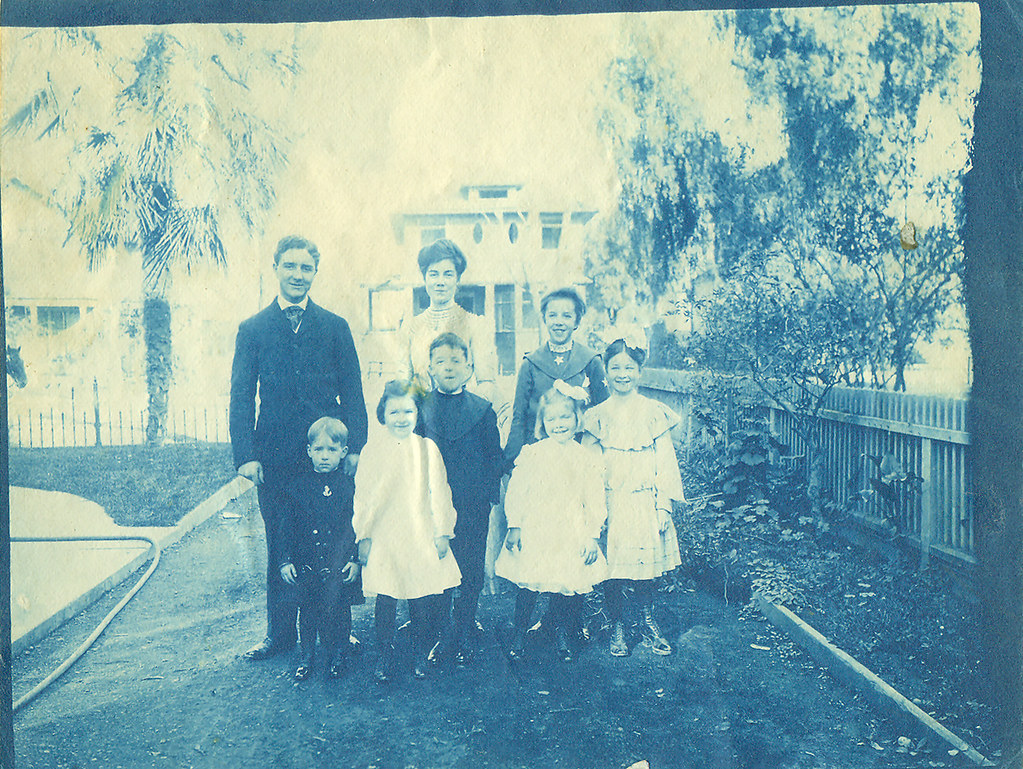
“Happy family cyanotype 2” by simpleinsomnia is licensed under CC BY 2.0 
 .
.
There are two views of children — that they are small people who do not yet know very much or that they are pets who can talk. I prefer the former. One implication is that children and parents are, in a fundamental sense, peers. Obviously they are not equal in what they know or what they can do or how strong they are. But they are not different sorts of people in a way that goes beyond that. Children should usually believe their parents about things the parents know much more about but parents should believe children when that asymmetry is reversed, as it sometimes is. The mere fact that one is parent and the other child does not determine which is right and which wrong when they disagree; that is determined, as between adults, by which has better arguments, more evidence.
One implication of treating children as people not pets is that you have to keep promises to them, as to other people. Another is that if you assert something to them you have the same obligation you would have if you said it to an adult to defend it or, if you find you cannot, admit that you can’t.
I once heard an elderly man tell a child who disagreed with him on something that he should never contradict his elders. The statement struck me as not merely wrong but blasphemous. The elder was probably correct on what they disagreed about but the appropriate response is to demonstrate that, at worst decline to argue it, not to imply either that truth is determined by seniority or that it is discourteous to point out errors to a status superior. I am reasonably sure that neither of my parents ever told me to believe something just because they said so or refused to entertain arguments against their views. The son of my first marriage, who spent summers with me and my wife when he was growing up, told a friend that his project for that summer was to get my wife to say “because I told you so.” I doubt that he succeeded.
Treating your children as your peers is easier if you sometimes interact with them in contexts where they demonstrably are at least your equal. I was the first member of our family to play World of Warcraft, so when my wife and our children, then eleven and fourteen, joined the game I was more skilled, had a higher level character, more in-game resources. They improved over time and there was a long period, during which we sometimes played separately, sometimes as a family team, were all on about the same level. By the time I eventually quit the game some years later we all had top level characters and all three of them had become more skilled at the game than I was.
Going back to my childhood, the nearest equivalent that occurs to me is ping-pong. We had a table in the basement on which my father and I played. We equalized the contest with a sliding handicap, a number of points I started each game with. Every time he won the handicap went up, every time I won it went down. Over a period of years, as I got better, the handicap went down, eventually to zero, I think occasionally below zero. The family also played bridge together, there being conveniently four of us.
I spent a lot of time arguing with my father on a wide range of subjects. Someone who met us skiing on Colorado when I was in high school told a friend of mine that we spent all our time arguing and I won half the arguments. I don’t think the latter was true, but if my father won a majority of the arguments he won them fair.
June 2, 2025
The progressive case for unlimited immigration
Theophilus Chilton takes on the progressive arguments for bringing in as many “high quality” immigrants as humanly possible from his own professional background:
One of the constants that you can count on in any debate about the value of immigration (of every sort) is the inevitable assertion about the NECESSITY of immigration. Immigrants POWER AMERICA. Without them, NOTHING WOULD HAPPEN! They are ELITE HUMAN CAPITAL without which the White American chuds who did things like build the atom bomb and otherwise created modern technological civilisation would barely be able to keep the lights on in their single-wides. It’s not just that immigrants want a new life or might be useful — they are an absolutely necessity and the ones coming here are the cream of the world’s crop.
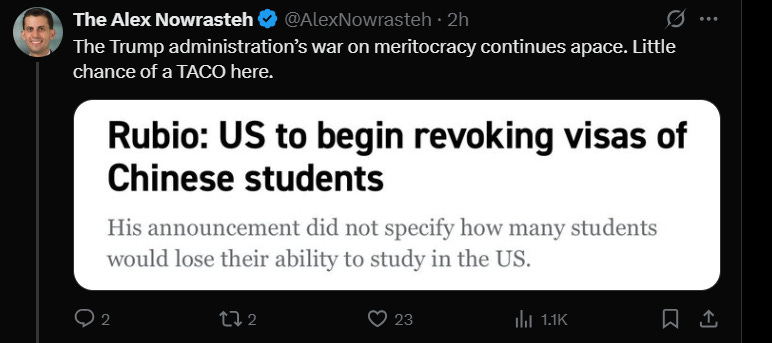
As a result, the recent move by Marco Rubio and the State Department to revoke visas from Chinese students in American universities (especially those associated with the CCP or who are in positions to commit especially damaging industrial espionage) will certainly not be well-received by this crowd. For example, witness Alex Nowrasteh, who’s whole schtick is to burble on about “meritocracy” and whine about “affirmative action for White Americans” while filling a useless sinecure at the Cato Institute that he got by being the token immigrant. He is appalled that we’d act in our own national interest rather than in the interests of a bunch of random foreigners.
Immigration man have big sad
Many people who know me on X already know this, but most readers here may not. Before I made a radical life-changing vocational choice a few years ago, I used to be a scientist in Big Pharma. For a little over two decades, I worked in the biotech/biopharma industry, covering a wide range of drug development stages and product types. I’ve developed vaccines (which is why I was skeptical about the Covid vaxx from the very beginning). I’ve developed small molecule drugs. I helped to bring to market several of the pharmaceuticals that millions take regularly and which you see advertised on television. I’ve done everything from bench scale analytical work to protein purification on 5000-liter batches used in support of human clinical trials. I’m proficient in literally dozens of different analytical techniques. Before that, in both undergraduate and graduate school, I specialised in synthetic organic small molecule development across a number of different subspecialties. And I’m good at all of this.
One other thing that I did throughout was work side-by-side with, and later manage, LOTS of visa holders and immigrants, especially from “tech heavy” countries like India and China, the stereotypical “H1-Bers”. As a result, I consider myself to be a pretty good judge of the value which visa holders bring to tech fields.
My judgment is, and has been for decades, that their value is minimal and it certainly does not live up to the hype. Indeed, one of the constants that I observed among most Indian, Chinese, and other visa holders was that they did not really, truly understand the science that was involved with the products being developed and the techniques being used to develop and test them. Most of these folks were the living embodiment of cramming to pass the test. When the test methods and the SOPs being employed were straightforward, these folks were great. They had a robot-like efficiency that comes with repetitively doing the same thing over and over and over again. Unfortunately, for anything requiring innovative or independent thinking, they’d be totally lost. If results from a test deviated from expectations and required some commonsense interpretation? That’s where the wheels came off. I mean, there was little to no capacity to deal with anything that wasn’t completely textbook.
Even basic scientific sense was often missing. At one job, there was an Indian guy who would takes dumps in the bathroom and then walk straight out back to his manufacturing suite in the cell line division without even washing his hands. I know this because I observed it for myself several times. I mean, even if you don’t care about getting fecal coliform bacteria all over door handles and whatnot, at least don’t carry them back into the suite where you’re helping to grow batches of genetically engineered E. coli. I assume he was properly gowned before going in, but still, there’s just that basic lack of sense there.
And then there are the ethics (or lack thereof) displayed by many visa holders (especially Chinese and Middle Eastern). Data manipulation, tweaked results, etc. etc. These tend to occur because both of those groups are under intense social pressure within their own cultures to “get the right results” rather than just dealing with the results you get. The “tiger mom” mentality carries over into the workplace. There is a reason for why these two groups are disproportionately overrepresented on the FDA’s debarment list. Indians can be subject to serious lapses in integrity as well, though theirs tend to revolve more around cutting corners and mistreating underlings, as I illustrated in a thread on X about three years ago where I recounted my time working for an Indian-owned company.
Over the years, my observations have been substantiated and reiterated by any number of people in various tech-heavy industry to whom I’ve related them. Whether it’s pharma or IT or medicine or metallurgy or whatever else, the familiar story is told. It’s really, really difficult to reconcile this mass of lived experience with the theoretical assertions made by people like Nowrasteh that immigrants are this valuable resource that we absolutely need to be or remain competitive in world markets.
In effect, the goal with this type of white-collar mass immigration is to “roboticise” tech fields which can’t be given over to AI or actual robotics just yet. The formula is to import masses of workers who can simply follow a script and save companies money on labour costs. If you think about it, this is really a low IQ, high time preference approach by corporations whereby they sacrifice real innovativeness and future competitiveness for short-term savings. I’d argue that the entry of H1-B and other visa holders in large numbers into American tech industries which accelerated around the late 2000s-early 2010s has actually led to a slowdown in real innovation. We may have tons of new apps for our phones, but fewer truly groundbreaking advances in tech across the board.
May 20, 2025
Joe Biden’s cancer diagnosis
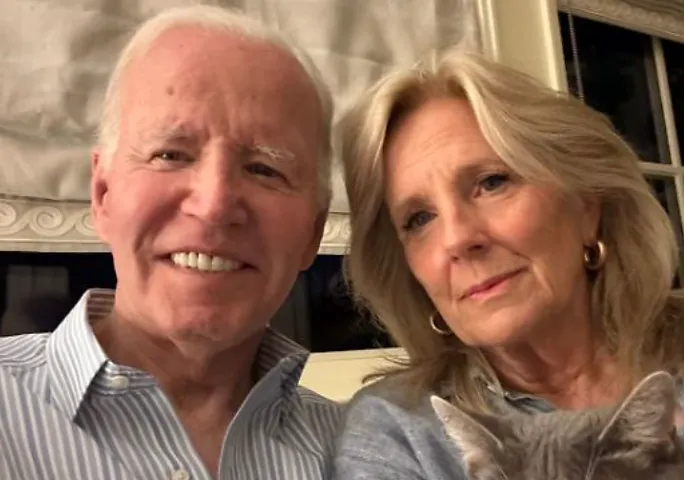
News broke the other day that former President Joe Biden is suffering from a highly advanced cancer and it only reinforces the questions about who was really performing the role of the President during Biden’s term in office:
Well, now it almost isn’t funny anymore.
Here’s the progression of the Democrats’ desperate attempts to shame you out of talking about Joe Biden’s mental and physical health:
“Stop talking about this because it’s not true.”
“Stop talking about this because he’s not the president anymore.”
“Stop talking about this because he has cancer.”You may notice a pattern.
I think it was Andrew Klavan who made me realize the First Commandment of the Democratic Party: Thou shalt STFU. All their gaslighting, shaming, whataboutism, and other dishonest rhetorical techniques are attempts to stop you from talking about whichever lie they’re telling at that particular moment.
Why would they stop at cancer?
A lot of medical professionals are pointing out that a prostate cancer diagnosis doesn’t just come out of the blue like this. It’s easily detectable in blood work, it takes years and years to progress, and it should’ve been detected at his last annual physical.
Even Dr. Ezekiel Emanuel (an oncologist, Rahm’s older brother, and certainly no MAGA-head) says Biden must have learned of this diagnosis many years ago.
If Biden was undergoing cancer treatments during his presidency — remember all those unexplained trips to Delaware? — it would explain a lot of his behavior. “Chemo brain”. And of course he and Jill would keep it under wraps, because it would only strengthen a 25th Amendment challenge.
Who else knew about this, and when did they know it?
And who the hell was performing the duties of the president of the United States for four years?
Keep in mind that Joe Biden loves using his personal tragedies as a Get Out of Jail Free card. We heard it in that just-released Robert Hur audio from October 2023, when Biden deflected a question he didn’t want to answer about his handling of classified documents by complaining that his son Beau died. He couldn’t remember the exact year, but he used it as an excuse anyway.
If he’ll use his dead son, why wouldn’t he use a cancer diagnosis?
eugyppius also notes that such an advanced case can’t have just popped up recently, reinforcing the notion that his term in office was partially or completely a “regency”:
Yesterday evening, Joe Biden’s office announced that the former president had been diagnosed “with an aggressive form of prostate cancer that has spread to his bones“. Biden must have had this cancer for a long time for it to have spread that far, and thus it seems very strange that someone receiving presidential levels of medical care should have been diagnosed only just last week. Many in our circles posit that insiders have known about Biden’s illness for years, but that they have kept his diagnosis and treatment under wraps for political reasons. Among other things, they argue that this explains a July 2022 gaffe in which Biden complained that environmental pollution is “why I and so damn many other people I grew up with have cancer“.1
In fact, I think a simple cover-up is the most harmless possibility here. It’s likely that doctors have diagnosed Biden’s cancer so late because the former president was subject to a high degree of isolation and medical neglect while in office. Perhaps family and close advisers carefully managed Biden’s annual physicals to avoid any inconvenient findings as part of a broader campaign to hide his dementia. Alternatively, it’s possible that signs of cancer were discovered at some point, but that Biden’s inner circle avoided confirming the diagnosis or pursuing treatment. Either way, the late diagnosis and the advanced cancer together suggest that Biden has been left sick and untreated for a long time.
As I wrote last year, Biden’s presidency was an informal and unacknowledged regency. Biden himself did not have the mental capacity to rule on his own, and so a confined circle of close advisers and family effectively directed the actions of the presidential office on his behalf.
Importantly, this regency was not “the White House” or “Biden’s staff” or “the Democratic Party” in general. It was much smaller than all of those things. The regents worked hard to obscure Biden’s dementia from Congress, from large parts of Biden’s own campaign, from the Democratic Party and from many others within Biden’s White House. They ensured that even internal meetings unfolded in highly scripted and predetermined ways, so that cabinet and other officials could not gain a clear idea of Biden’s mental state. They berated and intimidated anyone voicing concern about the president’s health behind the scenes. And they had very simple reasons for doing all of this: If Biden’s dementia were to become common knowledge and not merely an object of private suspicion (however widespread), the regency would be shown up as illegitimate and potentially broken.
Regents exercise power by restricting access to their charge and restricting their charge’s access to information and the outside world. It is thus unsurprising to find that Biden’s regents subjected him to strict social isolation, particularly towards the end of his term …
1. The White House clarified that Biden was referencing his earlier diagnoses for non-melanoma skin cancer.
QotD: The autohagiography of the NHS
I grew up, for example, in the inculcated belief that the National Health Service was, according to the slogan of the time, “the envy of the world”. Millions of people believed this, and indeed it was an assertion heard for many years whenever the subject of health care came up. The slogan was last wheeled out in any force in 2008 for the 60th anniversary of its founding.
Oddly enough, it never occurred to the people who repeated the slogan to examine the basis of the claim. Who, exactly, were the people doing the envying — not just one or two of them, but en masse? It is no doubt true that immigrants from very poor countries were pleased enough to receive care under the NHS, comparing it with what they would have received at home. But is it really much of an achievement for a developed country to have health care better than that offered in Somalia or Bangladesh?
A war of anecdotes, while always gratifying to the human mind, is not the way to decide important questions such as the superiority or inferiority of a system of health care.
It never occurred to those who repeated the “envy” slogan to look to comparable countries across the Channel or North Sea to see whether, in fact, those countries had anything to envy. In fact, between 1948 and 1975, even Spain under Franco performed better in the matter of improving the health of the population than did Britain. In most respects, in fact, Britain lagged or limped behind other countries, always in the rear and struggling to catch up.
What eventually struck me, then, was the willingness of so many people to repeat and believe a slogan without any compulsion whatever to do so, and without the slightest inclination to examine its truth — indeed without any awareness of the need for such an examination. There was no oppressive force to prevent or deter them from intellectual inquiry, but they preferred the comfort the slogan offered to the effort and possible discomfort of finding the truth. The NHS, or rather the idea of the NHS, played the role of teddy bear to a population with many anxieties.
True enough, many individuals may have experienced deficiencies in the service — long waiting times, offhand or disagreeable interactions with the bureaucracy, etc. But like Russian peasants of old who believed that the Tsar knew nothing of the oppression which they suffered, and would have put an end to it if he had known, the British continued to believe that the National Health Service had been born with original virtue and that the defects they experienced were exceptions. Repeated scandals of gross neglect or sub-standard treatment were shrugged off in the same way. And in a certain dog-in-the-manger way, the British were inclined to believe that if the NHS was unpleasant to negotiate, at least (being more or less a monopoly) it was equally unpleasant for everyone. Fairness and justice were equated with equal misery. Anyway, being ill is always unpleasant, so what did anyone expect?
Theodore Dalrymple, “Worshipping the NHS”, New English Review, 2020-05-07.
May 16, 2025
For some reason, men who sleep around don’t want to marry women who sleep around
Young women who approach casual sex the way that young men do (or used to, anyway) are shocked to find that men don’t want to settle down in a long term relationship with a woman with a similar “bodycount”:

A young woman at a club with unrealistically disinterested young men.
Image generated by Grok.
First of all, men are very different than women, but guys are also fairly simple creatures.
Here are the fundamentals, ladies …
If a man sees you as a potential match, is attracted to you, you feed him, seem to want to take care of him, you’re a good mom (if you have kids), have good sex with him, are nice to him, he enjoys talking to you and you genuinely seem to think he’s great, he will think he’s the luckiest guy on earth. The great thing about all of this is that it’s mostly under your control. Yes, you might have to dress up and have some open conversations about what the two of you like in bed, but it’s a doable list. Being 6’4′ or making $500,000 per year to get some woman’s attention may be outside of a man’s control, but if a man considers a woman relationship material, she is probably capable of locking him in if she wants to do it.
Of course, like everything else in life, there is some nuance involved here.
For one thing, good sex is a key part of a good relationship, BUT unlike a lot of women, men are also generally very comfortable with the idea of having sex OUTSIDE OF RELATIONSHIPS. A lot of men can enjoy sex with women they just met, women they know they’ll never see again, or even women THEY DON’T EVEN LIKE AS HUMAN BEINGS. Men just have a biological drive toward sex, the same way, for example, a lot of dogs have a biological drive toward prey. The second my dog sees a cat; she wants to chase it. If she catches up to the cat, she doesn’t even know what to do, but she does know she wants it to run so she can have the fun of running after it. It’s an innate drive for her and most men have that same kind of innate drive around sex, even though most of us never have the opportunity to fully express it.
[…]
For example, all other things being equal, just about every man would prefer a virgin to a woman with say 50 previous partners. Why? Well, in a man’s book, being promiscuous is a huge negative in a woman you’re interested in long term for reasons great and small, fair and unfair.
Like what?
Well, first and foremost, the traditional concern is that if she’s sleeping around, how do you know your child is yours? The last thing any man wants to do is get cucked and end up spending his life raising a child some other man impregnated his wife with right under his nose. Along similar lines, the more a woman has slept around, the more likely it is that she may cheat. After all, unless you’re the absolute peak of the pyramid for men, having sex requires a lot of effort and work. For women? Not so much. She’ll have easy opportunities every day of the week, probably multiple times per day, and if she feels comfortable sleeping around, can you trust her?
How easy is it? Well, once, I remember talking to a female friend of mine who had moved to another city, was lonely, and she complained to me that she “Just needed to get laid.” I laughed at her over the phone and told her something like, “All you have to do is dress up, go to a hotel bar, look for any attractive single man, sit next to him, and talk to him for 5 minutes, then ask him to take you up to his room. You’ll be having sex 5 minutes after. It’s that easy” – and it is, for women.
We can go on. Promiscuous women are statistically less likely to stay married. You also have to think they probably aren’t going to be as satisfied in bed if they’re comparing you to a large number of men. You know, “Well, Brett had that amazing 8 pack, Jimmy was really hung, Paul could go forever, and Todd did that really cool thing with his tongue, so how good is this compared to those guys?” Furthermore, it’s natural for men to want large numbers of female partners, but not so much for women, which usually means women who sleep around have issues. How many mentally healthy, happy women are racking up truly large numbers of guys? Not many.


