Quotulatiousness

May 27, 2020

American passenger trains before Amtrak

Filed under: Business, Government, History, Railways, USA — Tags: , , , , — Nicholas @ 03:00

George Hamlin reflects on the state of the US passenger rail system before the formation of Amtrak in 1971:

… non-commuter U.S. passenger trains can be said to have been under siege essentially for my entire lifetime, beginning not long after the end of World War II. Many railroads spent large sums to re-equip with streamlined lightweight equipment after the war, only to see what was originally couched as an investment turn into essentially a drain on their companies’ treasuries.

And the “rewards” for this? Passengers decamped to the rapidly-expanding airlines, and their personal automobiles. The decisive blow came in 1956, with the passage of the Federal Aid Highway Act, which led to the Interstate Highway System.

Quoting from Joe Welsh’s Pennsy Streamliners, The Blue Ribbon Fleet (page 138), “Referring to the challenge, [PRR President] Symes wrote ‘There is such a thing as planning an orderly retreat in the face of superior forces.’ Clearly, the bugle had been sounded.”

In 1958, an Interstate Commerce Commission Hearing Examiner predicted that there would be no intercity passenger trains by 1970; he only missed by four months, effectively (and didn’t count on the Southern Railway, Rio Grande and Rock Island shying away from the government’s largesse). In 1959, TRAINS magazine devoted an entire issue to what was now clearly a crisis; the cover bore the legend “Who Shot the Passenger Train?”, complete with simulated bullet hole.

The 1960s in the U.S. could well be described as the “train-off” decade from a transportation history perspective; get, and read, Fred Frailey’s Twilight of the Great Trains, for a blow-by-blow analysis. The 1970s quickly produced the Penn Central bankruptcy, which proved to be the catalyst for government intervention; less than a year later, Amtrak was on the scene.

And since, it has frequently found itself in a “Perils of Pauline” existence, ranging from lack of funding to buy equipment, in many cases, to several bouts of route eliminations, to micro-management by politicians that don’t seem to be willing to provide consistent operational funding so that the company can make reasonable plans.

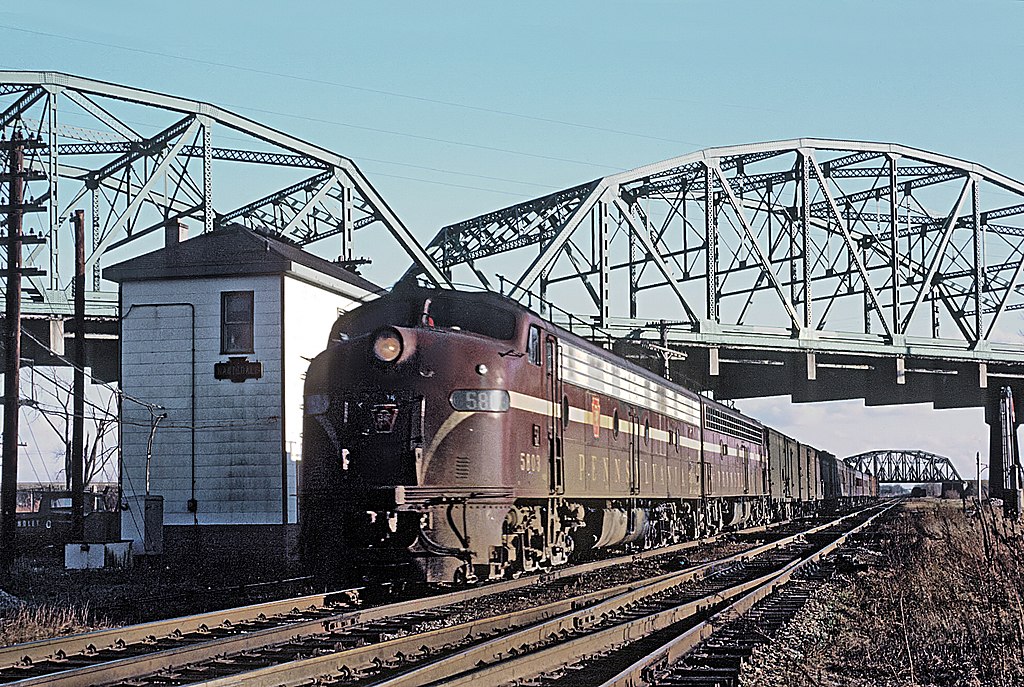
PRR E8A 5803 with Train 72, The Red Bird, passing the Hartsdale, Indiana tower and crossing the NYC and EJ&E on November 26, 1965.
Photo from the Roger Puta collection via Wikimedia Commons.

May 23, 2020

“If you want to advance your cause, make friends with the Ontario Mohawks. They pretty much run the country.”

Filed under: Cancon, Government, Railways — Tags: , , , , — Nicholas @ 03:00

Chris Selley on the utter, abject defeat of the Canadian and British Columbian governments in their “negotiations” with the hereditary leadership of the Wet’suwet’en:

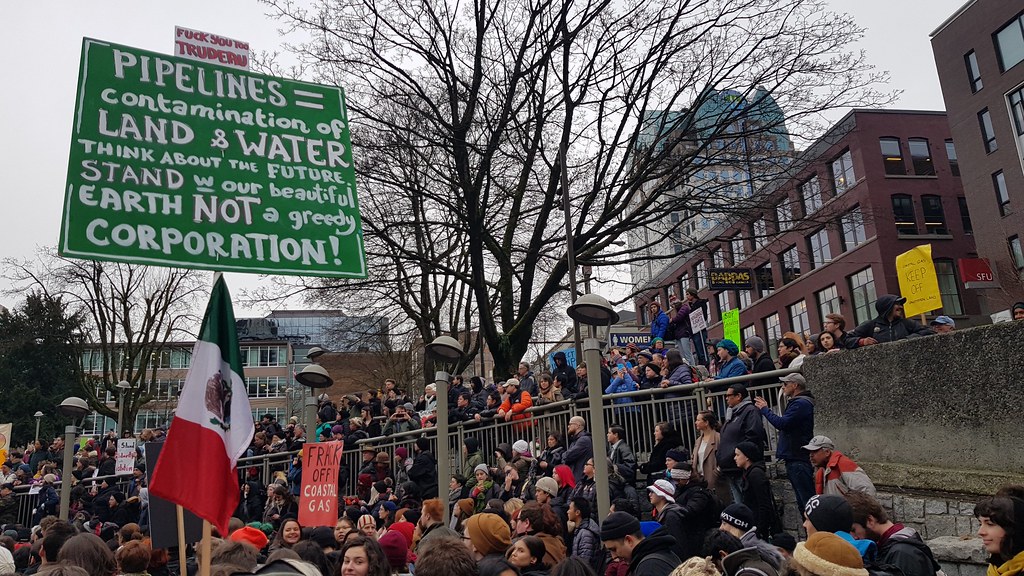
“Vancouver Solidarity with Wet’suwet’en” by jencastrotakespictures is licensed under CC BY-NC-SA 2.0

“We’re not understanding what is the rush here,” elected chief Maureen Luggi told CBC — a sentiment Naziel echoed. “We sat here for 30 years already, waiting and talking about it,” Naziel said. “We can wait another year or two. It’s not going to hurt anything.”

Indeed, from the average Wet’suwet’en member’s point of view, there is no hurry at all. The logical thing would be to fix the governance structure, heal the wounds that need healing, and then undertake these monumental negotiations.

But for the governments involved, this wasn’t about offering the Wet’suwet’en a better future. It was about putting out a fire: A group of Mohawks thousands of kilometres away in eastern Ontario had blockaded CN’s main line in solidarity with the hereditary chiefs; and the Ontario Provincial Police, armed with an injunction demanding the blockade end, refused to lift a finger.

Something had to give. Somebody had to get screwed, and it was the rank-and-file Wet’suwet’en. For no good reason whatsoever, the hereditary chiefs now hold all the keys to their future. It’s an appalling and appallingly predictable result.

“I don’t see why the government gave them this, because this has got nothing to do with what the protests across Canada started from,” chief Dan George of Ts’il Kaz Koh First Nation told CBC. “Those issues are not resolved. They can set up roadblocks again and do it again, and that’s what I’m worried about.”

If negotiations don’t go well, that might well prove to be a prescient remark. But for now, the hereditary chiefs’ victory is total: They have every reason to stay the course. The message to other groups, however, is clear: If you want to advance your cause, make friends with the Ontario Mohawks. They pretty much run the country.

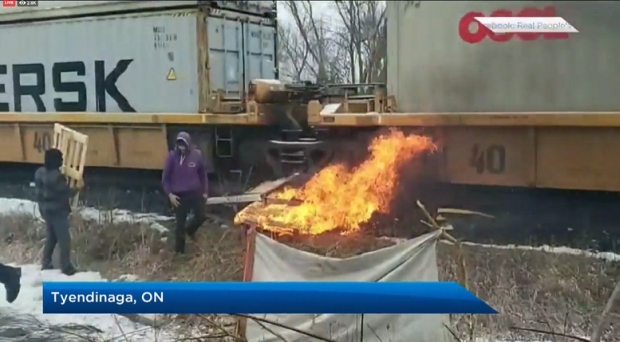
Screencap from a TV report on Mohawk Warriors attempting to set a freight car on fire along the Canadian National mainline through Tyendinaga near Belleville, Ontario in February, 2020.

May 8, 2020

Fallen flag — the Atchison, Topeka & Santa Fe Railway

Filed under: Business, History, Railways, USA — Tags: , , , , — Nicholas @ 03:00

This month’s fallen flag article for Classic Trains is the story of the Atchison, Topeka & Santa Fe Railway by George Drury:

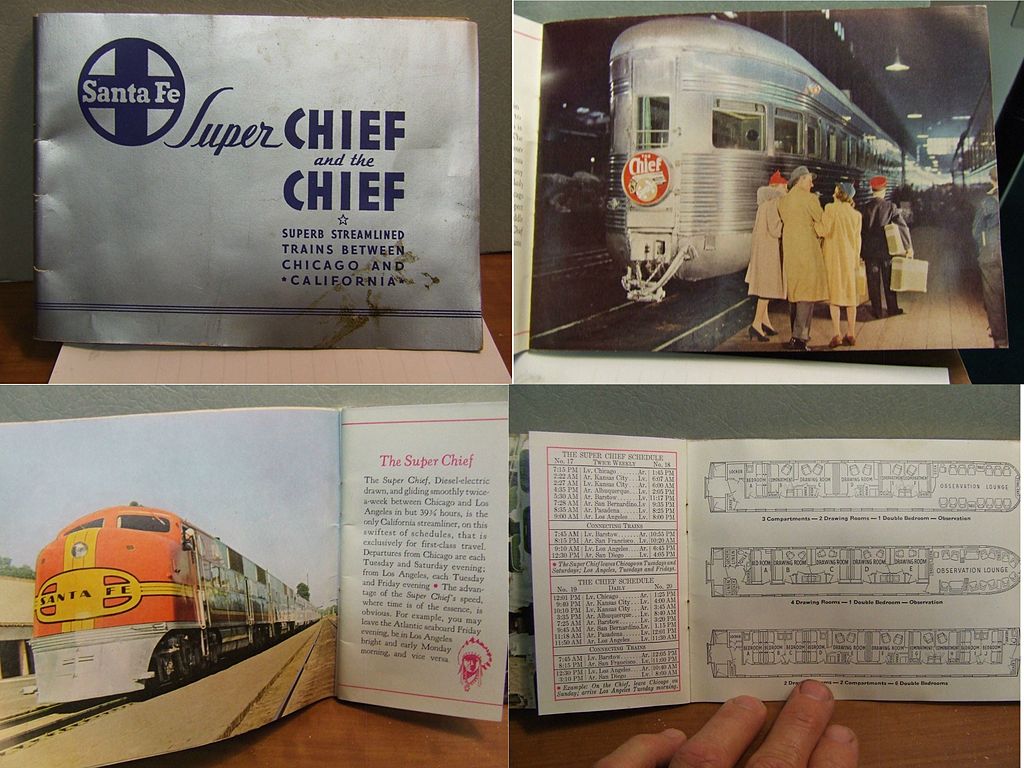
Pages from a circa 1937 booklet about the Santa Fe trains The Chief and the Super Chief. The railroad was showcasing the streamlined changes made to its main Chicago to California trains. Super Chief had given up its boxcab locomotives for EMC E1 units. Chief was no longer pulled by the “Blue Goose” steam locomotive, but by EMD diesel locomotives.
Wikimedia Commons.

The Atchison & Topeka Railroad was chartered in 1859 to join the towns of its title and continue southwest toward Santa Fe, New Mexico.

“Santa Fe” was added to the corporate name in 1863. Construction started in 1869; by the end of 1872 the railroad extended to the Kansas-Colorado border, opening much of Kansas to settlement and carrying wheat and cattle east to markets. The railroad temporarily set aside its goal of Santa Fe — once the trading capital of the Spanish colony in that area — and continued building west, reaching Pueblo, Colorado, in 1876, just in time for the silver rush at Leadville, Colorado.

In 1878, the railroad resumed construction toward Santa Fe, building southwest from La Junta to Trinidad, Colorado, then south over Raton Pass. It chose that route instead of an easier route south across the plains from Dodge City because of Native American attacks and a lack of water on the southerly route and coal deposits near Trinidad, Colorado, and Raton, New Mexico.

The Denver & Rio Grande was also aiming at Raton Pass, but Santa Fe crews arose early one morning in 1878 and were hard at work with picks and shovels when the Rio Grande crews showed up after breakfast. At the same time the two railroads skirmished over occupancy of the Royal Gorge of the Arkansas River west of Canon City, Colorado; the Rio Grande won that battle.

The Santa Fe reached Albuquerque, New Mexico, in 1880 (because of geography the city of Santa Fe found itself at the end of a short branch from Lamy, New Mexico) and connected with the Southern Pacific at Deming, New Mexico, in 1881. The Santa Fe then built southwest from Benson, Arizona, to Nogales, on the Mexican border. There it connected with the Sonora Railway, which Santa Fe interests had constructed north from the Mexican port of Guaymas.

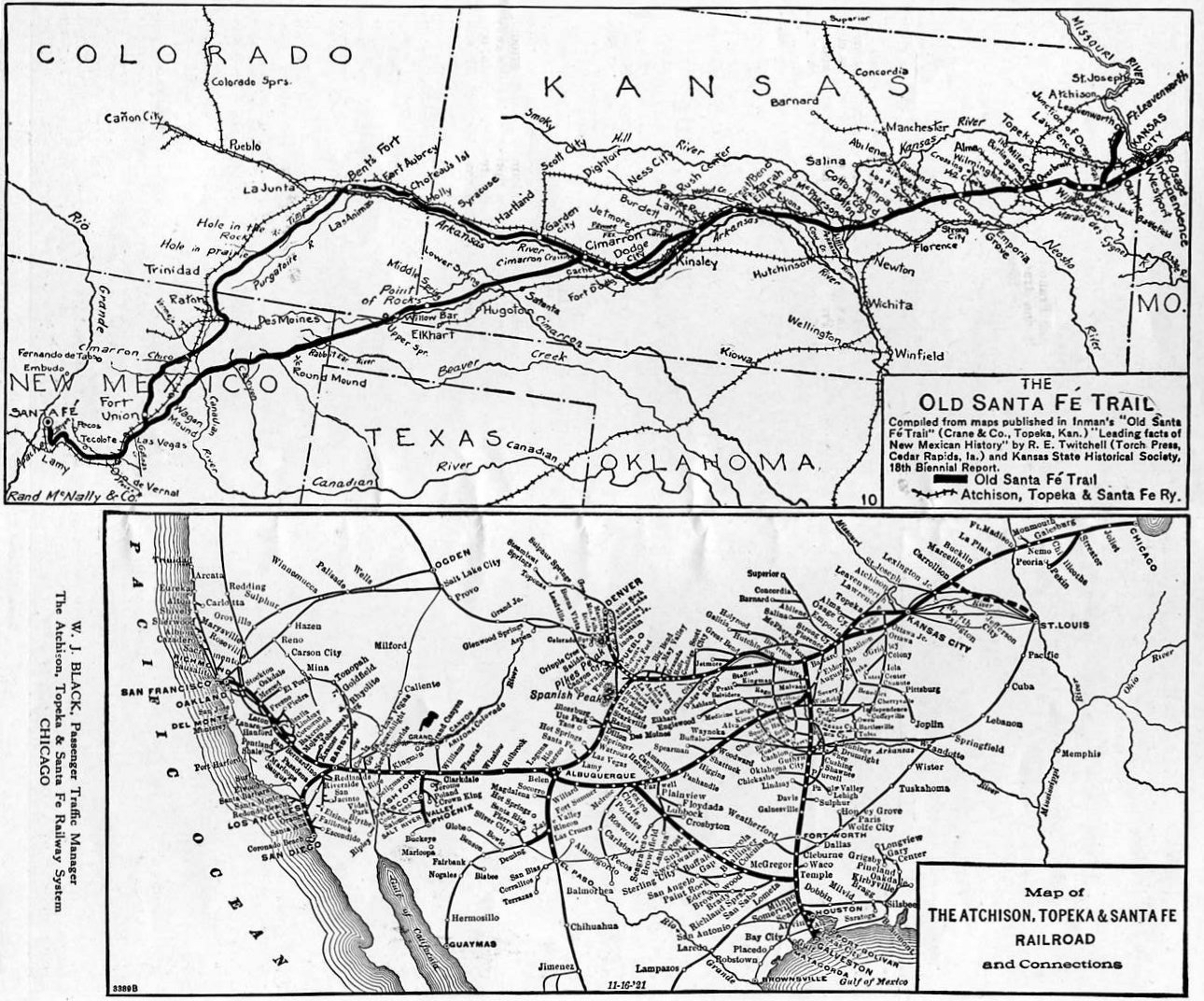
Comparison map showing the Santa Fe Trail and the ATSF Railway, 1922.
Map from By the Way – A condensed guide of points of interest along the Santa Fe lines to California, Rand McNally and Company via Wikimedia Commons.

In 1960 the Santa Fe bought the Toledo, Peoria & Western Railroad, then sold a half interest to the Pennsylvania Railroad. The TP&W cut straight east across Illinois from near Fort Madison, Iowa, to a connection with the Pennsy at Effner, Indiana, forming a bypass around Chicago for traffic moving between the two lines. The TP&W route didn’t mesh with the traffic pattern Conrail developed after 1976, so Santa Fe bought back the other half, merged the TP&W in 1983, then sold it back into independence in 1989.

During the 1960s the Santa Fe explored merger with the Frisco and the Missouri Pacific with no success. By 1980 Santa Fe, which had been the top railroad in route mileage in the 1950s, was surrounded by larger railroads. It was well managed and profitable, and it had the best route between the Midwest and Southern California, but its neighbors were larger, and friendly connections had been taken over by rival railroads. Southern Pacific was in the same situation. In 1980 Santa Fe and SP proposed merger. Approval seemed certain, but in 1986 the Interstate Commerce Commission denied permission because the merger would create a railroad monopoly in New Mexico, Arizona, and California.

The Santa Fe, suddenly the smallest of the Super Seven freight railroads, began spinning off branches and secondary lines and became primarily a conduit for containers and trailers moving between the Midwest and Southern California. In June 1994 Santa Fe and Burlington Northern announced their intention to merge — BN would buy Santa Fe. The deal was consummated in 1995, forming the Burlington Northern Santa Fe, known today as BNSF Railway.

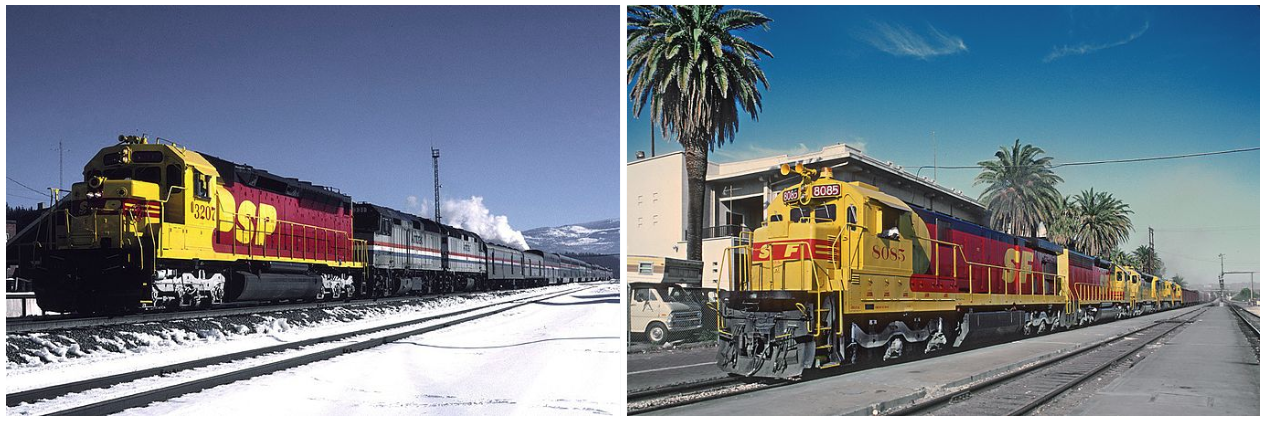
The denied merger between the Southern Pacific and the Santa Fe included an eye-catching proposed “Kodachrome” paint scheme for locomotives, as described in the Wikipedia article:

The holding company controlled all the rail and non-rail assets of the former Santa Fe Industries and Southern Pacific Company, and it was intended that the two railroads would be merged. They were confident enough that this would be approved that they began repainting locomotives into a new unified paint scheme, including the letters SP or SF and an adjacent empty space for the other two (as SPSF, the reverse order of the holding company).

The locomotive livery featured the Santa Fe’s Yellowbonnet with a red stripe on the locomotive’s nose; the remainder of the locomotive body was painted in Southern Pacific’s scarlet red (from their Bloody Nose scheme) with a black roof and black extending down to the lower part of the locomotive’s radiator grills. The numberboards were red with white numbers. In large block letters within the red portion of the sides was either “SP” (for Southern Pacific-owned locomotives) or “SF” (for Santa Fe-owned locomotives). The lettering was positioned on the locomotive sides so that the other half of the lettering could be added after the merger became official. Two ATSF EMD SD45-2s (ATSF #7219 and #7221) were painted with the full SPSF lettering to show what the unified paint scheme would look like after the merger was complete. One Santa Fe caboose was also painted with “SPSF” in a similar situation.

This paint scheme, combining yellow, red and black, has come to be called the Kodachrome paint scheme due to the colors’ resemblance to those on the boxes that Kodak used to package its Kodachrome slide film (which was heavily used by railfans of the time). After the ICC’s denial, railroad industry writers, employees of both railroads and railfans alike joked that SPSF really stood for “Shouldn’t Paint So Fast”.

May 1, 2020

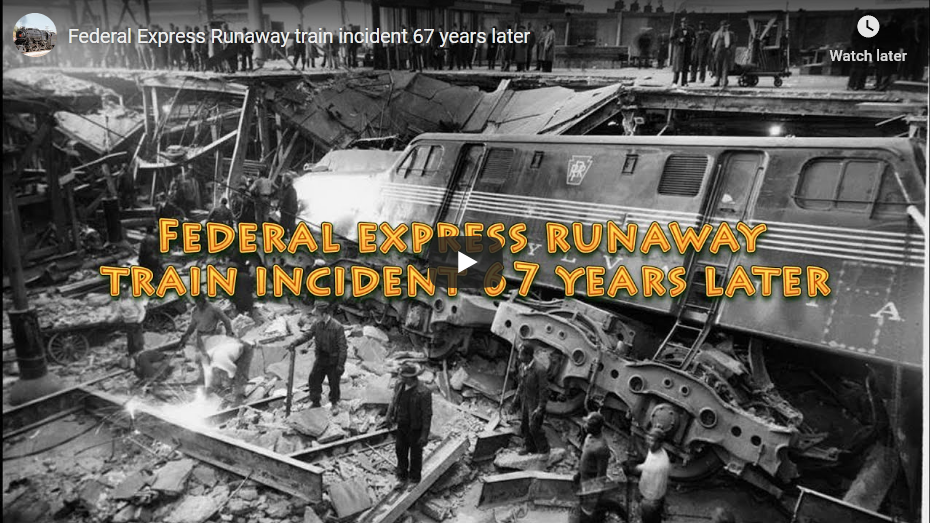
Federal Express runaway train incident 67 years later

Filed under: History, Railways, USA — Tags: , , , — Nicholas @ 02:00

Thunderbolt 1000 Siren Productions
Published 17 Jan 2020

2 days late and I lost several hours of sleep but holy hell it’s worth it now that it’s done! Enjoy this pretty interesting story on a runaway GG1 just days before Eisenhower’s inaguration
Please don’t shoot me for the Trump pics 😐
Next to come up is Glendale and *passes out*

Please donate!
https://www.gofundme.com/thunderbolt-…

I’m just a struggling college student! Your generous donations will enable me to continue my education and ensure future posts and educational films. Thank you!!!

Discord server: https://discord.gg/Tqwr4RV

Patron:
https://www.patreon.com/Thunderbolt1000

Deviantart: https://www.deviantart.com/pennsy

April 28, 2020

Robber Barons and the Battle of the Tunnel

Filed under: Business, Government, History, Law, Politics, Railways, USA — Tags: , , , — Nicholas @ 04:00

The History Guy: History Deserves to Be Remembered
Published 1 Feb 2019

During the gilded age ruthless businessmen fought for control of railway lines. The Albany and Susquehanna railroad was another battlefield in the “Railroad wars.” In this episode, The History Guy remembers “the Battle of the Tunnel”.

This is original content based on research by The History Guy. Images in the Public Domain are carefully selected and provide illustration. As images of actual events are sometimes not available, images of similar objects and events are used for illustration.

All events are portrayed in historical context and for educational purposes. No images or content are primarily intended to shock and disgust. Those who do not learn from history are doomed to repeat it. Non censuram.

Patreon: https://www.patreon.com/TheHistoryGuy

The History Guy: History Deserves to Be Remembered is the place to find short snippets of forgotten history from five to fifteen minutes long. If you like history too, this is the channel for you.

Awesome The History Guy merchandise is available at:
teespring.com/stores/the-history-guy

Script by THG

#newyork #thehistoryguy #ushistory

April 23, 2020

Quintinshill, the Worst Railway Disaster in British History

Filed under: Britain, History, Military, Railways, WW1 — Tags: , , , — Nicholas @ 02:00

The History Guy: History Deserves to Be Remembered
Published 15 Sep 2018

Railroads played a critical role for the United Kingdom in the Great War. But the increased burden on the nation’s railways had its cost. In the early morning hours of May 22, 1915, a crowded schedule resulted in the 1915 Quintinshill Rail Disaster, the worst railway disaster in British history. Its victims, mostly men of the 1/7 Royal Scots regiment, deserve to be remembered.

The History Guy uses media that are in the public domain. As photographs of actual events are sometimes not available, photographs of similar objects and events are used for illustration.

The episode includes historical photos involving the Great War and a 1915 railway disaster. Those photos are provided in context of the historical events. No graphic violence is shown.

Patreon: https://www.patreon.com/TheHistoryGuy

The History Guy: History Deserves to Be Remembered is the place to find short snippets of forgotten history from five to fifteen minutes long. If you like history too, this is the channel for you.

Awesome The History Guy merchandise is available at:
https://teespring.com/stores/the-hist…

The episode is intended for educational purposes. All events are portrayed in historical context.

#quintinshill #wwi #thehistoryguy

April 20, 2020

“New York City subways were ‘a major disseminator — if not the principal transmission vehicle — of coronavirus infection'”

Filed under: Government, Health, Politics, Railways, USA — Tags: , , , , , — Nicholas @ 05:00

Randal O’Toole wonders why the lone sacred cow of mass transit is still running, despite its potential role in spreading disease:

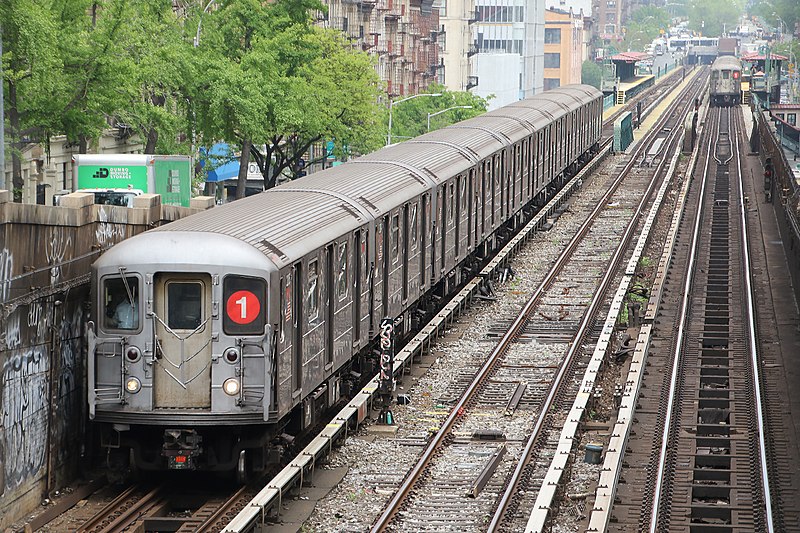
MTA NYC Subway 1 trains at 125th St., 14 May, 2018.
Photo by Mtattrain via Wikimedia Commons.

Sit‐​down restaurants and bars have been shut down. Public officials are discouraging or even forbidding people from doing “unnecessary travel,” even if it is to visit a second home where they might be able to socially distance themselves better than in their first, more urban home. All sorts of other rules are being passed, all supposedly for our own good.

So why are urban transit systems still running? A 2018 study found that “mass transportation systems offer an effective way of accelerating the spread of infectious diseases.” A 2011 study found that people who use mass transit were nearly six times more likely to have acute respiratory infections than those who don’t. Not surprisingly, a study published a few days ago found that New York City subways were “a major disseminator — if not the principal transmission vehicle — of coronavirus infection.”

Transit agencies say they are helping “essential workers” go about their business. But if they are so essential, isn’t it important to find them a safe way of getting to work? If we truly cared about people’s safety, then transit services should have shut down at the same time we closed other non‐​essential businesses and asked people to stay at home.

[…]

Unfortunately, the transit lobby has successfully turned government‐​subsidized transit into a sacred cow. Transit is supposedly greener than driving when in fact it’s an energy hog. Transit is supposedly needed to help poor people get to work when in fact the people most likely to commute by transit are those earning more than $75,000 a year.

When the pandemic took away most of transit’s customers, instead of shutting down, which would have been the responsible thing to do, transit agencies demanded that Congress give them $25 billion, tripling federal support to transit this year. Thanks to transit’s sacred cow status, Congress agreed without any serious debate.

Effectively, Congress rewarded the agencies for spreading disease. It would have been better to use that money to help transit‐​dependent essential workers buy a car so they could have a safe way of getting to work.

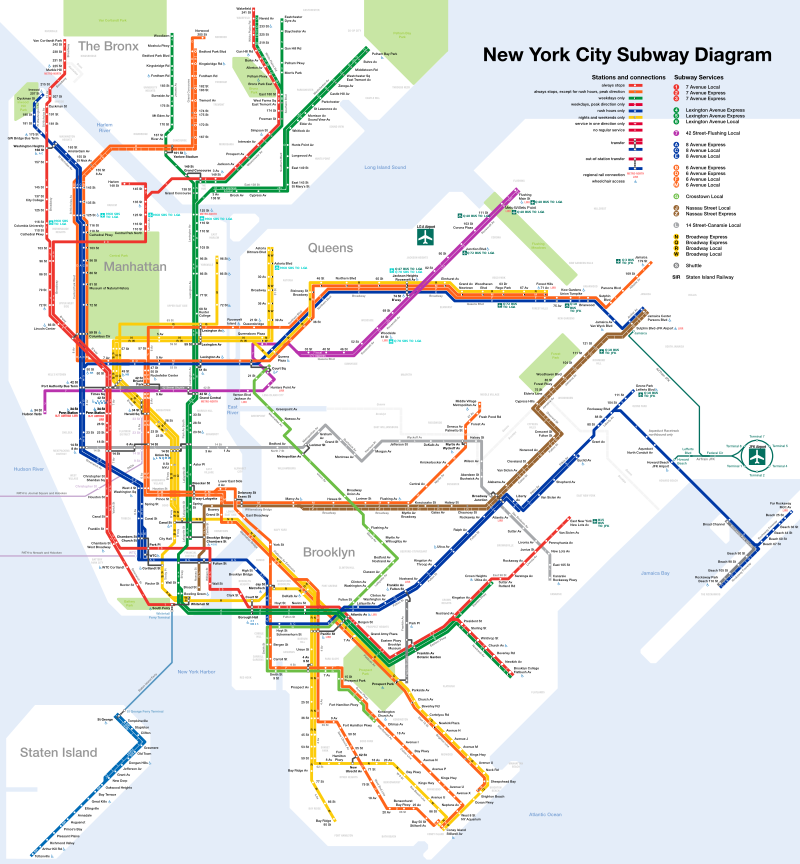
New York City subway system.
Image by Jake Berman (maps.complutense.org) based on information from the MTA, via Wikimedia Commons.

April 13, 2020

James J. Hill, US railroading’s premier “market entrepreneur”

Filed under: Business, Government, History, Railways, USA — Tags: , , , — Nicholas @ 03:00

Dane Stuhlsatz outlines the story of US federal government subsidies and other interventions into the 19th century railroad industry and the one tycoon who avoided the lure:

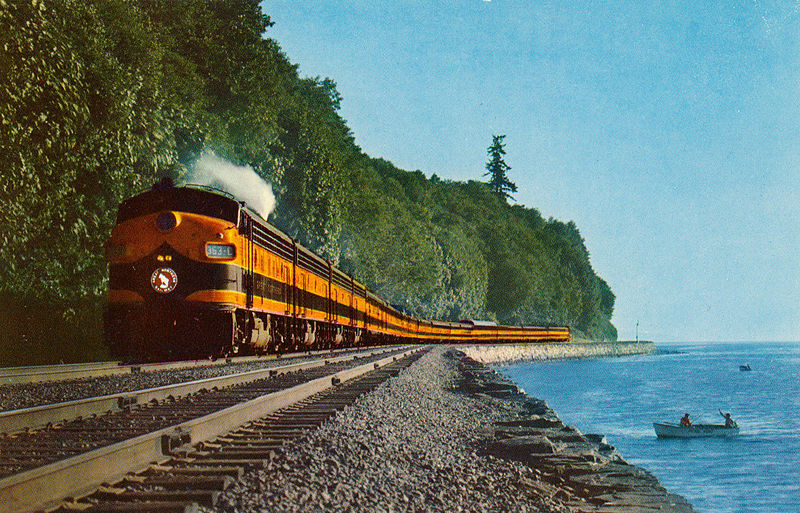
Postcard photo of the Great Northern Railway’s “Empire Builder” streamliner between Everett and Seattle, Washington, circa 1963.
Great Northern Railway postcard via Wikimedia Commons.

Burton W. Folsom, Jr. outlined this story in his book, The Myth of the Robber Barons, identifying two models of entrepreneurship; the “political entrepreneurism” of lines like the Union Pacific and Central Pacific versus the “market entrepreneurism” of James J. Hill and his Great Northern Railway.

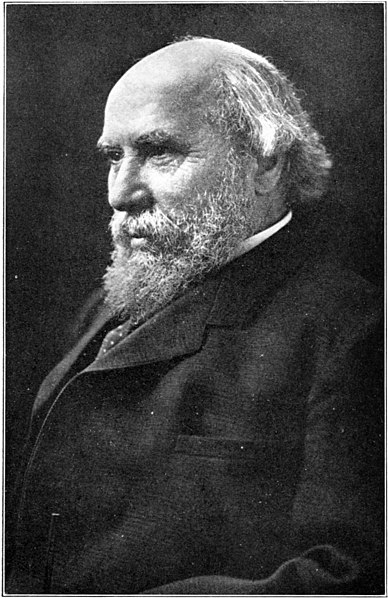
Canadian-born James J. Hill (1838-1916) in 1914.
Photo from Famous Living Americans, edited by Mary Griffin Webb and Edna Lenore Webb via Wikimedia Commons.

As Folsom details, the former chased government largesse, ultimately in exchange for loss of control of their business, while the latter chased profits through prudent business decisions. Hill’s success juxtaposed with UP’s and CP’s failure is due in no small part to his steadfast refusal to accept any federal subsidies. In short, UP’s and CP’s government subsidized incentives were vastly different from Hill’s profit driven incentives, which lead to vastly different outcomes.

Federal subsidies incentivized speed, not efficiency. The subsidies were paid in the form of both land grants and direct payments. For each mile of track laid, the UP and CP would receive 20 acres of land and either $16,000 (for track on flat land), $32,000 (for track on hilly terrain), or $48,000 (on mountainous terrain). This incentive for speed resulted in winding, inefficient, routes built with inferior materials, ultimately culminating in a federal price tag of 44,000,000 acres and $61,000,000 (astronomical sums in the 1860s-70s). Despite all this federal assistance, shortly after the golden spike was driven on May 10, 1869 at Promontory Summit, Utah, the UP and CP were nearly bankrupt and required further assistance to stay afloat.

The lines which were born and brought up on federal aid needed federal aid to continue. This led to the passage of the Thurman Law in 1874 which forced UP to pay 25% of its earnings a year to pay its federal debt.

UP’s profitability decisions were also subject to government approval. Branch lines — smaller lines off the main line into rural communities — which could have helped UP’s bottom line, were often not approved by federal bureaucrats. Additionally, the federal Bureau of Railroad Accounts required constant checking of UP’s books. All these measures stifled the ingenuity that UP so desperately needed to make its line profitable. UP quickly found out that the power to subsidize was the power to destroy.

Hill’s line on the other hand was methodically surveyed and built, on the shortest routes possible, with the least gradient possible, and using the best steel and other materials on the market at the time. Rather than political largess, Hill made his decisions based on profit and loss. But, for all the efficiency that Hill built into his line — he was able to transport across the country faster, cheaper, and with less maintenance costs than could the UP and CP — arguably the most important aspect for the viability of his business was the freedom to conduct business untethered by the strings that accompanied government subsidies.

While Hill was free to build when and where he wanted so long as he reached voluntary agreements with landowners, consumers, and employees, UP was tied up in red tape. As Hill’s line grew evermore profitable and reliable for customers, the UP and CP struggled along on federal aid, until they ultimately went bankrupt in 1893.

For his part, Hill’s line was the only transcontinental railroad to never go bankrupt.

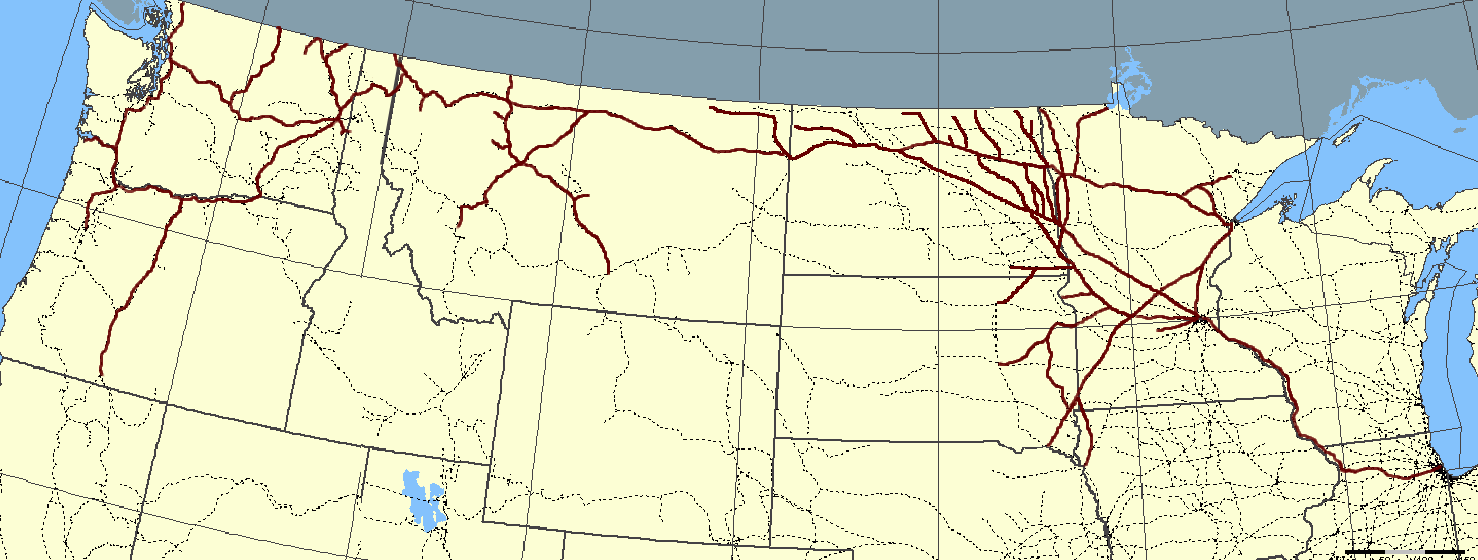
Route map from the Great Northern Railway, circa 1920. Red lines are the GN route; dotted lines are other railroads. Created from the Map Maker at nationalatlas.gov and routes drawn in, using a 1920 map as a reference.
Map by Elkman via Wikimedia Commons.

April 2, 2020

Fallen flag — the Pere Marquette Railway

Filed under: History, Railways, USA — Tags: , , , , , , — Nicholas @ 03:00

This month’s fallen flag article for Classic Trains is the story of the Pere Marquette Railway by Kevin P. Keefe:

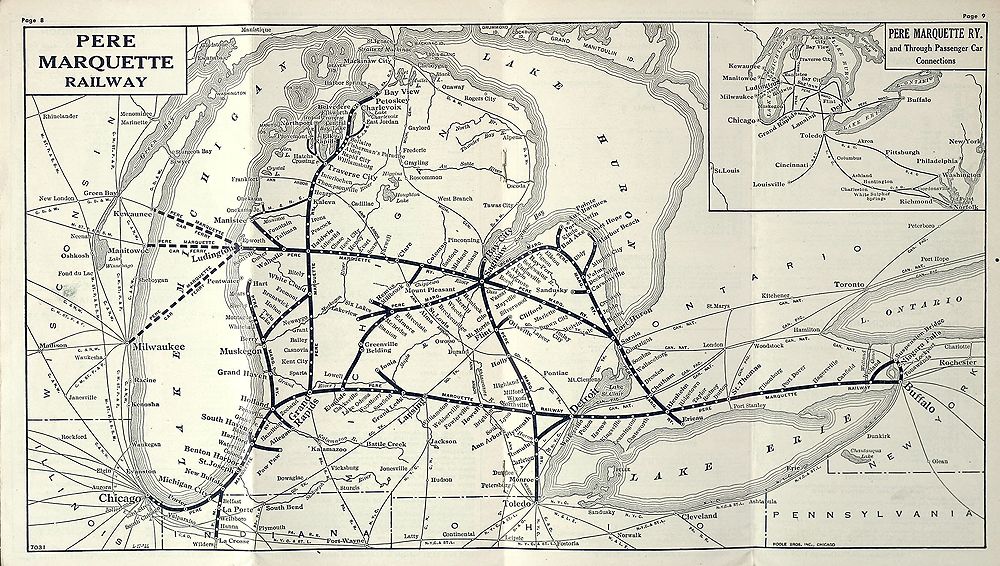
C&O’s formal acquisition of the Pere Marquette in 1947 did more than help usher in the postwar merger era; it also closed the book on a railroad with a colorful and quirky history. PM was created in 1900 by the consolidation of three roads: Flint & Pere Marquette; Detroit, Grand Rapids & Western; and Chicago & West Michigan. (The town of Pere Marquette; today we know the place as Ludington. Jacques Marquette, the French missionary and explorer, died and was buried here in 1675, and the name Pere Marquette had been given to the inlet lake off Lake Michigan, the river that feeds into it, and an 1847 community there.)

All three carriers had roots in the lumber industry, so the new Pere Marquette Railroad not only connected important Michigan cities, it also operated a branchline network covering much of the state’s Lower Peninsula. PM’s early corporate history was chaotic, marked by receivership and ownership changes. The Cincinnati, Hamilton & Dayton acquired PM in 1904 and for a time leased it to various parties, including the Erie Railroad. Thus did Baltimore & Ohio briefly control the PM through its ownership of the CH&D. When Pere Marquette came out of a receivership in 1907, it would be for only five years.

Those early, troublesome times, however, were marked by two strategic steps forward. One was the chartering of the Pere Marquette of Indiana, which built from New Buffalo, Michigan, southwest to Porter, Indiana, allowing PM to reach Chicago, via trackage rights on the Lake Shore & Michigan Southern (NYC). The second was the lease of the Lake Erie & Detroit River Railway, pushing PM eastward from Walkerville (Windsor), Ontario, to St. Thomas, thence to Suspension Bridge (Niagara Falls), New York, via rights on Michigan Central affiliate Canada Southern, and on to Buffalo on the NYC. Patched together as they were, these additions allowed PM to position itself as a Buffalo–Chicago bridge carrier.

Pere Marquette route map from a 1944 timetable.
Via Classic Trains.

In the ensuing years, the rectangular PM logo would largely disappear from view, although the road’s eventual 12 E7’s wore the script Pere Marquette train name, along with C&O identification, into the mid-1950s, thanks to equipment trust restrictions. PM’s three GE 70-tonners of 1947 were sold, but a few of its 16 EMD switchers (2 SW1’s of 1939 and ’42, 14 NW2’s of 1943–46) carried PM lettering into the 1960s, and C&O kept PM’s color pattern of yellow front-end bands with red pinstriping on a blue body on 11 more EMDs of 1948 that came fully lettered C&O: NW2’s 1850–1856 and E7’s 95–98.

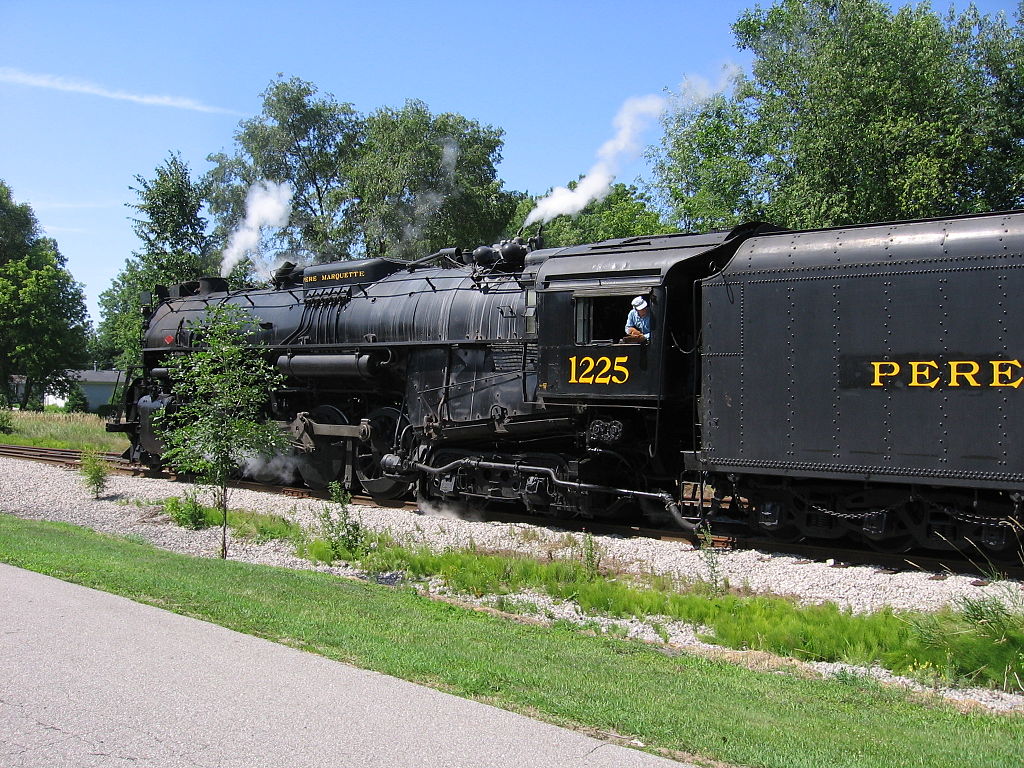
As for the famous Berkshires, they, along with all of Pere Marquette’s steam locomotives, were retired by 1951. Eleven found a temporary reprieve on C&O’s Chesapeake District in Kentucky and West Virginia, but only for a few months. Two, 1223 and 1225, survived as display items in Michigan, and as a student at Michigan State University, I became involved with the restoration of the 1225, which today occasionally operates on excursions.

Perhaps it’s fitting that the Pere Marquette’s last equipment order as an independent railroad was in 1947 for six of EMD’s 1,500 h.p. BL2 “branchline” diesels, Nos. 80–85. Chosen to negotiate PM’s web of secondary lines — most of them rooted in the road’s origins as a logger — the homely diesels were as quirky and as singular as the PM itself. Pointedly, even though they sported the “speed striping” as found on the E7’s, the BL2’s were delivered in full “Chesapeake & Ohio” lettering.

Pere Marquette 1225, a Berkshire 2-8-4 steam locomotive, passes through Alma in March 2009.
Photo by Chelseyafoster via Wikimedia Commons.

The Pere Marquette also had a maritime division and one of their ships had a disastrous voyage (via Wikipedia) 110 years ago:

The Pere Marquette operated a number of rail car ferries on the Detroit and St. Clair Rivers and on Lake Erie and Lake Michigan. The PM’s fleet of car ferries, which operated on Lake Michigan from Ludington, Michigan to Milwaukee, Kewaunee, and Manitowoc, Wisconsin, were an important transportation link avoiding the terminal and interchange delays around the southern tip of Lake Michigan and through Chicago. Their superintendent for over 30 years was William L. Mercereau.

Pere Marquette 18

On September 10, 1910, Pere Marquette 18 was bound for Milwaukee, Wisconsin, from Ludington, Michigan, with a load of 29 railroad freight cars and 62 persons. Near midnight, the vessel began to take on massive amounts of water. The captain dumped nine railroad cars into Lake Michigan, but this was no use — the ship was going down. The Pere Marquette 17, traveling nearby, picked up the distress call and sped to assist the foundering vessel. Soon after she arrived and she could come alongside, the Pere Marquette 18 sank with the loss of 28 lives; there were 33 survivors. Her wreck has yet to be located and is the largest unlocated wreck of the Great Lakes.

April 1, 2020

The Orient Express: King of Trains, Train of Kings

Geographics
Published 29 Nov 2019

The journey to the Express was not a simple one. For upper class travellers to enjoy a luxury, non-stop train ride across seven nations, it would take the dream of a lovesick Belgian engineer, with his rather interesting supporting cast: an American industrialist, the inventor of US tabloid journalism, the Prince of Wales, and one of the most prolific mass murderers of the 19th and 20th Centuries.

Credits:
Host – Simon Whistler
Author – Arnaldo Teodorani
Producer – Jennifer Da Silva
Executive Producer – Shell Harris

Business inquiries to admin@toptenz.net

March 11, 2020

Canadian National’s perfect storm

In Trains, Bill Stephens highlights the terrible time Canada’s largest railway has been having since the beginning of the year:

“DSC02285” by Bengt 1955 is licensed under CC BY-NC 2.0

It would be hard to imagine a worse start to the year for Canadian National, whose volume is down 16% due to a string of events that’s mostly odd, unrelated, and unrelenting. CN is taking it on the chin, as no other North American railroad has seen its volume fall by more than 10% this year and rival Canadian Pacific’s traffic is up 10%.

First, there was Mother Nature. Winter arrived in January with eight days of deep cold in Western Canada, forcing CN to restrict train length. Then powerful rainstorms lashed southern British Columbia starting Jan. 30, washing out CN’s main to Vancouver for six days.

The major washouts occurred in the rugged Fraser River canyon directional running zone where CN and CP share trackage, with CN hosting westbounds and CP carrying eastbounds. The railways had to resort to running directional fleets of 15 to 20 trains at a time over CP’s line. The single-track bottleneck caused eastbound traffic to stack up at the Port of Vancouver and westbounds to be staged as far away as the Prairies. The directional running zone ranks among the top three freight mains by tonnage in North America, alongside BNSF Railway’s Southern Transcon in the Southwest and Union Pacific’s triple track across Nebraska. So this blockage was, by itself, a big deal.

Then came nearly a month of civil protests. On Feb. 6, as CN began digging out from the washout backlog, the first of several First Nations blockades set up camp on CN’s tracks. The blockades, protesting a proposed natural gas pipeline in British Columbia, halted traffic on CN’s Montreal-Toronto mainline in the East. Also ultimately affected: CN’s line to Prince Rupert, British Columbia, which was blocked by protests for six days. Other protests came and went in Edmonton, Alberta; Winnipeg, Manitoba; Quebec; and British Columbia. CP was affected, too, but to a much lesser extent. CP even hosted detour traffic for CN between Montreal and Toronto.

As if that wasn’t enough, then came regulatory woes. The same day the protests began, a CP crude oil train derailed and caught fire in Guernsey, Sask., the second such wreck in the area since December. Hours later Transport Canada issued a ministerial order that restricted key trains – those with 20 or more cars of hazardous materials – to 20 mph in metropolitan areas and 25 mph elsewhere. With the stroke of a pen, Transport Minister Marc Garneau’s knee-jerk reaction effectively reduced CN’s overall capacity by a third. You could call this slowdown “Whoa Canada!”

March 6, 2020

“[A] decision of such absolutely mind-boggling stupidity and irresponsibility that it could only have come from Justin Trudeau, himself”

Filed under: Cancon, Government, Law, Politics, Railways — Tags: , , , — Nicholas @ 05:00

Ted Campbell on the Trudeau government’s apparent abject surrender to the Wet’suwet’en hereditary chiefs (“apparent” because we still don’t have any details of the “deal”):

The Wet’suwet’en hereditary chiefs’ agenda seems simple enough to me. They don’t like the notion that the Wet’suwet’en people can elect band councils that might act for the good of the people and < quelle horreur > the people might even disagree with the hereditary chiefs. Some (male) hereditary chiefs seem to have managed to strip some other (female) chiefs of their titles because they, the female chiefs, sided with the elected councils. This is, in 21st century British Columbia, something of a replay of 17th century Europe and the end of the divine right of kings, except that the Wet’suwet’en hereditary chiefs might succeed where Charles I and Louis XVI failed because they have the dimwits in the Trudeau cabinet on their side.

To make matters worse, as John Morris of the Canadian Press points out in an article published in the Globe and Mail, the government negotiated with the hereditary chiefs, only ~ with the people who broke the law; and they ignored the elected leaders ~ the people who played by the rules.

How typically Trudeau: he surrenders, cravenly, to the reactionary, anti-democratic lawbreakers and, simultaneously, shuts out the elected representatives of the Wet’suwet’en peoples. Is that the Canada in which we all want to live? Is that the sort of “leadership” for which millions of Canadians voted in 2019? I think not. Justin Trudeau is both a fool and a coward and his party, the Liberal Party of Canada, has a duty to Canada: throw the bum out!

But, not to worry, the Trudeau regime’s propagandists press agents will tell us that it’s all good, we “won,” something or other … didn’t we? And who cares if we lost something nebulous like honour and responsibility? It’s all about reconciliation, isn’t it? What do trivialities like democracy and the national interest matter when really important things, like preserving the power of hereditary chiefs over elected councils, are at stake? But that reactionary system seems to have been strengthened, and so “It was a famous victory.”

March 5, 2020

Fallen flag — The Clinchfield Railroad

This month’s fallen flag article in Classic Trains magazine recounts the story of the Carolina, Clinchfield & Ohio, later known as the Clinchfield Railroad:

Clinchfield Railroad SD40 locomotive number 3002 at Spartanburg, SC in February 1968.
Roger Puta photo via Wikimedia Commons.

The Clinchfield was different. It was conceived by men who had the vision and resources to do things right. It was built to the highest engineering standards of the early 20th century. It never went through a financial failure or reorganization. Indeed, the Carolina, Clinchfield & Ohio Railway was the antithesis of traditional railroad evolution.

In 1902, a wealthy regional businessman, George L. Carter, began stitching together an integrated industrial enterprise to develop vast coal deposits in the Clinch (River) Fields of southwest Virginia and to deliver the coal across the southern Appalachian mountains to markets in the Carolinas and to ships calling at Wilmington, Charleston, Savannah, and Jacksonville. Carter, from whom Howard Hughes could have learned a thing to two about secrecy, operated using the South & Western Railway banner. The name said everything … and nothing. The S&W was chartered from any point on the Atlantic Ocean to any point on the Great Lakes. Carter agents seized by legal means and/or physical occupation key terrain features through the mountains in competition with the Chesapeake & Ohio and the Southern Railway.

Clinchfield Railroad map. The Clinchfield’s 277-mile, 5-state line stretched from Elkhorn City, Kentucky, to Spartanburg, South Carolina.
Map via Classic Trains.

Within that generous charter was the idea of building a railroad to haul coal south and merchandise in both directions between the Midwest and the Southeast. The plans also incorporated development of several on-line cities to consume coal and make products from regional resources to diversify and grow the freight business. Finally, a steamship line was organized to move coal beyond the ports to customers in the Caribbean.

By 1905, Carter realized he needed far more capital than he could personally provide. Reluctantly, he managed to convince Blair & Co., a big Wall Street investment house, to finance the project. M. J. Caples, an engineer with mining and railroad experience, laid out and then built a magnificent low-grade, high-capacity railroad. Tunnels, steel viaducts, generous fills, and rocky cuts appeared as needed. More than 4 percent (almost 10 miles) of the line was underground in 55 tunnels. With construction of the 277-mile railroad well advanced, its name was changed to Carolina, Clinchfield & Ohio Railway in 1908.

Coal began flowing across the 242 miles from Dante, Va., to Spartanburg, South Carolina, in 1909 while the owners and engineers debated how to cross the Cumberland mountains into the Ohio River valley. Between 1912 and 1915, a 35-mile extension including what was then the 10th-longest tunnel in the U.S. created a through route connecting Chesapeake & Ohio at Elkhorn City, Kentucky, with the three major southeastern carriers (Seaboard at Bostic, North Carolina; Atlantic Coast Line and Southern at Spartanburg). In constant-value dollars, the five-state CC&O was the most expensive railroad ever built in the U.S.

February 29, 2020

“And then, somewhat astonishingly, the Ontario Provincial Police actually upheld the law”

Filed under: Cancon, Government, Law, Politics, Railways — Tags: , , , — Nicholas @ 05:00

Chris Selley calls for some answers in the still-not-fully resolved railway disruptions by First Nations and climate activists and the calling-it-spineless-is-a-compliment reactions of various levels of government to widespread contempt for the law:

Screencap from a TV report on Mohawk Warriors attempting to set a freight car on fire along the Canadian National mainline through Tyendinaga near Belleville, Ontario.

When Canada’s ongoing spate of rail blockades finally peters out, this country has some work to do. A parliamentary committee might be up to the job, but even a full-on independent inquiry might not be excessive. A small group of Mohawks in Tyendinaga, Ont., in solidarity with an even smaller group of hereditary Wet’suwet’en chiefs, managed to blockade the Canadian National Railway for two weeks, not just holding hostage a chunk of the country’s economy, productivity and mobility, but demanding as ransom the cancellation of a liquefied natural gas pipelines that all First Nations affected by it, and it seems a comfortable majority of their residents, support.

It’s not a national disaster or anything. But as Prime Minister Justin Trudeau belatedly realized, it’s simply not an acceptable outcome in a democracy operating under the rule of law. And there is every reason to believe it could happen again — especially because we don’t really know how or why it ended when it did.

Operating at peak obnoxiousness, Trudeau had scolded those who demanded enforcement of a court order against the Tyendinaga blockade as boors, violence-mongers and idiots: “We are not the kind of country where politicians get to tell the police what to do,” he huffed. And then, frustrated by a lack of Sunny Ways among the federal government’s negotiating partners, he suddenly told the police what to do — or at the very least what he thought should happen.

[…]

The relatively undramatic end to the Tyendinaga blockade, after two weeks of dire warnings about Oka and Ipperwash reruns, raises another key question: Is there any reason we should believe it was safer to enforce the injunction on Day 14, as opposed to Day One or Two or Six?

Attempting negotiations was a perfectly sensible approach, even though it was very difficult to discern any room for compromise when one of the blockaders’ demands was so simple, blunt and inconceivable: shutting down the Coastal GasLink pipeline project. But the government is likely to face similarly unbending demands from future blockaders: Shutting down the Trans Mountain pipeline project, for example. Surely we can’t establish “two weeks of futility and then enforcement” as a policy moving forward. (Some might argue it was already established by a 13-day blockade of CN tracks near Sarnia, Ont., in 2013 — but that wasn’t nearly as crippling a blow to the railway’s operations.)

Police in Quebec were perfectly happy to enforce an injunction against a blockade on Montreal’s South Shore, which ended swiftly and without incident. Another on Mohawk territory in Kahnawake remains in place, and Premier François Legault has been excoriated for suggesting police face a heavily armed populace there — but at least it’s an attempt at an explanation. When it comes to the OPP’s inaction, we have none. For that matter, we probably deserve some insight into how protesters were able to set a roaring bonfire next to a moving train in Tyendinaga, wholly unmolested, just a couple of days after the blockade came down.

February 26, 2020

“… the First World’s most dysfunctional train: The Canadian, which in theory links Vancouver to Toronto”

Filed under: Business, Cancon, Railways — Tags: , , , , — Nicholas @ 03:00

Chris Selley fires all his guns at the pride of VIA Rail Canada’s passenger services, The Canadian:

VIA dome observation car, on The Canadian in 2007.
Photo by Savannah Grandfather via Wikimedia.

With the Ontario Provincial Police somehow finally roused to action in Tyendinaga, Ont., it seems the CN railway blockade may not last its third week. This outstanding achievement in law enforcement will come as a relief in particular to the nation’s business community, people who enjoy staple foods, and the propane-dependent. The minority of travellers along the Windsor-to-Quebec City corridor who ride VIA Rail were not as imperilled: most essential, tight-budgeted VIA trips can also be made by bus, with only moderate time lost and with money saved as a consolation. But they too will be pleased. As maddening as VIA’s corridor services can be, with their ancient rolling stock, outrageously stale food, mostly theoretical wi-fi, schedules that get slower rather than faster and reliable delays regardless, trains are just genetically superior to buses.

Or at least, most are. The Windsor-to-Quebec City services are practically Japanese in comparison to what must be the First World’s most dysfunctional train: The Canadian, which in theory links Vancouver to Toronto. It has been shut down almost since the blockade began, and hardly anyone has noticed. It’s time we talk about this crazy thing.

What, you may ask, is the most ridiculous thing about The Canadian? Some might point to the astonishing level of subsidy: In 2018, the average corridor passenger enjoyed a subsidy of $32, or 17 cents per mile. The average passenger on The Canadian: $596, or 48 cents a mile, for a total of $49 million.

But never mind the price for a second; look what it’s buying. Fifty years ago, CN’s Super Continental was scheduled to take 67 hours. Today The Canadian, plying the same route and giving way to every freight train, is budgeted a mind-boggling 85 hours eastbound and 97 westbound.

[…]

For all the subsidies, The Canadian is eye-wateringly expensive. For the full one-way trip, a cabin for two will set you back $3,824, meals included. You can take a five-day mid-range Caribbean cruise for that, and that’s no coincidence: The Canadian is essentially a cruise ship on rails. It’s just that, well, Canadian taxpayers don’t subsidize cruise lines. Because that would be nuts.

I’ve always wanted to ride The Canadian, but I never could afford both the time and the money at the same time. (I have the time now, but I’m struggling to pay my bills, so even a GO Train trip into Toronto needs to be carefully budgeted … a trip on The Canadian would be a very significant percentage of my gross annual income!).

Canadian Pacific FP7 locomotive 1410 at the head of The Canadian stopped at Dorval, Quebec on 6 September, 1965. The Canadian was Canadian Pacific’s premier passenger train before VIA Rail was formed.
Photo by Roger Puta via Wikimedia Commons.

« Newer PostsOlder Posts »

Powered by WordPress