
… that’s a problem for modern political science, because — put briefly but not unfairly — all modern political science rests on the idea of the Social Contract, which is false. And not just contingently false, either — it didn’t get overtaken by events or anything like that. It’s false ab initio, because it rests on false premises. It seemed true enough — true enough to serve as the basis of what was once the least-worst government in the history of the human race — but the truth is great and shall prevail a bit, as I think the old saying goes.
Hobbes didn’t actually use the phrase “social contract” in Leviathan, but that’s where his famous “state of nature” argument ends. In the state of nature, Hobbes says, the only “law” is self defense. Every man hath the right to every thing, because nothing is off limits when it comes to self preservation; thus disputes can only be adjudicated by force. And this state of nature will prevail indefinitely, Hobbes says, because even though some men are stronger than others, and some are quicker, cleverer, etc. than others, chance is what it is, and everybody has to sleep sometime — in other words, no man is so secure in so many advantages that he can impose his will on all possible rivals, all the time. We won’t be dragged out of the state of nature by a strongman.
The only way out of the state of nature, Hobbes argues, is for all of us, collectively, to lay down at least some of our rights to a corporate person, the so-called “Leviathan”, who then enforces those rights for us. So far, so familiar, I’m sure, but even if you got all this in a civics class in high school (for the real old fogeys) or a Western Civ class in college (for the rest of us), they probably didn’t go over a few important caveats, to wit:
The phrase corporate person means something very different from what even intelligent modern people think it does, to say nothing of douchebag Leftists. In the highly Latinate English of Hobbes’s day, “to incorporate” meant “to make into a body”, and they used it literally. In Hobbes’s day, you could say that God “incorporated” (or simply “corporated”) Adam from the dust, and nobody would bat an eye. I honestly have no idea what Leftists think the term “corporate person” means — and to be fair, I guess, they seem to have no idea either — but for us, we hear “corporation” and we think in terms of business concerns. Which means we tend to attribute to Hobbes the view that the Leviathan, the corporate person, is an actual flesh and blood person — specifically, the reigning monarch.
That’s wrong. Hobbes was quite clear that the Leviathan could be a senate or something. He thought that was a bad idea, of course — the historical development of English isn’t the only reason we think Hobbes means “the person of the king” when he writes about the Leviathan — but it could be. So long as it’s the ultimate authority, it’s the Leviathan. For convenience, let’s call it “the Leviathan State”, although I hope it’s obvious why Hobbes would consider that redundant.
Second caveat, and the main reason (I suppose) it never occurred to Hobbes to call it a social contract: It can’t be broken. By anyone. Ever. It can be overtaken by events (third caveat, below), but no one can opt out on his own authority. The reason for this is simple: If you don’t permanently lay down your right to self defense (except in limited, Rittenhouse-esque situations that aren’t germane here), then what’s the point? A contract that can be broken at any time, just because you feel like it, is no contract at all. And consider the logical consequences of doing that, from the standpoint of Hobbes’s initial argument: If one of us reverts to the state of nature, then we all do, and the war of all against all begins again.
Third caveat: The Leviathan can be defeated. Hobbes considers international relations a version of the state of nature, one there’s no getting out of. If pressed, he’d probably try to attribute Charles I’s defeat in the English Civil War to outside causes. Indeed at one point he comes perilously close to arguing something very like that New Donatist / “Mandate of Heaven” thing we discussed below, but however it happened, it is unquestionably the case that Charles I’s government is no more. Hobbes bowed to reality — he saw that Parliament actually held the power in England, whatever the theoretical rights and wrongs of it, so even though the physical person of Charles II was there with him in Paris, Hobbes took the Engagement and sailed home.
Severian, “True Conclusions from False Premises”, Founding Questions, 2021-11-22.
March 16, 2025
QotD: The “Social Contract”
March 15, 2025
QotD: Strategy
Strategy itself is a slippery term, used in slightly different ways in different contexts. In everyday usage, it is simply a plan to accomplish some task, whereas formal military definitions tend to specify the particular end. The US joint doctrinal definition, for instance, is: “A prudent idea or set of ideas for employing the instruments of national power in a synchronized and integrated fashion to achieve theater, national, and/or multinational objectives”. If strategy is not quite a theory for victory, the connection between them is apparent.
There is a subtle problem with this definition, however. Victories are rarely won in precisely the way the victors anticipate. Few commanders can call their own shots, as Napoleon did in Italy or William Slim in Burma. Wars are complex and messy things, and good strategy requires constant adaptation to circumstance — a system of expedients, as Moltke put it. Even with the benefit of hindsight, the cause of a war’s outcome is not always perfectly clear, as the ongoing debate over strategic bombing bears witness.
Indeed, the very idea that strategy represents a plan is very recent. From the first adoption of the word into modern languages,1 strategy was defined more as an art: of “commanding and of skilfully employing the means [the commander] has available”, of “campaigning”, of “effectively directing masses in the theater of war”. The emphasis was decidedly on execution, not planning. As recently as 2001, the US Army’s FM 3-0 Operations defined strategy as: “the art and science of developing and employing armed forces and other instruments of national power in a synchronized fashion to secure national or multinational objectives”. Something one does, not something one thinks.
This is best understood by analogy to tactics, a realm less given to formalism and abstraction. What makes a good tactician? Devising a good plan is certainly part of it, but most tactical concepts are not especially unique — there are only so many tools in the tactical toolkit. The real challenge lies in execution: providing for comms and logistics, ensuring subordinates understand the plan, going through rehearsals, making sure that everyone is doing their job correctly, then putting oneself at the point where things are likely to go wrong and dealing with the unexpected.
Ben Duval, “Is Strategy Just a Theory of Victory? Notes on an Annoying Buzzword”, The Bazaar of War, 2024-12-01.
1. This was before Clausewitz’s inadvertent redefinition of strategy, when the term still referred to what we now call “operational art”.
March 14, 2025
QotD: You can’t cut taxes without disproportionally benefitting “the wealthy”
Anybody who uses the phrase “tax cuts for the wealthy” to gin up opposition to lowering taxes is either a dupe or a villain.
How do I know this? Do some research. Find a graph of how income taxes paid segregates by wealth of the payer. I’d post one here, but X hates links.
The bottom 40% in income pay effectively nothing in income tax. The “rich” pay such a disproportionately high percentage of it that the tax take of entire states can be significantly affected by a handful of high-net-worth individuals moving out. In Europe this happens to small countries.
Because of this, it is effectively impossible to cut taxes in any way at all without disproportionately benefiting the “wealthy”.
When demagogues like Reich honk about “tax cuts for the wealthy”, what they actually mean is: taxes should never decrease. The state should confiscate and reallocate more and more wealth, forever and ever, amen.
March 13, 2025
QotD: Processing flax to make linen
The process for this is called retting and changed relatively little during the pre-modern period. The term “retting”, related to the Dutch reten shares the same root as English “rot” and that is essentially what we are going to do: we are going to rot away every fiber that isn’t the bast fibers themselves. The first step is to dry the stalks out, at least to a certain point. Then in the most common form of retting (called “water retting”) the partially dried stalks are submerged in stagnant or slow-moving waters (because you do not want too much water-motion action on the flax washing it away). Pliny (Natural History 19.17) notes the use of weights to hold the stalks down under the water. The water penetrates into the partially dried stalks, causing the pith to expand and rupture the skin of the stalk, which permits bacteria into the stalk. That bacteria then rots away the chemicals which bind the fibers together (this is pectin, located in the cell walls of the plant cells) allowing the fibers to be separated. This process takes around two to three weeks to complete, but has to be carefully controlled and monitored; over-retting will make the bast fibers themselves too weak, while under-retting will make it more difficult to separate the fibers.
By the Roman period at least, the potential benefits of retting in warm water were already well known (Pliny, NH 19.17). There is some evidence, for instance from Staonia and Saetabis, that at least by the Roman period specially built pools fed by small channels and exposed to the sun (so they would heat up) were sometimes used to speed the process. Very fine flax was in some cases double-retted, where stalks are partially retted, removed early, then retted a second time. Alternately, in water-poor regions, retting might instead be done via “dew retting” where the stalks are instead spread evenly and carefully on either grassy fields or even on the roofs of houses (e.g. Joshua 2:6), where the action of morning dew provides the necessary moisture for bacteria to break down the pectin. Dew retting generally seems to have taken rather longer as a process.
Once retted, the flax must be dried completely. The nest step is breaking, where the pith of the stalks is broken up by being beaten, sometimes with a wooden club (Pliny mentions a particular type of mallet, a stupparius malleus, or a “tow-club”, tow being the term for short broken fibers produced in the processing of flax, for this purpose, Pliny, NH 19.17). In some places (particularly in Northern Europe) it seems that stomping on the flax by foot or having horses do so was used for this purpose. Once broken up, the pith and other fibers may be separated from the bast using a wooden knife in a process called scutching (the knife is called a scutching knife). By the 1800s, this process was assisted through the use of a swingle, essentially a board stood upright with an opening at the top where the flax could be inserted and held, while the scutcher then strikes with the scutching knife downward against the board. Scutching is a fairly rapid process; Sir George Nicholas detailing flax production in the 1800s (in The Flax-Grower (1848), 45-6) reports that a skilled worker could scutch ten to fifteen pounds of flax a day by hand, though improper retting or low-quality flax might be more difficult to process. Scutching, when completed, left a bundle of fibers (sometimes slightly twisted to hold them together), with almost all of the other plant matter removed.
All of these steps, from planting to scutching, seem to have generally been done on the farm where the flax was being cultivated. At least in the early modern period, it was only once the flax had been scutched that the bundles might be sold (Nicholas, op. cit., 47). That said, our flax is not quite ready to spin just yet. The final step is hackling (also spelled heckling), where the bast fibers are combed along a special tool (a hackling board or comb) to remove the last of the extraneous plant matter, leaving just the bast fibers themselves. The hackling board itself is generally a wooden board with several rows of nails (the “teeth”) put through it, through the earliest hackles seem to have been made of bone or else a wood board using thorns or thistle as teeth (see Barber (1992), 14 for a reconstruction). The fibers that come out of this process are generally separated into grades; the “tow” fibers are short, loose or broken fibers that come loose from the longer strands of bast during scutching or hackling; these are gathered and spun separately and typically make a lower-quality linen thread when spun. They stand in contrast to the “line” of long bast fiber strands, which after hackling form long wavy coils of fibers called stricks; the small tangles give these fibers coherence and account for part of the strength of high quality linen, once spun. Pliny comments on the roughness of the entire process, quipping that “the more roughly treated [the linen is] the better it is” (Pliny NH 19.18). Nicholas, on this point, is explicit that the two grades ought to be kept separate, so as not to lower the value of the more useful fibers (op. cit., 47).
There was a significant amount of skill in the entire process. Pliny notes that the ratio of flax input to usable fiber output was skill dependent (NH 19.18) and that a good worker could get around fifteen Roman pounds (10.875lbs, 4.93kg) of usable fiber out of fifty Roman pounds (36.25lbs, 16.44kg) of raw flax. Nicholas agrees, noting that hand scutching skill was deemed sufficiently important for experienced scutchers to be sent to train workers elsewhere in the best methods (op. cit. 47). Pliny concludes on this basis that producing flax was a sufficiently skilled job as to befit free men (Nicholas also assumes a male worker, at least with his pronouns; he is explicit that breaking was done by men, though with women or children assisting by placing and retrieving the bundles of flax as they are broken), though it seems that much of this work was also done by women, particularly scutching and hackling. In each case it seems fairly clear that this work was done mostly on the flax farm itself, by many of the same people living and working on that farm.
The final result of all of this processing are bundles of individual flax bast filaments which are now quite smooth, with a yellow, “flaxen” color (though early pulled, very fine flax may be a quite pale yellow, whereas utilitarian late-pulled flax is a deeper near-brown yellow), ready to spin. We’ll deal with color treatment in a later post, but I should note here that linen is notoriously difficult to dye, but can be bleached, for instance by exposing the fibers to the sun during the drying process.
Bret Devereaux, “Collections: Clothing, How Did They Make It? Part II: Scouring in the Shire”, A Collection of Unmitigated Pedantry, 2021-03-12.
March 12, 2025
QotD: A different parable of democracy’s origins
Then one day, somebody came up with a daring suggestion: what if instead of actually fighting a civil war, they instead had a pretend civil war. The two contenders for the throne would arm-wrestle, and everybody would treat the winner as if he had actually won the civil war, and thus many lives would be saved. Everybody applauded this idea, unfortunately the first time it was tried the loser of the arm-wrestling contest decided to try his luck anyways, broke the deal, started the civil war, and won. The problem with this approach is that it’s “unstable”, because one’s ability to win an arm-wrestle is only loosely correlated with one’s ability to win a hypothetical civil war. The rule-by-arm-wrestle system can work so long as nobody challenges it, but as soon as somebody does, it’s prone to collapse.
Then somebody else observed that in the last few civil wars, the side with the bigger army always won, and proposed that instead of settling the succession on the battlefield, the two sides simply count up the number of soldiers they would be able to muster, and the side with the largest hypothetical army would win without the war being fought. Note how different this situation is from the previous proposal! This time, the defeated party of the fake, simulated war has good reason not to be a sore loser, because he’s just seen that if the matter really came to blows, he’d probably lose. The solution is “stable” in this sense, all sides are incentivized to accept the outcome. And thus democracy was born.
I like this as a pragmatic argument for a loosely democratic system. It has nothing to do with the moral case for popular sovereignty, or whether it is right and just for the governed to have a say in government, it’s simply about avoiding violent instability by giving everybody a sneak peek at how the putative civil war might turn out, then all agreeing to not have it. But this theory has another selling-point, which is that it also tells us why democracy arose when it did, and why it may now be on the way out. If the principle is that governments will tend towards a form and structure and rule of succession that’s closely tied to their ability to fend off challengers, the that suggests that the most common form of government will depend heavily on what the dominant military technology and strategy of its era happens to be.
For example: in the early Middle Ages, wars were fought by a much smaller number of people, and success in warfare was more dependent on the actions of an elite group of professional soldier-aristocrats. And sure enough, political power was also concentrated in the hands of this much smaller group, because in the event that somebody decided to contest the state, it was the opinion of this group that mattered, not the opinions of everybody.
Sometime in the nineteenth century, the “meta” for total warfare changed dramatically. The combination of mass production, replaceable parts in machinery, and new weaponry that was deadly even in the hands of the untrained masses, all meant that suddenly the pure, arithmetic quantity of men under arms on each side became a much more potent factor in the military calculus. Is it any wonder that a little while later, democracy began to spread like wildfire around the globe? Mass suffrage and mass conscription are inextricably bound with one another. The people have generally ruled in our lifetimes, but only because a little while before (these things always operate on a lag) wars were decided by masses of conscripts with rifles.
There’s no rule that says this connection between military success and popular support has to hold true forever, and in fact it probably won’t. You can imagine this going a few different ways. Perhaps the conflicts of the future will be settled by vast swarms of autonomous killer robots, and the winner will be whoever can produce the best robots the fastest. This world might be conducive to rule by industrial conglomerates and robber-barons, a return to the great age of oligarchy, but with a less aristocratic, more plutocratic spin. If we look to the past, there was a class of societies whose militaries had an extreme ratio of capital intensity to labor intensity — the Mediterranean merchant republics with their fleets and their mercenary armies of condottieri. If future wars are settled by robots, we may find ourselves bowing to a new, doubtless very different, doge.
There’s another possible world, where control of information becomes supreme. You can think of this world as being an intensification of our current one, with an arms race of ever more sophisticated techniques for swaying the masses. Surface democracy spins out of control as an ecosystem of competing psychological operations vie to program or reprogram or deprogram swarms of bewildered and unsuspecting voters, alternatingly using them as betting chips and battering rams. This is a world ruled by the meme lords — brutally efficient teams of spin doctors, influencers, AIs, and the occasional legacy media organization. Like I said, pretty much just an intensified version of our current world.
My guess, however, is that neither of these worlds will come to pass, but instead a third one. The history of military technology is a history of the ancient contest between offensive technologies and defensive technologies, with both sides having held the crown at various points. We may be about to see the balance shift decisively in favor of offensive technologies, with extreme political consequences. Arguably we’ve been in that world ever since the invention of the atom bomb, but WMDs haven’t affected this strategic calculus as much as you might guess, due to all the issues surrounding their use (to be clear, this is a good thing).
Technology marches on, however, and I believe there’s a chance that it’s about to deliver us into a new golden age of assassination.1 Between miniaturized drones with onboard target recognition, bioengineered plagues designed to target exactly one person, and a host of more creative ideas that I don’t even want to write about for fear of summoning them into existence, it may soon become very dangerous to be a public figure with any enemies — that is to say, dangerous to be a public figure at all. What kind of men will rule such a world, where your reign could end the moment somebody discovers it?
Two kinds of men: men with nothing to lose, and men that you will never find. This world of ever-present threat to those with power is a world eerily well adapted to governance by grey, faceless men in grey, faceless buildings. A world of conspiracies hatched in unobtrusive exurban office parks, of directives concealed within stacks of paperwork, where the primary goal of power is to hide itself from view. In other words it’s the world that MITI already inhabits. As in so many things, the future is here, it’s just unevenly distributed.
John Psmith, “REVIEW: MITI and the Japanese Miracle by Chalmers Johnson”, Mr. and Mrs. Psmith’s Bookshelf, 2023-04-03.
1. Japan had a high-profile and socially traumatizing assassination just recently. I find it noteworthy that Abe was killed when he wasn’t Prime Minister anymore, but was perhaps more influential than ever as a deep state power player.
March 11, 2025
QotD: Herbert Hoover wins the presidency
The main issue is Prohibition. Smith, true to his roots, is against. Hoover, true to his own roots (his mother was a temperance activist) is in favor. The country is starting to realize Prohibition isn’t going too well, but they’re not ready to abandon it entirely, and Hoover promises to close loopholes and fix it up. Advantage: Hoover.
The second issue is tariffs. Everyone wants some. Hoover promises that if he wins, he will call a special session of Congress to debate the tariff question. Advantage: Hoover.
The last issue is personality. Republican strategists decide the best way for their candidate to handle his respective strengths and weaknesses is not to campaign at all, or be anywhere near the public, or expose himself to the public in any way. Instead, they are “selling a conception. Hoover was the omnicompetent engineer, humanitarian, and public servant, the ‘most useful American citizen now alive’. He was an almost supernatural figure, whose wisdom encompasses all branches, whose judgment was never at fault, who knew the answers to all questions.” Al Smith is supremely charismatic, but “boasted of never having read a book”. Advantage: unclear, but Hoover’s strategy does seem to work pretty well for him. He racks up most of the media endorsements. Only TIME Magazine dissents, saying that “In a society of temperate, industrious, unspectacular beavers, such a beaver-man would make an ideal King-beaver. But humans are different.”
Apparently not that different. Hoover wins 444 votes to 87, one of the greatest electoral landslides in American history.
Anne McCormick of the New York Times describes the inauguration:
We were in a mood for magic … and the whole country was a vast, expectant gallery, its eyes focused on Washington. We had summoned a great engineer to solve our problems for us; now we sat back comfortable and confidently to watch our problems being solved. The modern technical mind was for the first time at the head of a government. Relieved and gratified, we turned over to that mind all of the complications and difficulties no other had been able to settle. Almost with the air of giving genius its chance, we waited for the performance to begin.
Scott Alexander, “Book Review: Hoover”, Slate Star Codex, 2020-03-17.
March 10, 2025
QotD: The “Basic College Dude” of the 2020s
But mostly it’s just because none of them stick in my memory. The #1 characteristic of the Basic College Dude is that even if he’s there, he’s not there. He’s checked out — mentally, emotionally, spiritually (if that even means anything anymore). Unlike the girls, all of whom seem to be in 72 different clubs and organizations (and list them all on their email auto-signatures, such that by junior year, their honorifics are longer than my entire resume), the guys don’t seem to do much of anything. How do they while away their hours? I assume with social media, like everyone, and with video games and blackout drinking …
… the latter of which I have seen, a lot, and if you’ll permit a brief digression, if you really want to know how fucked our society is, go to a student bar on a Friday night. I myself was a bit of a party animal in college, and like everyone I went over the line a few times, but college kid drinking these days is almost Soviet — they’re aiming to get knee-walking, gutter-puking, total-blackout shitfaced, and they set about it as grimly and efficiently as possible. The girls, too, with the added bonus that they’re all on Ambien and Klonopin and every other happy pill you’ve ever heard of, which makes for some interesting, by which I mean terrifying, behavior …
[…]
But mostly it’s because college dudes have had their libidos beaten out of them. […]
Not only does the BCD not know how to do this, as Nikolai says, he apparently doesn’t actually want to. Constant stimulation by blinking screens, shit diets, and a lifetime of indoctrination have reversed the sexual dilithium crystals. Heartiste used to go on about this, and while I’m no biochemist, either, I think his theory is sound: There’s so much environmental estrogen floating around that men develop the emotional equivalent of gynecomastia, while women turn butch. Throw nth wave feminism into the mix, and you’ve got women acting like the crudest, most obnoxious male stereotypes (they call this “being strong and empowered”), while the men mope and sigh to their diaries.
The end result is that the BCD walks around like he’s shellshocked. He does the bare minimum, hoping to just grind it out without any further affronts to his basic human dignity … but so mal-educated is he, that the phrase “basic human dignity” doesn’t even register with him.
Severian, “The Basic College Dude”, Founding Questions, 2021-10-05.
March 9, 2025
QotD: HR metastasized
The Peter Principle tells us that everyone gets promoted to their own level of incompetence. So, that explains why the people actually running HR departments are incompetent. The second is Parkinson’s Law, which everyone usually takes to be about work expanding to fill the time available etc. In reality the book as a whole is about how bureaucracy will eat an organisation from the inside. Like one of those parasitic wasps where the pupae eat the spider from the inside out. The lesson of this is that proper management of any organisation is a constant battle against the growth of the bureaucracy. Proper managers should — must — spend significant amounts of their time turning a blowtorch on that internal bureaucracy. Real slash and burn, proper Carthaginian Solution on their arses.
The third has the most direct and exact relevance here. Up the Organisation. In which we are told that the personnel department (what we had before Human Resources) should be the secretary of the line manager. Someone wants to hire someone? Sure. The person who decides who to hire is the person doing the hiring. He needs an assistant only in so far as someone should phone up the local rag to put the job ad in.
Now, it is necessary to have someone making sure the details for the paycheque are right, that they enrolled in the company equity scheme, health care is sorted. But that’s some beancounter preferably hundreds of miles away from any actual influence upon anything.
All of which — from that distillation of the finest ponderings upon corporate management civilisation has so far achieved — tells us what to do with Human Resources.
Turn the blowtorches on the power skirts. Possibly even the full Carthaginian. Tho’ who we’ll find to buy as drabs and doxies the usual inhabitants of HR is another matter. Dunno, might be worth ploughing them into the fields and selling the salt instead.
Tim Worstall, “The Invasion Of The Power Skirts”, It’s all obvious or trivial except …, 2024-12-06.
March 8, 2025
QotD: India’s post-independence economic mistake
Strong and centralised control is something that only a rich country can afford because only a rich economy can weather the costs – the inefficiencies, the politically directed nonsenses – that such control insists upon.
Of course, rich countries shouldn’t make themselves poorer in this manner either but an already poor place can’t afford to have them – because if it does then people die.
India’s poor because of that attempt at socialist development. Something we can prove by the manner in which development sped up when even some portion of the socialism was dropped. Sure, the Webbs set up the LSE, the place I started to learn my economics but they were responsible for far greater evils than my views as well.
Tim Worstall, “A Sad Lesson About India’s History”, Continental Telegraph, 2020-05-01.
March 7, 2025
QotD: Infantry combat and esprit de corps
Well, no. Not quite.
We can approach this question through the idea of cohesion – the moral force that holds a group of combatants together on the battlefield under the intense emotional stresses of combat. The intense bonds that soldiers form in modern armies (particularly those in the European pattern) are not an accident, but a core part of how those armies, institutionally, seek to build cohesion. [W]e discussed briefly the emergence of the extensively drilled and disciplined “mechanical” soldier of Early Modern Europe, noting that this approach wasn’t necessary for the effective use of firearms (the Ottoman Janissaries, for instance, were quite good with firearms, but were not trained and organized in this way), but rather was a product of elite aristocratic (read: officer) disdain for their up-jumped peasant soldiers and thus the assumption by those aristocrats that the only way to get such men to fight effectively was to relentlessly drill them.
Now the funny thing about this system is that it clearly worked, but not for the reasons its aristocratic pioneers believed. It was only really after the Second World War that systematic study began to be made of unit cohesion (e.g. S.L.A. Marshall, Men Against Fire (1947), though subsequent literature on the topic is voluminous and Marshal’s work has its problems, but its conclusions are broadly accepted having been confirmed in subsequent studies) [NR: Some discussion on Marshall and his theories here]. What emerged quite clearly was that it wasn’t “the cause” or patriotism that held troops together under fire, but group cohesion born out of an intense need not to let fellow soldiers in the unit down. In short, what held units together and made them fight more effectively was (in part, there are many conclusions in Men Against Fire) the strong social bonds between comrades.
And, in fact, the drill and discipline of early modern European armies unintentionally did quite a lot of cohesion building things. Soldiers were removed from civilian society (isolation from larger groups builds unit cohesion), split into very small groups (keeping the core group that coheres below Dunbar’s number aids in group cohesion; thus why the platoon is a natural unit size) and then pushed through difficult and unpleasant training (that drill and discipline) creating a sense of unique shared experience and sacrifice. All of which doesn’t render men machines, but it does create strong social bonds within the units that will keep the men fighting even when they care little for their cause (which they generally did in this period; one does not find a super-abundance of patriotism among, say, the Army of Flanders).
And there is a tendency to point to this cohesion, its modern source in “toughening” boot camp and to say, “aha! That is the true universal about effective soldier-warriors!” Except – and you knew there was going to be an except – except it isn’t. Systems built on the use of drill and discipline for the development of unit cohesion through social bonds are actually, historically speaking, quite rare. We see systems like that in use by the Romans from the Middle Republic forward (but significantly faded by the end of late antiquity; the Byzantine army doesn’t seem to function this way), in China from the Han Dynasty onward, in Japan for the ashigaru infantry from the Sengoku period, and in Europe from the Early Modern period. That sounds like a lot, but that is relatively small minority of the historical period and even then in a relatively small minority of places. It is, for instance, a period that only covers about half of the historical period in Western Europe, the place most often associated with this very system of organization (though that association is perhaps unfair to East Asia).
Instead, most societies relied on existing social bonds formed outside of the experience of war for cohesion. Greek hoplite armies, for instance, generally formed up by polis (read: city) and then within those blocks by still smaller and smaller social divisions, so that family and neighbors would be standing shoulder to shoulder in the battle line (Sparta does this through the system of communal messes, the syssitia, but the idea that you fought alongside the men you dined with socially – your neighbors, generally – was perfectly normal in most Greek cities). That was intentional – it allowed the phalanx to cohere through the social pressure not to be seen as a coward before the men who meant the most to you, whose shaming gaze you would have to endure in civilian life. The same pressures, by the well, held together the (mostly volunteer) armies of the American Civil War (on this, see, McPherson, For Cause and Comrades (1997)).
By contrast, “warrior” classes often rely on a sort of class solidarity along with the demand of an individual military aristocrat to be individually militarily excellent. Richard Kaeuper quips of the literature of the medieval knightly class that it was filled with “utterly tireless, almost obsessional emphasis placed on personal prowess” (R.W. Kaeuper, Chivalry and Violence in Medieval Europe (1999)). We’ve talked a fair bit about the values of mounted aristocrats, both in their role as combatants and in their roles as generals and those values are relatively disconnected from discipline-induced forms of buddy-cohesion. Of course exactly what “good generalship” or “good officership” looks like varies wildly from place to place – Alexander was expected to command his cavalry from the front; Roman emperors rarely took the battlefield and when they did they commanded from the rear since it would be foolish to risk the “brain” of the army in personal combat and in any event someone at the front of a cavalry charge can hardly direct the rest of the army.
One of the things I find most striking about the “warrior ethos” advanced by writers like Pressfield is that it accepts as normal the unique nature of the bonds that hold soldiers together in battle, assuming this bond and its shared sacrifice to be at once unique to combat and also transcendent to all combatants. But one of the key points made very well in Sebastian Junger’s War (2010) and later Tribe (2016) is just how strange that experience is, historically. Junger notes that in earlier societies, soldiers would have returned from war into communities (often small, agricultural communities or tribal communities) every bit as close-knit as the infantry platoon – and indeed, often involving literally the same people as the infantry platoon. Instead, the intense feeling of uniqueness that modern soldiers feel about the bonds of combat is because of the historically unusual deracination produced by modern societies by the industrial revolution and the post-industrial period.
Bret Devereaux, “Collections: The Universal Warrior, Part IIb: A Soldier’s Lot”, A Collection of Unmitigated Pedantry, 2021-02-05.
March 6, 2025
QotD: Old Etonians
When I first started there, the traditions seemed daunting, and while you had a week of grace period to find your feet, it took a lot longer for the novelty truly to wear off. Dressed in a tailsuit that makes you look like a penguin, and that even the production team of Downton Abbey would question, it’s a complete culture shock. Teachers become “beaks”; homework becomes “EW (short for Extra Work)”, and the threat of “tardy book” (a punishment where you have to get up early to report to the School Office) is ever present. Your life is governed by a tutor, housemaster, and dame (a surrogate mother for your time there, and the most influential person in your day-to-day life), and outside of lessons (known as “schools”) you’re left to your own devices. It’s a sink or swim situation, and some can’t hack the overload of independence.
You’re constantly surrounded by things named after great men who have come before you – whether that be John Maynard Keynes (an economics society) or William Gladstone (a library) – and you can’t help but see yourself as heir to some great dynasty. Sitting in Upper School – a large schoolroom now mainly used for talks by visiting speakers – the walls are lined with marble busts of illustrious Old Etonians past, and it’s not hard to daydream about joining them. In our first ever assembly the head master put it best: “If you know that some interesting people have gone on to do some interesting things, whether it’s George Orwell or the Duke of Wellington, that does implicitly ask the question, why not you?” Success never seems far away, and often you’re regaled with tales about the time your beak caught a famous actor smoking, or how awful a pupil a noted academic once was. Neither does service, particularly when you pass the memorial boards for the First World War (as you do daily on the way to chapel): 1157 Old Etonians died, and 37 Old Etonians have won the Victoria Cross – 17 more than any other school.
In your final years, it’s fun to try and work out who’s going to be most successful after leaving, and – it never seems too outlandish – who among you could be a future prime minister. The people you consider are never confined to a particular group – it’s not “one of the debaters” or “one of the Rugby XV” – in fact, it’s often those who you can’t seem to categorize, or transverse the groups that are most magnetic. To get into Eton, you have to do well in the infamous “List Test”, composed of a computerized assessment and an interview with one of the beaks. For an eleven year old, it can be brutal (one boy left crying midway through our test), particularly as you don’t know what they want: they’re not looking for candidates that fit a particular box. Potential is valued more than current ability, and the greatest asset is that of being interesting. With only one in five getting an offer (odds stiffer than Oxbridge), and after five years of being expected to perform at the highest level, it’s unsurprising that students end up so successful.
Ivo Delingpole, “Boris and the Spirit of Eton”, Die Weltwoche, 2020-01-29.
March 5, 2025
QotD: British and French Enlightenments
By the time she wrote, a number of historians had accepted that the Enlightenment, once characterized as the “Age of Reason”, came in two versions, the radical and the skeptical. The former was identified with France, the latter with Scotland. Historians of the period also acknowledged that the anti-clericalism that obsessed the French philosophes was not reciprocated in Britain or America. Indeed, in both the latter countries many Enlightenment concepts — human rights, liberty, equality, tolerance, science, progress — complemented rather than opposed church thinking.
Himmelfarb joined this revisionist process and accelerated its pace dramatically. She argued that, central though many Scots were to the movement, there were also so many original English contributors that a more accurate name than the “Scottish Enlightenment” would be the “British Enlightenment”.
Moreover, unlike the French who elevated reason to a primary role in human affairs, British thinkers gave reason a secondary, instrumental role. In Britain it was virtue that trumped all other qualities. This was not personal virtue but the “social virtues” — compassion, benevolence, sympathy — which British philosophers believed naturally, instinctively, and habitually bound people to one another. This amounted to a moral reformation.
In making her case, Himmelfarb included people in the British Enlightenment who until then had been assumed to be part of the Counter-Enlightenment, especially John Wesley and Edmund Burke. She assigned prominent roles to the social movements of Methodism and Evangelical philanthropy. Despite the fact that the American colonists rebelled from Britain to found a republic, Himmelfarb demonstrated how very close they were to the British Enlightenment and how distant from French republicans.
In France, the ideology of reason challenged not only religion and the church, but also all the institutions dependent upon them. Reason was inherently subversive. But British moral philosophy was reformist rather than radical, respectful of both the past and present, even while looking forward to a more enlightened future. It was optimistic and had no quarrel with religion, which was why in both Britain and the United States, the church itself could become a principal source for the spread of enlightened ideas.
In Britain, the elevation of the social virtues derived from both academic philosophy and religious practice. In the eighteenth century, Adam Smith, the professor of moral philosophy at Glasgow University, was more celebrated for his Theory of Moral Sentiments (1759) than for his later thesis about the wealth of nations. He argued that sympathy and benevolence were moral virtues that sprang directly from the human condition. In being virtuous, especially towards those who could not help themselves, man rewarded himself by fulfilling his human nature.
Edmund Burke began public life as a disciple of Smith. He wrote an early pamphlet on scarcity which endorsed Smith’s laissez-faire approach as the best way to serve not only economic activity in general but the lower orders in particular. His Counter-Enlightenment status is usually assigned for his critique of the French Revolution, but Burke was at the same time a supporter of American independence. While his own government was pursuing its military campaign in America, Burke was urging it to respect the liberty of both Americans and Englishmen.
Some historians have been led by this apparent paradox to claim that at different stages of his life there were two different Edmund Burkes, one liberal and the other conservative. Himmelfarb disagreed. She argued that his views were always consistent with the ideas about moral virtue that permeated the whole of the British Enlightenment. Indeed, Burke took this philosophy a step further by making the “sentiments, manners, and moral opinion” of the people the basis not only of social relations but also of politics.
Keith Windschuttle, “Gertrude Himmelfarb and the Enlightenment”, New Criterion, 2020-02.
March 4, 2025
FDR – behind closed doors – was as bad as Trump while the Dunkirk evacuation was going on
Winston Churchill became prime minister of Britain the same day the Germans launched their attack against France and the Low Countries in May, 1940. The situation went from bad to appalling in very short order as the vaunted French army’s high command crumbled under the stress (even if the soldiers fought bravely in most cases). The British Expeditionary Force retreated with the French mobile forces toward the English Channel, eventually evacuating as many troops as they could from the port of Dunkirk. During this time, Churchill was appealing to the American President Franklin D. Roosevelt for whatever aid he could send.
Postwar histories tended to portray FDR as both benevolent and helpful toward Churchill in this stressful period, but behind closed doors FDR was far less a future ally, as Andreas Koureas explained on Twitter:
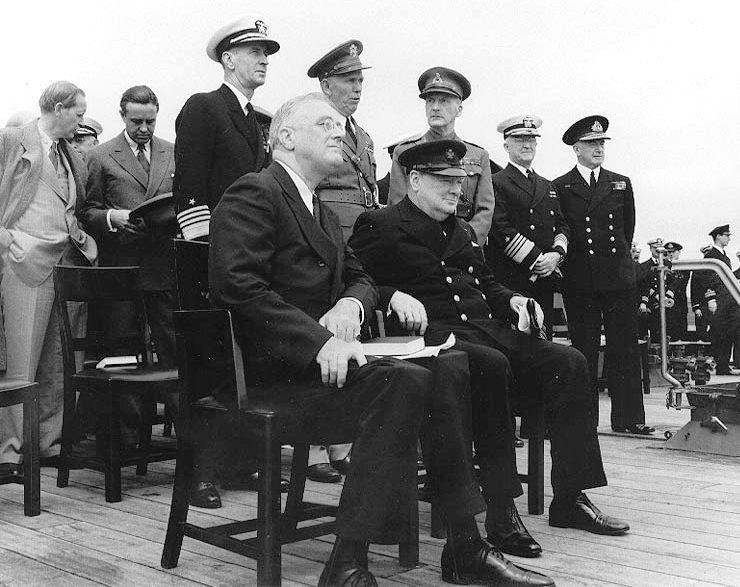
More than a year after FDR’s attempt to pry Canada and the Royal Navy away from a “dying” Britain, he and Churchill met onboard HMS Prince of Wales, in Placentia Bay, Newfoundland, during the Atlantic Charter Conference. President Franklin D. Roosevelt (left) and Prime Minister Winston Churchill are seated in the foreground. Standing directly behind them are Admiral Ernest J. King, USN; General George C. Marshall, U.S. Army; General Sir John Dill, British Army; Admiral Harold R. Stark, USN; and Admiral Sir Dudley Pound, RN. At far left is Harry Hopkins, talking with W. Averell Harriman.
US Naval Historical Center Photograph #: NH 67209 via Wikimedia Commons.
Ironically, the truth is that in 1940, Roosevelt — behind closed doors — behaved worse than Trump.
On the 20th May 1940, after multiple failed pleas for aid, Churchill wrote to Roosevelt that:
“If members of the present administration were finished and others came in to parley amid the ruins, you must not be blind to the fact that the sole remaining bargaining counter with Germany would be the fleet, and if this country was left by the United States to its fate no one would have the right to blame those then responsible if they made the best terms they could for the surviving inhabitants. Excuse me, Mr. President, putting this nightmare bluntly.”
Roosevelt’s refusal for aid was understandable given the political situation in America. As he told Churchill earlier that month, it wasn’t “wise for that suggestion to be made to the Congress at this moment”.
However, what he did after the 20th May telegram wasn’t.
Not bothering to even reply to Churchill’s warnings, Roosevelt instead sought to get Canada to give up on Britain.
As Roosevelt thought that Britain would likely collapse, and Churchill could not be trusted to maintain the struggle, he summoned a delegation for Canada.
The aim was to get Canada to pester Britain to have the Royal Navy sent across the Atlantic, before Britain’s seemingly-inevitable collapse.
Furthermore, to ensure this, the Americans wanted Canada to encourage the other British Dominions to get on board such a plan, and likewise gang up against Britain.
You can see Mackenzie King’s (PM of Canada) disbelief and horror in his diary,
“The United States was seeking to save itself at the expense of Britain. That it was an appeal to the selfishness of the Dominions at the expense of the British Isles. […] I instinctively revolted against such a thought. My reaction was that I would rather die than do aught to save ourselves or any part of this continent at the expense of Britain.”
King telegrammed Churchill on the 30th May that this was the closed-door political situation across the Atlantic.
Bear in mind, Roosevelt was trying to instigate this during the Dunkirk evacuations.
How Churchill didn’t break knowing the one ally he needed in his darkest hour thought he’d fail, I have no idea.
On the 5th June 1940, Churchill wrote back to Mackenzie King,
“We must be careful not to let the Americans view too complacently prospect of a British collapse, out of which they would get the British Fleet and the guardianship of the British Empire, minus Great Britain. […] Although President [Roosevelt] is our best friend, no practical help has been forthcoming from the United States as yet.”
(The first key mover that swung Roosevelt into entrusting Churchill to continue the struggle — and as such aid would not be wasted on Britain — was when Churchill ordered the Royal Navy’s Force H to open fire and destroy the French Fleet at Mers-el-Kébir — after Admiral Gensoul had refused the very reasonable offers from Britain, despite Germany and Italy demanding the transference of the French Fleet as part of the armistices.)
QotD: Twitter-thought and the basic university student
Alas, Twitter is still a thing that exists, so even though I tried it for about five minutes and promptly forgot all about it, my students didn’t … which explains, like nothing else can, their bizarre approach to classwork. For every quiz I gave, no matter how straightforward the question, I’d have at least one barracks lawyer coming to me afterwards, trying to weasel her (always her, mentally if not biologically) way back into some points, with some elaborate rationale why her picking the wrong answer was really my fault, because in class I said “The Russians won the Battle of Stalingrad” and the question on the quiz was “Who lost the Battle of Stalingrad?” and how is she supposed to be expected to recognize that “lost” is the opposite of “won” when it comes to battles and blah blah blah (thanks, Greta!).
Or the other depressingly common thing, which was when that same kid, who went to the fucking mattresses for one point on one quiz — which amounts to something like 0.01% of her final semester grade — just didn’t turn in the term paper. This happened at all academic levels, from community college (where you often lose half a class or more by the end of a semester) all the way up through the SPLACs, which cost something in the neighborhood of $70K a year all in. I never could figure this out — I mean, how can they not know that the term paper is 30% of your final grade, while all the quizzes put together amount to 10%? — but then it hit me: Twitter.
Everything on social media has, of necessity, equal weight, in that whatever’s in your feed at the present time is the only thing that exists. So when Snowflake was in “schoolwork” mode and missed that one question on that one quiz, it was the only thing that mattered in her world. My quiz was at the top of her Twitter feed, so she had to put all her energy into battling me for it. By the end of the semester, though, she was in “sorority” mode, or “getting ready for that kickass ski vacation” mode, or “beefing with that basic bitch Becky” mode, so my term paper barely registered — if she bothered to turn anything in at all, it was copy-pasted straight from wikipedia, because who cares, when Becky is out there on Twitter, h8ing?
Severian, “Also Sprach Froggy”, Founding Questions, 2021-09-30.
March 3, 2025
QotD: Arguments around “spontaneous order” and “divine intervention”
It seems to me that this is a bit like the old “irresistible force versus immovable object” paradox. On the one hand, the universe, life, human life, seem impossibly complex to have happened randomly. On the other hand, the universe is actually very large. Perhaps there are enough monkeys banging away at typewriters to produce not just Shakespeare, but the script of every Seinfeld episode.
Esteban, “Evolution, Economies And Spontaneous Order”, Continental Telegraph, 2020-01-22.


