
Nick Cohen, over in the Guardian, is busy telling us all that we must drink less and that Scotland raising the minimum price of alcohol (hitting poor people’s cheap cider and bargain booze, but not directly affecting craft lagers, appellation d’origine contrôlée wines and artisan gin) is a Good Thing because the industry makes its profits by exploiting addicts who are drinking themselves to death en masse.
It is a truth universally unacknowledged that, like drugs cartels, the drink industry makes most of its money from addicts. It thrives on hooked customers, who put boosting the brewers’ profits before their and their families’ health and happiness. Sixty per cent of alcohol sales – worth £27bn a year in England – are to “increasing risk” drinkers taking more than 21 units of alcohol a week, in the case of men (about 10 pints or two bottles of wine), and “harmful” drinkers taking more than 50… Twenty one units (14 for women) does not sound much in my world of journalism, but it is a sign of people who cannot go a day without a shot of their drug, which is as good a definition of an addiction as any.
Now, there’s a question there about who decided what that “risk” was and how large it was. Cohen gets into the Salvation Army-style temperance-league apocalyptic warnings about the horrors of heavy drinking and warns that by the time you’re knocking back fifty units a week (for men, thirty-five for women) you’re undergoing “full degeneration”.
But is that based on any firm evidence? One interesting study, reassuring to the toper, can be found here, which among other things makes the gentle point that since we either under-report what we consume, or we pour away half of the booze we buy undrunk, planning policy on what we admit to consuming may not be accurate.
Jason Lynch, “How Much Is ‘Too Much’?”, Continental Telegraph, 2018-05-08.
May 31, 2018
QotD: Difficulties in using self-reported data
May 30, 2018
QotD: Microeconomics
… I sincerely believe – believe to the point that I can say that I know – that principles of microeconomics is the most important economics course any student can ever take. Ever. By far. If taught properly, and learned with an open and critical and attentive mind, a principles of microeconomics course will impart to the student more understanding of the operation of economies than will all other economics courses combined – and I include here even well-taught PhD econ courses.
Too many academic economists, in my experience, are bored with microeconomic principles. Such principles are so basic. No genius is required to understand them or to teach them well. Teaching microeconomic principles provides no opportunity to showcase great cleverness or to push out the frontiers of understanding. It is, instead, to repeat timeless verities – and verities the majority of which have been known and understood by wise economists for nearly 250 years, and nearly all of which have been known and understood by wise economists for the past 50 years.
[…]
My goal in teaching Principles of Microeconomics is not to launch my students on a path to earn a doctorate in the subject, or even for them to become econ majors. While I’m always pleased when a student, after taking my class, switches his or her major to economics, I teach the course as if it is the only economics course these students will ever take. (Empirically, this assumption of mine is true.) So unlike many other intro-econ courses, I do absolutely no mathematics; I even draw no cost curves. I define a handful of esoteric terms (such as the “law of diminishing marginal utility”) but never mention many others (such as “perfect competition” or “marginal rates of substitution”) that are typical fare in many other principles-of-microecon courses. I wouldn’t even dream of doing indifference-curve analysis in such a course.
I open the course with some economic history. (“Have you any idea how materially prosperous you are compared to the vast majority of your ancestors?!”) I spend a lot of time on supply and demand. I devote two whole sections to international trade, another to public choice, and one to public goods and taxation. (Each section is two-and-a-half-hours long. And I cover some other topics in addition; I mention these only to give a flavor of my course.)
My goal – by teaching basic, foundational, principles of microeconomics – is to inoculate students against the bulk of the common economic myths that they’ll encounter throughout their lives – myths such as that the great abundance of goods and services available to us denizens of modernity is the result of a process that can be easily mimicked or understood in detail by smart people or planners – that the market value of goods or services can be raised by price floors (such as a legislated minimum wage) or lowered by price ceilings (such as rent control) – that benefits can be created without costs – that government is an institution capable of rising above the realities that ensure that private institutions never perform ‘perfectly’ – that intentions are results – that destruction of property is a source of prosperity – that exchange across political boundaries differs in economically meaningful ways from exchange that takes place within political boundaries – that the only consequences that occur or that matter are those that are easily anticipated and seen.
Don Boudreaux, “Teach the Timeless Verities”, Café Hayek, 2014-08-26.
May 29, 2018
QotD: Gandhi on the Holocaust
I am aware that for many not privileged to have visited the former British Raj, the names Gujarat, Rajasthan, and Deccan are simply words. But other names, such as Germany, Poland, Czechoslovakia, somehow have a harder profile. The term “Jew,” also, has a reasonably hard profile, and I feel all Jews sitting emotionally at the movie Gandhi should be apprised of the advice that the Mahatma offered their coreligionists when faced with the Nazi peril: they should commit collective suicide. If only the Jews of Germany had the good sense to offer their throats willingly to the Nazi butchers’ knives and throw themselves into the sea from cliffs they would arouse world public opinion, Gandhi was convinced, and their moral triumph would be remembered for “ages to come.” If they would only pray for Hitler (as their throats were cut, presumably), they would leave a “rich heritage to mankind.” Although Gandhi had known Jews from his earliest days in South Africa — where his three staunchest white supporters were Jews, every one — he disapproved of how rarely they loved their enemies. And he never repented of his recommendation of collective suicide. Even after the war, when the full extent of the Holocaust was revealed, Gandhi told Louis Fischer, one of his biographers, that the Jews died anyway, didn’t they? They might as well have died significantly.
Richard Grenier, “The Gandhi Nobody Knows”, Commentary, 1983-03-01.
May 28, 2018
QotD: Correcting mistakes in private and public enterprises
… government cannot do just one thing, and some of the repercussions of what it chooses to do will be, as it were, mistakes in the perspective of the public even if the initial action were not. But the public’s dissatisfaction with these adverse outcomes can make itself known only via the politically charged process of complaint to authorities, petition for redress of grievance, lobbying, payoffs to public officials, and all the rest of the endlessly complex apparatus for the operation of the government’s political and bureaucratic setup. One is lucky to get any constructive response at all from the government, whose effective control is apt to be in the hands of entrenched politicians, bureaucrats, and private-sector cronies in the various iron triangles that pervade the state at large. If one does succeed in getting a constructive response, it is likely to come forth only after years of expensive and time-consuming delays.
This lack of an effective feedback-incentive mechanism is among the greatest flaws of all government activities. Markets, in contrast, are certainly not perfect relative to the model criteria economists have devised to evaluate them, but they are undoubtedly superior in the operation of their feedback information and response to mistakes. To remove an activity from the market and place in under government control is to ensure that henceforth mistakes, whether they arise from bad judgement, corruption, or ignorance, will not elicit a proper or timely response. In the government realm, mistakes and the slow, counter-productive responses, like doomed lovers, sink together slowly in the quicksand of bad actions being made ever worse by ill-fated reactions.
Robert Higgs, “Dealing with Mistakes: Government Action versus Private Action”, The Beacon, 2016-08-17.
May 27, 2018
QotD: Epicurus on the ethics of pleasure
Epicurus begins with the question asked by Socrates at the end of the fifth century — what is the good life? His answer is that the good lies not in virtue or justice or wisdom — though these are not to be ignored — but in happiness.
“Pleasure” he writes, “is our first and kindred good. It is the starting point of every choice and every aversion, and to it we come back, inasmuch as we make feeling the rule by which to judge of every good thing.”
Now we have more than enough of Epicurus to know that he is not arguing for what are called the self-indulgent pleasures — of eating and drinking and sex and the like. Aristippus of Cyrene (c435-366 BC), we are told, had already argued for these. He also claimed that happiness was the highest good, but went on to claim that happiness lay in the pursuit of pleasure regardless of convention or the feelings of others or of the future.
This interpretation was attached to Epicurus in his own lifetime, and the attachment has been maintained down to the present — so that the words “Epicure” and “Epicurean” have the meaning of self-indulgent luxury.
What Epicurus plainly means by happiness is the absence of pain. We are driven to act by a feeling of discontent. We seek food because we are hungry. We seek warmth because we are cold. We seek medicine because we are sick. Once we have acted correctly and removed the cause of discontent, we are happy.
Turning to his own words, he says:
When we say… that pleasure is the end and aim, we do not mean the pleasures of the prodigal or the pleasures of sensuality, as we are understood to do by some through ignorance, prejudice or wilful misrepresentation. By pleasure we mean the absence of pain in the body and of trouble in the soul. It is not by an unbroken succession of drinking bouts and of revelry, not by sexual lust, nor the enjoyment of fish and other delicacies of a luxurious table, which produce a pleasant life; it is sober reasoning, searching out the grounds of every choice and avoidance, and banishing those beliefs through which the greatest tumults take possession of the soul. Of this the beginning and the greatest good is wisdom. Therefore wisdom is a more precious thing that even philosophy; from it springs all the other virtues, for it teaches that we cannot live pleasantly without living wisely, honourably and justly; nor live wisely, honourably and justly without living pleasantly.
In this scheme, therefore, happiness is to be defined as peace of mind, or ataraxia. This pursuit of happiness does involve bodily pleasure, but such pleasure is a means to the greater end of ataraxia. “No pleasure” he says, “is a bad thing in itself, but the things which produce certain pleasures entail disturbances many times greater than the pleasures themselves.”
His ethics of pleasure can be summarised as:
The pleasure which produces no pain is to be embraced. The pain which produces no pleasure is to be avoided. The pleasure is to be avoided which prevents a greater pleasure, or produces a greater pain. The pain is to be endured which averts a greater pain, or secures a greater pleasure.
And so the happy man for Epicurus is one who lives simply within his means, who seeks only those pleasures which contribute to his long term peace of mind.
And while hedonism is ultimately a doctrine of selfishness, what Epicurus had in mind was not a life spent in the pursuit of solitary happiness. He says: “Of the means which wisdom acquires to ensure happiness throughout the whole of life, by far the most important is friendship.”
It may be that we seek friendship for selfish reasons. But friendship is to be persistently sought and maintained throughout life. Epicurus himself had an immense capacity for friendship.
Sean Gabb, “Epicurus: Father of the Enlightenment”, speaking to the 6/20 Club in London, 2007-09-06.
May 26, 2018
QotD: Child labour
In response to something I’d written about labor unions, a critic started badgering me about child labor.
What a terrible feature of capitalism, he said.
No, it was a terrible feature of all of world history, I replied.
Thank goodness for people who passed laws against it, he said.
No, I said, thank goodness for capitalism, which created enough wealth that families didn’t have to send their kids to work anymore just to avoid starvation.
Then I was asked: do I really believe my kids would be better off in a factory (than in school, presumably)?
As if the choice we’re talking about is between factory work and school! The actual choice faced by these families is between factory work and starvation.
The British charity Oxfam found that in Bangladesh, where the government caved in to Western demands to suppress child labor, the children — you’ll never guess — didn’t wind up in school! How about that.
Where did they wind up? In prostitution, or dead.
Nice going, geniuses.
Yes, there were laws passed against child labor, but those came when child labor was already practically a thing of the past.
No law is going to keep families from avoiding starvation — and even the left-wing International Labor Organization admits that this is the real reason for child labor. Only capital accumulation makes it possible to end child labor humanely.
My opponent probably isn’t a bad guy. He’s just absorbed the conventional wisdom on pretty much everything.
It’s very easy to blame “capitalism” for child labor. Where is the average person going to hear any other explanation?
Tom Woods, “SJWs Really Mean Well, But Accidentally Starve Some Children”, The Tom Woods Show, 2016-09-13.
May 25, 2018
QotD: Muggeridge’s Law
While Malcolm Muggeridge was the editor of Punch, it was announced that Khrushchev and Bulganin were coming to England. Muggeridge hit upon the idea of a mock itinerary, a lineup of the most ludicrous places the two paunchy pear-shaped little Soviet leaders could possibly be paraded through during the solemn process of a state visit. Shortly before press time, half the feature had to be scrapped. It coincided exactly with the official itinerary, just released, prompting Muggeridge to observe: We live in an age in which it is no longer possible to be funny. There is nothing you can imagine, no matter how ludicrous, that will not promptly be enacted before your very eyes, probably by someone well known.
Tom Wolfe, “Stalking the Billion-Footed Beast: A literary manifesto for the new social novel”, Harpers, 1989-11.
May 24, 2018
QotD: Hunter S. Thompson on the importance of breakfast
It is not going to be easy for those poor bastards out in San Francisco who have been waiting all day in a condition of extreme fear and anxiety for my long and finely reasoned analysis of “The Meaning of Jimmy Carter” to come roaring out of my faithful mojo wire and across 2,000 miles of telephone line to understand why I am sitting here in a Texas motel full of hookers and writing at length on The Meaning of Breakfast……. But like almost everything else worth understanding, the explanation for this is deceptively quick and basic.
After more than ten years of trying to deal with politics and politicians in a professional manner, I have finally come to the harsh understanding that there is no way at all – not even for a doctor of chemotherapy with total access to the whole spectrum of legal and illegal drugs, the physical constitution of a mule shark and a brain as rare and sharp and original as the Sloat diamond – to function as a political journalist without abandoning the whole concept of a decent breakfast. I have worked like 12 bastards for more than a decade to be able to have it both ways, but the conflict is too basic and too deeply rooted in the nature of both politics and breakfast to ever be reconciled. It is one of those very few Great Forks in The Road of Life that cannot be avoided: like a Jesuit priest who is also a practicing nudist with a $200-a-day smack habit wanting to be the first Naked Pope (or Pope Naked the First, if we want to use the language of the church)….… Or a vegetarian pacifist with a .44 magnum fetish who wants to run for president without giving up his membership in the National Rifle Association or his New York City pistol permit that allows him to wear twin six-guns on Meet the Press, Face the Nation and all of his press conferences.
There are some combinations that nobody can handle: shooting bats on the wing with a double-barreled .410 and a head full of jimson weed is one of them, and another is the idea that it is possible for a freelance writer with at least four close friends named Jones to cover a hopelessly scrambled presidential campaign better than any six-man team of career political journalists on the New York Times or the Washington Post and still eat a three-hour breakfast in the sun every morning.
Hunter S. Thompson, “Fear and Loathing on the Campaign Trail ’76: Third-rate romance, low-rent rendezvous — hanging with Ted Kennedy, Jimmy Carter, and a bottle of Wild Turkey”, Rolling Stone, 1976-06-03.
May 23, 2018
QotD: The threaten, bribe, bamboozle hypothesis
Ruling elites have three basic ways to keep the subject population under their thumb: threaten, bribe, and bamboozle. Everything they do is a variant of one of these basic actions. So, if the lush, misleading overgrowth were cut away, all government activities could be undertaken by only three departments: the Department of Cops and Soldiers; the Department of Santa Claus; and the Department of Delusion. However, if such a drastic, visible simplification were undertaken, the efficacy of the bamboozlement would be greatly diminished. It would be a public disservice to load more truth on the public than it can stand.
Much of what the government does ostensibly to carry out some valuable purpose (e.g., assisting the deserving poor, the sick, the struggling millionaire farmers, the domestic sellers facing allegedly unfair import competition, the sober college students, the elderly, people suffering ethnic or racial discrimination; protecting the nation against menacing foreigners and aliens from outer space; containing disastrous global warming; promoting a cleaner, healthier environment; undertaking or subsidizing scientific and technological research) amounts to specific forms of bribery, to buying people’s loyalties by giving them a portion of the loot the government acquires by means of its threats of enforcement and its bamboozlement in regard to the subjects’ “civic duty” to cough up taxes as the government stipulates. The state’s organizational complexity and its associated pragmatic and ideological veils prevent the general public from seeing what is really going on and then, perhaps, opposing it or becoming more recalcitrant in complying with government edicts and demands for tribute, thereby throwing sand in the state’s machinery of oppression and plunder.
As an exercise, you might test the TBB (threaten, bribe, bamboozle) hypothesis. See if you can find any significant government activity that does not fit under one or more of these three rubrics.
Robert Higgs, “The Three Basic Means by Which Ruling Elites Maintain Their Control”, The Beacon, 2016-09-07.
May 22, 2018
QotD: Capitalism is the most feminist economic system ever
We really do need to be pointing out that the Good Old Days are now. Both technological advance and productivity growth have been driven by that combination of capitalism and markets. Capitalism, in its lust for profits, leading to the invention. Markets and the ability to copy what works being what creates the general uplift in standards by the spreading and wide use of those inventions.
The net effect of this has been, well, it’s been to make women’s lives vastly better. Starting with the point that many women actually have lives as a result. Childbirth has moved from being the leading cause of female death* to a mild risk which kills very few – each one a tragedy which is why we’re so happy that we have reduced that risk. We’ve automated all the heavy lifting in society meaning that women can indeed, with their generally lighter musculature, compete in near all areas of work. We’ve done more automation of household drudgery than we have of anything else too, freeing the distaff side from that chain upon their ambitions.
We’ve even freed all from the child bearing consequences of bonking – much to the great pleasure of man and woman alike.
Women today are the most privileged, richest, group of women who have ever stumbled across the surface of this planet. And in comparison to the men in their society they’re the most equal too. All of which leads to an interesting question. Just why are they whining so much?
*Possibly an exaggeration but not much of one. Certainly not about the mid 19th century before Semmelweiss.
Tim Worstall, “Capitalism Is The Most Feminist Economic System Ever”, Continental Telegraph, 2018-04-30.
May 21, 2018
QotD: The key difference between private and public enterprise is effective feedback
State bureaucracies are notoriously inept in reacting constructively to their own mistakes. For example, they continuously seek to increase their budgets, staffs, and authority, even when their projects have proven counter-productive or disastrous. It’s almost as if they promote their institutional objectives best by fouling up their programs, then coming back to their funding sources to explain that they cannot succeed unless they receive more resources to do so. Thus do public agencies pour money and effort down the rat hole for years on end, wasting the public’s money every step of the way. The feedback system in this case is obviously perverse so far as serving the public interest is concerned.
Such perversity is practically guaranteed in government operations because government operates outside the realm of private property rights, the price system, and the profit-and-loss accounting that constitute a feedback system in the market realm. In the market, money-losing projects do not persist indefinitely. Their owners and managers eventually decide against throwing good money after bad and close the unprofitable operations. Owners who refuse to read and respond correctly to the clear message transmitted by profits and losses suffer reductions of their own wealth, which serves as a powerful incentive to act correctly and to rectify the mistakes they have made before even more wealth goes down the drain.
Robert Higgs, “Dealing with Mistakes: Government Action versus Private Action”, The Beacon, 2016-08-17.
May 20, 2018
QotD: Robert Conquest’s Laws of Politics
1. Everyone is conservative about what he knows best.
2. Any organization not explicitly right-wing sooner or later becomes left-wing.
3. The simplest way to explain the behavior of any bureaucratic organization is to assume that it is controlled by a cabal of its enemies.
May 19, 2018
QotD: Operation “keeping up appearances”
It’s hard to blame the Army, and even if it wasn’t not all of even most of the blame can be laid at the Army’s doorstep.
Government, both Conservative and Liberal kept repeating Pierre Trudeau’s lie that “we’re here and we’re doing our full, fair and agreed upon share.” Kudos to Prime Minister Mulroney who, when faced with irrefutable and embarrassingly public evidence that we simply could not deploy and sustain two small brigades in war, cancelled the North Norway brigade commitment and pulled the Germany-based brigade back to Canada.
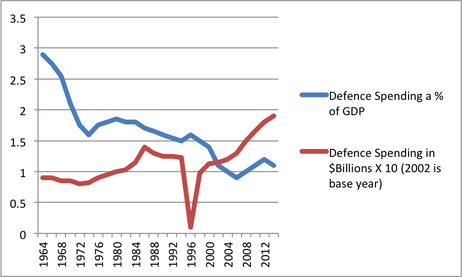
This graph, which is only rough, being drawn from three different sources and “rounded” for ease of plotting, shows, essentially, what happened between 1964 (Prime Minister Pearson) and 2014 Prime Minister Harper). As you can see defence spending as a percentage of Gross Domestic Product ~ a fair measure of our national, political commitment to our defence of Canada and of our allies and neighbours, has declined steadily even though, generally, with one “blip” in the Chrétien era, when he was trying to wrestle with the deficit, the actual dollars spent on defence have grown in number. What it really shows is that our GDP grew a lot in the past 50 years ~ it’s now almost $2.5 Trillion (that’s $2,500,000,000,000.00) ~ but our political willingness (or appreciation of the necessity) to spend 2% of GDP, as we did in about 1970s and as we have, sort of, agreed (in NATO) do aspire to do again, has not kept pace with our increasing prosperity. In fact, while the dollars spend on defence have doubled, in 50 years, the % of GDP spent of defence has fallen to ⅓ of its 1964 level. But ministers’ desires to “talk good fight” remain at historically high levels and even as resources shrink admirals and generals are told to “keep up appearances”. That, keeping up appearances, was what the admirals and generals wanted to do … no one really wanted to go into various international military fora and say “as our resources decline we’re going to have to do less,” instead they went out and said “we’re learning new ways to do more with less,” which is, of course, utter nonsense. Meanwhile more and more quite senior officers came back from tours of duty in the USA and brought with them some very American ideas about organization and management. Now American organizational models might work very well for armies with 1,000,000+ soldiers, or even for those with 495,000, like South Korea’s perhaps, even for those with 100,000+ like the French army, but they are not always or even often suitable for an army with 20,000± regulars and 25,000± reservists. The new organizations might make us look bigger, on paper, but they hide the fact the army has been hollowed out since 1970.
The Army of 1964, the one that consumed its fair share of the 3% of GDP that Canada spent on defence had four brigades, the largest had about 6,500 soldiers in it, the smaller ones had about 5,000 each. That was more men and women in combat units than we have in the entire, top heavy, Canadian Army today in total. But we still have three of the four brigades, we have nine instead of 13 battalions of infantry and three instead of four regiments of artillery … but how? Simple: it’s the Potemkin village, again, battalions that should have 950 soldiers have 500 … if their lucky. In fact there are no combat ready infantry battalions. Any battalion being readied for operations must be reinforced from other infantry battalions … we have nine battalion commanders and nine regimental sergeants major and so on but we only have enough soldiers in rifle platoons to staff five battalions … maybe only four if the battalions are properly equipped with mortars and heavy assault weapons. Why? Because no one, not ministers, not senior civil servants and not the generals want to “cut his coat according to his cloth.”
Ted Campbell, “A Canadian Potemkin Village”, Ted Campbell’s Point of View, 2016-09-15.
May 18, 2018
QotD: The purpose of propaganda
No one understood better than Stalin that the true object of propaganda is neither to convince nor even to persuade, but to produce a uniform pattern of public utterance in which the first trace of unorthodox thought immediately reveals itself as a jarring dissonance.
Leonard Schapiro, The Communist Party of the Soviet Union, 1960.


