Quotulatiousness

July 26, 2024

Getting meta on “cancelling the cancellers”

Filed under: Media, Politics, USA — Tags: , , , , , — Nicholas @ 05:00

Nearly a week ago, I posted an excerpt from John Carter’s essay at Postcards From Barsoom called “Right Wing Cancel Squads“. As sometimes happens, this particular essay caught the attention of a lot of folks online and triggered much discussion pro and con. John did his best to summarize and respond here, and (as I post links to Scott Alexander’s Astral Codex Ten now and again), I thought John’s response to Scott’s criticism was worth highlighting:

Somehow, Scott Alexander took interest in my essay, and addressed it at length. I’m not deeply familiar with Alexander, aside from a vague awareness that he’s a big deal in the rationalist community, to say nothing of being a much bigger deal than I am, and that he’s dealt with lying journalists and hysterical wokoids enough himself to have a healthy distaste for them. Alexander is characteristically calm and thorough, starting with a selection of screenshotted posts on Notes from various writers and commenters who take the pro-fight-the-enemy side, before presenting an extensive set of excerpts from my own essay.

Scott sidesteps the ethical question, to focus instead on the practical considerations, on the grounds of which he comes down (as expected, given his ideological niche) on the don’t-cancel side. He enumerates a series of objections, which can be approximately summarized as1:

    1) cancellation will not, in fact, teach anyone anything – after all, just look at how eager the right is to cancel;

    2) this has been going on forever, e.g. the Red Scare, so one more whirl ‘bout the merry-go-round isn’t likely to stop the wheel a turnin’;

    3) If you act like the woke, you are the woke;

    4) Most cancellations have been of liberals, by liberals, so if the right starts doing this it is likely to turn on itself;

    5) cancellation destroys competence, because avoiding cancellation takes on a higher salience to people than doing their damn jobs;

    6) embracing cancel culture has ruined the left’s name, which is why it is struggling despite holding all of the institutional power;

    7) going mad with power before you actually have power is probably stupid;

And finally

    8) there are better options.

The better options Alexander describes are mostly at the policy and tech level, such as better moderation tools that take the personal politics of platform moderators out of the equation, or dismantling those aspects of the regulatory state, such as the sillier and more self-contradictory elements of Civil Rights law, which nourish cancel culture in the first place. Alexander’s policy proposals are all great, and I completely agree that the most effective long-term solution is to tear the legal basis of cancel culture up by the roots, set those roots on fire, and salt the earth in which they were planted.

Regarding power, and the simple fact that the right does not have it in any formal sense, Charles Haywood and Bennett’s Phylactery made the same very cogent point. I don’t think any sane person could disagree.

I’m not convinced by some of Alexander’s other points. For instance, the right is an extremely contentious place, with the modal rightist being pretty low in agreeableness, which probably makes it hard for circular firing squads to be terribly effective. That isn’t to say that rightists don’t have strong beliefs – there are fanatics all over the place – but those beliefs are so contradictory between the various factions that the ideology of the right is infamously difficult to describe. Just look at the perennial holy war between Christians and pagans/Nietzscheans/vitalists.

As to the Red Scare, it’s probably worth pointing out that McCarthy was actually right: there really were communists trying to infiltrate the Western social order; tragically for us, the communists succeeded, which is a large part of the reason why we are where we are now.

As to the unpopularity of the left, I do not think this is only because of their po-faced censoriousness, although there is no question that that contributes. It probably also has something to do with their vicious racial and sexual hatred, their contemptuous hostility towards Western civilization, and their propensity to emotionally abuse children to the point that those children demand that they be allowed to mutilate their genitalia, amongst a great number of other horrors.

Finally, as to Alexander’s first point, that cancellation does not teach anyone anything. Au contraire. Look around at how society has changed in just the last decade. Sure, if you’re an autistic rationalist, a contrarian ideologue, or a Bohemian free spirit, cancel culture has only made you hate the left more. But this is a fairly small fraction of the population. What about the normies? In a remarkably short period of time, they went from opposing gay marriage, to supporting it. Why? Because examples were made of a few people who opposed it, and the rest got into line. Most people are basically NPCs: they don’t follow a praxis emerging from carefully thought out philosophical systems, but simply go along with whatever they perceive the prevailing morality to be. They are not rational, nor are they principled. They simply respond to incentives, which is to say, to rewards and to punishments. Put a few heads on pikes to demarcate new social boundaries, and the normies will in general respect them.2

There are limits to the ability to enact social change via incentive structure manipulation, because if the social boundaries you establish don’t map to the eternal verities of human nature, the resulting social order will generate a lot of friction and consequently destabilize … as our society observably is. However, the social boundaries the right intends to enforce do, in fact, map to human nature. The left has been figuratively beheading the people who object to the surgical genital mutilation and chemical sterilization of children; the right intends to metaphorically behead the people who have been advocating and carrying out that child abuse in the first place. There’s a profound moral asymmetry there, but I think there’s also a practical asymmetry, because the right isn’t demanding that everyone publicly agree sadomasochistic psychosis is healthy.


    1. I skipped one in the middle because it looked redundant.

    2. [NR] Sarah Hoyt is one of the folks most likely to describe herself as being on Team Heads-On-Pikes, and I suspect she has a non-trivial following who share in that inclination.


Vance, the harbinger

Filed under: Media, Politics, USA — Tags: , , , , — Nicholas @ 04:00

In City Journal, Christopher Rufo explains why Trump selected a VP candidate that goes against the “usual” ticket balance criteria for a presidential team:

U.S. Senator J.D. Vance speaking with attendees at The People’s Convention at Huntington Place in Detroit, Michigan, 16 June, 2024.
Detail of a photo by Gage Skidmore via Wikimedia Commons.

The Vance selection is not a gambit to secure a particular demographic or region — white men are Trump’s base; Ohio is a safe red state — but an effort to cultivate an emerging counter-elite that could make the second Trump administration substantially more effective than the first.

This story is built into J. D. Vance’s biographical arc. He was the all-American kid who rose from humble beginnings to make his way in the world: the Marines; Yale Law; venture capital; a best-selling book. He learned the language of the prestige institutions, cultivated powerful patrons, and quickly climbed the ladder in academia, finance, and business. He had made it.

Then, his story takes a turn. Having entered the ranks of America’s elite, Vance became disillusioned and disenchanted with it, correctly identifying it as a force of hypocrisy and corruption. He defected — first, by parting ways with the respectable conservatism of the Beltway, and then by embracing Donald Trump.

Some have criticized this as a cynical move, but my sense is that it is the opposite. A cynic would have continued to build an elite résumé; Vance sacrificed his respectability within a certain stratum, assumed considerable risk by moving toward Trump, and, in my view, was genuinely convinced that the establishment, both Left and Right, had exhausted itself and had to be opposed.

Now, not only has Vance been selected as a vice-presidential nominee; more significantly, he has charted the path for an emerging new conservative counter-elite.

The political balance is beginning to shift. A significant cohort of power brokers in Silicon Valley and on Wall Street have publicly moved toward Trump in this election cycle. Some of the names are familiar: Elon Musk, Marc Andreessen, David Sacks, Bill Ackman. But hundreds of other influential figures are assembling behind the scenes to support Trump’s campaign. Even some of Trump’s former adversaries, such as Mark Zuckerberg, have expressed cautious admiration for the former president.

Vance can now position himself at the center of this counter-elite. He has been in the boardrooms, made the pitches, and built the relationships. He speaks their language. They can do business together.

This could represent a sea-change. During the first Trump administration, especially following the death of George Floyd, institutional elites could neither express admiration for nor devote public support to Trump without paying a significant political price. Now the market has shifted, with a dissident elite moving along a similar path as Vance.

Latest Liberal ad totally DESTROYS Pierre Poilievre and the Conservatives

Filed under: Cancon, Media, Politics — Tags: , , , — Nicholas @ 03:00

If you’re new here, you may not recognize my headline as being sarcastic. Here’s Chris Selley‘s attempt to figure out what the Liberal brain trust is up to with their latest anti-Tory ad:

“The CEO of Elections Canada has indicated his opposition to it, and let me just say I’m at peace with that.”

These words, spoken by Pierre Poilievre a decade ago, are part of an absolutely bizarre 46-second video the Liberal Party of Canada released in recent days trying to convince us — a very novel approach — that the Conservative leader is too wacky and full of dangerous ideas to vote for.

Read that sentence again. It’s supposed to be a scare quote. Are you scared? Or, more likely, do you not know what the hell he’s talking about? Removed from its context it’s not just uncontroversial; it barely even exists. It’s like someone negotiating the return date on their dry cleaning, or asking for no mayonnaise on their Whopper.

There’s another quote like that in the same 46-second video: “We’re Conservatives, so we don’t believe in that”.

Believe in what? No idea. Keynesian economics? The curse of the Oak Island treasure? Could be anything.

The notion that communications is the Liberals’ “problem” is as laughable as ever, but good grief are they ever terrible at communicating.

Usually politicians take other politicians’ quotes out of context to make them look bad. Here the Liberals have done … I really have no idea what. It’s like they’re so hopelessly ensconced in their echo chamber that they can’t tell which echoes have even escaped the chamber into the real world … if the real world even still exists.

Those intimately familiar with Poilievre’s parliamentary record (which is what, maybe 90 people in the world?) might surmise, correctly, that in the first instance he was talking in his role as minister of state for democratic reform in the Harper government about Bill C-23. That was the 2014 legislation that, most controversially, toughened voter-ID requirements: Your voter-information card, delivered by mail, would no longer be sufficient proof of your identity to cast your ballot. You wouldn’t be able to “vouch” for another voter.

This was unnecessary, I felt at the time, and I might still, though the prospect of electoral fraud doesn’t make Liberal eyes roll quite as theatrically as it used to. But it seems clear the serious foreign interference in play is considerably smarter and more insidious than just sending some people to vote without proof of citizenship (which few of us offer up to vote as it stands).

Anyway, Poilievre was telling a Senate committee, on April 8, 2014, that he understood then chief electoral officer Marc Mayrand disagreed with the bill, and that he disagreed with Mayrand, and that he was “at peace with it.”

I do hope you were sitting down for that bombshell.

July 25, 2024

QotD: Why devolution has not worked in the United Kingdom

Reading this Samizdata quote of the day got me thinking about why devolution in the UK has been a general disappointment and source of endless annoyance.

I remember when arguments were originally made for devolution, commentators would claim that devolution would work in the same way that the federal structure of the US works, or, for that matter, how the cantonal system works in Switzerland. By which they meant that if a state such as Zug in Switzerland or Wisconsin in the US tried a specific policy (encouraging cryptos, or enacting Workfare, to take two actual examples), that the perceived success or failure of these policies would be studied by other cantons and states. Hence the idea that devolution allows a sort of “laboratory experiment” of policy to take place. It creates a virtuous kind of competition. That’s the theory.

What seems to have happened is that since devolution in the UK, Scotland, Wales and to some extent, Northern Ireland, have competed with England in who can be the most statist, authoritarian and in general, be the biggest set of fools. Whether it is 20 mph speed limits spreading to many places and harsh lockdowns (Wales) or minimum pricing on booze and “snitching” on your own family for views about gender (Scotland), the Celtic fringe appears to be more interested in being more oppressive, rather than less. I cannot think of a single issue in which the devolved governments of the UK have been more liberal, and more respectful, of liberty under the rule of law. (Feel free to suggest where I am mistaken.)

One possible problem is that because the UK’s overall government holds considerable budgetary power, the devolved bits of the UK don’t face the consequences of feckless policy to the extent necessary to improve behaviour.

Even so, I don’t entirely know why the Scots and Welsh have taken this turn and I resist the temptation to engage in armchair culture guessing about why they tend to be more collectivist at present. It was not always thus. Wales has been a bastion of a kind of liberalism, fused to a certain degree with non-conformity in religion, and Scotland had both the non-conformist thing, and the whole “enlightment” (Smith, Hume, Ferguson, etc) element. At some point, however, that appears to have stopped. Wales became a hotbed of socialism in the 20th century, in part due to the rise of organised labour in heavy industry, and then the whole folklore – much of it sentimental bullshit – about the great achievements in healthcare of Nye Bevan. Scotland had its version of this, plus the resentments about Mrs Thatcher and the decline of Scotland as a manufacturing power.

[…]

Maybe the “test lab” force of devolution will play a part in demonstrating that, as and when we get a Labour government for the whole of the UK, it will be a shitshow on a scale to put what has happened in the Celtic parts of the UK in the shade.

Johnathan Pearce, “Why has devolution not worked in a liberal direction?”, Samizdata, 2024-04-23.

July 24, 2024

Investigate one assassination attempt, reveal the truth about two earlier assassinations?

Filed under: Government, History, Media, Politics, USA — Tags: , , , — Nicholas @ 03:00

I have to admit that I’m skeptical about this, as conspiracies tend to unravel the larger they get (hence the old joke about three being able to keep a secret, if two of them are dead), and the tradition of deathbed confessions has had six decades to reveal itself. However, Benjamin Dichter thinks that a full, honest investigation into the attempt on Donald Trump’s life in Butler, PA would also yield historical dividends on the assassinations of JFK and RFK in the 1960s:

On July 13, 2024, both tragedy and an iconic photograph in American political history emerged from the attempted assassination of the 45th president. Even the harshest critics of Donald J. Trump among the legacy media were forced to acknowledge the moment, which many believe has cemented President Trump as an American icon. This failed assassination has become one of the most pivotal moments in American history, akin to tragedies such as 9/11, Pearl Harbor, and the attempted assassination of Reagan. It is rapidly emerging as a unifying moment for many Americans, signaling that the media’s rhetoric and repeated attempts to label Trump as a dictator, a neo-Nazi, and other unsubstantiated vitriolic claims have gone too far.

Donald Trump, surrounded by Secret Service agents, raises his fist after an attempt on his life during a campaign speech in Butler, PA on 13 July, 2024. One spectator was killed and two others were reported to be in critical condition. The shooter was killed by Pennsylvania State Troopers, according to reports in the succeeding hours.

As a Canadian who has spent much of my life traveling to the US, I have always sensed an underlying, unresolved collective emotional trauma that lingers like morning fog. This trauma stems from the assassinations of President John F. Kennedy and his brother Robert F. Kennedy — both murders believed by the majority of Americans to remain unsolved. More on that in a bit.

A friend of mine, working with the Department of Defense in the domain of security readiness for the US government, has told me the level of incompetence and fumbling of security obligations during Trump’s speech in Butler, PA, was inconceivable. He is not one to be hyperbolic, and we are both believers in Hanlon’s Razor. However, after his long career in the military and then at the Department of Defense, where he learned there is no shortage of incompetence due to government bureaucracy, he insists that the most basic protocols were violated in this case.

How is it possible that anyone could get within 125 yards of a former President and current candidate with a rifle? Not just a small pistol hidden in a pocket, but a large AR-15 platform rifle. “The idea that this could happen uncoordinated is absurd” he said. Even the legacy media is unable to spin their usual ridiculous deflections, which often appear like a frenzy of spawning sharks whenever President Trump is in their midst.

The gravity of this situation has changed everything and heralds a dawn of opportunity for America. For Trump, it is a chance to show the world how the gears of the machine turn. How things really work behind the scene. He is presented with a massive opportunity to seek retribution on behalf of the American people, who are still grappling with unresolved issues from past traumas.

Unlike the tragic assassinations of JFK and Robert F. Kennedy, Trump survived and will likely return to office. Also caught in the chaos were innocent bystanders, notably Corey Comperatore, who sacrificed himself by shielding his family from gunfire, along with two other victims whose injuries were not life-threatening. The innocent victims and their families who will vote in November, make this a situation that hits home with many Americans regardless of party affiliation.

July 23, 2024

The next phase of the campaign to replace “Orwellian” with “Trudeaupian”

On the Fraser Institute blog, Jake Fuss and Alex Whalen outline the Trudeau government’s latest attempt to drive the word “Orwellian” out of common usage by making “Trudeaupian” the more authoritarian descriptor:

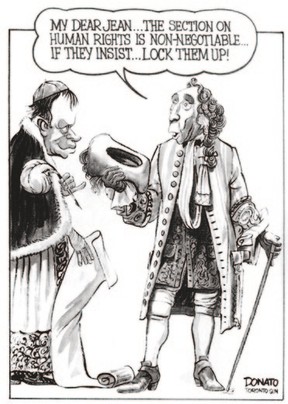
A Toronto Sun editorial cartoon by Andy Donato during Pierre Trudeau’s efforts to pass the Canadian Charter of Rights and Freedoms. You can certainly see where Justin Trudeau learned his approach to human rights.

This year marks the 75th anniversary of George Orwell’s classic novel 1984 (and it’s been 40 years since the actual year 1984). In the novel, Orwell explains the dangers of totalitarianism by exploring what happens when government exercises extreme levels of control over citizens including censoring and controlling language. While Canada is a relatively free country in 2024, there are aspects of Orwell’s world reflected in government policy today.

The Human Freedom Index, published annually by the Fraser Institute and Cato Institute, defines freedom as a social concept that recognizes the dignity of individuals by the absence of coercive constraint. In a free society, citizens are free to do, say or think almost anything they want, provided it does not infringe on the right of others to do the same.

Canada currently fares relatively well compared to other countries on the Human Freedom Index, placing 13th out of 165 countries. However, our score has dropped six spots on the index since 2008 when Canada recorded its highest ever rank.

This is not surprising given the Trudeau government’s recent efforts to control and manage the free exchange of ideas. The recent Online Streaming Act imposes various content rules on major streaming services such as Netflix, and requirements to extract funds to be redirected toward favoured groups. The Act seemingly seeks to bring the entire Internet under the regulation of a government body.

In another piece of recent legislation, the Online News Act, the government attempted to force certain social media platforms to pay other legacy news outlets for carrying content. In response, the social media platforms chose simply not to allow content from those news providers on their platforms, resulting in a dramatic reduction of Canadians’ access to news.

Now, a new piece of federal legislation — Bill C-63, the Online Harms Act — seeks to control language and grant government power to punish citizens for what the government deems to be unfavourable speech.

The government has sold Bill C-63 as a way to promote the online safety of Canadians, reduce harms, and ensure the operators of social media services are held accountable. In reality, however, the bill is Orwell’s Big Brother concept brought to life, where government controls information and limits free exchange. The legislation seeks to punish citizens not just for what the governments deems as “hate speech” but also grants the state power to bring Canadians before tribunals on suspicion that they might say something hateful in the future. Not surprisingly, many have raised concerns about the constitutionality of the Bill, which will surely be tested in court.

Claim – “Everybody wants Gaza’s gas”

Filed under: Economics, Media, Middle East, Politics, Quotations, Russia, USA — Tags: , , , , — Nicholas @ 04:00

Tim Worstall explains why the popular idea that it’s demand for the natural gas reserves that sit under Palestine that is driving much of the situation in the Middle East is utter codswallop:

“Oil Platform in the Santa Barbara Channel, California” by Ken Lund is licensed under CC BY-SA 2.0 .

So we’ve a big thing about how all this fighting in Gaza is really about fossil fuels. @JamesMelville seems to think it’s true:

    “Everybody wants Gaza’s gas.”

    Oil and gas reserves – that’s the real proxy war in the Middle East.

    This video provides a really succinct summary of the situation.

This “really succinct” summary includes the idea that the invasion of Iraq was all about access to that country’s oil. Which is very silly indeed. Before the war people paid Iraq for the oil. During the war people paid Iraq for the oil. After the war people are paying Iraq for the oil. The war hasn’t changed Iraq’s oil price — the global oil price has changed it, but not the war — and so the effect of the war upon access to Iraq’s oil has been, well, it’s been zero.

No, it’s not possible to then go off and say that Iraq wouldn’t sell to Americans and that’s why or anything like that. The US didn’t buy much Middle East oil anyway — mainly West African instead. But more than that, this is idiocy about how commodity markets work.

This is something we can test with a more recent example. So, there are sanctions on Russian oil these days over Ukraine. Western Europe, the US, doesn’t buy Russian oil. Russia is still exporting about what it used to. Because it’s a commodity, oil is.

What’s happening is that the Russian oil that used to come to Europe now goes to — say — India. And the Far East, or Middle East, whatever, oil that used to go to India now comes to Europe (the US is now a net exporter itself). Because that’s what happens with commodities. The very name, commodity, means they are substitutable. So, if one particular source cannot sell to one particular user then there’s a bit of a reshuffle. The same oil gets produced, the same oil gets consumed, it’s just the consumption has been moved around a bit and is now by different people. The net effect of sanctions on Russian oil has been, more or less, to increase the profits of those who run oil tankers. Ho Hum.

We’re also treated to the revelation that the US wants everyone to use liquefied natural gas because the US is the big exporter of LNG (well, it’s one). Therefore the US insists that Israel must develop the LNG fields off Gaza. Which is insane. If you’re an exporter you don’t want to start insisting on the start up of your own competition. The US demanding that the LNG not be produced at all would make logical sense but that’s not how conspirazoid ignorance works, is it? It has to be both a conspiracy and also a ludicrous one.

And a third claim. That this natural gas off Gaza is really worth $500 billion. That’s half a trillion dollars. We’ve looked at this value of gas off Gaza claim before and it’s tittery. $4 billion (that’s four billion, not five hundred billion) might be a reasonable claim and that’s just not enough to go to war over.

July 22, 2024

Kamalamentum

Filed under: Media, Politics, USA — Tags: , , , — Nicholas @ 05:00

On Sunday, Joe Biden announced that he won’t be seeking the Democratic Party’s presidential nomination after all and that he supported Vice President Kamala Harris as the party’s best chance to win in November. Mark Steyn comments:

So Biden gets served the Ultimate Anyway, and we are now supposed to get excited about which white-male governors in the Democrat Party are willing to challenge the first female … first black … first “Asian-American” … first Montreal schoolgirl … first Canadian since Chester Arthur to be nominated for president.

Oh, no, wait — he wasn’t nominated; he succeeded after the incumbent was assassinated. Hmm.

If anyone thinks this is the last plot twist, you’re forgetting we’re in the final seasons of Dynasty here — the Fallon-abducted-by-space-aliens Moldavian-massacre phase.

[…]

There are a lot of voters who like the Higher Bollocks Kamala can slough off so effortlessly. The stuff about working together to understand where we are can, in the right hands, be an appealing simulacrum of profundity. Particularly when sluiced through the court eunuchs of the Washington press corps — the same guys who’ve been telling us these last couple of weeks that the Democrat bigshots are at war with each other and have no consensus on the way forward, rather than merely doing a bit of dime-store melodrama while implementing the plan predicted way back at the dawn of the Biden Era by Diane Calabrese.

There seems to be a lot of coordinating for a Sunday afternoon. The Clintons have already endorsed Kamala, and the Biden campaign finance chair has already moved on:

    Please give what you can today (money given here will be used 100% to elect Kamala Harris President).

And, just to put this in a global context, Joe’s farewell message sounded a lot to me like a demented version of Liz Truss, British prime minister for twenty minutes. You can’t tell the palace coups without a scorecard: Liz, weeks after winning the Tory leadership, was taken out by “the markets”; Biden, weeks after winning the Democrat nomination, was taken out by the donors (“No more dough until no more Joe“). There’s a lot of it about, don’t you think? You’d almost get the impression “elections” are just boob bait for the rubes …

Still, let us shed a tear for the latest guy to be written out of the soap. It’s only a few weeks since MSNBC’s Joe Scarborough was hailing the alleged commander-in-chief as “intellectually, analytically … the best Biden ever“. Then, tragically, the analytical genius came down with Sudden Overnight Dementia Syndrome. Because that’s the world we live in: Long Covid, drive-thru dementia.

Biden now assures us that he’s going to finish his term — which would be a novelty as, in terms of putting in a full day’s work, he’s never really started it. But we shall see. I’ve said before that it would be greatly to Kamala’s advantage to run as the incumbent.

That’s still the way to bet.

“Lovable loser” is not a good look for a political leader, even a British one

Filed under: Britain, Media, Politics — Tags: , , , , — Nicholas @ 03:00

In The Critic, Andy Mayer points out that former British PM Rishi Sunak does not deserve the post facto praise he’s been getting from the media and should not be “rehabilitated” by them:

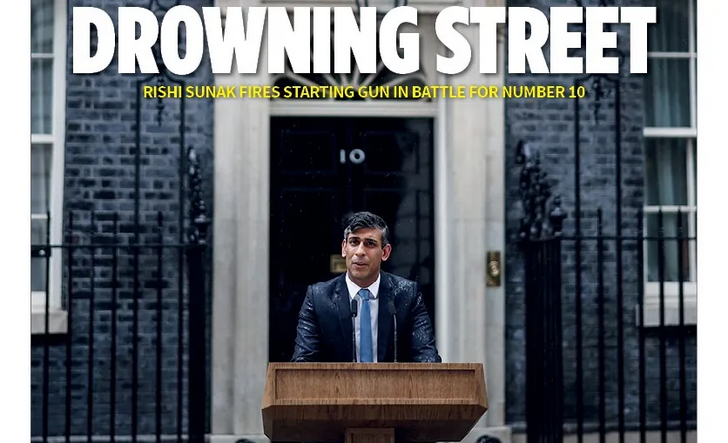
Rishi Sunak was a “wet” even before his farcical aquatic ceremony to kick off the 2024 general election.

We love a loser in Britain. From Eddie the Eagle to Gareth Southgate, our default reaction to a lack of success is warm appreciation. Parliament in that regard could not have been kinder to Rishi Sunak on his return as Leader of the Opposition. Never mind that the Conservative Party now looks more like the garrison of Rourke’s Drift than a campaign army. Never mind that the majority lies speared in the dust from their July 4th Isandlwana. Never mind that on the horizon General Farage is stirring the nativists for a future Bore War. The Lord Chelmsford of Prime Ministers marches on.

Less allegorically, Sunak, having made a couple of good speeches, is as one commentator put it “precisely the leader the Conservative Party needs right now”. On a personal level he is clearly a lovely guy, smart, capable, talented and has a very bright Clegg-like future ahead of him, whether in the valley or teaming up with Tony Blair to hawk AI to dictators. He is being feted by all the usual suspects who regard Parliament as a jolly club for centrist dads. Little thought however has been put into how this comes across to the poor bloody Tory infantry still pulling the bodies out of the metaphorical Buffalo River, wondering whether the inexperienced lieutenants rowing in the redoubts have what it takes to hold the line.

So let us be blunt, as a leader Sunak was hopeless. He had no coherent ideology or vision. He treated consensus building as an end in itself rather than as a means to an end. Even then he was better at building coalitions against rather than for him and was advised by people who used polls to tell them what to think, rather than as tools to move the public their way. He was neither a campaigner nor a political strategist.

As a result, he demonstrated cataclysmic judgement on the timing of the election. Whether this was through arrogance, naivety, or ignorance, he amplified the losses. He did so in the teeth of ample public commentary praising an assumed wise decision to delay until winter. Catching his own side by surprise, benefitting only morally vacuous apparatchiks boosting their betting accounts, and a far better prepared Opposition.

In office he was addicted to fad policies like generational bans, the Rwanda scheme, and the triple lock. He ducked hard choices on growth like building homes and cutting red tape, both things his deeply buried Thatcherite instincts should have told him were fights worth having. He was useless at implementation. Note, for example, the failure of his own borders policy or thinking through how to reform Ed Miliband’s ideological Net Zero architecture into something pragmatic.

He was right about one big thing — the importance of fiscal prudence and sound money. But he was also the Chancellor who undermined that prudence with wasteful lockdown splurges that destroyed growth and pushed the national debt over 100 per cent. He loved the sugar rush of popularity that came with being a spender in a crisis, but afterwards reformed nothing, preferring instead to raise taxes, generally by copying Labour’s madder talking points. For example, putting up corporation (company profits) tax to 25 per cent, freezing personal allowances, and hitting the North Sea with a 75 per cent “temporary” windfall tax, that has already outlasted the short period of high prices that inspired it. The latter has mortally wounded domestic investment, ripe for the Labour administration to finish it off. An error made despite his predecessor Osborne making exactly the same mistake with the same disastrous consequences only a few years earlier.

QotD: Post-apartheid South Africa

There were two things that finally caused the dam to break and muted criticism of the South African regime to start appearing in the international press: the first was the situation in Zimbabwe. Like South Africa, Zimbabwe had recently ended decades of white minority rule, but in Zimbabwe things went way more wrong, way more quickly. Robert Mugabe, the incumbent president of Zimbabwe, was running in a contested election, and decided to ensure his victory with a campaign of mass murder and torture which in turn triggered a famine and a refugee crisis.

All of this brought tons of international condemnation onto the Zimbabwean regime, and a lot of countries looking for ways to pressure it to stop the atrocities. The glaring exception was Mbeki’s South Africa, which staunchly defended Zimbabwe for years as the killing and the starvation just kept ratcheting up. It’s unclear why they did this, beyond the ANC and ZANU-PF (the Zimbabwean ruling party) having a certain ideological and familial kinship, both being post-colonialist revolutionary parties that had overthrown white minority rule. But whatever the reason, this was the straw that finally caused Western politicians and celebrities to wake up a little bit and realize that South Africa was now ruled by thugs.

The second, even more catastrophic event that caused the South African government to lose the sheen of respectability was the AIDS epidemic and their response to it. The story of how Mbeki buried his head in the sand, embraced quack theories on the causes of AIDS, and condemned hundreds of thousands of people to avoidable deaths is well known at this point, but Johnson’s book is full of grimly hysterical details that turn the whole story into the darkest comedy you’ve ever seen.

For example: I had no idea that Mbeki was so ahead of his time in outsourcing his opinions to schizopoasters on the internet. According to his confidantes, at the height of the crisis the president was frequently staying up all night interacting pseudonymously with other cranks on conspiracy-minded forums (an important cautionary tale for all those … umm … friends of mine who enjoy dabbling in a conspiracy forum or two). These views were then laundered through a succession of bumbling and imbecilic health ministers such as Nkosazana Dlamini-Zuma or Mantombazana Tshabalala-Msimang who gave surreal press conferences extolling the healing powers of “Africanist” remedies such as potions made from garlic, beetroot, and potato.

Actually, the potions were a step up in some respects, the original recommendation from the South African government was that AIDS patients should consume “Virodene”, a toxic industrial solvent marketed by a husband-wife con-artist duo named Olga and Siegfried Visser. Later documents came to light revealing large and inexplicable money transfers between the Vissers and Tshabalala-Msiming. The Vissers then established a secret lab in Tanzania where they experimented on unsuspecting human subjects, engaged in bizarre sexual antics, and performed cryonics experiments on corpses. Despite this busy schedule, they also produced a constant stream of confidential memos on AIDS policy that were avidly consumed by Mbeki.

The horror of it all is that by this point there were very good drugs that could massively cut the risk of mother-child HIV transmission and somewhat reduced the odds of contracting the virus after a traumatic sexual encounter. There were a lot of traumatic sexual encounters. A contemporaneous survey found that around 60 percent of South Africans believed that forcing sex on somebody was not necessarily violence, and a common “Africanist” belief was that sex with a virgin could cure AIDS, all of which led to extreme levels of child rape. The government then did everything in its power to prevent the victims of these rapes from accessing drugs that could stave off a deadly disease. At first the excuse was that they were too expensive, then when the drug companies called that bluff and offered the drugs for free, it became that they caused “mutations”.

John Psmith, “REVIEW: South Africa’s Brave New World, by R.W. Johnson”, Mr. and Mrs. Psmith’s Bookshelf, 2023-03-20.

July 20, 2024

Begun, the Cancellation Wars have!

Filed under: Media, Politics, USA — Tags: , , , , , — Nicholas @ 05:00

At Postcards From Barsoom, John Carter discusses how the cancellation wars have gone over the last decade:

The left’s reaction to the missed shot heard around the world has been exactly as calm and measured as we have grown to expect. Sensing that America is teetering on the edge of the abyss of civil violence and realizing that they need to deescalate the situation, liberals have thrown open their arms with a message of conciliation and unity, as embodied by popular slogans such as “Make Aiming Great Again”. You can really feel the love.

Recently Xitter’s Libs of TikTok, neé Chaya Raichik, got a Home Depot employee fired from her job. The woman herself isn’t important – just another obese, frumpy hicklib convinced that Trump is Antichrist McHitler because her opinion box on her living room wall has spent the last eight years lying to her about Russia. The details aren’t all that interesting: the woman made an ill-considered comment on Facebook to the effect that she wished the would-be assassin hadn’t missed, which Raichik shared with her audience of ragebait junkies, which led to an angry veteran confronting the woman at her place of work, the video of which Raichik also shared, which led to Home Depot canning the unpleasant sow.

The result has been an immediate moral split on the right, between those who are appalled, and those who applaud. The former consider it a basic civic principle that people should not lose their jobs for getting mad on the Internet, no matter how objectionable or offensive their words. Isn’t free speech what we’ve been fighting for all these years? If the right starts using the power of the cancel mob, do we not become no different from the left?

[…]

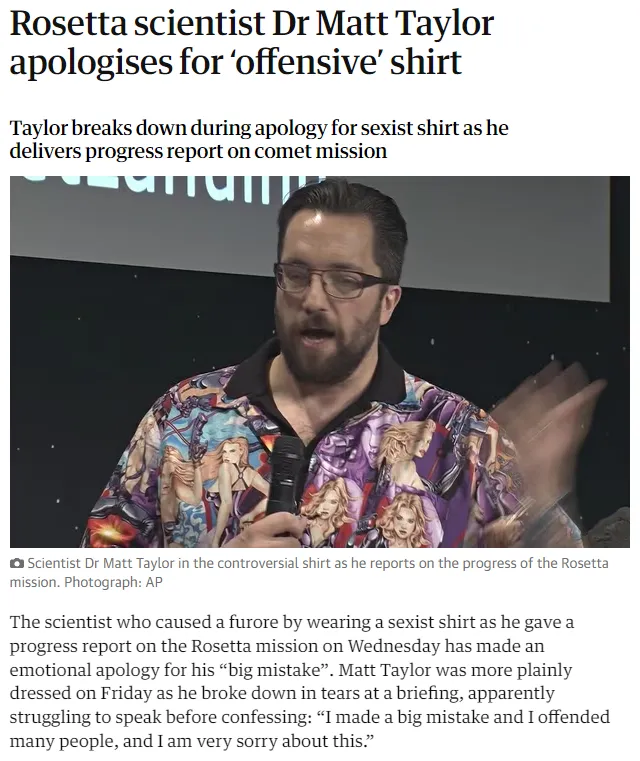
The first incident in that series, the cancellation of space scientist Dr. Matt Taylor, was my personal emotional breaking point with the left. Before that I considered myself to be broadly aligned with the left, mainly due to disgust over the fallout of the 2008 financial crisis, and disillusionment with the then-ongoing, pointless, costly horror of the perpetual terror war. What happened to Matt Taylor shook me out of it. Here was a guy who had just landed a robot on a comet, reduced to a mass of blubbering jello because shrieking women didn’t like the way the sexy Barbarella prints on his Hawaiian shirt objectified women i.e. made the ugly ones feel bad. At the time, that hersterical1 mob included many I counted as friends. I tried reasoning with them, pointing out that his shirt had been designed by a friend of his, an independent female artist, and that by wearing the shirt at the press conference at the apex of his career, with many more millions of eyes focused upon him than had ever looked his way before or would ever glance his way again, he was helping that friend, who is a woman herself, to expand her business. It didn’t matter, of course. Caught up in the digital maenad frenzy, there was no reasoning with them.

Over the decade subsequent to Dr. Taylor’s defenestration, we have seen people get cancelled for refusing to use the right pronouns, for refusing to genuflect before the rainbow, for wearing red hats in public, for donating to the wrong political causes, for getting into arguments with black people, for being related to someone who used a racial slur, for voicing words in Chinese that sound like racial slurs, and on and on without rhyme, reason, or limiting principle.

The left has been absolutely ruthless and relentless in its pursuit of total monolithic discursive purity.

This is not merely an Internet phenomenon, with consequences limited to those who draw the terrible gaze of the beast with a million eyes. You have almost certainly felt this in your personal life, the subtle, steady pressure to bite your tongue in every social and professional situation, the knowledge that if you say too much, if you cross one of the myriad invisible, ever-shifting red lines in the left’s mutable cat’s cradle of taboos, you risk total social and professional death.

All the more galling has been that leftists themselves feel absolutely no shame about voicing their demented gibberish at every opportunity, no matter how professionally or socially inappropriate. Again, most of you will have experienced this. Maybe there’s that Thanksgiving dinner, at which you did your best to avoid anything divisively political, only to endure sermons from your liberal aunt, who felt it her moral duty to correct her wayward relations, who are ignorant and need to educate themselves, on the urgency of climate change or the ethical imperative of confronting whiteness wherever it may be glimpsed. Maybe you’ve had to grit your teeth at an office meeting, the purpose of which was ostensibly to discuss the new sales tracking software, at which Debby from accounting inserted an egregious dig at the Bad Orange Russian Agent under the mistaken impression that this would meet with universal approval.

All it takes is one of these people to ruin a workplace for everyone. The moment one of them sees or hears anything that triggers them, no matter how innocuous, they run to HR, and your job is on the line. They are active in this, spontaneously discovering new ways to be offended, such that no one can predict what will send them off into a tantrum next. Everyone knows this, with the result that everyone is constantly walking on eggshells, aware that the walls have ears, as do the blue-haired women built like walls. For all the hand-wringing over the Home Depot lady’s firing, I suspect a lot of her coworkers sighed with relief when they got the news that they would no longer have to dance around her tender sensibilities in the lunch room.


When diversity and competence requirements conflict

Filed under: Government, Media, Politics, USA — Tags: , , , , — Nicholas @ 04:00

Janice Fiamengo compares the iconic Trumpian reaction after being wounded by a sniper with the cries for diversity at all costs from others:

Donald Trump, surrounded by Secret Service agents, raises his fist after an attempt on his life during a campaign speech in Butler, PA on 13 July, 2024.

Many observers have had harsh words for the female Secret Service agents who performed poorly in response to the attempt on Trump’s life last Saturday (see this Wired article for a catalogue of the charges, in which the author cannot muster a single rebuttal). Some noted that Trump’s security detail for the Republican National Convention is now, it appears, exclusively male. And rightly so. There is no equality when bullets start to fly, and it is lethal to pretend there is.

When the first shot rang out, 50-year-old Pennsylvanian firefighter Corey Comperatore is reported to have done what men typically do in such situations: he shielded his wife and daughters, taking a bullet to the head. Women far more rarely perform such acts of self-sacrifice.

Comperatore lost his life because of a multitude of errors on the part of the Secret Service, including a long hesitation by snipers tasked with neutralizing threats. Video shows that at least one of these snipers, seemingly with the gunman in his sites, failed to take action until seconds after the gunman began firing. The agent seemed befuddled, scrambling back when the first shot came. Was he new on the job, inadequately trained, or sub-par in his skills? Or directed not to fire?

I am not equipped to answer these or the many other, darker, questions about the bungled security operation. What can be said for certain is that if some element of the Secret Service was not treasonously complicit in the attempt on Trump’s life, it was certainly massively inadequate to its task of protecting him and others at the rally. The gunman was allowed to gain access to his rooftop shooting position, and Trump was not extracted the moment the shooter’s presence became known.

Director Kimberly A. Cheatle, who expressed to CBS News in interview her concern with “developing and giving opportunities to everyone in our work force, and particularly women“, has a lot to answer for.

Perhaps the women we saw in Trump’s security detail were new recruits helping Cheatle reach her target of 30% women by 2030. They looked amateur, panicked, and unpracticed. One of the women attempting to remove Trump from the stage was simply too small, and hesitant, for the task; she looked at one point as if she were engaged in a group hug at a United Church reconciliation ceremony. (As many have noted, her small stature enabled Trump’s fist-raised gesture of masculine defiance and his exhilarating “Fight! Fight! Fight!”). As Trump was being taken into the security vehicle, the four women surrounding the car looked jumpy and confused, scared and awkward. One woman was visibly unable to holster her gun.

I’ve never seen so many women guarding a former president, and I’ve never seen so many women obviously incapable.

We know that men and women have different strengths and aptitudes. Nearly a decade ago, the United States Marine Corps demonstrated through a year-long study of hundreds of Marines that even women who could pass the physical exam simply could not carry out standard military tasks as efficiently as men. The study found, unsurprisingly, that “The males were more accurate hitting targets, faster at climbing over obstacles, better at avoiding injuries.” The women struggled to carry weapons and ammunition, and even to use the weaponry properly. Women’s higher injury rate was marked: “The well documented comparative disadvantage in upper and lower-body strength resulted in higher fatigue levels of most women, which contributed to greater incidents of overuse injuries such as stress fractures.”

July 19, 2024

Argentina’s decades-long struggle with inflation

Filed under: Americas, Economics, Politics — Tags: , , — Nicholas @ 04:00

At the Foundation for Economic Education, Marcos Falcone provides an update on President Javier Milei’s ongoing efforts to drag the Argentine economy back from hyperinflation:

As Javier Milei rose to power in December of last year, Argentina suffered from an annual inflation rate of over 211 percent, only behind Venezuela and Lebanon. Having risen consistently for over two decades, a combination of perpetually unbalanced budgets and investors’ distrust made money creation (and thus inflation) almost unavoidable.

In that context, Javier Milei’s first promise in his inaugural address was to avoid hyperinflation. In order to do that, his highest priority was to balance the budget so as to stop monetizing the deficit. And indeed, after just one month, the government announced in January that Argentina achieved its first financial surplus in 16 years. In successive months, the budget has been kept balanced.

Quick action seems to be causing quick effects. Indeed, inflation has plunged from 25 percent in December to an expected 4 percent in July. This is happening in a context of price readjustments, with prices like rent going down (after the government repealed rent control laws) and energy and transport prices going up (as the government is cutting subsidies). Even the IMF has admitted that inflation is falling faster than expected. In fact, inflation is coming down so fast that banks have started offering mortgages for the first time in seven years. This signals that the market expects inflation to stay down.

Milei told Argentines that the process of defeating inflation would hurt—and it has. The downside of the government’s economic plan is that the country has entered a recession which is likely to last until at least the end of the year. Amid some layoffs, the country’s industrial output is decreasing. The spending cuts that allowed the country to balance the budget have resulted in less income for provinces and specific groups like retirees.

The rise of the reactionaries – Gen X poised to pounce and seize

Filed under: Cancon, Economics, Media, Politics, USA — Tags: , , , , — Nicholas @ 03:00

Andrew Potter tries to explain why Gen X are much more likely to support conservative policies than the groovy fossil Boomers and the painfully Socialized Millennials and GenZ’ers:

Generation X Word Cloud Concept collage background
Best Motivation Blog: What Generation Is X

As North American politics continues its rightward lurch, it is becoming increasingly commonplace to note the outsized role of Gen Xers in pushing this trend. In 2022, a Politico essay tried to explain “How Gen X became the Trumpiest generation“. That same year, an essay in Salon lamented how “of course Gen X was always going to sell out and vote Republican”. Writing in The Line last year, Rahim Mohamed wondered “how Generation MTV became Generation GOP?” These aren’t outliers – there is a whole sub genre of cultural commentary devoted to trying to explain just why Gen Xers are so right wing, compared to both their Boomer predecessors and the Millennials and Zs who followed.

This raises a couple of questions, the first of which is: is it even true? And if so, why?

On the facts of the matter, it appears that members of Generation X are, on the whole, more conservative than other generations, and this is especially true in the United States. For the past three or four years, polls have consistently shown that Gen Xers are more likely to see the country as going in the wrong direction, more likely to disapprove of Joe Biden, and more likely to support Donald Trump and vote Republican, than any other generational cohort. And while every generation tends to become more conservative as it ages, it is a tendency that accelerated under Gen X.

Pollsters have found similar support for these trends in Canada. An Abacus survey conducted last August found Gen Xers had the highest level of support for the Conservatives, with 41 per cent of those surveyed intending to vote CPC. And just this past June, the pollster Frank Graves released a series of charts tracking sentiment in Canada on a number of issues, including national attachment, social cohesion, and voter intention. He found significant intergenerational discord, with members of Gen X showing the highest level of support for smaller government, and Gen X males having the highest level of support for the CPC.

So why is this the case? How did the generation that fought (and won) the first culture war against conservatives, that launched the antiglobalization movement, that made heroes out of left wing icons like Kurt Cobain and Naomi Klein, become the most right wing cohort of all? Did we follow our Boomer parents’ hippies-to-yuppies trajectory in selling out? Or is there something else at work, beyond crass financial self-interest?

There’s probably at least something to be said for the “crass self-interest” angle. Despite the long-standing claim to being the first generation to do worse than their parents, the truth is, Gen X is raking it in. Starting right around the pandemic, Canadian Gen Xers quietly overtook Boomers as the generation with the highest average household net worth. It may also explain why alone amongst the generations, members of Gen X list “cost of living” as their most salient political issue, in contrast with both the older and younger cohorts who identify things like climate change, health care, and the environment as the most important issues facing Canada.

July 18, 2024

For some people (especially on social media) even contradictory evidence proves your beliefs are correct

Filed under: Media, Politics, USA — Tags: , , , , — Nicholas @ 04:00

Chris Bray once again puts on the virtual hazmat suit and wades into the putrid mess that is most of social media after the Trump assassination attempt:

First, a remarkable number of people — see Ruth Ben-Ghiat’s social media feed, if you feel the need to stare into the abyss — conclude under all circumstances that all evidence shows how bad [folk devil figure] is.

1.) Donald Trump took a bullet through the side of the head.

2.) NOW DO YOU SEE HOW DANGEROUS DONALD TRUMP IS?!?!?!?

That son-of-a-bitch is going around absorbing bullets with his stupid Nazi ear, the bastard. You know who else got a bullet in the head, THINK ABOUT IT.

These people could stand in Trump’s presence, watching someone beat the man with a lead pipe, and shake their heads over the outrageousness of Donald Trump’s behavior. Stop assaulting that lead pipe with your face, Adolf!

A sizable percentage of the American population has no path to a rational, fact-facing evaluation of reality, and their psychosis is transportable. It can be carried through Trump and to another symbol-figure instantly. Again, go see the social media accounts of people like Bill Kristol or Liz Cheney if you feel the need to test this theory. Donald Trump is the worst person who has ever lived, far more dangerous than Adolf Hitler … and, update has finished downloading, JD Vance is far more horribler and Hitlerian than Donald Trump. Remember that Ron DeSantis was also far more dangerous than Trump for about ten minutes this year. They will do this and do this and do this, forever, for whichever figure the media points them at. [Name here] is more dangerous than Hitler. They’re actually programmed. The name can be swapped into the same software.

Second, social media is a currently a sewage bucket overflowing with programmed idiots expressing public sorrow that the shooter missed, and a bunch of people are losing their dismal jobs over the expression of that sentiment. See this pathetic example, if you feel the need.

« Newer PostsOlder Posts »

Powered by WordPress