
Published on 27 Mar 2017
Woodrow Wilson, 28th President of the United States, is one of the most controversial characters of his era. His racial views, his view on peace and the post-war world, his decision to go to war with Germany in 1917 are still being debated to this day. We take a look at the life of Wilson to better understand his motivation.
March 28, 2017
Champion for Democracy? – Woodrow Wilson I WHO DID WHAT IN WW1?
Comments Off on Champion for Democracy? – Woodrow Wilson I WHO DID WHAT IN WW1?
March 27, 2017
2017 – the year of the Great Dissatisfaction
Kevin Williamson says that “our world is full of wonders, but not everyone finds a place in it”:
Once, the question the ambitious and dissatisfied asked themselves was: “How do I climb that ladder?” Current tastes run more toward smashing the ladder and the hierarchies for which it stands in the name of … whatever: feminism or anti-feminism, black liberation or white nationalism, global justice or national sovereignty.
We spend our days surrounded by great miracles and minor irritations. My friend Jay Nordlinger recently recounted how Joseph Stalin allowed the film The Grapes of Wrath to be shown in the Soviet Union, believing that to see an indictment of capitalism from within the beast itself would be salutary for the proletariat. The proletariat took another lesson from the film: The Joads, apparently the poorest people in America, had a Ford, a luxury no working man in the workers’ paradise could dream of. A similar story is told about the television series Dallas: The Soviets thought their subjects would recoil from the mischief of J. R. Ewing and his Texas oil cronies, but all the poor Russians could see was that American servants lived better than Soviet doctors and professors. If we could share our daily tales of woe with our great-grandparents — e.g., my complaints about the Wi-Fi on airplanes — they would not take from that the conclusion we intended.
We do not have a problem of privation in the United States. Not really. What we have is something related to what Arthur Brooks (“the most interesting man in Washington,” Tim Alberta calls him) describes as the need for earned success. We are not happy with mere material abundance. We — and not to go all Iron John on you, but I think “we” here applies especially to men — need to feel that we have earned our keep, that we have established a place for ourselves in the world by our labor or by other virtues, especially such masculine virtues as physical courage and endurance. I suspect that is a big part of the reason for the exaggeratedly reverential, practically sacramental attitude we current express toward soldiers, police officers, and firemen. Of course they are brave and deserve our gratitude, but if we had felt the need to ceremonially thank everyone for their service in 1948, we’d never have done anything else with our time. In 2017, there are many more jobs for courtiers than for soldiers, and the virtues earning the highest return are not bravery or toughness but conversational cleverness, skill in social navigation, excellence in bureaucracy, and keenness in finance.
[…]
And there is the paradox within our paradox: The world is wondrous and beautiful and exciting and rich, and many of us have trouble finding our place in it, in part, because it is wondrous and beautiful and exciting and rich, so much so that we have lost touch with certain older realities. One of those realities is that children need fathers. Another is that fathers need children.
But these are what my colleague David French calls the “wounds that public policy will not heal.” Our churches are full of people who would love to talk to you about healing, but many have lost interest in that sort of thing, too. And so they turn to Trump, to Le Pen, to Chavismo (which is what Bernie Sanders is peddling), and, perhaps, to opiate-induced oblivion. Where will they turn when they figure out — and they will figure it out — that there are no answers in these, either?
And what will we offer them?
Comments Off on 2017 – the year of the Great Dissatisfaction
Do you believe the experts?
In Reason, Noah Berlatsky reviews The Death of Expertise: The Campaign Against Established Knowledge and Why It Matters, by Tom Nichols:
Believe the experts! Experts are not perfect, but they are more likely than non-experts to be right. Experts know what they do not know, and are therefore more cautious and better able to self-correct. Sometimes, in small ways, non-experts may outperform experts. But in general, America and the world need more respect for expertise.
That is the thesis of Tom Nichols’ The Death of Expertise: The Campaign Against Established Knowledge and Why It Matters. It is also, as it turns out, a critique of the book itself. Nichols, a professor at the U.S. Naval War College, is an expert on Russia and national security; he is not, however, an expert on expertise.* His hand wringing about kids today is not grounded in a scholarly background in education policy or the history of student activism. He is a generalist dilettante writing a polemic against generalist dilettantes. As such, the best support for his argument is his own failure to prove it.
There are two central flaws in The Death of Expertise. The first is temporal. As the title implies, the book is written as though there were once a golden age when expertise was widely valued — and when the democratic polity was well-informed and took its duty to understand foreign and domestic affairs seriously. “The foundational knowledge of the average American is now so low that it has crashed through the floor of ‘uninformed,’ passed ‘misinformed’ on the way down, and finally is now plummeting to ‘aggressively wrong,'” Nichols declares. His proof for this statement is that “within my living memory I’ve never seen anything like it.”
As Nichols would ordinarily be the first to point out, the vague common-sense intuitions and memories of non-experts are not a good foundation for a sweeping theory of social change. Nichols admits that Americans are not actually any more ignorant than they were 50 years ago. But he quickly pivots to insist that “holding the line [of ignorance] isn’t good enough” and then spends the rest of the book writing as if he didn’t know that Americans are not getting more ignorant.
The myth of the informed democratic voter is itself an example of long-ingrained, stubborn anti-knowledge. In their brilliant new Democracy for Realists (Princeton University Press), the political scientists Christopher H. Achen and Larry M. Bartels explain that laypeople and experts alike have developed a “folk theory” holding that American democracy is built on an engaged electorate that casts its votes for rational policy reasons. Unfortunately, as Achen and Bartels demonstrate, decades of research have shredded this theory, stomped on it, and set the remains on fire.
Comments Off on Do you believe the experts?
QotD: The nursery school campus
I wanted to ask you about that. If Emma Sulkowicz were a student of yours, in an art class you were teaching, how would you grade her work?
[laughs] I’d give her a D! I call it “mattress feminism.” Perpetually lugging around your bad memories – never evolving or moving on! It’s like a parody of the worst aspects of that kind of grievance-oriented feminism. I called my feminism “Amazon feminism” or “street-smart feminism,” where you remain vigilant, learn how to defend yourself, and take responsibility for the choices you make. If something bad happens, you learn from it. You become stronger and move on. But hauling a mattress around on campus? Columbia, one of the great Ivy League schools with a tremendous history of scholarship, utterly disgraced itself in how it handled that case. It enabled this protracted masochistic exercise where a young woman trapped herself in her own bad memories and publicly labeled herself as a victim, which will now be her identity forever. This isn’t feminism – which should empower women, not cripple them.
It’s yet more evidence of the current absence of psychology. To go around exhibiting and foregrounding your wounds is a classic neurotic symptom. But people are so lacking now in basic Freudian consciousness – because Freud got thrown out of mainstream feminism by Kate Millett and Gloria Steinem and company. So no one sees the pathology in all this. And for Columbia to permit this girl to carry her mattress onstage and disrupt the commencement ceremony was absolutely ludicrous. It demonstrates the total degradation of once eminent and admirable educational institutions to caretaking nursery schools. I prophesied this in a piece I wrote in 1992 for the Times Literary Supplement called “The Nursery-School Campus”. At the time, nobody understood what I was saying. But I was arguing that the obsessive focus by American academe with students’ emotional well-being was not what European universities have ever been concerned with. European universities don’t have this consumer-oriented view that they have to make their students enjoy themselves and feel good about themselves, with everything driven by self-esteem. Now we have people emerging with Ivy League degrees who have no idea how little they know about history or literature. Their minds are shockingly untrained. They’ve been treated as fragile emotional beings throughout their schooling. The situation is worsening year by year, as teachers have to watch what they say and give trigger warnings, because God forbid that American students should have to confront the brutal realities of human life.
Meanwhile, while all of this nursery-school enabling is going on, we have the entire world veering towards ISIS – with barbaric decapitations and gay guys being thrown off roofs and stoned to death. All the harsh realities of human history are erupting, and this young generation is going to be utterly unprepared to deal with it. The nation is eventually going to be endangered by the inability of several generations of young people to make political decisions about a real world that they do not understand. The primitive realities of human life are exploding out there!
Camille Paglia, interviewed by David Daley in “Camille Paglia: How Bill Clinton is like Bill Cosby”, Salon, 2015-07-28.
Comments Off on QotD: The nursery school campus
March 26, 2017
The Mark Steyn Show with Maxime Bernier
Published on Mar 23, 2017
In this brand new edition of The Mark Steyn Show, Mark talks to Canadian Conservative Party leadership candidate Maxime Bernier. M Bernier was the country’s Foreign Minister under Stephen Harper until his rising star somewhat spectacularly self-detonated. But, after biding his time, he returned as a hero of the libertarian right – “the Albertan from Quebec”, as he became known. Steyn and Bernier talk about what it means to be a conservative francophone in rural Quebec, the role of a medium-rank power in a turbulent world, and Canadian-US relations.
Comments Off on The Mark Steyn Show with Maxime Bernier
March 25, 2017
QotD: Why I hate Big Oil
For many years now, I – and many sceptics like me – have been accused by climate alarmists of being “in the pay of Big Oil”. But even though we deserve it for promoting fossil fuels so enthusiastically and fighting their critics so heroically, few of us have ever received even a penny for our troubles. That’s because Big Oil is far too busy trying to greenwash its image – as Shell itself did by sponsoring the Guardian’s environment pages for many years – to waste time on the plucky, outspoken heroes who do a better job for Big Oil’s PR than the Big Oil’s paid PR departments do.
Mainly, though it’s disgust. Big Oil has this public image of being an industry for fearless, no-nonsense manly men who aren’t afraid of getting their hands dirty or braving the environmentalists’ wrath in order to do their ugly but important work supplying the world with much-needed energy.
Yet it’s an image almost entirely undeserved.
Almost everyone at a senior level in Big Oil is a craven, simpering, politically correct, spineless, surrender-monkey corporate shill. They’re cowards who are scared of free markets, won’t speak up for capitalism, won’t even defend their core business.
James Delingpole, “Why I Totally Hate Big Oil – And Why You Should Too…”, Breitbart.com, 2017-03-14.
Comments Off on QotD: Why I hate Big Oil
March 24, 2017
Kathleen Wynne … the Ontario Liberal Party’s saviour?
Chris Selley tries to position Ontario Premier Kathleen Wynne as being the greatest asset of the Liberal Party:
The question of Kathleen Wynne’s future as leader of the Ontario Liberal Party made its way to the public airwaves this week in the form a panel discussion on TVO’s The Agenda. Host Steve Paikin asked former Liberal MP Greg Sorbara what advice he would offer the premier, and his response caused a bit of a stir.
“It is extremely unlikely that you’ll win the next election. The facts are the facts,” he said he would tell her. “I have not seen a party in the last year of its mandate turn (poll) numbers around when they are as bad as (the Liberals’) are.” And he noted the numbers are “particularly bad” for Wynne personally.
The latest Mainstreet Research/Postmedia poll, released last week, had the Liberals at 22-per-cent support, 10 points behind the Tories. Forum Research last measured Wynne’s approval rating at 11 per cent, and her disapproval rating at 77 per cent. Just nine per cent said she would make the best premier of the three party leaders.
Okay, so where does Wynn come off as the Liberals’ best hope?
If Liberals are worried “it’s all over,” as Sorbara put it, I would submit it’s in large part because, on election day 2018, they’ll have been in power for 15 and a half not very impressive years. That’s the longest streak in Ontario in three decades. No party has managed it federally since St. Laurent took over from Mackenzie King.
Stuff builds up.
Stuff like, you know, Dalton McGuinty promising in writing not to raise taxes, then instituting a “health premium,” which he claimed wasn’t a tax, and then admitting under duress that it was a tax; like lottery retailers defrauding players to the tune of $100 million, and casinos managing to lose money; like allowing Ornge to spin out of control into corruption, mismanagement and overspending; like the electronic health records debacle; like turning a blind eye while native protesters illegally occupied Caledonia; like flushing a billion dollars or so down the john to cancel gas plants sooner than risk voters’ ire, then claiming there’s “no wrong time to make the right decision;” like various apparatchiks winding up arrested for little things like bribery and conspiring to delete government emails; like taking hundreds of thousands of dollars from companies that benefit from government largesse, shamelessly demanding cash for access to ministers, and only changing the rules when it finally became politically untenable; like a debt-to-GDP ratio that grew 40 per cent, from third-lowest among the provinces to fourth-highest; and like astronomical hydro bills born to a significant degree of bad political decisions.
All of that, and yet Wynne somehow managed to get a majority government last time around. Ontario’s masochistic voters clearly do deserve to get it, as Mencken said, “good and hard”.
Comments Off on Kathleen Wynne … the Ontario Liberal Party’s saviour?
March 23, 2017
The “Resistance” chooses some Nazi-era symbology for self-labelling
Curtis Edmonds shared this on the Facebook Conservative and Libertarian Fiction Alliance page. We really do live in a post-parody world (link is to an archived version of the post):
Shortly after the presidential election, “Trump Nation/Whites Only” was written on the wall outside a majority-immigrant church in Maryland. The response is to either quietly wash the wall or stand against hatred and promote tolerance. “All citizens of good conscious must join the Resistance to Donald J. Trump’s authoritarian administration,” writes public relations consultant Len Stein. To visualize and unite the various resistance groups and present the movement with a unifying symbol, Stein proposes that resisters wear a triangle ‘R’ badge on their sleeves when protesting—immigrants, refugees, people of every ethnicity, religion, sexual orientation or political affiliation. The ‘R’ triangle symbols were designed by Tucker Viemeister. I asked Stein to talk more about this act of resistance.

If that one’s not setting off your historical symbol alarm, here are the recommended variations for Trump Resistance folks to display:

Comments Off on The “Resistance” chooses some Nazi-era symbology for self-labelling
March 22, 2017
Alberta in the 1970s “had more revenue than it knew what to do with. THAT IS NOT A FIGURE OF SPEECH”
Colby Cosh on the past and future of the Alberta Progressive Conservative party:
On Saturday, as was generally foreseen, Jason Kenney became leader of the Alberta Progressive Conservatives. This sounds portentous and impressive. But one of the things that strikes you, since Kenney is proposing to (at a bare minimum) re-brand the Alberta PCs, is that their leaders are not exactly an honour roll of mighty statesmen. The party was successful and did good, and Albertans are grateful for its legacy. But they are, perhaps, grateful in the reluctant, compromised way one might be grateful to an ex-wife who was not much fun but helped the kids turn out well.
Peter Lougheed helped to change Canada’s destiny and define the compact between Ottawa and the provinces. Ralph Klein put the province on a competitive, economically diverse footing and established the fiscal health that a New Democratic government is now exploiting. But Lougheed’s electorally unsuccessful forerunners are forgotten by all but families and friends, and Klein’s successors all came to unhappy political ends.
Why, then, do Albertans speak so fondly of the Progressive Conservative heritage? I am afraid the answer is that older Albertans have chosen to forget it and younger ones don’t understand it. Peter Lougheed led a government that, owing to 1970s oil prices, had more revenue than it knew what to do with. THAT IS NOT A FIGURE OF SPEECH. Much of the art of Alberta government in the Seventies was trying to think up new, non-wasteful uses for oil money.
Most of Lougheed’s choices turned out to be very wasteful indeed after he left office. Those budgeting conditions have occurred only a few times anywhere in the annals of Western civilization, and they are never coming back. If they did, it would now be thought insane to follow a Lougheed program — make bad infrastructure and “value-added industry” bets, throw doomed loans at resource and tech companies, flood the cities with cheapo housing.
Comments Off on Alberta in the 1970s “had more revenue than it knew what to do with. THAT IS NOT A FIGURE OF SPEECH”
A check-in from the “libertarian writers’ mafia”
In the most recent issue of the Libertarian Enterprise, J. Neil Schulman talks about “rational security”:
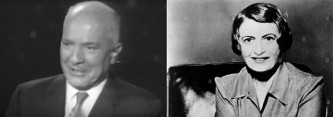
Two of my favorite authors — Robert A Heinlein and Ayn Rand — favored a limited government that would provide an effective national defense against foreign invaders and foreign spies. Rand died March 6, 1982; Heinlein on May 8, 1988 — both of them well before domestic terrorism by foreign nationals or immigrants was a major political issue.
Both Heinlein and Rand, however, were aware of domestic political violence, industrial sabotage, and foreign espionage by both foreigners and immigrants, going back before their own births — Rand February 2, 1905, Heinlein July 7, 1907.
Both Heinlein and Rand wrote futuristic novels portraying totalitarianism (including expansive government spying on its own citizens) within the United States. Both authors also portrayed in their fiction writing and discussed in their nonfiction writing the chaos caused by capricious government control over individual lives and private property.
In their tradition, I’ve done quite a bit of that, also, in my own fiction and nonfiction.
So has my libertarian friend author Brad Linaweaver, whose writings I try never to miss an opportunity to plug.
Brad, like myself, writes in the tradition of Heinlein and Rand — more so even than I do, since Brad also favors limited government while I am an anarchist. Nonetheless I am capable of making political observations and analysis from a non-anarchist viewpoint.
We come to this day in which Brad and I find ourselves without the comfort and living wisdom of Robert A. Heinlein and Ayn Rand. We are now both in our sixties, old enough to be libertarian literary elders.
Oh, we’re not the only ones. L. Neil Smith still writes libertarian novels and opines on his own The Libertarian Enterprise. There are others of our “libertarian writers’ mafia” still living and writing, but none as politically focused as we are — and often, in our opinion, not as good at keeping their eyes on the ball.
Comments Off on A check-in from the “libertarian writers’ mafia”
March 21, 2017
March 20, 2017
Scotland … here they go again
Scottish First Minister Nicola Sturgeon is eager to get the voters back to the polls for another go-around for Scottish independence (well, not independence-independence, but separate-from-Britain-but-desperate-to-stay-in-the-EU-independence). Stephen Daisley comments on the situation as of Saturday:

The SNP has managed to spin normally sceptical hacks the line that Downing Street was caught on the back foot by Miss Sturgeon’s Monday surprise. It’s true that the timing was news to Number 10 — received wisdom ran that the Nationalist leader would unveil her gambit at the SNP annual spring conference in Aberdeen this afternoon.
But the UK Government has known since 2014, when Miss Sturgeon’s party refused to accept their 55% to 45% defeat, that another push for separation was a matter of ‘when’, rather than ‘if’. Contingency plans have been in place for some time, both to push back a referendum do-over until after Brexit and, if need be, to fight one immediately. The Nationalists are not dealing with that nice Mr Cameron anymore.
And Theresa May’s response to Miss Sturgeon’s demand was more cautiously-worded, better thought through, than the contributions that became common from David Cameron during the first referendum. Crucially, she did not dole out a flat No; instead, she said Not Yet.
[…]
Next week, she will ask MSPs to vote for a Section 30 request, petitioning Westminster for the power to hold a second referendum. There is no mandate for the Scottish Parliament to pursue such a policy. The constitution is reserved to the UK Parliament; a party winning a Holyrood election on a manifesto of surrendering Britain’s independent nuclear deterrent or withdrawing Scottish troops from an international conflict would not be thought to have grounds for pursuing such policies.
Even if this point were conceded — it is done so from first principles by the eager constitutionalists who populate the Scottish academy — there is another flaw in the Nationalists’ argument. True, they came first in the May 2016 election and their manifesto envisioned ‘Scotland being taken out of the EU against our will’ as cause for a re-run of 2014’s ‘once in a generation’ poll. But the Nationalists failed to secure a majority of seats at Holyrood for that proposition, winning only 63 out of 129. Fortunately for the SNP, they have six to spare in the shape of the Scottish Greens, once a conscientious party of the Left but, under Patrick Harvie, a Me-Too faction for the most triangulating government since New Labour.
Every time the Nats get themselves into a jam, every time it looks like they might finally have to stop girning and start governing, up pop the six little anoraks, festooned with CND badges and brimming with good intentions, and they come to the rescue. Time after time, Mr Harvie drags the SNP out of a hole and gets nothing in return except a pat on the head. That isn’t leadership; it’s the political instincts of Lassie.
The Greens’ amening of Miss Sturgeon’s gambit is different from previous acts of handmaidenry because it breaks the party’s pledge to the voters. In the manifesto they were elected on last May, the Greens promised:
‘Citizens should be able to play a direct role in the legislative process: on presenting a petition signed by an appropriate number of voters, citizens should be able to trigger a vote on important issues of devolved responsibility. As we proposed on the one year anniversary of the Independence Referendum, this is the Scottish Greens’ preferred way of deciding to hold a second referendum on Independence. If a new referendum is to happen, it should come about by the will of the people, and not be driven by calculations of party political advantage. In such a referendum the Scottish Greens will campaign for independence.’
H/T to Colby Cosh for the link.
Towards a taxonomy of the tribes of the Alt-Right
A guest post at Catallaxy Files tries to identify the various sub-groups of the larger Alt-Right movement:
The Alt-Right may be described as the group of people who have been cast out of polite, progressive society. It is not a particularly intellectual movement, but this is a characteristic of the mechanism of its formation: Intellectuals as a group largely have the capacity and inclination to avoid being kicked out of polite society. This is not to suggest that the typical member of the Alt-Right is brutish; far from it. One of the characteristics of the progressive movement is its tendency to attack the people for their privilege: the people who choose to become Alt-Right are both able and independently minded. These are people who get things done.
[…]
Who are they and what do they believe? Again, there isn’t exactly a formal list. Moreover, many loudly deny being part of the Alt-Right, while quietly indicating that they are somewhat aligned. There are some identifiable groupings. Among them there are degrees of acceptance of the truths that are colloquially called ‘red pills’ (as per the Matrix). To this end, Vox Day, one of the more intellectually capable individuals who is openly part of the Alt-Right, set out 16 points on which there is general agreement. A new person in the movement – either intellectually curious or recently cast out – may only agree with 3 or 4 of these points. These people are considered ‘Alt-Lite’. Anyone who agrees with the vast bulk of these points is ‘Alt-Right’. Those on the spectrum from White Nationalism to White Supremacy are a subgroup referred to as the ‘Alt-White’; those with a broader view that has scope for all nationalities and peoples as the ‘Alt-West’. Finally, there are a group of generally aligned intellectual strands which are referred to collectively as the Dark Enlightenment.
The Alt-White holds an interesting position within the Alt-Right. From one perspective, they have been cast out the longest, and were also the originators of the term ‘Alt-Right’, which lends them a touch of primacy. At the same time, they are inclined to a degree of overextension and the their intellectual output is targeted at a broader but less educated base than some other groups. There is a degree of tension, especially where white nationalism gives way to white supremacy. […]
The Alt-West seems to be where a lot of those who were cast out from a more liberal or libertarian position seem to end up. These people may have come to the Alt-Right out of Gamergate, out of the computing/technology industry, out of science fiction community, or a number of other incidents. […] Gamergate is a story in itself, starting with a personal feud on a gaming site and morphing into an acrimonious ideological confrontation between an “alt-right” group and the feral left.
The Alt-Lite is really about getting your toes wet. Its transitional. As such it described people in process more than a set community. That said, places like this expose people to a metered dose of this red-pill.
There is another faction that is roughly ‘men’s groups’, men trying to navigate a world that is hostile to them and to family formation. There is some deep stuff in there if you are looking into social interaction, but it’s largely not suitable for ‘polite company’. A number of the men who started that grouping have broadened out from that starting base. See this site or this one for something less given in to the hedonism and base tendencies of the age.
Comments Off on Towards a taxonomy of the tribes of the Alt-Right
QotD: The Christian church and the Communist Party
That people believe what they want to believe, was among the discoveries of my adolescence. Reading obituaries of Robert Conquest (1917–2015; died Monday), the shock of this discovery comes back. I was then both an Atheist and a Cold Warrior. This insight into human nature and denature appeared to buttress both of these convictions: for it seemed to me that the Communist Party and the Christian Religion were products of blind faith, perpetuated by people who “wanted to believe,” and therefore believed what they wanted.
Much was once said about the Alice-in-Wonderland parody of the Roman Church that the Communist Party offered. Immortal Christ founded the one, infallible Marx the other. Officially-recognized “apostles” followed from each (Peter, Paul, John, in one case; Lenin, Stalin, Mao, in the other). The Party like the Church is a bureaucracy, under a hierarchy to be obeyed without thought or hesitation. Each has a form of “confession,” and all the other “sacraments” can be paired. Advancement requires strict fidelity to doctrine. Both institutions hunt “heresies” and canonize “saints.” They thrive on persecution. The utopia of perfect Scientific Socialism is a destination like Heaven. And so on: I haven’t the energy to redraw the whole chart.
That the Communist faith is “materialist,” and that of the Church “spiritual,” makes the parody more amusing. One might also say that Satan is a parody of Our Lord. In logic, however, a parody does not constitute a refutation.
David Warren, “Transfiguration”, Essays in Idleness, 2015-08-06.
Comments Off on QotD: The Christian church and the Communist Party
March 18, 2017
Camille Paglia on her latest book and other issues
In Vice, Mitchell Sunderland talks to Camille Paglia about her latest book and other topics near to her heart:
BROADLY: Your book is called Free Women, Free Men. Why do you believe men need to be free for women to be free?
Camille Paglia: My primary inspiration since adolescence has been the thrilling decades of the 1920s and 30s, following American women gaining the right to vote in 1920. There were so many major women figures entering the professions—like my idols Amelia Earhart and Katharine Hepburn, who were determined to show that women could achieve at the same level as men. The bold new women of that period did not insult or denigrate men. They admired what men had done and simply demanded the opportunity to show that women could match or surpass it. One of my persistent quarrels with second-wave feminism is how male-bashing became its default mode from the start. Movements often attract fanatics or borderline personalities, and that’s exactly what happened. Too many damaged women with bitter gripes against men took over feminist discourse. Kate Millett was a prime example — her life has been an endless series of mental breakdowns and hospitalizations.What I’m saying in Free Women, Free Men is that women can never be truly free until they let men too be free — which means that men have every right to determine their own identities, interests, and passions without intrusive surveillance and censorship by women with their own political agenda. For example, if there is an official Women’s Center on the Yale University campus (which there is), then there should be a Men’s Center too — and Yale men should be free to carry on and carouse there and say whatever the hell they want to each other, without snoops outside the door ready to report them to the totalitarian sexual harassment office.
The book argues that construction workers and other working class men’s work have gone unnoticed. How has society ignored their contributions to society?
It is an absolute outrage how so many pampered, affluent, upper-middle-class professional women chronically spout snide anti-male feminist rhetoric, while they remain completely blind to the constant labor and sacrifices going on all around them as working-class men create and maintain the fabulous infrastructure that makes modern life possible in the Western world. Only a tiny number of women want to enter the trades where most of the nitty-gritty physical work is actually going on — plumbing, electricity, construction. Women have played virtually no role in the erection of those magnificent towers in every major city in the world. It’s men who operate the cranes or set the foundations or wash windows on the 85th floor. It’s men who troop out at 2:00 AM during an ice storm to restore power to neighborhoods where falling trees have brought down live wires. It’s men who mix the stinking, toxic cauldrons to spread steaming hot tar on city roofs. Last year in a nearby town, I drove by a huge, chaotic scene where emergency workers in hazmat suits were struggling with a giant pipe break, as raw sewage was pouring into the street. Of course all those workers up to their knees in a torrent of thick brown water were men! I’ve seen figures indicating that 92 per cent of people killed on the job are men — and it’s precisely because men are heroically doing most of the dangerous jobs in modern society. The bourgeois blindness of feminist leaders to low-status working-class labor by men is morally corrupt! Gay men, on the other hand, have always shown their awed admiration of working-class masculinity and fortitude. It’s no coincidence that a buff construction worker in a hard hat was one of the iconic personae of the gay disco group, the Village People, during the Studio 54 era![…]
How should young people preserve free speech?
Stand up, speak out, and refuse to be silenced! But identify the real source of oppression, which is embedded in the increasingly byzantine structure of higher education. Push back against the nanny-state college administrators who subject you to authoritarian surveillance and undemocratic thought control! I sent up a prophetic warning shot about this in my 1992 article, “The Corruption of the Humanities in the US,” which was published in London and is reprinted in my new book. The rapid, uncontrolled spread of overpaid administrators on college campuses over the past 30 years has marginalized the faculty, downgraded education, and converted students into marketing tools. Administrators are locked in a mercenary commercial relationship with tuition-paying parents and in a coercive symbiosis with intrusive regulators of the federal government. Young people have been far too passive about the degree to which their lives are being controlled by commissars of social engineering who pay lip service to liberalism but who are at root Stalinist autocrats who despise and suppress individualism. There is no excuse whatever for the grotesque rise in tuition costs, which has bankrupted families and imposed crippling debt on students trying to start their lives. When will young people wake up to the connection between rampant student debt and the administrator-sanctioned suppression of free speech on campus? Follow the money — the yellow brick road leads to the new administrator master class.
Comments Off on Camille Paglia on her latest book and other issues


