
The other day I was explaining to a young person what the word “epistemology” means. To keep things simple, I said it is how you know what you know, or in terms of political discussion, how you know you are right. They asked for an example. I said that the use of logic and reason beginning from a set of givens or first principles is one approach to epsitemology. They said they assumed everyone used that approach. I told them that I thought not — that, by my observation, the most common epistemology through history has been: “I was told it by a high status person in my family or tribe.” Based on sampling of social media, I still think this is still the case today.
Warren Meyer, “History’s Most Common Epistemology”, Coyote Blog, 2017-05-09.
May 28, 2019
May 27, 2019
A genuine, bona fide electrified, six-car Fisking!
Once upon a time, in the primordial early days of blogging, an artform was evolved that perfectly suited the ecological niche occupied by bloggers: the Fisking. Thanks to his great respect for the ways of the past, David Thompson is a highly skilled modern practitioner of that ancient artform:
Here’s an idea! Change your parents’ bad voting habits by refusing to breed.
In the pages of Slate, Christina Cauterucci, whose enthusiasms include “gender and feminism,” wishes to share her wisdom:
The prospect of harnessing one’s sexual and reproductive powers for social good is a tempting one. So, I’d like to present what I humbly consider a much better proposal: Instead of a sex strike, let’s try a grandkid strike.
It’s a “brilliant new weapon of progressivism,” says Ms Cauterucci, and “exactly the kind of radical response today’s radical threats to equity, justice, and humanity demand.” Specifically,
It’s time to demand that baby boomers and Gen Xers decide which they’d rather have: their vague attachments to policies that have poisoned the earth and will soon make it difficult for anyone but the obscenely wealthy to live healthy, happy lives, or a pack of adorable munchkins in itty-bitty suspenders ready for unlimited tickle fights and cookie-baking sessions.
This is followed almost immediately by,
I’ve already decided that I’m not having kids,
Which, for the purposes of Ms Cauterucci’s article, is somewhat convenient. This reproductive decision was, we’re told, arrived at because,
Child care is extravagantly expensive, and paid family leave is a rare luxury. Bringing a new set of chubby cheeks and wonderfully incomprehensible babblings into the world is the most destructive thing one couple can do to the planet. It seems certain that today’s babies will be tomorrow’s survivors of famine, water shortages, unprecedented natural disasters, and refugee crises.
And furthermore,
It’s unethical, what with climate change and all. And it’s too dangerous — you’ve seen the news reports on school shootings and know how easy it is for violent men to get their hands on guns.
Um, okay then. Apparently, the thought of becoming a parent immediately conjures mental images of famine, earthquakes, shootings and death. Proof, if more were needed, that the exquisitely woke are just like thee and me. Not unhinged in any way.
Comments Off on A genuine, bona fide electrified, six-car Fisking!
QotD: The Green death cult
In keeping with all millenarian movements, the extinction-obsessed green cult reserves its priestly fury for ordinary people. Even when it is putting pressure on the government, it is really asking it to punish us. It wants tighter controls on car-driving, restrictions on flying, green taxes on meat. That these things would severely hit the pockets of ordinary people – but not the deep pockets of Emma Thompson and the double-barrelled eco-snobs who run Extinction Rebellion – is immaterial to the angry bourgeoisie. So convinced are they of their own goodness, and of our wickedness, that they think it is utterly acceptable for officialdom to make our lives harder in order to strongarm us into being more “green”. People complaining about Extinction Rebellion disrupting people’s lives in London over the past few days are missing the point – the entire point of the green movement is to disrupt ordinary people’s lives, and even to immiserate them. All in the jumped-up name of “saving the planet”.
And now the green cult has pushed Ms [Greta] Thunberg into the position of its global leader, its child-like saviour, the messiah of their miserabilist political creed. What they have done to Ms Thunberg is unforgivable. They have pumped her – and millions of other children – with the politics of fear. They have convinced the next generation that the planet is on the cusp of doom. They have injected dread into the youth. “I want you to panic”, said Ms Thunberg at Davos, and the billionaires and celebs and marauding NGOs that were in attendance all lapped it up. Because adult society loves nothing more than having its own fear and confusions obediently parroted back to it by teenagers. They celebrate Thunberg because she tells them how horrible they are: it is an entirely S&M relationship, speaking to the deep self-loathing of the 21st-century elites.
Brendan O’Neill, “The cult of Greta Thunberg: This young woman sounds increasingly like a millenarian weirdo”, Spiked, 2019-04-22.
Comments Off on QotD: The Green death cult
May 25, 2019
India’s “Modi generation”
Mihir Swarup Sharma discusses the demographic, political, and social impact of India’s most influential generation:

Israeli President Reuven Rivlin and IDF Chief of General Staff Gadi Eizenkot meet with Indian Prime Minister Narendra Modi, in Jerusalem, July 5, 2017.
Photo by Mark Neyman / GPO via Wikimedia Commons.
The Modi generation, which is and will be India’s most influential ever, will reshape this country the way that other demographic bulges — think of the US’ Baby Boomers — have done so elsewhere. Their India will be substantively different, in terms of domestic and global politics, than that which has come before.
What might this India look like? First, it will be impatient. Young people are less willing to wait for national glory. In the People’s Republic of China, the rule for the country, set by Deng Xiaoping, was to “bide your time and hide your strength”. Xi Jinping’s China, where the agenda is being set to appease a generation of young single men, has abandoned Deng’s maxim. This will be even more true for India, which is after all a democracy that must respond to the most powerful voting bloc in its history. It will be impatient about economics as well. Young Indians expect a better life soon. Today they are willing to give Modi some more time to achieve it. But, in the years to come, that patience will run out.
Second, it will be aggressive. India can no longer “hide its strength”. That was the lesson we must take from the political salience in this election of Balakot, of the promise by the ruling party to enter their houses and kill India’s enemies. A national machismo is the natural consequence of a bulge of young, unemployed and unemployable men. India is perhaps less able to sustain this aggressiveness than, say, China. But the times in which India would be able to absorb terrorist attacks, for example, without a major pushback have passed.
Third, it will be a risk-taker. Young people have a belief in their own invincibility, and Indian policy will be forced to reflect this. Others might argue demonetisation was a foolish mistake; but what matters to many voters is that Modi took a risk, and according to them in a good cause. The Balakot air strike on Pakistan may not have achieved a fundamental strategic transformation of the India-Pakistan relationship (though some experts disagree) but it played well politically because it was not just a demonstration of strength as a nation, but an example of a tolerance to risk. In this sense, the notion of Indian leadership has become one of risk-taking; Manmohan Singh was pilloried for caution and “silence”, Modi is considered an epochal leader because he takes risks.
Comments Off on India’s “Modi generation”
May 24, 2019
QotD: Politics and culture
… sometimes Mark Steyn seems like the only conservative you can discuss these issues with, because most Republicans think popular culture is beside the point, if not downright dangerous. Steyn, on the other hand, has performed “Kung Fu Fighting” before thousands of people in civic auditoria more accustomed to Mary Kay Cosmetics conventions, so he gets it.
“Social conservatives are always editing pop culture,” says Steyn, “and it’s completely pathetic. Conservatives play to the caricature. Mention a French movie and the crowd turns on you. It’s a reductive view of the world. There are ideological enforcers casting aside works of art because they contain bad words or uncomfortable associations. It’s one of the biggest abdications of the American right. Who gives a crap about who gets elected to the Congressional district in Ohio? — that’s not going to change the culture. It’s movies that move the culture. And if you abdicate that space, you lose. Jeb Bush spent a billion dollars to get 2.8 per cent of the vote in Iowa. Mitt Romney and people like him who have a billion dollars — don’t spend it on politics, buy a TV network! Theatre, movies, music, that’s where the battles are fought. They’ve abdicated that space in the schools. As a result, my kid had to sit through Al Gore’s lousy movie three times. All effective storytelling is inherently conservative — because your choices have consequences. For the Left, nothing has consequences. But the trends are all in the Left’s direction, because the Right got out of the game — they chose to make themselves culturally irrelevant. If you’re not in the same room, having the conversation, there’s not gonna be a solution.”
Mark Steyn, interviewed by John Bloom, “Mark Steyn, Cole Porter and Free Speech”, Quadrant, 2017-05-11.
Comments Off on QotD: Politics and culture
May 23, 2019
Those “theories of history”
At Rotten Chestnuts, Severian starts off talking great-man versus vast-impersonal-forces-of-history then segues into passivity (not Severian’s, but the widespread use of the passive voice):
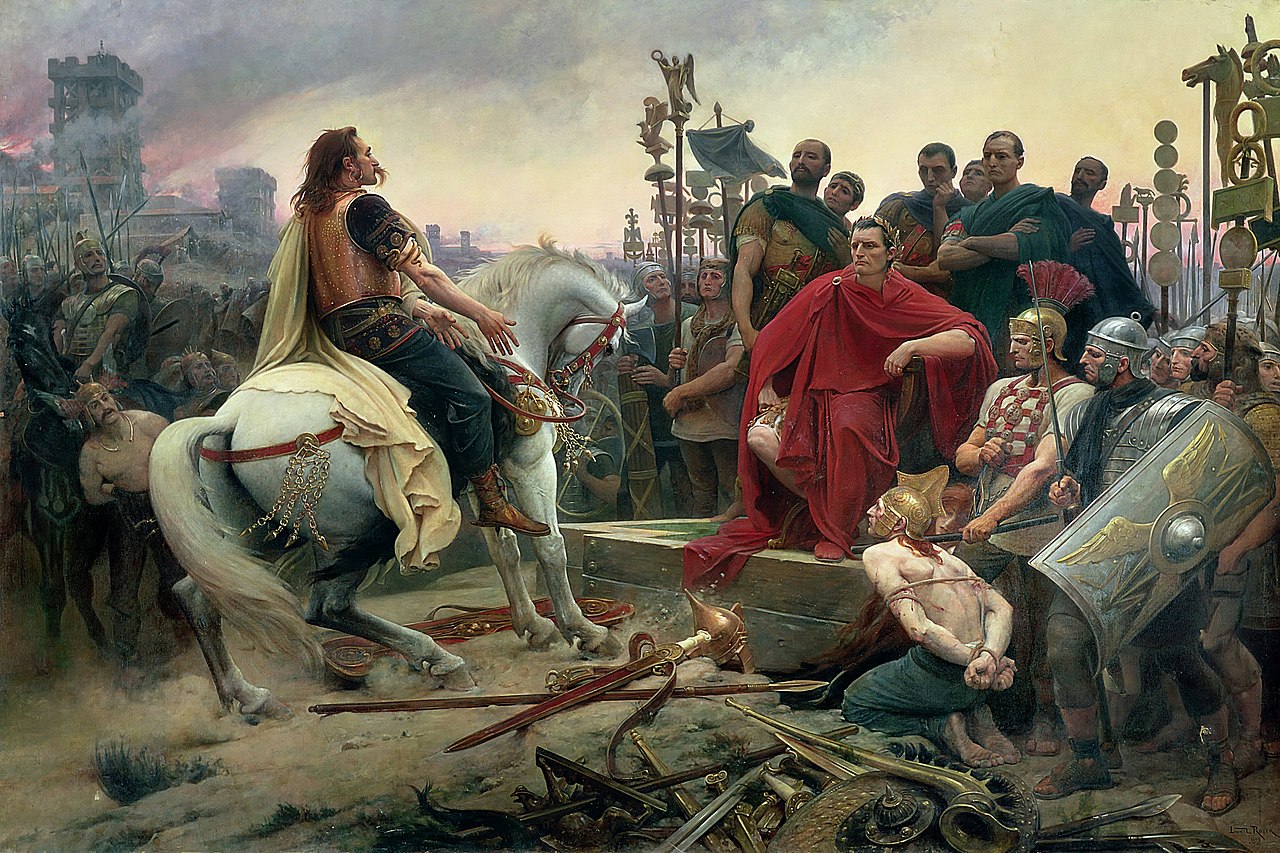
Lionel Royer (1852-1926). Vercingetorix jette ses armes aux pieds de Jules César (Vercingetorix throws down his arms at the feet of Julius Caesar)
The painting depicts the surrender of the Gallic chieftain after the Battle of Alesia (52 BC). The depiction of Gauls with long hair and mustaches is also called into question today. The horse is a Percheron, although at this time this breed was not in Gaul. The rectangular shield also does not accord with the time when they were mostly oval.
Musée CROZATIER du Puy-en-Velay. — http://www.mairie-le-puy-en-velay.fr/ via Wikimedia Commons.
Academics, of course, are all in on “social” explanations of historical phenomena. Being weak, ineffective people themselves, with no experience of life, the very idea of a Caesar frightens and repels them… so they construct theories of History in which it is impossible for a Caesar to exist. On this view, “social forces” (what they used to call “the relations of the means of production”) tore the Roman Republic apart; the Empire was its inevitable next stage. Assign whatever name you like to the Imperator — whether Caesar, Marius, Sulla, or Miles Gloriosus, he’s just the temporary face of the vast, impersonal social forces that control our fate. None of this “History is just the biographies of great men” for them!
The eggheads have a point, though, albeit not the one they think they’re making. The Roman elite’s social system was designed to produce a certain type of man. Whether Gaius Julius Caesar was personally the embodiment of that system, or a perversion of it, is irrelevant — the system was designed to produce men like Caesar, fellows with a very particular set of skills. Eggheads have never seen one, but anyone who has kicked around the world outside the ivory tower for a bit has met that type of guy. The skills themselves are fairly common, at least in embryo. Whether a potential Caesar becomes actual might well be merely a question of opportunity and scale.
A terrifying notion, that, when you look around the modern West. The one characteristic all effective elites have in common is the self-knowledge that they are the elite. The British, for instance, thought nothing of sending some 19 year old kid, whose slim formal education was mostly Latin and Greek, off to govern the Punjab. It worked, largely because that kid, whatever his defects of intellect and ability, had character, of the kind you just don’t get without a pedigree stretching back to Hastings.
Again, if you’ve ever met one of the horsey set you know what I’m talking about. If you haven’t, the most accessible American equivalents are the sons and grandsons of career army officers. Think of Lieutenant Dan in Forrest Gump, as played by Gary Sinise in the movie. That kind of guy always completes the mission, or dies trying, because it’s simply unthinkable that he won’t. After five generations, West Point is in his DNA…
Comments Off on Those “theories of history”
The Supreme Court of Canada goes on a roadtrip
John Carpay explains why the Supreme Court’s junket in September isn’t a good idea:
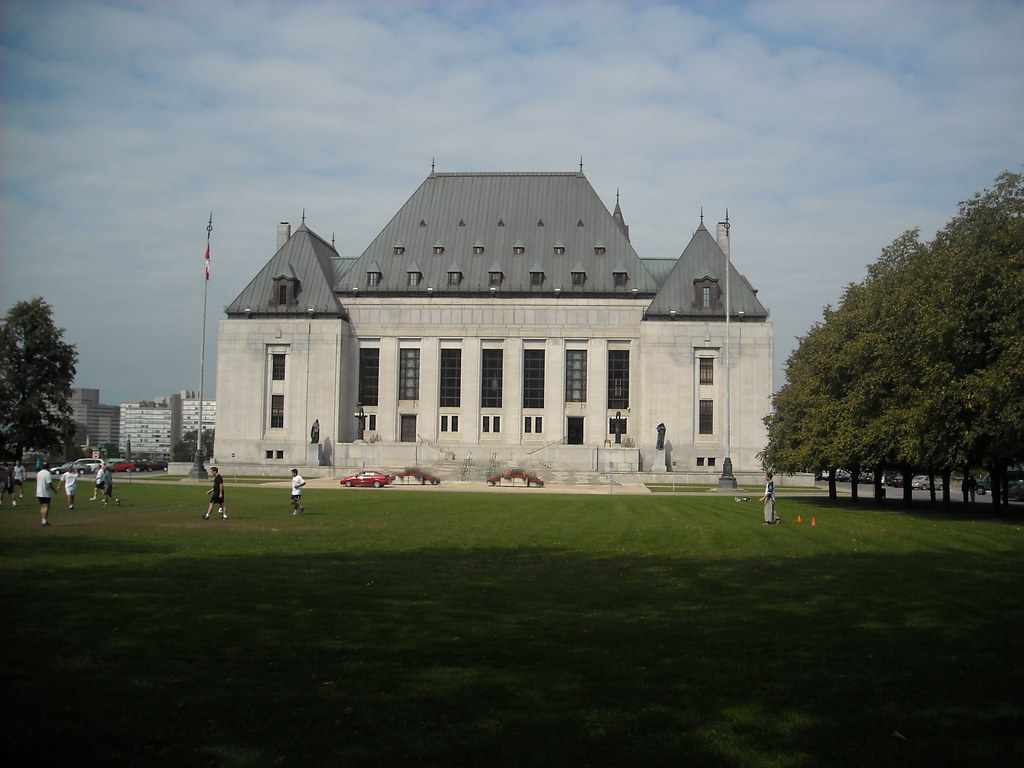
“Supreme Court of Canada, Ottawa”by daniel0685 is licensed under CC BY 2.0

While hearing two cases in Winnipeg rather than Ottawa is a friendly gesture, the Court’s choice of which groups to meet with – and not meet with – in Winnipeg is necessarily a political choice. If you thought the Court would meet with Ukrainians and Germans (Manitoba’s two largest non-English ethnic communities), prisoners, seniors, taxpayer groups and English language rights activists opposed to official bilingualism, you would be wrong.
In fact, the Court has announced that it will meet with “indigenous communities, the francophone community, the legal community, and students.” What message does this send to the Canadian public, which wants an impartial court deciding on aboriginal claims? What does meeting with the francophone community in Winnipeg say in relation to the Court hearing a case about minority language educational rights? And what if university tuition payments were at the heart of a case that came before the SCC, with its Justices having met only with students, but not with taxpayers?
As Canadians, the Supreme Court judges already interact with the public in their private lives, in Ottawa and elsewhere. One could reasonably assume that the nine lawyers appointed to this Court each meet individually with various people regularly, on the basis of friendship, shared interests, or family obligations. The people with whom any one judge meets over the course of a year would likely not form a perfect microcosm of Canadian society, in terms of race, religion, political views, income, and level of education. This is to be expected, and there is nothing wrong with it, because the personal connections formed by any one judge are not publicly endorsed by the Court. Not so for these meetings of “the Court” as a whole in Winnipeg, which is what makes the Court’s exclusion of many groups worrisome.
Chief Justice Wagner would no doubt respond to the above by saying that he and his colleagues will do their very best to decide all cases impartially, regardless of which groups they chose to meet with (and not meet with) in Winnipeg. And he would be right.
But that doesn’t solve the problem. The Court has made a political decision to meet with francophones, not English language rights activists; lawyers not prisoners; students not seniors; aboriginals not Germans or Ukrainians. In view of the ancient and centrally important legal maxim, “Not only must justice be done; justice must be seen to be done,” the Court should not be making these political decisions in the first place, in order to avoid even the appearance of possible bias.
It’s bad enough that the Prime Minister is seen to be putting a thumb on the scales of justice, but much worse if the highest court in the land is perceived to be doing the same thing.
Comments Off on The Supreme Court of Canada goes on a roadtrip
May 22, 2019
Climate change, no, climate crisis, no, climate catastrophe, no, we mean climate APOCALYPSE!!!
The official marching orders for journalists now insist that the language to use around what was formerly “global warming” or “climate change” will now be described in starker, more frightening terms. Canada’s Liberal Party, under Justin Trudeau, has been virtue signalling for pretty much its entire term in office on the climate issue and with a fall election coming into view, the rhetoric will become more extreme and shrill. Jay Currie discusses climate change and the Canadian election:
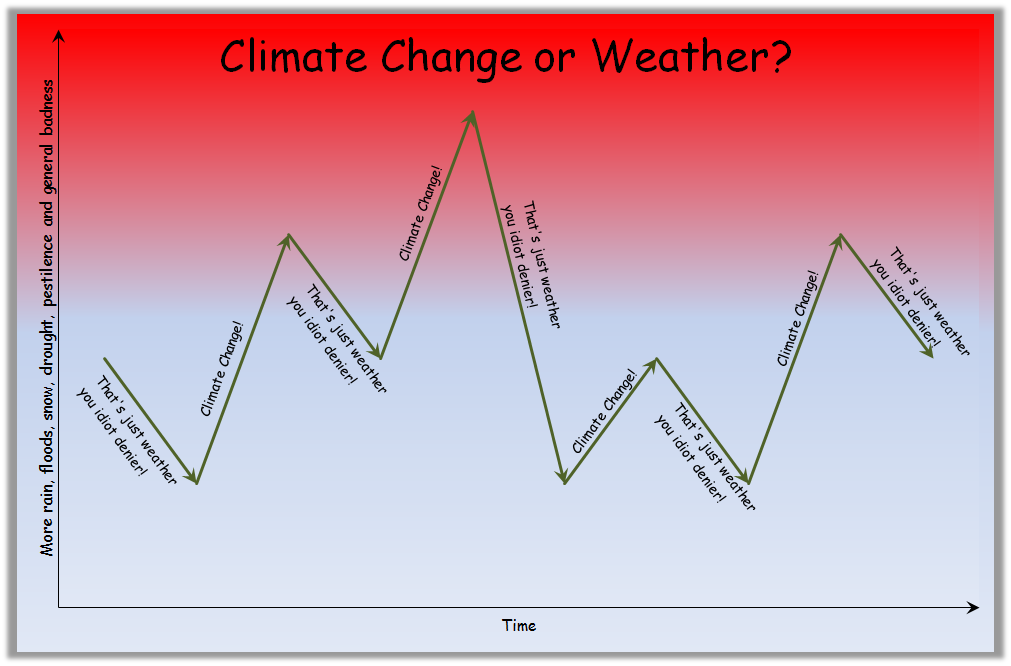
I suspect this divide between people who think “doing something” about climate change (no matter how futile) and people who do not accept the urgency of dealing with something they really don’t believe in will inform politics in the West for the next few years. Most particularly, it will inform the next Canadian federal election.
The Liberal Party of Canada has been going all in on its “tax on carbon pollution” (a fine bit of wordsmithing managing to attach “carbon” to “pollution”). Led by the remarkably scolding Catherine McKenna, the Libs seem to think that purporting to “do something” about climate change is a vote winner. So McKenna tours the country speaking to uncritical school children and assorted environmentalists about how important having a “carbon tax” is. The Liberals tax will save the planet, ensure sea level rise stops (easy because sea level is not actually rising), save the Arctic ice cap (already saving itself, thank you), keep polar bears from extinction (also easy because virtually all polar bear populations are growing) and reduce or eliminate climate change “caused” weather events. Plus, Canada will honour its Paris Accord commitments (we won’t) and serve as a beacon to lesser nations like China and India in their efforts to combat climate change (as if).
The Liberals think that the fact that a carbon dioxide tax in Canada will have a rounding error effect on worldwide emissions and no detectable effect on world temperature does not matter politically. What matters politically is that the Liberals believe that there is a large constituency out there which urgently wants to “do something”.
The NDP is fully on board and, of course, the Greens have been banging the climate change drum forever. Andrew Scheer’s Conservatives seem to be on the fence. Like the Coalition in Australia, the Conservatives endorse the “climate change is a problem” line and very few are willing to challenge the underlying science or economics for fear of being branded uncool “climate change deniers”. But the Conservatives seem to be, prudently in my view, dragging their feet on “doing something” about CO2.
Political virtue signalling on the climate file is the easy part. All that is really required is the abandonment of any sort of scientific judgement (easy when you are told that all the scientists agree that climate change is real and primarily human caused) and policy skepticism (we don’t need a cost benefit analysis, this is an emergency!). The hard part occurs when you try to “do something”. Because doing something means that people are going to see their expenses rise without actually seeing (in any tangible way) any actual benefit. In fact, as Ontario’s wonderfully disastrous adventure in wind energy demonstrated, tax dollars can be wasted and consumer prices increased all without making any difference at all to the climate.
Comments Off on Climate change, no, climate crisis, no, climate catastrophe, no, we mean climate APOCALYPSE!!!
May 21, 2019
The Brexit Party may be getting dirty foreign money! Call out the plod!
In the Guardian, totally neutral and disinterested journalists report on former Labour PM Gordon Brown’s call to investigate where the Brexit Party is getting its funding from:
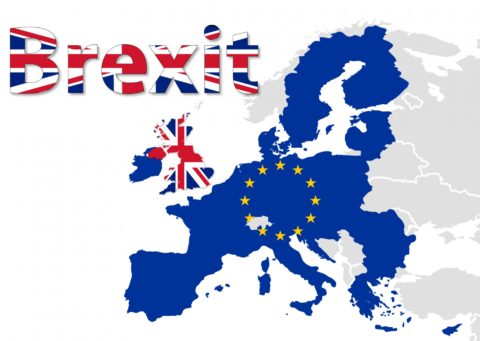
The Electoral Commission is under mounting pressure to launch an investigation into the funding of Nigel Farage’s Brexit party because of concerns that its donation structure could allow foreign interference in British democracy.
Before Thursday’s crucial European elections, Gordon Brown has written to the Electoral Commission calling on it to urgently examine whether the party has sufficient safeguards on its website to prevent the contribution of “dirty money”.
The former Labour prime minister will use a speech in Glasgow on Monday to say an investigation into the Brexit party’s finances is urgent and essential.
“Nigel Farage says this election is about democracy. Democracy is fatally undermined if unexplained, unreported and thus undeclared and perhaps under the counter and underhand campaign finance – from whom and from where we do not know – is being used to influence the very elections that are at the heart of our democratic system,” he will say, according to pre-released extracts.
As Tim Worstall points out:
It’s actually an entire 13 paragraphs later that we get to the meat of the matter:
Only donations over £500 have to be declared under British law.
The Brexit Party is obeying every jot and tittle of electoral and fundraising law. This is the very system that the federast establishment set up itself. But, you know, the wrong people are succeeding under it so aspertions must be cast.
And guess what? The Electoral Commission isn’t going to get anything done by Thursday. Not even to be able to confirm that the law is being obeyed as it should be. But we’ve managed to get the propaganda out there that Nigel’s posse are bought by the Russians and that’s the point of it all anyway.
You might think me a little cynical here. But sadly I’m not. When I was working for Ukip the Times – Sam Coates it was – announced that we simply weren’t going to contest the next election. No reason given, no analysis performed, an apology of any prominence never was forthcoming. Just a bit of disinformation dropped into the public conversation there.
That’s how the federasts play and any governance system that has to play that way isn’t one we desire to be a part of, is it?
The Hell with the EU.
Of course, dirty anonymous foreign money sources can fund other groups too.
Comments Off on The Brexit Party may be getting dirty foreign money! Call out the plod!
May 18, 2019
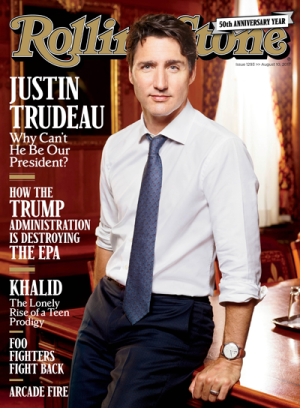
Justin Trudeau expects more than just ordinary loyalty from civil servants
In the Post Millennial, Mika Ryu summarizes Trudeau’s un-statesman-like behaviour through the Admiral Norman persecution — including his decision not to be in the house when a motion was passed apologizing to Norman — and offers an explanation for Trudeau’s oddities:
… according to a Globe and Mail report published around 6am on Friday by their Ottawa Bureau Chief Robert Fife, who also broke the SNC-Lavalin story in February of this year.
In the new bombshell report, Mr. Trudeau is alleged to have been furious about the leak that prevented the Liberal government from cancelling a massive ship building contract that was already well on its way to being executed.
The prime minister is alleged to have felt “betrayed” by the leak, after “all he had done” for the public service after a decade under Harper. This is very similar to the reason why he yelled at MP Celina Caesar-Chavannes when she told him that she would not run for re-election.
It is becoming clear that defeating Harper has turned Trudeau into a hero in his own mind, for which the entire country and all of its citizen owe him an infinite debt.
It was already known that the Privy Council Office had called in the RCMP to investigate the person behind the collapse of a would-be sweetheart deal for the well-connected “Rockefellers of Atlantic Canada”. This was a very unusual move, which was supported by alleged “Irving’s Boy”.
It continues to paint a troubling picture of the prime minister, a man who perhaps might not have “been so forward” with his corruption if he knew that the national newspapers would report on it, even in the face of the state’s increasing use of sinister carrots and sticks in the run-up to the election.
Comments Off on Justin Trudeau expects more than just ordinary loyalty from civil servants
QotD: “Revenue neutral” tax cuts
Real men (as well as pull-no-punches women) cut taxes. The lesser mortals that tend to inhabit Washington wring their hands and get all weak in the knees when it comes to cutting taxes. Rumors are President Trump will propose a real tax cut. I certainly hope so.
Once upon a time, most Republicans believed in tax cuts. Somewhere along the way, inside the beltway especially, Republicans forgot about the benefits of cutting taxes. Republicans became more concerned with government keeping “its” revenue than letting the people keep their money.
Too many Republican have become timid about tax cuts, often spouting the milquetoast line of “revenue neutral tax cuts.”
Let me translate that little bit of Washington-speak for you. “Revenue neutral” tax cuts aren’t really tax cuts. It’s more like tax shifting. Some will pay more. Some will pay less. And the net effect will be that government will collect the same amount of taxes.
If revenue neutral tax shifting is what Republicans stand for, maybe it’s time we re-evaluated what we really stand for.
What will “revenue neutral” tax cut mean to your business? Well, that may depend on how expensive your lobbyist is. Which side of the “revenue-neutral” ledger you wind up on may depend on how well the skids are greased, hardly, a pleasant scenario to anticipate.
I believe as John F. Kennedy and Ronald Reagan did, that the best way to stimulate our economy, promote job growth, and give our ailing middle class a raise is to cut taxes for all.
Rand Paul, “Real Men Cut Taxes”, Breitbart.com, 2016-04-25.
Comments Off on QotD: “Revenue neutral” tax cuts


