Quotulatiousness

July 26, 2019

The young Boris Johnson at Oxford

Filed under: Britain, Education, Politics — Tags: , , — Nicholas @ 05:00

Toby Young recounts his first encounter with the new Prime Minister of the United Kingdom at Oxford in 1983:

Boris Johnson, Secretary of State for Foreign and Commonwealth Affairs at an informal meeting of the Foreign Affairs Council on 15 February 2018.
Photo by Velislav Nikolov via Wikimedia Commons.

I first set eyes on Boris Johnson in the autumn of 1983 when we went up to Oxford at the same time. I knew who he was since my uncle Christopher was an ex-boyfriend of his mother’s and he had told me to keep an eye out for him, but I still wasn’t prepared for the sight (and sound) of him at the dispatch box of the Oxford Union. This was the world famous debating society where ambitious undergraduates honed their public-speaking skills before embarking on careers in politics or journalism, and Boris was proposing the motion.

With his huge mop of blond hair, his tie askew and his shirt escaping from his trousers, he looked like an overgrown schoolboy. Yet with his imposing physical build, his thick neck and his broad, Germanic forehead, there was also something of Nietzsche’s Übermensch about him. You could imagine him in lederhosen, wandering through the Black Forest with an axe over his shoulder, looking for ogres to kill. This same combination — a state of advanced dishevelment and a sense of coiled strength, of an almost tangible will to power — was even more pronounced in his way of speaking.

He began to advance an argument in what sounded like a parody of the high style in British politics — theatrical, dramatic, self-serious — when — a few seconds in — he appeared to completely forget what he was about to say. He looked up, startled — Where am I? — and asked the packed chamber which side he was supposed to be on. “What’s the motion, anyway?” Before anyone could answer, a light bulb appeared above his head and he was off, this time in an even more orotund, florid manner. Yet within a few seconds he’d wrong-footed himself again, this time because it had suddenly occurred to him that there was an equally compelling argument for the opposite point of view. This endless flipping and flopping, in which he seemed to constantly surprise himself, went on for the next 15 minutes. The impression he gave was of someone who’d been plucked from his bed in the middle of the night and then plonked down at the dispatch box of the Oxford Union without the faintest idea of what he was supposed to be talking about.

I’d been to enough Union debates at this point to know just how mercilessly the crowd could punish those who came before them unprepared. That was particularly true of freshmen, who were expected to have mastered all the arcane procedural rules, some of them dating back to the Union’s founding in 1823. But Boris’s chaotic, scatter-brained approach had the opposite effect. The motion was deadly serious — “This House Would Reintroduce Capital Punishment” — yet almost everything that came out of his mouth provoked gales of laughter. This was no ordinary undergraduate proposing a motion, but a Music Hall veteran performing a well-rehearsed comic routine. His lack of preparedness seemed less like evidence of his own shortcomings as a debater and more a way of sending up all the other speakers, as well as the pomposity of the proceedings. You got the sense that he could easily have delivered a highly effective speech if he’d wanted to, but was too clever and sophisticated — and honest — to enter into such a silly charade. To do what the other debaters were doing, and pretend he believed what was coming out of his mouth, would have been patronising. Everyone else was taking the audience for fools, but not him. He was openly insincere and, in being so, somehow seemed more authentic than everyone else.

To say I was impressed would be an understatement. A few years before arriving at Oxford I had watched the television adaptation of Brideshead Revisited, Evelyn Waugh’s Oxford novel, and had been expecting to meet the modern-day equivalents of Sebastian Flyte and Anthony Blanche: larger-than-life, devil-may-care aristocrats delivering bon mots in between sips of champagne and spoonfuls of caviar. But the reality was very different: warm beer, stale sandwiches and second-hand opinions. Lots of spotty students, all as gauche as me. Less like an Oscar Wilde play than a Mike Leigh film.

In Boris, though, it was as if I’d finally encountered the “real” Oxford, the Platonic ideal. While the rest of us were works-in-progress, vainly trying on different personae, Boris was the finished article. He was an instantly recognizable character from the comic tradition in English letters: a pantomime toff. He was Sir Toby Belch in Twelfth Night demanding more cakes and ale, Bertie Wooster trying to pass himself off as Eustace H. Plimsoll when appearing in court after overdoing it on Boat Race night. Yet at the same time fizzing with vim and vinegar — “bursting with spunk,” as he once put it, explaining why he needs so many different female partners. He was a cross between Hugh Grant and a silverback gorilla.

My uncle had described him as a “genius” and as a boy he’d been regarded as something of a wunderkind. There was the occasion when he was holidaying with his family in Greece, aged 10, and asked a group of Classics professors if he could join their game of Scrabble. They indulged the precocious, blond-haired moppet, only to be beaten by him. Thinking it was a one-off, they asked him to play another round and, again, he won. On and on it went, game after game. At the prep school he attended before going to Eton, Britain’s grandest private school, he was seen as a prodigy. A schoolmaster who taught him back then told his biographer, Andrew Gimson, that he was the quickest-learner he’d ever encountered. In the staff room, the teachers would compare notes about the “fantastically able boy.”

He was without doubt the biggest man on campus — the person most likely to succeed. He made no secret of his desire to be Prime Minister one day, and not just a run-of-the-mill, common-or-garden PM, but up there with Gladstone and Disraeli. And this was a scaling back of his ambitions — as a boy he’d told his younger sister Rachel that he wanted to be “world king.” (There was an intermediate stage during his teenage years when he harboured fantasies of becoming President of the United States — something that’s technically possible, given that he was born in New York.) He was by no means the only member of the Oxford Union to express such hopes during that period, but in his case you felt it might actually happen. Unlike so many other privileged undergraduates, with their vaulting sense of entitlement, Boris’s gargantuan self-belief seemed of a piece with his outsized personality. He had an electrifying, charismatic presence of a kind I’d only read about in books before. Our mutual friend Lloyd Evans, who knew Boris better than me at Oxford, put it well. “He’s a war leader,” he told Andrew Gimson. “He is one of the two or three most extraordinary people I’ve ever met. You just feel he’s going somewhere. People just love him. They enjoy going with him and they enjoy being led.”

To get a sense of Boris Johnson’s unique charm, here’s a brilliant pastiche of some of his TV appearances, stitched together as if it was his Olympic Games Welcome during his time as Lord Mayor of London (do watch, it’s hilarious).

July 24, 2019

“[T]he debt ‘ceiling’ is about as sturdy and solid as those featured on those DIY home reno disaster shows”

Filed under: Economics, Government, Politics, USA — Tags: , , — Nicholas @ 03:00

Mark Steyn notes that yesterday’s the “big victory” over the debt ceiling (in President Trump’s words) could be almost the same as the “big victory” he wrote about eight years earlier:

The western front of the United States Capitol. The Neoclassical style building is located in Washington, D.C., on top of Capitol Hill at the east end of the National Mall. The Capitol was designated a National Historic Landmark in 1960.
Photo via Wikimedia Commons.

That thoughtful observer of the passing parade, Nancy Pelosi, weighed in on the “debt ceiling” negotiations the other day: “What we’re trying to do is save the world from the Republican budget. We’re trying to save life on this planet as we know it today.”

It’s always good to have things explained in terms we simpletons can understand. After a while, all the stuff about debt-to-GDP ratio and CBO alternative baseline scenarios starts to give you a bit of a headache, so we should be grateful to the House Minority Leader for putting it in layman’s terms: What’s at stake is “life on this planet as we know it today.” So, if right now you’re living anywhere in the general vicinity of this planet, it’s good to know Nancy’s in there pitching for you.

What about life on this planet tomorrow? How’s that look if Nancy gets her way? The Democrat model of governance is to spend four trillion dollars while only collecting two trillion, borrowing the rest from tomorrow. Instead of “printing money,” we’re printing credit cards and preapproving our unborn grandchildren. To facilitate this proposition, Washington created its own form of fantasy accounting: “baseline budgeting,” under which growth-in-government is factored in to federal bookkeeping as a permanent feature of life. As Arthur Herman of the American Enterprise Institute pointed out this week, under present rules, if the government were to announce a spending freeze – that’s to say, no increases, no cuts, everything just stays exactly the same – the Congressional Budget Office would score it as a $9 trillion savings. In real-world terms, there are no “savings,” and there’s certainly no $9 trillion. In fact, there isn’t one thin dime. But nevertheless that’s how it would be measured at the CBO.

Around the world, most folks have to work harder than that to save $9 trillion. That’s roughly the combined GDPs of Japan and Germany. But in America it’s an accounting device. This is something to bear in mind when you’re listening to the amount of “savings” touted by whatever triumphant bipartisan deal is announced at the eleventh hour in Washington.

So I find myself less interested in “life on this planet as we know it today” than in life on this planet as we’re likely to know it tomorrow if Nancy Pelosi and her chums decline to reacquaint themselves with reality. If you kinda dig life on this planet as you know it, ask yourself this: What’s holding the joint up? As the old gag goes, if you owe the bank a thousand dollars, you have a problem; if you owe the bank a million dollars, the bank has a problem. If you owe the banks 15,000,000,000,000 dollars, the planet has a problem. Whatever comparisons one might make with Europe’s soi-disant “PIIGS” re debt per capita or deficit-to-GDP ratio, the sheer hard numbers involved represent a threat to the planet that Portugal or Ireland does not. It also represents a threat to Americans. Three years ago, the first developed nation to hit the skids was Iceland. But, unless you’re Icelandic, who cares? And, if you are Icelandic, you hunker down, readjust to straitened circumstances, and a few years down the line Iceland will still be Iceland and, if that’s your bag, relatively pleasant.

That’s not an option for the U.S. We are chugging a highly toxic cocktail: 21st-century spendaholic government with mid-20th-century assumptions about American power. After the Battle of Saratoga, Adam Smith replied to a pal despondent that the revolting colonials were going to be the ruin of Britain: “There is a great deal of ruin in a nation,” said a sanguine Smith.

July 22, 2019

No Flag Northern Ireland

Filed under: Britain, Europe, History, Politics — Tags: , , , , — Nicholas @ 02:00

CGP Grey
Published on 18 Jun 2019

Northern Ireland’s officially unofficial flag.

July 21, 2019

QotD: History in a totalitarian age

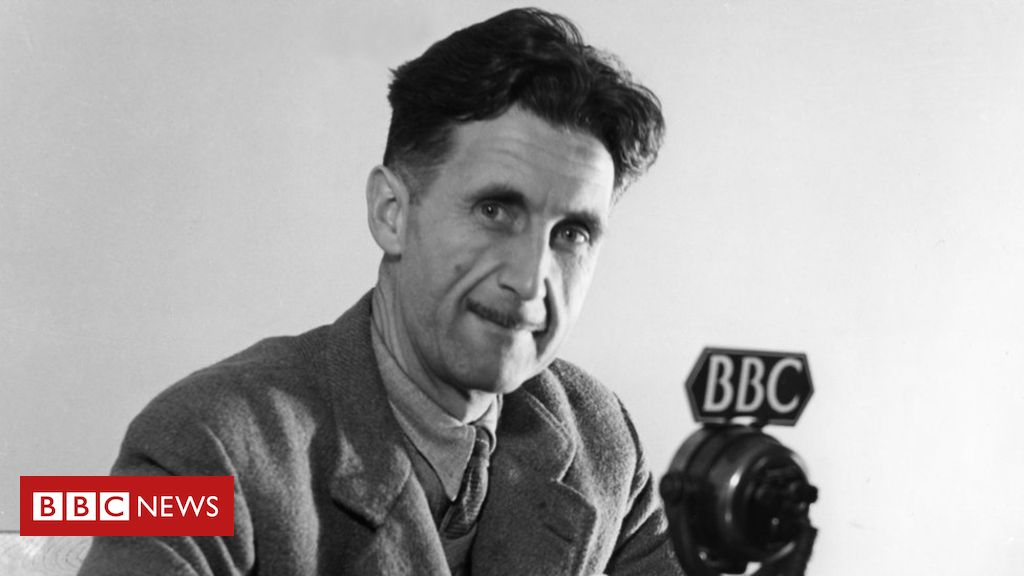
Orwell’s press card portrait, 1943

I know it is the fashion to say that most of recorded history is lies anyway. I am willing to believe that history is for the most part inaccurate and biased, but what is peculiar to our own age is the abandonment of the idea that history could be truthfully written. In the past people deliberately lied, or they unconsciously coloured what they wrote, or they struggled after the truth, well knowing that they must make many mistakes; but in each case they believed that “facts” existed and were more or less discoverable. And in practice there was always a considerable body of fact which would have been agreed to by almost everyone. If you look up the history of the last war in, for instance, the Encyclopaedia Britannica, you will find that a respectable amount of the material is drawn from German sources. A British and a German historian would disagree deeply on many things, even on fundamentals, but there would still be that body of, as it were, neutral fact on which neither would seriously challenge the other. It is just this common basis of agreement, with its implication that human beings are all one species of animal, that totalitarianism destroys. Nazi theory indeed specifically denies that such a thing as “the truth” exists. There is, for instance, no such thing as “Science”. There is only “German Science”, “Jewish Science”, etc. The implied objective of this line of thought is a nightmare world in which the Leader, or some ruling clique, controls not only the future but the past. If the Leader says of such and such an event, “It never happened” — well, it never happened. If he says that two and two are five — well, two and two are five. This prospect frightens me much more than bombs — and after our experiences of the last few years that is not a frivolous statement.

But is it perhaps childish or morbid to terrify oneself with visions of a totalitarian future? Before writing off the totalitarian world as a nightmare that can’t come true, just remember that in 1925 the world of today would have seemed a nightmare that couldn’t come true. Against that shifting phantasmagoric world in which black may be white tomorrow and yesterday’s weather can be changed by decree, there are in reality only two safeguards. One is that however much you deny the truth, the truth goes on existing, as it were, behind your back, and you consequently can’t violate it in ways that impair military efficiency. The other is that so long as some parts of the earth remain unconquered, the liberal tradition can be kept alive. Let Fascism, or possibly even a combination of several Fascisms, conquer the whole world, and those two conditions no longer exist. We in England underrate the danger of this kind of thing, because our traditions and our past security have given us a sentimental belief that it all comes right in the end and the thing you most fear never really happens. Nourished for hundreds of years on a literature in which Right invariably triumphs in the last chapter, we believe half-instinctively that evil always defeats itself in the long run. Pacifism, for instance, is founded largely on this belief. Don’t resist evil, and it will somehow destroy itself. But why should it? What evidence is there that it does? And what instance is there of a modern industrialized state collapsing unless conquered from the outside by military force?

Consider for instance the re-institution of slavery. Who could have imagined twenty years ago that slavery would return to Europe? Well, slavery has been restored under our noses. The forced-labour camps all over Europe and North Africa where Poles, Russians, Jews and political prisoners of every race toil at road-making or swamp-draining for their bare rations, are simple chattle slavery. The most one can say is that the buying and selling of slaves by individuals is not yet permitted. In other ways — the breaking-up of families, for instance — the conditions are probably worse than they were on the American cotton plantations. There is no reason for thinking that this state of affairs will change while any totalitarian domination endures. We don’t grasp its full implications, because in our mystical way we feel that a regime founded on slavery must collapse. But it is worth comparing the duration of the slave empires of antiquity with that of any modern state. Civilizations founded on slavery have lasted for such periods as four thousand years.

When I think of antiquity, the detail that frightens me is that those hundreds of millions of slaves on whose backs civilization rested generation after generation have left behind them no record whatever. We do not even know their names. In the whole of Greek and Roman history, how many slaves’ names are known to you? I can think of two, or possibly three. One is Spartacus and the other is Epictetus. Also, in the Roman room at the British Museum there is a glass jar with the maker’s name inscribed on the bottom, “Felix fecit“. I have a mental picture of poor Felix (a Gaul with red hair and a metal collar round his neck), but in fact he may not have been a slave; so there are only two slaves whose names I definitely know, and probably few people can remember more. The rest have gone down into utter silence.

George Orwell, “Looking back on the Spanish War”, New Road, 1943 (republished in England, Your England and Other Essays, 1953).

July 20, 2019

“Boris Johnson is the only man alive who could convincingly turn The Emperor’s New Clothes into a one-man play”

Filed under: Britain, History, Media, Politics, Religion — Tags: , , , — Nicholas @ 05:00

In Spiked, Alaa al-Ameri says that Boris Johnson actually does have a valid point in his criticism of Islam:

Boris Johnson, Secretary of State for Foreign and Commonwealth Affairs at an informal meeting of the Foreign Affairs Council on 15 February 2018.
Photo by Velislav Nikolov via Wikimedia Commons.

Boris Johnson is the only man alive who could convincingly turn The Emperor’s New Clothes into a one-man play. He’s perfect for every role – the pompous, bumbling, vain emperor; the barefaced conmen trafficking in audacious whoppers; and, most importantly, the little boy, unable to keep from blurting out the obvious, especially when everyone around him is busy parroting the convenient lie of the day.

Not for the first time, Johnson has offended polite society by suggesting that there might be something less than perfectly laudable about some aspects of Islam. Perish the thought. In particular, offence-miners at the Guardian have discovered that Johnson once wrote that Islam has held Muslim countries back by “centuries”.

A cursory look around the world is enough to conclude that there may be something to Johnson’s argument. A deeper look at Arab and Muslim history – both ancient and recent – might at least confirm the possibility that such a statement is something other than flat-out bigotry. Or so you might have thought, if you had recently awoken from a 30-year coma. In 2019, however, such thoughts are unthinkable.

We can moralise all day long about the evils of European colonialism. But it was a historical blink of an eye in comparison to the centuries of Arab and Muslim colonialism that produced the cultures to which Johnson was referring. We can wring our hands over the influence of literalist Christianity on American politics. But this is a drop in the ocean compared to the cultural and political leverage of Islam across the globe. We can lament the potential harm to Indian democracy posed by militant Hindu nationalism. But there is nothing questionable about entertaining the notion that centuries of Muslim global imperialism – which ended less than 100 years ago – might have left behind a less than a gleaming legacy.

“Scheer is demonstrating what it actually looks like for a Canadian political leader to be utterly beholden to a special interest group”

Filed under: Bureaucracy, Cancon, Economics, Food, Politics — Tags: , , , — Nicholas @ 03:00

I wasn’t a fan of Andrew Scheer even before he bought the leadership of the Conservative party with Quebec dairy money. I think he was one of the worst possible choices for Tory leader, but we’re stuck with his ineffectual bought-and-paid-for self to attempt to beat an incumbent PM who has the undying loyalty of 95% of the mainstream media. And we know beyond a shadow of a doubt that his loyalty isn’t to Canada or to the Tories, but to his paymasters in Big Dairy. Despite this, Chris Selley says that The Milk Dud’s vassalage to a well-moneyed and legally privileged class may end up destroying the government cartel that is Supply Management:

Andrew Scheer, paid tool of Big Dairy, chugs some milk during a Press Gallery speech in 2017. I’ve called him the “Milk Dud” ever since.
Screencapture from a CTV video uploaded to YouTube.

There’s no shame in a conservative politician opposing the federal government of a gigantic country containing multitudes of lifestyles trying to create an ideal diet for all its citizens. “I’ll eat what I want, get out of my kitchen,” is a perfectly respectable position — especially since the food guide is such a joyless, under-salted slog. But that’s not Scheer’s position. Instead he’s vowing to “get it right.” This suggests consulting people other than medical and scientific experts, most of whom were relatively pleased with this edition of the food guide. It suggests bringing industry voices back into the mix. And that’s not something anyone other than Big Dairy and Big Meat should want.

The so-con comparison is somewhat facetious, of course: Abortion is a third-rail issue, or at least the media treats it as such, whereas unwavering protectionist support for our dairy farmers is an all-party consensus-cum-contest to see who can most abase themselves. The winner, by far, is Andrew Scheer. On Wednesday he excoriated the Liberal government for allegedly missing deadlines to explain how it would compensate dairy farmers for ever-so-slightly opening the Canadian market to European and Asian countries.

“(This) mistreatment is unacceptable,” he told the Saskatonian audience. His future government would “never back down from defending the (dairy) sector,” he vowed.

In a strange way, it gives me hope. Surely it’s objectively weird that a man the Liberals are trying to portray as the human embodiment of Canada’s future ruination is so cartoonishly in favour of subsidizing and coddling a given industry, thereby continuing to inflate prices for Canadian consumers, and yet his opponents’ only instinct is to find a way to agree with him. By rights it ought to be the Conservatives who bust up lactosa nostra (copyright CBC’s David Cochrane). But having rebuffed Big Dairy’s dubious dietary advice, the option is entirely open to the Liberals as well. The average Canadian grocery shopper will thank whichever party finally gets it done.

July 18, 2019

QotD: “They might speak English, but they don’t speak Western”

Filed under: Books, Education, History, Media, Politics, Quotations, USA — Tags: , , , , , — Nicholas @ 01:00

[Responding to a photo of a protest sign labelled “Dumbledore wouldn’t let this happen“] I swear, it’s all you ever see from them.

But something happened to me last night, I had a kind of realization. It suddenly hit me WHY that is.

It’s because Harry Potter is literally all they collectively know.

Schools don’t teach history anymore.
They no longer teach the canon of Western literature.
They certainly don’t teach the Bible.

So Millennials literally have no points of common reference. It’s not that they all just want to look like complete morons by infantilizing their political metaphor to the level of a children’s book, it’s that they have no other choice.

They’re literally bereft of the allegorical language of the West. I’m sure there’s some Harry Potter monster analogy I could use to explain it to them, how it’s like monsters have come along and literally stolen their ability to speak, their common language, and their birthright.

They can no longer express or understand the set of references we have from our past, our most prized stories, and our culture’s religious quotations. They can’t do Shakespeare, Milton, or even Mark Twain because they’ve never learned any of these while they were being taught Indonesian multicultural dancing and given participation awards. They don’t know what happened at Hastings in 1066, at Runnymede in 1215, or even at Sarajevo in 28th June 1914, because they were being given feminist diversity training instead of learning the history of their civilization. They certainly don’t know what “the least of these” refers to or where it comes from, as a recent event with a White House staffer proved.

They’ve lost the entire allegorical language of the West. They might speak English, but they don’t speak Western. To them, it’s like a foreign, dead, alien language. A set of stories they do not know.

RPGPundit, “Harry Potter and the way Millennial Leftists Don’t Even Speak Western Anymore”, The RPGPundit, 2017-02-02.

July 17, 2019

Andrew Scheer falls into carefully prepared media trap on “conversion therapy”

Filed under: Cancon, Media, Politics — Tags: , , , — Nicholas @ 05:00

Chris Selley explains why federal Conservative leader Andrew Scheer is now being pilloried over his stance on banning so-called “conversion therapy”:

Andrew Scheer meets British Prime Minister Theresa May
Photo via Wikimedia Commons

The day before Global ran its story, CBC reported it had “obtained” a letter the feds sent to the provinces in June asking them to ramp up efforts to outlaw preposterous and potentially dangerous so-called treatments designed to turn homosexual people into heterosexual people. “The provincial, territorial, municipal and federal governments all have roles to play to protect Canadians from the harms associated with this practice,” read the letter, signed by federal Justice Minister David Lametti among others. “The federal government is committed to doing everything within its jurisdiction to combat conversion therapy” — including, supposedly, amendments to the Criminal Code.

Global took that to Scheer, who had nothing nice to say about conversion therapy: “We will always … stand up for the rights of LGBTQ individuals and protect their rights and … we’re opposed to any type of practice that would forcibly attempt to change someone’s sexual orientation.”

Asked whether he would support a “ban,” Scheer responded precisely as opposition leaders always do in the absence of legislation: “We will wait and see exactly what is being contemplated.” After all, Scheer trenchantly noted, “this is something that this Liberal government is only now recently proposing.”

This entirely reasonable position begat the above-noted headline, and the above-noted headline begat mass outrage — including among commentators who know very well how the game is played. “Why would you allow any ambiguity about where you stand?” Global radio host Charles Adler fumed on Twitter, addressing Scheer. “Why can’t you just say this so-called therapy is peddled by charlatans. It exploits vulnerable people including children. Voluntary or coercive, it’s bogus.”

Now, if you think it’s self-evident that conversion therapy ought to be illegal in Canada, and you hold anyone who doesn’t share and proselytize that opinion in contempt, then Scheer has given you your answer. But if that’s what you think, you should be just as furious with the Liberals — probably more.

Not only is the “plan for (a) conversion therapy ban” referred to in the Global headline nothing of the sort, but rather a hitherto private and suddenly, conveniently, public letter that explicitly leaves open the question of federal jurisdiction. But the letter was sent just a few weeks after the Liberals ruled out exactly what the headline would have us believe they are now proposing!

July 16, 2019

Totalitarian Temptations in Free Societies by Ryszard Legutko

Filed under: Books, Economics, Government, History, Politics — Tags: , , , , — Nicholas @ 05:00

Daniel Pipes reviews a recent translation (from Polish) by Teresa Adelson:

Legutko does not claim liberalism resembles communism in its monstrosity, much less that the two ideologies are identical; he fully acknowledges that the first is democratic and the second brutally tyrannical. After recognizing this contrast, however, he gets down to the more pungent topic of what the two have in common.

He first perceived those commonalities in the 1970s when visiting the West, where he saw how its liberals preferred communists to anti-communists; later, with the overthrow of the Soviet Bloc, he watched liberals warmly welcome communists, but not their anti-communist opponents. Why so?

Because, he argues, liberalism shares with communism a powerful faith in rational minds finding solutions which translates into a drive to improve the citizen, modernize him, and mold him into a superior being. Accordingly, both ideologies politicize, and thereby debase, every aspect of life, including sexuality, the family, religion, sports, entertainment, and the arts. (Here’s a mischievous but deadly serious question: which is the more awful art, the communist or the liberal, Stalin’s or the Venice Biennale’s?) [see below]

Both engage in social engineering to create a society whose members are “indistinguishable, in words, thoughts, and deeds ” from one another, aiming for a largely interchangeable population with no dissidents making trouble. Each sublimely assumes its specific vision constitutes the greatest hope for mankind and represents the end of history, the final stage of mankind’s evolution.

Trouble is, such grand schemes for improving mankind inevitably lead to severe disappointment; human beings, it turns out, are far more stubborn and less malleable then dreamers would like. When things go badly (say, food production for communists, unfettered immigration for liberals), two nasty consequences follow.

July 14, 2019

The Epstein scandal is another example of the importance of accurate names

Filed under: Law, Politics, USA — Tags: , , , , , , — Nicholas @ 05:00

ESR has some concerns about the Epstein case, specifically on the correct terminology to use:

The sage Confucius was once asked what he would do if he was a governor. He said he would “rectify the names” to make words correspond to reality. He understood what General Semantics teaches; if your linguistic map is sufficiently confused, you will misunderstand the territory. And be readily outmaneuvered by those who are less confused.

Mug shot of Jeffrey Epstein made available by the Palm Beach County Sheriff’s Department, taken following his indictment for soliciting a prostitute in 2006.
Image via Wikimedia Commons.

And that brings us to the Jeffrey Epstein scandal. In particular, the widespread tagging of Epstein as a pedophile.

No, Richard Epstein is not a pedophile. This is important. If conservatives keep misidentifying him as one, I fear some unfortunate consequences.

Pedophiles desire pre-pubertal children. This is not Epstein’s kink; he quite obviously likes his girls to be as young as possible but fully nubile. The correct term for this is “ephebophile”, and being clear about the distinction matters. I’ll explain why.

The Left has a long history of triggering conservatives into self-discrediting moral panics (“Rock and roll is the devil’s music”). It also has a strong internal contingent that would like to normalize pedophilia. I mean the real thing, not Epstein’s creepy ephebophilia.

Homosexual pedophiles have been biding their time in order to get adult-on-adult homosexuality fully normalized as battlespace prep, but you see a few trial balloons go up occasionally in places like Salon. The last round of this was interrupted by the need to take down Milo Yiannopolous, but the internal logic of left-wing sexual liberationism always demands new ways to freak out the normals, and the pedophiles are more than willing to be next up in satisfying that perpetual demand.

Liberals have proven themselves utterly useless at resisting the liberationist ratchet, so I’m not even bothering to address them. Conservatives, if you want to prevent the next turn, don’t give the pedophilia-normalizers maneuvering room. Rectify the names; make the distinctions that matter.

Epstein’s behavior is repulsive because we judge young postpubertal humans to be too psychologically immature to give adult consent, but it’s nowhere near the evil that is the sexual abuse of prepubertal children.

QotD: The legacy of the original hippies

Filed under: Politics, Quotations, USA — Tags: , , , — Nicholas @ 01:00

In my younger days, when I myself wore my hair long and may have dabbled in the occasional Red Dragon, Purple Om and Roobarb ‘n’ Custard, I think I might have been quite surprised to learn that the hippies I idealised at the time — well, I liked Easy Rider, and used to play Jefferson Airplane’s “White Rabbit” more often than was good for me — in fact shared the same ideological roots as the Hitler Youth.

Not now I’m older and wiser, I don’t. Beneath the kaftan of every other hippie beats the heart of a fascist — the intolerance, the zeal, the control-freakery — and it all stems from that moment, pinpointed in the documentary, when a left-wing activist and Berkeley drop-out named Jerry Rubin had a sudden insight: that there were more hippies than there were radicals.

The unfortunate result of this was that Rubin and his ilk realised that they could prey like vampires on these fluffy-headed flower children and turn their innocent yearning for peace, love and drug-addled sex into something much more dangerous, whose effects we are ruing to this day.

All that long hair, those beads, the patchouli, the starry eyes, the psychedelic sounds of the Grateful Dead; they were really just a kandy-kolored, tangerine-flake Trojan Horse for the values — or rather the anti-values — that have gone on to make our culture so weak, decadent and vulnerable to destruction by more iron-willed invaders.

This was, of course, exactly what influential campus thinkers of the time such as German-born cultural Marxist philosopher Herbert Marcuse wanted. For them, free love, female emancipation, black empowerment, the groovy rejection of authority and pursuit of the self — all sugar-coated with a great soundtrack and lashings of lovely psychotropics — were really just a means to an end: the death of the family, the dismantling of the system, and, ultimately the destruction of western civilisation.

James Delingpole, “Hippies gave us wonderful things, but they left an evil legacy too”, The Spectator, 2017-06-10.

July 12, 2019

Mark Steyn urges caution when considering the Epstein case

Filed under: Government, Law, Politics, USA — Tags: , , , , — Nicholas @ 03:00

It may make sense to avoid a rush to judgement, as the way the federal justice system works these days does not encourage a belief in its impartiality or, for that matter, its dedication to the concept of “justice”:

I am wary of saying anything too definitive re the Jeffrey Epstein case, because so much of the reporting is way too trusting of the federal prosecutors’ official narrative. Don’t get me wrong: I take it as read that he’s an industrial-scale pedophile, if only because it seems to be the only thing anybody knows about him – including how he made his billion dollars. He apparently requires three “massages” a day by underage girls. So, upon being informed that Mr Epstein was flying his “Lolita Express” around Africa with Bill Clinton, Kevin Spacey and a softcore porn actress called Chauntae Davies on board, I’m disinclined to accept the official explanation that this was an Aids-relief “humanitarian” mission.

Mug shot of Jeffrey Epstein made available by the Palm Beach County Sheriff’s Department, taken following his indictment for soliciting a prostitute in 2006.
Image via Wikimedia Commons.

That said, as longtime readers know, I regard federal justice as appallingly corrupt, and so the sudden revival of Epstein’s prosecution is somewhat more than intriguing. First, and as often with prominent American cases, the details make no sense:

    In a memo filed to the court, prosecutors outlined the scope of Epstein’s vast wealth to argue that he has the means to flee the country and escape prosecution, noting that he not only has homes in Manhattan, Palm Beach, New Mexico and Paris — with his Upper East Side townhouse, of which prosecutors are seeking the forfeiture, alone worth $77 million — but also owns a private island in the US Virgin Islands.

    He also has three US passports, owns at least 15 vehicles and has access to two private jets, according to the memo.

I can understand how a rich man comes to have fifteen cars, but how pray, does one individual citizen acquire three US passports? And from a government supposedly on “orange alert” these last eighteen years.

Second, Epstein was the beneficiary of a ludicrously lenient federal plea deal a decade ago for exactly the same charges. So this would appear to be “double jeopardy”. Not so fast, say the feds:

    It is well-settled in the Second Circuit [appellate court] that a plea agreement in one US Attorney’s office does not bind another unless otherwise stated.

Is that so? Thanks to that litigious loser Cary Katz, I’m more familiar with Second Circuit jurisprudence than I might otherwise wish. But I had no idea of the above. So apparently, when you enter into a plea deal with “the United States” that says things like “the United States, in consultation with and subject to the good faith and approval of Epstein’s counsel, shall select an attorney representative for…” and “if Epstein successfully fulfills all of the terms and conditions of this agreement, the United States also agrees that it will not institute any criminal charges against…”, the words “the United States” only apply to the United States that resides at 27 Ocean View Parkway, Miami Beach and not the United States that resides at 32b Rotting Wharf Lane, The Bronx. So forget double jeopardy; you could have demicentuple jeopardy. Who knew?

One more thing: it seems fairly obvious that Epstein is also a procurer for those whose appetites likewise run to schoolgirls. This is where the manifests of his airplane are at least somewhat inferential. Yet the new indictment is concerned only with “the New York Residence” and “the Palm Beach Residence” — and not the Lolita Express jetting well-heeled buddies to Paedo Island. Is this some cozy arrangement to ensure that Bill Clinton et al are excluded from the case?

July 10, 2019

Fake news, whacky conspiracy theories, and the arrest of Jeffrey Epstein

Filed under: Law, Media, Politics, USA — Tags: , , , , — Nicholas @ 05:00

In The Week, Matthew Walther uses the Epstein case to illustrate why many so-called “low information voters” tend to believe all sorts of odd things like Pizzagate:

The arrest of the apparent billionaire investor Jeffrey Epstein at a New Jersey airport on Saturday on federal charges for crimes he was accused of during the Bush administration should not be surprising to anyone who has followed the news carefully. He may have escaped in 2008 with a ludicrous one-year stint in a county jail that he was allowed to leave six days a week, but his name has never quite been out of the headlines. Between 2008 and 2015 Epstein reportedly settled more than a dozen lawsuits from Jane Does alleging sexual assault; the youngest of his alleged victims was 14 years old.

Mug shot of Jeffrey Epstein made available by the Palm Beach County Sheriff’s Department, taken following his indictment for soliciting a prostitute in 2006.
Image via Wikimedia Commons.

The only question is why did it take this long? Why was the ludicrous deal that gave Epstein and his fellow conspirators immunity in exchange for a slap-on-the-wrist jail sentence ever allowed to go through in the first place?

[…]

We should keep all of this in mind the next time we feel inclined to sneer at so-called “low-information voters,” especially the kookier sort. You know the people I mean. Wackos. Gun nuts. 8channers. Conspiracy theorists in Middle America who watch InfoWars (one of the few journalistic outlets to discuss the issue of pedophilia regularly) and post about QAnon and “spirit cooking” and the lizard people. The news that a globalized cabal of billionaires and politicians and journalists and Hollywood bigwigs might be flying around the world raping teenaged girls will not surprise them in the least because it is what they have long suspected. For the rest of us it is like finding out that the Jersey Devil is real or turning on cable news and finding Anderson Cooper and his panel engaged in a matter-of-fact discussion of Elvis’s residence among the Zixls on the 19th moon of Dazotera.

Among other things, the Epstein case forces us to ask ourselves some uncomfortable questions about the real meaning of “fake” news. There is, or should be, more to being informed than fact-checking formalism. If you have spent the last few years earnestly consuming mainstream left-of-center media in this country you will be under the impression that the United States has fallen under the control of a spray-tanned Mussolini clone who is never more than five minutes away from making birth control illegal. If you watch Fox News and read conservative publications, you no doubt bemoan the fact that Ronald Reagan’s heir is being hamstrung by a bunch of avocado toast-eating feminist witches. Meanwhile, Alex Jones’s audience will tell you that America, like the rest of the world, is ruled by a depraved internationalist elite whose ultimate allegiance is not to countries or political parties or ideologies but to one another. These people believe in nothing. They will safeguard their wealth and privilege at any cost. They will never break rank. And they will commit unspeakable crimes with impunity, while anyone who dares to speculate openly is sued or hounded out of public life as a kook.

Liberals: “vote for us, you ignorant, uneducated conservative plebians!”

Filed under: Cancon, Education, Politics — Tags: , , , , , — Nicholas @ 03:00

Andrew Coyne sneaks in a literary quote from Chesterton on the eternal snobbery of the not-so-hidden class war in Canadian politics:

Democracy, in G. K. Chesterton’s careful definition, means government by the uneducated, “while aristocracy means government by the badly educated.”

The enduring value of this distinction was suggested by the ruckus stirred up over the weekend by Amir Attaran, professor of law at University of Ottawa. Responding to a recent Abacus Data poll finding the Tories leading the Liberals by a wide margin among Canadians with a high school diploma or less, with the Liberals ahead among those with bachelor degrees or higher, the professor tweeted: “The party of the uneducated. Every poll says this.”

In the ensuing furor, Attaran tried to protest that he was just stating a fact, but the disdain in the tweet was clear enough to most. For their part, while some Tories quibbled with the data (just one poll, within the margin of error, misplaced correlation etc), most seemed less offended by the sentiment — every poll does show the less formal education a voter has, the more likely they are to support the Conservatives — than by the suggestion there was something shameful about it.

It was, in short, another skirmish in the continuing class war: class, now defined not by occupation or birth, as in Chesterton’s time, but by education. Conservatives, true to form, professed outrage at this arrogant display of Liberal elitism, while Liberal partisans protested that they were not snobs, it’s just that Conservatives are such ignorant boobs (I paraphrase).

The professor compounded matters by objecting, not only that he is not a Liberal, but that he is not an elite, since his parents were immigrants. And everyone did their best to be as exquisitely sensitive (“let us respect the inherent dignity of labour”) as they could while still being viciously hurtful (“not uneducated, just unintelligent”).

At the Post Millennial, Joshua Lieblein describes his initial reaction followed by sober second thoughts:

When I read the following condescending tweets from University of Ottawa professor Amir Attaran, my first thought was, “Well, somehow he wasn’t educated enough to predict this reaction. What did he expect?”

[…]

And then I realized that I wasn’t giving him enough credit. Professor Attaran knew exactly what to expect.

Professor Attaran wants you to read his unsolicited and deliberately insulting tweets. He wants you to talk about the tight links between the polling firm that provided him with his QUOTATION and the Liberal Party of Canada. He wants you to hurl all kinds of abuse at him.

Then, he and others will go through the pile of invective generated by this Sunday evening musing, pick out the most racist and inflammatory takes, and use them to justify the idea that facts are under assault, that minorities cannot speak out on issues of the day in Canada, that Conservatives don’t believe in freedom of speech, and that “right-wing mobs” exist and are being directed by CPC thought leaders.

It’s not like this is a new phenomenon, or something that’s new to Canada. Did you think all of Trudeau’s ridiculous behaviour was spontaneous? Sure, some of it is. The man is a certifiable moron. But we really should have guessed that we were being played for fools by the time he was doing shirtless photobombs of weddings.

July 7, 2019

Cancelling student loans would be a really, really bad economic move

Filed under: Economics, Education, Politics, USA — Tags: , , , , — Nicholas @ 03:00

Art Carden explains why cancelling outstanding student loan debt — despite its huge popularity on the campaign trail — would be a very bad idea:

University College, University of Toronto, 31 July, 2008.
Photo by “SurlyDuff” via Wikimedia Commons.

It’s one of the rules of electoral success: advocate policies that concentrate the benefits on an easy-to-identify interest group (preferably one that is sympathetic in the public eye) and disperse the costs onto the entire electorate. It’s how we get Coke sweetened with corn syrup rather than actual sugar. It’s also how we get proposals to cancel student loans. As my AIER colleague Will Luther points out, the fact that two of the Democratic frontrunners have made debt cancellation such an important part of their campaigns suggests that the issue is going to be with us for a while.

But would it be a good idea to cancel student debt? And importantly, how does even the prospect of canceled student debt affect people’s incentives?

Regressive Tax

First, let’s consider the quality of the policy. A lot of commentators are pointing out that it’s fundamentally regressive, meaning that we’re basically taxing the poor to pay the rich. As economist Alexander William Salter puts it in the Dallas Morning News, it’s

    a transfer of wealth to those with relatively high levels of expected lifetime income, at the expense of those with relatively lower levels of expected lifetime income.

The idea might have some merit, but it will make wealth and income inequality worse rather than better.

Even saying that the idea might have some merit is perhaps too charitable. In 2011, economist Justin Wolfers called it the “Worst. Idea. Ever.” in a Freakonomics post. Why? First, there’s the distributional effect. If we’re going to have policies that transfer wealth from one group to another, it doesn’t make much sense to transfer wealth from taxpayers generally to high-income college graduates. As Will Luther and so many others have pointed out, a college degree brings spectacular financial returns. As a group, college graduates aren’t “needy” by any reasonable definition.

« Newer PostsOlder Posts »

Powered by WordPress