Quotulatiousness

June 12, 2022

The “w-word” is no longer allowed, please update your Newspeak Dictionary, citizens

Filed under: Britain, Media, Politics, USA — Tags: , , , , , — Nicholas @ 05:00

Brendan O’Neill on how the dreaded “w-word” is being actively erased from woke vocabulary [Note — to avoid being prosecuted under some progressive British law, I’m protecting the innocent eyes of my readers by substituting [the “w-word”] in this article to avoid offence]:

Two people at EuroPride 2019 in Vienna holding an LGBTQ+ pride rainbow flag featuring a design by Daniel Quasar; this variation of the rainbow flag was initially promoted as “Progress” a PRIDE Flag Reboot.
Photo by Bojan Cvetanović via Wikimedia Commons.

Over the past week we have witnessed two biological males – or men, as we used to call them – winning first and second place in a [the “w-word”]‘s cycling race. We’ve watched as the Crown Prosecution Service has hired a diversity consultant who is trans and who has previously suggested that [the “w-word”] could be replaced with “womxn”. We’ve heard that civil servants have received equality training telling them that the phrase “adult human female” – which is the dictionary definition of [the “w-word”] – is a transphobic dogwhistle. We’ve seen the publication of a new study by King’s College London which suggests that one way around sex / gender controversies might be to change the wording of questions in official documents like the census. For example, you could ask respondents “Do you menstruate?” rather than “Are you a [the “w-word”]?”.

Anyone who doubts that the word [the “w-word”], and the entire idea of [the “w-word”]hood, is being erased, sacrificed at the altar of the ideology of transgenderism, will surely have had a rude awakening these past few days. When men can claim [the “w-word”]‘s sporting prizes, it is clear that [the “w-word”]‘s sport risks becoming a thing of the past. When powerful institutions like the CPS and the civil service flirt with the idea that it is sinful to utter the words “adult human female”, it is obvious that even talking about [the “w-word”] has become a risky business. When even someone as globally influential as Michelle Obama uses the unpronounceable word “womxn”, as she did in a story shared to her Instagram page, you know that it’s not just time-rich, purple-haired campus crazies who have tumbled down the rabbit hole of genderfluidity. No, from the sporting world to the political world, from the justice system to the state bureaucracy, the idea that sex can be changed, and that language must be changed to avoid offending the trans minority, is orthodox now.

Strikingly, Mrs Obama’s use of the word “womxn” was related to the Roe v Wade controversy. She shared on Instagram a series of slides created by the nonprofit campaign group When We All Vote. One of them said: “State lawmakers will have the power to strip womxn of the right to make decisions about their bodies and their healthcare.” There is a dark irony to this comment, and one that exposes just how messed up the war on [the “w-word”]hood has become. That Obama-endorsed IG slide frets about [the “w-word”] being stripped of the right to control their bodies and yet it implicitly strips [the “w-word”] of the right to use certain words when they talk about themselves and what they need. “Womxn” is a reprimanding word, used to remind the female masses that their kind includes men now too. As Dictionary.com said of “womxn” when it added it in 2019, it is designed to be “inclusive of trans and non-binary” people. That is, blokes. In stripping out the old, supposedly problematic word “[the “w-word”]“, even as it wrings its hands over [the “w-word”] – sorry, womxn – being stripped of their bodily autonomy, When We All Vote unwittingly highlights the profound confusions and deep illiberalism behind today’s erasure of [the “w-word”]hood.

Barely a day passes without fresh reports about the linguistic war on [the “w-word”]kind. So the recent civil-service story involves a group called A:gender, which supports trans and intersex people who work in government departments. The Times got hold of some training videos A:gender has produced, which are shown to thousands of civil servants every year, one of which claims that it is impossible to define [the “w-word”] and that saying “adult human female” can be “transphobic”. Beware, these woke educators warn the civil service, of “transphobia [that] is increasingly presented as feminism”. To reiterate, this is civil servants we’re talking about, the people responsible for the smooth functioning of the nation. And they’re being told that if you say out loud what the dictionary says [the “w-word”] is, then you are a bigot. They’re being told that the likes of JK Rowling, whose great thoughtcrime is to understand biology, promote hatred dressed up as feminism.
“Culture is upstream of politics; and the culture is clearly changing”

In the free-to-cheapskates segment of Andrew Sullivan’s Weekly Dish, he discusses some of the cultural sea change convulsing American society and how that will inevitably feed into the political situation in an election year:

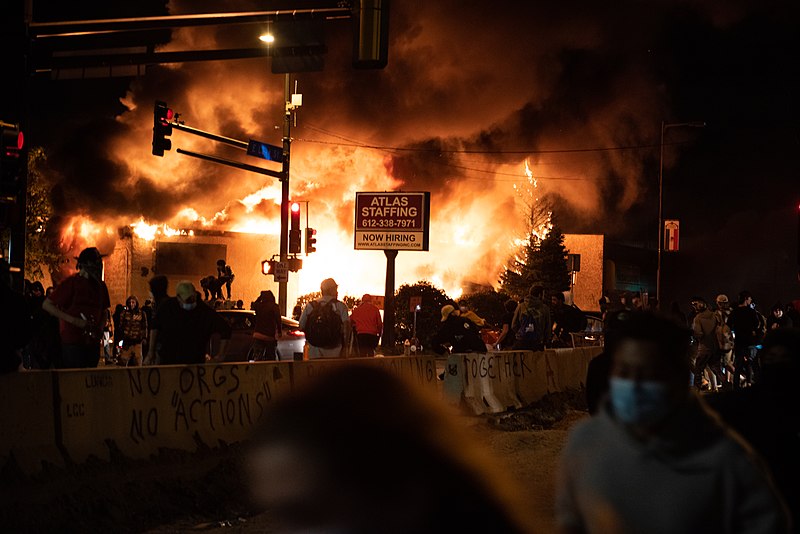
A building burning in Minneapolis following the death of George Floyd.
Photo by Hungryogrephotos via Wikipedia.

We]re now two years out from what may in retrospect be seen as peak “social justice”. In the summer of 2020, a hefty section of the elite was enthralled with the idea of the police being defunded, demobilized and demonized. Critical theory’s critique of liberal democracy as a mere mask for “white supremacy” everywhere. Countless people were required to read woke tracts — from DiAngelo to Kendi — as part of their employment. Corporate America jumped in, shedding any pretense of political neutrality; mainstream media swiftly adopted the new language and premises of critical theory. The Trump madness, and his attempted sabotage of an election, largely silenced liberals in their clash with the left. They had a more immediate threat. And rightly so.

But now look where we are.

Last year, Eric Adams became mayor of New York City, propelled by minority voters horrified by surging crime and chaos. This past week, DA Chesa Boudin, scion of leftwing terrorists, was ousted by minority voters in San Francisco, after he allowed much of the city to become a chaotic hellhole in pursuit of “racial justice”.

Recent polling suggests a sea-change in attitudes. Pew found that only three percent of African-Americans put “racism/diversity/culture” as the most important issue to them while 17 percent cited “violence/crime”, and 11 percent said “economic issues”. (Among Democrats overall, “49% now view racism as a major problem, down from 67% about a year ago”.) New York City voters now put “crime” ahead of “racial inequality” as their most urgent concern by a huge ratio of 12:1. Polling in San Francisco found that 67 percent of Asian-Americans wanted Boudin gone — a sign that the Democrats’ ascendant coalition of non-whites is now fast-descendant.

Hispanics also appear to be fleeing the left. In the usually Dem-friendly Quinnipiac poll last month, “48% of Hispanic registered voters said they wanted Republicans to take control of the House of Representatives, while just 34% said they wanted Democrats in power. In addition, 49% of Hispanic voters said they wanted the GOP to win the Senate, while 36% said they wanted Democrats to remain in control of the chamber.” Biden’s approval among Hispanics is now 24 percent. I’m not sure what to make of this, but even if it’s half true, it’s an electoral emergency for Democrats.

Some Dem pols have noticed the vast cultural gap between most Latino voters and wealthy white leftists, and adjusted. Democratic Congressman Ritchie Torres last week criticized the use of the absurd term “Latinx” — because denying the sex binary is not exactly integral to a culture where the language itself is divided into masculine and feminine. AOC, of course, demurs.

Elite imposition of the new social justice religion — indoctrinating children in the precepts and premises of critical race and gender theory — has also met ferocious backlash as parents began to absorb what their kids were being taught: that America is a uniquely evil country based forever on white supremacy; that your race is the most important thing about you; that biological sex must be replaced by socially constructed genders of near-infinite number; and that all this needs to be taught in kindergarten. Yes, some of this was politically exploited or hyped by the right. But if you think there is no there there in this concern about schooling, you’re dreaming.

Across the country, school boards are thereby in turmoil, with those supporting less ideological education on the march. On the question of trans rights, there is broad support for inclusion — but most Americans are understandably uncomfortable with pre-pubescent kids having irreversible sex changes, and with trans women competing with women in sports. For which those normies are called “hateful”.

June 11, 2022

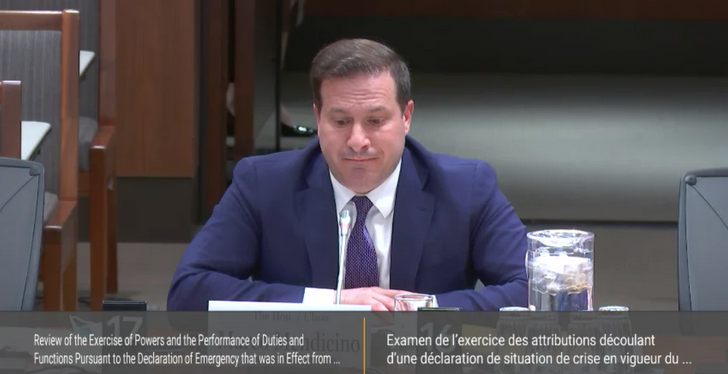
As federal minister of public safety, it’s Marco Mendicino’s job to lie to Canadians

At least, the headline is my interpretation of Matt Gurney‘s somewhat more cautious and measured assessment of the minister’s recent performance:

To celebrate World Press Freedom Day last month, Prime Minister Justin Trudeau said some wonderful things about the importance of truth.

“In the age of disinformation and misinformation,” the statement read, “independent, fact-based reporting is vital. We must all come together to support the work of journalists and double down in the fight against disinformation.”

Stirring stuff. But does the prime minister, his government and the Liberals’ many supporters think any of that actually applies to them?

Marco Mendicino is the federal minister of public safety — a tough job in challenging times. But I’ve come to the unsettling conclusion that Minister Mendicino is not being honest with Canadians.

On the issue of gun control, I’m sorry to say he’s simply lying.

Last week here at The Line, I analyzed the Liberals’ proposed Bill C-21, a package of gun-control measures. My views on this file differ sharply from the government’s. But I’d have hoped that we could at least agree that honesty should be central to the government’s proposals and publicity.

No dice. Last weekend, on CTV’s Question Period, the minister said this: “Bill C-21 doesn’t target law-abiding gun owners, it targets handgun violence, it targets organized crime … I have enormous respect for law-abiding gun owners …”

Well, let’s just go have a gander at the minister’s own webpage, eh? The Public Safety Ministry summarized the proposed legal and regulatory changes. There are 13 specific proposed changes to the Firearms Act. Two are “internal” to the government itself and don’t directly bear on gun owners, law-abiding or otherwise. One targets firearms-related marketing, another is exemptions for “elite sports shooters”. The remaining nine are entirely aimed at the “law-abiding gun owners” the minister insists aren’t being targeted. The page also notes that the government will also be changing regulations (separately from the proposed bill) relating to the safe storage of firearms and ammunition magazine limits … again, aimed entirely and solely at law-abiding gun owners. Indeed, along with some entirely process-focused Criminal Code proposals, there’s only one — one — proposed change that actually focuses on gun smuggling, which is widely believed by law enforcement to be the primary driver of firearms homicides in Canada. (Other planned changes are too vague to be properly analyzed in this context, but could plausibly be aimed at smuggling or blackmarket sales.)

But do the math. One clear mention of smuggling, at least 11 that only affect licensed owners. Denying this is dishonest, full stop.

Let’s be clear: the minister is entirely within his rights to argue that the proposed measures targeting lawful owners are necessary, appropriate and reasonable. These are legitimate debates. What is not up for debate is that the majority of these proposals exclusively target and/or affect law-abiding gun owners. There’s no ambiguity here. The meaning and purpose of C-21 is clear.

June 9, 2022

Moving Sprinting to the extremes

Filed under: Media, Politics, USA — Tags: , , , , — Nicholas @ 05:00

Scott Alexander considers the passion-provoking question, “which US political party has moved further/faster to the extreme end of the spectrum?”

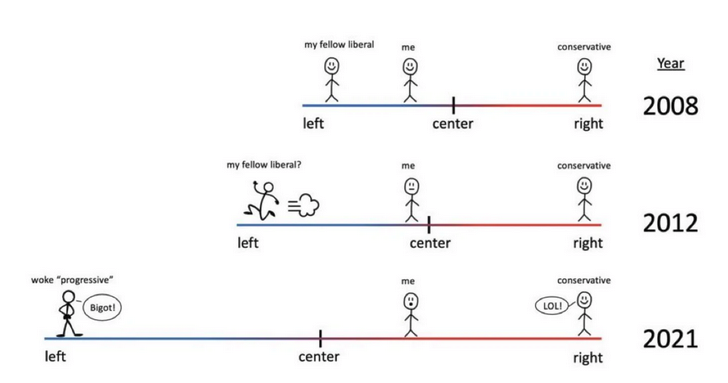
Matt Yglesias has written a couple of posts […] on the subject of this meme (originally by Colin Wright, recently signal-boosted by Elon Musk):

He concludes that, contra the image where the Right stays in the same place and the Left moves, both Republicans and Democrats have “changed a lot” since 2008. He wisely avoids speculating on whether one party has moved further or faster than the other.

I’m less wise, so I’ve been trying to look into this question. My conclusion is: man, people really have strong emotions on this.

I think a lot of the disagreement happens because this is more than one question. You can operationalize it a couple different ways:

  • Which party’s policy positions have changed more in their preferred direction (ie gotten further left for the Democrats, or further right for the Republicans) since 2008 — or 1990, or 1950, or some other year when people feel like things weren’t so partisan?
  • Which party has diverged further from ordinary Americans?
  • Which party has become more ideologically pure faster than the others (ie its members all agree and don’t tolerate dissent)?
  • Which party has become crazier in terms of worldview and messaging, in a way orthogonal to specific policy proposals? That is, suppose one party wants 20% lower taxes, and plans to convene a meeting of economists to make sure this is a good idea. The other party wants 10% higher taxes, and says a conspiracy of Jews and lizardmen is holding them back, and asks its members to riot and bring down the government until they get the tax policy they want. The first party has a more extreme policy position (20% is more than 10%), but the second party seems crazier.

I think these subquestions are easier to get clear answers on and will hopefully start less of a fight, starting with …

June 5, 2022

Privatize the libraries?

Filed under: Books, Politics, USA — Tags: , , — Nicholas @ 05:00

In the latest SHuSH newsletter, Kenneth Whyte discovers — perhaps to his surprise — he’s not actually the most visible crank on public library issues:

I’m no longer the world’s biggest crank on public libraries. My argument, you’ll recall, is that public libraries are a good thing, but that North Americans borrowing rather than buying three out of every four books they read is a bad thing for the incomes of authors, the economics of publishers, and the welfare of just about everyone else involved in the book industry. That’s fainthearted stuff compared to this week’s tweet from Chris Freiman, a philosophy professor at William & Mary:

As you can guess from the 4,152 comments he’d generated by last night, Freiman’s was an unpopular take. Summing up the responses:

No one has been in a mood to ask if Freiman has a point, or where he’s coming from. For what it’s worth, he has a track record of criticism of government welfare spending. His usual schtick is to ask why so many Americans are poor when the poverty line for a family of three is $18,530 (annually) and welfare spending on a family of three from all three levels of government amounts to $61,830 (annually). It’s not the worst question.

His answer appears to be that directly transferring funds to the poor would be a more effective and efficient way of alleviating poverty than allowing governments to keep running expensive programs that are failing to achieve the same end. That’s not the worst answer.

But does he have a point regarding libraries?

I give him half a point. Public libraries are overwhelmingly used by people who can afford to buy books, and those people are reading primarily for pleasure. I’m all for lending books to people who can’t afford them, who have trouble accessing them, or who want to improve their minds by reading important or serious stuff. But to the extent that libraries are giving middle-class patrons free entertainment—sure, privatize them. There are better uses of public money. Apply the funds to reduce tax burdens on low-income families or improve conditions in government-run nursing homes.

Where the privatization argument fails is that libraries do a lot more than provide middle-class patrons with entertainment. They are important community hubs and for a minority of users they continue to fulfill their original purpose, which, says historian Ed D’Angelo, was to “promote and sustain the knowledge and values necessary for a democratic civilization”. Privatization would likely destroy the valuable public service aspects of public libraries.

In fact, the real problem with public libraries today is that they’re already half privatized. Starting in the middle of the last century, they stopped believing in their role as the community’s edifier-in-chief. They adopted the mindset of the marketplace, giving people what they wanted, filling their shelves with multiple copies of the hottest bestsellers, however vacuous, and measuring their success by counting foot traffic at their branches. They now manage those branches like Walmart supercentres, maximizing transactions per square foot of space. Who cares what patrons are reading, or why, so long as the turnstiles are spinning.

I’d prefer they leave private-sector thinking to the private sector, and let public libraries rebuild their lending practices around their original mission of elevating the minds of citizens. Surely we can’t yet afford to abandon the latter objective.

My solutions to the public library problem, in order of preference, are a much more robust public lending right, an exclusive new release window for the retail trade, and user fees for patrons who can afford them. More discussion here.

In any event, thanks to Professor Freiman for revealing me as a moderate.

June 4, 2022

Ontario’s election – “This was a weird campaign during a weird moment in history. Adjust your hot-takes accordingly, friends.”

Filed under: Cancon, Media, Politics — Tags: , , , , — Nicholas @ 05:00

From the Ontario election wrap-up post from the editors of The Line:

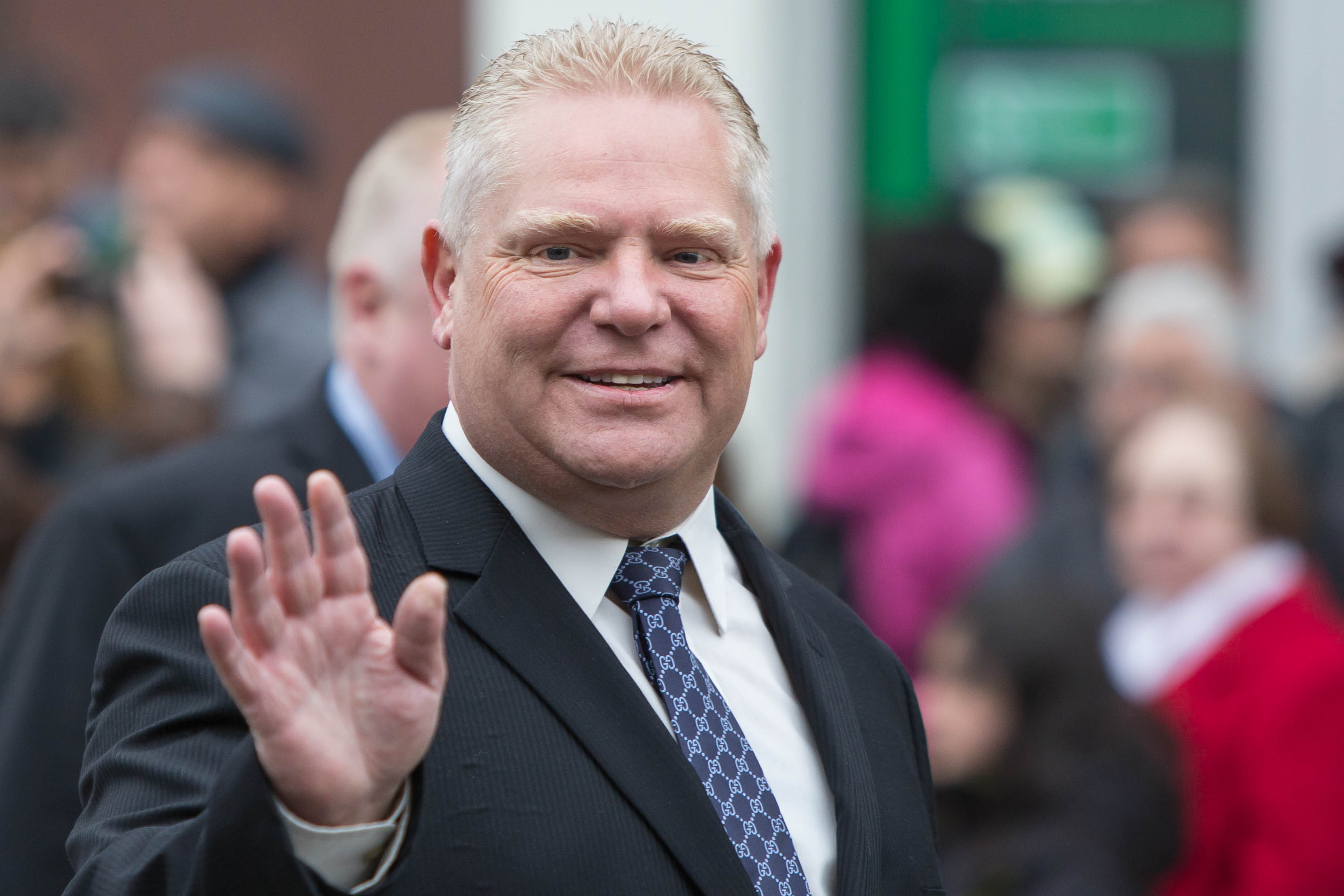
Newly re-elected Ontario Premier Doug Ford, seen here at the 2014 Good Friday procession in East York, Canada.
Photo via Wikimedia.

Doug Ford and the Ontario Progressive Conservatives obviously feel pretty good this Friday. They really did about as well as they could possibly have hoped to do. Still, we urge our readers and all the analysts and pundits out there not to overreact to Ford’s victory. He’s not a political genius, he’s not some sort of colossus standing astride our politics, and he is not the man who must be immediately beamed into the federal Conservative leadership so that he can slay Trudeau’s government and win 200 seats.

Doug? He’s just a guy who got lucky last night. (Politically, we mean. Get your minds out of the gutter.)

We’re not taking anything away from Ford, or his campaign leadership, or all the people who worked hard for the PCs over the last month. They did a lot of smart things, they did them well, and they are reaping the benefits. It was an effective campaign. It rubbed a lot of people the wrong way, but your Line editors suspect it rubbed people the wrong way precisely because it was an effective campaign. Keeping Ford out of sight, avoiding a lot of questions, keeping things low-key … these weren’t accidents. These were deliberate decisions. You have to start any analysis of the PC campaign by granting that. Yeah, it was well conceived and well executed. A hat tip to the people behind it.

But the point that we want to make, and it shouldn’t take away from anything said above, is that the Progressive Conservatives maxed out the luck-o-meter. If this election had been a year ago, coming off the government’s catastrophic handling of Ontario’s third wave, it probably would have been Doug Ford resigning last night. The government caught an enormous break because factors well beyond its control shifted the public’s focus off its greatest vulnerability, the management of the pandemic, and put it solidly on economic and cost-of-living issues that the PCs are much, much more comfortable talking about.

So yeah, the PCs had a good campaign, but you couldn’t buy that kind of luck. None of it happened in Ontario or even Canada. This was a global trend. After two years of pandemic, people are tired and they’re getting worried about other things. The timing for Ford could not have been better. So we absolutely give full credit to his campaign for a good job, but we also insist on acknowledging the huge role of luck and timing. We don’t know if it’s better to be lucky than good. But we certainly know it’s nice to be both at once.

We raise this as a note of caution before the punditry gets too carried away. This election is undoubtedly a huge victory for the Tories. But it is also a really, really weird election. The circumstances of it are very unique. The combination of low turnout, pandemic fatigue, Ford’s personal political brand in Ontario, bizarrely lacklustre campaigns by the opposition, and a confluence of global trends that all netted out in Ford’s favour don’t tell us anything about the state of the conservative coalition in Canada, who would make a good federal leader, or what’s going to happen at the next federal election. This was a weird campaign during a weird moment in history. Adjust your hot-takes accordingly, friends.

Campaigning from your basement worked very well for Joe Biden, and now it’s done the job for Doug Ford. It probably wouldn’t work for Justin Trudeau — if he’s not performing for the camera, it’s not clear whether he actually exists. Ford certainly benefitted from the small attention his opponents on the right — the New Blue and Ontario parties — although minor parties have pretty much always been a non-factor in Ontario politics. They were summoned into existance by the way Ford and the Progressive Conservatives governed during the pandemic … almost indistinguishable from the federal Liberals under Justin Trudeau. The PCs seemed to rely on their “progressive” urges at the expense of anything remotely “conservative”.

Moving on to the other two major parties … it’s not pretty:

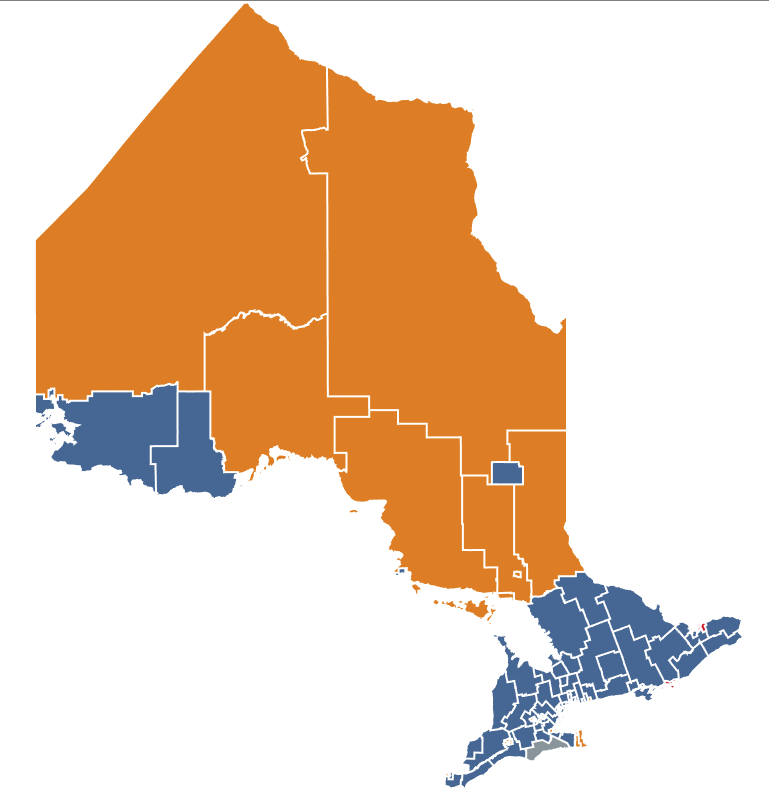
Preliminary riding-by-riding results from the 2022 Ontario election.
Blue – Progressive Conservative, Orange – New Democratic Party, Red – Liberal Party, Green – Green Party

Okay, let’s do the NDP first. The NDP is probably feeling pretty good today. We get it. Even a week or two ago polls were suggesting they were about to lose their hold on official opposition to the Liberals. That would’ve been a disaster for the party. There’s no way around that. They’ve avoided that fate. The NDP has remained in second, although they lost a bunch of seats to the PCs (see above). In the days to come, the party is going to have to take a few cold showers, give their heads a vigorous shake, and realize that warm feeling they’re enjoying right now isn’t the afterglow of victory, it’s the fading adrenaline rush of a near-death experience. Avoiding annihilation shouldn’t be good enough. But that’s all they did.

Andrea Horwath, long-time leader of the party, has already announced that she is stepping down. And rightly so. The Line has some fondness for Andrea. God knows we’ve had the opportunity to get to know her during her tenure as provincial NDP leader, which basically overlaps entirely with our entire careers in journalism. She is a decent person with a better sense of humour than often comes across in public, and she has nothing to be ashamed about. She has taken the party as far as she can, and it’s time for someone else to take over and deal with what might be a changing environment — one that is not obviously changing in the NDP’s favour (again, see above).

[…]

Writing critically about the Liberal campaign today feels a little bit like flogging a dead horse, and then shooting it a bunch of times, and then setting it on fire, and then hunting down all of its little horsey relatives and shooting all of them too. And then peeing on them. But still. It was a really bad campaign by the Liberals. The leader was bad. We’re sorry, but he was. If Steven Del Duca ever encountered charisma we suspect his body would reject it like a donated kidney. The party’s campaign platform was a weird mishmash of stuff that sounded vaguely on point for 2022, but also often read like something copied and pasted directly out of Ontario Liberal campaign platforms going back as far as the 1990s.

Some of the problems the campaign experienced had easy explanations. The party’s 2018 performance was so terrible they lost official party status, and the access to budgets and staff in the legislature that goes along with that status. The party has been trying to rebuild with at least one hand tied behind its back ever since. The campaign team was quite lean, and as a series of ejected candidates show, it was not able to properly vet the full slate of candidates it ran. You can understand how the lack of personnel and money contributed to those problems. But what we can’t understand is why the campaign insisted on making so many weird decisions. Handguns and abortion as campaign issues? In a provincial campaign? Talking up free transit rides, which will only appeal in the deepest downtown cores, where all they could do was hurt the NDP? A mid-campaign pledge to make COVID-19 vaccinations mandatory for school children, which was then never really mentioned again?

The NDP ran a bad campaign, but the Liberals just seemed to be totally disjointed, as if there wasn’t any agreement among the party leadership on what the platform should be so random unrelated items got floated as trial balloons on almost a daily basis, with no follow-up on most of them. Perhaps the party couldn’t afford the cost of proper in-depth pre-election polling or perhaps this was the party leadership’s belated buyer’s remorse over the leader they’d elected.

June 3, 2022

Why the people who don’t freak out politically are the ones politicians pay the least attention to

Filed under: Cancon, Media, Politics, Railways — Tags: , , , — Nicholas @ 03:00

In the free-to-cheapskates portion of this Paul Wells essay, he shows why it’s the weirdos, the whackos, and the cheerleaders who get political parties to pander to them and the hair-not-on-fire, steady-as-they-go, non-freaking-out normies who get ignored:

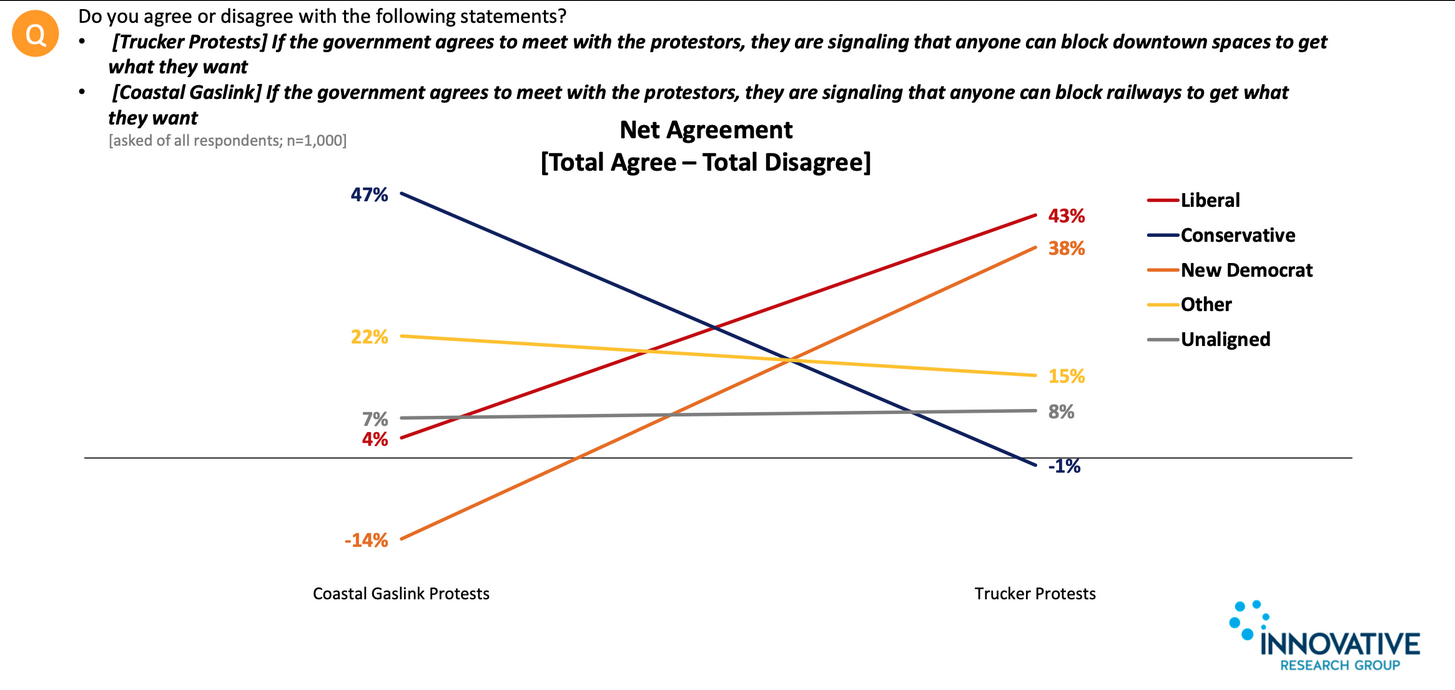
This graph is the best illustration of Canadian politics I’ve seen this year. It comes from Greg Lyle, the pollster who runs Innovative Research Group. He published it in February when downtown Ottawa was full of trucks. It takes some explaining, but we have time today.

On the left are results from a poll Lyle did in 2020. Rail blockades and protests had flared up across Canada, in support of Wet’suwet’en hereditary chiefs who opposed the Coastal GasLink pipeline project. One of the questions Lyle asked in 2020 was, Do you agree or disagree that “If the government agrees to meet with the protestors, they are signaling that anyone can block railways to get what they want”?

On the right are results from a poll Lyle did two years later, in March of this year. Agree/disagree, “If the government agrees to meet with the protestors, they are signaling that anyone can block downtown spaces to get what they want”?

[…]

In addition to NDP, Liberal and Conservative supporters, Lyle tracked opinions of people who support other parties. That’s the yellow line above. It’s nearly useless, a jumble of Green, People’s Party, Bloc Québécois and who knows what else.

But he also tracked responses of people who didn’t express support for any political party. That group’s responses didn’t swing at all between 2020 and 2022. That’s the black line above. Does meeting protesters encourage protests? Sure, on balance, a bit, these non-aligned voters said in 2020 (net +7%). People like them said the same thing in 2022 (net +8). Call this group the people who don’t freak out.

Now. Who gets heard in our politics? It goes without saying that the people in political parties, including the people in governments formed by political parties, are partisan. Liberals will tend to be on that upward-sloping red line in our graph. But what’s more important is that these days, only the people on the steeply-sloping partisan lines pay for our politics.

Since 2011, individual donors are the only source of funds for Canadian federal political parties. Corporate and union donations were eliminated in 2006. Public per-vote subsidies were eliminated in 2011. Today the only way I can pay my political party’s bills is if I can persuade lots of people like you to give me many small sums of money. And the people on that nice, even-keel, non-sloping black line in our graph? The people who don’t view every sparrow that falls as a little morality play about their heroes and the villains they face? Those people will never give anyone a dime. It’s the people who mood-swing wildly — who think our gang is great and their gang is the demon — who can be provoked into donating, again and again, until they max out for the year, and then again starting in January.

Irving Gerstein, the Conservative Party’s chief fundraiser under Stephen Harper, explained all of this in a 2013 column by Ken Whyte that stands as one of the most important documents for understanding our times: “Message creates momentum creates money.” Parties that reside permanently on the sloping lines of a Greg Lyle poll — that think, talk and act like their most fervent supporters — are able to separate those people from their money. Parties that exit the slope for the level meadows of moderation go nowhere.

May 31, 2022

Conspiracy theorists, like the deeply paranoid, aren’t always wrong

Chris Bray responds to a common response he’s encountered from people who are worried that everything we’re seeing is somehow part of a deep-laid, nefarious plan to … do something. Something evil, something terrible, something … undefined but wrong:

If all of our problems are caused by a secret cabal who are having a new Wannsee Conference [Wiki]— twelve assholes sitting around a table and carefully planning our destruction — then we could solve that problem in half an hour with a dozen lampposts. We just need some names and an address: problem solved.

I think it’s much harder if there’s no they and no plan behind an event like the Uvalde school shooting. You can kill a few plotters, but how do you fix a broadly distributed collapse of courage, honor, decency, competence, knowledge, skill, morality and … a bunch of other things, but that list is a good start. If identifiable actors are tearing things apart, you can know where to put your hands to stop them; you can act. If we’re just trapped in a miasma of vicious mediocrity and weakness, where are the levers that change our course? What’s the solution to widespread societal degradation, to a suicidal loss of shared values and ordinary ability?

Facing an endless string of metastasizing and coalescing implosions — the lockdown-induced mental health crisis among children, appalling growth in energy prices, severe fertilizer shortages, supply chain collapse, unacknowledged vaccine injuries, vaccines that make illness more likely, military failure and the madness of the Afghanistan debacle, an emerging food shortage that’s starting to look really disturbing — the easiest way to deal with it is to say that it’s all one crisis planned and implemented by one set of people. If that’s true, the solution doesn’t even require a full box of ammunition, and we could wake up tomorrow morning in a world that we’ve repaired.

But the problem is that I mostly don’t think it’s true. I think it’s all one interwoven societal crisis, but that it’s connected by the uselessness of overcredentialed weak people. As for the view that they’re planning all of this, I increasingly think that our bullshit elites, our highly compliant social climbers in positions of power, mostly couldn’t plan a plate of toast.

Now, this is important: This doesn’t mean that I don’t think any of it is ever true. Of course there’s fake news. There are false flags, there are staged ops, and there are crisis actors. (The Ghost Of Kyiv, Ukraine’s boldest fighter pilot, agrees with me.) It seems pretty clear at this point that the plot to kidnap Gretchen Whitmer, that terrifying thing, was some socially awkward dorks being urgently and persistently goaded by FBI provocateurs. And it’s no longer possible to pretend that the Capitol Police didn’t just open the doors on January 6 to the “mob” that “broke in”.

But the transition from “some things are fake” to it’s all a lie and a plan every step of the way is a bigger claim — he says, carefully — and one that doesn’t make that much sense. With regard to Uvalde and the cops who wouldn’t act, for example, cowardice and incompetence work just fine as an explanation, because we have examples to compare the moment to. Peacetime militaries build an officer corps around rules-focused behavior, around the ability to comply and to operate within a hierarchy; then wartime militaries go through a period of officer purges, as they work to find high-functioning leaders who can tolerate the chaos and pain of battle. Confronted with a high level of brutality and danger, some people just can’t do it. This strikes me as an unremarkable fact, and one that doesn’t require extraordinary explanations. The school district police chief, a bureaucrat for decades, pushing paper and going to meetings, was confronted with sudden shock and horror on an extraordinarily harrowing scale, and he lacked the ability to respond. McClellan also couldn’t bring himself to attack Richmond.

May 30, 2022

The Line on Pierre Poilievre’s campaign for Conservative leader

Filed under: Cancon, Media, Politics — Tags: , , , — Nicholas @ 05:00

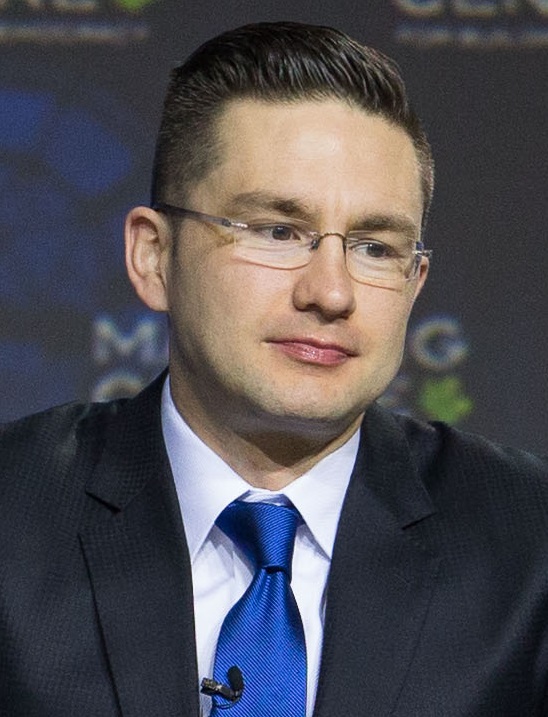
I honestly haven’t been paying much attention to the never-ending leadership contest the federal Conservatives have been running for what feels like years at this point. If I had to choose, Pierre Poilievre would probably be my choice — since Mad Max won’t go back to the party that stabbed him in the back — and he appears to be the one to beat as the contest enters its third decade. In the abbreviated-for-nonpaying-cheapskates weekly post from The Line, the editors have concerns about Poilievre and how he may operate first as the leader of the Official Opposition and then potentially as Prime Minister:

Conservative MP Pierre Poilievre at a Manning Centre event, 1 March 2014.
Manning Centre photo via Wikimedia Commons.

We at The Line are going to preface this little blurb about CPC leadership contender Pierre Poilievre with the following two points; firstly, we suspect he’s going to win the leadership race. Secondly, we suspect he’s probably on a trajectory to become prime minister. The usual caveats apply: campaigns matter, polls can be wrong, it’s a long time to go and anything can happen. Of course, of course. But at this godforsaken moment, PP’s got the mo. The gatekeepers are down at heel, and the populists are on the march. We don’t have to agree with any of this, or even like it, to acknowledge that we can feel the current of the wind.

So take these critiques with those expectations in mind. Still: Skippy had a bad week.

Look, the general assumption of the Canadian punditocracy to date has been that Pierre Poilievre is not only dangerous and corrosive — but that he’s also full of shit, that he’s disingenuously stoking populist anger in order to win the leadership of the CPC. Most — who happen to think he’s too smart to actually fall for any of his own rhetoric — genuinely believe he’ll slip back to some kind of sensible, slightly more tribal, but still broadly sane centrist form of conservatism after he scores the leadership mandate. Win from the right, govern from the centre: this is generally a winning formula for Conservatives.

We have a different take.

What if Poilievre is 100 per cent genuine in his beliefs about bitcoin, central bankers, the WEF, banning foreign oil, the lot of it? We’ve said it here at The Line before: COVID has driven everybody a little bit nuts. What if this week, we really just started to see the mask slip?

Because if that’s the case, this is what we could be looking at by 2025, or sooner: a prime minister who probably doesn’t respect imperfect institutions well enough to leave them alone, whether those institutions be the central bank or the Supreme Court. We’d have a prime minister more inclined to take his financial cues from Robert Breedlove than Tiff Macklem; we’d have a prime minister who seems to genuinely believe that the World Economic Forum is some kind of sinister cabal of (((globalists))) led by Klaus Schwab, and is pulling the strings of government because the forum bestowed ego-stoking titles like “Young Global Leaders” on a bunch of up-and-coming Canadian politicians — including Conservative politicians. And it means we’re looking at a prime minister who thinks that banning the import of foreign oil, potentially cutting ourselves off from the global market and forcing western producers to supply energy resources to Canadians first, sounds like a dandy idea. (Does the term: “integrated North American Energy Market” hold any sway, here? You know how much a refinery costs? Just don’t call it a National Energy Program, we guess.)

Look, we think that Pierre is ahead for a reason. On the general sweep of the state of politics, we suspect he’s got the best grasp of his electorate. He’s young, he’s smart, and he’s willing to litigate serious problems and entertain novel ideas to solve them. We’re heading into a period of increased inflation, war, and potentially global famine, and Poilievre could use his considerable intellect to identify Canada’s crucial problems, and steer us in a credible direction.

But not if he’s acting like a goddamn lunatic. Because nothing says “conservatism” like protectionist economic policies, conspiracy theories, and railing against norms and institutions, right?

So Poilievre, Jenni, if you’re listening (are you listening?) don’t make the mistake that Jason Kenney did in Alberta. Don’t win on promises you can’t deliver on and by talking about problems you only half understand. Don’t insulate yourself with people who don’t challenge you intellectually. If you’re going to actually be prime minister, you’re going to need to work with the very experts and gatekeepers that you hold in such obvious contempt. You’re going to need to network with major global leaders — perhaps even at major global conferences hosted to discuss economic and geopolitical issues — without being beholden to said fora’s attendees and organizers. You’re going to need to be able to determine fact from fantasy and critique from conspiracy.

We don’t doubt Poilievre’s ability to win. Rather, we’re getting awfully nervous about his ability to govern once/if he does.

May 29, 2022

We’ve evolved to the point that you don’t even need to turn the page for Gell-Mann Amnesia to kick in

Chris Bray has an almost unbelievable example of Gell-Mann Amnesia … literally on the same page of the site, two stories show how un-self-aware — and reflexively critical of non-progressives — the media can be:

Take exactly the same argument about exactly the same event and wedge it into two very different frames. Watch the result.

Here’s Politico, today, attending the NRA convention in Texas in the aftermath of a mass shooting at a school …

… and finding that NRA members are still gun-addled idiots who deflect concerns about guns by inventing a stupid fantasy argument — a conspiracy theory! — about mental illness:

    Here, amid acres of guns and tactical gear inside a cavernous convention hall, the proximate cause of the mass shooting in Uvalde, Texas, was not a rifle, but mental illness, shadowy forces of evil or, as one man in a “Let’s Go Brandon” T-shirt put it, the “destruction of our children” by the teachings of the left.

These idiots, can you believe that? They were actually dumb enough to argue that the rifle didn’t cause the shooting, and instead they blamed — wait for it, because OMFG — mental illness. What morons! Imagine being so caught up in stupid far-right conspiracy theories that you’d blame a school shooting on mental illness.

Okay, now. Watch this.

On the very same day, Politico posted this story, right underneath the NRA story on the front page:

And this is what Politico says those professors found:

    POLITICO: Can you take us through the profile of mass shooters that emerged from your research?

    Peterson: There’s this really consistent pathway. Early childhood trauma seems to be the foundation, whether violence in the home, sexual assault, parental suicides, extreme bullying. Then you see the build toward hopelessness, despair, isolation, self-loathing, oftentimes rejection from peers. That turns into a really identifiable crisis point where they’re acting differently. Sometimes they have previous suicide attempts.

The professors go on to say that the start of the solution to the crisis of school shootings is to improve the quality of childhood mental health services: “We need to build teams to investigate when kids are in crisis and then link those kids to mental health services. The problem is that in a lot of places, those services are not there. There’s no community mental health and no school-based mental health.”

Same publication, same day, same page.

QotD: Was Biden’s Afghan evacuation driven by Twitter “optics”?

Filed under: Asia, Military, Politics, Quotations, USA — Tags: , , , , , — Nicholas @ 01:00

Take the Afghanistan bugout. As Z Man pointed out in his column today, it was gonna happen. And it was going to be a cock up; that’s just the nature of these things. A halfway competent Apparat would’ve let Bad Orange Man own it. They could’ve milked it for years. Hell, decades — it was 2012 before we were finally allowed to stop talking about who did or didn’t do what in Vietnam.

But the Apparat didn’t do that, and the reason was: Twitter.

All the Blue Checkmarks on Twatter agreed that “letting” Bad Orange Man pull out of Afghanistan would be “handing him a win”. After all, he said he was going to do it! And if he somehow got out before the 20th anniversary, that’d be an even bigger win. Obviously, then, they had to “let” Biden do it, because that’s a “win”. And of course he had to do it in August, so that he could “spike the football” on 9/11/2021.

So the withdrawal had to be pushed into 2021, and it had to be slapdash. Indeed, it had to be the exact opposite of whatever Bad Orange Man was planning to do, so that there was no possible way Bad Orange Man could claim a “win”. It had to be all Biden …

… and so it was. With results that anyone smarter than a concussed goldfish — which of course excludes everyone with a Blue Checkmark — could’ve predicted.

If the Blue Checkmark Borg on Twatter, then, decides that Brandon needs to look tough by nuking Moscow, then it’s go time. And since the social dynamic on Twitter is ever-spiraling lunacy — the only way to “win” Twitter is by being more screechingly insane about everything than everyone else — then whoever gets there fustest with the mostest is going to drive the “decision”.

Severian, “Ukraine”, Founding Questions, 2022-02-24.

May 27, 2022

The cognitive dissonance of the elites

Chris Bray on yet another example of our kakistocrats congratulating themselves after presiding over failure:

[Los Angeles County Public Health Director Barbara] Ferrer is a relentless and enthusiastic interventionist, one of the highest-profile lockdowners and mask fetishists in the country, and here she is still wearing a mask — in the third year of a pandemic that hasn’t been ended by the widespread mask-wearing that has prevailed, and still largely prevails, in Los Angeles. Do X to cause Y, she says, doing X for a third straight year but still rather obviously not causing Y. Again, here’s Ferrer’s chart showing the effect of her bold public health interventions:

You can really see how that infections trendline came right down as Barbara Ferrer boldly threw herself in front of the virus.

But here’s the part that I find most telling: After Ferrer offers a long presentation on mitigations showing clearly that they haven’t worked as advertised, and after she says repeatedly and explicitly that the available Covid-19 vaccines “don’t work so great at preventing infection”, and that vaccinated people will be infected, Ferrer sits down for a discussion with several members of an expert panel. One of the panelists is Michele Kipke, a psychology PhD who serves as a clinical professor at USC and the vice-chair of research at Children’s Hospital Los Angeles (and as a school board member in my own small town in the suburbs). Having heard repeated statements about the unmistakably limited effectiveness of the available Covid-19 vaccines, Kipke offers this as a question:

“So, first of all, I just need to say, it is such an honor to be on the same stage with you. Barbara, you are my hero, and I am so glad that you have been our leader through these extremely difficult two years. So thank you.” And then there’s a long round of applause from the panel and the audience. You can just feel the scholarly skepticism and clinical rigor in that auditorium. This, ladies and gentlemen, is obviously the room where the tough questions are asked.

And then she goes on: “And so, as I think about this, I’ve really been asking the questions, what are, just picking up on the, I think, the discussion here, what are those lessons learned? There are, you know, sort of obviously a very difficult couple of years, but we’ve seen some really phenomenal successes that have come out of the last couple years. As Dr. Hu mentioned earlier, I had the good fortune of being a part of leading Vaccinate L.A., where we brought fourteen schools and programmatic units within USC together, and all harmonized our efforts, to get out there and support our communities, and to think about how to support vaccinations. And we engaged local artists. We — it was a community driven initiative, we wanted to listen and learn from the community, and then partner with them …”

And so on, but you get the point. “But through that work we’ve achieved so much,” she eventually says. The video is cued to the start of her “question”, if you want to see it all, but her question, in short, is, Why, in your view, did we do such an amazing job? Pivoting from Ferrer’s extremely open and direct discussion about the obvious limits of the vaccines — again, that actual direct quote is, “Vaccinated people are very likely to get infected” — Kipke asks about the success of the vaccination program.

May 25, 2022

QotD: The “social responsibility” of business

Filed under: Business, Economics, Politics, Quotations, USA — Tags: , — Nicholas @ 01:00

When I hear businessmen speak eloquently about the “social responsibilities of business in a free-enterprise system,” I am reminded of the wonderful line about the Frenchman who discovered at the age of 70 that he had been speaking prose all his life. The businessmen believe that they are defending free enterprise when they declaim that business is not concerned “merely” with profit but also with promoting desirable “social” ends; that business has a “social conscience” and takes seriously its responsibilities for providing employment, eliminating discrimination, avoiding pollution and whatever else may be the catchwords of the contemporary crop of reformers. In fact they are — or would be if they or anyone else took them seriously — preaching pure and unadulterated socialism. Businessmen who talk this way are unwitting puppets of the intellectual forces that have been undermining the basis of a free society these past decades.

Milton Friedman, “The Social Responsibility of Business is to Increase its Profits”, New York Times, 1970-09-13.

May 18, 2022

From “Software as a Service” to “Property as a Service” then to “Hypercapitalism” aka Neo-Feudalism

Filed under: Economics, Liberty, Politics — Tags: , , , , — Nicholas @ 05:00

Whenever I could, as the software I used to depend on switched from the old-fashioned “purchase a license” to “Software as a Service” model, I found something else to use or I didn’t bother “upgrading” from the last iteration before it went SaaS. My Microsoft Office installation is the 2007 version — after that I used Open Office (and now LibreOffice) for anything Microsoft-related. Even working in the software business, I hated SaaS and I try as much as I can to avoid products distributed that way. Imagine how I feel about the expansion of that toxic idea to other areas of life, as Chris Bray discusses here:

Twenty-two years ago, the economist and social critic Jeremy Rifkin warned about the emerging commodification of human experience. Markets have always exchanged private property, he wrote, and people have grown accustomed to the act of holding it personally – that is, of owning things. But in a new “hypercapitalist” world, he warned, ownership would be concentrated in a few corporate hands, and most people would pay to access property, “in the form of short-term leases, rentals, memberships, and other service arrangements,” rather than owning it. Remember that description about leasing all of your stuff in a series of service arrangements, because you’ll be seeing it again in a minute or two.

The man was not wrong about the degree to which businesses would aspire to turn one-time sales of stuff into endless monthly purchases of a service:

And then comes the politics:

    The shift from a propertied regime based on the idea of broadly distributed ownership to an access regime based on securing short-term limited use of assets controlled by networks of suppliers changes fundamentally our notions of how economic power is to be exercised in the years ahead. Because our political institutions and laws are steeped in market-based property relations, the shift from ownership to access also portends profound changes in the way we will govern ourselves in the new century.

And this, and look closely for the most important sentences — two of them, short and adjacent:

    In a society where virtually everything is accessed, however, what happens to the personal pride, obligation, and commitment that go with ownership? And what of self-sufficiency? Being propertied goes hand in hand with being independent. Property is the means by which we gain a sense of personal autonomy in the world. When we access the means of our existence, we become far more reliant on others. While we become more connected and interdependent, do we risk at the same time becoming less self-sufficient and more vulnerable?

    The shift in the structuring of human relationships from ownership to access appears to invite a trade-off of sorts whose outcome is far from certain. Will we liberate ourselves from our possessions, only to lose a sense of obligation to the things we fashion and use? Will we become more embedded in networks of relationships, only to become more dependent on powerful networks of corporate suppliers?

Property is autonomy. That was a warning about your own life: less autonomous, more dependent. And it was, specifically, a warning about corporate capitalism on the subscription model, and the social and political effects of a concentration of property in increasingly few hands. Hypercapitalism would be the new feudalism, a system of lords and serfs.

For the Canadian government, announcing new programs is far more important than implementing them

Filed under: Cancon, Europe, Government, Media, Politics — Tags: , , , — Nicholas @ 03:00

It often appears that the Liberal government in Ottawa operates almost exclusively on an “appearance only” basis: whatever the situation, it’s the “optics” that matter the most and actual delivery on announcements barely counts at all. It doesn’t help at all that the media generally has the same set of priorities, because they need things to talk about on news shows and the headlines don’t write themselves in the newspapers — and legacy media’s social media concerns are even more about flash and clickbait than their primary product.

Canada has been quick to announce new initiatives to help Ukrainian refugees, but true to form, very slow to actually make any of these initiatives happen, as Joti Heir discusses in The Line:

Justin Trudeau has always had a strong affinity for the symbolic gesture, especially when the media are around to record it.

It’s almost as though the Canadian federal government is working buttocks-backward when it comes to the Ukrainian refugee file. After Russia invaded Ukraine on February 24, helping Ukrainian refugees get to a safe place fast was the biggest concern. However, now, close to three months later, the bigger concern is how to help the refugees that are in Canada or making their way here.

“We are seeing an increasing amount of frustration within our community about the pace with which programs and announcements are being implemented,” says Orest Zakydalsky, senior policy analyst with the Ukrainian Canadian Congress (UCC).

“For example, a month ago, the prime minister announced income support when he co-hosted the [StandWithUkraine] telethon with the European Council president, he announced there would be income support for people coming to Canada. A month later, they’re not available.”

The announcement on April 9 indicated that Ukrainian refugees would be able to access $500 per week for a period of up to six weeks. At the same time, it was also announced that housing support in the form of two-week hotel stays would be provided. Both programs do not appear to have been implemented.

“We appreciate this is a very difficult situation for governments, this is a crisis that emerged very suddenly,” says Zakydalsky.

“On the other side, the other problem is that the people that are in Europe, that have left Ukraine, that are looking to come to Canada, see these announcements and quite reasonably think that when a program is announced it is available.”

« Newer PostsOlder Posts »

Powered by WordPress