Quotulatiousness

July 25, 2022

Political memes: threat or menace?

Filed under: Media, Politics, USA — Tags: , , , , — Nicholas @ 05:00

In Quillette, Christopher J. Ferguson considers the social dangers of sharing political memes:

Modern politics has always been replete with issues about which people feel passionate, sometimes aggressively so. But the culture wars currently raging in the US, Canada, and across much of the industrialized West seem to be particularly fraught. In my 50-plus years, I have never seen so much anger and hostility among citizens of otherwise stable countries. Some of these people will participate in protests or engage in civil disobedience, but many more will employ the political meme to express their discontent. Given how widespread the phenomenon has become, it’s worth asking whether political memes actually advance advocacy goals and our knowledge of important issues, or if they simply feed an unconstructive cycle of anger, misinformation, and polarization.

The term “meme” was coined by Richard Dawkins, who used it to describe units of culture, socially transmitted and imitated across generations in ways synonymous with genes — adaptive ideas survive, while maladaptive ideas perish. But in the social media age, the word usually refers to “an image, video, piece of text, etc., that is copied and spread rapidly by Internet users often with slight variations”. The subset of memes that focus on politics are generally designed to boil complex issues down to a digestible combination of emotive image and sloganeering text that flatters those who agree with its message and provokes those who do not.

Most academics who study memes agree that they are poisonous to healthy public discourse (“toxic” is a word that crops up a lot, even in the scholarly literature). One scholar bluntly called them “one of the main vehicles for misinformation”, and they tend to distort reality in several ways. By their very nature, they leave no room for nuance or complexity, and so they are frequently misleading; they tend to lean heavily on scornful condescension and moral sanctimony (usually, the intended takeaway is that anyone who agrees with the point of view being — inaccurately — mocked is an imbecile); they make copious use of ad hominem attacks, straw man fallacies, and motte-and-bailey arguments; they intentionally catastrophize, generalize, personalize, and encourage dichotomous thinking; and they are aggressive and sometimes dehumanizing. They are, in other words, methods of Internet communication that display all the symptoms of a borderline personality type of mental disorder. Of course, it’s possible to construct a meme that is short yet still thoughtful and sophisticated, but these are few and far between.

The best evidence we have today is incomplete and limited, but it suggests that political memes have a net negative effect on society. If the idea is to persuade or advance practical advocacy goals, then there is little evidence that they work. To the contrary, they may be counterproductive — the evidence we do have suggests that they contribute to political polarization, distort issues in the name of political expediency, and provoke indignation, hatred, and intolerance (on both sides of the political spectrum). Yes, the available evidence is fragmentary and would certainly benefit from better and more open science designs. However, it accords with larger observations about social media and political polarization. Perhaps new and better research will reveal that alarm about the negative effects of memes is simply another moral panic comparable to those that arose around video games or smoking in movies. But since memes add almost nothing to public discourse that would offset the risks, it’s probably worth hesitating before sharing them.

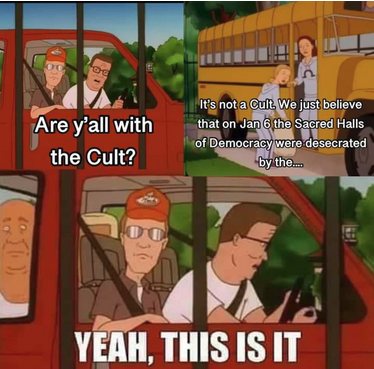
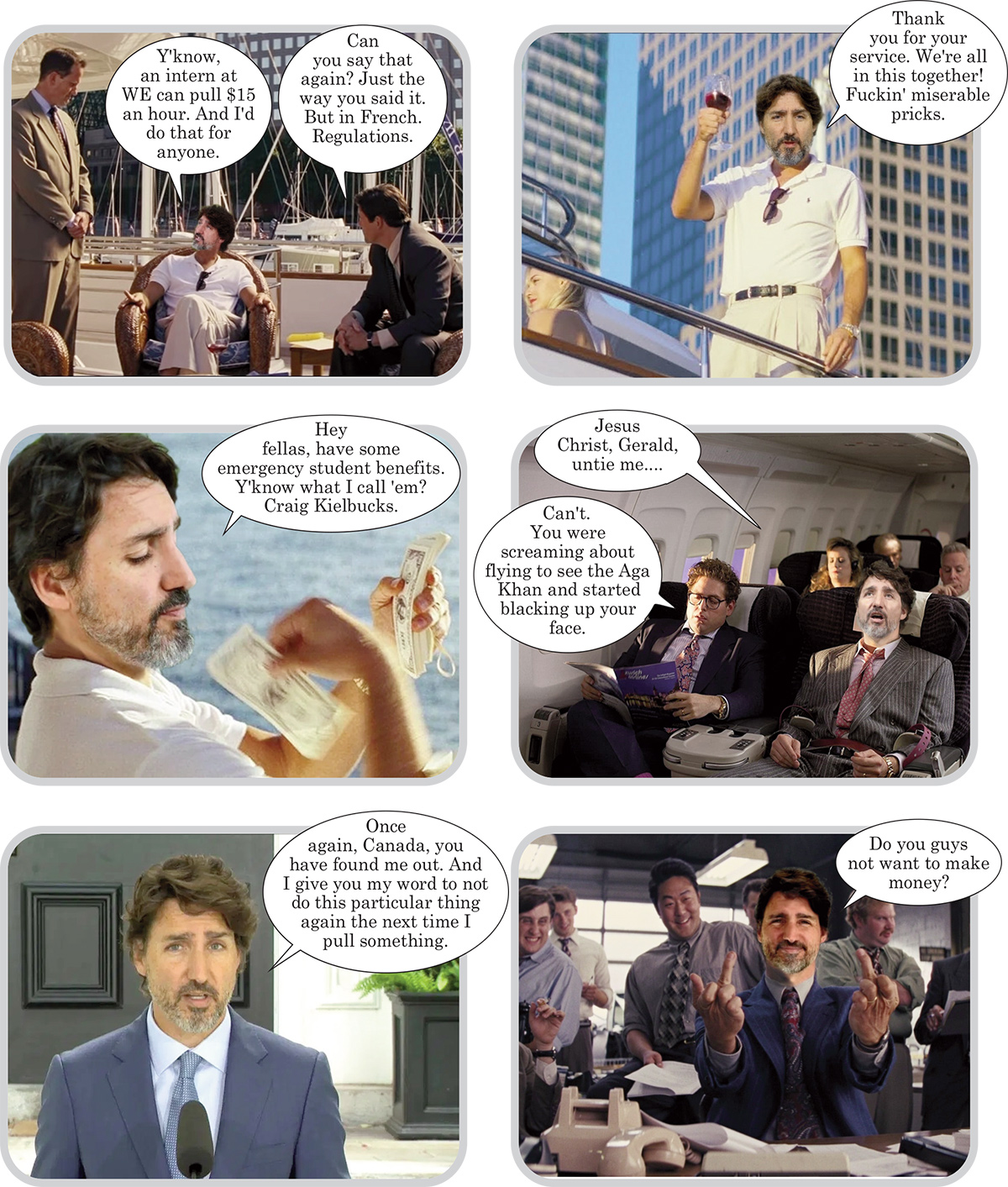
I save the odd meme that wanders through my various social media sites that I find amusing or (occasionally) effective, and memes as described in this article certainly do seem to be far more common than they were even a few years ago. A few selections below the fold, just because:

(more…)

July 23, 2022

Some of the events that lead to the Dutch farmers’ revolt

In UnHerd, Senay Boztas provides a useful chronology of how the Netherlands government managed to piss off so many Dutch farmers, leading to the protests we are still seeing (even if the legacy media is doing their best to ignore it):

“For many farmers it’s the end of their business and they will fight until the last. Sometimes these farms go back generations, they were built by hand, and people feel farmers heart and soul. This is all being taken away.”

Jan Brok, vice chairman of the BoerBurgerBeweging (BBB) party, understands why Netherlands farmers have spent the past month blockading food distribution centres, roads and ministers’ driveways. They are horrified by a new environmental policy that will mean a likely 30% reduction in livestock.

The Netherlands is a country of four million cattle, 13 million pigs, 104 million chickens, and just over 17 million people. It is Europe’s biggest meat exporter with a total area of just over 41,000 square kilometres, and a fifth of this is water. It is one of the world’s most densely populated countries, with the EU’s highest density of livestock.

But there is a significant cost to this abundance: the local environmental impact. Such intensive agriculture, and livestock farming in particular, creates harmful pollution. Manure and urine mix to produce ammonia, and together with run-off from nitrogen-rich fertiliser on fields ends up in lakes and streams, where it can promote excessive algae that smothers other life. Manure here is not a vital fertiliser but a problem waste product.

For decades, this success in trade and agriculture has been accompanied by high emissions of harmful nitrogen compounds, including nitrogen oxides emitted by industry and transport. Levels were dropping, and in 2015, the Dutch introduced a “trading scheme” known as the Programmatische Aanpak Stikstof (PAS) to try to reduce the pollution.

But a Council of State court ruling in 2019 — on a case brought by two local environmental organisations against various farms — ruled that this offsetting scheme was invalid. Permission could not be granted for polluting projects or farm expansion in exchange for promised nitrogen-related reductions in the future: the reductions needed to come first.

The government panicked: national shutdowns were put in place, building projects were put on hold and traffic speeds reduced to 100 kph in the daytime on major roads; it was also obvious that farming was a problem — something needed to be done about all ammonia, nitrogen oxide and nitrous oxide emissions.

Then, in January, the conservative-liberal-Christian coalition pledged to halve nitrogen production by 2030, with a €25 billion budget to back it up. That money was the loud part. The quiet part included the possibility of expropriation, of the government forcibly purchasing farmland. Plans drawn up by civil servants include slashing livestock numbers by 30%. More than €500 million is being brought forward for regional government to buy out farmers this year and next.

Leading the charge among the coalition partners are the Democrats 66 (D66) party. They insisted on “real action for the climate” in their last manifesto. Tjeerd de Groot, the D66 nature and farming spokesman, pointed out that the Netherlands is Europe’s biggest nitrogen emitter, followed by Belgium and Germany. He told a current affairs programme last week: “It is absolutely essential — but also painful — that the plans go through.”

In June, the government published two documents. One: a map showing the areas that need to reduce emissions by between 12% and 95%. The second was a statement that aimed to help farmers — which De Groot admits failed spectacularly. Farmers saw ruin, not a pair of documents. They looked at the percentage reduction figures next to their farms, and began interpreting how many cattle they would need to cull. It was an enormous blow. Many of them had made huge, expensive investments in new equipment to reduce the environmental impact of their herds.

Hence the massive uprising.

July 22, 2022

Sexual liberation to sexual revolution to … today’s sexual desert

Filed under: Health, History, Liberty, Politics, USA — Tags: , , , , , , — Nicholas @ 03:00

Chris Bray thinks that the sexual revolution “missed a turn, somewhere out in the desert”:

The discussion of what we didn’t mean to do is becoming an interesting one:

After decades of sexual liberation — Mattachine, Stonewall, Loving v. Virginia, Griswold v. Connecticut, Second Wave feminism and the Sexual Revolution, Lawrence v. Texas, Obergefell v. Hodges, and whatever else I’m missing in there (and I’m not sure Roe belongs on the list, but maybe) — we somehow arrive at a moment in which we merge a sexualized display of childhood and a relentless media-driven commodification of sexuality with the very clear reality that nobody’s having any sex:

    One of the most comprehensive sex studies to date — the National Survey of Sexual Health and Behavior — found evidence of declines in all types of partnered sexual activity in the U.S. Over the course of the study from 2009 to 2018, those surveyed reported declines in penile-vaginal intercourse, anal sex and partnered masturbation …

    Over the last 22 years, Herbenick has co-authored several studies about our sexual activity. Her most recent research finds that all of us, regardless of age, are having less sex, with the most dramatic decline among teenagers.

    At the start of the study in 2009, 79% of those ages 14 to 17, revealed they were not having sex. By 2018, that number rose to 89%.

Liberation stabbed pleasure in the heart; we emptied sex. Hypersexualization turns out to be desexualization. The unrelenting joylessness and death odor of contemporary sexual culture emerges from seventy years of growing openness and freedom. How?

There’s no way to fully cover a question of that scope in a single post — but I refer, as a start, to the earlier posts I wrote about the sexualization of childhood and the way Jim Jones used sex as a weapon. Breaking barriers and repressive anchors broke connections and reference points: Yes, some people were trapped in oppressive societal norms, and it’s not at all my view that all the sexual liberation in our past wasn’t really liberating. But we broke marriage to set people free, and whoops. Some people experienced bourgeois heteronormativity as a prison, and so set out to release everybody from their cages, which seem to have not been cages for a whole lot of people. Congratulations, we’ve freed you from being part of a family.

July 21, 2022

Farmers’ protests against insane environment mandates continue in the Netherlands

For some unknown reason, the huge protests by Dutch farmers against ridiculous environment-protection rules seems to be getting almost no media coverage. As Rex Murphy pointed out in the National Post, if this was happening in Canada, the government would already have imposed the Emergencies Act and be actively depriving people of their civil rights across the board. Somehow, this protest is uninteresting to most of the legacy media, but as Brendan O’Neill explains, it is a huge deal:

This strange, sunny week has provided the best proof yet that the West’s elites have taken leave of their senses. That they have fully retreated from reason, and from reality itself. As farmers and workers across the world continue to rise up against the tyrannical consequences of climate-change alarmism, what are the elites doing? Engaging in yet more climate-change alarmism. Wringing their hands over the hot weather and its forewarning, as they see it, of the manmade heat-death of the planet that is apparently just around the corner. They continue to peddle the very politics of eco-dread that is whacking farmers and the working class and storing up problems for us all.

The contrast could not have been more stark. On one side we have farmers everywhere from Ireland to the Netherlands to, of course, Sri Lanka making it as plain as they can that the warped ideology of Net Zero will make it harder for them to produce the food that humanity needs. And on the other side we have the Net Zero fanatics of the upper middle classes continuing to push their dire, destructive green ideology. The heatwave proves we must cut emissions even faster and more severely, they tweet in their breaks from sunning themselves in their spacious gardens, even as farmers tell them that the zealous obsession with cutting emissions will make it harder to grow crops. So this is where we’re at – with a ruling class more invested in fact-lite narratives of apocalypse than in the basic responsibility of a society to make food.

This politics is best understood as luxury apocalypticism. It is clearer than it has been for a very long time that the fantasy of the end of the world, of marauding, industrious mankind polluting itself into oblivion, is something only the well-off and time-rich can afford to indulge. The dream of eco-doom is a simultaneously self-hating and self-serving political narrative. It expresses the elite’s turn against the very modernity they helped to create while also flattering their belief that only they can save us. That only their plans to slash emissions, to cut back on global travel and generally to shrink the “human footprint” can hold Armageddon at bay. The great benefit of the global revolt of farmers and workers is that it is injecting a truth and a realism into public discussion that might just help to push back the luxurious and ruinous ideologies of the new elites.

Everywhere, farmers are saying “Enough”. In the Netherlands farmers have been revolting for weeks against their government’s perverse demands that they slash their use of nitrogen compounds. The Dutch government, under pressure from the EU, has committed itself to cutting its nitrogen emissions in half by 2030. This would entail farmers getting rid of vast numbers of their livestock, crushing their ability to make a living and to produce what needs to be produced. So we have the truly surreal situation where Dutch farmers are protesting in their thousands for the right to feed the people of the Netherlands while the elites of the Netherlands demonise them, harass them and even shoot at them. I can think of no better illustration of the loss of logic and humanity within the modern elites than this strange spectacle.

July 20, 2022

Apparently “Crisis-Pregnancy Centers” prey exclusively on young people who menstruate!

Filed under: Health, Media, Politics, USA — Tags: , , — Nicholas @ 03:00

Chris Bray reveals some of the shocking information a new investigation has turned up about so-called “Crisis-Pregnancy Centers” in the United States:

A quick illustration of the Red-Blue Chasm, the immensity of which can now only be estimated using theories borrowed from astrophysics.

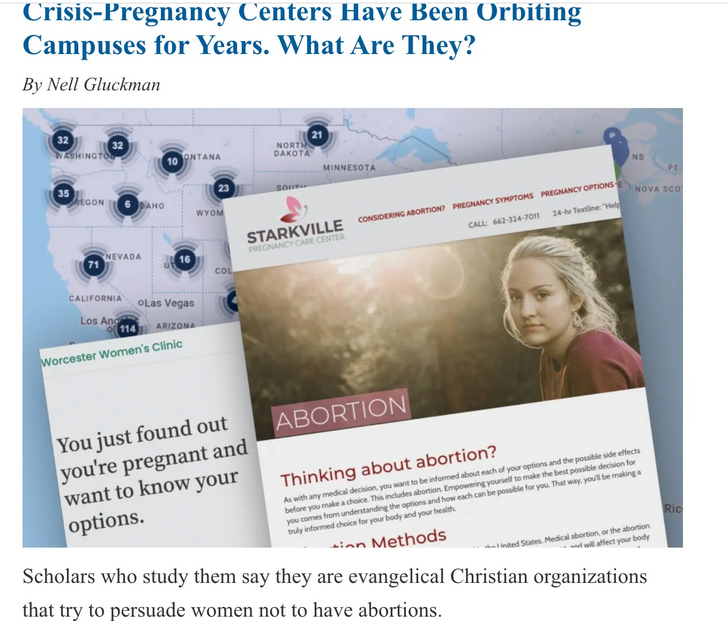
An email message this morning from The Chronicle of Higher Education offers a deep investigative dive into an obscure topic — in a message that barely fit on my screen, so the screenshot is cut off a bit at the top:

Figured that out, did they? Coming soon: “Pizza shops orbit college campuses. Scholars have determined that they offer a bread-like disc strewn with red liquid and white-colored molten coverings”.

The investigation of pregnancy centers proceeds on the kind of dark foreboding that a television show conveys with poor lighting and a low vibration on the soundtrack. Since the reporter didn’t manage to get a single pregnancy center advocate or volunteer on the record, despite sending some email messages, the whole investigation takes all criticism entirely at face value, uncontested and unexamined. That leads to framing like this:

    Some centers target college students. Andrea Swartzendruber, an epidemiologist at the University of Georgia, analyzed the centers’ locations in Georgia and found that they were disproportionately clustered around the state’s colleges and high schools when compared with other health clinics. Swartzendruber and her colleague Danielle Lambert have mapped the locations of more than 2,500 crisis-pregnancy centers across the United States.

Yes, friends, I’m afraid this is the actual dark truth: Pregnancy centers target young women. They don’t target eight year-old boys or the elderly at all! nOw Do YoU SeE tHe hIddEn aGenDa!?!?!?!? THERE’S NOT A SINGLE CRISIS-PREGNANCY CENTER INSIDE A SINGLE RETIREMENT COMMUNITY!!!!!

Anyway, scholars were able to determine this, using sophisticated geospatial analysis.

The story also includes shock-quotes from an actual college student, Hana, who went to a crisis pregnancy center, like this one: “She kept referring to my pregnancy as a baby.”

And then, presumably, they invaded Poland.

QotD: Fascism and the state

Filed under: Europe, History, Politics, Quotations — Tags: , , , , — Nicholas @ 01:00

One way to tell if you’re dealing with an actual Fascist is whether your subject has that theory of state power. If he doesn’t, you might be dealing with (say) a garden variety conservative-militarist strongman like Admiral Horthy in Hungary. Rulers like that will kill you if you look like a political threat, but they’re not invested in totalitarianizing their entire society.

Occasionally you’ll get one of these like Francisco Franco who borrows fascist tropes as propaganda tools but keeps a tight rein on the actual Fascist elements in his power base (the Falange). Franco remained a conservative monarchist all his life and passed power to the Spanish royal family on his death.

This highlights one of the other big lies about Fascism; that it’s a “conservative” ideology. Not true. Franco, a true reactionary, wanted to preserve and if necessary resurrect the power relations of pre-Civil-War Spain. Actual Fascism aims at a fundamental transformation of society into a perfected state never seen before. All of its type examples were influenced by Nietzschean ideas about the transformation of Man into Superman; Fascist art glorified speed, power, technology, and futurism.

Eric S. Raymond, “Spotting the wild Fascist”, Armed and Dangerous, 2019-04-30.

July 18, 2022

“Sophisticated liberals” yawning in synchrony

Filed under: Media, Politics, USA — Tags: , — Nicholas @ 03:00

Ed West linked to this Jacob Siegel post about the tactical use of the “yawn” response to deflect and avoid discussion of topics “sophisticated liberals” want to avoid:

An American who wants to understand how political change occurs in their country must study what I’ve come to think of as the “yawning” habit of sophisticated liberals.

The yawn is an avoidance tactic that feigns moral and intellectual superiority while exhibiting dullness and cowardice. It is deployed when some flagrantly abnormal thing is occurring, which the sophisticated liberal is too sophisticated to defend outright — since to do so would expose them to potential mockery and loss of status — but too cowardly to condemn, since that would risk placing them on the wrong side of Progress.

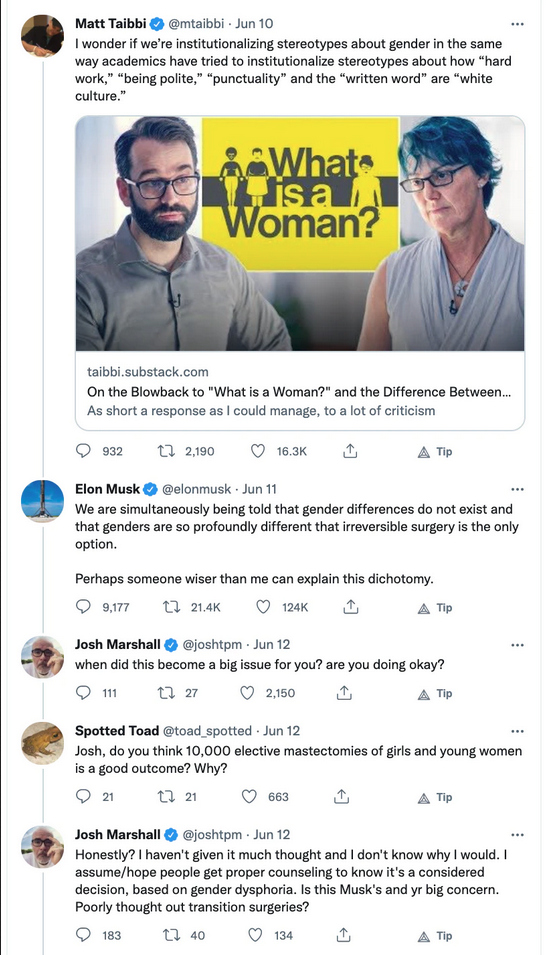
Here we can observe the liberal pundit Josh Marshall, yawning as loud as he can in response to questions about the precepts of gender ideology.

Marshall has not given much thought to why thousands of people, including adolescents, have suddenly decided to alter their bodies in irreversible ways. He’s not just incurious, he’s bragging about it. Only right-wing, extremist Putin lovers (of course, Marshall was a Russiagate conspiracist) would possibly care about an historically unprecedented, institutionally directed revolt against sexual dimorphism. A 2018 study by the British government found that the number of minors being referred for gender treatments, including hormone injections, increased by more than 4,000% in a single decade … How uninteresting. Yawn. The World Professional Association for Transgender Health just lowered the minimum age for children to receive puberty blockers or undergo transition surgery from 16 to 14. Double yawn.

“I’d like to know why you care,” the conservative pundit Matt Walsh is asked repeatedly in his new agitprop documentary What Is a Woman? The academics and other gender experts whom Walsh interviews clearly view this as an effective response to his line of questioning. It tells you something about the moral and intellectual vitality of contemporary liberalism that they simply assume that the people whose opinions they care about would agree there’s something very suspicious and déclassé about insisting on a definition of woman.

July 16, 2022

Declarations of faith in the Church of Scientism

Filed under: Health, Media, Politics, Religion, USA — Tags: , , , , — Nicholas @ 05:00

Chris Bray points out the hard-to-miss similarities between traditional religious beliefs and the modern beliefs of the congregations of the Church of Scientism:

Christian churches tend the bust out the HE IS RISEN banner on Easter Sunday, and here’s a version of the central declaration of faith from another religion, the Church of Scientism:

“We stand by science, so we stand by the vaccine.” These hang from every lamppost on the sizeable campus of a major research hospital in Los Angeles, an identical recitation of faith that appears before the eyes of the medical pilgrim every thirty steps or so. You can chant it in a rhythm, if you’re so inclined, as ye performest thine Stations of the Vaccine. The true penitent will park on Robertson, to walk past the maximum number of signs, but mark ye the parking restrictions, for the ways of Los Angeles parking enforcement are cruel, and many are they who suffer the penalties.

If this isn’t a declaration of a faith, then what is it? The call and response, the this-therefore-this:

Priest: Because of science, we save lives every day.

Congregation: We stand by science, so we stand by the vaccines.

You can hear the chanting in your head, can’t you? The repetition, the delivery of a mantra in a form that allows you to perceive it, and perceive it, and perceive it, and perceive it yet again before ye makest thine turn onto San Vicente. When you say it often and identically, it wears grooves; it patterns the dailiness of life with the avenues of belief. It’s Benedictine Scientism.

Or, you know, not. My bet is that most people never notice these signs, or never notice them twice, but the choice to make them and to display them is compellingly bizarre and creepy. I wish I could have witnessed the meeting of medical administrators that led to that choice, because I’m fairly confident that it played like a Paddy Chayefsky movie IRL.

I’ve been reminded over and over this week how important Substack has become. This absolute must read post from el gato malo discusses the complete implosion of popular trust in the mRNA injections, from the sharp decline in booster uptake to the “that parrot is dead” numbers regarding mRNA uptake in children under the age of five. Flatly, people aren’t taking this shit anymore, and they’re for damn sure not having it injected into their children.

A viable … conservative … party in Quebec? Isn’t that somewhere in Revelations?

Filed under: Cancon, History, Politics — Tags: , , , — Nicholas @ 03:00

In the free-to-cheapskates portion of a Paul Wells column on the unlikely and certainly unpredicted rise of a conservative party in Quebec, he points out just how ephemeral such parties have been in the past:

My Big Book of Columnists’ Clichés tells me I should call Duhaime the leader of Quebec’s “upstart” Conservative party, but if we’re being accurate here, it hasn’t really upstarted yet. Or maybe it keeps upstarting and then unstarting. Quebec had a Parti conservateur in the 19th and early 20th centuries, under whose banner eight premiers were elected. Maurice Duplessis essentially shut it down in the 1930s when he formed the Union Nationale. There was a Parti conservateur for a minute in the mid-60s, to no great effect. And there’s been a Parti conservateur since 2009.

The latest party’s impact on electoral politics so far has been negligible. It won less than 1.5% of the vote in 2018, the year Legault’s amorphous populist-nationalist Coalition Avenir Québec (CAQ) swept to power. It’s never elected a member to the National Assembly. For the past year, its only MNA has been a woman who got booted from Legault’s party for, uh, contributing to Duhaime’s.

But things have been getting weird in Quebec this year. An Angus Reid Institute poll last week put Duhaime’s upstart party (see how easy it is?) in second place, well behind Legault’s CAQ but ahead of the historic Liberal and PQ parties and the urban social democrats in Québec Solidaire.

The Quebec Conservatives are, in fact, the leading party among male voters age 18-34 and 35-54. They’re not nearly as competitive among young women or among older voters in general. Duhaime would need his vote to keep growing, and not just a little, to have any chance of winning an election. Frankly he’s likelier to win zero seats, and perhaps likeliest to win somewhere between zero and a dozen.

But the party has already gone from 500 memberships to 60,000 since Duhaime, a former Ottawa political staffer (Bloc Québécois, then Canadian Alliance) and Quebec City talk-radio host, became its leader in 2021. That’s three times as many memberships as the CAQ had when Legault became premier.

Duhaime is working on something, a discourse starkly different from Legault’s and also different, in important ways, from the recent positions of the federal Conservatives. He’s against vaccine restrictions — but he’s been careful not to associate with truck convoy protesters. He’s against Legault’s new French language law, Bill 96. Not because it’s mean to anglophones, although Duhaime is making at least a modest attempt to appeal to conservative anglophone voters, but because the law makes blanket use of the Constitution’s “notwithstanding” clause to sidestep Charter rights. Duhaime says no government should curtail rights so easily. He wants a great big dose of private for-profit health care.

After two years of legislation by order-in-council and intermittent curfews and the most sweeping use of the notwithstanding clause in 40 years, Legault’s Premier-knows-best shtick has opened up room on his libertarian right. Enough room for a solid competitor? Duhaime himself shrugged when I asked him, during a brief chat after the parking-lot scrum.

“We might win this,” he said. “We might get zero seats. On est la ‘wild card’ de la gang.”

July 15, 2022

Forget George Washington, Woodrow Wilson, and FDR – studying the presidency of Jimmy Carter is suddenly more relevant

Filed under: Books, Media, Politics, USA — Tags: , , , , , , — Nicholas @ 03:00

One of the readers of Scott Alexander’s Astral Codex Ten has contributed a review of The Outlier: The Unfinished Presidency of Jimmy Carter by Kai Bird. This is one of perhaps a dozen or so anonymous reviews that Scott publishes every year with the readers voting for the best review and the names of the contributors withheld until after the voting is finished:

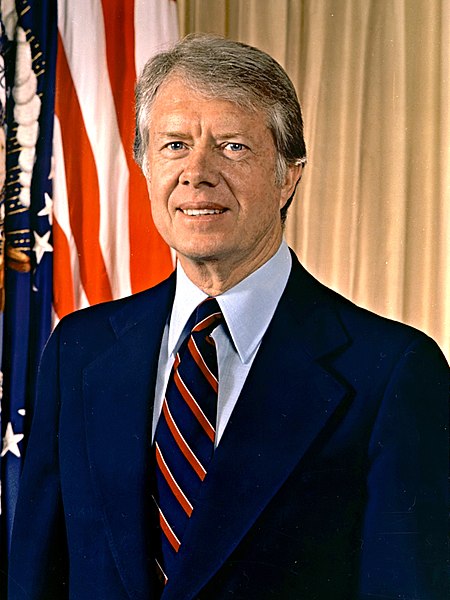
President James Earl “Jimmy” Carter.
Official portrait via Wikimedia Commons.

Like most people under 70, I was more aware of Carter’s post-presidency role as America’s kindly old grandfather, pottering around holding his wife’s hand and building Houses for Humanity. I mostly knew that he liked to wear sweaters, that he owned a peanut farm, and that he lost to Ronald Reagan.

But I wondered what, if any, hidden depths lay within the peanut farmer. Also, I wanted to enter this contest, and I didn’t want to pick a book that I thought a bunch of other people might also review. So I turned to The Outlier: The Unfinished Presidency of Jimmy Carter, by Kai Bird. Like Carter, this book seems to have been largely forgotten. It won a Pulitzer, but I had never heard of it until I googled “best book about Jimmy Carter”. It seems to have gotten a lot less attention than similar recent biographies about Grant, Roosevelt, and Truman, and it’s hard to imagine it ever becoming a TV show or a musical.

Carter was born in 1924 in Plains, Georgia, which, as you can tell from the name “Plains”, is very dull. His father was a successful farmer, which made his family wealthy by local standards. Almost every other Plains resident during Carter’s childhood was an impoverished African-American, many of whom worked on the Carter farm, a fact that is often cited as the answer to the central mystery of Carter’s childhood: how he grew up white in the Depression-era South without becoming a huge racist. It probably doesn’t tell the whole story, though, as his siblings came out just about as racist as you’d expect.

Carter attends the Naval Academy and eventually becomes a lieutenant on a nuclear submarine. At one point, he participates in a cleanup mission in which he is lowered directly into the core of an active nuclear reactor, thus causing him to develop superpowers that he will later use to win the presidency. Perhaps because of this experience — but, more likely, because he realizes that his deep-seated religious beliefs make him a poor fit for a career in an organization designed to wage war — he quits the Navy at 29 and returns home to Plains. “God did not intend for me to kill”, he says, which would have been an awesome catchphrase had those superpowers actually been real.

Searching for a new career, Carter runs for State Senate, loses due to voter fraud, then challenges the results and wins by 15 votes in a new election. A few years later, he runs for governor, and loses for real this time, to avowed segregationist (and man with a truly awesome name) Lester Maddox. Having never experienced failure in any way before, Carter is plunged into a profound spiritual crisis by this loss. Today, we would probably just say he was depressed. But as a religious Christian in the Deep South in 1966, you don’t “get depressed”, you have a spiritual crisis.

In 1970 Carter runs for governor again. This time, however, he decides to do whatever it takes to win. He runs a sleazy campaign that flies in the face of his modern-day reputation as kindly and honest. His campaign strategy has two core planks: 1) pretend to be a racist to appeal to the masses, and 2) avoid taking a stand on any other issue. Carter describes himself nonsensically as a “conservative progressive” and avoids commenting on the Vietnam War or the civil rights movement. He’s so good at pretending to be racist that the white supremacist White Citizens Council endorses him. He even wins the endorsement of his old opponent, outgoing Governor Maddox, who’s term-limited from running again. As far as anyone can tell, Carter never expresses any second thoughts about his disingenuous behavior during the campaign. Having passed through his spiritual crisis, he’s now guided by an unshakeable faith in his own goodness — a faith that justifies a victory by any means necessary.

The “fake racist” strategy works. Carter trounces his opponent, a wealthy businessman named Carl Sanders who he caricatures as “Cuff Links Carl” — when he’s not busy falsely accusing him of corruption, or hypocritically bashing him for his support of Martin Luther King. In January 1971, Carter is sworn in as the 76th Governor of Georgia.

Just a few minutes into his inaugural speech, Carter drops the pretenses of his campaign and executes on one of the most dramatic about-faces in modern-day political history when he declares that “the era of racial discrimination in Georgia is over”. The crowd gasps audibly, and outgoing Governor Maddox denounces Carter as a liar before the inauguration is even over. But Carter doesn’t care. He’s governor now, and he’s going to do what he wants.

July 14, 2022

QotD: Fascism and anti-semitism

Filed under: Europe, Germany, History, Politics, Quotations — Tags: , , , — Nicholas @ 01:00

The Fascist theory of power … defines the system from above, naturally evolving quite rapidly into Führerprinzip, the cult of the absolute leader whose authority may not be questioned. One important consequence is that fascist strongmen like to create institutions parallel to the civil police and line military that are answerable directly and personally to the Maximum Leader. Of course the best known example is Hitler’s SS, but any well-developed fascism generates equivalents.

You can have a quite an effective totalitarianism without this; Stalin, for example, never bothered with an SS-equivalent. You can get similar developments under Communism; consider Mao’s Red Guards. And on the third hand, Franco copied that part of the formula without actually being a Fascist. Still – if you think you’ve spotted a fascist demagogue ramping up to takeover, one of the things to check is whether he’s trailing a thug army behind him ready to turn into a personal instrument of force. If he isn’t, you’re probably wrong.

Another thing that follows from the Fascist theory of power is hostility towards markets, free enterprise, and trade. Yes, yes, I know, you’ve heard all your life that fascists are or were tools of capitalist oligarchs, but this is another big lie. In reality about the last person you want to be is a “capitalist oligarch” in the way of one of Maximum Leader’s plans. Because even if he needs you to run your factories, you’re likely to find out all the ways utter ruthlessness can compel you. Threats to your family are one time-honored method. You can’t buy him, because has the power to take anything he really wants from you.

In fact, one of the reasons fascist regimes turn anti-Semitic so often is because Jews are identified with mercantile activity. Which in the Fascist view of things, is corrupting and disruptive of loyalty bonds that should be more important than wealth. Furthermore, Fascism inherited from its parent Marxism the whole critique about capitalism alienating workers from their production.

The political economics of fascism is always state-socialist, and explicitly so. This follows directly from the drive for centralization.

Eric S. Raymond, “Spotting the wild Fascist”, Armed and Dangerous, 2019-04-30.

July 13, 2022

Joe Biden’s age and health can suddenly be discussed in the New York Times

Filed under: Media, Politics, USA — Tags: , , — Nicholas @ 05:00

In the free-to-cheapskates portion of Matt Taibbi’s TK News article on “The New Kremlinology”, he discusses the sudden change of policy for the New York Times regarding Joe Biden’s physical and cognitive condition:

After reading his formal remarks from the teleprompter, Joe Biden walks away from reporters without answering questions, August 2021.

On Monday, the New York Times ran a story pegged to a new poll, showing Joe Biden dragging a sub-Trumpish 33% approval rating into the midterms. The language was grave:

    Widespread concerns about the economy and inflation have helped turn the national mood decidedly dark, both on Mr. Biden and the trajectory of the nation… a pervasive sense of pessimism that spans every corner of the country …

The article followed another from the weekend, “At 79, Biden Is Testing the Boundaries of Age and the Presidency”. That piece, about Biden’s age — code for “cognitive decline” — was full of doom as well:

    Mr. Biden looks older than just a few years ago, a political liability that cannot be solved by traditional White House stratagems like staff shake-ups … Some aides quietly watch out for him. He often shuffles when he walks, and aides worry he will trip on a wire. He stumbles over words during public events, and they hold their breath to see if he makes it to the end without a gaffe.

Biden’s descent was obvious six years ago. Following the candidate in places like Nevada, Iowa, and New Hampshire, I listened to traveling press joke about his general lack of awareness and discuss new precautions his aides seemed to be taking to prevent him engaging audience members at events. Biden at the time was earning negative headlines for doing things like jamming a forefinger into the sternum of a black activist named Tracye Redd in Waterloo, Iowa, one of several such incidents just on that trip.

My former editor at Rolling Stone John Hendrickson, a genial, patient person whom I like a great deal, insisted from afar that Biden’s problems were due to continuing difficulties with a childhood stutter, something John had also overcome. He went on to write a piece for the Atlantic called “Joe Biden’s Stutter, and Mine” that became a viral phenomenon, abetting a common explanation for Biden’s stump behavior: he was dealing with a disability. The Times added op-eds from heroes like airline pilot Captain “Sully” Sullenberger with titles like, “Like Joe Biden, I Once Stuttered, Too. I Dare You to Mock Me”.

But I’d covered a much sharper Biden in 2008 and felt that even if the drain of overcoming a stutter had some effect, the problems were cognitive, not speech-related. He struggled to remember where he was and veered constantly into inappropriateness, challenging people physically, telling crazy-ass stories, and angering instantly. He’d move to inch-close face range of undecideds like Cedar Rapids resident Jaimee Warbasse and grab her hand (“we’re talking minutes”, she said) before saying, “If I haven’t swayed you today, then I can’t.” I called the mental health professionals who were all too happy to diagnose Donald Trump from afar for a story about the effort to remove Trump under the 25th amendment, and all declined to discuss Biden even off the record for “ethical” reasons.

This week, all that changed. Add stories like “Biden Promised to Stay Above the Fray, but Democrats Want a Fighter” and Michelle Goldberg’s “Joe Biden is Too Old to Be President Again”, and what we’ve got is a newspaper that catches real history spasmodically and often years late, but has the accuracy of an atomic clock when it comes to recording the shifting attitudes of elite opinion.

July 12, 2022

Ed West – “Farewell then, Boris Johnson, and to paraphrase another leader who had rather lost the support of his front bench, what an artist dies with him”

Filed under: Britain, Education, Greece, History, Politics — Tags: , , , — Nicholas @ 05:00

Outgoing (in several senses) British PM Boris Johnson was a political throwback in many ways:

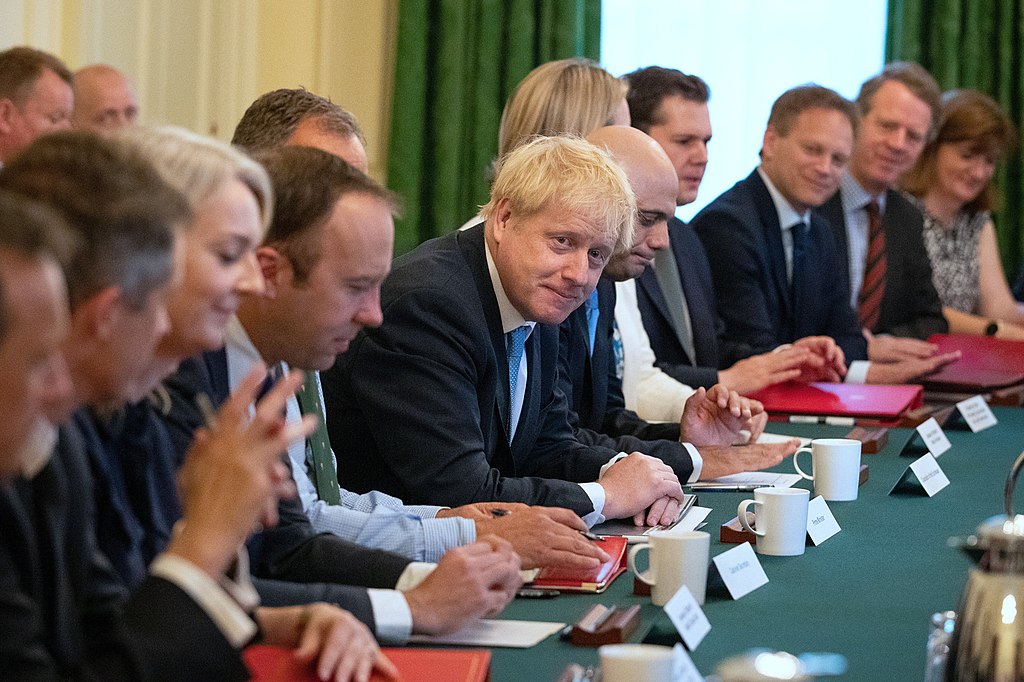
Prime Minister Boris Johnson at his first Cabinet meeting in Downing Street, 25 July 2019.
Official photograph via Wikimedia Commons.

Johnson was the most amusing prime minister in living memory, but also the most historically aware. The first British political leader since Harold Macmillan to read classics, he was hugely influenced by the ideas of the ancient world, in particular Fortuna. And as Tom Holland reflected in last Friday’s The Rest is History, this obsession with the classics guided his career.

Classics, Holland said, had once been a “how to do politics” course, from the time of Machiavelli to the aristocrats of the 18th and 19th centuries, seen as a guide to “how to behave morally and politically”. This became especially important as elites in Europe and America came to consciously imitate the ancients — five Victorian and Edwardian prime ministers read classics — but “that has not been the case for many, many years”.

Johnson in that way “is a throwback. He is someone for whom classics is central to his education, but I think the thing that is intriguing about it is that he studied it as an example of how to get ahead. He had a properly Greek/Roman understanding of Fortuna, Tyche, chance, this great goddess who has her favourites. He genuinely, in an inchoate sense but in a sense that does seem to be authentic, saw himself as fortune’s favourite, but of course it’s the essence of tragedy, the cruelty and humour of Fortuna, that she raises her favourites up only to hurl them down. The joke that fate has played on Johnson is a particularly cruel one.”

It’s hardly surprising that Boris believed in Fortuna, considering just how much she smiled on him. A little over a year ago I wrote about how incredibly fortunate Boris was to become leader in the middle of a seismic demographic shift that would make life very difficult for the Tories in just a few years.

It was all the more incredible because, just 12 months earlier, it appeared that Boris’s luck had finally run out. Having done everything to climb the greasy pole, Johnson had achieved his goal only for his dreams of power to turn sour. Apollo had fired his arrow at Britain and Boris was left with a country overrun by disease and necessitating authoritarian measures that repulsed him; soon he was sick himself, and it looked like he might follow his idol Pericles a bit too much by dying of the plague.

July 11, 2022

Well, we were overdue for another “Great Awakening”, but this time it’s woke

Filed under: Media, Politics, Religion, USA — Tags: , , , — Nicholas @ 03:00

In the Neo-Ciceronian Times, Theophilus Chilton outlines why it’s more sensible to regard today’s progressives as devout cultists rather than persuaded political activists:

You may not have been aware of it, but a religious revival has been sweeping America for the past few years. However, rather than the old-time religion of Christian piety, it’s a new religion with new idols and a new direction. Yet, not entirely new — it’s the latest phase in an evolving revolutionary belief system that has consciously set itself against every aspect of traditional American culture and society. Whereas earlier progressivism made an effort to appear to integrate itself into earlier American paradigms even as it was acting to overturn them, the current religion of Woke Progressivism has completely excised itself from any pretension of respect for previous Americanism.

Some on the Right balk at the terminology of referring to woke progressivism as a “religion”. After all, hasn’t the modern Left been characterised by a rejection of religion? By an increasingly overt atheism that not only denies traditional religion, but actively subverts and mocks? Yet, unlike European modes of leftism that have remained more within the boundaries of orthodox Marxism-Leninism, official atheism has never been able to gain more than a toehold in the United States. The American temperament is a religious one and therefore requires some object of piety towards which it is directed.

For the Left, this new object of piety was channeled into cultural Marxism, a form of New Leftism that has successfully managed to take over nearly every institution — government, corporate, cultural — in this country. It did so by providing a more comprehensive program, one that was as much cultural subversion and replacement as it was “traditional” economic leftism, than older forms of socialism. This new leftism, which in its full floruit is the woke progressivism we see today, provides a totalising replacement ideology that seeks to sweep away everything that came before it.

But is this new belief system a religion? I believe that it definitely can be thought of as one, since it displays all the typical sociological patterns found in religions as they have been found throughout history, plus a few that are typical of cult groups as they’re observed today.

To begin, woke progressivism has a precisely defined and systematically enforced body of doctrines which are to be believed, not rationalised. The fluidity of gender, the naturalness of homosexuality, the evil of whiteness — all of these and much more are to be received by simple faith. But these aren’t randomly chosen. They have overarching doctrinal bases that fit within the larger progressive ideological agenda. Put together, these constitute an interlocking body of progressive doctrine that provides a comprehensive ideology to its followers.

Yet at the same time, woke progressivism does have a means of receiving new revelation and new interpretation via its own body of canonical authorities who then pass on this doctrine to the larger body of the woke “church”. This is done primarily through means of the narrative-shaping performed by major media outlets working in conjunction with elements within government, NGOs, and academia (the complex of which is what neoreactionaries often refer to as “the Cathedral”). Indeed, that process has been at work for decades — e.g. it is how the Afrocentrism of the 1980s went from being an odd, laughable academic quirk to being received doctrine which naysaying can cause you to lose your job. Have you ever noticed how when some new element of the progressive narrative hits, whether it’s a fundamental element of ideology or simply how to think about some current news event, that progressives seem to adopt it all at once?

There’s a reason for that. Once a change or addition is decided, the doctrine is swiftly promulgated to all of the local parishes and becomes a received and accepted part of the faith.

July 8, 2022

Dutch government clearly has been cribbing notes from Justin Trudeau’s brownshirt tactics for dealing with unarmed protests

For such a big story, the revolt of the Dutch farmers doesn’t seem to be getting as much international coverage as you might expect … almost as though governments and the tame mainstream media are trying to hide it:

Whether it’s the Netherlands or Canada, the story is the same across the globe. Over the past several years, elitists occupying positions of power within governments have grown accustomed to imposing their will on ordinary citizens.

It doesn’t matter that they’re blatantly violating the social contract established by their own people. For the elitist, the only item on the agenda is maintaining power and dominion over the populace, whom they view as nothing more than subjects meant to obey their diktats without question.

Avoiding such power grabs, however, requires a vigilant citizenry, whose dedication to liberty must be stronger and more widespread than elitists’ devotion to tyranny. As witnessed during the Covid regime, compliance with the state gives birth to more draconian edicts, which only continue to erode the line between democracy and oligarchy.

Make no mistake, if the Dutch farmer protesters let their foot off the gas for one second, the state will not hesitate to shove their alarmist, degrowth policies down the people’s throats without remorse. Any form of surrender will likely continue to enable more overreaching policies, which will undoubtedly infringe upon the everyday lives of Dutch people.

The other day it was reported that police had opened fire on a tractor driven by a 16-year-old. Today, the young man was released from custody without charges:

Farmers’ protests in the Netherlands have reached the royal palace at Dam Square in Amsterdam. 16-year old Jouke, who was shot at by a police officer on Tuesday, was released without charges.

Opposition leader Geert Wilders released a bombshell letter showing the globalist Dutch government wants to use expropriated agricultural land for asylum centers.

Around 40,000 Dutch farmers paralyzed traffic in the Netherlands and blocked around 20 food distribution centers over the weekend with trucks and tractors. Yesterday the protests reached Dam Square in Amsterdam and the seat of government in The Hague. The airport in Groningen was blockaded by demonstrators on Wednesday, German farmers joined the protests in Heerenberg near the Dutch-German border.

In an incident near the blockaded food distribution center at Heerenveen in Friesland, police officers shot at 16-year-old Jouke’s tractor, which was already turning away from the roadblock, missing the boy’s head by an inch (Gateway Pundit reported). Jouke and two other protestors were arrested on suspicion of “attempted manslaughter” after which an angry crowd gathered in front of the police station in Leeuwarden. All three have now been released without charges.

A farmer in Leeuwarden told Canadian journalist Keean Bexte that the Rutte government had “created a climate where the police think they can shoot”. Dutch farmers are being dispossessed and committing suicide, the protester said, while China, for example, fails to meet any environmental regulations.

[…]

Sky News Australia host Rowan Dean compared the Dutch police tactics to the violent quashing of Canadian trucker protests by uparmored riot police, calling Premiers Trudeau and Marc Rutte the “golden pin-up boys for Klaus Schwab and the globalist fantasists of the World Economic Forum.”

“The similarities between Canada and Holland are as startling as they are disturbing,” Dean said. “Only a few months ago, it was the Canadian government that attacked its own citizens in the most grotesque and terrifyingly authoritarian manner during the so-called Truckers’ Convoy when the government actually froze the bank accounts and basically starved out any individuals in what was legitimate peaceful democratic opposition to Covid (vaccine) mandates. That ended badly for Trudeau.”

At the World Economic Forum in Davos 2021, Dutch PM Marc Rutte had boasted about “Holland’s involvement with the World Economic Forum’s Global Food Innovation Hubs, which is busily ‘transforming food systems and land use'”, Dean said.

At Ace of Spades H.Q., J.J. Sefton had this to say about the protests and the repressive measures taken by the Dutch and Canadian governments toward peaceful protestors:

Mind you, this is in Holland. I’m no ethnographer, but the Netherlands is a country and people that are about as liberal, peaceful and secular as they come. Like many other European nations, they atoned for the collective guilt over what happened to its Jews during the war (among other things) by opening its borders to a massive influx of Muslim immigrants with predictable results. Strange how what happened to Theo Van Gogh was all but ignored and someone like Geert Wilders is vilified. Yet with this green madness, somehow the people have woken up to the Globalist/EU wolf at their throat. The Dutch government’s response? Crush the farmers. You have to wonder what the reaction would have been had most or even some of them had been Muslim? Meh, Muslims don’t farm. But, think about it. This is Holland. Not North Korea, Cuba, Venezuela or Iran. Holland. A supposedly enlightened European democratic society that imposes its will on people and sets the water cannon and tear gas on them for daring to object.

Well, look at Canada only a few short months ago. In the wake of the truckers’ convoy protest over forced injections, how did Justin Castreau-cescu react? Arrests, confiscation of vehicles and bank accounts, among other things. Cana-fucking-da. Now look at what that maple syrup sucking hoser is up to:

    The Canadian government is funding a booklet being sent to schools across the country that teaches children to be wary of people who champion “free speech.”

    Yes, really.

It’s a Paul Joseph Watson video, hence the short quote. But it says it all. Holland is no longer Holland. Canada is no longer Canada and America is no longer America. You know it. They know it. The forces that hijacked those governments and societies know it. The question is not do they know that we know? Of course they know we know. Yet they are betting the farm that we are not going to do a damned thing about it. So, okay, J.J. What about this “optimism” thing? In a sense, as Dave in FL and CBD talked about, I am optimistic in that I understand that what cannot go on will not go on. And this crap for sure cannot go on.

In Spiked, Brendan O’Neill comments on the lack of interest among the people you’d expect to be most vocal in support of working people protesting against out-of-touch, arrogant elites:

If police were opening fire on protesters in a European nation, we would have heard about it, right? If there was a mass uprising of working people in a European Union country, taking to the streets in their thousands to cause disruption to roads, airports and parliament itself, it would be getting a lot of media coverage in the UK, wouldn’t it? The radical left would surely say something, too, given its claims to support ordinary people against The System. Cops shooting at working men and women whose only crime is that they pounded the streets to demand fairness and justice? There would be solidarity demos in the UK, for sure.

Well, all of this is happening, right now, in a nation that’s just an hour’s flight from Britain, and the media coverage here is notable by its absence. As for the left in Britain and elsewhere in Europe – there’s just silence. This is the story of the revolting Dutch farmers. These tractor-riding rebels have risen up against their government and its plans to introduce stringent environmental measures that they say will severely undermine their ability to make a living. They have been protesting for a couple of years now, but their fury has intensified in recent weeks. They’ve blocked motorways, blocked roads to airports, set fire to bales of hay, and descended on The Hague. Things are so serious that yesterday, in the province of Friesland, police opened fire. Mercifully, no one was injured.

There has been some reportage outside of the Netherlands, of course. But it has been strikingly muted. And it isn’t hard to see why. This is a people’s revolt against eco-tyranny, against the modern elite’s determination to slash “harmful” emissions with little regard for the consequences such action will have for working people and poor people. To the formers of elite consensus opinion, for whom environmentalism is tantamount to a religion, the sight of pesky little people rebelling against green diktats is too much to bear. So they either demonise these dissenters, as is happening in the Netherlands, or they ignore them in the hope they will go away, as is happening outside the Netherlands.

The farmers have a very good case. Their concern is that the government’s plans for slashing greenhouse gases will hit farming – and other industries – very hard indeed. The targets, introduced last month, commit the Netherlands to halving its use of nitrogen compounds by 2030. The government says emissions of nitrogen oxide and ammonia, both of which emanate from livestock, will need to be drastically cut. This will entail farmers getting rid of vast numbers of their livestock, potentially devastating their livelihoods. Fishermen are concerned, too. As of next year, fishing permits will be given out on the basis of the eco-friendliness of the trawler the fisherman is using, and many are worried that they’ll end up permit-less, unable to earn a living. They have blocked harbours in solidarity with the farmers. The construction industry could also suffer. Courts have blocked numerous infrastructure projects on the basis that the emissions they cause will breach the new eco-rules.

« Newer PostsOlder Posts »

Powered by WordPress