
Forgotten Weapons
Published 28 Sept 2017Once it became apparent that the MAS-36 was going to be used in a substantial amount of frontline combat (contrary to its intended role as a reserve or secondary rifle), it became important to provide it with grenade launching capability. The French military really liked rifle grenades as a way to have explosive support firepower always available with the frontline infantry, without needing to call for specialized units like mortar crews.
After various experiments with clamp-on launchers (like and including the WW1 VB launcher), the LG48 (lance grenade, or grenade throwing) rifle was adopted in 1948. It used the same basic projectile as the Mle 1937 50mm light mortar, but with a new tail assembly fitted which allowed it to slide over the muzzle of a MAS-36 rifle. The LG48 rifle was essentially just a MAS-36 with a new nosecap assembly which included a simple grenade sight and a range-setting adjustable sleeve over the barrel.
The LG48 pattern rifles were made both brand new in the St Etienne factory and also supplied as conversion kits to be applied in the field. Neither type ever received new or special markings to identify their grenade launching status. The Mle 1948 grenades and the LG48 rifles were declared obsolete in 1968, as the French had switched to the NATO standard type of rifle grenades in the early 1950s. In 1968 the existing rifles were ordered to be retrofitted back to standard MAS-36 pattern, and their lack of special markings makes those retrofitted rifles virtually indistinguishable from original MAS-36 rifles. The surviving examples, like the one in this video, are almost all from nations which received the rifles as military aid from France and were not subject to the French retrofitting order (this particular rifle was imported as part of a batch from Lebanon in the 1990s).
(more…)
October 10, 2023
MAS-36 LG48: A Grenade Launcher for the Bolt Action Infantry
October 9, 2023
THE BATTLE OF SYDNEY: Sabres, Meteors, Sea Furies And Two Blokes With A Bren Gun Battle A Runaway
Not A Pound For Air To Ground
Published 23 Jun 2023On the morning of the 30th of August, Anthony Thrower of Lavinia Street, Granville was out for a pleasure flight when his Auster Archer decided to make a break for freedom. What followed was a madcap three hour chase involving four jet fighters, two Hawker Sea Furies and two blokes with a Bren Gun.
Given that this incident pre-dated the more famous Battle Of Palmdale by a year, I thought it was interesting to compare how more conventionally armed aircraft fared against a slow, but determined piston-engined intruder. I hope you find it entertaining. I have to admit that as a Brit, I enjoyed poking a little fun at my Australian friends … hopefully they can take it in the spirit it’s intended.
Final point of note is to thank Bryanwheeler1608, whose comment put me onto this story in the first place. I hope you think I’ve done it justice!
October 8, 2023
The End of the Warsaw Uprising – WW2 – Week 267 – October 7, 1944
World War Two
Published 7 Oct 2023The Warsaw Uprising comes to its conclusion, a tragic one for the Poles. In the field in Europe, there are Allied attacks toward Aachen, Bologna, and Debrecen, while in China the Japanese have begun a new phase of their Ichi Go Offensive.
(more…)
The Grave of Canada’s Greatest General: Sir Arthur Currie
OTD Military History
Published 23 Jun 2023The grave of General Sir Arthur Currie in Mount Royal Cemetery in Montreal, Quebec. Arthur Currie was the commander of the Canadian Corps from June 1917 to the end of World War 1. Appointed as the Principal and Vice-Chancellor of McGill University in 1920, he held that position until his death in 1933.
(more…)
October 7, 2023
Eastern Front Tank Warfare 1944
World War Two
In this conflict, we’ve seen armored warfare on a greater scale than anything before or since. Indy takes a look at some of the tanks slugging it out on the Eastern Front, from the long-serving Panzer III and IV, to the newer and more powerful Tiger and T-34 85, and the monstrous IS-2.
(more…)
Rearming West Germany: The G1 FAL
Forgotten Weapons
Published 19 Jun 2023Today we are taking a look at a German G1 pattern FAL. The initial purchased of the G1 were actual made by the German Border Guard (the Bundesgrenschutz). In the aftermath of World War Two, the western Allies decided to perpetually disarm Germany, and German security was provided by French, British, and American forces. As the Iron Curtain fell across Europe, that attitude softened — West Germany was on the front lines of the Cold War, and could be a valuable ally against Communism in the East. Thus in 1951, the West German Bundesgrenzschutz (Border Guards) were formed and armed — basically with all WW2 Wehrmacht equipment. Looking to improve its small arms in 1955/56, the BGS tested a number of modern rifles and decided to adopt the FAL.
The BGS initially ordered 2,000 FAL rifles from FN, with wooden hand guards and a fixed flash hider (essentially a standard Belgian FAL) — these are known as the “A” pattern. A second BGS order for 4,800 more rifles followed, this time of the “B” pattern with a metal handguard and folding bipod. This was the first use of an integral bipod on the FAL, and would go on to be a popular option for other buyers.
In 1955, the German Army was reinstated as the Bundeswehr. Looking over the BGS rifle testing, the Bundeswehr also decided to adopt the FAL, and placed and order for 100,000 rifles — the “C” pattern. These include sights lowered 3mm by specific German request, as well as a set of swappable muzzle devices (flash hider and blank-firing adapter).
Ultimately, FN was unwilling to license FAL production to West Germany, and this drove the Germans to adopt the Spanish CETME as the G3 rifle, which it was able to license. The Bundeswehr G1 rifles were eventually transferred to the BGS and later sold to other allies as surplus.
Special thanks to Bear Arms in Scottsdale, AZ for providing access to this rifle for video!
(more…)
October 6, 2023
Farnborough Airshow – 1959 (in colour)
spottydog4477
Published 28 Dec 2009Farnborough Airshow – 1959 (in colour)
QotD: The “Marian Reforms” to Roman legions
First off we need to establish what changes are generally understood to fall under the heading of the “Marian Reforms”, before we then try to actually locate those changes in our evidence (and then marvel at our general inability to do so). Understood broadly the Marian reforms are supposed to be a combination tactical, organizational and equipment reforms associated with Gaius Marius in the last decade of the 100s. As it turns out, Marius initiated almost none of these reforms, some of these supposed reforms didn’t happen at all at any point and some of them happened outside the time period in question.
In short, the things that are supposed to have happened here are:
- (Tactical-Organizational) A shift in battle tactics from the two-century maniple (c. 120 men) to the six-century cohort (c. 480 men) as the primary tactical unit on the battlefield,1 as well as the primary organizational unit of the Roman army. Elements of the older Polybian legion persist in names and titles.
- (Organizational) A shift from poorly paid conscript soldiers drawn from Rome’s propertied class (the assidui) drawn up through the dilectus to the use of volunteers drawn from Rome’s property-less poor (the proletarii or capite censi) who served as effectively professional soldiers, lacking any other means of subsistence.
- (Organizational) The practice of granting land and/or citizenship to Roman soldiers on discharge as a regular feature of Roman service.
- (Organizational) The end of the light infantry velites and Roman citizen cavalry (the equites) as part of the legion, as a product of the next point making such wealth distinctions unimportant.
- (Logistical) The introduction of state-supplied equipment (in place of self-supplied equipment) which enabled the mass-recruitment of the proletarii, as they no longer needed to be able to afford their own equipment, as part of a reform ascribed by some scholars to Gaius Gracchus (trib. 123-2).
- (Equipment) The introduction of a new design of pilum with a wooden rivet designed to break on impact with enemy shields (Plut. Mar. 25).
- (Equipment) The prioritization of the aquila, the eagle standard, over other standards in the legion (Plin. NH 10.16), often framed as the aquila fully replacing these other standards.
- (Equipment) The introduction of the furca, a Y-shaped pole for carrying the soldier’s pack (the sarcina), leading to better legionary logistics.
As we’re going to discuss, some of these things happened – but not because of Marius – and some of them didn’t happen at all. So how on earth did this idea of a big “Marian Reform” end up so pervasive in how we (used to) understand the Roman army of this period? The answer really has a lot to do with gaps (lacunae) in our sources. For the early second century, we have two really quite good sources on Roman military activity, Livy and Polybius. But both give out by mid-century,2 leaving us relatively blind until Julius Caesar‘s comentarii (de Bello Gallico and de Bello Civili) suddenly give us a massive infusion of information as we can see Caesar’s army functioning often in quite minute detail.
And we see what seem to be quite different armies! Caesar is using cohorts as tactical and operational units, rather than maniples. His armies don’t seem to have any citizen cavalry in them and they seem to be very loyal to him; he’s using a lot of non-citizens in auxiliary roles in a way that we know will become very standard in the imperial period (eventually making up half the army by Tiberius‘ reign). And indeed, moving forward, the legions of the early empire end up a lot more visible to us, both because of the literary evidence (Tacitus!) and also because, as they become more stationary on fixed frontiers, they leave forts and inscriptions and other evidence we can see far more clearly than the ever-moving armies of the Roman Republic.
And then into that there is Gaius Marius. Remember that our sources in this period are a bit patchier, without a strong continuous narrative (but with a lot of sources so we generally have someone for most of it). But Marius gets a lot of focus because of his roles in the civil wars and his spectacular seven consulships, and the one thing we are told quite clearly about him is that in 107 when he raised his first consular army he broke tradition by accepting volunteers from the proletarii (Sall. Iug. 86.1; Plut. Mar. 9.1). The temptation then to see that substantial change (which, to be clear, our sources are exaggerating for reasons I’ll discuss in a moment) as connected to all the other changes from the “Polybian” legion to the “Caesarian” legion and thus to assume that Marius is doing all of them, reading far too deeply into a few lines of Sallust and Plutarch (the latter not generally a particularly good guide on military affairs).
And I should note finally at the outset that this all also plays into a tendency in our sources generally: ancient authors really like narratives where one particular aristocrat can be credited with making major reforms or innovations as an expression of their particular virtue. We’ve talked about this with Lycurgus, but it shows up consistently with rulers supposedly introducing new weapons and new practices as big, top-down reforms that, on closer inspection, turn out to be gradual changes we can see signs of happening over quite some time. It’s an understandable if irritating bias of habit for authors whose purpose in writing is the education of aristocrats on how to be leaders – every big change has to be a product of the character and leadership of aristocrats (even when it wasn’t). Plutarch, especially, of all ancient authors, loves these sorts of just-so stories and guess who we are heavily reliant on for the life of Gaius Marius? But until relatively recently, historians were often far more willing to accept these sorts of just-so stories than they should have been (in part because late 19th and early 20th century historians shared some of those same assumptions about elite leadership and in part because singular reforms make for compelling stories).
Bret Devereaux, “Collections: The Marian Reforms Weren’t a Thing”, A Collection of Unmitigated Pedantry, 2023-06-30.
1. Note that the size of the century has changed, from 60 to 80 as well.
2. Polybius’ history, already incomplete as we have it, ends, while Livy’s continuous narrative which originally went through the first century cuts out almost completely in 167, leaving us with just summaries of his work.
October 5, 2023
The Soviet Spies who Kickstarted the Nuclear Arms Race
World War Two
Published 4 Oct 2023Last episode we saw Klaus Fuchs steal details of the American atomic bomb for the Soviet Union. But he’s only one component of a much bigger conspiracy. Today, Astrid introduces you to the mysterious web of Soviet atomic spies. Their work changed our world forever.
(more…)
The Great War: Its End and Effects, Lecture by Prof Margaret MacMillan
McDonald Centre
Published 25 Jan 201922 January 2019, “How far did the Versailles Treaty make Peace?”, Professor Margaret MacMillan, Warden of St Antony’s College, Oxford. The lecture was sponsored by Christ Church Cathedral and the McDonald Centre for Theology, Ethics, and Public Life, Oxford.
October 4, 2023
Paris under the Swastika – Collaboration and Resistance – On the Homefront 019
World War Two
Published 3 Oct 2023Occupied Paris, a paradoxical city of banality and brutality, of resistance and collaboration. Join Anna as she takes you on a tour of the city from occupation, the establishment of the Pétain regime and collaboration, the growth of resistance, and finally liberation. But the story doesn’t end there and into the 21st century, the city of lights is haunted by its occupation.
(more…)
Last Gasp of the German Maxim: the Air-Cooled MG 08/18
Forgotten Weapons
Published 7 Jun 2023The MG 08/18 was developed at the very end of World War One as a lighter alternative to the MG 08/15. It used an air-cooled barrel, and between not needing water and having lighter parts it managed to weigh about 6 pounds less than the 08/15. Only a few hundred appear to have been produced before the end of the war, and they were not used by the German military during the Weimar era (the Mg 08/15 was). The 08/18 barrel jacket served as the basis for the MG34 barrel shroud, interestingly.
Thanks to Limex for giving me access to this very rare gun to film for you!
(more…)
October 3, 2023
The William Tell Aerial Gunnery Competitions; The CF-101 Voodoo in action
Polyus
Published 23 Aug 2021William Tell: an aerial gunnery competition to assess NORAD’s interceptor squadrons. Canadian CF-101s entered 7 of these competitions and won 3 overall “Top Gun” awards as well as one “Top Unit” award. Pretty impressive results when considering how few squadrons Canada fielded as compared with the vast United States Air Force. Results confirmed that the CF-101s on quick reaction alert at bases across the country were indeed useful in their defense.
(more…)
October 2, 2023
The fall and rise of siege warfare
Sieges are probably about a year or so younger than the first fortified village — as soon as someone came up with the bright idea of throwing a wall around it for protection, some equally bright spark likely started coming up with ways to get inside that wall. In The Critic, Peter Caddick-Adams considers the eclipse and return of siege warfare in Europe in reviewing Iain MacGregor’s The Lighthouse of Stalingrad and Prit Buttar’s To Besiege a City: Leningrad 1941-42:
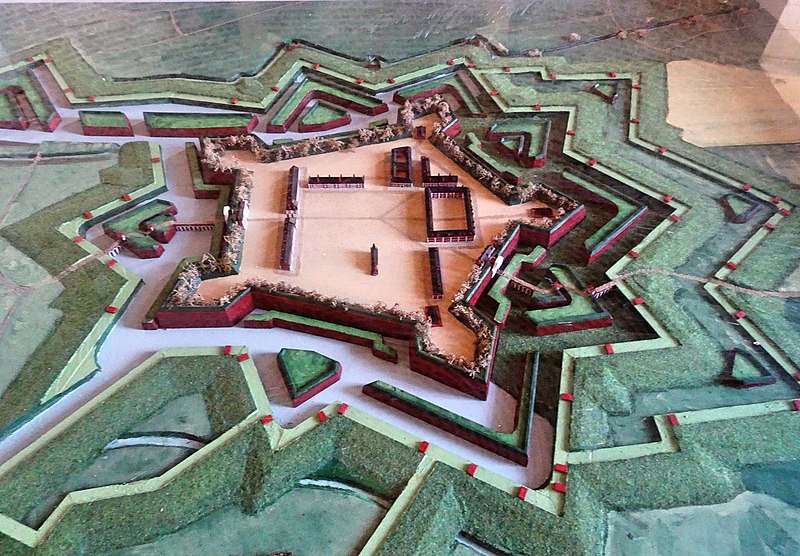
A model of the Vauban fortress at Arras in northern France. Arras is one of the Fortifications of Vauban, a UNESCO World Heritage Site.
Image via Wikimedia Commons.
The history of war is never far removed from battles for cities. Many of us, of whatever creed, were brought up on the story of the walls of Jericho tumbling after the Israelites marched around the stronghold once a day for six days, seven times on the seventh day, and then blew their trumpets. Though no archaeological evidence at Tell es-Sultan, in modern Palestine, corroborates the arresting visual image related in Joshua, Chapter 6, diggers have uncovered a range of defensive stone and brick walls dating back to 8,000 BC. It indicates that even 10,000 years ago, the ancients indulged in the odd siege when the mood took them. The biblical story also introduces us to the concept of intimidation, today fashionably called “psychological warfare”.
The much younger fortress of Troy provides insights into another city-focussed era of battles. Beneath today’s Hisarlik in northern Turkey are nine archaeological layers. Troy VIII was the alluring city of Classical and Hellenistic times, as portrayed in the Iliad, Homer’s Odyssey and Virgil’s Aeneid. The Romans took the lessons of Homeric Troy seriously and clad all their major settlements with defensive walls, as any exploration of Canterbury, Chester or York will confirm. These acted as magnets for opponents, as in Boudicca’s revolt of AD 60–61. Cities such as Colchester, London and St Albans were sacked, as much for what they represented as for their physical presence.
When the Normans arrived in their longships, they imported the concept of stone castles to control the newly conquered English. Their walled cities would be ungraded and contested scores of times over the succeeding six centuries. Henry V’s siege of Harfleur (modern Le Havre) in 1415, the beginning of the Agincourt campaign famously depicted in Shakespeare’s play, underlined the drawback of traditional sieges. They took longer and were usually far costlier than expected. Several thousand men camped in a small area with no knowledge of hygiene inevitably resulted in a high mortality rate amongst the attackers before a shot was fired.
Harfleur was also the first time an English army made use of gunpowder artillery in a siege, a technology that had trickled its way across the world from China. Powder and fuse heralded events 38 years later, when an Ottoman army shook the Christian world to its core by breaching the massive walls of Constantinople (Istanbul) after a 53-day bombardment using cannons. On Tuesday, 29 May 1453, stone finally gave way to bronze and iron, finishing the last remnant of the Roman Empire. Europe was never quite the same again. Fortress architecture started to employ breadth, using earthen ramparts and ditches, rather than height.
Strategy for urban warfare intensified during the lifetime of the French fortress engineer Vauban (1633–1707), who used landscaped terrain as well as geometrically designed defensive walls to deter would-be besiegers. When viewed from above, his fortification designs resemble starfish. So successful were his tactics that sieges, always costly and time-consuming, lessened in importance. His contemporary Marlborough recognised that on any cost-benefit analysis, Vauban had rendered sieges militarily unprofitable, restoring manoeuvre to campaigns.
Subsequent wars fought in the Napoleonic era, the Crimea, between the American North and South, and by Prussia generally reflected this return to mobility. There was the odd attritional discrepancy with the 1854–55 siege of Sevastopol, that of Petersburg in 1864–65 and Paris in 1870–71. Cities were still fought for, but usually contests were removed away from the walls, where forces could conduct wide sweeping manoeuvres, such as Leipzig in 1813 or Ypres in the Great War. As weapons grew more accurate and their munitions heavier, fortifications broadened and sank into the ground, culminating in the trenches of 1914–18. In this era, dominance of terrain became the hallmark, and it was virtually siege-free.
It was remarkable that urban warfare returned on an industrial scale during the Second World War, a time usually associated with blitzkrieg and rapid tank thrusts. This happened at Leningrad, Sevastopol and Stalingrad in the East; at Ortona and Cassino in Italy, Caen; Carentan and St Lo in Normandy; in Aachen and later assaults on Aschaffenburg and Cologne, Magdeburg, Leipzig and Berlin in 1945. Subsequent NATO doctrine for the defence of central Europe focussed on the threat of more attrition. Plans were devised to defend quite small localities, putting grit in the Soviet steamroller and making the cost of attacking Western towns and cities prohibitive.
Update: Broken URL corrected.
Why France Lost Vietnam: The Battle of Dien Bien Phu
Real Time History
Published 29 Sept 2023After the French success in the Battle of Na San, the battle of Dien Bien Phu is supposed to defeat the Viet Minh once and for all. But instead the weeks-long siege becomes a symbol of the French defeat in Vietnam.
(more…)


