
World War Two
Published 18 Nov 2023Heinrich Himmler wants to build an Army of Soviet POWs, but that has some problems; Patrick Hurley becomes US Ambassador to China, but even before that he’s in hot water with Chiang Kai-Shek; and in the field in the west, the Allies launch Operation Queen to try to cross the Roer River and reach the Rhine.
(more…)
November 19, 2023
How Himmler Learned to Love the Russians – WW2 – Week 273 – November 18, 1944
Comments Off on How Himmler Learned to Love the Russians – WW2 – Week 273 – November 18, 1944
Last Ditch Innovation: The Development of the Gerat 06 and Gerat 06H Rifles
Forgotten Weapons
Published 19 Nov 2012I’m very happy today to present a video we did in cooperation with Oleg Volk, which I’ve titled “Last Ditch Innovation”. It is a look at two late-WW2 German prototype rifles which are the evolutionary grandparents of the CETME and the H&K series of roller-delayed firearms (91, 93, MP5, etc). Thanks to some very generous friends, we have examples of both guns to disassemble and shoot … so sit back, relax, and enjoy the show.
Comments Off on Last Ditch Innovation: The Development of the Gerat 06 and Gerat 06H Rifles
November 18, 2023
World War Two’s most common tank
Lindybeige
Published 2 Aug 2023What click-bait title should I have used for this? “The tank that gave the Germans nightmares”? “The Commonest Communist tank?” “The tank of the teeming red hordes”? As I describe here, they made ever-so many of this type of tank, and that fact alone makes it an important tank.
(more…)
Comments Off on World War Two’s most common tank
November 16, 2023
The US military may need to find a modern-day Patroclus
John Carter explains why the sudden swerve in US military recruitment from all-diverse-all-the-time to an ad that might have been created in the 1960s … and why it still won’t help:

He is the very essence of a modern major general.
Sing, o muse, of the wrath of Achilles, son of Peleus, that brought countless ills upon the Achaeans …
Thus opens the foundational epic of European civilization.
Achilles is angry because his woman, Briseis, has been appropriated by Agamemnon, the leader of the Greeks. He expresses this discontent by going on strike. While the rest of the Greek army fights and dies outside the walls of Troy, Achilles lounges in his tent, content to sit out the combat until Agamemnon comes to his senses and returns his war bride. If Achilles were simply any other warm body with a spear, this wouldn’t be such a big deal, but he is Achilles – the greatest warrior of the Heroic Age. Without him, the Greeks are at a severe disadvantage. Achilles’ petulance is therefore a problem for Agamemnon.
The lesson is hardly a subtle one. Kings and generals need to keep their soldiers happy. They especially need to keep their best soldiers happy. If they don’t – for instance, by taking their women from them – morale will suffer, and they may well find themselves without the crucial support of their warriors when it most matters.
Washington seems to have missed that lesson, and now, they’re paying the price.
For the last decade they have been relentlessly and mercilessly whipping American whites: defaming them as racists, mocking their intelligence and manliness, tearing down their statues, erasing the names of their ancestral heroes, replacing their fictional archetypes with diverse doppelgangers in the media, disadvantaging them in education and employment, demanding that they attend racial struggle sessions. The list of outrages and humiliations is long and all too familiar, permeating as it does every one of our institutions.
But now, the Empire of Lies faces a problem.
War has returned to the world. History, its rumoured demise notwithstanding, once again stalks the land. Russia mauls the Ukraine; Israel is beset with enemies; the Empire’s influence in Africa frays by the day; China salivates over Taiwan.
Meanwhile the American domestic economy, long since hollowed out by the extractive rent-seeking of financial parasites, lurches from one crisis to the next. The Great Satan remains powerful, for the present, but the young bucks can scent that the silverback is not what he used to be. Their provocations increase in daring and intensity. If they aren’t slapped down, their boldness will only increase.
The criminal regime that has insinuated itself into the halls of American power is running against a clock. They must have a war to cover the slow collapse of their fake economy. They must have a war to prevent rival regimes from displacing their American golem. But their golem is crumbling. Therefore they must have a war sooner rather than later, because with every moment of delay America becomes weaker, while China and Russia become stronger.
Their problem is that no one wants to fight for them.
The core warrior population of America has always been the Scots-Irish of the Appalachian regions, the good ol’ boys of the South, and the farm boys of the Midwest. Hillbillies and rednecks, in other words. Many families from these areas have multi-generational traditions of service. Dad served in Vietnam, Grampa in WWII, Great-Grandpa in the Great War, and Great-Grandpa’s Pappy fought under Lee in the War of Northern Aggression.
These are precisely the white populations that have been singled out for the most unrelenting and vicious racial abuse over the last several decades. They are the one group that it’s okay to defame in the media, depicted as ignorant, bigoted, backwards, and inbred. The people running Hollywood seem to have a special disgust for them. For generations they have born this with a sort of stoic good cheer, accepting their role as the heel in the great kayfabe of American political drama even as they shouldered a disproportionate burden of blood, tears, and sweat in America’s imperial wars.
The events of the last two decades seem to have put an end to that. It wasn’t just the psychotic frenzy of race communism that gripped the regime’s mind, although that certainly played a factor as the military has hardly been immune to it. Who wants to serve in an armed forces that has thrown meritocracy in the trash to make sure the commissioned ranks include as many strong black lesbians as possible, that spends more time making sure the enlisted ranks understand the nuances of pronoun usage and the finer points of critical race theory than training for war? Demoralizing as all that has been, the absolutely pointless debacle of the Neocon Forever War in the Middle East has played at least as large a role.
Maryland Council of Safety Revolutionary Flintlock
Forgotten Weapons
Published 20 Nov 2014In the buildup to the US War of Independence, “Committees of Safety” were organized in the colonial state to form shadow governments for the independence movement. These committees (or councils, as a few were named) had, among other tasks, the responsibility of sourcing arms for the local militia forces.
This was done both by purchasing arms available at the time from gunsmiths, commercial dealers, and private individuals and also by contracting with gunsmiths to manufacture guns specifically for the council or committee. Typically these guns were not specially marked — there was no particular reason to do so — and as a result they are very difficult to authenticate today. A Revolutionary War weapon could have been anything available at the time.
One notable exception is an order placed by the Maryland Council of Safety. They ordered quite a lot of guns from area manufacturers, including a batch of 500 pistols. In addition, they hired an inspector to verify the quality of the finished guns, and mark them. The inspector was named Thomas Ewing, and his marking looked rather like a tulip. Records about the guns he oversaw and marked remain in existence, and allow them to be identified — including this example.
(more…)
Comments Off on Maryland Council of Safety Revolutionary Flintlock
QotD: Infantry soldiers in the age of pike and shot
The pike and the musket shifted the center of warfare away from aristocrats on horses towards aristocrats commanding large bodies of non-aristocratic infantry. But, as comes out quite clearly in their writing, those aristocrats were quite confident that the up-jumped peasants in their infantry lacked any in-born courage at all. Instead, they assumed (in their prejudice) that such soldiers would require relentless synchronized drilling in order to render the complex sequence of actions to reload a musket absolutely mechanical. As Lee points out [in Waging War], this training approach wasn’t necessary – other contemporary societies adapted to gunpowder just fine without it – but was a product of the values and prejudices of the European aristocracy of the 1500 and 1600s.
Such soldiers were, in their ideal, to quickly but mechanically reload their weapons, respond to orders and shift formation more or less oblivious to the battle around them. Indeed, uniforms for these soldiers came to favor high, starched collars precisely to limit their field of vision. This is not the man who, in Tyrtaeus’ words (elsewhere in his corpus), “bites on his lip and stands against the foe” but rather a human who, in the perfect form, was so mechanical in motions and habits that their courage or lack thereof, their awareness of the battlefield or lack thereof, didn’t matter at all. But at least, the [Classical] Greek might think, at least such men still ought not quail under fire but instead stood tall in the face of it.
After all, as late as the Second World War, it was thought that good British officers ought not duck or take cover under fire, in order to demonstrate and model good coolness under fire for their soldiers. The impression I get from talking to recent combat veterans (admittedly, American ones rather than British, since I live in the United States) is that an officer who behaved in that same way on today’s battlefield would be thought reckless (or stupid), not brave. Instead, the modern image of courage under fire is the soldier moving fast, staying low, moving to and through cover whenever possible – recklessness is discouraged precisely because it might put a comrade in danger.
Instead, the courage that is valued in many of today’s armies is the courage to stay calm and make cool, rational decisions. It is, to borrow the first line in Rudyard Kipling’s “If-“, “If you can keep your head when all about you/Are losing theirs and blaming it on you.” Which is not at all what was expected of the 17th century infantryman, whose officers trusted him to make nearly no decisions at all! But, as we’ve discussed, the modern system of combat demands that lots of decisions be devolved down further and further in the command hierarchy, with senior officers giving subordinates (often down to NCOs) the freedom to alter plans on the fly at the local level so long as they are following the general mission instructions (a system often referred to by its German term, auftragstaktik).
Bret Devereaux, “Collections: The Universal Warrior, Part IIa: The Many Faces of Battle”, A Collection of Unmitigated Pedantry, 2021-02-05.
Comments Off on QotD: Infantry soldiers in the age of pike and shot
November 14, 2023
“Like all Luttwak stories, this is probably false but totally believable”
In the latest book review from Mr. and Mrs. Psmith’s Bookshelf, John Psmith considers Edward Luttwak’s fascinating and controversial The Grand Strategy of the Roman Empire, a book I quite enjoyed reading although I think his much later The Grand Strategy of the Byzantine Empire one of his best books.
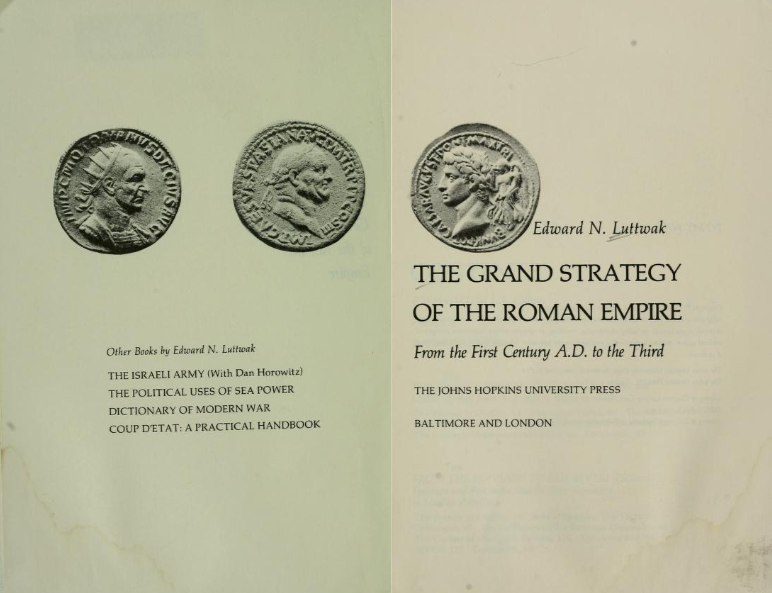
In one of the dozens of notorious interviews of Edward Luttwak that float around the internet, he’s asked how he chose the topic for his PhD dissertation. His answer is that one day at university he had a humiliating social encounter. Immediately afterwards, somebody pounced on him and asked what his dissertation was about anyway. He hadn’t even started thinking about what his topic would be, but he obviously couldn’t say that, and so instead he puffed himself up and made something up on the spot, and he did so by saying the most grandiloquent series of words one at a time like a large language model feverishly choosing the next token to maximize self importance: “The … GRAND … Strategy … … OF THE ROMAN EMPIRE!!” His interlocutor was sufficiently awed and impressed, but then he had to write the damn thing. Like all Luttwak stories, this is probably false but totally believable.1
But I’m very glad he wrote that thesis, because it was later turned into the wonderful book I’m reviewing. Now, one of the ways that the Psmiths subvert traditional gender roles is that it’s Jane, not I, who thinks about the Roman Empire every day. But this is only pretending to be a book about the Roman Empire. It’s really a book about “grand strategy” — how states can efficiently allocate scarce military, diplomatic, and financial resources to counter a variety of internal and external threats. It’s true that the examples are mainly drawn from four centuries of Roman history — starting with the Julio-Claudian dynasty and ending with the Empire losing control of Italy and Western Europe — but the analysis, and the lessons, are abstract enough that they transcend that particular context.
Luttwak believes that the state is a kind of machine for turning arable land into military power via taxation and conscription. A state that wants to maximize its survival odds can do so in three ways: (1) it can increase its “inputs”, by bringing a larger quantity of arable land under its control (so long as it avoids a commensurate increase in the threats it faces); (2) It can increase the efficiency of the machine, by extracting more grain and more labor from the people it rules, or by undertaking internal reforms to reduce the amount of potential that’s bled away by corruption and decadence; or (3) It can use its military as effectively as possible, doing more with less, killing many birds with one stone or setting up situations where a small allocation of force can tie down much larger opponents.
This third option is more or less what Luttwak means by “grand strategy,” and I think it may be the key that ties together all of Luttwak’s writing and thought. What do a book about the ancient world and a book about Cold War era coups have in common? They’re both about doing more with less, economizing force by wielding it with overwhelming brutality and efficiency. Luttwak’s coldly arithmetic view of the state is reminiscent of nothing so much as James C. Scott’s view of the world,2 but Luttwak is on the opposite team. Scott is an anarchist, Luttwak is a hard-boiled realist, and moreover he’s one with a deep aesthetic appreciation for power and violence, especially when used elegantly, like a scalpel, such that they have effects far out of proportion with their quantity.3
The history of Rome that Luttwak wants to tell is not the history of its cultural or civilizational achievements, but rather the history of how these people were so incredibly good at economizing on violence that they were able to waste a huge portion of their military and economic potential on civil wars, but still keep the lights on and the barbarians at bay. “Grand strategy” is how they accomplished that, but the strategy changed as the threats evolved and as the internal condition of the empire deteriorated. Luttwak delineates three distinct epochs — the founding of the empire under the Julio-Claudian dynasty, the rationalization of frontiers under the Antonine emperors, and the Crisis of the Third Century — and argues that each of the three featured a fundamentally different overall strategic posture on the part of Rome.
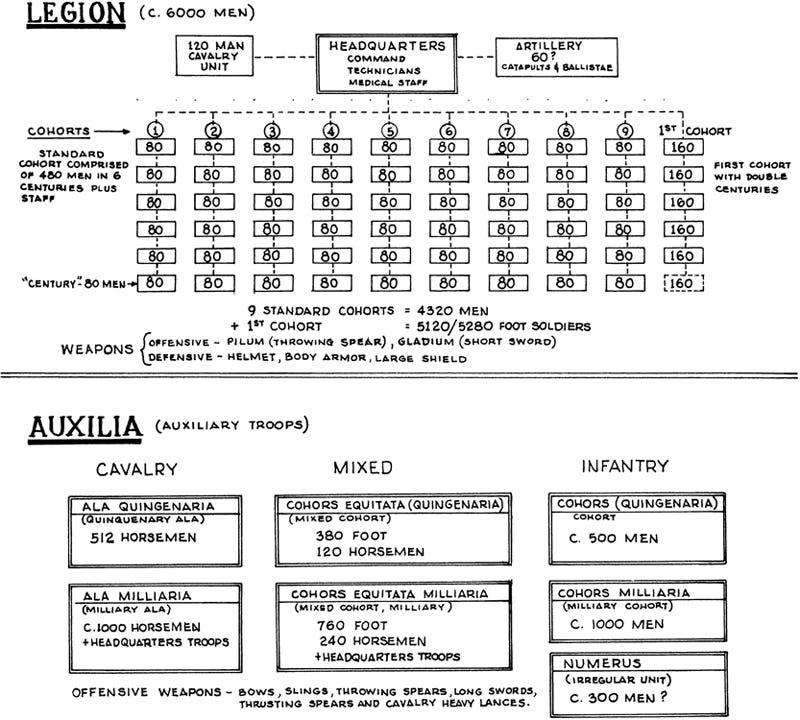
But before we get into all of that, I suppose we ought to talk about the legions. When people think of Roman military power, they usually think of the heavily-armed guys with red cloaks and horsehair plumes on their helmets. But of course they only made up a small fraction of the Roman military. We know that this has to be true because ancient armies, as much as modern armies, relied on combined-arms for their success. A legionary was a very scary kind of soldier, combining the roles of heavy infantry and combat engineer, but an army made up entirely of heavy infantry would be shredded by an opposing force of horse archers, for instance. So the Romans brought many other kinds of troops to bear: skirmishers, slingers, archers, light infantry, cavalry of their own (including mounted archers, light cavalry, and lancers with primitive barding that are a clear precursor of Medieval knights). And … almost to a man, all of these other forces were non-Roman.4 They were either mercenaries, or allied barbarians, or auxiliaries. As a kid in ancient history class I just accepted this as a fact, but reflect on it for a second and it seems very weird. This whole arrangement caused the Romans no end of trouble, so why did they do it that way?
Take the Luttwak pill and it all becomes clear: the Romans went all-in on legionaries as a way of economizing on force. The only people Rome could absolutely rely on were her citizens. The definition of a “real” Roman changed over time — at first it was only inhabitants of the city of Rome itself, later it was expanded to the surrounding countryside, and finally to all of Italy. But at every point it was a tiny fraction of the total population of the empire. Of that tiny fraction, some even smaller fraction are available to be trained as soldiers and to bear arms. What do you want those guys to be doing? The Roman answer is that you want them to be legionaries, because legionaries are not general-purpose soldiers, they’re specialists, and their specialties are: (1) besieging enemy cities, and (2) battles of attrition and annihilation.
1. Evidence that it’s false, he tells a completely different story in a different interview!
“I chose the subject because no theme in contemporary strategy was anywhere as interesting as the simple question of how Rome defended its territories (and added to them, now and then). Also, I did not want to waste my days reading the stultified & chaotically duplicative literature of ‘political science’ in which Strategy is imprisoned, when I could read instead in the often elegant, multi-lingual literature of Roman imperial studies.”
2. The zoomed-out, autistic alien robot anthropologist nature of this analysis also reminds me a bit of Vaclav Smil.
3. Wouldn’t the most elegant use of power be its deployment in such a way that it doesn’t really have to be used at all? In fact this is the main theme of Luttwak’s most recent book, The Grand Strategy of the Byzantine Empire, a sort of sequel to this one. In the same interview as in the first footnote, Luttwak summarizes the argument of that book: Byzantine strategy was based on:
“a single, paradoxical, principle: do everything possible to raise, equip and train the best possible army and navy, and then … do everything possible to use them as little as possible … every alternative was to be tried to avoid, or at least minimize the destructive ‘attrition’ combat of main forces. Instead, potential enemies were to be dissuaded, bribed, subverted, weakened by getting others to attack them, sidetracked into other ventures; if enemy forces attacked nonetheless, they were to be contained and delayed by skirmishing, feints and demonstrations while the search went on for other powers near or far willing to attack or at least threaten the enemy power; if enemy attacks persisted nonetheless, they were to be met by countering maneuvers designed to exhaust them rather than the destructive combat of main forces, the very last resort. It was not only the precious trained manpower of the empire that this strategy wanted to conserve, but also the enemy’s … because today’s enemy could become tomorrow’s ally.
4. This isn’t quite true in every period. For instance during the Punic Wars, the Romans fielded “equites“, native Roman cavalry of their own, but it fell out of fashion pretty quickly thereafter.
Comments Off on “Like all Luttwak stories, this is probably false but totally believable”
Inside T-72: A Commander’s Perspective | Tank Chats Reloaded
The Tank Museum
Published 21 Jul 2023A fast tank with a low profile and a big gun, the T-72 is a classic Soviet designed Main Battle Tank, in use all over the world. In this video, we talk to Dag Patchett, a former T-72 commander and get his impressions of a tank built in the Cold War era but still very much in service.
(more…)
Comments Off on Inside T-72: A Commander’s Perspective | Tank Chats Reloaded
November 13, 2023
Krešimir: Croatia’s Truly Insane Grenade Launcher
Forgotten Weapons
Published 17 Jul 2023The Krešimir is honestly the most bonkers weapon I have come across in a long while. Made by IM Metall in Croatia at the beginning of the Croatian Homeland War circa 1991, this is a semiautomatic grenade launcher. Most grenade launchers fire a big cartridge with an explosive warhead, but not this thing. Instead, it uses a 5-round magazine of M50 hand grenades with percussion fuses. A second magazine holds 7.62x39mm grenade-launching blank cartridges. Pulling the trigger drops two strikers in succession; one to ignite the hand grenade fuse, and then one to fire the launching cartridge. What could possibly go wrong?
When you do fire, the recoil cycles the whole barrel and bolt backwards like a long recoil action, although it appears to be blowback and not locked. This loads a fresh grenade in the barrel and leaves it ready to fire again with the next trigger pull. We don’t know how many of these insane creations were actually made, but I have multiple reports of their actual wartime use from veterans of the conflict.
Thanks to the Sisak Municipal Museum for giving me access to film this!
(more…)
Comments Off on Krešimir: Croatia’s Truly Insane Grenade Launcher
November 12, 2023
The Futile Fight in Hurtgen Forest – WW2 – Week 272 – November 11, 1944
World War Two
Published 11 Nov 2023The struggle for Hurtgen forest, one tiny piece at a time, continues. The Allies have, however, secured Walcheren Island, and also launch Operation Queen to try and reach and cross the Roer River, and further south even launch a new offensive aiming for Metz. Things are not going well for the Americans on Leyte, though, but they’re even worse for the Chinese as both Guilin and Liuzhou fall to the Japanese. As for the Soviets, they are busy making big plans for a gigantic offensive to drive in to Germany when the new year comes.
(more…)
Comments Off on The Futile Fight in Hurtgen Forest – WW2 – Week 272 – November 11, 1944
November 11, 2023
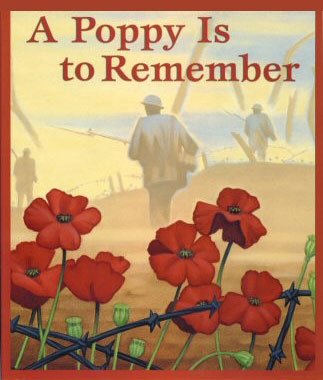
In memoriam
A simple recognition of some of our family members who served in the First and Second World Wars:
The Great War
 Private William Penman, Scots Guards, died 16 May, 1915 at Le Touret, age 25
(Elizabeth’s great uncle)- Private Archibald Turner Mulholland, Argyll & Sutherland Highlanders, mortally wounded 25 September, 1915 at Loos, age 27
(Elizabeth’s great uncle) - Private David Buller, Highland Light Infantry, died 21 October, 1915 at Loos, age 35
(Elizabeth’s great grandfather) - Private Harold Edgar Brand, East Yorkshire Regiment. died 4 June, 1917 at Tournai.
(My first cousin, three times removed) - Private Walter Porteous, Durham Light Infantry, died 4 October, 1917 at Passchendaele, age 18
(my great uncle, who had married the day before he left for the front and never returned) - Corporal John Mulholland, Argyll & Sutherland Highlanders, wounded 2 September, 1914 (shortly before the First Battle of the Aisne), wounded again 29 June, 1918, lived through the war.
(Elizabeth’s great uncle)
The Second World War
- Flying Officer Richard Porteous, Royal Air Force, survived the defeat in Malaya, was evacuated to India and lived through the war
(my great uncle) - Able Seaman John Penman, Royal Navy, served in the Defensively Equipped Merchant fleet on the Atlantic convoys, the Murmansk Run (he may have been on a ship in convoy PQ-17, as we know he spent a winter in Russia) and other convoy routes, was involved in firefighting and rescue efforts during the Bombay Docks explosion in 1944, lived through the war
(Elizabeth’s father) - Private Archie Black (commissioned after the war and retired as a Major), Gordon Highlanders, captured during the fall of Singapore (aged 15) and survived a Japanese POW camp (he had begun to write an autobiography shortly before he died)
(Elizabeth’s uncle) - Elizabeth Buller, “Lumberjill” in the Women’s Timber Corps, an offshoot of the Women’s Land Army in Scotland through the war.
(Elizabeth’s mother) - Trooper Leslie Taplan Russon, 3rd Royal Tank Regiment, died at Tobruk, 19 December, 1942 (aged 23).
Leslie was my father’s first cousin, once removed (and therefore my first cousin, twice removed).
My maternal grandfather, Matthew Kendrew Thornton, was in a reserved occupation during the war as a plater working at Smith’s Docks in Middlesbrough. The original design for the famous Flower-class corvettes came from Smith’s Docks and 16 of the 196 built in the UK during the war (more were built in Canada). My great-grandmother was an enthusiastic ARP warden through the war (she reportedly enjoyed enforcing blackout compliance in the neighbourhood using the rattle and whistle that came with the job).
For the curious, the Commonwealth War Graves Commission the Royal British Legion, and the Library and Archives Canada WW1 and WW2 records site provide search engines you can use to look up your family name. The RBL’s Every One Remembered site shows you everyone who died in the Great War in British or Empire service (Canadians, Australians, New Zealanders, South Africans and other Imperial countries). The CWGC site also includes those who died in the Second World War. Library and Archives Canada allows searches of the Canadian Expeditionary Force and the Royal Newfoundland Regiment for all who served during WW1, and including those who volunteered for the CEF but were not accepted.
In Flanders fields the poppies blow
Between the crosses row on row,
That mark our place; and in the sky
The larks, still bravely singing, fly
Scarce heard amid the guns below.We are the Dead. Short days ago
We lived, felt dawn, saw sunset glow,
Loved and were loved, and now we lie
In Flanders fields.Take up our quarrel with the foe:
To you from failing hands we throw
The torch; be yours to hold it high.
If ye break faith with us who die
We shall not sleep, though poppies grow
In Flanders fields.Lieutenant Colonel John McCrae, MD Canadian Army Medical Corps (1872-1918)
Here is Mark Knopfler’s wonderful song “Remembrance Day” from his Get Lucky album, set to a slideshow of British and Canadian images from World War I through to more recent conflicts put together by Bob Oldfield:
November 10, 2023
Luftwaffe Drilling and US M6 Survival Rifle
Forgotten Weapons
Published 8 Sept 2014Today we’re looking at a pair of military survival rifles. One is a Luftwaffe M30 drilling — the most finely finished and luxurious survival rifle ever issued by a military force. The other is a US Air Force M6 survival gun — spartan and utilitarian — the polar opposite of the M30.
(more…)
Comments Off on Luftwaffe Drilling and US M6 Survival Rifle
November 9, 2023
Defending a stateless society: the Estonian way
David Friedman responded to a criticism of his views from Brad DeLong. Unfortunately, the criticism was written about a decade before David saw it, so he posted his response on his own Substack instead:
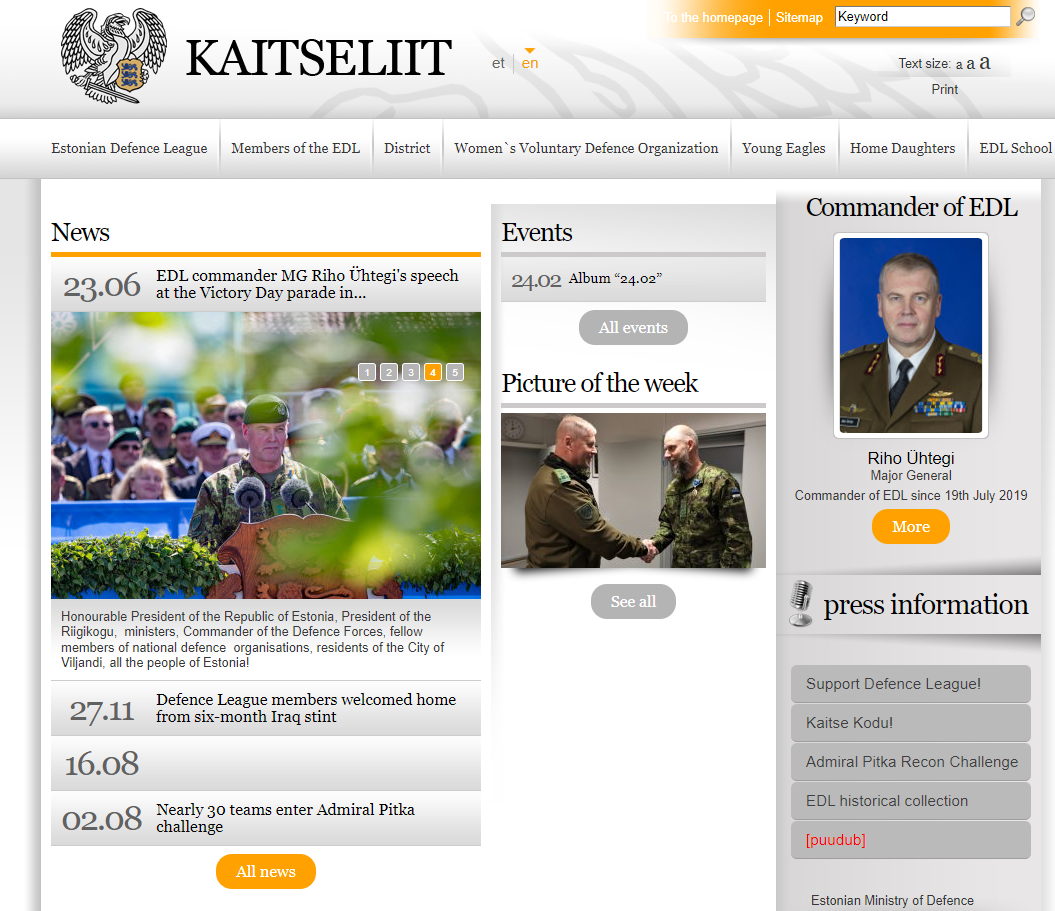
English version of the Estonian Defence League’s home page as of 2023-11-08.
https://www.kaitseliit.ee/en
Back in 2013 I came across a piece by Brad DeLong critical of my views. It argued that there were good reasons why anarcho-capitalist ideas did not appear until the nineteenth century, reasons illustrated by how badly a stateless society had worked in the Highlands of Scotland in the 17th century. I wrote a response and posted it to his blog, then waited for it to appear.
I eventually discovered what I should have realized earlier — that his post had been made nine years earlier. It is not surprising that my comment did not appear. The issues are no less interesting now than they were then, so here is my response:
Your argument rejecting a stateless order on the evidence of the Scottish Highlands is no more convincing than would be a similar argument claiming that Nazi Germany or Pol Pot’s Cambodia shows how bad a society where law is enforced by the state must be. The existence of societies without state law enforcement that work badly — I do not know enough about the Scottish Highlands to judge how accurate your account is — is no more evidence against anarchy than the existence of societies with state law enforcement that work badly is against the alternative to anarchy.
To make your case, you have to show that societies without state law enforcement have consistently worked worse than otherwise similar societies with it. For a little evidence against that claim I offer the contrast between Iceland and Norway in the tenth and eleventh centuries or northern Somalia pre-1960 when, despite some intervention by the British, it was in essence a stateless society, and the situation in the same areas after the British and Italians set up the nation of Somalia, imposing a nation state on a stateless society. You can find short accounts of both those cases, as well as references and a more general discussion of historical feud societies, in my Legal Systems Very Different From Ours. A late draft is webbed.
So far as the claim that the idea of societies where law enforcement is private is a recent invention, that is almost the opposite of the truth. The nation state as we know it today is a relatively recent development. For historical evidence, I recommend Seeing Like a State by James Scott, who offers a perceptive account of the ways in which societies had to be changed in order that states could rule them.
As best I can tell, most existing legal systems developed out of systems where law enforcement was private — whether, as you would presumably argue, improving on those systems or not is hard to tell. That is clearly true of, at least, Anglo-American common law, Jewish law and Islamic law, and I think Roman law as well. For details again see my book.
In which context, I am curious as to whether you regard yourself as a believer in the Whig theory of history, which views it as a story of continual progress, implying that “institutions A were replaced by institutions B” can be taken as clear evidence of the superiority of the latter.
And From the Real World
In chapter 56 of the third edition of The Machinery of Freedom I discussed how a stateless society might defend against an aggressive state, which I regard as the hardest problem for such a society. One of the possibilities I raise is having people voluntarily train and equip themselves for warfare for the fun (and patriotism) of it, as people now engage in paintball, medieval combat in the Society for Creative Anachronism, and various other military hobbies.
A correspondent sent me a real world example of that approach — the Estonian Defense League, civilian volunteers trained in the skills of insurgency. They refer to it as “military sport”. Competitions almost every week.
Estonia’s army of 6000 would not have much chance against a Russian invasion but the Estonians believe, with the examples of Iraq and Afghanistan in mind, that a large number of trained and armed insurgents could make an invasion expensive. The underlying principle, reflected in a Poul Anderson science fiction story1 and one of my small collection of economics jokes,2 is that to stop someone from doing something you do not have to make it impossible, just unprofitable. You can leverage his rationality.
Estonia has a population of 1.3 million. The league has 16,000 volunteers. Scale the number up to the population of the U.S. and you get a militia of about four million, roughly twice the manpower of the U.S. armed forces, active and reserve combined. The League is considered within the area of government of the Ministry of Defense, which presumably provides its weaponry; in an anarchist equivalent the volunteers would have to provide their own or get them by voluntary donation. But the largest cost, the labor, would be free.
Switzerland has a much larger military, staffed by universal compulsory service, but there are also private military associations that conduct voluntary training in between required military drills. Members pay a small fee that helps fund the association and use their issued arms and equipment for the drills.
1. The story is “Margin of Profit“. I discuss it in an essay for a work in progress, a book or web page containing works of short literature with interesting economics in them.
2. Two men encountered a hungry bear. One turned to run. “It’s hopeless,” the other told him, “you can’t outrun a bear.” “No,” he replied, “But I might be able to outrun you.”
November 8, 2023
Details from the day of the Hamas terror attack on Israel
Matt Gurney in The Line:
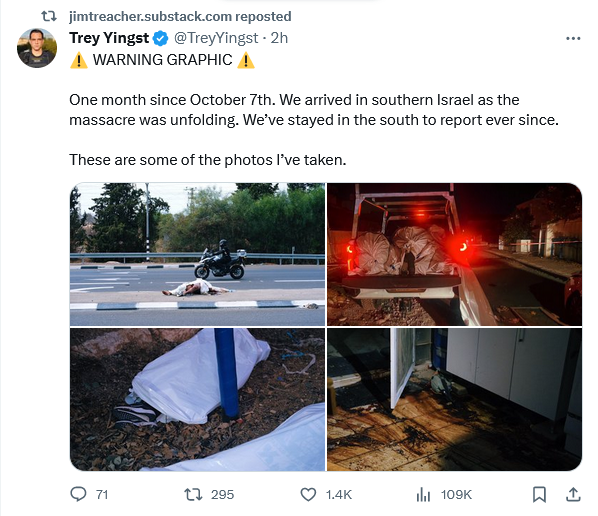
On Nov. 6, one-month-less-a-day after the Hamas assault on southern Israel, I was one of a small number of journalists to receive a briefing by a senior Israeli government official at the Israeli consulate in Toronto. Part of the briefing was the showing of a film, approximately 42 minutes long, that contained video and audio records of the attack. The sights and sounds came from many sources, including home security footage, survivor footage, surveillance cameras at private residences, military facilities and in public places, as well as cameras and Go-Pro-style body worn cameras carried by Hamas. Later in the film, we also see footage taken by Israeli first responders — some of it informally, via body worn cameras and smartphones, but some of it also deliberately and meticulously, as part of the documenting of the attack’s aftermath. The video also included audio portions of what the Israeli government claims is intercepted Hamas communications sent during the attack.
I have to preface this near the top: I can’t vouch for the authenticity of the videos, or of the translations. I believe that the videos are authentic and the translations accurate — the latter is easier, since it has by now been shown to enough people that any false translations would have been noted by members of the audience, but I don’t speak Hebrew or Arabic, and had to rely on the captions. As for the videos, while some of what I saw on Monday was new to me, other clips have already been shared widely on social media. There’s a decent chance you’ve seen some of them, too. For further disclosure, many of the clips are very short — a few seconds each. The Israelis said that in many cases, they are only choosing to release what the families of victims have agreed to allow to be shown. That’s an editorial decision, and I haven’t seen the unedited videos. I can’t tell you what I wasn’t shown.
So if you’re absolutely determined to find a way to discredit or dismiss everything I’m about to say, I’ll keep it easy for you. I saw what was presented to me, by Israel, and have little ability to independently confirm any of it.
If you’re interested in hearing what I saw, though, here it is.
I should start by telling you I don’t plan to dwell on all the atrocities or try to summarize the whole 42 minutes of carnage I watched in any kind of coherent sequence. It’s not that the atrocities aren’t important — they’re obviously the central point of the briefing for reporters, and what I was asked to bear witness to. My thinking is simply this: much of what I could tell you has been summarized elsewhere. The global media first saw this film, in Israel, two weeks ago; some of my Ottawa-based colleagues saw it last week. If you’re looking for a summary of the contents, those exist already. I don’t think you’d benefit from just another version of that, and I know I wouldn’t enjoy writing one. So in the main, I’ll avoid long, descriptive passages where I tell you what I saw. I’ll try to offer something different.
But first, let’s get this out of the way. I confess that I was afraid when the video started. Simple fear. Fear I’d crack, fear I’d have to look away, fear I’d somehow fail to meet the moment. I don’t know if that was a rational fear — what the hell does meeting the moment even mean? — but I was afraid. I was afraid from the moment I was asked to attend and said yes. As the film began, though, I found many of the videos less graphic than I’d feared, and actually less graphic than some of what I’d already seen and written about. No one should mistake me — the videos are graphic, some of them extremely so. But in many cases, the videos are taken from too far away or from an unsteady camera (particularly the body worn ones) and many of the worst gruesome details are thus obscured or missed.
Not all of them. Lord no, not all. But some. That helped.
Comments Off on Details from the day of the Hamas terror attack on Israel
November 7, 2023
Swiss Tankbuchse 41 Semi-automatic Antitank Rifle
Forgotten Weapons
Published 29 Oct 2018Originally developed for use in light tanks purchased from Czechoslovakia, the Tankbuchse 41 was a 24x139mm semi-automatic rifle designed by Adolph Furrer of the Waffenfabrik Bern factory. Furrer was also responsible for the LMG-25 and MP41/44 used by the Swiss, and with the TB-41 he once again used the operating system he was most familiar with: a short recoil toggle-locked action. The gun was ready and adopted in 1941, and a total of 3,581 were produced, used in light tanks, lake patrol boats, fortifications, and on wheeled carriages by the infantry.
High explosive and armor piercing projectiles were made, both weighing 3475 grains (225g) and with muzzle velocities between 2800 and 2950 fps (860-900 fps). The armor piercing round could perforate 30cm of perpendicular armor plate at 500m — more than most other contemporary antitank rifles. Designed specifically for rapid fire, the gun fed from six-round magazines, and automatically ejected the magazine when the last round was chambered, so that the crew could reload it without having to run the crank handle. The guns never saw combat use, and by the end of World War Two were being pulled back out of inventory and relegated primarily to fortress use.
(more…)
Comments Off on Swiss Tankbuchse 41 Semi-automatic Antitank Rifle


