
The Tank Museum
Published 14 Jul 2023In this video, we look at the Pak 35/36, the German Army’s first anti-tank gun. Obsolete by 1941, it picked up the nickname Heeresanklopfgerat – the army door knocker – after its inability to penetrate tank armour. In spite of this, it carried on in service until 1945. Chris Copson talks you through the gun and its history.
(more…)
November 6, 2023
The Army Door Knocker | Pak 35/36 | Anti-Tank Chats
Comments Off on The Army Door Knocker | Pak 35/36 | Anti-Tank Chats
November 5, 2023
Military “institutional racism” and the Expert Infantry Badge
Chris Bray on a recent article in which a USAF Colonel lectures other “white colonels” about institutional racism in America’s military services:
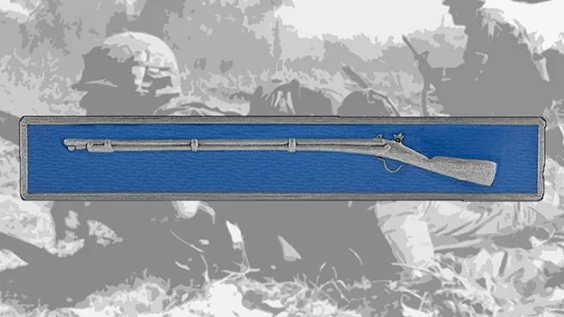
US Army Expert Infantry Badge
Image from armyfacts.com
Thoughts about the Air Force colonel who delivers sanctimonious lectures about institutional racism to his fellow “white colonels”.
In you’re an infantry soldier in the US Army, you can distinguish yourself by earning an Expert Infantry Badge. To do that, you have to qualify as an expert with the rifle, then complete a series of skills tests like “set headspace and timing on a caliber .50 machine gun” and “operate as a station in a radio net with SINCGARS radio single channel”. Then, finally, you have to complete a 12-mile road march. You can read the standards for that event here: carry a rifle and magazines, wear a helmet at all times, carry a rucksack weighing at least 35 pounds, and so on. When the person with the stopwatch says that three hours have elapsed, you’re either standing behind the finish line or in front of it; you either earn the EIB or you don’t.
The test isn’t subjective — the judges don’t award you style points. If you crawl across the finish line in a pool of blood and urine, sobbing for mommy, but you do it in less than three hours, and you still have your rucksack and your rifle and everything else at the end, you get the EIB.
Nor is it weighted. If you’re a fourth-generation VMI graduate with a fine old family name that can be found on the rolls of the Mayflower Society, you get the EIB if you cross the finish line on time. If you’re an E-2 who grew up in a trailer park and barely made it out of high school and doesn’t remember the names of all your so-called stepdads, you get the EIB if you cross the finish line on time. Officers and enlisted work to exactly the same standard. The credential comes from the task, full stop. This fact is the core of every credential you can earn in the military: If you’re authorized to wear the Parachutist Badge, you went to Fort Benning, or whatever they call it now, and jumped out of the plane five times without missing the ground. You did the thing. Doing the thing is who you are, in a growing list of things.
As a set of organizations built on task competence, for plainly measurable tasks that can’t be faked or fudged, the armed forces have been America’s first meritocracy. The first black West Point graduate was commissioned in 1877; the first black Medal of Honor recipient was born into slavery. Even in the segregated military, credentials obtained through task competence bore weight, as the court-martial of Jackie Robinson suggests with its outcome: In 1944, in Texas, a black officer was correct to harshly demand respect from a white enlisted soldier.
If you’ve served in the military, you’ve seen this. In my first posting as an infantryman, my company commander, first sergeant, platoon sergeant, and squad leader were black, a fact that I never heard anyone even mention. Rank, profession, and authority come from doing, without socioeconomic or racial chutes or ladders: If you can fly the plane, you’re a pilot. Up to the boundaries of the flag ranks, politics and identity don’t matter. (Regarding those flag ranks, see the late David Hackworth’s discussion of “perfumed princes”.)
And so the descent of the American military into the performative politics of DEI and equity and Robin DiAngelo books just blindly shits on the core value of the American military, which is that you get the rank and the status for what you do, full stop.
QotD: The Auftragstaktik principle of the Third Reich
[The Nazis], being Social Darwinists to the core, applied the military principle of Auftragstaktik to civilian life. “Mission-oriented” tactics means that the overall commanders leave as much as possible to the on-the-spot commanders, be they officers or noncoms, on the theory that properly-trained leaders will have a much better understanding of what needs to be done, and how to do it, than some general back at HQ. It’s the main reason the Wehrmacht could keep fighting so well, for so long, in the face of overwhelming opposition — tasks that would fall to an American company, or a Russian regiment, were often undertaken by a Wehrmacht platoon under the command of a senior corporal.
Obviously civilian life isn’t as goal-directed as the military in wartime, but a similar principle applied — given a vague set of generalized objectives from the top (Kershaw’s famous “working towards the Führer” thesis), everyone at every level was encouraged to move the ball downfield as he saw fit … with the added twist that, in the absence of a clearly defined, military-style chain of command, the various “subordinates” would ruthlessly battle it out with each other, Darwin-style, for bureaucratic supremacy.
Thus the Nazis’ infamous plate-of-spaghetti org charts. I’m not an expert, but I’m pretty sure there were more than a few guys who held wildly different ranks in various different organizations simultaneously. He might be a mere patrolman in the Order Police, but an officer in the SS, a noncom in the SA (you could be in both, at least in the early days), and so forth. I wouldn’t be surprised if there was more than one guy who technically reported to himself, somewhere deep in the bowels of the RHSA [Reich Security Main Office]. You could spend a lifetime trying to sort this stuff out …
Severian, “The Crisis of the Third Decade”, Rotten Chestnuts, 2021-03-18.
Comments Off on QotD: The Auftragstaktik principle of the Third Reich
November 4, 2023
MKb-42(H) Assault Rifle with ZF-41 scope
Forgotten Weapons
Published 31 Aug 2014The MKb-42(H), or Maschinenkarabiner-42 (Haenel), was the first production iteration of the German Sturmgewehr. It was chambered for the then-new 8x33mm kurz cartridge, and fired both semiauto and full-auto from an open bolt. Approximately 11,000 of these were made before production changed to the closed-bolt MP43.
(more…)
Comments Off on MKb-42(H) Assault Rifle with ZF-41 scope
November 3, 2023
Understanding Combined Arms Warfare
Army University Press
Published 24 Mar 2023Designed to support the U.S. Army Captains Career Course, “Understanding Combined Arms Warfare” defines and outlines the important aspects of modern combined arms operations. This is not a complete history of combined arms warfare. It is intended to highlight the most important aspects of the subject.
The beginning of the documentary establishes a common understanding of combined arms warfare by discussing doctrinal and equipment developments in World War I. The second part compares the development of French and German Army mechanization during the interwar period and describes how each country fared during the Battle of France in 1940. The film concludes by showing how the United States applied combined arms operations in the European Theater in World War II.
(more…)
Comments Off on Understanding Combined Arms Warfare
November 1, 2023
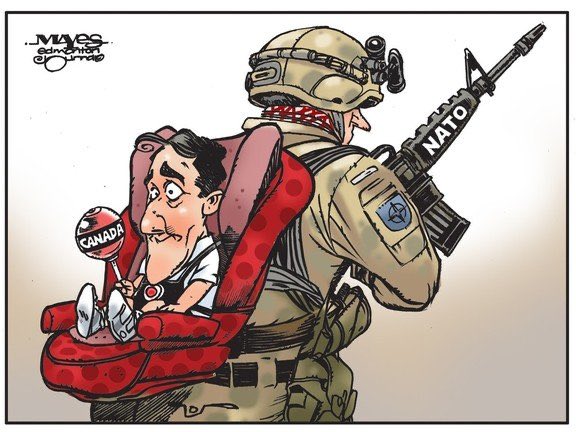
Canada’s (deliberate lack of) strategy
In The Line, Vincent Rigby discusses Canada’s notable lack of any kind of strategy to cope with an international situation that seems to be changing (or deteriorating, take your pick) at a rapid pace:
On the foreign policy front, the Canadian government unveiled its long-awaited Indo-Pacific Strategy almost a year ago. It was a welcome development for Canada’s role in a region at the epicentre of global events. But it was remarkably light on security and is now under severe stress given the serious diplomatic falling-out with India. But more importantly, where is Canada’s broader foreign policy? What will we do in other parts of a turbulent world to protect our security and values? How will we balance regional priorities? Canada has not produced a comprehensive foreign policy statement in 18 years.
On the defence front, Canada unveiled a new policy, Strong, Secure and Engaged, in 2017. After the Russian invasion of Ukraine, the government committed in April 2022 to produce an update to that policy in the following months. A year and a half later, Canadians are still waiting. In the meantime, officials have spoken publicly of possible cuts to the defence budget of $900 million a year over four years as part of broader government spending reductions. A severely stretched military may soon be stretched even further.
On the home front, Canada continues to lurch from crisis to crisis — the Freedom Convoy with its populist underpinnings, Chinese interference in federal elections, possible Indian complicity in the murder of a Canadian citizen, and now tension at home over the fighting in the Middle East. More than ever, Canada’s large diaspora communities feature prominently in security and foreign policy discussions. While Canadians await the findings of yet another public inquiry into the China affair, a broader strategy to confront national security threats is nowhere to be seen. Canada has not produced a national security policy in 19 years.
To be fair, the government has not sat idle during recent global developments. For example, it has ramped up its support to Ukraine (notwithstanding a slow start and the recent embarrassment in the House of Commons), taken measures to improve economic security, and established a National Security Council. But these efforts are all too often modest, piecemeal and reactive.
A Canadian senator famously quipped nearly a century ago that Canada was “a fireproof house far from inflammable materials”. It was barely true in the 1920s, and it is even less so today. But Canadians, despite all recent evidence to the contrary, apparently still believe this to be the case. They assume that the threats are not aimed at Canada, and that the U.S. would come to their rescue regardless. On both counts, such assumptions are dangerous, especially if Donald Trump were to return as president. The government, echoing the indifference of most Canadians, chooses to focus on domestic priorities, from increasing affordable housing to improving health care to fighting inflation. All are undeniably important. But as every prime minister declares, the government ultimately has no greater responsibility than the security of its citizens.
Canada needs an integrated, coherent strategy (or strategies), supported by appropriate resources and capabilities, to respond effectively both at home and overseas to this new world order. It will require trade-offs, but the case needs to be made to Canadians that the generation-long, post-Cold War peace dividend is no longer on offer. Our allies get that — so too must Canada. In the absence of such strategy, the security of Canadians will deteriorate further, and relationships with key NATO and Five-Eyes allies, already in peril, will suffer even more. If not careful, Canada may find itself more alone in the world than ever.
Comments Off on Canada’s (deliberate lack of) strategy
The BAR M1918A3 by Ohio Ordnance – Shooting and Mechanism
Forgotten Weapons
Published 13 Jul 2014Today we’re looking at one of Ohio Ordnance’s semiauto M1918A3 BARs – how it shoots, how it works, and what the pros and cons of the military BAR variants were in World War I and World War II.
(more…)
Comments Off on The BAR M1918A3 by Ohio Ordnance – Shooting and Mechanism
October 31, 2023
As we’re always told in a pious tone of voice, “violence never settles anything”
Chris Bray, ever the iconoclast, begs to differ:
One of the things everyone knows about Gaza is that the Israeli attack is just creating more violence, as the next generation of Palestinians watches the bombs fall. Inevitably, the story goes, the young are learning hate and rage, and will pay it forward. Here’s the upscale think tank version of the argument, under the headline, “Israel risks creating a newly traumatized and radicalized generation of Palestinians”:
What will remain of Gaza’s population, and among Palestinians elsewhere in the occupied West Bank and East Jerusalem and inside Israel proper, will be a newly traumatized and radicalized generation of youth, none of whom were born or of voting age when Hamas was elected … As a result, Hamas’s self-declared raison d’etre — “resisting the [Israeli] occupation with all means and methods” — will only grow in the minds of Palestinian youth. This will render unsuccessful Israel’s attempts to eliminate Hamas militarily.
Here’s an example of the Twitter rando version, which you’ll see over and over again if you engage with social media at all:
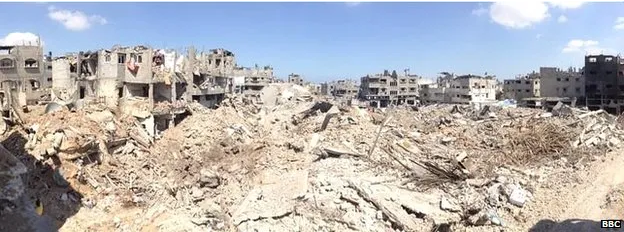
But is that true? Without advocating for brutality, I find myself looking for historical examples and mostly coming up with the opposite. To start managing the “yes, but” up front, there are many ways of waging war, and the extractive nation-building warfare of an imperial constabulary — low-grade fighting, prolonged counterinsurgency without decisive violence — does seem to often lead to more violence and “blowback” over time. But what Israel is doing now in Gaza seems like something else entirely.
If this violence will create “the next generation of Hamas”, then the children of the Germans who were firebombed in Dresden and Hamburg should be constantly strapping on suicide vests and attacking Ramstein air base. After the Wounded Knee massacre, it shouldn’t be safe for white settlers to live near the Lakota, and South Dakota should be a hellscape. Or consider North Vietnam, which won its war: “The US carried out more than a million bombing raids during the 20-year conflict, dropping some 5 million tonnes of ordnance on the Southeast Asian country.” After the war, a substantial Vietnamese population resettled in California. Violence trains the next generation to hate, right? So the Vietnamese must constantly attack Orange County.
The horror of total war has mostly not seemed to produce more violence. It seems to have mostly left later generations brutalized and horrified, and highly unlikely to go on fighting. Waging war decisively seems to be historically … decisive? The experience of crushing defeat seems to be a cycle-breaker, and even a horrifyingly costly victory — as for the North Vietnamese — seems to limit the appetite of next generations for more war.
Japan nurtured a profoundly violent warrior culture for a long time, with the nation’s soldiers serving as brutal invaders and horrible occupiers, then faced a ghastly campaign of firebombing and two nuclear bombs. Japan no longer has a brutal martial culture; the next generations didn’t become the new warriors. The currently popular theory says that they had to: the children witnessing this horror will be the next generation of militants, because trauma teaches violence. Tomorrow’s Hamas comes from today’s JDAMs. The people who lost World War II don’t seem to prove that theory.
Someone is going to say in the comments that I have blood on my fangs, but the point isn’t to cheerlead for the killing in Gaza. The point is to consider evidence about what comes next, and to ask what the comparable examples are. Is it factually true that youth, traumatized by war, become the violent next generation? We ran this experiment a lot in the twentieth century, and I think we have some strong hints at a consistent answer.

As Robert Heinlein had retired Lt. Col. Jean V. Dubois say to his History and Moral Philosophy class in Starship Troopers:
Anyone who clings to the historically untrue — and thoroughly immoral — doctrine that “violence never settles anything” I would advise to conjure the ghosts of Napoleon Bonaparte and the Duke of Wellington and let them debate it. The ghost of Hitler could referee, and the jury might well be the Dodo, the Great Auk and the Passenger Pigeon. Violence, naked force, has settled more issues in history than has any other factor, and the contrary opinion is wishful thinking at its worst. Breeds that forget this basic truth have always paid for it with their lives and their freedoms.
October 30, 2023
QotD: Study military history in hopes of avoiding future conflicts
Bret Devereaux, “Collections: Why Military History?”, A Collection of Unmitigated Pedantry, 2020-11-13.
October 29, 2023
Arguments for not buying military kit “off the shelf”
Sir Humphrey provides some of the reasons why it’s not a simple economic case for a nation’s military procurement to buy “off the shelf” equipment even from a close ally:
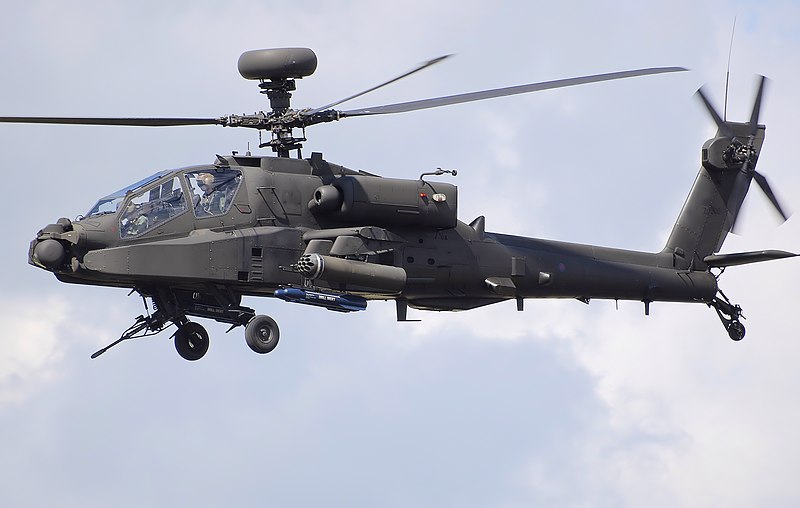
Not all kit needs to be or can be domestically sourced. The British army uses Apache attack helicopters which are licensed from the original US manufacturer.
Westland Apache WAH-64D Longbow helicopter (UK Army registration ZJ206) displays at Kemble Air Day 2008, Kemble Airport, Gloucestershire, England in June 2008.
Public domain photograph by Adrian Pingstone.
The arguments for buying American are on the face of it reasonable. The US produces good quality equipment able to meet many UK defence needs. There is a strong supply chain in place, ensuring that there are plenty of spare parts in the system to draw on when needed, and at cheaper cost due to bulk buying. The equipment is usually designed to be interoperable with NATO partners, so it can be integrated to work alongside allies and with existing equipment. It can be delivered quickly, it works and lots of other people use it, so why shouldn’t the UK? There are in fact many good reasons why the UK should not exclusively buy American.
Earlier this month, we looked at the Canadian Surface Combatant (CSC) program and why the Canadian Armed Forces never seemed to get the same “bang for the buck” that our American or British allies seem to manage. Here, Sir Humphrey points out that even the British military has to make procurement decisions that weigh cost and convenience with some very significant national security concerns:
To start with, US kit is designed by US companies to meet US requirements, not British ones. This may sound obvious but there is a dangerous view some put forward that “off the shelf” means the UK could just buy something and use it. There is no such thing as “off the shelf” unless you want it as it comes in its US version, with no modifications, changes or installation of British equipment. The moment you do this, you’ve created a UK variant with its own bespoke requirements and supply needs, for which you are dependent on the US defence industry to support – and there is no guarantee that this can or will happen. From the outset you have lost operational sovereignty and control over your military equipment.
Buying from the US means the UK would need to request a Foreign Military Sale (FMS) case through the US government, seeking legislative approval to purchase the equipment. If, for example, the UK wanted to buy a new tank, it would be reliant on US government approval to do so, not just for the initial purchase, but for all spares buy thereafter. The way that FMS works is that it sets out approval not just for purchase, but sets a schedule for spare parts purchases, services, and upgrades, all of which are done at the time and schedule set by US government and industry, and not the British government. This means that the UK would lose control over when to purchase spares or upgrades and would be forced to buy to a foreign governments timetable. This is why FMS is so successful for the US – it offers cheap entry prices but makes a killing in the long-term spares and support market. To buy from the US means to accept that you are handing over control of your spares and logistics chain to a foreign power who determines the timing of when and what you buy. This is fine in small doses but if you buy exclusively from the US, suddenly means you’ve got no control over how you want to support your armed forces.
The next challenge is the integration work needed to make things work for the UK. One of the risks of buying a foreign design is that you lack operational sovereignty over the design and its internal contents. Equipment supplied by the US will often come with a variety of sealed, tamper proof boxes containing US government-controlled technology that cannot be accessed by the purchasing nation. As the operator, you do not have full control over your military equipment, you don’t know what is necessarily in the boxes, and you are reliant on the US to fix issues with them. By contrast any equipment designed and built in the UK means that the MOD has full control and sovereignty over it to open it up, modify, adapt or change it to meet British needs. To buy US means accepting we cannot change a design without a foreign nations’ approval, which in turn means exposing our own sensitive military technology and equipment to the US, to conduct trials to ensure it can work with the US provided equipment. This represents an astounding loss of sovereign control on advanced weapon systems and means potentially giving the US defence industry insight into UK capabilities that manufacturers may want to keep commercially sensitive.
The Battle of Leyte Gulf – WW2 – Week 270 – October 28, 1944
World War Two
Published 28 Oct 2023This is it — the big showdown between US and Japanese Navies, and the largest naval battle ever fought in terms of total tonnage. American landings on Leyte itself are still in progress, and the Soviets’ Debrecen Operation comes to its end.
(more…)
Comments Off on The Battle of Leyte Gulf – WW2 – Week 270 – October 28, 1944
October 28, 2023
Israel’s Zugzwang
Not being a huge chess nerd, I’d never encountered the term “zugzwang” before, but as Niall Ferguson and Jay Mens explain here, it’s an appropriate way to characterize the situation Israel finds itself in at the moment:
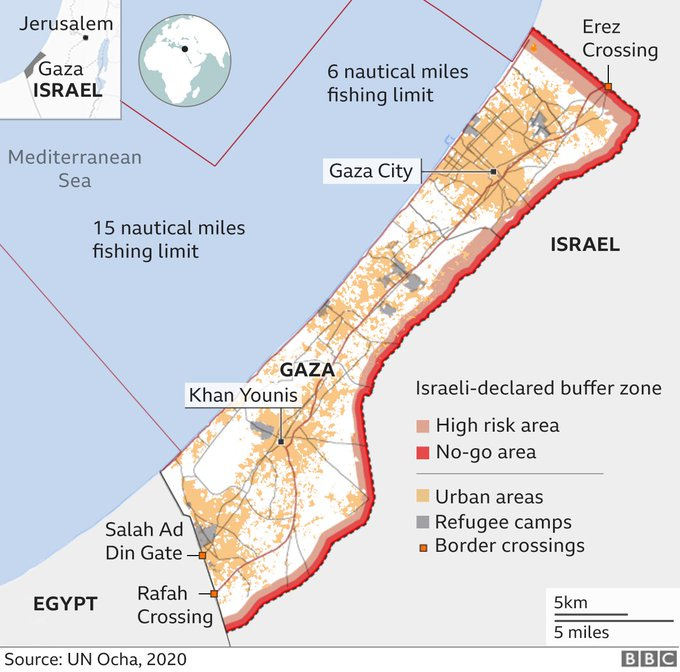
Zugzwang is one of the ultimate challenges for a chess player. In zugzwang, a player is in a situation where any move can only weaken one’s position and carries the risk of checkmate — but not moving isn’t an option. Beyond the intrinsic horror of Hamas’s October 7 massacre, it is now obvious that the attack was designed to provoke Israel into reacting. The extent of the zugzwang is increasingly clear, and Israel has few good options. Nor does the United States.
No one should have been surprised by the attacks on Israel by Hamas and Palestinian Islamic Jihad (PIJ). Over the last year, there have been more than a dozen public meetings between Iranian officials and the leaders of Hamas, Hezbollah, and PIJ. Enormous quantities of men and matériel have moved from Iraq into Syria, with other matériel arriving by land and air to Lebanon. Hezbollah and the Iranian Revolutionary Guards Corps (IRGC), the common thread of the region’s so-called “Axis of Resistance”, have worked to build and consolidate enormous bunkers and fortifications across Syria along with Hezbollah. Some anticipated another Lebanon War, others expected another Gaza War, and others expected a Third Intifada. The only thing few — if any — expected was a design to drag Israel into all these battles and several more at once.
The Imperative to Act
In the aftermath of October 7, Israel must strike back. Propelled by nationwide rage, a new government of national unity in Jerusalem has vowed to destroy Hamas. If that is the true goal, a ground operation in Gaza is necessary. Such an operation began in Israel on Friday night. The very nature of urban warfare means that it will have an enormous human cost and an uncertain duration. And this is not just urban warfare: there are two Gazas — the aboveground and the underground network of tunnels where Hamas’s men and weapons are stored.
And time is not on Israel’s side. International support is already waning, and nowhere more than in the Arab world. Egypt and Jordan, Israel’s most important security partners in the region, have already accused Israel of planning the ethnic cleansing of Gaza. Worse still, the operation will tie down a significant portion of Israel’s manpower and assets. Israel will, as a result, be especially vulnerable to the risk of overextension.
Gaza isn’t the only problem. There is also the West Bank, where unrest is already growing and where the Palestinian Authority is at risk of collapse. Then, to the north, Hezbollah has its vast arsenal of rockets, drones, men, and missiles in Lebanon, while on the Syrian border tens of thousands of Iraqi militants have amassed with the goal of “liberating” the Golan. Thousands more Iranian-made drones and ballistic missiles are spread out across dozens of bases in Iraq, Syria, and Yemen. For that reason, Israel now relies on American support. Jerusalem is likely waiting for the last of American reinforcements — including another carrier strike group — to arrive in the region prior to launching its attack. But is there an alternative?
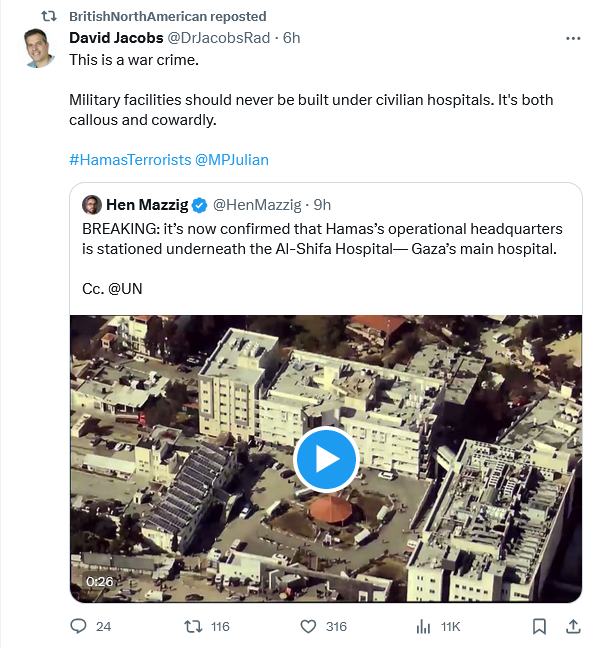
Of course, it’s widely believed that Hamas deliberately positions its facilities to make Israeli attacks less likely due to the elevated risk of unacceptable levels of collateral damage … like this:
Comments Off on Israel’s Zugzwang
Smith versus Smith: US Army/Marine relations in 1944
World War Two
Published 27 Oct 2023When Marine Corps General Holland “Howling Mad” Smith removed Infantry General Ralph Smith from command in 1944 during the Battle of Saipan, it began a controversy that soon snowballed, threatening to sabotage Army-Marine relations at a time when cooperation was the key to victory.
(more…)
Comments Off on Smith versus Smith: US Army/Marine relations in 1944
Prototype Winchester WW1 .50 Cal Antitank Rifle
Forgotten Weapons
Published 5 Jul 2017With the advent of the tank in World War One, antitank rifles became a priority for many countries, to provide infantry with some weapon to counter the new armored threat. The best known example of these (and the only one to see significant production before the end of WWI) was the German Tankgewehr, any captured Tankgewehrs would form the basis for the US development of the .50 BMG cartridge.
This experimental Winchester rifle, made in late 1918, was part of that development. It is the only known surviving example of its type, and suffered a catastrophic failure during testing, as the receiver is cracked completely in half. The mechanism, however, is quite interesting. It uses a 1911-styled pistol grip as the bolt handle (similar to the Czech SS41 antitank rifle that would come decades later). It was fitted with a relatively large detachable box magazine and a mounting point for a telescopic sight.
(more…)
Comments Off on Prototype Winchester WW1 .50 Cal Antitank Rifle
October 27, 2023
The Tale of Fat Man and Little Boy
World War Two
Published 26 Oct 2023Here near the end of 1944, we look at the development of the atomic bomb. What different methods of creating a nuclear reaction are being developed? How close are they to development? How does it work? Will they be able to make one in 1945? Will it go boom?
(more…)
Comments Off on The Tale of Fat Man and Little Boy


