
Forgotten Weapons
Published 18 Nov 2015The Colt 1847 Walker revolver was a massive 4 1/2 pound handgun made for Samuel Walker of the US Mounted Rifles (he also served with the Texas Rangers) as a way to equip mounted troops with greater firepower than single-shot carbines. The Walker was the first true martial handgun made by Colt, and despite its problems (nearly a third of the guns procured by the military would be returned to Colt for repairs, and more than a few literally blew up) it would save Colt from bankruptcy after the commercial failure of his Paterson revolver of 1836.
Only 1100 of these guns were made, 1000 for the military and a further 100 for commercial sale. The military ones were issued to five companied of Mounted Rifles, and can be identified by their factory unit marks for Companies A through E (this particular gun is a Company A one). Roughly half of them were delivered in time to see active use in the Mexican-American War, but all of them would see use for many years later in the hands of the US military, the Texas Rangers, the Confederate military, and in civilian hands. The design would evolve into the Colt Dragoon revolvers and ultimately lead to the 1851 Navy and 1860 Army designs — arguably the most iconic muzzle loading revolvers ever made.
October 25, 2023
1847 Walker Revolver: the Texas Behemoth
October 24, 2023
See Inside The M3 Grant | Tank Chats Reloaded
The Tank Museum
Published 30 Jun 2023With a crew of six and a chaotically crowded interior, the Grant was a US-produced WW II tank more used by the British and Indian Armies than anyone else. Join Chris Copson as he explores probably the best preserved example of this rare vehicle – and listen out for the cheese sandwich …
(more…)
October 23, 2023
The RAF’s true workhorse fighter in the Battle of Britain – the Hawker Hurricane
William Loneskie sings the praises of the Hawker Hurricane, the main fighter plane of the Royal Air Force during the Battle of Britain in 1940:
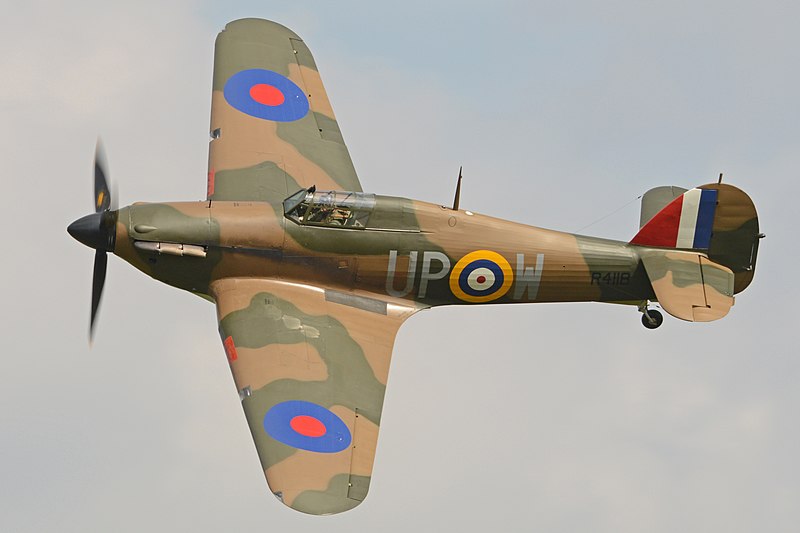
Hawker Hurricane Mark I. This is the only airworthy Hurricane with a genuine Battle of Britain history. Since 2015 she has lodged with the Shuttleworth Collection and is seen displaying at the 2017 Season Premier Airshow at Old Warden, Bedfordshire, UK.
Photo by Alan Wilson via Wikimedia Commons.
In the popular mind it was the Supermarine Spitfire which carried the day for the Royal Air Force during the Battle of Britain. The grace of RJ Mitchell’s design was appreciated by the public as something very special, as it was for the pilots who flew it.
But it was the slower Hawker Hurricane which accounted for most of the German airmen killed in 1940 and destroyed most of their Heinkels, Junkers and Dorniers. Although nearly 200 Hurricanes had been lost in the Battle of France there were 32 squadrons of Hurricanes in the Battle of Britain compared with 19 of Spitfires.
By the time air battles commenced over England in 1940, the RAF had a secret weapon – BAM 100. This was British Air Ministry 100 octane fuel which had been developed and manufactured in the United States, bought for cash by the UK government, and shipped across the Atlantic by tankers. Compared with the previous 87 octane petrol, the new fuel boosted the speed of the Hurricane and the Spitfire by around 30mph. The Luftwaffe pilots were taken by surprise and couldn’t understand where the extra power came from until later in the war German technicians tested fuel from a downed aircraft.
Side by side the Spitfire and Hurricane, both powered by the iconic Rolls-Royce V12 Merlin, were very different. The Spitfire with its elliptical wing and perfect proportions “looked as if it could fly”, as Sergeant Cyril Bamberger of 610 and 41 squadrons said. But the Hurricane, if not quite an ugly duckling, had an ungainly appearance.
While the Spitfire was of all-metal construction, the Hurricane’s structure was a halfway house between fabric covered biplanes, such as the Gloster Gladiator, and all-aluminium monoplanes. An unintended consequence of the Hurricane’s fabric-covered fuselage was that German cannon shells could pass straight through without exploding. Its pilots soon realised that the Hurricane could take a lot of punishment, and the ground crews, the unsung heroes of the battle, could often repair the aircraft on station unlike the Spitfire, which was difficult to produce, maintain and repair.
Getting airborne in a squadron scramble, or landing on a grass airstrip, the Hurricane was safer than its compatriot because Camm had designed its undercarriage to open outwards, not inwards, making its track wider.
In the air the Hurricane shrugged off its ugly duckling appearance and became a killing machine. Flight Lieutenant Peter Brothers of 32 and 257 Squadrons said: “It was a superb combat aircraft … it was a better gun platform than the Spitfire”. Squadron Leader Tom Dalton Morgan said that, although he had flown more hours on the Spitfire, “as a fighting machine I preferred the Hurricane”.
The Hurricane could out-turn a Messerschmitt Bf109. Its turning radius of 785ft compared with 895ft for the German machine and 860ft for the Spitfire. The Hurricane’s thick wing allowed a different configuration of its eight .303 Browning guns giving a closer concentration of fire at a rate of 19 rounds per second.
Hero-worship of Admiral Nelson seen as (somewhat) harmful
On Saturday, Sir Humphrey noted the anniversary of Trafalgar and indicated that the Royal Navy’s idolization of Admiral Nelson somewhat obscures the rest of the Royal Navy’s historical role:
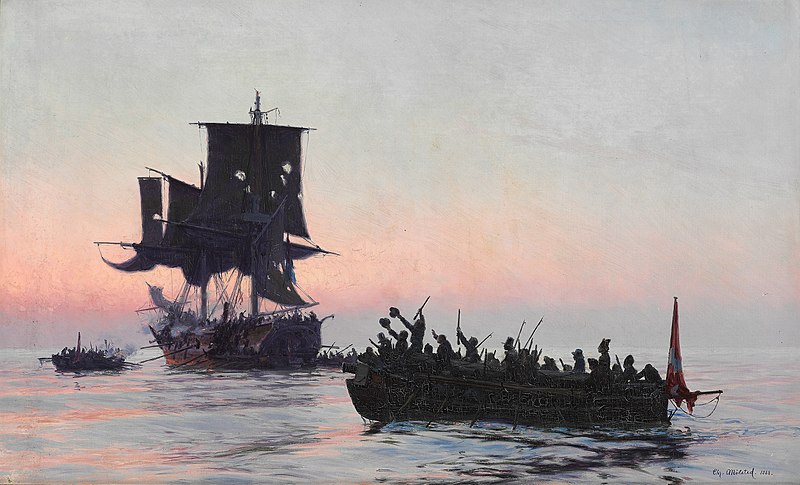
“Danish privateers intercepting an enemy vessel during the Napoleonic Wars”.
Oil painting by Christian Mølsted, 1888 from the Collection of the Museum of National History via Wikimedia Commons.
There is an argument, which the author has sympathy with, that the RN has perhaps idolised Nelson too much. That while he did much good, the adoration of him comes at the cost of forgetting countless other leaders and battles which have relevance to this day. This is not to denigrate or play down the impact of Trafalgar, but to ask whether we should be equally aware of other parts of Royal Navy history too. Understanding the Royal Navy of the late 18th and early 19th century can provide us with much to consider and learn from in looking at how to shape the Royal Navy of the early 21st century. If you look at the Royal Navy of today and of Nelson’s time (and throughout the Napoleonic Wars), a strong case can be made that although the technology is materially different, the missions, function, and capability that the RN offers to the Government of the day are little changed.
While we tend to fix attention mostly on the major battle of Trafalgar, the RN fulfilled a wide variety of different missions throughout the war. The fleet was responsible for blockading Europe, monitoring French movements, and providing timely intelligence on the activity of enemy fleets. Legions of smaller ships stood off hostile coasts, outside of engagement range, on lonely picket duties to track the foe. The Royal Navy also maintained forces capable of strategic blockades in locations like Gibraltar and the Skagerrak, relying on chokepoints to secure control of the sea.
The UK was a mercantile nation with a heavy reliance on trade, and with the land routes of Europe closed by Napoleon, the Merchant Navy was vital to victory. The Royal Navy played a key role in escorting ships in convoy, ensuring their protection from hostile forces and helping ensure vitally needed trade goods arrived in British ports. This included timber from colonies in North America, vital to building and repairing warships. Similarly British policy to defeat Napoleon relied on supporting continental land powers, and a steady flow of munitions and materiel were sent by sea, escorted by RN warships to Baltic ports to help support nations fighting France.
The Royal Navy maintained forces of small raiding craft to hold the French coast at risk throughout the wars, sending vessels to attack French coastal locations, capturing intelligence and tying down hundreds of French coastal artillery batteries and thousands of men who could have been deployed elsewhere to protect French soil. More widely the UK engaged in strategic raiding and blockade, for example operations in the Adriatic Campaign (1807-14) where a small number of British warships blockaded ports, conducted amphibious operations and engaged in surface combat with different foes. In the same vein the UK found itself targeted by Danish & Norwegian raiders too, who fought the so-called “Gunboat War” from 1807 to 14 against the UK, where many small scale actions between British brigs and small ships against gunboats in the Baltic. This often forgotten campaign saw violent clashes and victories on both sides with the sinking and capture of many RN vessels to protect convoy trade.
More widely the Royal Navy worked closely with the British Army in a variety of amphibious operations, providing ships to deploy and sustain the Army on campaign. There were a number of impressive amphibious failures, but also some successes too, particularly in the West Indies and Egypt, where working as part of a jointly integrated force, the Royal Navy provided fire support (and even operated Congreve land attack rockets for shore bombardment) as the British Army fought the French ashore. In the Peninsular War the RN was vital for ensuring the supply of Wellington’s forces and, where necessary evacuating them, such as during the retreat from Corunna.
Icon of Canadian Search and Rescue For 40 years; the story of the CH-113 Labrador
Polyus
Published 3 Sept 2021The Boeing-Vertol CH-113 Labrador was an icon of Canadian search and rescue for 40 years. It served on both the right and left coast and undertook many life saving rescues in its day. Originally ordered as two models, an army transport version and a search and rescue version, they were all converted to a common standard when the army took possession of their Chinook helicopters. As a dedicated search and rescue helicopter it excelled at its role. Its replacement is a long story for another time but involves several facepalm moments thanks to short sighted decision making. As a result it was kept in service longer than anticipated but still did the job well.
0:00 Introduction
0:27 Previous generation of search and rescue
1:18 Acquisition of the CH-46 Sea Knight
4:10 Definitive CH-113 Labrador model
5:53 Replacement and retirement
6:38 Conclusion
(more…)
October 22, 2023
SS Commando Coup in Hungary – WW2 – Week 269 – October 21, 1944
World War Two
Published 21 Oct 2023The Germans engineer a coup in Hungary to keep the Hungarian army in the war, but the Allies have finally entered Germany in force, taking Aachen in the west. The Soviets liberate Belgrade in the east, and launch new attacks in Baltics, and at the other end of the world come American landings in the Philippines, and the recall of Vinegar Joe Stilwell from China.
00:00 Intro
01:00 Recap
01:21 Raids on the Philippines
04:42 The Invasion of Leyte
06:11 Joe Stilwell is recalled from China
08:12 The Battle of Aachen
12:24 Battle of the Scheldt
14:03 Soviet attacks in the Baltics
16:23 Horthy’s fall- a coup in Hungary
19:45 Germans close in on Slovakia
21:55 Belgrade Liberated
24:47 Summary
25:01 Conclusion
(more…)
“Grandpa Nambu” Japanese Pistol
Forgotten Weapons
Published 15 Nov 2016The 1902 “Grandpa” Nambu is one of the first wave of successful military automatic pistols, developed by Kijiro Nambu and his team over the course of five years, from 1897 to 1902. It was the first automatic pistol to be used by the Japanese military, although it was a private-purchase sidearm for officers and not formally purchased or issued by the military. It took several design cues from the C96 Mauser, in the form of a pivoting locking block and a bottlenecked cartridge.
The Grandpa was only made from 1902 until 1906, with less than 2400 examples produced in total — many of which were sold to Thailand. In 1906 a series of improvements were made to the gun, including increasing the size of the trigger and trigger guard, a swiveling lanyard ring, a slightly larger grip, new magazine, and deletion of the shoulder stock slot that had been standard on all previous Nambu pistols. The formal Japanese designation (Type A) did not change as a result, but in American collector parlance the new model became the “Papa” Nambu.
Cool Forgotten Weapons Merch! http://shop.bbtv.com/collections/forg…
QotD: The changes in Roman legionary equipment attributed to the “Marian reforms”
There only two parts of this narrative unambiguously suggested by our sources are equipment changes: that Marius introduced a new type of pilum (Plut. Mar. 25) and that he standardized legionary standards around the aquila, the eagle standard (Plin. NH 10.16).
For the pilum, Plutarch says that Marius designed it to incorporate a wooden rivet where the long metal shank met the heavy wooden shaft, replacing one of the two iron nails with a wooden rivet that would break on impact, in order to better disable the shield. The problem is that the pilum is actually archaeologically one of the best attested Roman weapons with the result that we can follow its development fairly closely. And the late, great Peter Connolly did exactly that in a series of articles in the Journal of Roman Military Equipment Studies1 and while the design of the pilum does develop over time, there’s simply no evidence for what Plutarch describes. The “broad tanged” pilum type could have been modified this way, but we’ve never found one actually so modified; instead the pila of this type we find all have rivets (two of them) in place (where rivets are preserved at all). Moreoever, most pila of that “broad tanged” type, both before and after Marius, have the edges of that broad tang bent over at the sides, which would prevent the sort of sliding action Plutarch describes even if one of the rivets broke. Meanwhile, by the first century there are three types of pila around (socketed, broad-tanged and spike-tanged) only one of which could be modified in this way (the broad-tanged type), and that type doesn’t dominate during the first century when one might expect Marius’ new-style pila to be in use. In practice then the conclusion seems to be that Plutarch made up or misunderstood this “innovation” in the pilum or, at best, the design was adopted briefly and then abandoned.
On to the aquila. Now, it is absolutely true that the aquila, the legionary eagle, became a key standard for the Roman legions. Pliny the Elder notes that before Marius it was merely the foremost of five standards, the others being the wolf, minotaur, horse and boar (Plin. HN 10.16). But even a brief glance as legionary standards into the early empire (see Keppie (1984), 205-213 for an incomplete and somewhat dated list) shows that bulls, boars and wolves remained pretty common legionary emblems (alongside the eagle) into the empire. The eagle seems to have been something of a personal totem for Marius (e.g. Plut. Mar. 36.5-6) so it is hardly surprising he’d have emphasized it, the same way that legions founded by Caesar – or which wanted to be seen as founded by Caesar – adopted the bull emblem, quite a lot. But this is a weak accomplishment, since Pliny already notes that the eagle was, even before Marius, already prima cum quattuor aliis (“first among four others”), and so it remained: first among a range of other emblems and standards. Though of all of the things we may credit Marius with instituting, this perhaps gets the closest, if we believe Pliny that Marius further elevated the eagle into its particular position.
Then there is the institution of the Roman marching pack and the furca to carry it, such that Marius’ soldiers became known as “Marius’ mules” because he made them carry all of their own kit rather than, as previous legions had supposedly done, carrying it all on mules. Surely this extremely famous element of the narrative cannot be flawed? And Plutarch sort of says this, he notes that, “Setting out on the expedition, he laboured to perfect his army as it went along, practicing the men in all kinds of running and in long marches, and compelling them to carry their own baggage and to prepare their own food. Hence, in after times, men who were fond of toil and did whatever was enjoined upon them contentedly and without a murmur, were called Marian mules” (Plut. 13.1; trans. B. Perrin). Except that doesn’t say anything about instituting the classic Roman pack that we see, for instance, depicted on Trajan’s column, does it? It just says Marius made his men carry their baggage and prepare their own food, leading to the nickname for men who did toil without complaint.
The problem is that those two things – making soldiers carry their baggage and cook their own food (along with kicking out camp followers) – are ubiquitous commonplaces of good generalship with instances that pre-date Marius. P. Cornelius Scipio Aemilianus does exactly this – getting rid of camp servants, wagons and pack animals, making soldiers cook their own food and kicking out the camp followers – according to Appian in 134 when he besieged Numantia (which fell in 133, App. Hisp. 85). And then Q. Caecilius Metellus, Marius’ own former commander, does the exact same thing in 109 when he takes command against Jugurtha in North Africa, kicking the sutlers out of the camp, getting rid of pack animals and private servants, making soldiers cook their own food, carry their own rations and their own weapons (Sall. Iug. 42.2; note that Sallust dies in in the 30s BC, 80-odd years before Plutarch is born, so Plutarch may well be getting this trope from Sallust and then attributing it to the wrong Roman). Critiques of generals who issued rations rather than making their soldiers cook or praise for generals who didn’t remained standard into the empire (e.g. Tac. Hist. 2.88; Hdn. 4.7.4-6; Dio Cass. 62.5.5). In short this trope was not new to Marius nor was it new to Plutarch’s version of Marius; it was a standard trope of generals restoring good discipline to their soldiers. Plutarch even hedges noting another story that the term “Marius’ mules” might actually have come how well Marius as a junior officer got along with animals (Plut. Mar. 13.2)!
Well, fine enough, but what about the idea that state-issued equipment is emerging in this period? Well, it might be but our evidence is not great. As noted when we discussed the dilectus, Polybius implies – and his schematic for conscription makes little sense otherwise – that the Romans are in that period buying their own equipment. He also notes that the quaestors deduct from a soldier’s pay the price of their rations (if they are Romans; socii eat for free), their clothing and any additional equipment they need (Polyb. 6.39.14). It makes sense; if a fellow forgot a sword or his breaks, you need to get that replaced, so you fine him the value of it and then issue him one from the common store.
Now Keppie (1984) assumes this system changes during the tribunate(s) of Gaius Gracchus (123-2) and you can see the temptation in this idea. If Gaius Gracchus shifts equipment to being issued at state expense, then suddenly there’s no reason not to recruit the landless proletarii (discussed below) opening the door for Marius to do so (discussed below) and fundamentally transforming the Roman army into the longer-service, professional form we see in the empire. The problem is that, well, it didn’t happen. First, we have no evidence at all that Gaius Gracchus did anything related to soldier’s arms and armor; what we have is a single line from Plutarch that soldiers should be issued clothing at state expense with nothing deducted from their pay to meet this cost (Plut. C. Gracch. 5.1). The assumption here is that this also covered arms and armor, but Plutarch doesn’t say that at all. The more fatal flaw is that we can be very, extremely sure this reform didn’t stick, because we have a bunch of Roman “pay stubs” from the imperial period (from Egypt, naturally) and regular deductions vestimentis, “for clothing” show up as standard.2 Indeed, they show up alongside deductions for food and replacement socks, boots and so on, exactly as Polybius would have us expect. Apart from the fact that this is presumably being done by a procurator instead of a quaestor (a change in the structure of administration in the provinces run directly by the emperor), this is the same system.
Now there are reasons to think that at least some equipment was state supplied or contracted (even if it may have been billed to the accounts of the soldiers who got it). Scipio creates a public armaments production center in Carthago Nova in 210, but this may be a one off. Seemingly more centralized production of arms under contract are more common in the late Republic and by the imperial period we start to see evidence of fabricae which seem to be central production sites for military equipment.3 But we have no hint in the sources of any sudden reform to this system. It may well be a gradual change as the “mix” of personal and state-ordered equipment slowly tilts in favor of the latter; the system Polybius describes could accommodate both situations, so there’s no need for a sudden big shift. Alternately, the preponderance of state-produced equipment might well be connected to the formalization of a long-service professional army under Augustus. Even then, we still find pieces of equipment in Roman imperial sites which were clearly personal; soldiers could still go and get a fancy version of standard kit, stamp their name in it and call it theirs. All I think we can say with any degree of confidence is that self-purchased equipment seems to be the norm in Polybius’ day whereas state-issued equipment seems to be the norm by the end of the first century. But Marius has nothing to do with it, as far as we can tell and no ancient source claims that he did.
Oh and by the by, if you are picking up from all of this (and our discussion of Lycurgus) that Plutarch is a difficult source that needs to be treated with a lot of caution because he never lets the facts get in the way of a good story … well, that’s true.
Bret Devereaux, “Collections: The Marian Reforms Weren’t a Thing”, A Collection of Unmitigated Pedantry, 2023-06-30.
1. “Pilum, Gladius and Pugio in the Late Republic”, JRMES 5 (1997), then “The Reconstruction and Use of Roman Weaponry in the Second Century BC”, JRMES 11 (2000) and then “The pilum from Marius to Nero – a reconsideration of its development and function”, JRMES 12/13 (2001/2).
2. On this, see R.O. Fink, Roman Military Records on Papyrus (1971).
3. On all this, see Bishop and Coulston, Roman Military Equipment (2006), 233-240.
October 21, 2023
QotD: The US Army’s Korean War blooding
For his own sake and for that of those around him, a man must be prepared for the awful, shrieking moment of truth when he realizes he is all alone on a hill ten thousand miles from home, and that he may be killed in the next second.
The young men of America, from whatever strata, are raised in a permissive society. The increasing alienation of their education from the harsher realities of life makes their reorientation, once enlisted, doubly important.
Prior to 1950 they got no reorientation. They put on the uniform, but continued to get by, doing things rather more or less. They had no time for sergeants.
As discipline deteriorated, the generals themselves were hardly affected. They still had their position, their pomp and ceremonies. Surrounded by professionals of the old school, largely field rank, they still thought their rod was iron, for, seemingly, their own orders were obeyed.
But ground battle is a series of platoon actions. No longer can a field commander stand on a hill, like Lee or Grant, and oversee his formations. Orders in combat — the orders that kill men or get them killed, are not given by generals, or even by majors. They are given by lieutenants and sergeants, and sometimes by PFC’s.
When a sergeant gives a soldier an order in battle, it must have the same weight as that of a four-star general.
Such orders cannot be given by men who are some of the boys. Men willingly take orders to die only from those they are trained to regard as superior beings.
It was not until the summer of 1950, when the legions went forth, that the generals realized what they had agreed to, and what they had wrought.
The Old Army, outcast and alien and remote from the warm bosom of society, officer and man alike, ordered into Korea, would have gone without questioning. It would have died without counting. As on Bataan, it would not have listened for the angel’s trumpet or the clarion call. It would have heard the hard sound of its own bugles, and hard-bitten, cynical, wise in bitter ways, it would have kept its eyes on its sergeants.
It would have died. It would have retreated, or surrendered, only in the last extremity. In the enemy prison camps, exhausted, sick, it would have spat upon its captors, despising them to the last.
It would have died, but it might have held.
T.R. Fehrenbach, This Kind of War: A Study in Unpreparedness, 1963.
October 20, 2023
Zulu Kingdom’s Last Stand – The Anglo-Zulu War 1879
Real Time History
Published 18 Oct 2023The Anglo-Zulu War in 1879 is one of the most well known colonial wars of the British Empire. And while the British ultimately won and annexed the Zulu Kingdom, at the Battle of Isandlwana they suffered one of their worst defeats.
(more…)
October 18, 2023
Why the Canadian Surface Combatant (CSC) program will cost so much more than equivalent US or British ships
In The Line, Philippe Lagassé outlines the Canadian Surface Combatant (CSC) program — the next-generation front-line combat ships for the Royal Canadian Navy intended to replace the current Halifax-class frigates and the already retired Iroquois-class destroyers:
Building warships is an expensive business, especially if you’re getting back into it after a few decades. Take the Canadian Surface Combatant (CSC). Fifteen CSCs will be built at Halifax’s Irving Shipbuilding to replace Canada’s current frigates and decommissioned destroyers. According to a 2022 study by the Parliamentary Budget Officer (PBO), the CSC acquisition will cost $80.2 billion. Given that defence inflation is well above regular inflation, and that regular inflation is running hot, that number isn’t going to go down.
Canada’s CSC will be a variant of the Type 26 Global Combat Ship originally designed for the Royal Navy. The Canadian variant includes significant changes to the original Type 26 design, notably to the combat systems. With the estimated per unit cost of each ship topping $5.6 billion, the National Post‘s John Ivison warns that the CSC is out of control. Ivison notes that the United States Navy (USN) acquired its Constellation-class frigates for $1.66 billion. Why, he understandably asks, is Canada paying so much for the CSC, and to what end?
The Canadian government always views major military purchases for the Canadian Armed Forces primarily as regional economic development projects and always attempts to get all or at least a major part of the construction done in Canada. To most people this sounds sensible: big military equipment acquisitions mean a lot of money being spent, so why shouldn’t most of that money be spent inside Canada? The answer, in almost every case, is that it will be significantly more expensive because Canadian industry doesn’t regularly produce these ships/planes/helicopters/tanks, so a lot of money will need to be spent to construct the factories or shipyards, import the specialized equipment, hire and train the workforce, etc., and no rational private industry will spend that kind of money unless they’re guaranteed to be repaid (plus profit).
Ordinary items for the Canadian military like clothing, food, non-specialized vehicles (cars, trucks, etc.) may carry a small extra margin over run-of-the-mill stuff, but it will generally be competitive with imported equivalents. Highly specialized items generally won’t be competitively priced exactly because of those specialized qualities. The bigger and more unusual the item to be purchased, the less economic sense it makes to buy domestically.
There are also the conflicting desires of the elected government (who generally want to target the spending to electoral districts or regions that benefit “their” voters), the permanent bureaucracy (who want to ensure that programs last a long time to ensure jobs within the civil service), and the military procurement teams (who have a tendency to over-optimistically estimate up-front and long-term costs because they want to get the procurement process underway … it’s tougher to stop something already in-process than one that still needs formal approval).
Once there’s a budget and capabilities are identified, the requirements for individual projects are prepared. It’s here that the comparison with lower cost, off-the-shelf alternatives runs into difficultly. The USN has lots of different types of ships that do lots of specific things. The above-mentioned Constellation-class is one of many different types of warships that the USN will sail, each with specific mission sets and roles. The Canadian military has only been directed to acquire fifteen CSCs, but the government expects the CAF to do a variety of missions at sea — not as many as the USN, of course, but still a good number. Canada has other military ships, including the Arctic Offshore Patrol Vessels (AOPS) also being built by Irving, but the CSC will be Royal Canadian Navy (RCN)’s primary expeditionary platform. Canadian defence planners, therefore, need those 15 ships to be capable of undertaking various missions and roles. Compounding this challenge are technological changes and the ever-evolving threat. The requirements for the CSC need to be continuously updated, and in some cases expanded, to keep pace with these developments, too.
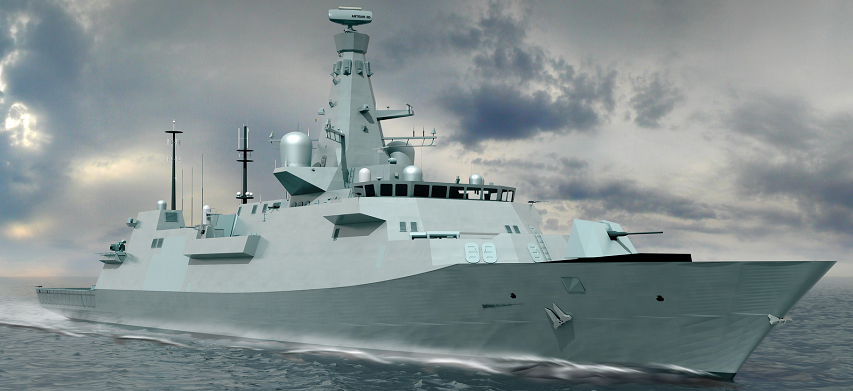
An artist’s rendition of BAE’s Type 26 Global Combat Ship, which was selected as the Canadian Surface Combatant design in 2019, the most recent “largest single expenditure in Canadian government history” (as all major weapon systems purchases tend to be).
(BAE Systems, via Flickr)
On purely economic grounds, it would often make sense to add Canada’s order on to existing US, British, or other allied military orders to benefit from the economies of scale … but pure economic benefits don’t rank highly on the overall scale of importance. There’s also the understandable desire of the government to buy fewer items with wider capabilities as the government’s requirements for the military change with time and circumstance.
Were Canadian defence planners too cavalier in their requirements and design modifications? Maybe. Looking at it from their perspective, though, we should appreciate that they thinking about capabilities for a ship that Canada will use until the 2100s.
Doubts about the CSC are going to keep multiplying. The per unit costs can only increase so much before people start seriously discussing reducing how many of them will be built. You can be sure that some within government are already asking “Why 15? Why not 12?” Serious concerns are also being raised about whether the defence budget can afford to maintain CSC and keep them technologically up to date after the fleet is introduced. Given the CAF’s personnel recruitment troubles, moreover, it’s unclear if the RCN will have enough sailors to operate the full fleet. The first CSC that hits the water, furthermore, will have all sorts of kinks and problems that will need to be sorted out. That’s standard for first ships off the line, but you can be sure that every failing will be met with handwringing and charges of incompetence.
To address these concerns, the government must let DND/CAF better explain what the CSC is designed to do and why it needs to do it. Simply telling Canadians that it’s the right ship isn’t enough when it’s easy to point to lower-cost alternatives. As well, the government needs to be far more transparent about estimates of costs and what’s driving them. Political and public support for the CSC shouldn’t be taken for granted, and growing concerns about the program can’t be simply brushed away.
October 17, 2023
Why WW1 Cavalry Was Essential On The Battlefield
The Great War
Published 13 Oct 2023The First World War was a catalyst for modern warfare with tanks, poison gas, flamethrowers and more. Cavalry didn’t have a place anymore on the modern battlefield – or so the common misconception goes. In this video we show how useful cavalry still was in WW1.
(more…)
October 16, 2023
The Allied Rape Wave of 1944 – War Against Humanity 116
World War Two
Published 12 Oct 2023Since the earliest days of humanity, where there has been war, there has been rape. This war is no different. As vast armies battle across Europe, the chaos in their wake breeds an epidemic of rape. In its action and its punishment the European rape wave is also highly racialised. It adds up to a storm of suffering.
(more…)
After the attacks, Hamas proudly shared photos and videos of the victims
In UnHerd, David Patrikarakos describes what he calls “the week Hamas reinvented horror”:
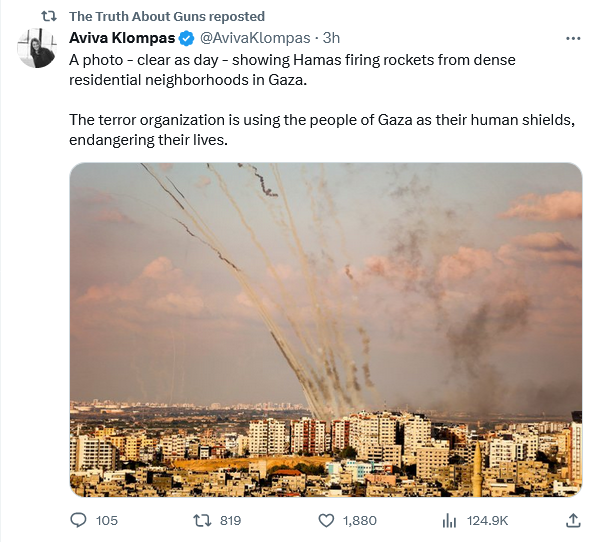
Israel and Gaza are a Pathé newsreel of violence. Atrocity mounts upon atrocity. Blood smeared on gristle. Festivals mottled with corpses. Women dragged off to be raped and killed. And, now, perhaps the ultimate taboo. “This is the most difficult image we’ve posted”, ran the Daily Telegraph’s front page, reprinting a tweet from the State of Israel’s official account. “As we are writing this we are shaking. We went back and forth about posting this. But we need each and everyone of you to know. This happened.”
The images were of the charred and blackened corpses of babies. Dead bodies are a fixture of my professional life, and I have never seen anything like it. I have never felt that level of nausea. Nothing is beyond the sadism of Hamas. Nothing, now, might be beyond the response — comes the reply from Israel.
Clearly, nothing now is beyond being live-streamed, uploaded, posted, tweeted or shared. Amid the horror and disgust, one thing has struck me above all: the footage has overwhelmingly come from the perpetrators. Yes, there is video shot by terrified and fleeing victims, but scroll through Twitter, Telegram and Instagram and what do you see? Hamas filming themselves barking at cowering Israeli families on the ground; parents covering their children’s eyes, desperate to banish reality; Hamas yanking soldiers off tanks and throwing them into the dirt; Hamas grinning as they parade an elderly woman around in a golf cart.
This conflict has lasted for almost a century, yet what we have seen this week has never been seen before. It is a nasty and brutal war fought over land where ideology and the interminable cycle of reprisals has made its resolution impossible. But it is something else, too. It is perhaps the world’s longest running geopolitical media spectacle. Nothing, not Kashmir nor the Balkans nor any of the other enduring conflicts largely created by empire, has received anywhere near this level of coverage. The depths plumbed by Hamas are unprecedentedly low.
Several factors explain the brutality. First is a perennial of human nature: old-fashioned rage and bloodlust. No one, least of all it seems Hamas, expected the attacks to be so successful. Coming upon hundreds of unarmed Israelis was obviously too much of a temptation for many of these incontinent fanatics.
Then there is the desire to provoke. To get Israel to overreact, but also its neighbours. Broadcast images of dead Palestinian babies onto those feeds and then maybe your Arab allies will start to wonder about the wisdom of their various normalisation agreements with Israel. History is turning away from Hamas. The warming of relations between Israel and Saudi Arabia threatens to destroy them forever. If the “Custodian of the Two Holy Places” decides the “Zionist Entity” is actually ok, then it’s only the politically impotent and half-witted Bashar al-Assad beside you, and the Iranians, who are formidable but largely alone.
It’s a basic strategy but a generally successful one. Don’t forget that one of the reasons bin Laden struck the World Trade Center was to get the Leviathan to lash out, which it did. Hamas has limited options. This is perhaps the one card it can play with any real efficacy.
October 15, 2023
The Isolation of Army Group North – WW2 – Week 268 – October 14, 1944
World War Two
Published 14 Oct 2023Churchill, Stalin, and Roosevelt meet at the Moscow Conference and talk about future “spheres of influence” in the Balkans. They also make plans for the future of Poland. In the field the Soviet Red Army completes the isolation of Army Group North and also advances in Hungary and Yugoslavia. The Allies enter Aachen in the west and cross the Rubicon in Italy. The Americans are still fighting the Japanese on Peleliu, and this week also make raids against Japanese airfields ahead of next week’s invasion of the Philippines.
01:00 Recap
01:22 The Moscow Conference begins
03:43 Isolating Army Group North
06:29 Soviet advances toward Belgrade
08:14 The Debrecen Operation
13:20 Horthy and Hungary
14:30 Chiang Kai-shek accuses Joe Stilwell
16:19 American raids on Formosa
19:29 The fight for Peleliu continues
20:01 Antwerp and Aachen
22:01 The Allies cross the Rubicon
(more…)


