
Regarding [Vladimir Putin’s] Magical Mystery War, I’m going with the stoyak that the casualty counts peddled by the [western media] is part of a very very old playbook which various Western observers have peddled since 1905-that of Russian stupidity and indifference to casualties. Russia loses a war? They’re stupid gopniks who flung their soldiers into meat grinders until they rebelled (1905 or 1917). Russia wins a war? They’re stupid gopniks who flung their soldiers into meat grinders until they won (1945, 2023). Note that you can effortlessly pivot your propaganda when it becomes obvious in hindsight the outcome of the war. This becomes very important when [Putin] negotiates his 18th century kabiniettskreig ending to the war, since nobody in the West, especially AINO, understands how a cabinet war is fought, much less ends. They will claim that they foiled Putin’s plan for conquering all Ukraine (which he never has wanted) by killing hundreds of thousands of poor, oppressed, stupid, vodka-fueled gopniks used as cannon fodder who simply overwhelmed the valiant forces of good by sheer numbers. Not by superior strategy or tactics, or weapons, but the good ol’ Russian sledgehammer. Just like Hitler’s excuse in 1945, when Ivan was knock knock knockin’ on his bunker door. His generals who survived carried that piece of gospel West when the US Army started studying how to fight the Reds and asked the Germans how they did it. Their answer was happily embraced by the next generation of Very Clever Boys in the 1960s and carried forward to today’s Fistagon — Wunderwaffen.
Pickle Rick, commenting on “Friday Mailbag”, Founding Questions, 2023-12-01.
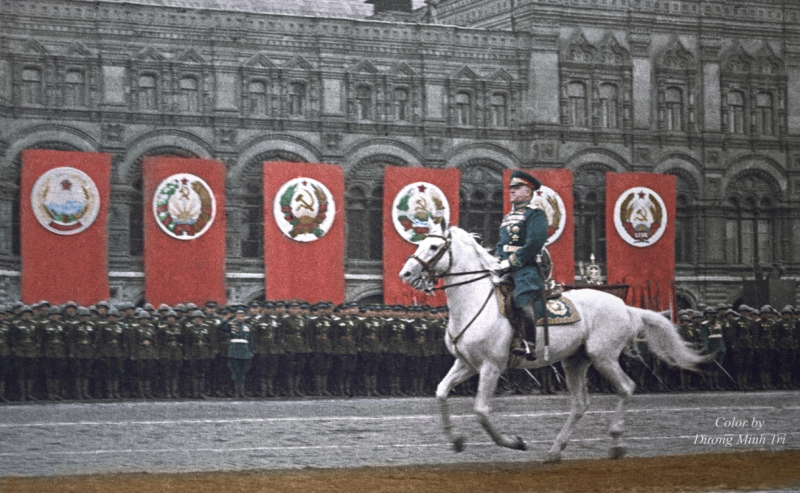
Rick agreed to me posting this quote as long as I included this colourized photo of Marshal of the Soviet Union Georgy Zhukov (“because it’s gangsta as FUCK”)
December 2, 2023
QotD: Western media and Putin’s war
December 1, 2023
“You’ve reached the Royal Canadian Navy. Your naval emergency is very important to us, so please stay on the line for … a few years and we will send a frigate when one becomes available”
Paul Wells was disturbed by a recent extremely downbeat video posted on YouTube by the head of Canada’s Navy so he got in touch with the man himself for an interview:
That was a hell of a video that Vice Admiral Angus Topshee, the Commander of the Royal Canadian Navy, put on Youtube this week. Topshee depicts a Navy in a “critical state”, facing “very serious challenges right now that could mean we fail to meet our force posture and readiness commitments in 2024 and beyond”.
The Navy’s not alone — the Air Force and Army are “confronted with similar challenges”, Topshee says in the video. The biggest challenge is that the Navy’s getting smaller, about 14% smaller today than in 2014. The West Coast fleet is “beset with a shortage of qualified techs” and the fleet can only deploy one of its three offshore patrol vessels at a time. The Halifax-class frigates that form the basis of Canada’s oceangoing capability will need to keep floating for 15 more years, even though they should already have been retired. All of the 12 frigates: Topshee’s political masters have made so many commitments there’s no margin for a reduction in the Halifax-class fleet.
Here’s the video:
To borrow a naval term, it’s quite a broadside. So I emailed Topshee on Wednesday and asked for an interview. He wrote back promptly and we were on the phone within hours. Here’s our interview in Q&A format, edited for length.
PW: Are you in the habit of putting out videos that are this stark in their diagnosis? If I went back, would I find one of these every year?
AT: No, there was a unique combination of circumstances that led to video being produced. The promise I made when I took command of the Navy is that we have to be honest. Things are the way they are. They’re not necessarily the way we want them to be. And we’ve got to be very honest about that difference. And so I’ve tried to be frank, and we try and rebuild trust. And to be completely honest, we went through a cultural crisis in the Canadian Armed Forces. And my feeling is that if you want people to trust you, then you have to be completely open, transparent and honest with them. That’s the approach I’ve taken throughout my tenure in command of the Navy.
PW: Is the fact that this video’s on YouTube a reflection of any difficulty you’re having getting heard internally?
AT: No. I’ve shared my assessments with the leadership of the Department, up to and including this minister and the previous Minister. I feel I’m being heard and respected. This was more about, we wanted to put the message out internally. Unfortunately, there’s some very specific IT challenges around how we disseminate internal messages. And so [Youtube] was the channel we used.
[…]
PW: It’s slower to train up recruits in the Navy, because you have to put them on a ship, and that has logistical implications? Whereas in the army, I could take them to an open field?
AT: The commander of the army is going to hate me for saying this, but it’s always been easier to raise an army than to generate a navy or build an air force. Fundamentally, the basic core tasks of an infantry soldier really come down to those individual capabilities that can be trained relatively quickly. Now, actually commanding and controlling and employing that army is a fantastically complicated thing. But it starts with the infantry soldier: relatively easy to build. The training required to generate a sailor is pretty significant. The Mar-Techs that I talked about? [In the video, Topshee says the navy has been losing a highly-trained marine technician every two days.] You know, we’re talking five to 10 years to get to the level of training and experience that they require. So that’s why, you know, we need to make some immediate changes to stabilize ourselves. To grow back to health is going to take time. If we don’t change the system, it will take virtually forever to get back. So we need to make changes to allow us to accelerate how quickly we can do this. Because the honest truth is that while we’re short sailors at the moment, we would probably actually need more sailors to meet the needs of the future fleet that we’re building right now
PW: On the West Coast, you say you are having to prioritize the Halifax class [the big ocean-going frigates that form the Navy’s backbone] at the expense of the Kingston class [smaller ships primarily for coastal service and patrol].
AT: Historically, the West Coast has always had greater personnel generation problems. Partly because there’s a there’s a smaller personnel footprint over there. So when you’re short a number of sailors you feel it more acutely, because the denominator is smaller. So yes, that’s the coast where we’ve felt the pressures most acutely. We’re seeing similar pressures building on the East Coast, but we have not been forced to make any changes. So what we’ve done is we’ve made sure that we can continue to operate our frigates, because right now the West Coast is deploying two frigates, Ottawa and Vancouver, in the Indo-Pacific alongside Asterix [a supply ship]. We need to sustain that level of commitment to meet the requirements of the Indo-Pacific Strategy.

QotD: The OODA loop
There was a fighter pilot named John Boyd who became the most important strategic theorist writing in English during the 20th century. He began with E/M (energy-maneuverability theory), which became the basis on which modern fighter aircraft are designed and modern fighter tactics taught. He ended his career as one of the architects of the winning “left-hook” strategy in the 1991 Gulf War. Connecting these was a general theory of military effectiveness (and more generally, organizational effectiveness) centered around what he called the OODA loop.
OODA theory is worth reading about in more depth for anyone interested in … well, any kind of competitive dynamics, actually – military, commercial, individual, anything. The Wikipedia article is a good start. Stripped to its essentials, the theory is that competing entities have to go through repeated iterations of observing conditions, relating observation to a generative theory, deciding what option to pursue, and acting. Victory tends to go to the competitor who can run this cycle the fastest.
OODA theory was originally generalized from the observation that in fighter design, maneuverability (especially a shorter turning radius) beats straight-line speed. When you get inside your opponent’s OODA loop, either physically or conceptually, you can attack him from unexpected angles. You can be where he isn’t. You have the initiative; he is reduced to reacting, often with too little and too late.
Eric S. Raymond, “The Smartphone Wars: Tightening the OODA Loop”, Armed and Dangerous, 2011-02-18.
November 30, 2023
Men and Morale: Canadian Army Training in the Second World War
WW2TV
Published 1 Feb 2023Men and Morale: Canadian Army Training in the Second World War
Part of Canadian Week on WW2TV With Megan HamiltonThe Canadian Army of the Second World War spent more time preparing and training their citizen soldiers then they did in sustained action. This chiefly took place across Canada and in the United Kingdom. Adequate training functioned as a cradle for collective action, morale, empowerment, self-confidence, and, ultimately, success in battle. Yet, due to a number of factors, a sufficient standard of training was not always achieved by all.
There were limits to the Canadian Army’s ability to control the morale of its men as it created a vast organization from scratch. Training camp experiences varied, influenced by factors such as food, weather, comfort, group cohesion, leadership, skill level, discipline, social activities, and interactions with local civilians. In fact, it required a constant negotiation between camp leadership and the rank and file. Drawing from her research on both the Canadian and wider Commonwealth armies, Megan’s presentation will explain why soldiers’ morale in training was a difficult, yet vital, balancing act.
Originally from Vernon, British Columbia, Megan Hamilton is a social and military historian of the 20th century. She has an Honours Bachelor of Arts degree from Wilfrid Laurier University and a Master of Arts degree from the University of Waterloo. Her federally-funded master’s research focused on the Canadian experience of the Second World War, specifically the Vernon Military Camp. Megan’s work has been published by a number of platforms and in 2022 she won the Tri-University History Program’s top essay prize for master’s students.
She is currently located in London, England, where she has begun a fully-funded PhD at King’s College London and the Imperial War Museum, supervised by Dr. Jonathan Fennell. Her dissertation is a study of Second World War army training across the Commonwealth.
(more…)
November 29, 2023
Yugoslav M57: Tito’s Tokarev
Forgotten Weapons
Published 7 Aug 2023Yugoslavia purchased both 1895 Nagant revolvers and TT33 Tokarev from the Soviet Union after World War Two, but this was only a holdover until domestic pistol production could begin. While Yugoslavia was formally communist, Tito was not a puppet of Moscow, and Yugoslavia did their own development to reverse-engineer the Tokarev pistol. In the process, they made a number of improvements to the design, resulting in the M57. Serial production began in 1963 and lasted until 1982, with about 270,000 made in total. It was the standard sidearm for the Yugoslav People’s Army and Yugoslav police forces until 1988.
The changes made from the standard Soviet pattern Tokarev include:
– Longer grip and 9-round magazine capacity
– Captive recoil spring
– Improved front sight
– Stronger firing pin with improved retention system
– Magazine disconnect safety
(more…)
November 28, 2023
Light Tank Mk IV | Tank Chats #173 | The Tank Museum
The Tank Museum
Published 18 Aug 2023Weighing in at five tons, machine gun armed and with a two-man crew, the Tank, Light, Mk IV was one of a series produced for the British Army by Vickers before World War II, seeing service on the NW Frontier of India. Recently restored, the Mk IV is the oldest running tank in our collection.
(more…)
QotD: The tactical problem of attacking WW1 trenches
[…]
So, the first problem: artillery. Neither side starts the war in trenches. Rather the war starts with large armies, consisting mostly of infantry with rifles, backed up by smaller amounts of cavalry for scouting duties (who typically fight dismounted because this is 1914, not 1814) and substantial amounts of artillery, mostly smaller caliber direct-fire1 guns, maneuvering in the open, trying to do fancy things like flanking and enveloping attacks to win by movement rather than by brute attrition (though it is worth noting that this war of maneuver is also the period of the highest casualties on a per-day basis). The tremendous lethality of those weapons – both rifles that are accurate for hundreds of yards, machine guns that can deny entire areas of the battlefield to infantry and the artillery, which is utterly murderous against any infantry it can see and by far the most lethal part of the equation – all of that demands trenches. Trenches shield the infantry from all of that firepower. So you end up with parallel trenches, typically a few hundred yards apart as the armies settle in to defenses and maneuver breaks down (because the armies are large enough to occupy the entire front from the Alps to the Sea).
The new problem this creates, from the perspective of the defender, is how to defend these trenches. If enemies actually get close to them, they are very vulnerable because the soldier at the top of the trench has a huge advantage against enemies in the trench: he can fire down more easily, can throw grenades down very easily and also has an enormous mechanical advantage if the fight comes to bayonets and trench-knives, which it might. If you end up fighting at the lip of your trench against massed enemy infantry, you have almost certainly already lost. The defensive solution here, of course, are those machine guns which can deploy enough fire to prohibit enemies moving over no man’s land: put a bunch of those in strong-points in your trench line and you can prevent enemy infantry from reaching you.
Now the attacker has the problem: how to prevent the machine guns from making approach impossible. The popular conception here is that WWI generals didn’t “figure out” machine guns for a long time; that’s not quite true. By the end of 1914, most everyone seems to have recognized that attacking into machine guns without some way of shutting them down was futile. But generals who had done their studies already had the ready solution: the way to beat infantry defenses was with artillery and had been for centuries. Light, smaller, direct-fire guns wouldn’t work2 but heavy, indirect-fire howitzers could! Now landing a shell directly in a trench was hard and trenches were already being zig-zagged to prevent shell fragments flying down the whole line anyway, so actually annihilating the defenses wasn’t quite in the cards (though heavy shells designed to penetrate the ground with large high-explosive payloads could heave a hundred meters of trench along with all of their inhabitants up into the air at a stretch with predictably fatal results). But anyone fool enough to be standing out during a barrage would be killed, so your artillery could force enemy gunners to hide in deep dugouts designed to resist artillery. Machine gunners hiding in deep dugouts can’t fire their machine guns at your approaching infantry.
And now we have the “race to the parapet”. The attacker opens with a barrage, which has two purposes: silence enemy artillery (which could utterly ruin the attack if it isn’t knocked out) and second to disable the machine guns: knock out some directly, force the crews of the rest to flee underground. But attacking infantry can’t occupy a position its own artillery is shelling, so there is some gap between when the shells stop and when the attack arrives. In that gap, the defender is going to rush to set up their machine guns while the attacker rushes to get to the lip of the trench:first one to get into position is going to inflict a terrible slaughter on the other.
Now the defender begins to look for ways to slant the race to his advantage. One option is better dugouts and indeed there is fairly rapid development in sophistication here, with artillery-resistant shelters dug many meters underground, often reinforced with lots of concrete. Artillery which could have torn apart the long-prepared expensive fortresses of a few decades earlier struggle to actually kill all of the infantry in such positions (though they can bury them alive and men hiding in a dugout are, of course, not at the parapet ready to fire). The other option was to slow the enemy advance and here came barbed wire. One misconception to clear up here: the barbed wire here is not like you would see on a fence (like an animal pen, or as an anti-climb device at the top of a chain link fence), it is not a single wire or a set of parallel wires. Rather it is set out in giant coils, like massive hay-bales of barbed wire, or else strung in large numbers of interwoven strands held up with wooden or metal posts. And there isn’t merely one line of it, but multiple lines deep. If the attacker goes in with no preparation, the result will be sadly predictable even without machine guns: troops will get stuck at the wire (or worse yet, on the wire) and then get shot to pieces. But even if troops have wire-cutters, cutting the wire and clearing passages through it will still slow them down … and this is a race.
Bret Devereaux, “Collections: No Man’s Land, Part I: The Trench Stalemate”, A Collection of Unmitigated Pedantry, 2021-09-17.
1. Direct fire here means the guns fire on a low trajectory; you are more or less pointing them where you want the shell to go and shooting straight at it, as you might with a traditional firearm.
2. The problem with direct-fire artillery here is that you cannot effectively hide it in a trench (because it’s direct fire) and you can’t keep it well concealed, so in the event of an attack, the enemy is likely to begin by using their artillery to disable your artillery. The limitations of direct-fire guns hit the French particularly hard once the trench stalemate set in, because it reduced the usefulness of their very effective 75mm field gun (the famed “French 75” after which the modern cocktail is named [Forgotten Weapons did a video covering both]). That didn’t make direct-fire guns useless, but it put a lot more importance on much heavier indirect-fire artillery.
November 27, 2023
This Cold War bomber was perfect. Why was it cancelled? | TSR2
Imperial War Museums
Published 9 Aug 2023In 1951, Britain introduced the English Electric Canberra. It would go onto become the RAF’s longest serving aircraft, designed to operate at high level. It was an incredibly efficient aircraft, but by the late 1950s everything changed. The Soviet Union brought into service brand new surface-to-air missiles and suddenly overnight the Canberra was vulnerable.
Now the British government needed a new aircraft, one that could beat this threat and fly under the radar. It was a huge ask for the technology of the time, but had it been successful the aircraft itself would have been a world beater. In this epsiode of Duxford in Depth, Liam Shaw takes a details look at the aircraft that never was, the BAC TSR-2.
(more…)
November 26, 2023
General Patton’s Metz Obsession – WW2 – Week 274 – November 25, 1944
World War Two
Published 25 Nov 2023Metz finally falls to Patton’s 3rd Army, but boy, it’s taken some time. To the south, the Allies also take Belfort and Strasbourg, and to the north Operation Queen continues trying to reach the Roer River. The Soviets complete their conquest of the islands in the Gulf of Riga and continue advancing in Hungary to the south, but it’s the Axis Powers — the Japanese — who are advancing in China, taking Dushan and Nanning.
01:15 Operation Queen Continues
04:49 9th Army attacks toward the Roer
05:54 Pattons 3rd Army takes Metz
09:22 Allies take Belfort, Mulhouse, and Strasbourg
13:56 8th Army Attacks in Italy
15:42 Soviet advances and German indecision
18:05 Japanese take Dushan and Nanning
19:21 The fight for Peleliu ends
21:43 Notes from all over
22:23 Conclusion
(more…)
Lancaster Howdah Pistols
Forgotten Weapons
Published 8 Nov 2014Charles Lancaster was a London master gunsmith who made 2-barrel and 4-barrel pistols in a variety of British revolver cartridges (commonly known as Howdah pistols). Many of his pistols was purchased privately by British military officers, explorers, and big-game hunters to use as backup weapons throughout the Empire. These three examples are chambered for the .380, .476, and .577 centerfire cartridges, and are all excellent examples of Lancaster’s work and the quality of Victorian-era British craftsmanship.
(more…)
November 25, 2023
Ridley Scott’s Napoleon
I was initially quite interested in Ridley Scott’s Napoleon, but given the criticism from historians, I doubt I’ll make the effort to see the film in the theatre. I’ve quite enjoyed some of Scott’s earlier “historic” movies, but it appears that he’s taken the historical figure of Napoleon and “interpreted” it to better fit his preferences for a film. Bret Devereaux‘s initial response is rather telling:
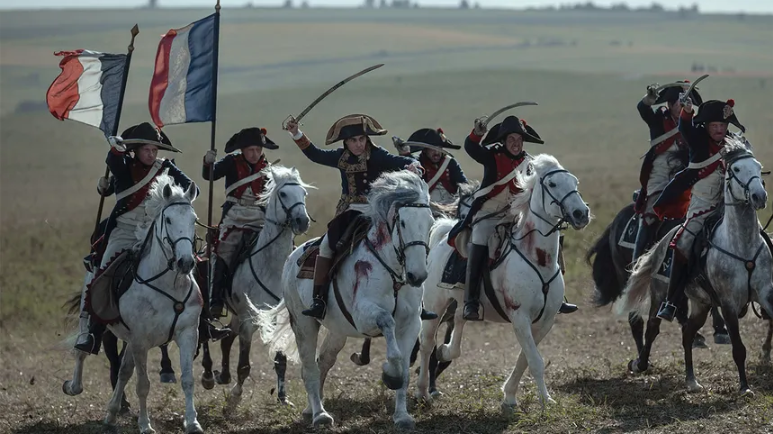
For this week’s musing, I want to comment at least briefly on dust-up surrounding Ridley Scott’s latest film, Napoleon and historians. As was evidently heavily reported, Ridley Scott responded to historians doing critiques of the film’s historical accuracy by telling them to “get a life” and suggesting that the earliest works on Napoleon were the most accurate and that subsequent historians have just progressively gotten more wrong.
I think there are two questions to untangle here: is the film accurate and does it matter? Now I haven’t yet seen the film, I’ve only seen the trailer. But my response to the trailer seems to have been basically every historian’s response to the trailer: Napoleon shows up at all sorts of places, doing all sorts of things he didn’t do. In particular, the battle scenes I’ve seen in the trailer and other snippets bear functionally no relationship to either Napoleonic warfare in general or the Battle of Austerlitz in particular (the bit with large numbers of soldiers drowning in a frozen lake was disconfirmed at the time; the lake was drained and few remains were found).
All of this is not a huge shock. All of Ridley Scott’s historical movies take huge liberties with their source material. Sometimes that’s in the service of a still interesting meditation on the past (Kingdom of Heaven, The Last Duel), sometimes in service of just a fun movie (Gladiator). Ridley Scott, in particular, has never mastered how basically any historical battle was fought and all of the battle scenes in his movies that I’ve seen are effectively nonsense (including Gladiator, which bears functionally no relationship to how Roman armies actually fought open field battles). Cool looking nonsense, but nonsense. Heck, Gladiator‘s entire plot is basically nonsense with some characters sharing historical names and very little else with their actual historical counterparts (the idea of Marcus Aurelius aiming to restore the republic in 180 is pretty silly).
So it isn’t a surprise that Ridley Scott’s grasp on Napoleonic warfare is about at the level of a not particularly motivated undergraduate student or that he has finessed or altered major historical details to make a better story. Its Ridley Scott, that’s what he does. Sometimes it works great (Kingdom of Heaven), sometimes it works poorly (Exodus: Gods and Kings).
Does it matter?
Unsurprisingly, I think that Ridley Scott is being more than a bit silly with his retorts to historians who are using his film as an opportunity to teach about the past. That’s what we do. Frankly, I find the defensiveness of “get a life” more than a bit surprising, as I assumed Ridley Scott knew he didn’t have much of a grasp on the history and was OK with that (or better yet, did have a grasp on it, but chose to alter it; I do not get this sense from his commentary), but it rather seems like he thinks he does know and is now very upset with the D+ he got on his exam and has decided to blame his “nitpicky” professor instead of his not having done the reading.
That said, when it comes to criticism (in the sense of “saying things are wrong“, rather than in the sense of “critical analysis”), I think there is a distinction to make. In the past I’ve framed this as the degree to which works “make the claim” to some kind of historical validity. It might be a fun exercise to talk about the armor in, say, Dungeons and Dragons or The Elder Scrolls and we might even learn something doing that, but neither of those works is making any claim to historical accuracy or rootedness. And so the tenor of the discussion is quite different.
But here I think Ridley Scott is to a significant degree making the claim. Of the battles, Ridley Scott says, “It’s amazing because you’re actually reconstructing the real thing” and that he “started to think like Napoleon”, which is once again both clearly making that claim (“the real thing”) and also just a remarkable thing to say given how much of a mess his battle scenes generally are. He also comments that “the scale of everything is so massive … I’d have 300 men and a hundred horses and 11 cameras in the field” and while that’s far more cameras than were on any Napoleonic battlefield, that’s just not a statement which suggests that Ridley Scott is even very aware of other achievements in recreating historical battles. Gettysburg (1993) had something on the order of five thousand reenactors on the field for filming and it is by no means the largest such effort! Spartacus (1967) had a cast of eight thousand Spanish soldiers to play the Roman legions.
So while I do not know if Napoleon is a good movie or not – I haven’t seen it yet – it seems pretty clear to me that Ridley Scott did make the claim for some of its fundamental historicity and the response of historians has been to reject that claim. And I think it’s actually quite fair to also skewer the apparent whiny arrogance of Scott making that claim baselessly and then responding petulantly when historians handed him that “D+, please come see me after class”. If you want to make historical fiction, by all means do – Scott is very good at it! – but do not be upset if historians call it what it is.
November 24, 2023
The Man Who Started the Cold War
World War Two
Published 23 Nov 2023What if I told you that a new conflict will sweep the globe in less than a year? It will open not with gunshots but with silent, shadowy espionage. The man who will kick off the Cold War is a quiet Canadian pilot, millionaire, and spymaster. A trusted aide to Churchill and FDR. I bet you haven’t heard this name before: William Stephenson.
(more…)
Freshwater Flattops; The Corn Belt Carriers Wolverine and Sable
[NR: These fascinating lake vessels first came to my attention back in 2013 – Lake Michigan’s carrier fleet.]
Ed Nash’s Military Matters
Published 8 Aug 2023Sources for this video can be found at the relevant article on:
https://militarymatters.online/
(more…)
November 23, 2023
Canada’s bold move in an increasingly unsettled world is to … cut the military budget
The rest of Canada’s friends and allies are almost all beefing up their military spending because the world situation has become objectively more dangerous, but Justin Trudeau has never been one to follow the trend, especially when it comes to icky military stuff. Tristin Hopper has the details:
Just as the Liberal government’s fiscal update confirms that they will be staying the course on high spending backed by high deficits, they’re making a notable exception when it comes to the perennially underfunded Canadian Armed Forces.
According to the latest budgetary projections, Canadian military spending is set to fall in absolute terms for at least the rest of Trudeau’s third term – the only G7 country to do so.
For the current fiscal year, Canada is set to spend $26.93 billion on its military. For the 2024/2025 fiscal year, that will drop to $25.73 billion, and then drop again to C$25.33 billion by 2026.
These cuts are all in spite of increasingly desperate calls by the minister of defence and the military’s own internal reports that the Canadian Armed Forces may soon struggle to fulfill even basic tasks. It also stands in sharp contrast to virtually all of Canada’s peer countries, who are roundly beefing up their defence spending in response to an increasingly volatile global environment.
While Bill Blair’s turn as Defence Minister has mostly involved shepherding nearly $1 billion in cuts, at the Halifax International Security Forum over the weekend he struck a very different tone of saying that Canada’s “aspirations” required “more resources”.
“We need to spend more on munitions. We need to spend more on military platforms, planes, submarines and ships. We need to spend more on the equipment, the resources and the training that the Canadian Armed Forces needs,” he said in comments published by the CBC.
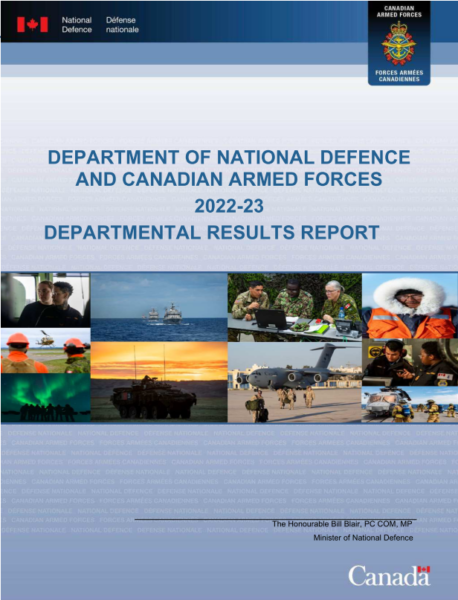
And Blair’s assessment was comparatively rosy when compared to the Department of National Defence’s annual departmental results report.Click image to download the PDF version
The 152-page document, which dropped earlier this month, painted a picture of a Canadian military that is hemorrhaging personnel and capability with no end in sight.
Among the highlights is a table indicating the “percentage of operations that are capable of being conducted concurrently”. Last year it was 100 per cent, but right now it’s plunged to a meagre 40 per cent.
“The CAF is currently unable to conduct multiple operations concurrently,” reads a footnote, adding that military readiness has been hit hard by “decreasing number of personnel and issues with equipment and vehicles”.
Recruiting is suffering an “applicant crisis”. There’s a shortage of “qualified aircraft technicians”. The military’s bases are in serious deterioration because they can’t afford “maintenance and repair”. Only about 40 per cent of the RCAF is operational due to “ongoing personnel shortages” and “inadequate maintenance infrastructure”.
It wasn’t too long ago that another defence minister, Anita Anand, was openly musing about raising Canada’s defence budget to the point where it would finally start meeting NATO’s minimum threshold for military spending.
November 21, 2023
Centaur | Tank Chats #172 | The Tank Museum
The Tank Museum
Published 28 Jul 2023Join David Willey as he tells the complex story of how the Centaur and its sister vehicles were developed when the need for a new cruiser tank emerged.
(more…)


