
The Korean War by Indy Neidell
Published 25 Jun 2024Despite the fact that there have been clear signs that they might soon invade South Korea, when the North actually does in force on June 25th, 1950, it comes as a complete shock to the world. But is this a full invasion, or just cross border raids such as there were in 1949? And is there something more behind this? Stalin’s Soviets? Mao’s Chinese? And how will the world react? Find out this week as our week by week coverage of the war begins!
(more…)
June 26, 2024
The Korean War Begins – Week 1 – June 25, 1950
Comments Off on The Korean War Begins – Week 1 – June 25, 1950
Why the Allies Lost The Battle of France
Real Time History
Published Mar 1, 2024In May 1940, Nazi Germany attacks in the West. The Allied armies of France, Britain, Belgium, and the Netherlands have more men, guns, and tanks than the Germans do – and the French army is considered the best in the world. But in just six weeks, German forces shock the world and smash the Allies. So how did Germany win so convincingly, so fast?
(more…)
Comments Off on Why the Allies Lost The Battle of France
June 25, 2024
“Nigel Farage’s sin […] was to tell the truth which our rulers and their bought, sycophantic media are desperate to hide from us”
As the British general election rumbles into its final days, most media outlets reacted very strongly to Nigel Farage’s willingness to break with the narrative over the outbreak of the Russo-Ukrainian war:

Nigel Farage has really got the elites and their prostitute mainstream media panicking, this time by being the only politician who dares tell the truth about the origins of the Russia-Ukraine war.
First let me stress that I am not condoning Putin’s invasion of Ukraine. But Putin has made it very clear for at least the last 15 years that he saw Ukraine and Georgia, which both have long borders with Russia, joining Nato as an existential threat to his country and warned “not an inch eastwards”.
The West arrogantly ignored Putin’s warnings. That was dumb.
At a conference in April 2008, where Putin was invited to address Nato leaders, he warned that inviting Ukraine and Georgia to join Nato, and thus parking Nato troops and missiles directly on Russia’s borders, would be seen as an existential threat to Russia’s security. This was even reported in the BBC’s in-house rag, the Guardian, on April 4 2008: “The Russian president, Vladimir Putin, today repeated his warning that Moscow would view any attempt to expand Nato to its borders as a ‘direct threat'”.
In December 2021, Putin yet again warned the West that allowing Ukraine and Georgia to join Nato would be unacceptable, in the first minute of this three-minute video. In this video Putin (sensibly in my opinion) asks whether the US would allow Russian troops and missiles to be positioned along its borders with Canada or Mexico and reiterates his “not an inch eastwards” threat.
Yet in January 2022, the US presented its written response to Russian demands on Ukraine not joining Nato and on Nato troops being withdrawn from Romania and Bulgaria, but made clear that it did not change Washington’s support for Ukraine’s right to pursue Nato membership, the most contentious issue in relations with Moscow.
The reply, which was delivered to the Russian Foreign Ministry by the US ambassador in Moscow, John Sullivan, repeated the US offer to negotiate with Russia over some aspects of European security, but the Secretary of State, Antony Blinken, said the issue of eventual Ukrainian membership of the alliance was one of principle.
Blinken was speaking hours after his Russian counterpart, Sergei Lavrov, threatened “retaliatory measures” if the US response did not satisfy the Kremlin.
“Without going to the specifics of the document, I can tell you that it reiterates what we said publicly for many weeks, and in a sense for many, many years. That we will uphold the principle of Nato’s open door”, Blinken said, adding: “There is no change. There will be no change.”
Comments Off on “Nigel Farage’s sin […] was to tell the truth which our rulers and their bought, sycophantic media are desperate to hide from us”
June 24, 2024
History Summarized: Augustus Versus Antony
Overly Sarcastic Productions
Published Apr 6, 2018Now that Caesar’s assassins are out of the picture, which would-be dictator will defeat the other to become the sole-ruler of Rome? In today’s episode of “How Long Before There’s Another Civil War?”: Not a lot … honestly not a very long time … BUT THEN WE GET THE ROMAN EMPIRE WOOOOOOOOO~~~
Comments Off on History Summarized: Augustus Versus Antony
QotD: Raid warfare on the Eurasian Steppes and on the Great Plains
The other strategic aim nomads might fight over is for the acquisition of some kind of movable good, which is to say raiding for stuff. Because all of the warriors (which is generally to say all of the free adult males) of these societies are mounted and because they have a subsistence system which allows rapid, relatively along distance movements (often concealed; remember that Mongols need not light any camp fires), nomads make fearsome raiders, able to strike, grab the things they are looking for and quickly retreat before a counterattack can be mobilized. That goes just as well for raiding each other as it does for raiding the farmers at the edges of the grasslands.
But what are the things here that they are aiming to get? It depends on the targets; nomadic raids into the settled zone generally aim to capture the goods that agrarian societies produce which nomadic societies do not: stocks of cereal crops, metal goods and luxury goods. But most nomadic raiding was directed against other nomads, seeking to acquire either people or animals.
On the Great Plains, the animals in question were invariably horses; the act of stealing, or “cutting out” a horse gives McGinnis part of the title of his book (Counting Coup and Cutting Horses) and raids for horses dominate both McGinnis and Secoy’s discussion of Plains Native American warfare. Horses were, after all, a scarce commodity which only percolated into the Great Plains from the South (and which could only be raised in quantity in its southern reaches), but which all tribes required both to hunt and fight effectively. Stealing enemy horses thus both strengthened your tribe while weakening your enemies, both in military and subsistence terms. The Mongols also engaged in quite a lot of raiding for horses, but also – in a pastoral subsistence system – a lot of simple cattle rustling as well (e.g. Ratchnevsky, op. cit., 28-31).
Raiding for people is more complex, but undeniably part of this system of warfare. But crucially this raiding was generally not for slave-trading (though there are exceptions which I discussed last time), but instead incorporative raiding. What I mean by that is that the intent in gaining captives in the raid was to incorporate those captives, either as full or subordinate members, into the nomadic community doing the raiding. Remember: the big tribe is the safe tribe, so incorporating new members is a good way to improve security in the long run.
On the Eurasian Steppe, incorporated captives became the ötögus bo’ol “bonded serfs” that we mentioned previously (Ratchnevsky, op. cit., 12-4). Unlike warfare on the Great Plains, it seems possible for the bo’ol to include adult men, either captured or sold (by destitute parents) as children or else taken as prisoners when their tribe or clan was essentially dissolved by being conquered in war. Indeed, in his own conquests, Chinggis only decreed the annihilation of one tribe, the Mongols’ traditional enemies, the Tatars – there he ordered the death of any Tatar male taller than the linchpin of an oxcart (May, Mongols, 12). In other cases, it is clear that the incorporation of defeated nomad warriors into the successful tribe was fairly normal, though raids to capture women and children (also for incorporation) were just as common. Bride abduction in particular was very common on the Steppe, as Ratchnevsky notes (op. cit., 34-5).
The incorporation of males was far less common in Great Plains Native American warfare, but the capture of women and children to enhance tribal strength in the long term was a core objective in raiding. McGinnis (op. cit., 42-3) notes how the Crow, after suffering a massive defeat in the early 1820s which resulted in the deaths of many warriors and the capture of perhaps several hundred women and children, steadily built their tribe back up over the following decades with an intentional strategy of capturing women and children from their enemies. As McGinnis (op. cit., 24) notes, women captured in this way might be married into the capturing tribe, adopted into it, or sometimes kept as an enslaved laborer (under quite bad conditions). Adult males, by contrast, were almost always killed; unlike on the Steppe, the incorporation of formerly hostile warriors doesn’t seem to have been considered possible (though one wonders if this would have become cultural practice given enough time; both McGinnis and Secoy note how the increasing lethality of warfare post-gun/horse led to slow population decline overall, which may, had the system run without outside interference long enough, led to the emergence of norms more closely resembling the Eurasian Steppe. We should keep in mind that the Eurasian horse-system had many centuries to sort itself out, whereas the North American horse-system was essentially strangled in its crib).
Of course, taken together with the previous discussion of territorial warfare, we can see that all of these raids have a double purpose: they both aim to acquire resources (horses, sheep, humans) and at the same time inflict damage on an opponent with the long-term goal of forcing that enemy to move further away, opening their pastures or hunting grounds for exploitation by the victorious tribe. Thus in the long-term, each successful raid is intended to build a sense of threat which eventually results in territorial gains (though in cases of real power asymmetry, the long term could come very rapidly; people aren’t stupid and if you are being raided by a clearly superior opponent, you are likely to move on before you lose everything of value).
Squaring the ugly reality of nomadic raiding with [George R.R.] Martin’s depiction [of his nomadic Dothraki] is tricky. On the one hand, a raid in which exceptional victory results in enemy women and children taken captive and fit adult males slain fits within either the Great Plains Native American or Steppe nomad military tradition. On the other hand, the immediate declaration by Drogo’s men that female captives taken this way are not marriageable (AGoT, 559; the idea is treated as laughable) and the killing of all of the very valuable livestock (which, even if the Dothraki are not herdsmen, these animals could be eaten, or quite easily driven to a place where they could be sold or traded for other resources, like metalwork) suggests that Martin has not understood why those raids happened. Instead, it seems like his imagination is only able to view these raids from the perspective of the settled people on the receiving end.
Instead, Martin’s understanding of Native American warfare seems not conditioned by any actual Native Americans, but rather by Hollywood depictions of Native Americans during the Hollywood “Golden Age” which were in turn conditioned by sensational accounts of Western settlers who themselves didn’t understand how Native American warfare worked on the Great Plains. As we will see, the Game of Thrones showrunners took that unfortunate subtext when making the show itself, and turned it into actual text.
Bret Devereaux, “Collections: That Dothraki Horde, Part IV: Screamers and Howlers”, A Collection of Unmitigated Pedantry, 2021-01-08.
Comments Off on QotD: Raid warfare on the Eurasian Steppes and on the Great Plains
June 23, 2024
Okinawa Ends – WW2 – Week 304 – June 22, 1945
World War Two
Published 22 Jun 2024Mitsuru Ushijima’s forces are defeated and the Battle of Okinawa is officially over. However, since most of the Japanese fought to the death, victory comes at a bloody cost – over 50,000 US casualties and over 100,000 Japanese and also possibly that many Okinawan deaths. The fight on North Borneo continues, there’s a raid on Wake Island, and the Japanese powers that be meet to actually discuss making some sort of peace with the Allies.
00:00 Intro
01:25 Truman And The Interim Committee
05:00 Battle Of Okinawa
08:06 The End Of Okinawa
13:22 Raid On Wake Island
14:23 Battle Of North Borneo
15:33 Hirohito Wants Peace
16:54 Conclusion
(more…)
Comments Off on Okinawa Ends – WW2 – Week 304 – June 22, 1945
June 22, 2024
The End of Everything
In First Things, Francis X. Maier reviews Victor Davis Hanson’s recent work The End of Everything: How Wars Descend into Annihilation:
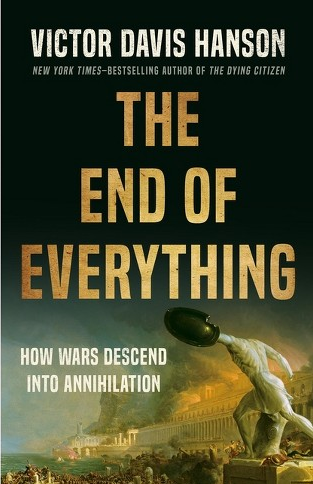
A senior fellow in military history and classics at Stanford University’s Hoover Institution, Hanson is a specialist on the human dimension and costs of war. His focus in The End of Everything is, as usual, on the past; specifically, the destruction of four great civilizations: ancient Thebes, Carthage, Constantinople, and the Aztec Empire. In each case, an otherwise enduring civilization was not merely conquered, but “annihilated” — in other words, completely erased and replaced. How such catastrophes could happen is the substance of Hanson’s book. And the lessons therein are worth noting.
In every case, the defeated suffered from fatal delusions. Each civilization overestimated its own strength or skill; each misread the willingness of allies to support it; and each underestimated the determination, strength, and ferocity of its enemy.
Thebes had a superb military heritage, but the Thebans’ tactics were outdated and their leadership no match for Macedon’s Alexander the Great. The city was razed and its surviving population scattered. Carthage — a thriving commercial center of 500,000 even after two military defeats by Rome — misread the greed, jealousy, and hatred of Rome, and Roman willingness to violate its own favorable treaty terms to extinguish its former enemy. The long Roman siege of the Third Punic War saw the killing or starvation of 450,000 Carthaginians, the survivors sold into slavery, the city leveled, and the land rendered uninhabitable for a century.
The Byzantine Empire, Rome’s successor in the East, survived for a millennium on superior military technology, genius diplomacy, impregnable fortifications, and confidence in the protection of heaven. By 1453, a shrunken and sclerotic Byzantine state could rely on none of these advantages, nor on any real help from the Christian West. But it nonetheless clung to a belief in the mantle of heaven and its own ability to withstand a determined Ottoman siege. The result was not merely defeat, but the erasure of any significant Greek and Christian presence in Constantinople. As for the Aztecs, they fatally misread Spanish intentions, ruthlessness, and duplicity, as well as the hatred of their conquered “allies” who switched sides and fought alongside the conquistadors.
The industrial-scale nature of human sacrifice and sacred cannibalism practiced by the Aztecs — more than 20,000 captives were ritually butchered each year — horrified the Spanish. It reinforced their fury and worked to justify their own ferocious violence, just as the Carthaginian practice of infant sacrifice had enraged the Romans. In the end, despite the seemingly massive strength of Aztec armies, a small group of Spanish adventurers utterly destroyed Tenochtitlán, the beautiful and architecturally elaborate Aztec capital, and wiped out an entire culture.
History never repeats itself, but patterns of human thought and behavior repeat themselves all the time. We humans are capable of astonishing acts of virtue, unselfish service, and heroism. We’re also capable of obscene, unimaginable violence. Anyone doubting the latter need only check the record of the last century. Or last year’s October 7 savagery, courtesy of Hamas.
The takeaway from Hanson’s book might be summarized in passages like this one:
Modern civilization faces a toxic paradox. The more that technologically advanced mankind develops the ability to wipe out wartime enemies, the more it develops a postmodern conceit that total war is an obsolete exercise, [assuming, mistakenly] that disagreements among civilized people will always be arbitrated by the cooler, more sophisticated, and more diplomatically minded. The same hubris that posits that complex tools of mass destruction can be created but never used, also fuels the fatal vanity that war itself is an anachronism and no longer an existential concern—at least in comparison to the supposedly greater threats of naturally occurring pandemics, meteoric impacts, man-made climate change, or overpopulation.
Or this one:
The gullibility, and indeed ignorance, of contemporary governments and leaders about the intent, hatred, ruthlessness, and capability of their enemies are not surprising. The retreat to comfortable nonchalance and credulousness, often the cargo of affluence and leisure, is predictable given unchanging human nature, despite the pretensions of a postmodern technologically advanced global village.
I suppose the lesson is this: There’s nothing sacred about the Pax Americana. Nothing guarantees its survival, legitimacy, comforts, power, or wealth. A sardonic observer like the Roman poet Juvenal — were he alive — might even observe that today’s America seems less like the “city on a hill” of Scripture, and more like a Carthaginian tophet, or the ritual site of child sacrifice. Of course, that would be unfair. A biblical leaven remains in the American experiment, and many good people still believe in its best ideals.
Comments Off on The End of Everything
The Curious Case of Hitler’s Corpse – War Against Humanity 136
World War Two
Published 21 Jun 2024Joseph Stalin claims that Adolf Hitler managed to escape Berlin and is now living somewhere in hiding. It’s complete nonsense of course. But it raises some interesting questions. What remains do we have of Hitler? How do we know they belong to the Fuhrer? And, why is Stalin spreading these far-fetched lies?
(more…)
Comments Off on The Curious Case of Hitler’s Corpse – War Against Humanity 136
Why and when did the Romans start wearing different clothing and armor?
Maiorianus
Published Mar 5, 2024
Comments Off on Why and when did the Romans start wearing different clothing and armor?
June 20, 2024
The birth of para-rescue
At The War Room, Dr. Robert Lyman discusses an air crash in 1943 and the innovative and daring rescue of the survivors using parachutes:
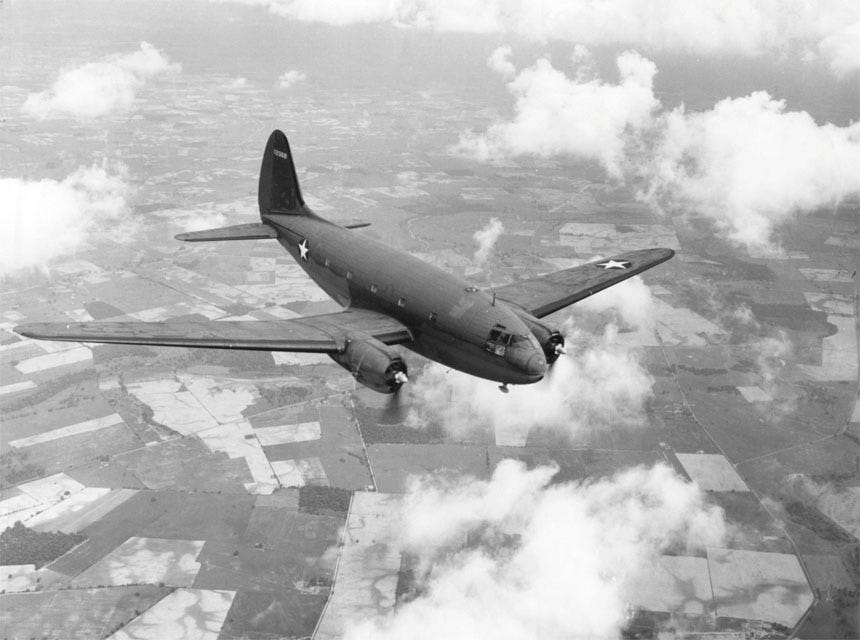
A United States Army Air Force (USAAF) C46 similar to that of Flight 12420.
The birth of para-rescue can be placed in operations across the Hump airlift in 1942 and 1943. The story of the crash of Flight 12420 was a central part of the story.
The story itself is extraordinary. In 1943 a Soviet spy inside the predecessor organization to the CIA and a proud descendant of the famous Southern leader General Robert E Lee, on his way to China to meet General Dai Li, the mysterious and secretive Kuomintang intelligence chief; a celebrated American journalist sent by President Roosevelt to ascertain the “truth about China”; and General “Vinegar Joe” Stilwell’s political adviser; together with eighteen others — American and Chinese — survived a C46 air crash on the mountainous and remote border between India and Burma. It was, and remains, the largest evacuation of an aircraft by parachute, and, given the fact that even the crew had never been trained in the technique, it was a miracle that so many survived. But they fell with their crippled plane from the frying pan into the fire. On disentangling themselves from their parachutes, the twenty shocked survivors soon found that they had arrived in wild country dominated by a tribe that had an especial reason to hate white men. The Nagas of the Patkoi Hills on their remote and unsurveyed land were notorious headhunters, who continued — despite the feeble wrath of distant British imperial authority — to practice both slavery and human sacrifice. Their specialty was the removal of the heads of their enemies — often women and children — achieved with a swipe of ugly, razor-sharp daos. On two occasions in recent years their village, or parts of it, had been burned to the ground and their warriors killed in running battles with sepoys sent to teach the villagers a lesson and to exert the authority of the Raj.
Nevertheless, and against all the odds, all but one of the twenty-one passengers and crew on the doomed aircraft survived. The story of the extraordinary adventure of those men among the Nagas of Pangsha and of their rescue by the young representative of the distant imperial power, the British deputy commissioner who arrived wearing “Bombay bloomers” and stout leather walking shoes, carrying a bamboo cane, and leading an armed party of “friendly” Nagas, is told in my book Among the Headhunters. In their meeting in some of the world’s most inaccessible and previously unmapped terrain, three very different worlds collided. The young, exuberant apostles of the vast industrial democracy of the United States came face-to-face with members of an ancient mongoloid race, uncomprehending of the extent of modernity that existed beyond the remote hills in which they lived and determined to preserve their local power, based on ancient head-hunting and slaving prerogatives. Both groups met — not for the first time for the Nagas, whose village had been burned twice, in 1936 and 1939, because of persistent head-hunting — the vestiges of British authority in India, disintegrating as the Japanese tsunami washed up at its gate.
One of the reasons for the survival of the men whose aircraft fell to earth that tumultuous day was the quick thinking, rapid action and spontaneous sacrifice of a group of US servicemen at the airbase from whence the aircraft departed that morning, Chabua. One in particular needs calling out, thirty-six-year-old ATC wing surgeon Lieutenant Colonel Don Flickinger. He had been duty medical officer at Pearl Harbor during the Japanese attack on December 7, 1941 and in 1943 found himself stationed in the upper reaches of Assam as part of the mammoth Hump airlift to China.
On the day the C46 went down over the rugged Paktoi ranges, the dividing line between astern India and Burma in the first leg of the journey to China, a C47 sent up to see if it could find the wreckage, and found the survivors waving from a remote village high in the hills. Using ground signalling panels the C47 dropped to the survivors they indicated that at least one of the party was badly injured. When the C47 returned to Chabua with the news that survivors were seen in the sprawling village and its location pinpointed on the map, the British deputy commissioner gave the Americans the grave news that the men were likely to be in grave danger. The villagers were, unknown to the survivors, the most practised headhunters of the region, a powerful and unruly tribe who were notorious for their violence. It was unlikely that the men would survive the encounter.
Comments Off on The birth of para-rescue
Canadian Armed Forces – Snow Machines
Ontario Regiment Museum
Published Mar 7, 2024During the TANK SATURDAY — Winter Warfare event in 2024, we had special guests from the Hussars Military Vehicle Club. They brought their fully restored CAF Arctic equipment to the museum and spoke to our visitors about the history and use of these unique vehicles.
(more…)
Comments Off on Canadian Armed Forces – Snow Machines
QotD: Canadian soldiers of the 1950s and early 1960s
J.L. Granatstein, Canada’s Army, 2002.
Comments Off on QotD: Canadian soldiers of the 1950s and early 1960s
June 19, 2024
Nazi Werwolves: Post War Terror – War Against Humanity 135
World War Two
Published 18 Jun 2024The guns are silent in Germany but the Allied Forces continue to suffer a flurry of bombings, assassinations, and shootings. Who is to blame? Well, the press suspects the Nazi Werwolves – terroristic bands of men, women, and children determined to carry on Hitler’s war. But just how serious is this violence really, and how many of the attackers are true believing Nazi fanatics?
(more…)
Comments Off on Nazi Werwolves: Post War Terror – War Against Humanity 135
Why the US Lost the Tet Offensive Despite Beating the NVA
Real Time History
Published Feb 16, 2024After years of boots on the ground and bloody combat in Vietnam, US officials are publicly confident. The strategy of eliminating the Viet Cong is working. The North Vietnamese communist forces are on their last legs and victory is only a matter of time. Or so they say. But as 1968 and the traditional lunar new year festivities begin, US and South Vietnamese troops find themselves on the receiving end of a formidable North Vietnamese surprise attack: The Tet Offensive.
(more…)
Comments Off on Why the US Lost the Tet Offensive Despite Beating the NVA
June 16, 2024
Mao Tightens His Grip – WW2 – Week 303 – June 15th, 1945
World War Two
Published 15 Jun 2024After several weeks of the Congress of the Chinese Communist Party, Mao Zedong’s power has consolidated to the point that it is absolute. All pledge loyalty Mao, and his infallibility shall not be questioned. Meanwhile the war goes on in the field with Australian landings on Brunei, continuing fighting on Okinawa, and the last part of Europe — in the Netherlands — liberated from Axis control.
(more…)
Comments Off on Mao Tightens His Grip – WW2 – Week 303 – June 15th, 1945


