
The Great War
Published on 7 Oct 2017Chair of Wisdom Time! This week we talk about the advancements of electricity during the war, the Wright brothers patent wars and hip/shoulder firing MGs. Oh and Italian Spiderman.
October 8, 2017
Electricity – Wright Brothers – Hip Firing MGs I OUT OF THE TRENCHES
Comments Off on Electricity – Wright Brothers – Hip Firing MGs I OUT OF THE TRENCHES
QotD: Excess officers
Excess? The German Army of WW II somehow managed to fight off for six years – that, or beat the ever loving crap out of – nearly the whole world with under three percent commissioned officers. Roman legions, perhaps the most formidable fighting machines of human history, got by with six to eight. Six to eight percent? Not on your life; six to eight, period, six military tribunes, a legate, and – arguably – the praefectus castrorum, who was more in the line of a late entry officer, as per the British system. Think about that one, one officer per every eight hundred men. And it was plenty.
What have we got? As of 2013 we had over eleven percent commissioned in the Marine Corps, seventeen percent in the Navy, almost nineteen percent in the Army, and nearly twenty percent of strength being commissioned officers in the Air Force.
The problems with having this many officers are multifold. I can only cover some of the more important ones.
This high a percentage of officers almost certainly means that there are people running around with bars and leaves and even eagles and perhaps stars who probably should have been non-coms. They may have the education and intelligence to be officers, but as a matter of attitude, outlooks, values, and approaches to things, they’d have been happier if they’d been wearing multiple stripes. I used to see a lot of this among lieutenants who decided to go Special Forces. In almost every case I have seen, these were guys who really wanted to be squad leaders which, in SF, they could be. The effect of commissioning so high a percentage of people has tended to be having an NCO corps weaker than it should have been and weaker than it needs to be. This tends to exacerbate another problem, officers will tend to micromanage if they’re allowed to. They will be allowed to, if there is a common perception that the NCO corps needs to be micromanaged, which, because some numbers actually do need to be micromanaged, casts them all in a questionable light in some circles. There’s another reason, one having little or nothing whatsoever to do with NCOs, for that kind of micro-management.
Tom Kratman, “There Are No Bad Regiments…”, Everyjoe.com, 2015-10-12.
Comments Off on QotD: Excess officers
October 6, 2017
Sabotage In The Desert – Battle of Broodseinde I THE GREAT WAR Week 167
The Great War
Published on 5 Oct 2017While the regular British forces were advancing towards Jerusalem and Baghdad, T.E. Lawrence and the Arab Revolt were causing havoc behind the lines. This week 100 years ago, they were continuing to attack the important Hejaz railway which was one of the vital supply routes for the Ottoman Army. On October 4, the Battle of Broodseinde was fought near Ypres and the costly British victory there caused real headaches for German general Erich Ludendorff.
Comments Off on Sabotage In The Desert – Battle of Broodseinde I THE GREAT WAR Week 167
October 5, 2017
The greatest general you’ve probably never heard of
I missed this article when it was posted in September: Iskander Rehman discusses the life and times of Byzantium’s greatest general, Belisarius:
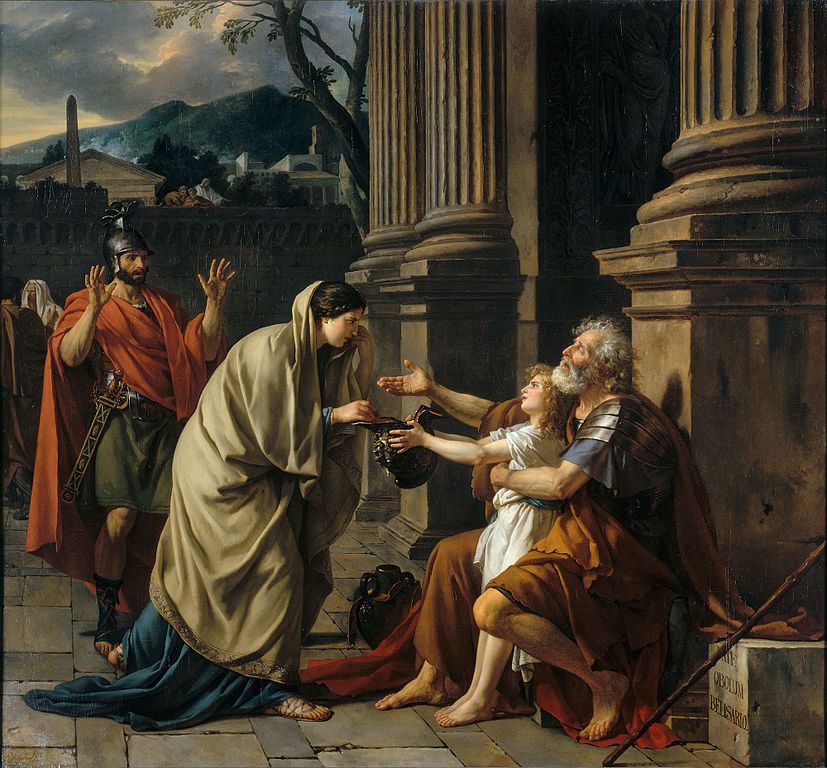
Belisarius begging for alms. Painting by Jacques-Louis David, 1781.
(Via Wikimedia)
In 1780, the great neoclassical painter Jacques-Louis David completed one of his finest works. Entitled “Belisarius Begging for Alms,” the oil painting depicts an aging warrior, blinded with a hand outstretched, seated at the base of a colossal Roman monument. His feet are bare, his beard unkempt, and his armor draped in coarse rags, dull in sheen. A slender walking cane rests to his side, propped against a stone slab bearing the name of a famous former general — Belisario, or Belisarius. A beautiful woman, her face etched in concern, drops a few coins into an upturned helmet, and whispers words of consolation. Her husband, a man in the vigor of youth and full military regalia, is in shock, his arms raised and his mouth open. He has just realized that the stricken veteran is his former commander, the legendary Belisarius himself.
Although his name is not as well known as it once was, Belisarius has long been considered one of history’s finest tacticians. Under the orders of the Byzantine emperor Justinian I, the sixth century general reclaimed vast tracts of Western Roman territory, from northern Africa to the Italian peninsula. Frequently outnumbered and leading an eclectic grouping of warriors composed of romaioi (Eastern Romans), foederati (Barbarian allies), and ethnikoi (specialist ethnic troops), the Thracian commander greatly expanded the footprint of the Byzantine empire at a time when many thought that Rome’s ancestral lands had been irredeemably lost. The fact that many of these conquests, as we shall see, only proved fleeting, has, if anything, only burnished his myth, transmogrifying the soldier into something of a crepuscular icon — Western Europe’s last great Roman protector before the advent of the so-called Dark Ages.
For Liddell Hart, Belisarius was also the consummate practitioner of the so-called “indirect approach” and the “master of the art of converting his weakness into strength; and the opponent’s strength into a weakness.” T.E. Lawrence, an avid reader of the ancient military classics, considered “the Thracian genius” to be one of “three really first-class Roman generals in history” (the other two being Scipio Africanus and Julius Caesar) and encouraged his friend, Robert Graves, to write the novel Count Belisarius. This piece of historically informed fiction retraces Belisarius’s military campaigns and was much admired by Winston Churchill, who is said to have often turned to it for guidance during the fraught early years of World War II.
Who was the man behind the myth? And why do the tales of Belisarius’s life and military exploits continue to resonate, firing the imaginations of great men from David to Churchill and Lawrence of Arabia? What insights can be gleaned, not only from his campaigns, but from the Eastern Roman Empire’s strategic literature more broadly?
Comments Off on The greatest general you’ve probably never heard of
October 4, 2017
Initial finding of gender-integrated infantry unit study
Duffelblog is your source for what’s going on in the US military:
A recent Department of Defense study on infantry units revealed that gender-integrated units smelled 237% better than non-integrated units.
“We set out to measure combat effectiveness of course, but the smell issue quickly took precedence as our female survey administrators noticed how much better it smelled in the integrated unit workspaces,” said Dr. Anthony Jenkins, study coordinator.
“The non-integrated units smelled like ass, BO, feet and beer,” said researcher Sienna Smith. “At the integrated sites, however, it smelled like a combination of Old Spice, Axe and wintergreen mouthwash, with a curious hint of Twilight Woods and Japanese Cherry Blossom body wash.”
Male unit members denied any changes in habits that could have led to the differences, though one was seen kicking a bottle of body spray under his rack as the research team inspected living spaces.
“Nah man, I mean Ma’am, I ain’t changin’ my style just cause we got girls around now. It’s probably all their scented lotions and soap and junk that you smell,” said Cpl. Juan Suarez.
Comments Off on Initial finding of gender-integrated infantry unit study
TANKFEST 2017 – Behind the Scenes with The Mighty Jingles
Tank Museum
Published on 3 Oct 2017See the best display of historic moving armour in the world, 29 June – 1 July, at The Tank Museum, Bovington. Tickets for TANKFEST 2018 are now on sale. www.tankfest.com
Youtuber The Mighty Jingles went behind the scenes at TANKFEST 2017 to meet the people who make TANKFEST work.
Comments Off on TANKFEST 2017 – Behind the Scenes with The Mighty Jingles
British Boys Anti-Tank Rifle
Forgotten Weapons
Published on 24 Aug 2015http://www.patreon.com/ForgottenWeapons
Hammer Price: $3,750
Pretty much every major military had an antitank rifle in service when WW2 kicked off, and the British example was the Boys rifle, named after the Captain Boys who designed it. It was a bolt action .55 caliber rifle with 5-round detachable magazines. If was obsolete by 1943 and replaced by the more effective but equally unpleasant PIAT.
Comments Off on British Boys Anti-Tank Rifle
October 3, 2017
Between Gulasch Barons and Defending Neutrality – Denmark in WW1 I THE GREAT WAR Special
The Great War
Published on 2 Oct 2017Denmark, Germany’s northern neighbour, declared neutrality when World War 1 broke out. But after the defeat against Germany in the 19th century, they were still worried and readied their defences. At the same time Germany’s hunger for supplies created a new rich elite which were called Gulasch Barons. 30,000 Danes also fought for Germany since they lived in a territory previously belonging to Denmark.
Comments Off on Between Gulasch Barons and Defending Neutrality – Denmark in WW1 I THE GREAT WAR Special
October 2, 2017
QotD: Maxims 61-70 of Maximally Effective Mercenaries
61. Don’t bring big grenades into small rooms.
62. Anything labelled “This end toward enemy” is dangerous at both ends.
63. The brass knows how to do it by knowing who can do it.
64. An ounce of sniper is worth a pound of suppressing fire.
65. After the toss, be the one with the pin, not the one with the grenade.
66. Necessity is the mother of deception.
67. If you can’t carry cash, carry a weapon.
68. Negotiating from a position of strength does not mean you shouldn’t also negotiate from a position near the exits.
69. Sometimes rank is a function of firepower.
70. Failure isn’t an option. It’s mandatory. The option is whether or not to let failure be the last thing you do.“Link Weimar” (aka Howard Tayler), Seventy Maxims of Maximally Effective Mercenaries: 301st Anniversary Annotated Edition, 2017.
Comments Off on QotD: Maxims 61-70 of Maximally Effective Mercenaries
October 1, 2017
Recap Of Our Trip To Italy and Slovenia I THE GREAT WAR
The Great War
Published on 30 Sep 2017Kobarid Museum: http://kobariski-muzej.si
Walk of Peace: http://www.potmiru.si/eng/
Lagazuoi: https://www.altabadia.org/en/summer-holidays/trekking-hiking/open-air-museum-lagazuoi-5-torri-1.html
Vittorio Veneto: http://www.museivittorioveneto.gov.it/en/museo_della_battaglia.html
La Baita: http://bit.ly/LaBaitaColDiLana
Indy and Flo make you jealous by telling you what you missed when we all went to Slovenia and Italy last week.
Comments Off on Recap Of Our Trip To Italy and Slovenia I THE GREAT WAR
QotD: Maxims 51-60 of Maximally Effective Mercenaries
51. Let them see you sharpen the sword before you fall on it.
52. The army you’ve got is never the army you want.
53. The intel you’ve got is never the intel you want.
54. It’s only too many troops if you can’t pay them.
55. It’s only too many weapons if they’re pointing in the wrong direction.
56. Infantry exists to paint targets for people with real guns.
57. Artillery exists to launch large chunks of budget at an enemy it cannot actually see.
58. The pen is mightiest when it writes orders for swords.
59. Two wrongs is probably not going to be enough.
60. Any weapon’s rate of fire is inversely proportional to the number of available targets.“Link Weimar” (aka Howard Tayler), Seventy Maxims of Maximally Effective Mercenaries: 301st Anniversary Annotated Edition, 2017.
Comments Off on QotD: Maxims 51-60 of Maximally Effective Mercenaries
September 30, 2017
QotD: Maxims 41-50 of Maximally Effective Mercenaries
41. “Do you have a backup?” means “I can’t fix this.”
42. “They’ll never expect this’ means “I want to try something stupid.”
43. If it’s stupid and it works, it’s still stupid and you’re lucky.
44. If it will blow a hole in the ground, it will double as an entrenching tool.
45. The size of the combat bonus is inversely proportional to the likelihood of surviving to collect it.
46. Don’t try to save money by conserving ammunition.
47. Don’t expect the enemy to cooperate in the creation of your dream engagement.
48. If it ain’t broke, it hasn’t been issued to the infantry.
49. Every client is one missed payment away from becoming a target.
50. Let them see you sharpen the sword before you fall on it.Howard Tayler, quoted by Rodney M. Bliss in “New Maxims Revealed For The First Time”, Rodney M. Bliss, 2015-12-18.
Comments Off on QotD: Maxims 41-50 of Maximally Effective Mercenaries
September 29, 2017
Battle of Polygon Wood – Betrayal At The Italian Front I THE GREAT WAR Week 166
The Great War
Published on 28 Sep 2017The British and Australian forces under Sir Herbert Plumer continue to advance at Passchendaele. Plumer’s new tactic comes with a high price in men and material but it also gets results. German flying ace Werner Voss fights his last legendary fight and on the Italian Front, some Austro-Hungarian officers want to end the war sooner than later – and not in their countries’ favour.
Comments Off on Battle of Polygon Wood – Betrayal At The Italian Front I THE GREAT WAR Week 166
QotD: Maxims 31-40 of Maximally Effective Mercenaries
31. Only cheaters prosper.
32. Anything is amphibious if you can get it back out of the water.
33. If you’re leaving tracks, you’re being followed.
34. If you’re leaving scorch-marks, you need a bigger gun.
35. That which does not kill you has made a tactical error.
36. When the going gets tough, the tough call for close air support.
37. There is no ‘overkill.’ There is only ‘open fire’ and ‘I need to reload.’
38. Just because it’s easy for you doesn’t mean it can’t be hard on your clients.
39. There is a difference between spare parts and extra [parts].
40. Not all good news is enemy action.Howard Tayler, quoted by Rodney M. Bliss in “New Maxims Revealed For The First Time”, Rodney M. Bliss, 2015-12-18.
Comments Off on QotD: Maxims 31-40 of Maximally Effective Mercenaries
September 28, 2017
More than you want to know about the Panzer III
Lindybeige
Published on 8 Jun 2017Panzer IIIs were common German tanks in WW2, and here I talk about them, and make a few general points.
Another video (there will be more) from ‘The Tank Museum’ at Bovington. Why they changed the name is beyond me. I’d like to meet the branding guru who came up with that idea and administer several hard slaps. It’s like changing ‘Wimbledon’ to ‘The Tennis Competition’.
Anyway, here, in its particular shade of beige, is the tank (with a brief shot of one of its cousins), and I ramble on about various bits of it. It’s all right for you – you just have to watch it once, but I had to edit this, which involves seeing each bit several times, and wading through all the footage of me droning on and on.
I use the word ‘burn’ to describe a H.E.A.T. round’s penetrating a tank, and as several people have pointed out, this is not technically the correct word. They are right, although the word is often used in this context, and the temperatures involved are very high, but yes, I admit it: I should not have used the word ‘burn’.
Yes, I am aware that the links on the end plate come in late. This is because YouTube has changed the system, which used to be flexible, to one that relies on limited templates. It doesn’t enable the user to put picture links in except in the last twenty seconds of a video, and so because I added a little shot at the end, the links all start late. Possibly the new system is supposed to be more idiot-resistant than the old one. Unfortunately, this makes it an obstacle for the intelligent.
Here’s a link to the tank museum’s site: http://www.tankmuseum.org/home
Comments Off on More than you want to know about the Panzer III


