
The Great War
Published on 6 Nov 2017Zionism, the movement for the establishment of a Jewish homeland, got new momentum during World War 1. Zionists, like Chaim Weizmann rallied for support in their respective home countries, others wanted to actively advance the zionist idea by taking part in the war and fought with the Jewish Legions. The Balfour Declaration of 1917 was another step towards fulfilling the idea of a home for the Jewish people.
November 7, 2017
Zionism during World War 1 I THE GREAT WAR Special
Comments Off on Zionism during World War 1 I THE GREAT WAR Special
November 6, 2017
Otto von Bismarck – IV: The Iron Chancellor – Extra History
Extra Credits
Published on 4 Nov 2017Bismarck turned up the heat on his long-term plan to unite the German Confederation under Prussian leadership. He allied with Austria to seize a piece of disputed land, then maneuvered them into a war that he decisively won. Even an assassination attempt could not stop him.
Comments Off on Otto von Bismarck – IV: The Iron Chancellor – Extra History
The end of the battle of Passchendaele, 1917
The Canadian Corps under Lieutenant General Arthur Currie began the final phase of the battle on 6 November, 1917:
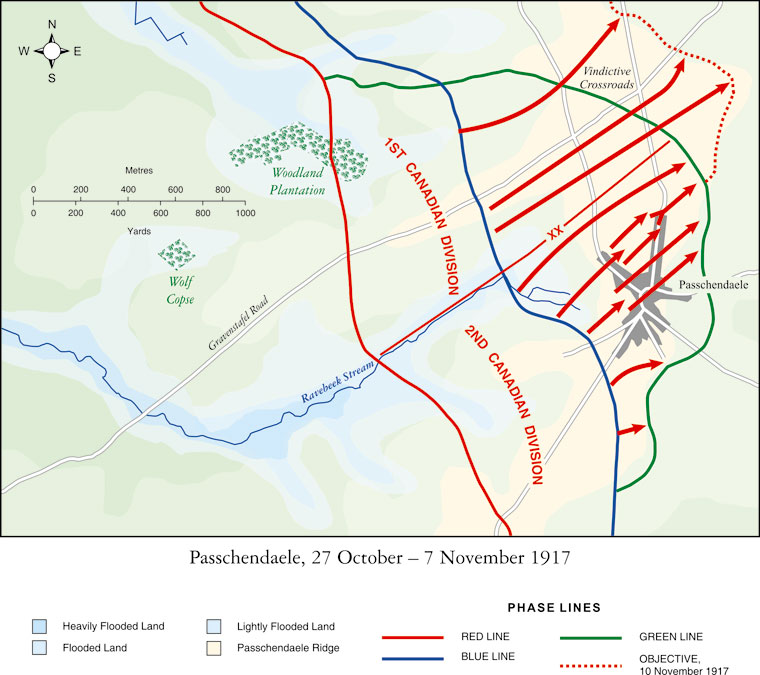
By 6 November, the Canadians were prepared to advance upon the Green Line. The final objective was to capture the high ground north of the town and to secure positions on the eastern side of Passchendaele Ridge. Again, according to Major Robert Massie: “The third attack … was the day when the First and Second Divisions took Passchendaele itself. On this occasion, the attack went off the most smoothly of any of the three. They had fair ground to go over, and especially those that went into Passchendaele itself had pretty fair going, and the objectives were reached on time.”
After early hand-to-hand fighting, the 2nd Division easily occupied Passchendaele just three hours after commencement of the attack at 0600 hours. The 1st Division, however, found itself in some trouble when one company of the 3rd Battalion became cut off and was stranded in a bog. When this situation eventually righted itself, the 1st Division continued toward its objectives. Well-camouflaged tunnels at Moseelmarkt provided an opportunity for the enemy to counterattack, but they were fended off by the Canadians. By the end of the day, the Canadian Corps was firmly in control of both Passchendaele and the ridge.
The final Canadian action at Passchendaele commenced at 0605 hours on 10 November 1917. Sir Arthur Currie used the opportunity to make adjustments to the line, strengthening his defensive positions. Robert Massie summed up the thoughts of many participating Canadians as follows: “What those men did at Passchendaele was beyond praise. There was no protection in that land. They could not get into the trenches which were full of mud, and you would see two or three of them huddled together during the night, lying on ground that was pure mud, without protection of any kind, and then going forward the next morning and cleaning up their job.”
[…]
The Canadians had done the impossible. After just 14 days of combat, they had driven the German army out of Passchendaele and off the ridge. There was almost nothing left of the village to hold. Altogether, the Canadian Corps had fired a total of 1,453,056 shells, containing 40,908 tons of high explosive. Aerial photography verified approximately one million shell holes in a one square mile area. The human cost was even greater. Casualties on the British side totalled over 310,000, including approximately 36,500 Australians and 3596 New Zealanders. German casualties totalled 260,000 troops.
For the Canadians, Currie’s words were prophetic. He had told Haig it would cost Canada 16,000 casualties to take Passchendaele – and, in truth, the final total was 15,654, many of whom were killed. One thousand Canadian bodies were never recovered, trapped forever in the mud of Flanders. Nine Canadians won the Victoria Cross during the battles for Passchendaele. While the human cost had been terrible: “Nevertheless, the competence, confidence, and maturity began in 1915 at Ypres a short distance away, and at Vimy Ridge earlier that spring, again confirmed the reputation of the Canadian Corps as the finest fighting formation on the Western Front.” So wrote esteemed Professor of History Doctor Ronald Haycock at the Royal Military College of Canada for The Oxford Companion to Canadian History in 2004.
Haig proved to be true to his word. By 14 November 1917, the Canadians had been returned to the relative quiet of the Vimy sector. They had not been asked to hold what it had cost them so much to take. However, by March 1918, all the gains made by Canada at Passchendaele would be lost in the German spring offensive known as Operation Michael.
General Sir David Watson praised the Canadian effort: “It need hardly be a matter of surprise that the Canadians by this time had the reputation of being the best shock troops in the Allied Armies. They had been pitted against the select guards and shock troops of Germany and the Canadian superiority was proven beyond question. They had the physique, the stamina, the initiative, the confidence between officers and men (so frequently of equal standing in civilian life) and happened to have the opportunity.”
British Prime Minister David Lloyd George was even clearer when it came to the Canadians: “Whenever the Germans found the Canadian Corps coming into the line they prepared for the worst.”
November 5, 2017
Breakthroughs and Setbacks – Fall 1917 I THE GREAT WAR Summary Part 11
The Great War
Published on 4 Nov 2017The Battle of Passchendaele begins on the Western Front, whilst the climate grows steadily more unstable in Russia, where General Kornilov hopes to seize power. Operation Albion is launched by Germany in the Northeast, and the French enjoy some successes, including at Malmaison. The tide is turned in the Battle of Caporetto. The death toll climbs ever higher, in yet another dark period of the Great War. We cover all this and more in our recap of Fall 1917.
Comments Off on Breakthroughs and Setbacks – Fall 1917 I THE GREAT WAR Summary Part 11
November 3, 2017
Battle of Beersheba – Canadian Frustration – Balfour Declaration I THE GREAT WAR Week 171
The Great War
Published on 2 Nov 2017On the Western Front this week, the Canadians under Sir Arthur Currie attempt to advance once more, whilst Haig remains optimistic about an imminent breakthrough. Following Caporetto, the Italian retreat continues, whilst the British Army enjoys success on the Palestine Front, with a little help from mounted ANZAC troops. With Lenin’s return, the revolution looms over the Russian capital, whilst the Balfour Declaration is issued in Britain.
Comments Off on Battle of Beersheba – Canadian Frustration – Balfour Declaration I THE GREAT WAR Week 171
November 2, 2017
The Short-Lived No1 Mk6 SMLE Lee Enfield
Forgotten Weapons
Published on 30 Mar 2017Prototype: Sold for $56,350 – http://jamesdjulia.com/item/1645-396/
Pre-production: Sold for $12,075 – http://jamesdjulia.com/item/1646-396/
No1 Mk6: Sold for $12,075 – http://jamesdjulia.com/item/1650-396/
No4 Mk1: Sold for $5,750 – http://jamesdjulia.com/item/1658-396/The SMLE No1 Mk3 was the iconic British infantry rifle of World War 1, but not the final evolution of the Lee Enfield design. By World War 2 it had been replaced by the new No4 Mk1 Lee Enfield, and this is the story of the interim models.
At the end of WW1, the British recognized several areas where the SMLE could be improved: a heavier barrel, a lighter bayonet, and aperture sights. This led to the development of the No1 Mk5 rifle (the Mk4 being a designation for a .22 rimfire training variation), with 20,000 examples made for troop trials in the mid 1920s. The Mk5 was well received by troops, with its rear-mounted aperture sight being seen as a substantial improvement over the previous tangent notch sight. However, experimentation continued and by 1926 prototypes of a Mk6 rifle were being made.
In 1929 a series of 1000 No1 Mk6 rifles was put into production, which would fit a new style of short and light spike bayonet as well as an improved type of aperture sight. They also featured a very distinctive large area of deep square checkering on the hand guard, intended to improve one’s grip on the rifle during bayonet drill. These rifles were nearly the same as what was ultimately adopted as the new No4 Mk1 rifle – so much so that in 1931 that designation was applied to the rifles and a batch of 2500 more made for trials. These trials rifles were mostly issued out to troops in the aftermath of Dunkirk, making them very scarce to find today, as most did not survive the war. Those that did will sport a new serial number with an “A” suffix to indicate their non-standard parts (in comparison to the production model No4 Mk1. Today were will look at the progressive development of a pre-prototype Mk6, Mk6 rifle number 1, a Mk6 trials rifle, and one of those 2500 trials No4 Mk1 rifles.
Comments Off on The Short-Lived No1 Mk6 SMLE Lee Enfield
October 31, 2017
The adage “When you get a free good, you use a lot more of it” also applies to the military
John Stossel talks to Erik Prince, the founder of Blackwater:
The military uses contractors to provide security, deliver mail, rescue soldiers and more. Private contractors often do jobs well, for much less than the government would spend.
”We did a helicopter resupply mission,” Prince told me. “We showed up with two helicopters and eight people — the Navy was doing it with 35 people.”
I asked, “Why would the Navy use 35 people?”
Prince answered, “The admiral that says, ‘I need 35 people to do that mission,’ didn’t pay for them. When you get a free good, you use a lot more of it.”
Prince also claims the military is slow to adjust. In Afghanistan, it’s “using equipment designed to fight the Soviet Union, (not ideal) for finding enemies living in caves or operating from a pickup truck.”
I suggested that the government eventually adjusts.
”No, they do not,” answered Prince. “In 16 years of warfare, the army never adjusted how they do deployments — never made them smaller and more nimble. You could actually do all the counter-insurgency missions over Afghanistan with propeller-driven aircraft.”
So far, Trump has ignored Prince’s advice. I assume he, like many people, is skeptical of military contractors. The word “mercenary” has a bad reputation.
He moved on after selling Blackwater, and dabbled in fighting piracy:
In 2010, Prince sold his security firm and moved on to other projects.
He persuaded the United Arab Emirates to fund a private anti-pirate force in Somalia. The U.N. called that a “brazen violation” of its arms embargo, but Prince went ahead anyway.
His mercenaries attacked pirates whenever they came near shore. His private army, plus merchant ships finally arming themselves, largely ended piracy in that part of the world. In 2010, Somali pirates took more than a thousand hostages. In 2014, they captured none.
Did you even hear about that success? I hadn’t before doing research on Prince. The media don’t like to report good things about for-profit soldiers. Commentator Keith Olbermann called Blackwater “a full-fledged criminal enterprise.” One TV anchor called Prince “horrible … the poster child for everything wrong with the military-industrial complex.”
When I showed that to Prince, he replied, “the hardcore anti-war left went after the troops in Vietnam … (I)n Iraq and Afghanistan they went after contractors … contractors providing a good service to support the U.S. military — vilified, demonized, because they were for-profit companies.”
If we don’t use private contractors, he added, we will fail in Afghanistan, where we’ve “spent close to a trillion dollars and are still losing.”
H/T to Stephen Green for the link.
Strategic Bombing on the Western Front I THE GREAT WAR Special
The Great War
Published on 30 Oct 2017Bismarck’s Channel: https://www.youtube.com/user/Bis18marck70/featured
With the development of planes shortly before the Great War, the concept of strategic bombing made its debut in this conflict. Each country had different doctrines with regards to strategic bombing, and in this video we’ll be looking at British, French and German doctrines regarding the bombing of civilian targets and supply lines, as well as considering their effectiveness.
Comments Off on Strategic Bombing on the Western Front I THE GREAT WAR Special
October 30, 2017
Tank Chats #19 Matilda II
Tank Museum
Published on 28 Apr 2016The name Matilda means Strength in Battle from the Germanic roots Maht, meaning strong and Hild meaning battle.
The Matilda was regarded as a superb tank in its day and carved a remarkable career for itself. A few served in France in 1940 but in the early stages of the North African campaign, under General Wavell, it virtually ruled the desert. Even when the Afrika Korps arrived it remained a formidable opponent, immune to everything but the notorious 88mm gun. Its main failings were its slow speed and small gun, which could not be improved.
Comments Off on Tank Chats #19 Matilda II
October 29, 2017
On the Battlefield of Caporetto – Exploring the Kolovrat I THE GREAT WAR Special
The Great War
Published on 28 Oct 2017The Walk of Peace in the Soča Region Foundation
http://www.potmiru.si/Follow Indy and his guide Leon up the heights of the Kolovrat Ridge and into the Italian frontline trenches and bunkers. From there we take a look down towards the Isonzo Valley and reconstruct the advance of the German and Austro-Hungarian forces during the Battle of Caporetto towards Tolmin and Kobarid. Walking through the narrow corridors, we try to understand the conditions in which the defenders lived and fought.
Comments Off on On the Battlefield of Caporetto – Exploring the Kolovrat I THE GREAT WAR Special
October 28, 2017
QotD: Special forces are not a “cheaper” alternative to large, conventional forces
Special Forces are a good tool, and an old one … their origins go all the way back to colonial (mid 18th century) North America when units like Butler’s Rangers and Rogers’ Rangers were formed. The British kept skirmishing troops alive in the form of The Rifles (heirs to the traditions of numerous, famous “rifle” and “light infantry” regiments) and many 21st century Canadian regiments still bear similar titles. Special Forces had a rebirth of sort in World War II when the British made raiding and commando operations into an important tool ~ because they, the Brits, did not have the resources to take the fight to the Germans in Europe in 1941 and ’42. Modern history is full of raiding exploits from Entebbe to the killing of Osama bin Laden and it all encourages penny pinching politicians to believe, incorrectly, that a few Special Forces soldiers can replace battalions and brigades … they cannot, they do not: they are (relatively) narrow specialists who do a few, small things very, very well but cannot conduct major combat operations or even their own specialized tasks for anything like a sustained period.
Canada needs some Special Forces ~ maybe 2,500 is the right number, I do not know. But good Special Forces are always drawn from a large pool of tough, superbly disciplined, well trained sailors, soldiers and aviators. If the government wants to use more and more Special Forces in a variety of roles then it needs, above all, to maintain a large enough, high quality base from which to create and sustain them. Special Forces are part of a modern, combat capable (and, therefore, expensive) military … they are not a low cost replacement for it, no matter what the Liberal Party of Canada might want.
Ted Campbell, “Special Forces”, Ted Campbell’s Point of View, 2017-10-16.
Comments Off on QotD: Special forces are not a “cheaper” alternative to large, conventional forces
October 27, 2017
The ever-shrinking Royal Navy
In The Register, Gareth Corfield suggests that the Ministry is considering flogging off more RN ships to South America to try to balance the budget:
UK Defence Secretary Sir Michael Fallon has denied that vital British warships may be quietly sold to South American nations as part of the ongoing defence review, according to reports.
Helicopter carrier HMS Ocean, already earmarked for sale to Brazil when she is withdrawn from the Royal Navy next year, may be joined by Type 23 frigates, according to respected defence industry magazine Jane’s.
The Type 23s are the backbone of the Royal Navy’s anti-surface and anti-submarine capability. They are the fighting teeth of the RN, used to ward off potentially hostile surface ships and submarines alike.
Current plans are for the new Type 26 frigate to replace the ageing but capable Type 23s. These new ships are set to enter service from the middle of the next decade, with the old leaving service on the (approximate) basis of “one in, one out”.
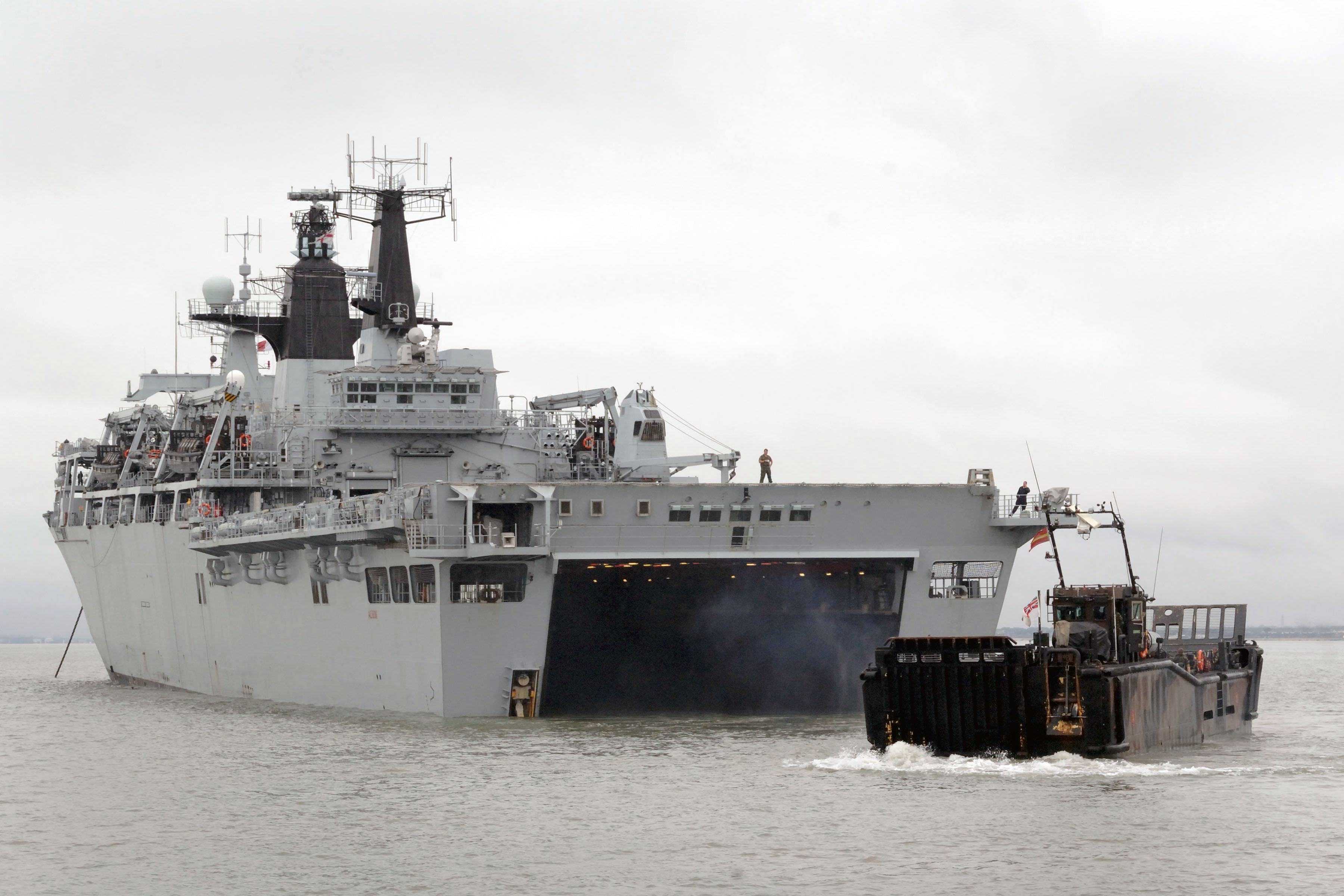
HMS Albion conducts amphibious operations with Landing Craft Utility (LCU) during Exercise Grey Heron off the coast of Portsmouth in 2007.
The Albion Class, Landing Platform Dock ships (LPD) primary function is to embark, transport, and deploy and recover (by air and sea) troops and their equipment, vehicles and miscellaneous cargo, forming part of an Amphibious Assault Force.
(Photo via Wikimedia)Two crucial amphibious warships, HMSes Albion and Bulwark, are rumoured to be on the chopping block of current defence cuts. Without these two ships, the Royal Navy cannot carry out amphibious landings, in the sense of “put Royal Marines in smaller boats that they can sail to beaches”. Both ships (only one is in service at any one time because we have neither the money nor manpower to run both at once) are fitted with big ramps and well docks allowing troops and vehicles aboard to be quickly loaded into landing craft.
Without its amphibious landing capability, the UK would not have been able to take the Falkland Islands back from Argentinian invaders after the 1982 invasion.
Comments Off on The ever-shrinking Royal Navy
The Battle of La Malmaison – Breakthrough at Caporetto I THE GREAT WAR Week 170
The Great War
Published on 26 Oct 2017The French score a morale boosting victory over the German at La Malmaison, but the Canadians were not so successful elsewhere on the Western Front. Whilst the Germans continue on through the Estonian Archipelago and onto the Russian mainland, the 12th Battle of the Isonzo takes place on the Italian Front. Unlike the 11 battles that came before it, this one was initiated by the Central Powers and was their biggest breakthrough yet on that front.
Comments Off on The Battle of La Malmaison – Breakthrough at Caporetto I THE GREAT WAR Week 170
October 26, 2017
Bonus quote-of-the-day
In an article in the Globe and Mail, Lee Berthiaume (Canadian Press) reports that “The Trudeau Liberals may have promised to ramp up Canada’s role in peacekeeping, but new UN figures show there were fewer Canadian peacekeepers in the field last month than at any point in recent memory … [and] … The revelation comes as Canada prepares to host a major peacekeeping summit in Vancouver next month, raising fears the country will be badly embarrassed unless the numbers start rising – and fast … [because] … The intervening year [since the Liberals promised 600+ blue beret wearing peacekeepers] has instead seen a steady decrease in the number of Canadian blue helmets and blue berets deployed around the world, from 112 peacekeepers in August 2016 to 68 last month.”
This is risky for Canadian soldiers because the Trudeau regime is not exactly famous for making sound, well though out, carefully crafted plans ~ witness the small business tax fiasco and democratic reform, just for examples. It is possible, even probable, that rather than be embarrassed in public the Liberals will react, as cornered rats often do, and commit troops to a dangerous, hopeless, worthless mission just to avoid yet another political humiliation. Canadian soldiers may soon find themselves in some rotten hellhole with orders to not, under any circumstances, shoot at a child soldier, not even in self defence, or do any harm to a person of colour … because the Liberals know that the media will be watching ~ platoons of journalists will be deployed, each more anxious than the next to win some prize by being the first to report on a Canadian killing a black child.
Ted Campbell, “Cornered?”, Ted Campbell’s Point of View, 2017-10-25.
Comments Off on Bonus quote-of-the-day
How A Man Shall Be Armed: 15th Century
Royal Armouries
Published on 20 Feb 2017The 15th Century was the highpoint of the armourers craft, with knights across Europe taking to the field of battle in elaborate and almost impregnable suits of plate armour. Discover how a knight of the 15th Century would arm themselves for combat.
Comments Off on How A Man Shall Be Armed: 15th Century


