
The Tank Museum
Published 20 May 2022Tank Museum Curator David Willey explores the current conflict in Ukraine and the performance of the T-72 tank; putting it into historical context and exploring other times during the last hundred years when the death of the tank has been predicted.
Consider becoming a Patreon Supporter today: https://www.patreon.com/tankmuseum
00:00 | Intro
00:40 | Wider context
11:01 | Tanks in History
(more…)
May 21, 2022
Ukraine & T-72: The death of the tank? | The Tank Museum
Comments Off on Ukraine & T-72: The death of the tank? | The Tank Museum
Ed Browning’s Winchester G30 Prototypes
Forgotten Weapons
Published 25 Jul 2016http://www.patreon.com/ForgottenWeapons/
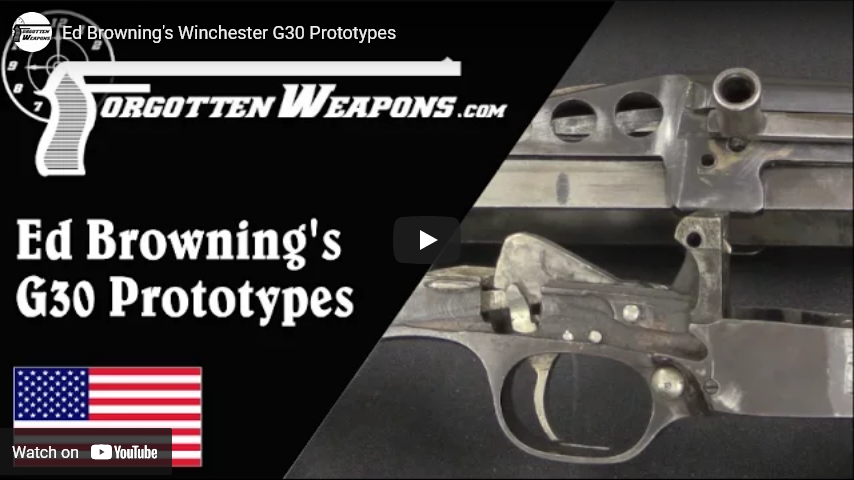
After Jonathan Edward “Ed” Browning had his 1929 rifle dropped from US military testing, he took the design back to his shop in Utah and kept working on it. By 1938 he had made enough improvements that he was ready to present the gun to Winchester, hoping they would be interested in purchasing the design. Specifically, he redesigned the receiver to move much of the bolt travel into the wrist of the stock, shortening the action. He also replaced the short recoil action with an annular gas piston. He made two sample rifles, one in military configuration and one in sporting configuration.
Winchester was looking for a self-loading rifle to market at the time, because they could see that war in Europe appeared to be imminent. They had been caught without a military rifle of their own during World War One, and did not want to be in that situation again. They thought that Ed Browning’s design showed merit, so they agreed to purchase it, and brought Browning onboard to help continue development.
With Winchester’s resources, it was possible to make the guns more professionally. Winchester designated the rifle the G30, and we have one of the examples made by Winchester in the video as well.
The tilting bolt mechanism took inspiration from John Moses Browning’s 1911 pistol, and the trigger housing bears an interesting resemblance to that of the French Berthier rifles (which may or may not be coincidental). The rifles appear to have worked reasonably well, although the annular gas piston was a hindrance which Browning apparently was unwilling to abandon. With his death in 1939, the project moved on to a new phase with David Marshall Williams taking on the job of improving it.
Comments Off on Ed Browning’s Winchester G30 Prototypes
May 20, 2022
The Crusades: Part 7 – The Third Crusade
seangabb
Published 5 Mar 2021The Crusades are the defining event of the Middle Ages. They brought the very different civilisations of Western Europe, Byzantium and Islam into an extended period of both conflict and peaceful co-existence. Between January and March 2021, Sean Gabb explored this long encounter with his students. Here is one of his lectures. All student contributions have been removed.
(more…)
Comments Off on The Crusades: Part 7 – The Third Crusade
The Cold War Legend That Delivered SAUSAGES To Tanks | Forces TV
Forces News
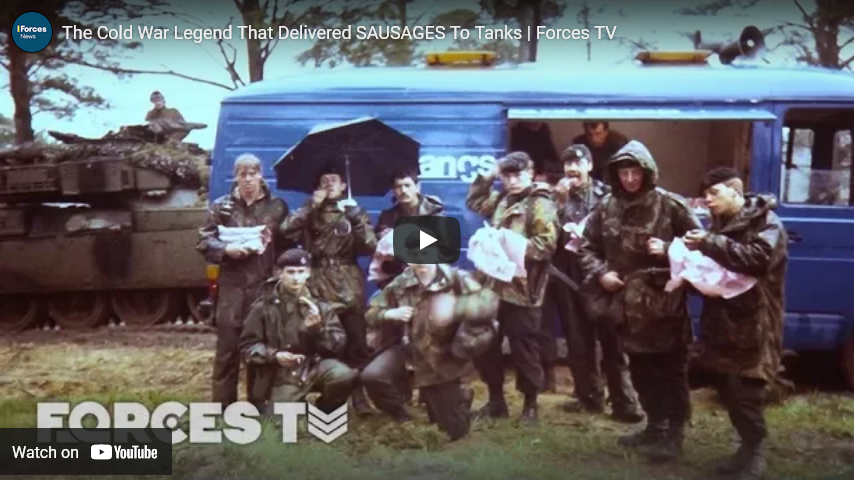
Published 26 Apr 2018To British troops based in north Germany in the last two decades of the Cold War, he was a legend. But this was no commando or member of the special forces.
Check out our website: http://forces.net
Twitter: https://twitter.com/ForcesNews
Comments Off on The Cold War Legend That Delivered SAUSAGES To Tanks | Forces TV
May 18, 2022
Trident: The Allied Plan to Win the War – Time Ghost News Flash
World War Two
Published 17 May 2022Washington, May 1943. It was the largest Anglo-American conference of the war so far. With the Axis being defeated in North Africa, the Mediterranean, and New Guinea, the need to agree on new strategic goals arose inside the Combined Chiefs of Staff. A new course of action was to be set against Italy, Japan, and Germany to capitalize on the recent successes. But debates and old dilemmas heated up when it came to resources, manpower, and the question “where to attack next”.
(more…)
Comments Off on Trident: The Allied Plan to Win the War – Time Ghost News Flash
L119A2: The New British SOF Rifle
Forgotten Weapons
Published 24 Jan 2022http://www.patreon.com/ForgottenWeapons
https://www.floatplane.com/channel/Fo…
Cool Forgotten Weapons merch! http://shop.forgottenweapons.com
Around 2013, the UK MoD began looking for a new rifle to replace the Special Forces’ L119A1. Those A1 rifles were getting old, and something new was needed — and there was some thought that a new rifle could improve on some shortcomings of the A1 model. The new rifle was produced by Colt Canada (formerly Diemaco), and it was procured in both 10″ and 15.7″ barrel lengths (note that the rifle in this video has a 16″ barrel to avoid being an SBR).
The most distinctive feature of the new L119A2 was the licensed LMT monolithic upper receiver. This was used because it allowed solid mounting of devices like lasers on the side rails. However, it had major shortcomings in terms of heat retention and cleanability. The A2 also now used a MagPul CTR stock, and Geissele triggers (an excellent improvement from the A1’s MILSPEC trigger). The same Surefire suppressors were used, as were the optics from the A1s — the new A2 tender did not include new optics (nor funding for them).
Very few photos are known showing the L119A2. It came into service around 2016 or 2017, and entered public awareness after Christian Craighead was photographed using one in the Nairobi Westlands mall siege in 2019.
Contact:
Forgotten Weapons
6281 N. Oracle 36270
Tucson, AZ 85740

Comments Off on L119A2: The New British SOF Rifle
QotD: Sparta’s excellent military reputation was not matched by actual battlefield excellence
Sparta had a formidable military reputation, but their actual battlefield performance hardly backed it up. During the fifth and fourth centuries, Sparta lost as often as it won. Spartan battlefield tactics were a bit better than other Greek poleis, but this is damning with faint praise. The Spartiates themselves were mostly like every other group of wealthy Greek hoplites. But the Spartan military reputation was extremely valuable – the loss of that reputation during the Peloponnesian War does much to explain the rough decades Sparta would experience following its end.
That is one of the core things we can learn from Sparta: a reputation for military excellence can often be more valuable than the excellence itself – real or imagined. A powerful army can only fight one battle at a time, but the idea of a powerful army can intimidate any number of enemies all at once. […] when Sparta was forced to turn from intimidation to force, it ran out of force with frightening speed.
Those who have been here for a while may already be wondering, “Wait, though – this is the guy who is always telling us that winning battles isn’t as important as achieving strategic objectives and who is always on about logistics and operations! What about that?” I think that actually goes a long way to explaining how an army with a modest advantage in tactics and organization ends up without a winning record. […] I want to stress something here: the horrors of Spartan society cannot be justified on the grounds they produced superior soldiers, because they quite evidently did not. Sparta’s actual military record was, in fact, depressingly average. Only the reputation was special; the men were just men.
Bret Devereaux, “Collections: This. Isn’t. Sparta. Part VI: Spartan Battle”, A Collection of Unmitigated Pedantry, 2019-09-20.
Comments Off on QotD: Sparta’s excellent military reputation was not matched by actual battlefield excellence
May 17, 2022
The Crusades: Part 6 — The Loss of Jerusalem
seangabb
Published 27 Feb 2021The Crusades are the defining event of the Middle Ages. They brought the very different civilisations of Western Europe, Byzantium and Islam into an extended period of both conflict and peaceful co-existence. Between January and March 2021, Sean Gabb explored this long encounter with his students. Here is one of his lectures. All student contributions have been removed.
(more…)
Comments Off on The Crusades: Part 6 — The Loss of Jerusalem
May 16, 2022
Heaviest Air Raid in Human History – WAH 060 – May 15, 1943
World War Two
Published 15 May 2022As the Warsaw Ghetto Uprising is being quashed, there are renewed Japanese atrocities in China, and the RAF sets a world record by bombing German civilians.
(more…)
Comments Off on Heaviest Air Raid in Human History – WAH 060 – May 15, 1943
Look at Life — The Flying Soldier (1965)
PauliosVids
Published 20 Nov 2018A look at helicopter training within the British Army.
Comments Off on Look at Life — The Flying Soldier (1965)
May 15, 2022
The End of the War in Africa – WW2 – 194 – May 14, 1943
World War Two
Published 14 May 2022With the end of the Tunisian Campaign, the Allies have won the war for the African Continent. What next? They meet at the Trident Conference in Washington DC to try and figure that out. Meanwhile, the fight in the field continues — in Burma, the Aleutians, China, and the Kuban.
(more…)
Comments Off on The End of the War in Africa – WW2 – 194 – May 14, 1943
Tank Chat #147 M14/41 | The Tank Museum
The Tank Museum
Published 4 Feb 2022► JOIN OUR PATREON: Our Patreons have already enjoyed Early Access and AD free viewing of our weekly YouTube video! Consider becoming a Patreon Supporter today: https://www.patreon.com/tankmuseum
► TIMESTAMP:
00:00 – INTRO
00:22 – FEATURES
(more…)
Comments Off on Tank Chat #147 M14/41 | The Tank Museum
May 14, 2022
Operation Chariot, the “Greatest Raid of All”
The raid on the French port of St. Nazaire in March 1942, codenamed “Operation Chariot” by the British, was one of the most daring and successful special forces operation of the Second World War. In The Critic, Richard Hopton reviews a new history of this operation by Giles Whittell:
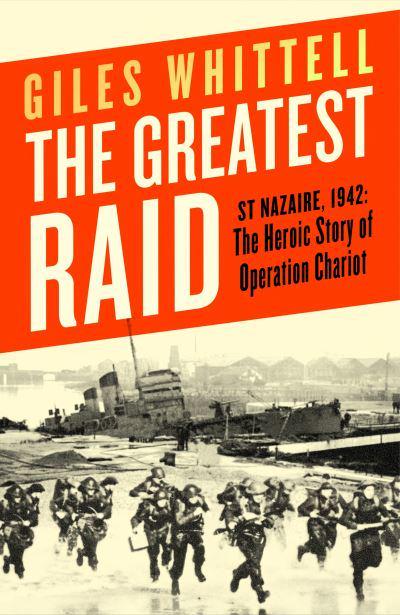
Operation Chariot, the Raid on St Nazaire, has long been known as “The Greatest Raid of All”. The audacity of the plan, the lethal danger of the operation, the inadequacy of the equipment provided, the astonishing courage of the participants and the spectacular success of its primary object have ensured its place in the annals of British martial heroism.
In the early hours of 28 March 1942, a force of 623 commandos and naval personnel stole up the Loire estuary to attack the port of St Nazaire. Leading the force was HMS Campbeltown, a superannuated destroyer acquired from the Americans, which had been converted into a floating bomb by the addition of four tons of high explosive secreted in her bows.
The plan was that she would ram the steel gate of the port’s immense dry dock where the charge would explode, demolishing the dock gate. The commandos would then swarm ashore to attack the dockyard installations, particularly the pumps and winding mechanisms which operated the dry dock. With the dock out of action, Hitler would not risk his battleship Tirpitz in the Atlantic where she could wreak havoc among the convoys supporting the war effort in Britain. This was the immediate, supposed object of the raid.
Giles Whittell’s new book is not the first full-length history of the event. C.E. Lucas-Phillips’s account, The Greatest Raid of All, was published in 1958 followed 40 years later by James Dorrian’s Storming St Nazaire, which remains the most detailed, authoritative account of the operation. In 2013 Robert Lyman published Into The Jaws of Death which told the story of the raid anew, with a greater concentration on the genesis and planning of the operation.
In 2007 Jeremy Clarkson took time away from messing around with cars to make a documentary for the BBC about the raid. The result was an “affectionate and enthralling” piece of television which brought the exploits of the Charioteers — as the men who took part in the raid have always been known — to a wider audience.
Although the ostensible object of the raid was to discourage the Germans from risking the Tirpitz in the Atlantic, it is now known that, by the spring of 1942, the German high command had already decided to keep the battleship moored safely in a distant Norwegian fjord. Accordingly, destroying the dry dock at St Nazaire was, strategically, a futile gesture.
Comments Off on Operation Chariot, the “Greatest Raid of All”
UK Special Forces’ M16 Variant: the L119A1
Forgotten Weapons
Published 21 Jan 2022http://www.patreon.com/ForgottenWeapons
https://www.floatplane.com/channel/Fo…
Cool Forgotten Weapons merch! http://shop.forgottenweapons.com
—
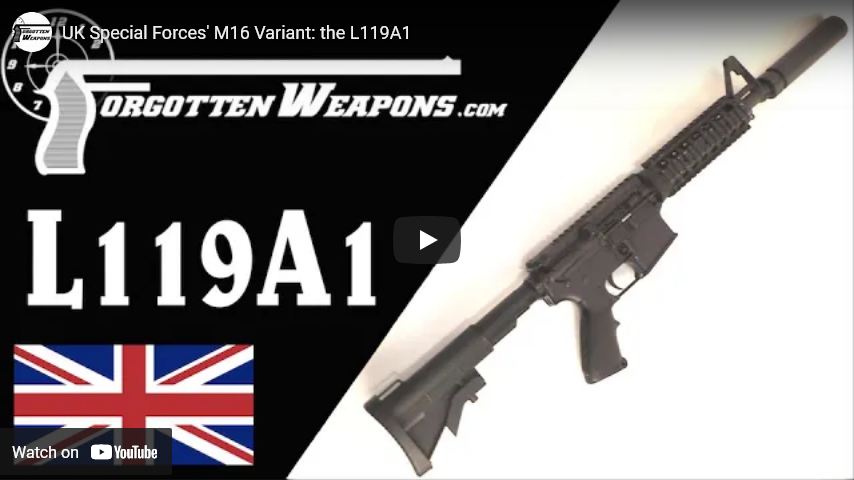
UPDATE: One correction to make; this rifle has the A2 charging handle. The original A1 version was essentially identical to the standard conventional charging handle. Sorry!
—In 1999, the UK Ministry of Defense put out a tender for a new rifle for UK Special Forces (UKSOF). The elite units of the British military were definitely not going to be using the L85! There was some competition (including the SIG 550 series), but it was pretty much known going in that the contract would be going to Diemaco (later Colt Canada) for a version of their C8 SFW (“Special Forces Weapon”). That was the case, but only after very extensive trials, which actually cost more than the procurement contract itself. The rifles were tested in all environmental extremes, including Alaska, Kuwait, and Brunei.
The rifle ultimately adopted had a number of unique features. It was at heart a Diemaco C8, with Diemaco’s early flat top upper (which predates Picatinny adoption, and is actually a bit closer to Weaver — but still compatible with modern accessories). Two barrel lengths were purchased, 10.0 inch and 15.7 inch. Other details include:
Stepped buffer tube
Textured telescoping stock
Permanently attached rubber buttplate
Lone Star grip
Knight’s RAS with locking clamps on both top and bottom rails
Strengthened gas block (usually but not always)
SureFire 216-A flash hider
Unique castle nut details
Ambidextrous charging handleThe barrel profile chosen for the L119A1 is quite heavy, and the 10 inch barreled version is substantially overgassed. The guns were heavy, but very reliable, and have since been adopted as the standard service rifle of the Royal Marines. The SOF opted to seek out a replacement around 2013-2016, and that would result in the L119A2 (a significantly different rifle).
Contact:
Forgotten Weapons
6281 N. Oracle 36270
Tucson, AZ 85740
Comments Off on UK Special Forces’ M16 Variant: the L119A1
May 13, 2022
Napoleon Took Moscow – Why He Didn’t Win The War
Real Time History
Published 12 May 2022Support us on Patreon: https://patreon.com/realtimehistory
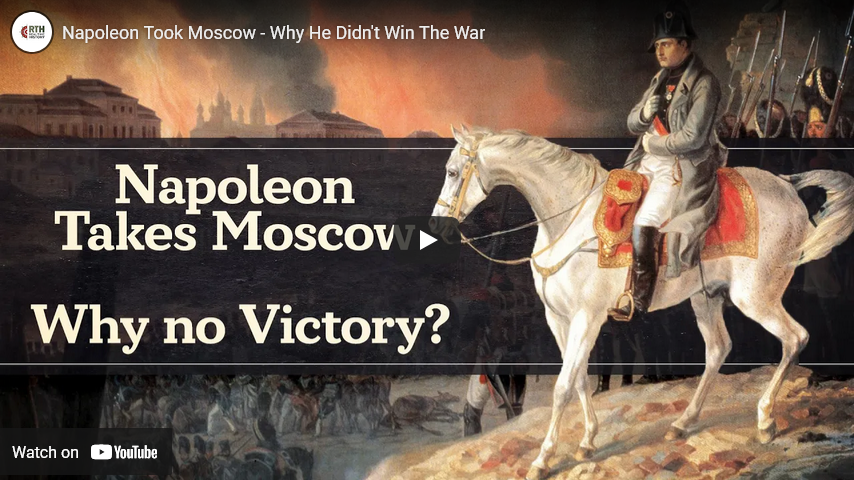
After the Battle of Borodino, both sides are badly mauled. Napoleon’s army marches on and reaches Moscow, the old Russian capital. In the Emperor’s eyes, capturing the city should win him the war. But while the local Russians set fire to the city, the Tsar in St. Petersburg and the Russian army command are thinking about turning the tide of the war — and not about accepting a French victory.
» THANK YOU TO OUR CO-PRODUCERS
John Ozment, James Darcangelo, Jacob Carter Landt, Thomas Brendan, Kurt Gillies, Scott Deederly, John Belland, Adam Smith, Taylor Allen, Rustem Sharipov, Christoph Wolf, Simen Røste, Marcus Bondura, Ramon Rijkhoek, Theodore Patrick Shannon, Philip Schoffman, Avi Woolf,» SOURCES
Boudon, Jacques-Olivier. Napoléon et la campagne de Russie en 1812. 2021.
Lieven, Dominic. Russia Against Napoleon. 2010.
Rey, Marie-Pierre. L’effroyable tragédie: une nouvelle histoire de la campagne de Russie. 2012.
Zamoyski, Adam. 1812: Napoleon’s Fatal March on Moscow. 2005.» OUR STORE
Website: https://realtimehistory.net»CREDITS
Presented by: Jesse Alexander
Written by: Jesse Alexander
Director: Toni Steller & Florian Wittig
Director of Photography: Toni Steller
Sound: Above Zero
Editing: Toni Steller
Motion Design: Toni Steller
Mixing, Mastering & Sound Design: http://above-zero.com
Digital Maps: Canadian Research and Mapping Association (CRMA)
Research by: Jesse Alexander
Fact checking: Florian WittigChannel Design: Simon Buckmaster
Contains licensed material by getty images
Maps: MapTiler/OpenStreetMap Contributors & GEOlayers3
All rights reserved – Real Time History GmbH 2022
Comments Off on Napoleon Took Moscow – Why He Didn’t Win The War


