
World War Two
Published 8 Apr 2023The Soviets are finally going to try and push the Axis out of Sevastopol and the Crimea. They also continue to drive the Axis back in Transnistria. Over in Burma and Northeastern India, the Japanese have the Allies under siege at not one, but two towns, and are also attacking Imphal from several points, but the Japanese have way bigger future plans up their sleeves in China.
(more…)
April 9, 2023
New Offensive in the Crimea – WW2 – Week 241 – April 8, 1944
Comments Off on New Offensive in the Crimea – WW2 – Week 241 – April 8, 1944
USMC units in the American Expeditionary Forces (AEF) in France
Another interesting excerpt from John Sayen’s Battalion: An Organizational Study of United States Infantry currently being serialized on Bruce Gudmundsson’s Tactical Notebook discusses the role of the US Marine Corps on the Western Front as part of Pershing’s AEF:
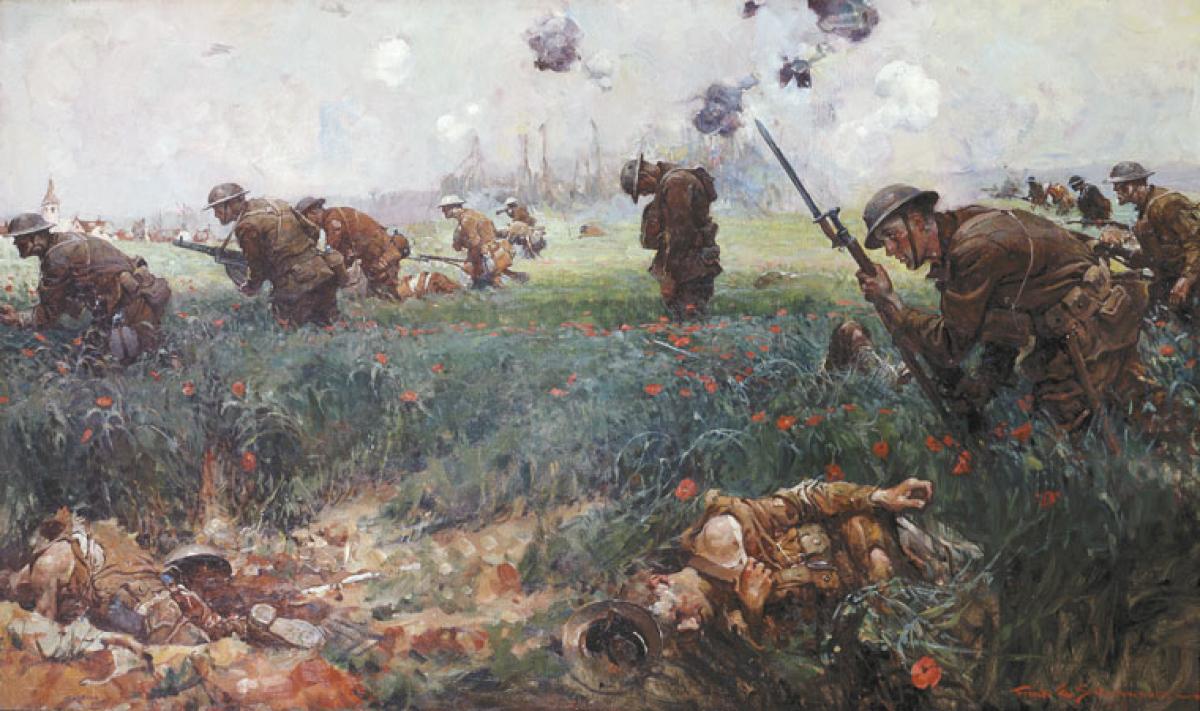
“How Twenty Marines Took Bouresches” by Frank E. Schoonover.
Originally published in the Ladies’ Home Journal Vol. 24 No. 1, via Wikimedia Commons
The Fifth Regiment arrived in France in July 1917. Being the fifth regiment of a four-regiment division, it soon found itself relegated to the sidelines and stuck with all the odd jobs such as providing military police details, couriers, and guards. Correctly reasoning that a larger unit would not be so easily pigeonholed, General Barnett [the Marine Corps Commandant] in October 1917 augmented the Fifth Regiment with the newly formed Sixth Regiment and Sixth Machinegun Battalion. The whole force constituted the AEF Fourth Brigade, or half the infantry of the AEF 2nd Division.*
Although the organization of the Fourth Brigade’s infantry regiments was supposed to be the same as that of all the other AEF infantry regiments, it did in fact differ in some details (see Appendix 2.6). Every Marine rifle and machinegun company had two additional sergeants to serve as gas NCOs and the Marines added gas officers to each battalion headquarters. Whether this helped reduce the number of gas casualties is unclear.
Marine enlisted men also tended to be given higher ranks than their Army counterparts. In a Marine regiment a platoon sergeant was not just the senior sergeant in a platoon, he was a gunnery sergeant, ranking as an Army sergeant first class (a rank that the Army awarded only to specialists) and well above a sergeant. Sergeants commanded all four sections in a Marine rifle platoon and this allowed an additional sergeant per half-platoon. The rifle section included two men trained equipped as snipers (enough for one sniper per half-platoon). Two more snipers were in company headquarters. Since 1887 when test results had exposed their poor marksmanship, the Marines had made rifle shooting into even more of a fetish than it had been in the Army. In contrast to the many soldiers sent into battle without even having fired their rifles, no Marine was even allowed overseas if he had not qualified as an expert rifleman or sharpshooter.
To give extra promotion, pay, and recognition (but not leadership responsibility) to the best shots the Marines introduced the rank of corporal (technical). The rank was also given to mechanics, horseshoers, saddlers, teamsters, and five senior operators in the telephone section of the regimental signal platoon to reward technical proficiency. However, despite their important but difficult and thankless duties, Marine cooks only ranked as privates.
[…]
The Marine AEF regiments differed from their Army counterparts in more than just structural details. They had a huge advantage in manpower quality. Except for about 7,100 draftees accepted during the war’s last weeks, the nearly 79,000 Marines who served in the war were all volunteers. About one sixth of these men had joined prior to the war. This was several times the Army’s percentage of pre-war men, even if those who had only National Guard service are included. Many Marine wartime volunteers were college men and included a lot of athletes.
The large number of officer-quality enlisted men persuaded General Barnett to direct on 4 June 1917 that, in future, all officers be appointed from the ranks. This move had the strong backing of Secretary Daniels who favored the practice of commissioning enlisted men. Such a system would be more in line with what the Germans and French were doing. Even the college men would have to have several months’ enlisted service before they could hope for a commission. By then their leadership potential could be properly evaluated. In addition, many pre-war enlisted men of greater age and experience but less education and growth potential could also become officers. Better still, the Marines were mostly infantry. Unlike the Army, they had few service or technical positions into which their best and brightest could be drained. Instead of getting the dregs, Marine infantry regiments got all the best officers and men. They were always kept at full strength with fully trained replacements, despite heavy casualties.**
The high quality men that the Marines were able to contribute to the AEF provoked a good deal of jealousy within the Army in general and from General Pershing in particular. The latter praised the Marines in private but refused to do so in public. Although Pershing had accepted the Fourth Marine Brigade into the AEF, he rebuffed every offer to send Marine artillery to France. The presence of both Marine infantry and artillery in France would have paved the way for the formation of a Marine AEF division. That would have given the Marines much more publicity at Army expense.
Late in the war Pershing relented enough to accept another Marine infantry brigade, the Fifth, which reached France in September 1918. However, although nearly all these Marines had qualified as expert marksmen, he employed them in menial jobs in the rear areas. At the same time, Pershing was rushing thousands of untrained Army recruits into front line combat where they were routinely and needlessly slaughtered.***
* Major David N. Buckner USMC, A Brief History of the Tenth Marines (Washington DC, Historical Div. HQMC; 1981) pp. 16-17.
** Heinl pp. 191-228; and J. Robert Moskin, The Story of the U.S. Marine Corps (New York, Paddington Press Ltd. 1979) pp. 138-139; LtGen William K. Jones USMC(Ret) A Brief History of the 6th Marines (Washington DC, History and Museum Div. HQMC 1987) p 1.
*** Heinl pp. 194-195 and 208-210; Allan R. Millett, Bullard op cit p. 321.
Comments Off on USMC units in the American Expeditionary Forces (AEF) in France
Uncancelled History | EP. 01 Robert E. Lee
Nebulous Media
Published 21 Nov 2022Jonathan Horn joins Douglas Murray on this episode to discuss Robert E. Lee’s infamous legacy. The two dissect his childhood, military career and life after the war. Should Robert E. Lee stay cancelled?
(more…)
Comments Off on Uncancelled History | EP. 01 Robert E. Lee
April 8, 2023
Russia’s Last Crusade – The Crimean War 1853-1856
Real Time History
Published 7 Apr 2023The Crimean War between the Ottoman Empire and Russia (and later the UK and France) has been called the last crusade and the first modern war at the same time.
(more…)
Comments Off on Russia’s Last Crusade – The Crimean War 1853-1856
Błyskawica: The Polish Home Army’s Clandestine SMG
Forgotten Weapons
Published 23 Dec 2022The Błyskawica (“Lightning”) is an SMG developed in occupied Poland to be issued out to Home Army units during Operation Tempest: the liberation uprisings planned for the advance of the Red Army into Poland.
The gun was developed starting in September 1942 by two engineers, Wacław Zawrotny and Seweryn Wielanier. Both were smart and talented, but neither had previous experience in arms design. The design they created is both innovative in some areas and inferior in others as a result, with major inspiration coming from the Sten and the MP40. Production was undertaken in the harshest conditions of occupied Warsaw, where just possession of cutting tools required German military permission.* It is a credit to the skill and dedication of the Home Army team that some 750 Błyskawica guns were made; the largest mass production of any underground weapon that I am aware of.
Ultimately, Operation Tempest did not come to full fruition, as the NKVD’s treatment of Polish fighters as collaborators destroyed Home Army interest in cooperation. The Błyskawica guns were never issued as planned, with only the few dozen last made being used in the Warsaw Uprising. The remaining 700-odd examples have never been found — perhaps they remain in long-forgotten caches still to this day?
For the full story of the Błyskawica, see Leszek Erenfeicht’s excellent article:
https://www.forgottenweapons.com/subm…Many thanks to the Polish Army Museum for giving me access to film this exceptionally rare item for you! Check them out at: http://www.muzeumwp.pl/?language=EN
* This created some interesting situations in which a shop might take a contract to make material for the Wehrmacht as a way to get access to the tools needed for Błyskawica component production. To those who did not know the whole story, such a shop was collaborationist.
Comments Off on Błyskawica: The Polish Home Army’s Clandestine SMG
April 7, 2023
Stormtroopers – The German Elite of WW1 – Sabaton History 119
Sabaton History
Published 6 Apr 2023By the middle of the Great War, several nations had begun to experiment with shock troops, and Germany was one of them. The Sturmtruppen were a revolution on the battlefield, for sure, but what did they actually do? What equipment did they carry and use? What were the men actually like? Today we’ll look at all that.
(more…)
Comments Off on Stormtroopers – The German Elite of WW1 – Sabaton History 119
Manpower shortages in the American Expeditionary Forces (AEF) during WW1
This is an excerpt from Battalion: An Organizational Study of United States Infantry, an unpublished book by the late John Sayen which is being serialized at Bruce Gudmundsson’s Tactical Notebook on Substack. While I haven’t read a lot on the AEF, as I’ve concentrated much more on the Canadian Corps as part of the British Expeditionary Force, I was aware that the American divisions were organized quite differently from either British or French equivalents. The significanly larger division organization — 28,000 men compared to about half that in other allied armies — was intended to give US Army units greater staying power in combat, but it didn’t work out as planned for many reasons:
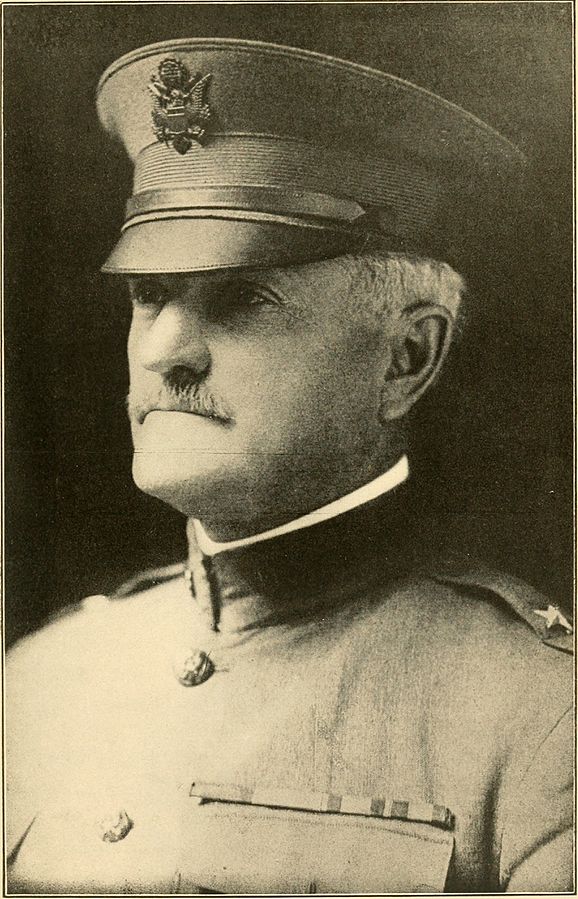
General John J. “Black Jack” Pershing, Commander-in-Chief of the American Expeditionary Forces in France during the First World War.
Image via Wikimedia Commons.
The basic tactical concept behind the square AEF divisions under which the two regiments holding the division’s front line could be relieved by two more regiments to their rear was seriously undermined. The two regiments that were supposed to be resting were the ones that had to man all the work details. When it came time for them to relieve the front-line regiments it was, as historian Allan Millett described it, often a question “of replacing exhausted troops who had suffered casualties with exhausted troops who had not”.
It had certainly not been intended that the infantry serve as labor troops. Such tasks were supposed to have been carried out by separate regiments of pioneers modeled on those used by the French. In the French Army, pioneer regiments were lightly armed infantry serving under corps and army headquarters. They tended to consist of older men and were not the elite assault troops that filled the pioneer platoons in the infantry regiments. Though they could fight when necessary, their main function was to furnish the bulk of the semi-skilled and unskilled labor in the forward areas.
In imitation of this system the War Department raised 37 AEF pioneer regiments. These were organized as AEF infantry regiments without machinegun companies or sapper-bomber, pioneer, or one-pounder gun platoons. Only two of the 29 pioneer regiments to reach France did so before the last three months of the war. One regiment was supposed to go to each army corps and several to each army. However, the AEF pioneers proved to be so badly trained and led (even by AEF standards) that after front line service involving a mere 241 battle casualties most of the pioneers were pulled out of combat to serve as unarmed laborers far to the rear.
It wasn’t just combat casualties that reduced US divisional effectiveness:
Early planning had called for one third of all divisions to serve as replacement depots or field-training units charged with keeping the remaining combat divisions filled with men. The system broke down, however, as heavy losses forced the intended depot divisions to be used as combat units instead. Only six of the 42 AEF divisions to reach France before the Armistice (three more arrived soon afterwards) actually served as replacement or training depots instead of the 14 that were needed.
As an emergency measure, five combat divisions, and later two of the depot divisions, were skeletonized to immediately create urgently needed replacements but, of course, this rendered them useless for either combat or depot duty. Another division had to be fragmented to provide men for rear area support duties and yet another was broken up to flesh out three French divisions. Even in February 1918, (before the AEF had seen serious combat) the four combat divisions in the AEF I Corps were 8,500 men short (mostly in their infantry regiments). The 41st Division, which was the corps’ depot division and charged with supplying those missing men was itself 4,500 men short. By early October 1918, AEF combat units needed 80,000 replacements but only 45,000 were expected before 1 November. At the end of October, the total shortfall had reached 119,690, including 95,303 infantrymen and 8,210 machine gunners. Only 66,490 replacement infantrymen and machine gunners would be available any time soon. For most of the war, AEF combat divisions were typically short by 4,000 men. After August 1918, even divisions fresh from the United States usually needed men. Too many divisions had been organized too quickly.
Of course, the root cause of the manpower problem was even more basic. Men were being used up faster than they could be replaced. The AEF suffered most of its battle casualties between 25 April and 11 November 1918, a period of less than seven months. These combat losses amounted to between 260,000 and 290,000 officers and men, of whom some 53,000 were killed in action or died of their wounds. The rest were wounded or gassed but 85% of these subsequently returned to duty. About 4,500 AEF prisoners of war were repatriated after the Armistice. Five thousand others became victims of “shell shock.” Accidental casualties, including those known to have been caused by “friendly fire” (total friendly fire losses must have been considerable, given the poor state of infantry-artillery coordination), or disease or self-inflicted wounds, far exceeded those sustained in battle.
Two thirds of the more than 125,000 Army and Marine Corps deaths between April 1917 and May 1919 occurred overseas and nearly half (57,000) were from disease. Pneumonia and influenza-pneumonia, which produced the infamous “swine flu” epidemic of 1918, were the chief killers but many victims who became ill before the Armistice did not actually die until after it. Between 14 September and 8 November 1918 some 370,000 cases were reported in the United States alone. Within less than two years between one quarter and one third of the men serving in the US Army had died or became temporarily or permanently disabled by battle, disease, accident, or misconduct. Had such losses continued, the United States might soon have begun to experience the same war weariness and manpower “burnout” that had been plaguing the British, French, and Germans.
With regard to the infantry, the woes of the AEF replacement and training system were much increased by the prevailing belief that because an infantryman needed few technical skills he had little to learn and could be quickly and easily trained from very average human material. Technical arms such as the engineers, signal corps, artillery, and, more significantly, the air corps got the pick of the AEF’s manpower.
The infantry soon became the repository for those deemed unfit for anything better. Many infantrymen saw themselves, and were seen, as cannon fodder. Morale and cohesion were further undermined by the practice of stripping new divisions of men (often before they had even left the United States) to fill older ones. The better men and officers avoided infantry duty to seek less demanding “technical” jobs. Of course, training suffered grievously.
As demands for replacements became more insistent, men who supposedly had received several months’ training were appearing in the front lines not knowing how to load their rifles. Others proved to be recent immigrants who could not speak English. Infantrymen of small physique who might have rendered useful service in non-infantry roles, soon collapsed under the physical burdens placed on them and became liabilities rather than assets. Losses among even good infantry were heavy enough but mediocre infantry melted away at an astonishing rate. Indiscipline, disorganization, and ignorance inevitably increased losses by what must have seemed like a couple of orders of magnitude. These losses were likely to be replaced, if at all, by men of even lower caliber.
Straggling was an especially pernicious problem, which the military police had only limited success in controlling. Even more than actual casualties, it caused some units to simply evaporate. During the Meuse-Argonne offensive, for example, one division reported that it was down to only 1,600 effective men. However, soon after it arrived at a rest area, it reported 8,400 men in its infantry regiments alone.
Comments Off on Manpower shortages in the American Expeditionary Forces (AEF) during WW1
April 6, 2023
Tikka T3x Arctic / Canadian Rangers C19 Rifle, 7.62 / .308 Win
Bloke on the Range
Published 29 Mar 2019Bloke unboxes and takes a first look at the Tikka T3x Arctic rifle, adopted as the C19 rifle for the Canadian Rangers in 7.62 NATO / .308 Winchester. Is the hype real? Oh yes! Yes, it really is!
(more…)
Comments Off on Tikka T3x Arctic / Canadian Rangers C19 Rifle, 7.62 / .308 Win
QotD: The general’s pre-battle speech to the army
The modern pre-battle general’s speech is quite old. We can actually be very specific: it originates in a specific work: Thucydides’ Histories [of the Peloponnesian War] (written c. 400 B.C.). Prior to this, looking at Homer or Herodotus, commanders give very brief remarks to their troops before a fight, but the fully developed form of the speech, often presented in pairs (one for each army) contrasting the two sides, is all Thucydides. It’s fairly clear that a few of Thucydides’ speeches seem to have gone on to define the standard form and ancient authors after Thucydides functionally mix and match their components (we’ll talk about them in a moment). This is not a particularly creative genre.
Now, there is tremendous debate as to if these speeches were ever delivered and if so, how they were delivered (see the bibliography note below; none of this is really original to me). For my part, while I think we need to be alive to the fact that what we see in our textual sources are dressed up literary compressions of the tradition of the pre-battle speech, I suspect that, particularly by the Roman period, yes, such speeches were a part of the standard practice of generalship. Onasander, writing about the duties of a general in the first century CE, tells us as much, writing, “For if a general is drawing up his men before battle, the encouragement of his words makes them despise the danger and covet the honour; and a trumpet-call resounding in the ears does not so effectively awaken the soul to the conflict of battle as a speech that urges to strenuous valour rouses the martial spirit to confront danger.” Onasander is a philosopher, not a military man, but his work became a standard handbook for military leaders in Antiquity; one assumes he is not entirely baseless.
And of course, we have the body of literature that records these speeches. They must be, in many cases, invented or polished versions; in many cases the author would have no way of knowing the real worlds actually said. And many of them are quite obviously too long and complex for the situations into which they are placed. And yet I think they probably do represent some of what was often said; in many cases there are good indications that they may reflect the general sentiments expressed at a given point. Crucially, pre-battle speeches, alone among the standard kinds of rhetoric, refuse to follow the standard formulas of Greek and Roman rhetoric. There is generally no exordium (meaning introduction; except if there is an apology for the lack of one, in the form of, “I have no need to tell you …”) or narratio (the narrated account), no clear divisio (the division of the argument, an outline in speech form) and so on. Greek and Roman oratory was, by the first century or so, quite well developed and relatively formulaic, even rigid, in structure. The temptation to adapt these speeches, when committing them to a written history, to the forms of every other kind of oratory must have been intense, and yet they remain clearly distinct. It is certainly not because the genre of the battle speech was more interesting in a literary sense than other forms of rhetoric, because oh my it wasn’t. The most logical explanation to me has always been that they continue to remain distinct because however artificial the versions of battle speeches we get in literature are, they are tethered to the “real thing” in fundamental ways.
Finally, the mere existence of the genre. As I’ve noted elsewhere, we want to keep in mind that Greek and Roman literature were produced in extremely militarized societies, especially during the Roman Republic. And unlike many modern societies, where military service is more common among poorer citizens, in these societies military service was the pride of the elite, meaning that the literate were more likely both to know what a battle actually looked like and to have their expectations shaped by war literature than the commons. And that second point is forceful; even if battle speeches were not standard before Thucydides, it is hard to see how generals in the centuries after him could resist giving them once they became a standard trope of “what good generals do.”
So did generals give speeches? Yes, probably. Among other reasons we can be sure is that our sources criticize generals who fail to give speeches. Did they give these speeches? No, probably not; Plutarch says as much (Mor. 803b) though I will caution that Plutarch is not always the best when it comes to the reality of the battlefield (unlike many other ancient authors, Plutarch was a life-long civilian in a decidedly demilitarized province – Achaea – who also often wrote at great chronological distance from his subjects; his sense of military matters is generally weak compared to Thucydides, Polybius or Caesar, for instance). Probably the actual speeches were a bit more roughly cut and more compartmentalized; a set of quick remarks that might be delivered to one unit after another as the general rode along the line before a battle (e.g. Thuc. 4.96.1). There are also all sorts of technical considerations: how do you give a speech to so many people, and so on (and before you all rush to the comments to give me an explanation of how you think it was done, please read the works cited below, I promise you someone has thought of it, noted every time it is mentioned or implied in the sources and tested its feasibility already; exhaustive does not begin to describe the scholarship on oratory and crowd size), which we’ll never have perfect answers for. But they did give them and they did seem to think they were important.
Why does that matter for us? Because those very same classical texts formed the foundation for officer training and culture in much of Europe until relatively recently. Learning to read Greek and Latin by marinating in these specific texts was a standard part of schooling and intellectual development for elite men in early modern and modern Europe (and the United States) through the Second World War. Napoleon famously advised his officers to study Caesar, Hannibal and Alexander the Great (along with Frederick II and the best general you’ve never heard of, Gustavus Adolphus of Sweden). Reading the classical accounts of these battles (or, in some cases, modern adaptations of them) was a standard part of elite schooling as well as officer training. Any student that did so was bound to run into these speeches, their formulas quite different from other forms of rhetoric but no less rigid (borrowing from a handful of exemplars in Thucydides) and imbibe the view of generalship they contained. Consequently, later European commanders tended for quite some time to replicate these tropes.
(Bibliography notes: There is a ton written on ancient battle speeches, nearly all of it in journal articles that are difficult to acquire for the general public, and much of it not in English. I think the best possible place to begin (in English) is J.E. Lendon, “Battle Description in the Ancient Historians Part II: Speeches, Results and Sea Battles” Greece & Rome 64.1 (2017). The other standard article on the topic is E. Anson “The General’s Pre-Battle Exohortation in Graeco-Roman Warfare” Greece & Rome 57.2 (2010). In terms of structure, note J.C. Iglesias Zoida, “The Battle Exhortation in Ancient Rhetoric” Rhetorica 25 (2007). For those with wider language skills, those articles can point you to the non-English scholarship. They can also serve as compendia of nearly all of the ancient battle speeches; there is little substitute for simply reading a bunch of them on your own.)
Bret Devereaux, “Collections: The Battle of Helm’s Deep, Part VII: Hanging by a Thread”, A Collection of Unmitigated Pedantry, 2020-06-12.
Comments Off on QotD: The general’s pre-battle speech to the army
April 5, 2023
The modern Canadian Army – go on deployment to Poland, train Ukraine troops … and have to buy your own rations
Is it hard to figure out why the Canadian Armed Forces are having recruiting shortfalls when they can’t even manage to feed the troops they send overseas to train Ukrainian soldiers?
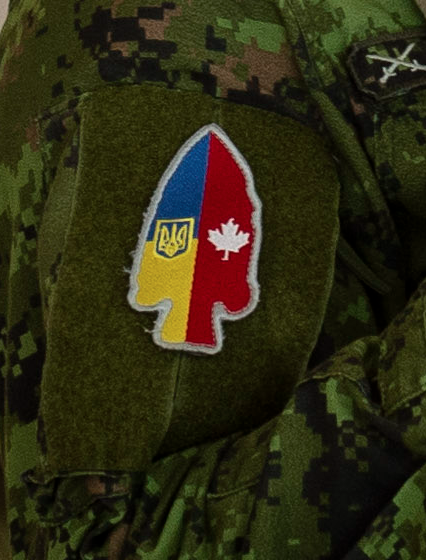
Operation Unifier shoulder patch for Canadian troops in Ukraine.
Detail from a photo in the Operation Unifier image gallery – https://www.canada.ca/en/department-national-defence/services/operations/military-operations/current-operations/operation-unifier.html
The Canadian soldiers are in Poland to train Ukrainian military personnel but since Canada did not send military cooks on the mission, the troops were told to eat at local restaurants.
But there is a massive backlog with the Canadian Forces reimbursing the soldiers for those costs, sending some of them thousands of dollars into debt. Their families contacted this newspaper to complain about the situation they say is causing financial stress at home.
After this newspaper [the Ottawa Citizen] inquired about the situation, the Canadian Forces confirmed Monday that there are problems with payments of per diems and the reimbursement of other expenses. The Canadian Forces is now promising to speed up the process.
“We apologize to the members and their families for the distress this has caused, and thank them for their patience,” said Capt. Nicolas Plourde-Fleury, spokesman for Canadian Joint Operations Command (CJOC). “We want them to know we have implemented measures to better support them moving forward.”
Approximately 100 Canadian military personnel are currently serving in Poland as part of a contingent to train Ukraine troops. The first arrived in October 2022 but the mission added more personnel in February and March.
As part of Operation Unifier, the Canadian soldiers are providing training in basic and advanced engineering skills, the use of explosives for demolition work, demining and skills relating to the use and operation of the Leopard 2 tanks in combat.
The Canadian Forces usually has its own cooks to provide troops with food. But in this situation, the Canadians initially received their meals from the Polish military. Later, the Canadian soldiers were told to eat in local restaurants and they would be reimbursed by the Canadian Forces.
Comments Off on The modern Canadian Army – go on deployment to Poland, train Ukraine troops … and have to buy your own rations
PTRS 41: The Soviet Semiauto Antitank Rifle (aka an SKS on Steroids)
Forgotten Weapons
Published 14 Dec 2022Prior to World War Two, the Soviet Union had a rather lackluster interest in antitank rifles — a series of guns were developed, but slowly and without all that much success. The Barbarossa invasion gave a very immediate need for just this sort of weapon, however, to give Soviet infantry units an organic anti-armor capability. Two star Soviet designers were tasked with designing AT rifles, Degtyarev and Simonov. The cartridge they were to use was the new 14.5x114mm, a high-velocity monster using a tungsten carbine cored projectile.
After a shockingly fast development period, the guns from both design bureaus were accepted. The Degtyarev became the PTRD-41, a single-shot auto-ejecting design that was extremely cheap and fast to produce. The Simonov design became the PTRS-41, a 5-shot semiauto offering more firepower but also taking longer to produce. The Degtyarev entered service first, with the first substantial deliveries of PTRS rifles arriving in 1942.
Both designs would serve through the war, with hundreds of thousands being made. Many were put into storage in 1945, and they are still seen today in Ukraine periodically. The PTRS would go on to be the basis for Simonov’s 7.62x39mm infantry rifle, adopted as the SKS.
(more…)
Comments Off on PTRS 41: The Soviet Semiauto Antitank Rifle (aka an SKS on Steroids)
April 4, 2023
Tank Chats Reloaded | Challenger 1 | The Tank Museum
The Tank Museum
Published 16 Dec 2022In the first episode of Tank Chats Reloaded we hear from Major General Patrick Cordingley who both commanded Challenger 1 during the First Gulf War and was involved in its design. Also introducing our new presenter Chris Copson, host of the new Tank Chats Reloaded series — where we’ll be revisiting old favourites from Tank Chats.
(more…)
Comments Off on Tank Chats Reloaded | Challenger 1 | The Tank Museum
April 3, 2023
Goodbye Manstein… Hello Model – WW2 – Week 240 – April 1, 1944
World War Two
Published 1 Apr 2023As the Allies prepare to close in on Germany from all fronts, a shake up of the German military leadership can only achieve so much…
(more…)
Comments Off on Goodbye Manstein… Hello Model – WW2 – Week 240 – April 1, 1944
April 2, 2023
Vektor Mini-SS: South Africa’s Answer to the FN Minimi
Forgotten Weapons
Published 9 Dec 2022While under international embargo and at war in the late 1970s, South Africa needed a new 7.62mm GPMG. The answer was Vektor’s SS77, a design which would replace the FN MAG in South African service in the 1980s. The gun had really substantial problems for many years, and took a lot of work to revise and improve until it was finally fit for service. However, that work did result in a really excellent gun. With the US adoption of the FN Minimi as a Squad Automatic Weapon, interest developed in a 5.56mm version of the SS77.
Named the Mini-SS, this was initially envisioned as a conversion of the SS77, but that never actually came to pass. Instead, the Mini-SS was built from the ground up as a 5.56mm SAW, with a number of changes to reduce its weight (like a simple fixed polymer stock, fixed gas port, and the removal of tripod attachment points). Coming into service in the early 1990s, the Mini-SS has developed an excellent reputation.
Mechanically, both of the Vektor designs are unusual for the use of an asymmetric side-tilting bolt (like the ZH-29 and only a few other production guns). It is a very simply gun to disassemble, and has a lot of quite clever design features.
(more…)
Comments Off on Vektor Mini-SS: South Africa’s Answer to the FN Minimi
QotD: The (in-)effectiveness of chemical weapons against “Modern System” armies
But let’s put that in a real-world context. Five Japanese doomsday cultists used about five liters of sarin in a terror attack on a Tokyo Subway in 1995, deployed, in this case, in a contained area, packed full to the brim with people – a potential worst-case (from our point of view; “best” case from the attackers point of view) situation. But the attack killed only 12 people and injured about a thousand. Those are tragic, horrible numbers to be sure – but statistically insignificant in a battlefield situation. And no army could count on ever being given the kind of high-vulnerability environment like a subway station in an actual war.
In order to produce mass casualties in battlefield conditions, a chemical attacker has to deploy tons – and I mean that word literally – of this stuff. Chemical weapons barrages in the First World War involved thousands and tens of thousands of shells – and still didn’t produce a high fatality rate (though the deaths that did occur were terrible). But once you are talking about producing tens of thousands of tons of this stuff and distributing it to front-line combat units in the event of a war, you have introduced all sorts of other problems. One of the biggest is shelf-life: most nerve gasses (which tend to have very high lethality) are not only very expensive to produce in quantity, they have very short shelf-lives. The other option is mustard gas – cheaper, with a long shelf-life, but required in vast quantities (during WWII, when just about every power stockpiled the stuff, the stockpiles were typically in the many tens of thousands of tons range, to give a sense of how much it was thought would be required – and then think about delivering those munitions).
[…]
But that’s not the only problem – the other problem is doctrine. Remember that the modern system is all about fast movement. I don’t want to get too deep into maneuver-warfare doctrine (one of these days!) but in most of its modern forms (e.g. AirLand Battle, Deep Battle, etc) it aims to avoid the stalemate of static warfare by accelerating the tempo of the battle beyond the defender’s ability to cope with, eventually (it is hoped) leading the front to decompose as command and control breaks down.
And chemical weapons are just not great for this. Active use of chemical weapons – even by your own side – poses all sorts of issues to an army that is trying to move fast and break things. This problem actually emerged back in WWI: even if your chemical attack breaks the enemy front lines, the residue of the attack is now an obstruction for you. […] A modern system army, even if it is on the defensive operationally, is going to want to make a lot of tactical offensives (counterattacks, spoiling attacks). Turning the battle into a slow-moving mush of long-lasting chemical munitions (like mustard gas!) is counterproductive.
But that leaves the fast-dispersing nerve agents, like sarin. Which are very expensive, hard to store, hard to provision in quantity and – oh yes – still less effective than high explosives when facing another expensive, modern system army, which is likely to be very well protected against such munitions (for instance, most modern armored vehicles are designed to be functionally immune to chemical munitions assuming they are buttoned up).
This impression is borne out by the history of chemical weapons; for top-tier armies, just over a century of being a solution in search of a problem. The stalemate of WWI produced a frantic search for solutions – far from being stupidly complacent (as is often the pop-history version of WWI), many commanders were desperately searching for something, anything to break the bloody stalemate and restore mobility. We tend to remember the successful innovations – armor, infiltration tactics, airpower – because they shape subsequent warfare. But at the time, there were a host of efforts: highly planned bite-and-hold assaults, drawn out brutal et continu efforts, dirigibles, mining and sapping, ultra-massive artillery barrages (trying a wide variety of shell-types and weights). And, of course, gas. Gas sits in the second category: one more innovation which failed to break the trench stalemate. In the end, even in WWI, it wasn’t any more effective than an equivalent amount of high explosives (as the relative casualty figures attest). Tanks and infiltration tactics – that is to say, the modern system – succeeded where gas failed, in breaking the trench stalemate, with its superiority at the role demonstrated vividly in WWII.
Bret Devereaux, “Collections: Why Don’t We Use Chemical Weapons Anymore?”, A Collection of Unmitigated Pedantry, 2020-03-20.
Comments Off on QotD: The (in-)effectiveness of chemical weapons against “Modern System” armies


