
Forgotten Weapons
Published 30 Dec 2022The Type 94 was the standard infantry antitank gun of the Japanese Army during World Ware Two. It was developed in the early 1930s as tensions with the Soviet Union rose; there had not been much need for Japanese antitank weapons in China. However, high explosive ammunition was also made for the gun, and it was used in an infantry support role with HE in China as well as in the Pacific.
The Type 94 was small and light, and could be disassembled for transportation without vehicles — a very useful capability on islands like Guadalcanal. Against US M3 Stuart light tanks, the Type 94 was a reasonably potent weapon.
Note that the Japanese also had a Type 94 tank gun, which was not the same as this — and did not use the same 37mm cartridge.
(more…)
April 21, 2023
Type 94 Japanese 37mm Antitank Gun on Guadalcanal
QotD: In ancient Greek armies, soldiers were classified by the shields they carried
Plutarch reports this Spartan saying (trans. Bernadotte Perrin):
When someone asked why they visited disgrace upon those among them who lost their shields, but did not do the same thing to those who lost their helmets or their breastplates, he said, “Because these they put on for their own sake, but the shield for the common good of the whole line.” (Plut. Mor. 220A)
This relates to how hoplites generally – not merely Spartans – fought in the phalanx. Plutarch, writing at a distance (long after hoplite warfare had stopped being a regular reality of Greek life), seems unaware that he is representing as distinctly Spartan something that was common to most Greek poleis (indeed, harsh punishments for tossing aside a shield in battle seemed to have existed in every Greek polis).
When pulled into a tight formation, each hoplite‘s shield overlapped, protecting not only his own body, but also blocking off the potentially vulnerable right-hand side of the man to his left. A hoplite‘s armor protected only himself. That’s not to say it wasn’t important! Hoplites wore quite heavy armor for the time-period; the typical late-fifth/fourth century kit included a bronze helmet and the linothorax, a laminated, layered textile defense that was relatively inexpensive, but fairly heavy and quite robust. Wealthier hoplites might enhance this defense by substituting a bronze breastplate for the linothorax, or by adding bronze greaves (essentially a shin-and-lower-leg-guard); ankle and arm protections were rarer, but not unknown.
But the shield – without the shield one could not be a hoplite. The Greeks generally classified soldiers by the shield they carried, in fact. Light troops were called peltasts because they carried the pelta – a smaller, circular shield with a cutout that was much lighter and cheaper. Later medium-infantry were thureophoroi because they carried the thureos, a shield design copied from the Gauls. But the highest-status infantrymen were the hoplites, called such because the singular hoplon (ὅπλον) could be used to mean the aspis (while the plural hopla (ὁπλά) meant all of the hoplite‘s equipment, a complete set).
(Sidenote: this doesn’t stop in the Hellenistic period. In addition to the thureophoroi, who are a Hellenistic troop-type, we also have Macedonian soldiers classified as chalkaspides (“bronze-shields” – they seem to be the standard sarissa pike-infantry) or argyraspides (“silver-shields”, an elite guard derived from Alexander’s hypaspides, which again note – means “aspis-bearers”!), chrysaspides (“gold-shields”, a little-known elite unit in the Seleucid army c. 166) and the poorly understood leukaspides (“white-shields”) of the Antigonid army. All of the –aspides seem to have carried the Macedonian-style aspis with the extra satchel-style neck-strap, the ochane)
(Second aside: it is also possible to overstate the degree to which the aspis was tied to the hoplite‘s formation. I remain convinced, given the shape and weight of the shield, that it was designed for the phalanx, but like many pieces of military equipment, the aspis was versatile. It was far from an ideal shield for solo combat, but it would serve fairly well, and we know it was used that way some of the time.)
Bret Devereaux, “New Acquisitions: Hoplite-Style Disease Control”, A Collection of Unmitigated Pedantry, 2020-03-17.
April 19, 2023
The USMC finds a new mission after WW1
Another excerpt from John Sayen’s Battalion: An Organizational Study of United States Infantry (unpublished, but serialized on Bruce Gudmundsson’s Tactical Notebook:
The 1919 demobilization was nearly as traumatic for the Marines as it was for the Army. Their numbers fell from a peak of 75,000 to about 1,000 officers and 16,000 enlisted in 1920. Authorized strength was 17,400. The 15 Marine regiments and at least three, probably four, machinegun battalions existing at the end of November 1918 had withered away to only five regiments and a couple of separate battalions (one artillery and one infantry) by the following August.
Marine commitments, however, remained heavy. The brigades in both Haiti and the Dominican Republic had their hands full suppressing new rebellions. Guard detachments were still needed for Navy bases and Navy ships. The number of men required for the latter duty had fallen by only 10% since 1918. The Marines also had to staff their own bases at Quantico, Parris Island, and San Diego and they had to find men to rebuild the advance base force as well. When these facts were brought to the attention of Congress in 1920 the latter increased the Marine Corps’ authorized strength to 1,093 officers and 27,400 enlisted but then approved funding for only 20,000.
[…]
The bulk of the Corps’ operating forces were still engaged in colonial police work in the Caribbean. However, the new Commandant, Major General John A. Lejeune, was prescient enough to realize that this would not last and that a much more permanent mission would be needed to secure his service’s future. Instead, Lejeune and his advisors concluded that the real mission of the Marine Corps was “readiness”. While this concept might seem trite, one should consider that the United States was and is primarily an insular power. Its standing army in 1920 served primarily as a garrison force and cadre for a much larger wartime citizen army. Little or none of it would be available for immediate use upon the outbreak of a major war beyond the troops already deployed to major US overseas possessions like the Philippines, Hawaii, or the Panama Canal.
Although the Army of 1920 seemed to have little idea about who its future adversaries were likely to be, the Navy had already fingered Japan as its most likely future opponent. Japan had the most powerful navy after the United States and Great Britain and Japanese-American animosity was growing. The Japanese resented the treatment of Japanese immigrants in California. Americans resented Japan’s high handed actions in China. The Japanese saw American criticism of Japan’s China policy as interference in Japan’s rightful sphere of influence. Any war fought against Japan would be primarily naval in character. However, post war disarmament treaties forbade improvements to any American fortresses west of Hawaii. The League of Nations had also mandated most of the central Pacific islands to Japanese control.
If it was to successfully engage the Japanese fleet, or to threaten Japan itself, the United States Navy would need bases in those central Pacific islands. Hawaii was too far away to be useful and the Philippines were too vulnerable to Japanese attack. Only an expeditionary force could seize and hold the central Pacific islands that the Navy needed and that expeditionary force would have to be ready to move whenever and wherever the Navy did. By staying “ready”, requiring only limited reserve augmentation and, being already under the Navy’s control, the Marine Corps would be much better positioned than the Army to provide this expeditionary force, at least during the critical early stages of the next war.*
* Heinl op cit pp. 253-254; Moskin op cit pp. 219-222; and Clifford op cit pp. 25-29 and 61-64.
World War 2 Ice Cream of the US NAVY
Tasting History with Max Miller
Published 18 Apr 2023
(more…)
Time to remove US nuclear weapons from Europe?
CDR Salamander has long advocated getting the final few American “tactical” nuclear weapons off European soil and makes the case for doing it now:
It may seem like a strange thing to propose while there is the largest land war in Europe since 1945 going on, but as it is something I’ve been a supporter of for a few decades I might as well be consistent: we are long overdue to remove American nuclear weapons from Europe.
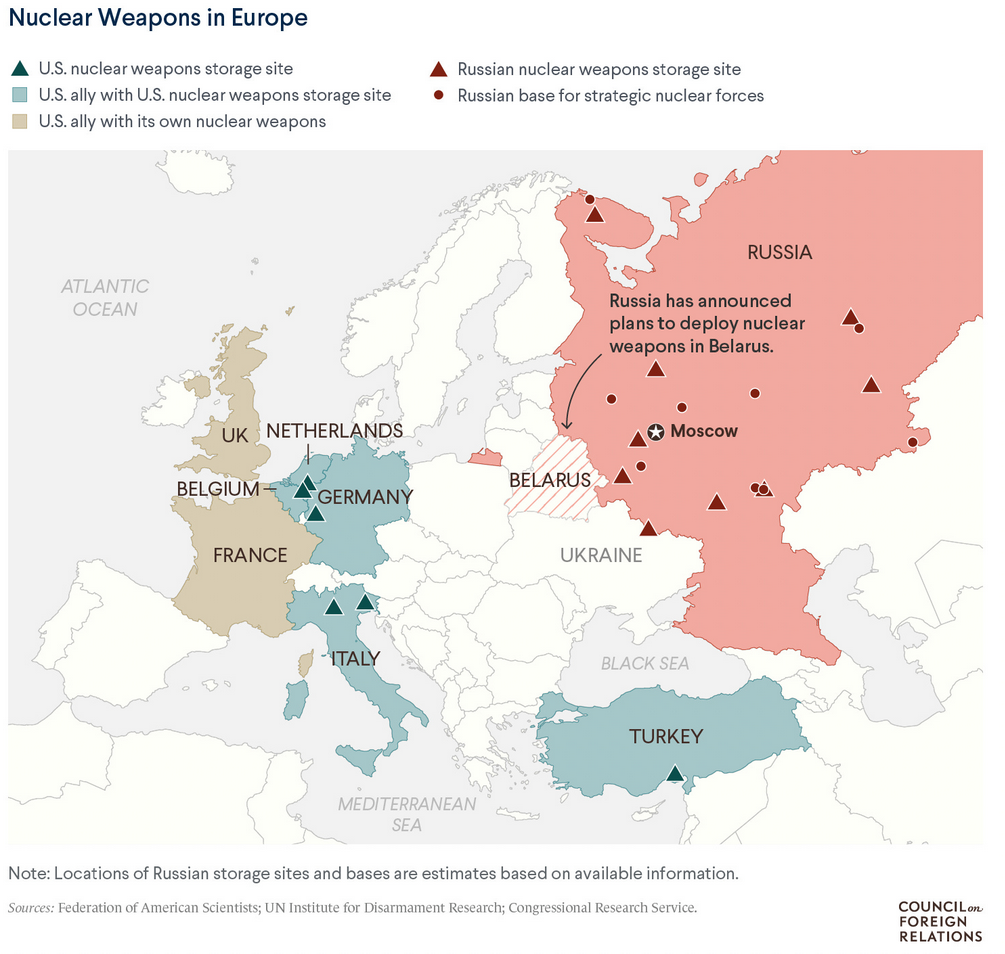
It is 2023. Just look at this map.
[…]
The Soviet Union stopped existing over three decades ago.
Even though we’ve decreased from 7,000 warheads down to 100 … there really is no reason to keep what remains in Europe.
- Gravity bombs on continental Europe – that require tactical aircraft to deliver them – are the least survivable, reliable, or timely way to deliver a nuclear weapon.
- There is no such thing as a tactical nuclear weapon. I don’t care what some theorist proposes to defend their pet theories, you lob one nuke an order of magnitude larger than the Hiroshima bomb and only a foolish nation would let their strategic nuclear forces stay unused and in danger.
- Gravity bombs are not a first strike weapon and are a poor second strike weapon. As such, you have to consider that the the time gap from approval to flash-boom would be so long the war would be over before your F-XX pickled their nuke over their target – even if the aircraft made it off the ground.
- If they are NATO weapons, you not only have to get NATO to approve their use, but host nation to as well … in addition to the USA. Do you really think the Russians would not leverage their influence with the useful idiots in the Euro-Green parties, former communists, and general black-block anti-nuke activists to politically of physically stop the use of the nukes, especially in BEL, NLD, DEU, and ITA? Add that to point 3 above.
- Especially with the weapons in Turkey – the risk of these bombs having a bad day due to human or natural causes is non-zero. In the days of mutually assured destruction, those non-zero odds were manageable, but there is no reasonable person in the third decade of the 21st Century who can with a straight face explain to you why any tactical, operational, or strategic use justify their presence. They deter no enemy, but puts every friend in danger.
- Look again at the map above. Exactly what target set are you going to “service” at that range (non-refueled)?
- If things go nuclear in Europe then the right weapons are either British, French, and if they must be American are sitting in a silo in CONUS, a SSBN in the Atlantic, or a B-2 in Missouri.
Philip II of Macedon (359 to 336 B.C.E.)
Historia Civilis
Published 24 May 2017
(more…)
April 18, 2023
Guadalcanal’s Red Beach Landing: America’s First Offensive in WW2
Forgotten Weapons
Published 24 Dec 2022After (formally) joining World War Two in the wake of Pearl Harbor, the United States endured a series of defeats at the hands of the Japanese. The Philippines garrison fell, Wake Island fell, Guam fell. British possessions in Southeast Asia teetered and fell as well — the campaign was not going well for the Allies.
The first American offensive of the war would come on August 7th, 1942 with the landing of the 1st and 5th Marines at Red Beach on Guadalcanal. Part of a multi-prong assault (the nearby Japanese bases on Tulagi and Gavutu/Tanambogo were also captured at the same time), the attack on Guadalcanal was made to secure the airstrip under Japanese construction there. If the island became an operational Japanese air base, Allied supply shipping to Australia would come under threat, and this could imperil the whole area of operations.
Fortunately for the Marines, US intelligence massively overestimated the Japanese force on Guadalcanal. It was in fact only a few hundred infantry, leading a work force of about 3,000 laborers (mostly Koreans). They thought the US landings were just a small raid, and dispersed into the jungle to wait for the US departure. Instead, the Marines were there to take the airfield and hold it. They were not, however, very well prepared. The Navy suffered a massive defeat in the waters off Guadalcanal the very next night, and would pull out of the area August 9th, leaving the Marines with dangerously low supplies of food, ammunition, and other essentials.
(more…)
April 17, 2023
Tank Chats Reloaded | Panzer IV | The Tank Museum
The Tank Museum
Published 30 Dec 2022Let’s go inside Panzer IV with another episode of Tank Chats Reloaded. Chris Copson takes a detailed look inside the tank which was considered the backbone of the Wehrmacht‘s Panzer force, uncovering the reality of what it might’ve been like to serve as a Panzer crew member in WW2.
(more…)
April 16, 2023
4,000 German teens trapped in Tarnopol – WW2 – Week 242 – April 15, 1944
World War Two
Published 15 Apr 2023Thousands of German soldiers, mostly new teenage recruits, are obeying Hitler’s “Fortress Directive” and are surrounded in Tarnopol; it does not go well for them. German forces in Ukraine manage to all pull back across the Dniester, but they are under serious pressure in the Crimea. Meanwhile, in India, the Japanese siege of Kohima continues, and in China they are poised to launch a gigantic offensive.
(more…)
April 15, 2023
Do the Germans Know About Operation Overlord?
World War Two
Published 14 Apr 2023We are getting closer and closer to D-Day and the potential liberation of Nazi Europe. But how much do the Germans know about this? Is the leak inside the British Embassy in Ankara enough to thwart the efforts of Operation Bodyguard, Operation Fortitude, and everything else the Allies are doing to deceive Adolf Hitler? Let’s find out. This is the story of Cicero.
(more…)
Type 68 North Korean Tokarev/High Power Hybrid
Forgotten Weapons
Published 18 May 2020The Type 68 is a North Korean hybrid of the Tokarev and the High Power, used as a military service pistol until replaced by the Beak-Du-San copy of the CZ75. The general outline of the gun is a copy of the Tokarev, with a modular removable fire control group, lack of manual safety, and tall thin sights. It is chambered for 7.62x25mm, and uses a magazine identical to the standard Tokarev except for not having a magazine catch cut, as the Type 68 has a heel magazine release.
Internally, the High Power elements include a detent-retained barrel pin, use of a solid barrel cam instead of a 1911/Tokarev swinging link, and a fixed barrel bushing. Two patterns of markings exist, one with a date and North Korean marking, and one (like this example) with only a serial number.
North Korean guns of all types are very rare in the United States. A very small number of Type 68s have come into the US, generally through Central America (probably via Cuba) and South Africa (via Rhodesia/Zimbabwe).
Update: It appears that the original design work for these was done by an independent engineering firm in Yugoslavia. The design (a TT33 with High Power type locking and angled slide serrations) was not completed in time for the trials that would lead to adoption of the Yugoslav M57, and the drawings were transferred to “another country” — probably North Korea.
(more…)
April 14, 2023
QotD: The three great strategic sins
The second sin is the elevation of operational concerns over strategic ones, the usurpation of strategy with operations, which we have discussed before. This is, by the by, also an error in managing the relationship of the trinity, allowing the general’s role in managing friction to usurp the state’s role in managing politics.
Perhaps the greatest example of this is the Japanese attack on Pearl Harbor; an operational consideration (the destruction of the US Pacific Fleet) and even the tactics necessary to achieve that operational objective, were elevated above the strategic consideration of “should Japan, in the midst of an endless, probably unwinnable war against a third-rate power (the Republic of China) also go to war with a first-rate power (the United States) in order to free up oil-supplies for the first war”. Hara Tadaichi’s pithy summary is always worth quoting, “We won a great tactical victory at Pearl Harbor and thereby lost the war.”
How does this error happen? It tends to come from two main sources. First, it usually occurs most dramatically in military systems where the military leadership – which has been trained for operations and tactics, not strategy, which you will recall is the province of kings, ministers and presidents – usurps the leadership of the state. Second, it tends to occur when those military leaders – influenced by their operational training – take the operational conditions of their planning as assumed constants. “What do we do if we go to war with the United States” becomes “What do we do when we go to war with the United States” which elides out the strategic question “should we go to war with the United States?” entirely – and catastrophically, as for Imperial Japan, the answer to that unasked question of should we do this was clearly Oh my, NO.
(Bibliography note: It would hardly be fitting for me to declare these errors common and not provide examples. Two of the best case-studies I have read in this kind of strategic-thinking-failure-as-organizational-culture-failure are I. Hull, Absolute Destruction: Military Culture and the Practices of War in Imperial Germany (2005) and Parshall and Tully, Shattered Sword: The Untold Story of the Battle of Midway (2005). Also worth checking out, Daddis, “Chasing the Austerlitz Ideal: The Enduring Quest for Decisive Battle” in Armed Forces Journal (2006): 38-41. The same themes naturally come up in Daddis, Withdrawal: Reassessing America’s Final Years in Vietnam (2017)).
The third and final sin is easy to understand: a failure to update the strategy as conditions change. Quite often this happens in conjunction with the second sin, as once those operational concerns take over the place of strategy, it becomes difficult for leaders to consider new strategy as opposed to simply new operations in the pursuit of strategic goals which are often already lost beyond all retrieval. But this can happen without a subordination failure, due to sunk-costs and the different incentives faced by the state and its leaders. The classic example being functionally every major power in the First World War: by 1915 or 1916, it ought to have been obvious that no gains made as a result of the war could possibly be worth its continuance. Yet it was continued, both because having lost so much it seemed wrong to give up without “victory” and also because, for the politicians who had initially supported the war, to admit it was a useless waste was political suicide.
Bret Devereaux, “Collections: The Battle of Helm’s Deep, Part VIII: The Mind of Saruman”, A Collection of Unmitigated Pedantry, 2020-06-19.
April 10, 2023
It’s totally normal for a country to send troops overseas and neglect paying to feed them, right?
This week’s Dispatch post from The Line includes some commentary on the story I linked to last week from the Ottawa Citizen, reporting that Canadian soldiers sent to Poland to train Ukrainian troops are being stiffed by the Department of National Defence on their food bills:
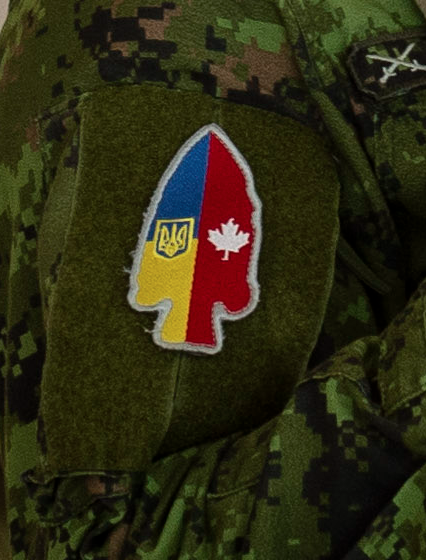
Operation Unifier shoulder patch for Canadian troops in Ukraine.
Detail from a photo in the Operation Unifier image gallery
Here’s a totally normal story from a well-functioning country that isn’t at all broken: it turns out that processing per diems for a hundred or so folks is now beyond the capability of the federal government.
This story came to us courtesy the Ottawa Citizen, where David Pugliese reported that the company sized unit of Canadian military personnel operating in Poland has seen months worth of expense filings go unpaid. In some situations, a military unit sent abroad would include its own logistical support team, including cooks. In other situations, a relatively small unit sent to a place with functioning civilian infrastructure is told to feed themselves and keep the receipts for reimbursement. For our troops in Poland, there to provide logistical and training support to Ukrainian forces since October, the government went the latter route.
And that’s fine. Really. Frankly, we’re sure the troops are happier eating out at local places and enjoying delicious Polish food — really, it’s amazing — than getting three servings of military slop a day. The problem, though, as these poor troops discovered, is that the military and national defence bureaucracy no longer has the ability to process the expense payments. So these balances are just sitting on their personal credit cards. For months.
[…]
The mission began in October.
It seems almost pointless to add much actual insight and analysis here. This kind of dysfunction speaks for itself. We’ll limit ourselves to two comments: operational deployments are incredible stressful on military personnel and their families on the homefront. That’s uncontroversial, and unavoidable. That’s why military service is recognized as a sacrifice even during peacetime deployments. The basic bargain we make with our servicemembers is while they are serving their country abroad, their country will take care of their families at home. Leaving these families with high-interest credit-card balances they can’t pay off because the Canadian government is too broken to reimburse soldiers for expenses they were told to incur is an on-the-nose failure of Canada to honour its debt to the the military parents, spouses and children who have been, in effect, ordered to advance the Canadian government money to subsidize military deployments.
The second comment we’ll make, is that this isn’t just further evidence in support of the Canada-is-broken thesis — it’s a very specific kind of break. We’ve all known that Canadian governments, at all levels, have struggled to turn new policies into new programs. That’s not new. But even granting that failure, we’ve generally been able to keep doing the things we already do. There seemed to be enough residual muscle memory in our governments. Can we do new things? No, not really. But we’ll keep doing the stuff we already do.
This military fiasco is alarming because it’s a sign that our state-capacity issues are now extending into areas that previously worked. Not only are we struggling to do new things, we’re forgetting how to do things we used to be able to do. This goes beyond what our typical gripes about state capacity. This is something else. This is state atrophy, or rot.
Now that the public is paying attention, we suspect we’ll see some reasonably rapid progress. The government will throw bureaucrats and maybe consultants at the problem until it goes away. This is how they have reacted to similar issues: we hurled ground staff at airport delays until they cleared, and bureaucrats at passport offices until the backlogs eased.
But we have to ask why we now require exceptional redeployments of staff to maintain typical levels of service. And we don’t like the answers we can come up with. Ottawa has added tens of thousands of civil servants, at an annual cost of tens of billions, in recent years. During that time Ottawa has also sharply ramped up spending on consultants; the annual cost now surpasses $20 billion.
And yet.
What the hell is going on?
I’ve been saying for literally years now, the more the government tries to do the less well it does everything, and this fiasco is a perfect example of that sclerosis spreading further.
The Crimean Naval War at Sea – Battleships, Bombardments and the Black Sea
Drachinifel
Published 5 Apr 2023Today we take a look at most of the naval theaters of the Crimean War on conjunction with the fine people @realtimehistory find their video here: Last Crusade or F…
(more…)
US Army and Marine Corps deployments other than with the American Expeditionary Forces (AEF)
Another excerpt from John Sayen’s Battalion: An Organizational Study of United States Infantry currently being serialized on Bruce Gudmundsson’s Tactical Notebook shows where US infantry units (US Army and USMC) were deployed aside from those assigned to Pershing’s AEF on the Western Front in France:
Apart from the war in Europe, the principal military concern of the Wilson administration during 1917-18 was the protection of resources and installations considered vital to the war effort. The threat of German sabotage in the United States was taken very seriously. In addition, Mexico was still unstable politically and sporadic border clashes continued to occur into 1919. Mexican oil was also regarded as an essential resource and the troops stationed on the Mexican border were prepared to invade in order to keep it flowing. However, all the National Guard, National Army, and even the Regular Army regiments raised for wartime only were reserved for duty with the AEF. (The National Army 332nd and 339th Regiments did deploy to Italy and North Russia, respectively, but both remained under AEF command.) This left non-AEF assignments in the hands of the pre-war Regular Army regiments.
Out of 38 Regular infantry regiments available in 1917, 25 were on guard duty within the Continental United States or on the Mexican border and 13 garrisoned U.S. possessions overseas. Local defense forces raised in Hawaii and the Philippines eventually freed the pre-war regiments stationed in those places for duty elsewhere. By the end of the war the 15th Infantry in China, the 33rd and 65th (Puerto Rican) Infantry in the Canal Zone, and the 27th and 31st Infantry (both under the AEF tables) in Siberia were the only non-AEF regiments still overseas. Inside the United States state militia (non-National Guard) units and 48 newly raised battalions of “United States Guards” (recruited from men physically disqualified for overseas service) had freed 20 regiments from stateside guard duties, but not in time for any of them to fight in France.
Only twelve pre-war regiments actually saw combat in the AEF. Nine of them served with the early-arriving 1st, 2nd, and 3rd AEF Divisions. The other three were with the late arriving 5th and 7th Divisions. One more reached France with the 8th Division, but only days ahead of the Armistice. By this time, the Regular Army regiments had long ago been stripped of most of their pre-war men to provide cadre for new units. They were refilled with so many draftees that their makeup scarcely differed from those of the National Army.*
The situation with the Marines was similar to that of the Regular Army. Most Marine regiments had to perform security and colonial policing duties that kept them away from the “real” war in France. Also like the Army, the Marines made Herculean efforts to accommodate a flood of recruits, acquiring training bases at Quantico Virginia and Parris Island South Carolina, as their existing facilities became too crowded. The Second Regiment (First Provisional Brigade) continued to police Haiti while the Third and Fourth Regiments (Second Provisional Brigade) did the same for the Dominican Republic. The First Regiment remained at Philadelphia as the core of the Advance Base Force (ABF) but its role soon became little more than that of a caretaker of ABF equipment.
Although there was little danger from the German High Seas Fleet ABF units might still be needed in the Caribbean to help secure the Panama Canal and a few other critical points against potential attacks by German surface raiders or heavily armed “U-cruisers.” Political unrest was endangering both the Cuban sugar crop and Mexican oil. To address such concerns, the Marines raised the Seventh, Eighth, and Ninth Regiments as infantry units in August, October, and November 1917, respectively. The Seventh, with eight companies went to Guantanamo, Cuba, to protect American sugar interests. The Ninth Regiment (nine companies) and the headquarters of the Third Provisional Brigade followed. The Eighth Regiment with 10 companies, meanwhile, went to Fort Crockett near Galveston, Texas to be available to seize the Mexican oil fields with an amphibious landing, should the situation in Mexico get out of hand.
Three other rifle companies (possibly the ones missing from the Seventh and Ninth Regiments) occupied the Virgin Islands against possible raids by German submarines. In August 1918, the Seventh and Ninth Regiments expanded to 10 companies each. The situation in Cuba having subsided, the Marine garrison there was reduced to just the Seventh Regiment. The Ninth Regiment and the Third Brigade headquarters joined the Eighth at Fort Crockett.**
* Order of Battle of the United States Land Forces in the World War op cit pp. 310-314 and 1372-1379. A battalion of United States Guards was allowed 31 officers and 600 men. These units were recruited mainly from draftees physically disqualified for overseas service. The 27th and 31st Infantry when sent to Siberia were configured as AEF regiments, though they were never part of the AEF. Large numbers of men had to be drafted out of the 8th Division to build these two regiments up to AEF strength. This seriously disrupted the 8th Division’s organization.
** Order of Battle of the United States Land Forces in the World War op cit pp. 1372-78; Truman R. Strobridge, A Brief History of the Ninth Marines (Washington DC, Historical Division HQ US Marine Corps; revised version 1967) pp. 1-2; James S. Santelli, A Brief History of the Eighth Marines (Washington DC, Historical Division HQ US Marine Corps; 1976) pp. 1-3; and James S. Santelli, A Brief History of the Seventh Marines (Washington DC, Historical Division HQ US Marine Corps; 1980) pp. 1-5.


