
WW2TV
Published 17 Jan 2021Part 2 – The Plan With David O’Keefe
David O’Keefe joins us again. In Part 1 he talked about the real reason for the raid on Dieppe in August 1942. In Part 2 we talk about the plan for Operation Jubilee and David will share his presentation about the intentions of the raid and how it was supposed to unfold.
A final show sometime in the summer will come live from Dieppe to explain how the plan unravelled and how the nearly 1,000 British, Canadian and American commandos died.
(more…)
August 18, 2023
One Day in August – Dieppe – Part 2 – The Plan
Comments Off on One Day in August – Dieppe – Part 2 – The Plan
Did Hitler Cancel the Sturmgewehr?
Forgotten Weapons
Published 10 May 2023It is often said that Hitler personally cancelled the Sturmgewehr development … could that really be true?
Yes! He actually nixed the program three separate times, and the German Army General Staff continued the project behind his back. They knew the rifle was what the Wehrmacht desperately needed if it was to have any hope of victory in the East, and they were determined to bring it to fruition. He did ultimately relent, and approved it to replace the Mauser K98k in early 1944 — but by that time a great deal of opportunity had been lost. Today we will delve into the details of just how the program developed as it pertains to his approval …
(more…)
Comments Off on Did Hitler Cancel the Sturmgewehr?
August 17, 2023
“… the Chinese invented gunpowder and had it for six hundred years, but couldn’t see its military applications and only used it for fireworks”
John Psmith would like to debunk the claim in the headline here:
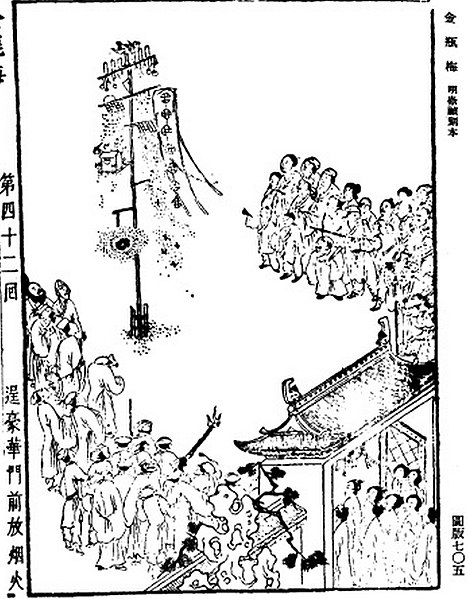
An illustration of a fireworks display from the 1628-1643 edition of the Ming dynasty book Jin Ping Mei (1628-1643 edition).
Reproduced in Joseph Needham (1986). Science and Civilisation in China, Volume 5: Chemistry and Chemical Technology, Part 7: Military Technology: The Gunpowder Epic. Cambridge University Press. Page 142.
There’s an old trope that the Chinese invented gunpowder and had it for six hundred years, but couldn’t see its military applications and only used it for fireworks. I still see this claim made all over the place, which surprises me because it’s more than just wrong, it’s implausible to anybody with any understanding of human nature.
Long before the discovery of gunpowder, the ancient Chinese were adept at the production of toxic smoke for insecticidal, fumigation, and military purposes. Siege engines containing vast pumps and furnaces for smoking out defenders are well attested as early as the 4th century. These preparations often contained lime or arsenic to make them extra nasty, and there’s a good chance that frequent use of the latter substance was what enabled early recognition of the properties of saltpetre, since arsenic can heighten the incendiary effects of potassium nitrate.
By the 9th century, there are Taoist alchemical manuals warning not to combine charcoal, saltpetre, and sulphur, especially in the presence of arsenic. Nevertheless the temptation to burn the stuff was high — saltpetre is effective as a flux in smelting, and can liberate nitric acid, which was of extreme importance to sages pursuing the secret of longevity by dissolving diamonds, religious charms, and body parts into potions. Yes, the quest for the elixir of life brought about the powder that deals death.
And so the Chinese invented gunpowder, and then things immediately began moving very fast. In the early 10th century, we see it used in a primitive flame-thrower. By the year 1000, it’s incorporated into small grenades and into giant barrel bombs lobbed by trebuchets. By the middle of the 13th century, as the Song Dynasty was buckling under the Mongol onslaught, Chinese engineers had figured out that raising the nitrate content of a gunpowder mixture resulted in a much greater explosive effect. Shortly thereafter you begin seeing accounts of truly destructive explosions that bring down city walls or flatten buildings. All of this still at least a hundred years before the first mention of gunpowder in Europe.
Meanwhile, they had also been developing guns. Way back in the 950s (when the gunpowder formula was much weaker, and produced deflagarative sparks and flames rather than true explosions), people had already thought to mount containers of gunpowder onto the ends of spears and shove them in peoples’ faces. This invention was called the “fire lance”, and it was quickly refined and improved into a single-use, hand-held flamethrower that stuck around until the early 20th century.1 But some other inventive Chinese took the fire lances and made them much bigger, stuck them on tripods, and eventually started filling their mouths with bits of iron, broken pottery, glass, and other shrapnel. This happened right around when the formula for gunpowder was getting less deflagarative and more explosive, and pretty soon somebody put the two together and the cannon was born.
All told it’s about three and a half centuries from the first sage singing his eyebrows, to guns and cannons dominating the battlefield.2 Along the way what we see is not a gaggle of childlike orientals marvelling over fireworks and unable to conceive of military applications. We also don’t see an omnipotent despotism resisting technological change, or a hidebound bureaucracy maintaining an engineered stagnation. No, what we see is pretty much the opposite of these Western stereotypes of ancient Chinese society. We see a thriving ecosystem of opportunistic inventors and tacticians, striving to outcompete each other and producing a steady pace of technological change far beyond what Medieval Europe could accomplish.
Yet despite all of that, when in 1841 the iron-sided HMS Nemesis sailed into the First Opium War, the Chinese were utterly outclassed. For most of human history, the civilization cradled by the Yellow and the Yangtze was the most advanced on earth, but then in a period of just a century or two it was totally eclipsed by the upstart Europeans. This is the central paradox of the history of Chinese science and technology. So … why did it happen?
1. Needham says he heard of one used by pirates in the South China Sea in the 1920s to set rigging alight on the ships that they boarded.
2. I’ve left out a ton of weird gunpowder-based weaponry and evolutionary dead ends that happened along the way, but Needham’s book does a great job of covering them.
Comments Off on “… the Chinese invented gunpowder and had it for six hundred years, but couldn’t see its military applications and only used it for fireworks”
Dieppe – One Day in August – Ian Fleming, Enigma and the Deadly Raid – Part 1
WW2TV
Published 29 Nov 2020In less than six hours in August 1942, nearly 1,000 British, Canadian and American commandos died in the French port of Dieppe in an operation that for decades seemed to have no real purpose. Was it a dry-run for D-Day, or perhaps a gesture by the Allies to placate Stalin’s impatience for a second front in the west?
Canadian historian David O’Keefe uses hitherto classified intelligence archives to prove that this catastrophic and apparently futile raid was in fact a mission, set up by Ian Fleming of British Naval Intelligence as part of a “pinch” policy designed to capture material relating to the four-rotor Enigma machine that would permit codebreakers like Alan Turing at Bletchley Park to turn the tide of the Second World War.
In this first show we will look at how the raid has been written about in previous books and the research David undertook and as importantly why he did it. In a future show, we will look at filming in Dieppe itself and explain the sequence of events.
(more…)
Comments Off on Dieppe – One Day in August – Ian Fleming, Enigma and the Deadly Raid – Part 1
See Inside Char B1 | French Tanks of World War Two
The Tank Museum
Published 12 May 2023Chris Copson goes inside one of his personal favourite tanks, the Second World War French Char B1, to discover the quirks and surprises hidden within. Find out why these tanks performed so badly against the German onslaught of 1940, despite being bigger and more heavily armoured than the vehicles they faced.
(more…)
Comments Off on See Inside Char B1 | French Tanks of World War Two
August 16, 2023
Hitler Youth Murder Canadian Soldiers – War Against Humanity 109
[NR: Between me scheduling this to post and it going live, there’s a strong possibility that YouTube will have retro-actively decided it must be restricted to viewing only on YouTube. My apologies if this is the case when you see this post.]
World War Two
Published 15 Aug 2023In Normandy, the Waffen SS butcher their military and civilian enemies while some Allied soldiers play fast and loose with the laws of the war. In China, hundreds of thousands flee their homes as friend, foe, and famine take their toll. Meanwhile, the spectre of deportation haunts Eastern Europe as Stalin reshapes his new empire.
(more…)
Comments Off on Hitler Youth Murder Canadian Soldiers – War Against Humanity 109
August 15, 2023
Gnome et Rhône R5: A Foiled Communist Arms Plan
Forgotten Weapons
Published 26 Apr 2023The R-5 was a French-made copy of the Sten produced after the 1944 liberation of France. It was built by Gnome et Rhône, a French company best known for making aircraft engines. The Sten was familiar to French forces, as many had been supplied as military aid to the Free French as well as Resistance organizations — and it was also a simple and cheap weapon to make.
In the aftermath of Liberation, there was a lot of political jockeying for power in France. Many different factions had armed themselves during occupation, from the far right to the far left, and everyone wanted to be in a position of power in post-war France. Gnome et Rhône was contracted to make 20,000 of the R-5 submachine guns specifically for the PCF, the French Communist Party (Parti communiste français). The Gaullist government found out about the production and took the guns for itself before any reached the PCF.
The R-5 (named because it was produced in Limoges, in the 5th Region of France as organized during the Resistance) was parts-interchangeable with the standard British MkII Sten, despite having a number of unique features. The R5 used a barrel 60mm (2.5 inches) longer than the standard Sten barrel, a solid wooden stock of the same shape as the MkII, and a vertical front grip inspired by the Thompson. Although missing on this example, it also had a rotating receiver cover that could be used to lock the bolt in the forward position.
Of the 20,000 R-5s ordered, only 8,000 were delivered as best we can tell today. They were used by the military within France and also in Indochina and even into Algeria. In the immediate postwar years France was heavily dependent on US and UK war material, but wanted to equip a larger force than the Anglo-American allies were planning to supply. The R-5 made a useful interim weapon while the French arms industry reestablished itself and eventually developed the MAS-49 rifle family and the MAT-49 submachine gun.
(more…)
Comments Off on Gnome et Rhône R5: A Foiled Communist Arms Plan
August 14, 2023
The Mighty Carl Gustaf MAAWS: A King Among Weapons
Interesting Engineering
Published 3 May 2023The Carl Gustaf recoilless rifle, produced by Saab Bofors Dynamics, is an adaptable and portable weapon system designed for anti-tank and anti-structure operations. Its original design was widely adopted by European armies as a primary anti-tank weapon before being replaced by the superior Carl Gustaf M2 in 1964.
In the early 1990s, the U.S. Army took an interest in the M3 model due to its lightweight design, versatility, and powerful anti-tank and anti-structure capabilities. It was initially adopted by the Army’s Special Operations Command (USASOC) and gained popularity among soldiers for its ease of use, accuracy, and effectiveness against a range of targets.
Compared to other weapons like the AT-4 and the FGM-148 Javelin, the M3 offers the advantage of reloadability thanks to its rifled metal/carbon fiber launch tube. At 22 lbs (10 kg), it is more manageable than the Javelin’s 50 lbs (22.7 kg), allowing for faster engagement compared to waiting for mortar support. It is also more cost-effective than the Javelin and artillery shells when targeting enemies in hard cover.
Overall, the Carl Gustaf recoilless rifle is a powerful and effective weapon system that has been widely adopted by militaries around the world. Its continued development and advancement in technology ensure that it will remain an important tool in modern warfare for years to come.
(more…)
Comments Off on The Mighty Carl Gustaf MAAWS: A King Among Weapons
QotD: The US Army in the Korean War
Korea was the kind of war that since the dawn of history was fought by professionals, by legions. It was fought by men who soon knew they had small support or sympathy at home, who could read in the papers statements by prominent men that they should be withdrawn. It was fought by men whom the Army — at its own peril — had given neither training nor indoctrination, nor the hardness and bitter pride men must have to fight a war in which they do not in their hearts believe.
The Army needed legions, but society didn’t want them. It wanted citizen-soldiers.
But the sociologists are right — absolutely right — in demanding that the centurion view of life not be imposed upon America. In a holy, patriotic war — like that fought by the French in 1793, or as a general war against Communism will be — America can get a lot more mileage out of citizen-soldiers than it can from legions.
No one has suggested that perhaps there should be two sets of rules, one for the professional Army, which may have to fight in far places, without the declaration of war, and without intrinsic belief in the value of its dying, for reasons of policy, chessmen on the checkerboard of diplomacy; and one for the high-minded, enthusiastic, and idealistic young men who come aboard only when the ship is sinking.
The other answer is to give up Korea-type wars, and to surrender great-power status, and a resultant hope of order — our own decent order — in the world. But America is rich and fat and very, very noticeable in this world.
It is a forlorn hope that we should be left alone.
In the first six months America suffered a near debacle because her Regular Army fighting men were the stuff of legions, but they had not been made into legionaries.
America was not more soft or more decadent than it had been twenty years earlier. It was confused, badly, on its attitudes toward war. It was still bringing up its youth to think there were no tigers, and it was still reluctant to forge them guns to shoot tigers.
Many of America’s youth, in the Army, faced horror badly because they had never been told they would have to face horror, or that horror is very normal in our unsane world. It had not been ground into them that they would have to obey their officers, even if the orders got them killed.
It has been a long, long time since American citizens have been able to take down the musket from the mantelpiece and go tiger hunting. But they still cling to the belief that they can do so, and do it well, without training.
This is the error that leads some men to cry out that Americans are decadent.
If Americans in 1950 were decadent, so were the rabble who streamed miserably into Valley Forge, where von Steuben made soldiers out of them. If American society had no will to defend itself, neither did it in 1861, at First Manassas, or later at Shiloh, when whole regiments of Americans turned tail and ran.
The men who lay warm and happy in their blankets at Kasserine, as the panzers rolled toward them in the dawn, were decadent, by this reasoning.
The problem is not that Americans are soft but that they simply will not face what war is all about until they have had their teeth kicked in. They will not face the fact that the military professionals, while some have ideas about society in general that are distorted and must be watched, still know better than anyone else how a war is won.
Free society cannot be oriented toward the battlefield — Sparta knew that trap — but some adjustments must be made, as the squabbling Athenians learned to their sorrow.
The sociologists and psychologists of Vienna had no answer to the Nazi bayonets, when they crashed against their doors. The soldiers of the democratic world did.
More than once, as at Valley Forge, after Bull Run, and Kasserine, the world has seen an American army rise from its own ashes, reorient itself, grow hard and bitter, knowledgeable and disciplined and tough.
In 1951, after six months of being battered, the Eighth Army in Korea rose from its own ashes of despair. No man who was there still believes Americans in the main are decadent, just as no man who saw Lieutenant General Matt Ridgway in operation doubts the sometime greatness of men.
T.R. Fehrenbach, This Kind of War: A Study in Unpreparedness, 1963.
Comments Off on QotD: The US Army in the Korean War
August 13, 2023
Panzer Revenge in Normandy – WW2 – Week 259 – August 12, 1944 (CENSORED)
World War Two
Published 12 Aug 2023The Germans launch a counter-attack to sabotage the Allied positions in France. In the Baltics the Soviet advances grind to a halt, but the Soviets are busy making plans to invade Romania in the south. Meanwhile in the center the Warsaw Uprising continues. Across the world the siege of Hengyang comes to its end with a Japanese victory, but the Battle for Guam ends with a Japanese loss.
[Promoted from the comments]: An increasingly persistent challenge for us at TimeGhost is that a growing number of our videos are being age restricted. While this was always the case with War Against Humanity, it’s started affecting this weekly series now too. This most recent video was restricted before it was even publicly published. As such we made the difficult decision to publish a censored version instead this week.
Why is it such a big issue? Well it doesn’t only limit the access to educational content for young people, but also to adult audiences. Age restricted videos have a barrier to viewing that ranges from territory to territory, with some countries requiring viewers not only to have a YouTube account, but to link it with their credit card. Even if an account belongs to a verified adult, it’s still less likely to be recommended an age restricted video.
Our core mission at TimeGhost is making the lessons of our past free and accessible to people around the world. While it’s challenging, especially with the new obstacles from YouTube, it’s still possible thanks to everyone in the TimeGhost Army who backs these videos. To all of you that signed up, or who watch regularly, thank you for joining us on this mission.
Comments Off on Panzer Revenge in Normandy – WW2 – Week 259 – August 12, 1944 (CENSORED)
August 12, 2023
Churchill and India
Andreas Koureas posted an extremely long thread on Twitter, outlining the complex situation he and his government faced during the Bengal Famine of 1943, along with more biographical details of Churchill’s views of India as a whole (edits and reformats as needed):
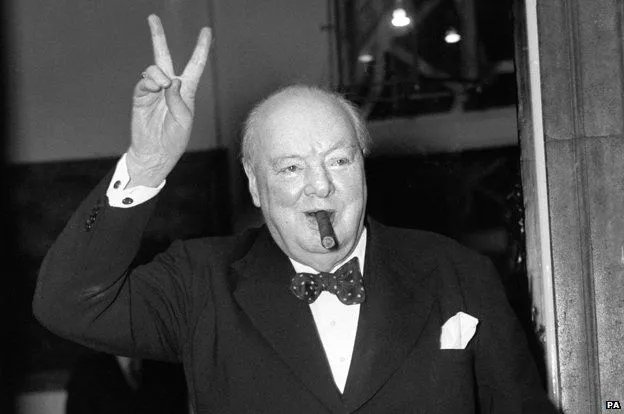
The most misunderstood part of Sir Winston Churchill’s life is his relationship with India. He neither hated Indians nor did he cause/contribute to the Bengal Famine. After reading through thousands of pages of primary sources, here’s what really happened.
A thread 🧵
I’ve covered this topic before, but in a recent poll my followers wanted a more in-depth thread. Sources are cited at the end. I’m also currently co-authoring a paper for a peer reviewed journal on the subject of the Bengal Famine, which should hopefully be out later this year.
I’ll first address the Bengal Famine (as that is the most serious accusation) and then Churchill’s general views on India. It goes without saying that there will be political activists who will completely ignore what I have to say, as well as the primary sources I’ll cite. I have no doubt, that just like in the past, there will be those who accuse me of only using “British sources”.
This is not true. I have primary sources written by Indians as well as papers by Indian academics.
Moreover, I have no doubt that such activists will, choose to “cite” the ahistorical journalistic articles from The Guardian or conspiratorial books like Churchill’s Secret War by Mukerjee — a debunked book that ignores most of what I’m about to write about, and is really what sparked the conspiracy of Churchill and the Bengal Famine. For everyone else, I hope you find this thread useful.
(more…)
Comments Off on Churchill and India
Hotchkiss Universal SMG
Forgotten Weapons
Published 27 Aug 2012The Hotchkiss Universal is a pretty interesting submachine gun, despite its rather clumsy appearance. The overriding design intent was to make a very compact folding carbine, and Hotchiss certainly met that objective. However, the gun ended up being too expensive and complex to achieve any real commercial success. Some wound up in Indochina, and some sales were made to Venezuela and Morocco, but that was about the extent of the Universal’s production. There are a few of these guns that were imported into the US as live semi-auto carbines, interestingly.
(more…)
Comments Off on Hotchkiss Universal SMG
August 10, 2023
MOBAT, WOMBAT, CONBAT | Anti-Tank Chats
The Tank Museum
Published 5 May 2023Welcome to this episode of Anti-Tank Chats. Today, Chris will be discussing the variations of a lesser-known weapon, the British Army’s B.A.T. (Battalion Anti-Tank Gun).
(more…)
Comments Off on MOBAT, WOMBAT, CONBAT | Anti-Tank Chats
August 9, 2023
America Plans to Incinerate Japan – War Against Humanity 107
World War Two
Published 8 Aug 2023The Allied Strategic bombing campaign has claimed hundreds of thousands of civilian lives across Europe and has made little real impact on the Axis war machine. Even so, the United States is determined to extend the campaign to Japan. Until now, the vast distances of the Asia-Pacific theatre have protected the imperial enemy. That all changes when the USAAF unleashes the Superfortress.
(more…)
Comments Off on America Plans to Incinerate Japan – War Against Humanity 107
Russian 1895 Nagant Revolver
Forgotten Weapons
Published 20 May 2013One of the mechanically interesting guns that is really widely available in the US for a great price (or was until very recently, it seems) is the Russian M1895 Nagant revolver. It was adopted by the Imperial Russian government in 1895 (replacing the Smith & Wesson No.3 as service revolver), and would serve all the way through World War II in the hands of the Red Army.
As with its other standard-issue arms, the Russian government intended to manufacture the M1895 revolvers domestically. However, when the Nagant was officially adopted the major Russian arsenals were already working at capacity to make the relatively new M1891 rifle, so the first 20,000 revolvers were made by Nagant in Liege, Belgium. In 1898 space had been freed up to start production at the Tula arsenal, where they would be made until 1945 (Ishevsk put the Nagant revolver into production as well during WWII).
The common version available in the US today is a 7-shot, double action revolver chambered for 7.62x38mm. That cartridge is a very long case with the bullet sunk down well below the case mouth. The cylinder of the Nagant cams forward upon firing, allowing the case mount to protrude into the barrel and seal the cylinder gap, thus increasing muzzle velocity slightly. This also allows the Nagant to be used effectively with a suppressor, unlike almost all other revolvers (in which gas leaking from the cylinder gap defeats the purpose of a suppressor).
The Nagant’s 7.62x38mm cartridge pushes a 108 grain jacketed flat-nose projectile at approximately 850 fps (I believe a lighter 85-grain load was also used by the military later, but I haven’t fired any of it), which puts it roughly between .32 ACP and .32-20 ballistics. Not a hand cannon by any stretch, but fairly typical for the era (the 8mm Nambu and 8mm French revolver cartridges were both pretty similar in performance to the 7.62mm Nagant).
As far as being a shooter, the Nagant is mediocre, but reliable. The grip and sights are acceptable (but not great), and the cylinder loads and unloads one round at a time. The low pressure round doesn’t stick in the cylinder, at least. The worst part for a recreational shooter is the trigger, which is very heavy in double action. Single action is also heavy, but very crisp. Recoil is mild, and not uncomfortable at all. The design was simple and effective, and really a good fit for the Red Army and WWII fighting conditions.
Comments Off on Russian 1895 Nagant Revolver


