
World War Two
Published 30 Aug 2023The Germans are assaulting London with waves of V-1 flying bombs. But Eddie Chapman, a career criminal, serial womaniser, and masterful double agent working for MI5’s Double Cross is fighting a secret battle to beat the bombs. When he’s done with that, he pulls the wool over the Reich’s eyes to help Britain beat the Kriegsmarine. This is Agent Zigzag.
(more…)
August 31, 2023
The Double Agent Saving London From the V-1 – WW2 Documentary Special
Comments Off on The Double Agent Saving London From the V-1 – WW2 Documentary Special
August 30, 2023
The endless search for the “Easy mode” in military conflict
CDR Salamander on the search for shortcuts to military excellence, despite literal millennia of evidence that there are no such shortcuts:
As the Russo-Ukrainian War reaches its 20th month, I hope everyone has been sufficiently sobered up to stand firmly against those promoting the “72-hour War” or spin an attractive story about some transformational secret sauce that provides an “easy button” for those tasked to do the very hard work of preparing a nation for war should, and if, it were to come.
See the Battle of Hostomel if you need a recent example of where buying this wishcasting can get you.
There is a reason we have continually railed against this Potomac Flotilla mindset for the better part of two decades here — it is the self-delusion of faculty lounge theories running up against the Gods of the Military Copybook Headings reality what we have thousands of years of experience to reference.
We are not smarter than previous generations. There is no secret weapon or war winning technology — or magic beans — that will allow us to skip past the hard work of a viable strategy backed up by a properly resourced industrial capacity to build, maintain, deploy, and sustain a fighting force on the other side of the Pacific for years if needed.
Not 24-hours. Not 72-hours. Think 72-weeks to 72-months and you have your mind right.
[…]
We do no one any good allowing free run towards the national security version of the prosperity gospel, a branch of the transformationalist cult, and their “name it and claim it” attitude towards solving hard problems.
From LCS to DDG-1000, to optimal manning, to six-sigma supply nightmares, to 100-hour workweeks, to 72-hour war CONOPS, to the “Deter by Punishment,” to “1,000 ship navy,” to the offset of this POM cycle, to counter-historical excuses for … again … not doing the hard work that takes so long to bear fruit that someone else will get credit for it.
Every time we have our top leaders — smart hard working professionals with the best intentions — step up to sound more like this guy — the worse we will all be.
It degrades them and endangers everyone.
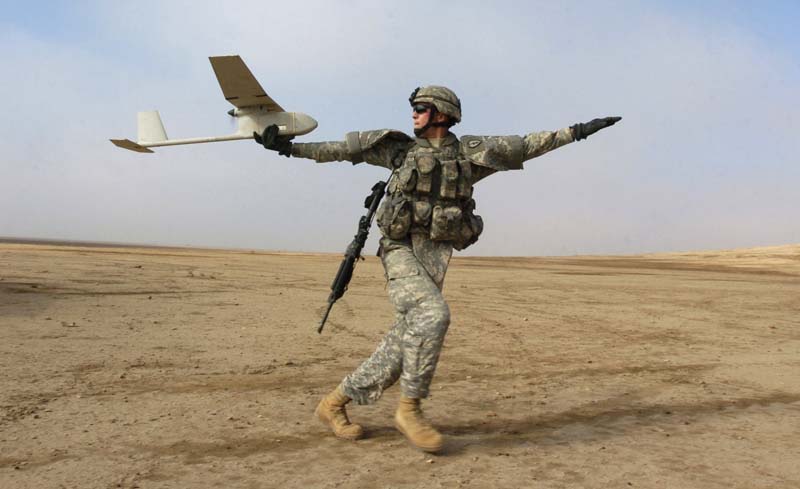
We don’t need to sell the utility of small drones being used down to the lowest levels of responsibility — it is demonstrated every day.
What we do need sold is Congress’s need to fund a revitalization of our defense industrial capacity and a focus on the naval and aerospace forces that will do most of the fighting in any expected war west of the International Dateline.
Supported by swarms of drones of all shapes and sizes.

Comments Off on The endless search for the “Easy mode” in military conflict
August 29, 2023
A Rare World War One Sniper’s Rifle: Model 1916 Lebel
Forgotten Weapons
Published 28 Feb 2018Unlike Great Britain and Germany, the French military never developed a formal sniper doctrine during World War One — they had no dedicated schools or instruction manuals for that specialty. The three major arsenals did produce scoped sniping rifles, however, with models of 1915, 1916, and 1917 (and a post-war 1921 pattern). We have a model 1916 example here today.
The rifles were completely ordinary off-the-rack Lebels, modified simply to add scope mounts. The 1916 pattern mount used a round peg on the side of the rear sight and a bracket wrapped around the front of the receiver, which allowed the scope to be quickly and easily detached for carry in a separate pouch (similar to what other nations did, to protect the optic from damage when not in use). The rifles were issued only in small numbers (2 per company, or even 2 per battalion) and it was left to the unit commander to decide how to employ them.
This particular scope has some neat provenance of being brought home by a US soldier after the war — it came back wrapped in a period copy of Stars and Stripes magazine. The rifle is of the appropriate type, but the “N” marks on the barrel and receiver indicated French overhaul in the 1930s, precluding it from being the original rifle this scope was mounted on.
(more…)
Comments Off on A Rare World War One Sniper’s Rifle: Model 1916 Lebel
August 27, 2023
The Liberation of Paris – WW2 – Week 261 – August 26, 1944
World War Two
Published 26 Aug 2023Paris is liberated by the Allies, a symbolic act that causes the world to rejoice. Something far more important to the course of the war, though, happens this week in Romania. The Allies continue to advance in the south of France and begin a new offensive in Italy, though the Pacific War has quietened down once again.
(more…)
Comments Off on The Liberation of Paris – WW2 – Week 261 – August 26, 1944
August 26, 2023
OSS “Bigot” 1911 dart-firing pistol
Forgotten Weapons
Published 2 Apr 2012The “Bigot” was a modification of an M1911 .45 caliber pistol developed by the Office of Strategic Services during WW2. The OSS was a clandestine operations service, the predecessor of the CIA. The Bigot was intended as a way for commandos to quietly eliminate sentries — although we are not sure what advantage it might have had over a silenced pistol. Questionable utility doesn’t prevent it from being a pretty interesting piece of equipment, though, and we had the opportunity to take a look at one up close recently.
Comments Off on OSS “Bigot” 1911 dart-firing pistol
August 25, 2023
Fortress Britain with Alice Roberts S01E03
Fortress Britain with Alice Roberts
Published 16 Apr 2023
Comments Off on Fortress Britain with Alice Roberts S01E03
August 24, 2023
Life and Death at the heart of Nazism – On the Homefront 018
World War Two
Published 22 Aug 2023The Nazis love to spread the myth that they have transformed the German capital from a city of sin, unemployment, and Marxist street violence to the centre of a glorious new Reich. But the reality is that right now, Berliners are trapped between the Allied bombing and the Nazi regime’s tightening grip. And yet, the men and women of Berlin continue to support this war. For them, it’s a war of survival.
(more…)
Comments Off on Life and Death at the heart of Nazism – On the Homefront 018
August 23, 2023
Slovenian SAR80: Sterling Out-Simplifies the AR-180
Forgotten Weapons
Published 15 May 2023The British Sterling firm designed the SAR-80 (specifically, their engineer Frank Waters) as a very simple rifle to sell to countries outside the main NATO/Warsaw Pact spheres of influence. Sterling ended up getting a license to produce the AR-18 though, and didn’t put Waters’ design into production.
When the newly formed Chartered Industries of Singapore came looking for a rifle to produce, the SAR-80 design was a chance for Sterling to sell a production license. CIS needed something to produce domestically to equip the Singaporean Army, and the SAR-80 met their needs. After selling the rifles to their own Army, the company went looking for export clients. They found a few, including Croatia, the Central African Republic, and Slovenia. A total of about 80,000 SAR-80 rifles were made, and this is one of the Slovenian-contract examples.
(more…)
Comments Off on Slovenian SAR80: Sterling Out-Simplifies the AR-180
August 22, 2023
History Summarized: Sparta’s Finest Hour
Overly Sarcastic Productions
Published 12 May 2023It’s not Thermopylai.
SOURCES & Further Reading:
Constantine Cavafy, The Collected Poems. Translated by Evangelos Sachperoglou, Oxford University Press, 2008. – George Economou, On Translating C.P. Cavafy’s “Come, O King of the Lacedaimonians”. https://newohioreview.org/2013/09/02/… – Plutarch, Lives of Agis and Cleomenes. Translated by Bernadotte Perrin, W. Heinemann, 1968. – Polybius, Histories. Edited by F. W. Walbank and Christian Habicht. Translated by W. R. Paton, VI, Harvard University Press, 2012.
– For way the heck more about Kleomenes and Kratisikleia, you can also read my undergraduate Honors Thesis, Greekness in Peril: Cavafy and the Essence of Hellenism. 2018. https://www.academia.edu/44709355/Gre…
(more…)
Comments Off on History Summarized: Sparta’s Finest Hour
August 21, 2023
Some good reasons why the Russo-Ukraine war is misunderstood in the West
A few days back, Bruce Gudmundsson outlined a few of the reasons the Western — particularly the English-language — reporting on the ongoing conflict between Russia and Ukraine gets it wrong:
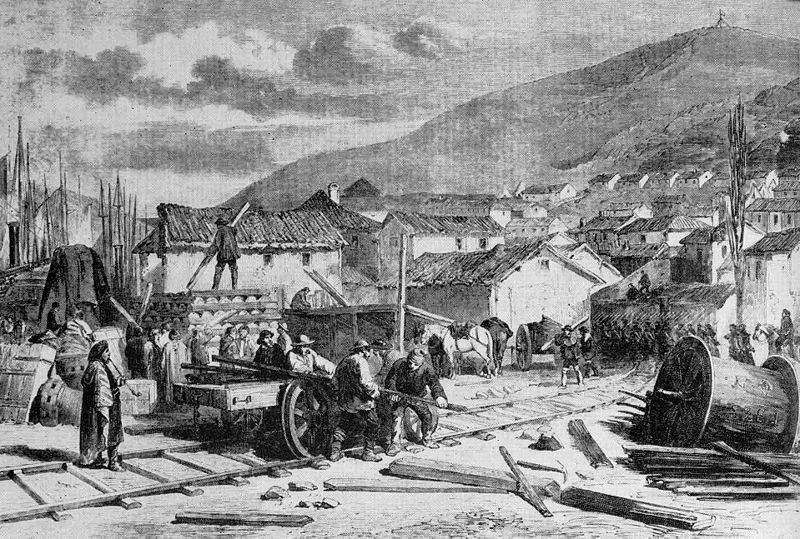
Railways have played a significant role in warfare since at least the Crimean War.
Navvies working on the Grand Crimean Central Railway, 1854. From Thomas Brassey, Railway Builder (1969).
As I live within a bowshot of a railroad crossing, the screech of metal wheels on metal rails frequently reminds me of one of the many things that so many Anglophone commentators get wrong about the war in Ukraine. Coming from places afflicted with (hat tip to Arlo Guthrie [NR: I’d give the credit to Steve Goodman, personally]) “the disappearing railroad blues”, these writers find it hard to imagine the degree to which Russian soldiers exploit the ability of the iron horse to move vast numbers of hundred-pound artillery shells. This blindspot, in turn, causes them to place far too much importance on means of movement, such as ships and trucks, that play second fiddle in the logistical symphony that supplies Russian forces in the field.
Tales of soldiers stealing pickles from convenience stores spark thoughts of another mistake that English-speaking critics have made with respect to the Russian supply system. Wise generals, from Alexander the Great to Francisco Franco, have long deployed vast quantities of food along with their armies. Nonetheless, the enduring fondness of English-speaking soldiers for bully beef, tinned biscuits, and other meals-ready-to-eat sets them apart from most other fighting men, past or present. To put things another way, we should not have been surprised that, when organizing an invasion of one of the great food-producing countries of our planet, Russian logisticians preferred the dispatch of fuel and ammunition to the delivery of items that could have been found in every bodega along the line of march.
Anglophone analysts also drew the wrong conclusions from reports of the loss, in battle, of Russian general officers. Such casualties, they argued, stemmed from an absence of trust. That is, Russian generals were killed because, lacking confidence in the competence of colonels, captains, and corporals, they felt obliged to exercise close supervision over forces engaged in combat.
The participation of generals in firefights, however, need not reflect an absence of faith in the fidelity and abilities of subordinates. Indeed, the original gangsters of “trust tactics” often recommended that the general officers commanding formations lead from the front. I suspect, moreover, that Russian leaders also understood that seeing a general die a soldier’s death usually exercises a positive influence on the morale of his subordinates. (“Say what you will about old General Strelkov, but he never asked us to do anything he wasn’t willing to do himself.”)
Finally, few who made much of the battle deaths of Russian general officers seem to have been aware that the Russian forces that crossed into Ukraine on 24 February 2022 were organized in a way that provided them with an extraordinarily high proportion of fighting generals. That is, when a peacetime formation formed a battalion tactical group, the general in charge of that organization usually took command of the unit it spawned. Thus, rather than having one general for every four or five battalions, the Russian forces of the first few months of the “special military operation” had five or six flag-rank officers for every four or five battalions.
Comments Off on Some good reasons why the Russo-Ukraine war is misunderstood in the West
August 20, 2023
Hitler Has a Bad Day – WW2 – Week 260 – August 19 – 1944
World War Two
Published 19 Aug 2023This week the Allies invade Southern France, and do so very successfully. They’re also successful in the north, closing the Falaise gap and trapping huge numbers of Germans. In the East, however, the Germans manage to stop the Soviet drive on Riga with a counter attack, and in Warsaw they continue to brutally put down the Warsaw Uprising.
(more…)
Comments Off on Hitler Has a Bad Day – WW2 – Week 260 – August 19 – 1944
QotD: Fear of death
The two basic drivers of social change are fear of death and caloric surplus. They exist, as Marxists would say if they cared about actual human behavior, dialectically — the fear of death prompts a frantic search for caloric surplus; once attained, caloric surplus makes the once-adaptive fear of death neurotic and dysfunctional, literally morbid.
[…]
As pretty much every Victorian anthropologist remarked, “savages” all seem deliriously happy — when life is a constant struggle, your every moment is filled with deep meaning, high purpose. So, too, with men at war — Robert Graves or someone like that once said that his time in the trenches were the greatest moments of his life, because everything other than the now disappeared. I can’t speak from personal experience, but I’d lay good money that no combat veteran completely re-enters the civilian world, largely for this reason.
Those are reasonable fears of death. We all accept, intellectually, that we could go at any time, and we will inevitably go eventually, but unless you’ve had a brush with death — a moment where you know, with perfect clarity, that there’s a significant chance you’re going now — you can’t really appreciate it, emotionally.
Severian, “Communal Salvation”, Rotten Chestnuts, 2020-11-19.
Comments Off on QotD: Fear of death
August 19, 2023
One Day in August – Dieppe Anniversary Battlefield Event (Operation Jubilee)
WW2TV
Published 19 Aug 2021One Day in August — Dieppe Anniversary Battlefield Event (Operation Jubilee) With David O’Keefe, Part 3 — Anniversary Battlefield Event.
David O’Keefe joins us for a third and final show about Operation Jubilee to explain how the plan unravelled and how the nearly 1,000 British, Canadian and American commandos died. We will use aerial footage, HD footage taken in Dieppe last week and maps, photos, and graphics.
In Part 1 David O’Keefe talked about the real reason for the raid on Dieppe in August 1942. In Part 2 David talked about the plan for Operation Jubilee. The intentions of the raid and how it was supposed to unfold.
(more…)
Comments Off on One Day in August – Dieppe Anniversary Battlefield Event (Operation Jubilee)
Dieppe Raid – 19 August, 1942
The History Chap
Published 15 Aug 2021The Dieppe Raid (codename Operation Jubilee) was a disastrous amphibious landing by the allies in France during World War 2. Nearly 4,000 allied soldiers (mainly Canadians) were killed, wounded or captured during the Battle of Dieppe.
1942 was turning out to be a bad year for the allies. The Nazis were sweeping forwards in Russia, the Japanese were sweeping though South East Asia. The British commonwealth troops were being pushed back by the Germans & Italians in North Africa and the Americans were still reeling from the attack on Pearl Harbour.
The British wanted to show that they were still willing to take the offensive in the war and were were being urged by Stalin to take some pressure off the Soviet Union. A plan was hatched to conduct a “smash & grab” raid on the port of Dieppe in northern France. The aim was to seize Dieppe and hold it for a limited time before evacuation, during which time the allied troops would collect intelligence and destroy German military infrastructure.
The Canadian government were keen to have their own troops play a role in the war and so the majority of the raiding force was made up of their troops. Initially planned for early July, Operation Jubilee was delayed for over a month due to bad weather and the need for a high tide at dawn. Eventually the Dieppe Raid took place just before 0400 on the 19th August 1942. 5,000 Canadians, 1,000 British and 50 US Rangers were to land at five different points along a 16km (10 mile front) either side of the port of Dieppe itself.
The result was a complete disaster. No major objectives were achieved, poor intelligence had not identified the strength of the German defences and the Germans were on high alert for a possible attack after the firefight at sea and the fact that there was high tide. Within less than 6 hours of the landing starting the order had been given to evacuate and by 1400 hours what remained of the allied force had been successfully removed.
The Dieppe Raid lasted 10 hours. They left behind 4,000 killed, wounded or prisoners of war — over 80% of whom were Canadians. The Royal Navy lost a destroyer and 33 landing craft whilst the RAF lost 106 planes.
The raid had sent a signal to the Germans that the Atlantic shoreline was not secure. That eventually they would have to fight the war on two fronts. It also raised morale within the population of occupied France. They were not alone. The best that can be said for the raid was that it taught the allies valuable lessons which were successfully implemented in the D-Day landings in Normandy in 1944. Maybe the sacrifice of the young men at Dieppe saved many more young men on D-Day.
(more…)
Comments Off on Dieppe Raid – 19 August, 1942
QotD: The third system (or “Modern system”) of war
What happens when two current-day modern systems meet? We don’t really know, though there is a lot of speculation. One of the things which made the conflict between Azerbaijan and Armenia so closely watched last year (in 2020, for those reading this later) was that it provided a chance to see two sides both with (sometimes incomplete) access to the full modern kit of war – not only tanks, jets and artillery, but cyber warfare, drones and so on. The results remain to be much discussed analyzed, but it may well be that a fourth system of war is in the offing, defined by the way that drone-based airpower combined with electronic surveillance and cyber-warfare redefined the battle-space and allowed Azerbaijan in particular to project firepower deep into areas where Armenian forces considered themselves safe.
But I shouldn’t get too off track. The point of all of this is that these systems of war are not merely different, they are so radically different that armies created in one system often fundamentally fail to understand the others (thus the tendency for second and third system armies to treat first system war as some strange new innovation in war, when it is in fact the oldest system by far). As we’re going to see, the aims, experiences and outcomes of these systems are often very different. They demand and inculcate different values and condition societies differently as well.
Bret Devereaux, “Collections: The Universal Warrior, Part IIa: The Many Faces of Battle”, A Collection of Unmitigated Pedantry, 2021-02-05.
Comments Off on QotD: The third system (or “Modern system”) of war


