
There’s no point in pretending that war isn’t horrible — flag-draped coffins are, in fact, a rather pristine symbol of those horrors. There’s a good reason societies honor their warriors.
An aside: I’ve long thought that prettifying World War II for domestic consumption contributed to both the media shock of Vietnam and the generation gap. WWII and Korea vets, who knew war first-hand, didn’t understand just how shocked their doted-on boomer kids were. “The Good War” wasn’t any more pleasant when you were experiencing it.
Virginia Postrel, “Horrors of War”, Dynamist.com, 2004-04-27.
September 6, 2019
QotD: The horrors of war
Comments Off on QotD: The horrors of war
September 5, 2019
Phony Trudeaumania has bitten the dust
Nico Johnson discusses the dangers of family dynasties in democratic countries:
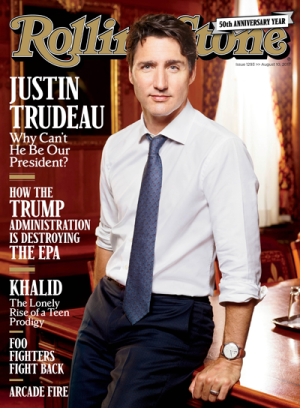
When future political historians look back at the 21st century, Justin Trudeau’s election as a Liberal leader may be regarded as a bland footnote. Despite all the hope Trudeau brought Canadians in his once seemingly eternal, post-election honeymoon, his leadership inevitably toppled into a swamp of sticky scandals and hurried apologies.
Justin Trudeau may still be re-elected. However, the Conservatives can rest easy in the knowledge that Trudeaumania, at least for this current Trudeau, is well and truly dead.
What is noteworthy, however, is the atmosphere of surprise and confusion that has clouded commentators’ judgements surrounding the downfall of Trudeau. In the corridors of Ottawa’s broadcasters, it may have appeared absurd that natural political decline should apply to their darling Prime Minister; the leader of the “woke world.”
Trudeau’s appearance of invincibility, which still makes these commentators swoon (note the SNC-Lavalin coverage) was first created in those blue-skied months following his leadership election in 2013.
Perhaps Justin, with his charisma and handsomeness, seemed like a breath of fresh air to Canadian progressives. Gone were those days of Ignatieff, the drooling philosopher, who rather spectacularly (considering his semi-illiterate predecessor) lost 43 seats forcing the Liberals into third-party status.
With Trudeau’s leadership, the Liberal party would have a candidate who seemed so perfect for Canadian political life that even a eugenicist would struggle to replicate it. With his status as an Anglophone-Quebecois, which managed to pacify the sensibilities of English Canada, whilst having his Quebecois heritage to maintain seat-rich Quebec—Trudeau must have seemed like a divine gift.
Yet even in those early days, Trudeau lacked noticeably in the fundamental requirements that statesmanship should necessitate. He had no political experience after being almost casually elected to the House of Commons. Nor did he possess any working experience, and had been entirely unknown to the Canadian public until the eulogy at his father’s funeral. To put it quite simply, Justin Trudeau would have never become Prime Minister of Canada if his father, Pierre, had not been one too.
Comments Off on Phony Trudeaumania has bitten the dust
September 4, 2019
Poor Greta Thunberg
Theodore Dalrymple on the grim-visaged child star of the environmental movement:
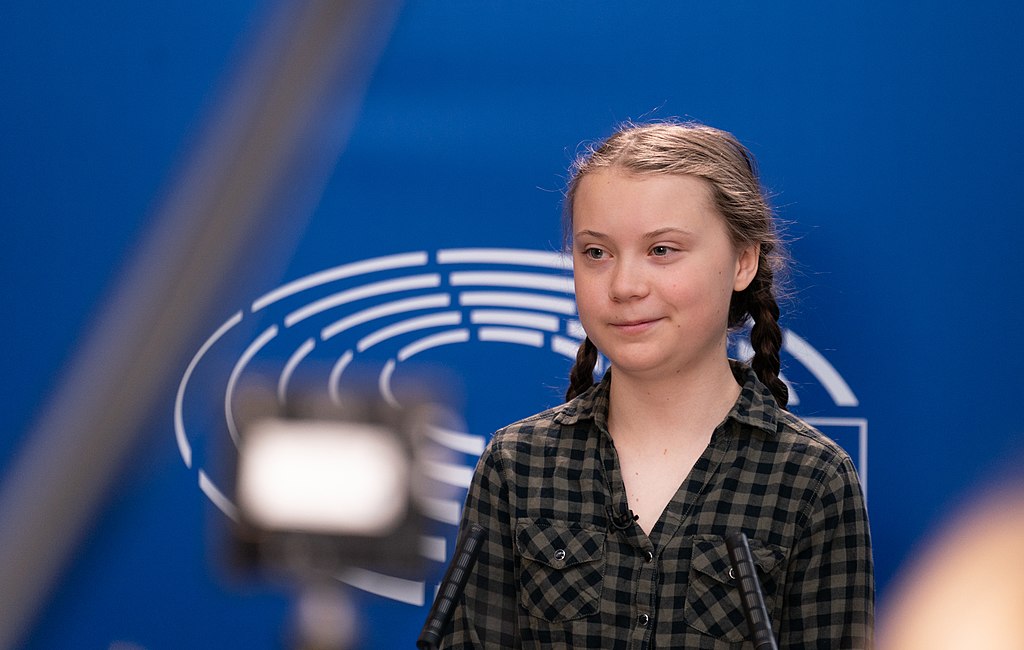
Greta Thunberg at the EU Parliament, 16 April, 2019.
European Parliament photo via Wikimedia Commons.
Poor Greta Thunberg! She is to self-righteousness and self-satisfaction what Mozart was to music, namely an astonishing youthful prodigy. Unlike Mozart, however, she is a very unattractive child, her unattractiveness arising not from her natural physical endowment but from the sheer grimness of her humourless puritanism which is inscribed on her face for all to see. She has succeeded in adding a new vision of hell to the many that I already have, namely being preached at by her for all eternity without intermission.
It is said that she suffers from a psychiatric condition, but whether or not this is so, her awfulness (of which, of course, she is blithely unaware) is not really her fault. Her transformation into a celebrity is the work of adults. It is they who have turned her into the Ayatollah Thunberg, the Khomeini of climate change.
In the days when reaching old age was exceptional, almost implying some kind of personal virtue, it was the elderly who were accorded respect and regarded as the repositories of wisdom. But as the old begin to outnumber the young, it is the young to whom falls the mantle. This is because we value the rare. No only does little Greta belong to a minority, but to a minority of that minority, for no one can deny that she is articulate, however monotonous, programmed or lacking in spontaneity her lines might be.
Adolescence in particular is now regarded as the acme of human existence, from which only decline is possible (and Greta exudes an air of permanent adolescence). I still have not quite made up my mind whether our age is the first of the geriatric adolescent or that of the adolescent geriatric, but I not infrequently notice around me seventy- and even eighty-year-olds who try to dress and comport themselves as if they were still about eighteen or nineteen. I find it sad, for of course the march of time is inexorable in its effects, albeit that it is true that it has slowed somewhat and people now age more slowly than they once did thanks, ultimately, to the material prosperity brought about by the creative destruction of capitalism. Nevertheless, the pretence that we have not aged is futile, though it is not futile only: it is both sad and shallow, in that it implies that life subsequent to adolescence has not brought its own rewards, and moreover that one has in effect learned nothing in the meantime, that the very best that can be hoped for is that one’s knowledge and wisdom, which plateaued at the age of eighteen, have maintained that elevated level ever since.
Based upon my experience of the elderly, I view the arrival of the adolescent geriatric, or the geriatric adolescent, with some consternation or trepidation. From a very early age I have had a liking for the elderly, often preferring them to the young, especially the young of my own and subsequent generations, but I have to admit that when an old person is nasty or querulous, he or she tends to be very nasty or querulous indeed, and exceedingly difficult to handle. In so far as adolescence is an age of egoistic querulousness, therefore, the prospect is daunting of an increase in bad-tempered geriatrics, angry that, despite their wish that they should remain adolescent forever (a wish that they are likely to confuse with a right because they have lived through a period when wishes rapidly transformed themselves into rights), they continue to age and will one day die. The Bible might tell us that there is a time and place for everything, but in the worldview of the geriatric adolescent, there is no time or place for old age.
Comments Off on Poor Greta Thunberg
September 3, 2019
When “raising awareness” works too well
Dylan Gibbons reports on a recent finding from the Harvard Business Review:

A new study published by the Harvard Business Review shows that in addition to men’s growing fears about women in the workforce and potentially being falsely accused, women are becoming more aware of the backlash and are actually less likely to hire certain women, specifically attractive women.
“Most of the reaction to #MeToo was celebratory; it assumed women were really going to benefit,” said Leanne Atwater, a management professor at the University of Houston. However, Atwater was skeptical. Rather than seeing an endless trail of steps forward before her, she and her colleagues forecasted a backlash.
“We said, ‘We aren’t sure this is going to go as positively as people think — there may be some fallout.'” And so, they tested their hypothesis.
The study began in early 2018. Two surveys were created, one for men and one for women. These surveys were then distributed to workers in various professional fields. In the end, they collected a large amount of data from 152 male and 303 female responders.
According to the study, 74% of women now say they are more willing now to speak out against harassment, while 77% of men anticipated being more careful about potentially inappropriate behaviour.
As for the idea that men do not know what constitutes harassment, the researchers found the opposite was true. Both genders appear to both know what constitutes harassment, and women may be more lenient with some of their own definitions of what constitutes harassment.
According to the report, “The surveys described 19 behaviors — for instance, continuing to ask a female subordinate out after she has said no, emailing sexual jokes to a female subordinate, and commenting on a female subordinate’s looks — and asked people whether they amounted to harassment.”
“Most men know what sexual harassment is, and most women know what it is,” Atwater says. “The idea that men don’t know their behavior is bad and that women are making a mountain out of a molehill is largely untrue. If anything, women are more lenient in defining harassment.”
Another recent action intended to increase the number of women in STEM subjects at an Australian university — by selectively lowering academic standards for admission — will almost certainly not achieve its stated goals, but will work to increase negative views of those women in the working world:
[A female engineer] also rightly points out that this lowering the bar for women is unfair to men losing the university places to women with lesser qualifications.
She points out that male students will notice that women are struggling more with the course material — the women allowed in because the bar was lowered.
She feels this is a net negative for women in the engineering sector in general, and I have to agree.
How, she asks, can employers be expected to see a woman’s engineering degree the same as a man’s if the employer knows the women got a break getting into the program?
She uses the term “positive discrimination” to describe the leg-up practices, and I really prefer that to “affirmative action” to describe it because the word “discrimination” is plain in it. And that’s exactly what it is. Discrimination against qualified people that will ultimately harm women who are qualified.
As she puts it, the only way to ensure that a woman’s qualifications mean as much as a man’s is to have equal hurdles for women.
I’m completely with her.
Comments Off on When “raising awareness” works too well
September 1, 2019
Gene Roddenberry was his own worst enemy
Ed Driscoll reviews the first of three volumes by Marc Cushman, relating the story behind the legendary original Star Trek TV series. Much of the first volume is apparently about the problems of getting NBC to let Gene Roddenberry back into their good graces after he humiliated the network over an earlier TV show:
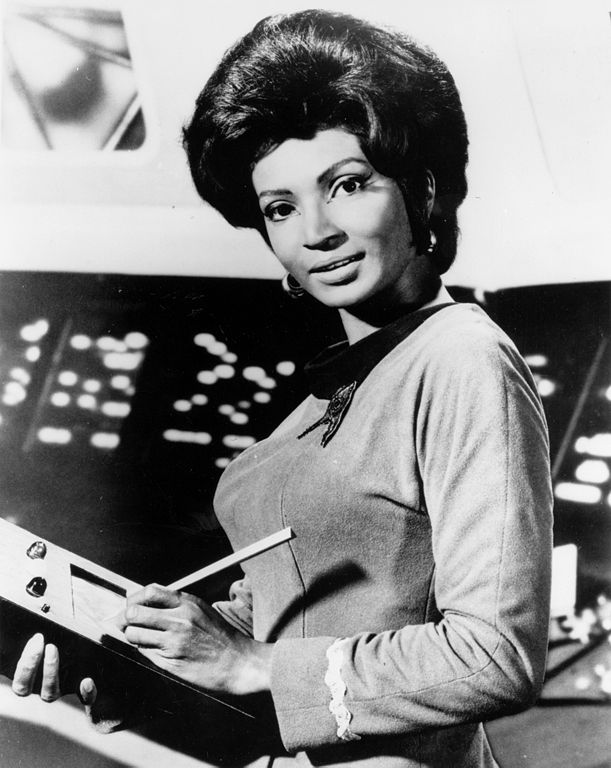
Nichelle Nichols was born in Robbins, Illinois on December 29, 1936. She played Lieutenant Uhura the Communications Officer on the U.S.S. Enterprise in the original series, Star Trek. Nichols stayed with the show and has appeared in six Star Trek movies. Her portrayal of Uhura on Star Trek marked one of the first non-stereotypical roles assigned to an African-American actress. Before joining the crew on Star Trek, she sang and danced with Duke Ellington’s band.
NASA photo via Wikimedia Commons.
Gene Roddenberry (1921-1991) was a religious agnostic and left-leaning Texan who became a WWII Army Air Force B-17 pilot, then an LA policeman who wrote numerous scripts for the burgeoning television industry in the 1950s. Eventually, he graduated to producing his own TV show in 1963, The Lieutenant, purchased by NBC and built around Gary Lockwood, the future guest star of Star Trek‘s second pilot, and the co-star of another landmark 1960s science fiction achievement, Stanley Kubrick’s 2001: A Space Odyssey.
The Lieutenant was for the most part a formulaic “military procedural” about life at Camp Pendleton, and featured numerous future Star Trek guest stars and cast members. However, Roddenberry, as was his wont, eventually decided to push the envelope, and put into production an episode on racism in the Marines called “To Set It Right,” with guest stars Dennis Hopper, future Star Trek regular Nichelle Nichols and future Trek guest star Don Marshall. The episode lost the support of the Marines, and the good will of NBC. As Roddenberry later recounted, “My problem was not the Marine Corps; it was NBC, who turned down the show flat … There was only one thing I could do, I went to the NAACP and they lowered the boom on NBC.”
As Cushman writes, this did not endear himself with NBC’s executive suit. “Roddenberry had won the battle … but lost the war. Despite satisfactory ratings, The Lieutenant was cancelled.” And NBC’s executives would not forget being hung out to dry by one of their product suppliers.
Even before The Lieutenant‘s only season of production was complete, Roddenberry began crafting a television show he called Star Trek. He had somehow stumbled into the perfect format for an hour-long network television series. While he admired shows such as Rod Serling’s The Twilight Zone and its recombinant network rival The Outer Limits for their ability to comment on American society through the metaphors of science fiction and horror, these were anthology shows, introducing a new cast each week. He knew the most successful network series were those with a recurring cast, such the many westerns that aired during the 1950s and ’60s, such as the long-running Bonanza and Gunsmoke. Viewers treated these archetypal characters almost as their own family members, which in turn encouraged them to tune in each week.
Given the networks’ love of westerns in the 1960s, it’s no coincidence that Roddenberry’s first pitch to the networks used the phrase “Wagon Train to the stars” as a metaphor to describe the show. (As Cushman writes, veteran western and science fiction writer Samuel Peeples actually coined that phrase, the first of many bits of Star Trek lore that Roddenberry would eventually co-opt and take credit for.)
It’s also no coincidence that the show’s second in command was written by Roddenberry as “a mysterious female, slim and dark, expressionless, cool, one of those women who will always look the same between years 20 and 50.” As Cushman deadpans, “To be more specific: actress Majel Barrett, Roddenberry’s lover.” (Roddenberry was also having a tryst with Nichelle Nichols; she would find her way into Star Trek‘s regular cast as well.) While the pointed-eared alien Mr. Spock was also present, he was much more in the background in Roddenberry’s first draft of Star Trek.
Comments Off on Gene Roddenberry was his own worst enemy
QotD: Wonks inside the Beltway
There are few words that stir the blood of a Beltway wonk like “the Commission has issued its report.” That means that those in the government must now react, importantly, and those in the media must now react as well — dissect, digest, explain to the benighted groundlings what it means, and issue Important Recommendations by way of reasoned editorials aimed at the corridors of power, but more likely received by a schoolteacher in Iowa who photocopies it off and puts it on the bulletin board in the staff lounge with yellow highlight-lines through the better parts.
The commission has issued its report! Mo better, the commission has issued recommendations! And the Washington press corps open their beaks, spindly necks trembling, waiting for the savory worm to be dropped from the blue-ribbon mother bird.
Unless you’ve spent some time in DC you can’t imagine the tremendous self-importance that possesses the people who feed off the government. They’re like people who live in the same town where NASA has a tracking station, and think that it makes them all astronauts.
James Lileks, Bleat, 2004-07-23.
Comments Off on QotD: Wonks inside the Beltway
August 30, 2019
“Stalingrad” – World War Two – Sabaton History 030 [Official]
Sabaton History
Published on 29 Aug 2019The Sabaton song “Stalingrad” is about the devastating battle of the Russian city of Stalingrad, which lasted for 5 months from August 1942 till February 1943. The battle is infamous for its brutal street fighting and high casualties on both sides.
Support Sabaton History on Patreon: https://www.patreon.com/sabatonhistory
Listen to Primo Victoria (where “Stalingrad” is featured):
CD: http://bit.ly/PrimoVictoriaStore
Spotify: http://bit.ly/PrimoVictoriaSpotify
Apple Music: http://bit.ly/PrimoVictoriaAppleMusic
iTunes: http://bit.ly/PrimoVictoriaiTunes
Amazon: http://bit.ly/PrimoVictoriaAmzn
Google Play: http://bit.ly/PrimoVictoriaGooglePlayHosted by: Indy Neidell
Written by: Markus Linke and Indy Neidell
Directed by: Astrid Deinhard and Wieke Kapteijns
Produced by: Pär Sundström, Astrid Deinhard and Spartacus Olsson
Creative Producer: Joram Appel
Executive Producers: Pär Sundström, Joakim Broden, Tomas Sunmo, Indy Neidell, Astrid Deinhard, and Spartacus Olsson
Maps by: Eastory
Edited by: Iryna Dulka
Sound Editing by: Marek KaminskiEastory YouTube Channel: https://www.youtube.com/channel/UCElybFZ60Hk1NSjgCf7I2sg
Archive by: Reuters/Screenocean https://www.screenocean.com
Music by Sabaton.Sources:
– Photo of Stalingrad field hospital – Natalia Bode
– Photo of the Soviet loudspeaker by Arkady Shaikhet
– Colorization by Klimbim: German soldier in Stalingrad, Soviet machine gunners
– IWM: TR 153An OnLion Entertainment GmbH and Raging Beaver Publishing AB co-Production.
© Raging Beaver Publishing AB, 2019 – all rights reserved.

Comments Off on “Stalingrad” – World War Two – Sabaton History 030 [Official]
August 28, 2019
The political football of “mass” immigration in the Canadian federal election campaign
Recently a registered third-party (under Canadian election rules) paid to have billboards put up in major cities that appeared to be from Maxime Bernier’s People’s Party of Canada:
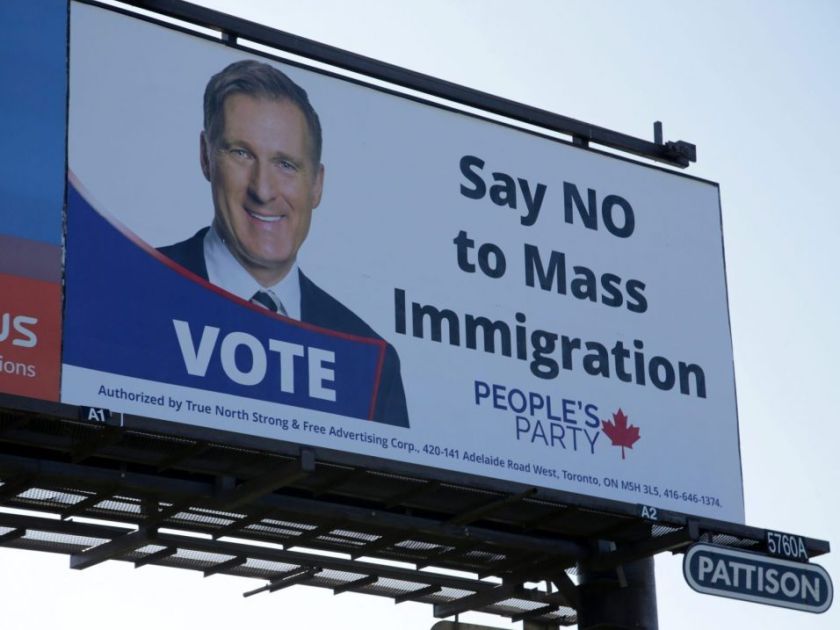
A billboard in Toronto, showing Maxime Bernier and an official-looking PPC message.
Photo from The Province – https://theprovince.com/opinion/columnists/gunter-berniers-legitimate-position-on-immigration-taken-down-by-spineless-billboard-company/wcm/ecab071c-b57d-4d93-b78c-274de524434c
Colby Cosh discusses the issues raised:
I offer sarcastic congratulations to everyone who gave Maxime Bernier the stupid controversy he wanted over the “Say NO to mass immigration” billboard, bearing his image, that briefly appeared in a few Canadian cities and was taken down in a hurry Monday morning. The billboards were purchased from Pattison Outdoor Advertising by a third-party supporter of Bernier’s People’s Party. The company’s initial response to the resulting outcry was to observe that the message of the billboard complied with advertising standards; it did not contain any hateful, disparaging, or discriminatory language.
“We take a neutral position on ads that comply with the ASC (Advertising Standards Canada) Code as we believe Canadians do not want us to be the judge or arbiter of what the public can or cannot see,” was Pattison’s original statement in the face of controversy. (Most everybody, including the company, seems to have missed the point that election advertising is explicitly “excluded from the application” of the Code on the grounds that political expression deserves the highest degree of deference; the Code does say, for what it’s worth, that “Canadians are entitled to expect” that such advertising respects the underlying principles.)
[…]
The question I have for objectors and denouncers of the billboard is how they think it could have been rewritten, expressing the same underlying idea, so as to be acceptable. If the unpleasant-sounding word “mass” were replaced with “large-scale,” would there have been less of a ruction? Maybe any objection to prospective levels of immigration to Canada is to be regarded as inherently racist and hateful, even when no racist or hateful language is used.
If that is the case, it is perfectly predictable that the People’s Party will exploit this and cry “mob censorship,” and public polls on immigration suggest they will have some success, in case recent history everywhere didn’t offer enough of a hint. Moreover, we are left with an awkward question how any limit upon or criteria for immigration, any government immigration policy per se, can be justified at all. What, indeed, can be the objection to “mass immigration”? Who will have the courage to put up a “Say YES to mass immigration” billboard?
Comments Off on The political football of “mass” immigration in the Canadian federal election campaign
August 27, 2019
So much for nil nisi bonum
The old Latin phrase De mortuis nihil nisi bonum encourages us to only speak well of the dead. The recent death of libertarian billionaire David Koch has brought forth a torrent of vituperation from many people in media and politics, as James Piereson and Naomi Schafer Riley record:
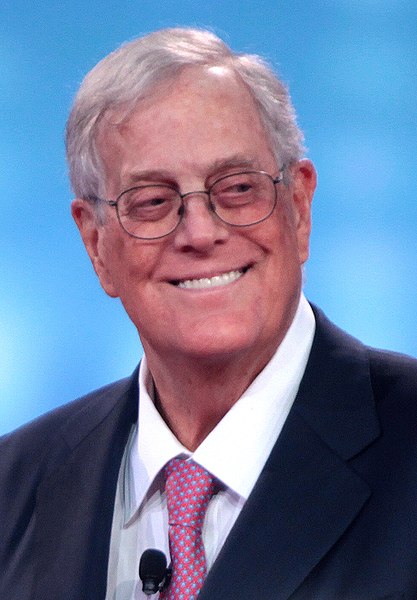
David Koch speaking at the Defending the American Dream Summit in Columbus, Ohio, 21 August 2015.
Photo by Gage Skidmore via Wikimedia Commons.
“Yesterday David Koch of the zillionaire Koch brothers died … of prostate cancer. I guess I’m going to have to reevaluate my low opinion of prostate cancer.” That was Bill Maher last Friday night, joking before his approving audience. Maher went on to say, “The Amazon is burning up. I’m glad he’s dead.” Maher is not known for his kindness toward those with whom he disagrees. In that sense, he reflects the thinking of a growing number of progressives and leftists who openly despise conservatives and libertarians. David Koch, along with his brother Charles, have for decades been targets of harsh rhetoric from the far Left.
What is it about David Koch that inspired such hatred? “We live in the world that he helped build, and it is on fire,” wrote Sarah Jones in New York, denouncing Koch’s “monstrous legacy.” In Esquire, Charles Pierce writes: “Except for his surviving brother, Charles, no man had a worse effect on American politics since the death of John C. Calhoun. Every malignancy currently afflicting us can be traced in one way or another into their wallets, and that’s not even to mention the lasting damage they’ve done to the planet as a whole.”
This is the kind of language that religious cults reserve for heretics and apostates — and in many ways, David and Charles Koch were blasphemers to the liberal orthodoxy. They believed in smaller government and thus criticized the welfare state, excessive taxation, and a great deal of government regulation. At the same time, they criticized America’s wars abroad, along with high levels of defense spending, and were sympathetic to the causes of gay rights and gay marriage. They were consistent in their views across a range of issues, antagonizing liberals but also vexing conservatives. The claim that David Koch was a reflexive right-winger is a caricature of his beliefs.
The Kochs believed in smaller government. Whether it was gay marriage or land wars in Asia, they consistently argued that less government intervention would produce freer and happier people. Their support for drug legalization and abortion rights irked plenty of conservatives, but it drove few over the edge as their support for lower taxes and greater school choice did for liberals. Perhaps nothing irked liberals more, though, than the Kochs’ fight for less environmental regulation. Blaming Charles and David Koch for singlehandedly destroying the rainforests or raising the temperature of the earth seems to be a common theme among critics — an attribution of immense power beyond the capacity of any man or family or company.
Comments Off on So much for nil nisi bonum
August 26, 2019
QotD: Princesses
How do you spot a Princess? She’ll be keen on pampering to an extent which indicates to the casual onlooker that her natural self must be extraordinarily rank if it takes such effort and expense to keep in check. (Princesses shouldn’t be confused with Professional Beauties, most of whom retain a healthy contempt for the business of exchanging physical gifts for fiscal rewards, from Hedy Lamarr saying “Any girl can be glamorous — all you have to do is stand still and look stupid” to the catwalk models who invariably live in jeans and sneakers after shrugging off the stupid clothes which Princesses pine for.)
The Princess believes that retail therapy is the answer to everything, even though the rest of us avert our eyes from this most obvious manifestation of the essential hollowness of a life that an over-enthusiasm for clothes-shopping invariably indicates in anyone out of their teens. They’ll have long nails, ostensibly to show that they’re ladies of leisure, but signalling to the rest of us that they’re very likely parasites with low sex-drives. They like big weddings — and as a liking for big weddings often goes hand in hand with humourlessness, they often have very short marriages. They are in short practitioners of the Violet Elizabeth Bott school of feminism – less about equal rights and fulfilling one’s potential than about stamping your foot till you get what you want.
They dislike men, seeing them not as flesh-and-blood people so much as platinum-and-titanium meal-tickets, and they mistrust women, seeing them as competition. An ageing Princess is more than likely to end up lonely — and with no life of the mind to comfort her, this loneliness may make her mentally addled at a comparatively young age. Once the sheen is off her skin, the Princess has nothing that would make one seek her out; like a lot of people over-keen on spangles and glitter, they are at heart rather drab people — drains not radiators, personality-wise — who never make things happen or drive things forward but rather wait to be rescued. They tend to find themselves eternally in the passenger seat of their life’s journey, stranded on the hard shoulder with their souvenirs, waiting in vain for hunky help to arrive.
Julie Burchill, “The Princess generation needs to grow up”, The Spectator, 2017-07-18.
Comments Off on QotD: Princesses
August 24, 2019
Remy: All My Loving (Beatles Parody)
ReasonTV
Published on 23 Aug 2019Remy discovers the hysterical, shrieking crowds are here for the entitlements.
Written and Performed by Remy
Produced and Edited by Austin Bragg
Music tracks and mastering by Ben Karlstrom
——————Reason is the planet’s leading source of news, politics, and culture from a libertarian perspective. Go to reason.com for a point of view you won’t get from legacy media and old left-right opinion magazines.
—————-
LYRICS:
Does adulthood dismay you?
Vote me and I’ll pay you
You won’t have to grow up it’s true
All your bills will be paid
Your adulthood delayed
And I’ll give all this money to youBob commuted to college
For discounted knowledge
So large debts he would not accrue
Lived at home, did some chores
Now he’ll also pay yours
Cuz I’ll give all his money to youAll this money
You will get from Bob
All this money
If I get this jobAll your work wages risen
Your debts all forgiven
Your childcare will be paid for too
Want free parental leave
Just takes one vote for me
And I’ll give all this money to youAll Bob’s money
I will give to you
All Bob’s money
If I win it’s true
All Bob’s money
All Bob’s money
All Bob’s money
I will give to you

Comments Off on Remy: All My Loving (Beatles Parody)
“82nd All The Way” – Alvin York – Sabaton History 029 [Official]
Sabaton History
Published on 22 Aug 2019When the Americans joined the Great War in Europe, the 82nd “All American” division was the division that would engage in heavy fighting at St Mihiel. Among them was Alvin York, leading his battalion at the ferocious Battle of Hill 223.
Support Sabaton History on Patreon: https://www.patreon.com/sabatonhistory
Listen to The Great War (Where “82nd All the Way” is featured):
CD: http://nblast.de/SabatonTheGreatWar
Spotify: https://sabat.one/TheGreatWarSpotify
Apple Music: https://sabat.one/TheGreatWarAppleMusic
iTunes: https://sabat.one/TheGreatWarItunes
Amazon: https://sabat.one/TheGreatWarAmazon
Google Play: https://sabat.one/TheGreatWarGooglePlayWatch the official music video for “82nd All the Way” right here: https://www.youtube.com/watch?v=0LS0Z…
Hosted by: Indy Neidell
Written by: Markus Linke and Indy Neidell
Directed by: Astrid Deinhard and Wieke Kapteijns
Produced by: Pär Sundström, Astrid Deinhard and Spartacus Olsson
Creative Producer: Joram Appel
Executive Producers: Pär Sundström, Joakim Broden, Tomas Sunmo, Indy Neidell, Astrid Deinhard, and Spartacus Olsson
Maps by: Eastory
Edited by: Iryna Dulka
Sound Editing by: Marek KaminskiEastory YouTube Channel: https://www.youtube.com/channel/UCEly…
Archive by: Reuters/Screenocean https://www.screenocean.com
Music by Sabaton.Sources:
– IWM: Q 516, 23706
– National Library of Scotland: 3155
– Saturday Evening Post scan and Alvin York portraits courtesy of the Tennessee State Library & Archives.
– National WWI Museum and Memorial
– Alvin York colorized by Chiel ZilverbergAn OnLion Entertainment GmbH and Raging Beaver Publishing AB co-Production.
© Raging Beaver Publishing AB, 2019 – all rights reserved.
From the comments:
Sabaton History
2 days ago
This video is about the 82nd Division who, together with Sergeant Alvin York stormed Hill 223 in September 1918. Just before that, the “Lost Battalion” made a stand against German forces in the same area. We have made an episode about the Sabaton Song “Lost Battalion” as well, which you can watch right here: https://youtu.be/pgNxijbDlJMWe love the reception of our weekly videos, and have some great stuff coming up over coming weeks. We want as many of our fans to see this, so make sure to share this channel with your friends, family, neighbours, colleagues, teachers and other loved ones. You’d be doing them and us a real favour! Cheers!
Comments Off on “82nd All The Way” – Alvin York – Sabaton History 029 [Official]
Prime Minister Dressup versus the Milk Dud
Barbara Kay on the most recent pre-campaign attack by the federal Liberals on Andrew “The Milk Dud” Scheer:

Andrew Scheer, paid tool of Big Dairy, chugs some milk during a Press Gallery speech in 2017. I’ve called him the “Milk Dud” ever since.
Screencapture from a CTV video uploaded to YouTube.
The Liberals know they are going into the coming federal election with their leader, Justin Trudeau, weighed down by the heavy baggage of the SNC-Lavalin debacle and the India Tickle Trunk Tour, amongst many other embarrassments. So the Conservatives had to expect some desperation moves to cast their leader, Andrew Scheer, in what the Libs consider an equally bad light.
And right on cue, the Libs unearthed a 2005 video of Andrew Scheer explaining to the House of Commons why he was personally opposed to the legalization of gay marriage.
We would do well to remember that the words Scheer spoke then constituted the belief system of 99% of the planet earth, including Barack Obama, who flipped on the issue when it became politically safe to do so. Gay marriage wasn’t even on the horizon of most countries in the West, nor is it legal yet in many western countries. (And as former NDP leader Thomas Mulcair pointed out in a CTV interview, Canadians would also do well to remember that in 1995 Ralph Goodale didn’t believe gays should even have the right to civil unions, let alone marriage.)
Scheer has no intention of revisiting gay marriage politically. It’s settled law, and he has given no indication that he considers it less than settled. Bringing up what he had to say in 2005 may be politically advantageous as a distraction, but it is unfair, while Conservative attacks on Trudeau for gaffes he has made and is still making as prime minister are perfectly fair comment.
Comments Off on Prime Minister Dressup versus the Milk Dud
QotD: Strikes at non-profit organizations
[…]
Which is where we get to see the pay deal matter in the raw. At the auto companies (well, absent those in and near bankruptcy problems) it was indeed possible to start shouting “But what about the workers?” Why should they get less generous pay or terms just so that the capitalists can make out like bandits? But here we’ve got exactly the same problem. And there are no capitalists, there are no profits. The income into NPR is pretty much exclusively used to pay the employees of NPR. There are no leakages to the capitalists so, in the absence of more money, what can be done?
[…]
You can see NPR’s finances here and it becomes obvious that they have available only two of the traditional three ways of dealing with a higher wage bill. In for profit companies there is that possibility of reducing the profit to pay the workers more. In the absence of profiteering this cannot of course happen. Thus, in order to accommodate higher wages they can either raise prices to stations which carry the programs or NPR can employ fewer people at those higher wages. They’re restricted to only two of those ways normally put forward. Something which does rather aid in highlighting why and how companies, for profit ones, react the way they do to forced pay rises.
That NPR is a non-profit aids in highlighting exactly the problems that all organisations have with demands for higher wages. With no profits to cut they can either charge more or employ fewer people, nothing else.
Tim Worstall, “NPR’s Problems – Isn’t It Fun When Workers At A Non-Profit Seek To Strike?”, Forbes, 2017-07-15.
Comments Off on QotD: Strikes at non-profit organizations
August 23, 2019
Reasons to expect an even weirder (and scarier) US election in 2020 than in 2016
At Rotten Chestnuts, Severian explains why the First World War was inevitable (because of the fecklessness of all the world leaders at the time) and then points out that the same sort of inevitability seems to be playing out in the run-up to the 2020 US elections:

Donald Trump addresses a rally in Nashville, TN in March 2017.
Photo released by the Office of the President of the United States via Wikimedia Commons.
In short, World War 1 was a massive, indescribably bloody dick-measuring contest between a few inbred yokels. To anyone who has met the Sons of Privilege,* or who is passingly familiar with the Peter Principle, this comes as no surprise. Hell, Lenin saw it, and a guy with his egg head further up his own ass you’ll never find.** All you have to do is look at the people, not the paper.
That’s where the modern political landscape gets so terrifying. Looking at the paper from the establishment Democrats’ point of view, their course of action seems obvious. And credit where it’s due, even Slow Joe Biden and Fauxcahontas are smart enough (or, more likely, have hired people who are smart enough) to see the obvious once it gets rubbed in their faces a few dozen times — Slow Joe is playing the above-it-all unifier, while Dances with Socialism has gone on a Hillary-esque “listening tour” for The Media’s benefit. Should they choose, The Media can now memory hole all the “fake Indian” stuff, and yell “racist!” at anyone who tries to dredge it back up …
… but I don’t think they’ll choose to. The human factor always wins, and the humans (using the term in its strictest biological sense) in The Media are fed up close to bursting. The mask is completely off “The Squad,” and The Media couldn’t be happier. I’m sure that, in their heart of hearts, Nancy Pelosi et al don’t have a problem with BDS, or the Green New Deal, or any of the rest of it. But flying to Israel on the taxpayer’s dime to support Palestinian terrorism just doesn’t play in Peoria, and the Establishment Dems know it. The Media, however, do not — just look at the coverage.
I’m also quite confident that Nancy et al are even, in their heart of hearts, ok with “Antifa” shooting at cops and firebombing ICE offices. Nancy, after all, came up in the heyday of Jim Jones’s San Francisco, so she’s no stranger to political violence. But The Media absolutely cream themselves over “revolutionaries.” They’ve kept this stuff under wraps so far — Nancy et al have convinced them it’ll hurt Donald Trump more than it will hurt them if they keep it bottled up — but every single person in The Media had xhzhyr first wet dream about Che Guevara. I doubt they can keep it in their pants too much longer, especially if — as seems all but certain — “Antifa” commits some gaudy, gross atrocity in the 2020 campaign season.
Nor can we discount the human factor regarding Normals. Every day brings a new insult — Twitter colluding with China to suppress democratic protests in Hong Kong while all-but-openly banning anyone to the right of Mao; gender-and-race-swapping comic book characters; anything and everything to throw sand in Normals’ faces. If Trump’s victory in 2016 was The Great Fuck You, I can’t even imagine what it’ll look like in 2020, after four more years of this stuff ramped up way past 11.
It’s not looking good, but since the idiots in charge have never even thought about looking up from the paper, the whole thing is going to catch them completely unprepared. Forget “that’s how you got Trump;” this is how you get the Somme.
* they’re like the Sons of Anarchy, but effete and usually gay.
** though he basically just stole the idea from Hobson, who, though a goofy love-the-worlder, was actually a pretty smart guy.
Comments Off on Reasons to expect an even weirder (and scarier) US election in 2020 than in 2016


