
September 7, 2011
Brendan O’Neill – The Riots: A Mob Made By The Welfare State?
The Perry-Paul pie-fight
The Ron Paul campaign released a new video, pointing out the fact that Paul had been one of a small group that originally supported Ronald Reagan for president (on the basis of Reagan’s professed desire for small government and lower taxes). Rick Perry, on the other hand, worked for Al Gore’s first presidential bid:
As Michael Suede says, it’s amazing that the Perry campaign’s response actually highlights Paul’s consistency and principles:
The Perry campaign released this statement in response to the pummeling:
“Rep. Paul’s letter is a broadside attack on every element of President Reagan’s record and philosophy. Paul thought President Reagan was so bad, he left the GOP,” said [Perry spokesman Mark] Miner. “It will be interesting to hear Rep. Paul explain why Reagan drove him from the party at tomorrow’s debate on the grounds of the Reagan Library.”
In one part of the letter, Paul wrote, “There is no credibility left for the Republican Party as a force to reduce the size of government. That is the message of the Reagan years.”
Paul continued, “Thanks to the President and Republican Party, we have lost the chance to reduce the deficit and the spending in a non-crisis fashion. Even worse, big government has been legitimized in a way the Democrats never could have accomplished.”
Paul even went so far as to call Reaganomics, “warmed-over Keynesianism.”
In other words, Paul initially supported Reagan because Reagan talked a great game on issues that Paul supported: reducing the size of government and lowering taxes. Reagan was elected, continued talking the talk, but failing to actually do anything — in fact, government continued to grow during his presidency (even if you discount the military build-up). Paul broke with Reagan because Reagan hadn’t done what he was elected to do. And the Perry campaign thinks this is a negative?
You can say a lot of positive things about Reagan, but his actual record was not what his Republican hagiographers pretend that it was.
In the letter, Ron Paul explains that spending under Reagan exploded and that the administration didn’t live up to its promises to keep the debt under control. Then Ron goes on to PREDICT THE FUTURE as he explains the dangers behind exploding deficits. So in essence, the Perry campaign is saying Ron Paul is bad because HE IS TOO CONSERVATIVE.
If they take away your freedom of speech, you can’t defend any of your rights
Mark Steyn on the rapidly constricting “right” to free speech in most of the western world:
To be honest, I didn’t really think much about “freedom of speech” until I found myself the subject of three “hate speech” complaints in Canada in 2007. I mean I was philosophically in favor of it, and I’d been consistently opposed to the Dominion’s ghastly “human rights” commissions and their equivalents elsewhere my entire adult life, and from time to time when an especially choice example of politically correct enforcement came up I’d whack it around for a column or two.
But I don’t think I really understood how advanced the Left’s assault on this core Western liberty actually was. In 2008, shortly before my writing was put on trial for “flagrant Islamophobia” in British Columbia, several National Review readers e-mailed from the U.S. to query what the big deal was. C’mon, lighten up, what could some “human rights” pseudo-court do? And I replied that the statutory penalty under the British Columbia “Human Rights” Code was that Maclean’s, Canada’s biggest-selling news weekly, and by extension any other publication, would be forbidden henceforth to publish anything by me about Islam, Europe, terrorism, demography, welfare, multiculturalism, and various related subjects. And that this prohibition would last forever, and was deemed to have the force of a supreme-court decision. I would in effect be rendered unpublishable in the land of my birth. [. . .]
And what I found odd about this was that very few other people found it odd at all. Indeed, the Canadian establishment seems to think it entirely natural that the Canadian state should be in the business of lifetime publication bans, just as the Dutch establishment thinks it entirely natural that the Dutch state should put elected leaders of parliamentary opposition parties on trial for their political platforms, and the French establishment thinks it appropriate for the French state to put novelists on trial for sentiments expressed by fictional characters. Across almost all the Western world apart from America, the state grows ever more comfortable with micro-regulating public discourse—and, in fact, not-so-public discourse: Lars Hedegaard, head of the Danish Free Press Society, has been tried, been acquitted, had his acquittal overruled, and been convicted of “racism” for some remarks about Islam’s treatment of women made (so he thought) in private but taped and released to the world.
September 6, 2011
Is the freelancing sector the “new industrial revolution”?
Sara Horowitz, founder of Freelancers Union, presents an anecdote-heavy but data-poor view of the surge in freelancing as “the Industrial Revolution of our time”:
It’s been called the Gig Economy, Freelance Nation, the Rise of the Creative Class, and the e-conomy, with the “e” standing for electronic, entrepreneurial, or perhaps eclectic. Everywhere we look, we can see the U.S. workforce undergoing a massive change. No longer do we work at the same company for 25 years, waiting for the gold watch, expecting the benefits and security that come with full-time employment. We’re no longer simply lawyers, or photographers, or writers. Instead, we’re part-time lawyers-cum-amateur photographers who write on the side.
Today, careers consist of piecing together various types of work, juggling multiple clients, learning to be marketing and accounting experts, and creating offices in bedrooms/coffee shops/coworking spaces. Independent workers abound. We call them freelancers, contractors, sole proprietors, consultants, temps, and the self-employed.
And, perhaps most surprisingly, many of them love it.
I’m in this category myself, as a self-employed technical writer. I buy my own tools, pay my own taxes (reminder to self: next tax installment due on the 15th), and — within reason — set my own working hours. Of course, my clients have a lot to say about when my working hours tend to be, so it’s more an extra degree of flexibility than it is total freedom. But it works well for me.
September 3, 2011
QotD: The American judicial system
Whatever one thinks about Conrad Black’s guilt or innocence, there is no doubt that he has proven his claim that America’s legal deck is stacked in prosecutors’ favour: Even before his conviction, he had to endure a genuinely Kafkaesque ordeal of assets being frozen and seized by the FBI, email and phone lines hacked, backroom deals with sleazy witnesses (David Radler, please call your office), and outrageous leveraging of blunderbuss statutes to generate dozens of charges on the basis of tangential procedural indiscretions. The very institution meant to protect innocent people from this machinery of state — the private legal sector — is an old-boys’ club whose members often seem just as concerned with seven-figure paydays as with keeping clients out of jail. The fact that Mr. Black happens to be a famous person makes the claims more credible because, as the author writes, if all this could happen to Conrad Black, it “could happen to anyone, and often does.”
Jonathan Kay, “Conrad Black and his new book: A man in full pay-back mode”, National Post, 2011-09-03
August 31, 2011
August 30, 2011
QotD: Casinos are a neon-decorated IRS
. . . no phenomenon of nature could possibly be as strange as the alternative reality one encounters entering Wendover, Nevada. In that physical regime, hotels and restaurants are connected to—and often concentric with—caverns with mirrored ceilings, walls, and columns, making it difficult to find your way across the room. Serried ranks of electronic slot machines are clung to by half-starved-looking wights — the cigarettes in their hands nothing but long cylinders of gray ash — worshipping runes that appear when they insert a coin and watch the lights and listen to musical notes that would make a Pac-Man fan start screaming, tearing his hair, and running for the roof with a rifle.
To be sure, there are other kinds of gambling going on. I saw a poker room, roulette wheels, and a genuine James Bond baccarat table. But they were truly lost in a great labyrinth of electronic slots. I was surprised not to see slot machines on a free wall of the men’s room.
I’d seen all of this before, mind you. I was in Las Vegas last year, and it was my second time. I first saw it only a couple of years after Bugsy Siegal did. And I gotta confess to youse guys, I just don’ geddit.
What I mean is, there are a number of points of view that various human beings have, which I am forced to accept purely intellectually. I know there are men who find other men sexually attractive, but I don’t really understand it. I know there are grownup people who seem to go into shock when they discover that their aged parents still enjoy sex — I think my mother would have lived longer if she’d had a boyfriend. And I know — but do not understand that folks like to hand their hard-earned money to casino owners who already have plenty of it.
Casinos are like a neon-decorated IRS.
L. Neil Smith, “The Past That Never Was — The Future That Will Never Be”, Libertarian Enterprise, 2011-08-28
Trivializing rape
Wendy McElroy points out how the underlying messages of the SlutWalkers have overwhelmed the original intent:
One message: It is fabulous for women to publicly flaunt their sexuality but an intolerable offense if men respond nonviolently. Wolf-whistles are taken as an attack. Disapproving or overly approving comments from men are an assault. But isn’t provoking a response the entire purpose of wearing fishnet stockings topped by a leather bustier?
Another message, as pointed out by Margaret Wente in the Globe and Mail: “Slutwalks are what you get when graduate students in feminist studies run out of things to do.” In other words, SlutWalks are an expression of privileged women who mistake a costume party for a political cause. While Iranian women fight for the right to pursue an education, North American feminists fight to reclaim pride in the word “slut.” SlutWalk is an extreme expression of mainstream feminism’s political impoverishment.
Yet SlutWalkers proclaim they are performing a political service by protesting the trivialization of rape. Nonsense. They are using the ill-considered words of one ignorant policeman as a reason to throw a street party.
I do not begrudge anyone having a good time but as a woman who has experienced rape, I object to the political agenda being attached to a costume party. I object to the posters and attitudes that vilify men as predators. I do so because I was attacked by one man, not by mankind, and when I was helped, it was by men. I object to the notion that women do not bear any responsibility for controlling their circumstances, such as attire. I object to rape being trivialized by associating it with sluttiness and making it part of a celebration.
August 29, 2011
Freedom, Science Fiction and the Singularity: A conversation with author Vernor Vinge
August 25, 2011
August 22, 2011
August 19, 2011
Cage match: Jason Kenney against Amnesty International
Paul Wells on the ongoing war of words between Canada’s immigration minister and the earnest folks at Amnesty International:
Some stories are so odd nobody knows how to handle them. I don’t know how else to explain why Immigration Minister Jason Kenney’s extraordinary public feud with Amnesty International has attracted so little coverage.
Here’s a senior Conservative minister departing from the Conservatives’ normal bland talking points and unleashing a written broadside against a critic. And Kenney’s sparring partner wasn’t a predictable target. It was the Canadian branch of Amnesty, one of the most revered human rights organizations in the world. But that didn’t stop the minister from calling Amnesty’s concerns “poppycock,” “sloppy and irresponsible” and “self-congratulatory moral preening.”
Here’s what the fuss was about: last month, Kenney and Public Safety Minister Vic Toews released the names and photos of 30 fugitives who’d evaded immigration authorities since being found inadmissible because they’re believed to be complicit in genocide, crimes against humanity or war crimes. In short, the ministers were asking the public to help track down fleeing war crimes suspects. The public has stepped up: since the ministers’ announcements, six of the 30 men have been apprehended and three of those six deported.
August 18, 2011
Omnibus bills: Canada’s equivalent to “riders” on US legislation
An omnibus bill is a collection of several individual bills that may or may not have been able to pass muster individually. It’s (from the government’s point of view) a great way to get a lot of legislative changes through parliament in relatively short order, but it encourages legislators to include their pet projects and special causes because of the decreased opportunity for opposition. The Conservative government’s proposed omnibus crime bill is a good example of this, as it is likely to incorporate warrantless data searches for police:
When Canada’s Conservatives took the most votes in the May 2011 federal election, Prime Minister Stephen Harper said that an “omnibus” security/crime bill would be introduced within 100 days. The bill would wrap up a whole host of ideas that were previously introduced as separate bills — and make individual ideas much more difficult to debate. A key part of the omnibus bill will apparently be “lawful access” rules giving police greater access to ISP and geolocation data — often without a warrant — and privacy advocates and liberals are up in arms.
Writing yesterday in The Globe & Mail, columnist Lawrence Martin said that the bill “will compel Internet service providers to disclose customer information to authorities without a court order. In other words — blunter words — law enforcement agencies will have a freer hand in spying on the private lives of Canadians.”
He quotes former Conservative public safety minister Stockwell Day, now retired, as swearing off warrantless access. “We are not in any way, shape or form wanting extra powers for police to pursue [information online] without warrants,” Day said—but there’s a new Conservative sheriff in town, and he wants his “lawful access.”
How bad were the last set of “lawful access” proposals? This bad:
Even the government’s own Privacy Commissioner is upset about the lawful access idea. On March 9, Privacy Commissioner Jennifer Stoddart sent a letter to Public Safety Canada in which she and other provincial privacy officials said the bill would “give authorities access to a wide scope of personal information without a warrant; for example, unlisted numbers, e-mail account data and IP addresses. The Government itself took the view that this information was sensitive enough to make trafficking in such ‘identity information’ a Criminal Code offence. Many Canadians consider this information sensitive and worthy of protection, which does not fit with the proposed self-authorized access model.”
“In our view, law enforcement and security agency access to information linking subscribers to devices and devices to subscribers should generally be subject to prior judicial scrutiny accompanied by the appropriate checks and balances.”
H/T to Brian Switzer for the link.
How unique (and therefore how easy to track) is your web browser?
The good folks at the Electronic Frontier Foundation (EFF) have a new tool you can use to find out how easy it would be for third parties to track your browser usage, based on how it differs from others:
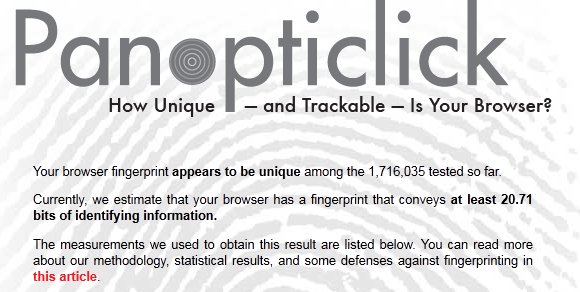
As you can see from my test (on a brand new machine), I have a unique browser configuration among the 1.7 million tested so far. My browser would be easy to track.
August 17, 2011
Penn Jillette: The word “God” is just another way of saying “I don’t know”
Penn is promoting his new book, God, No! Signs You May Already Be an Atheist and Other Magical Tales, which includes appearances on various TV shows. I suspect this is rather typical:
Last week I was interviewed for Piers Morgan’s show (which used to be Larry King’s show). Piers beat me up a bit for being an atheist (that’s his job) and then beat me up a bit for being a libertarian (also his job). He did this by asking me impossible questions, questions that none of us, Harold, Richard, me, (or Piers), could ever answer.
He started with “How did you get here?” and I started talking about my road to showbiz and atheism and he interrupted and said he meant how the universe was created. I said, “I don’t know.”
He said, “God,” an answer that meant Piers didn’t know either, but he had a word for it that was supposed to make me feel left out of his enlightened club.
Then he asked me what we could do to help poor people. I said I donated money, food, medical care, and services and he said, “No,” he meant, what could society do to solve the problem of poor people. Again, I was stumped.
He said the government had to do it, which I interpreted as another way of saying he didn’t know, but he thought that made me look mean … even though I do care and do try to help.
What makes me libertarian is what makes me an atheist — I don’t know. If I don’t know, I don’t believe. I don’t know exactly how we got here, and I don’t think anyone else does, either. We have some of the pieces of the puzzle and we’ll get more, but I’m not going to use faith to fill in the gaps. I’m not going to believe things that TV hosts state without proof. I’ll wait for real evidence and then I’ll believe.


