Quotulatiousness

December 31, 2018

7 Things You Should Know About Free Speech in Schools: Free Speech Rules (Episode 1)

Filed under: Bureaucracy, Education, Law, Liberty, USA — Tags: , , — Nicholas @ 02:00

ReasonTV
Published on 13 Dec 2018

Watch the first episode of Free Speech Rules, a new video series on free speech and the law. The first episode looks at the seven things you should know about how the First Amendment is applied in schools, from black armbands to ‘Bong Hits 4 Jesus.’

——————–
Subscribe to our YouTube channel: http://youtube.com/reasontv
Follow us on Twitter: https://twitter.com/reason
Subscribe to our podcast at Apple Podcasts: https://goo.gl/az3a7a

Reason is the planet’s leading source of news, politics, and culture from a libertarian perspective. Go to reason.com for a point of view you won’t get from legacy media and old left-right opinion magazines.
—————-

Watch the first episode of Free Speech Rules, a new video series on free speech and the law that’s written by Eugene Volokh, the Gary T. Schwartz Distinguished Professor of Law at UCLA, and the co-founder of the Volokh Conspiracy, which is hosted at Reason.com.

The first episode looks at the seven things you should know about how the First Amendment is applied in schools:

1) Political and religious speech is mostly protected.
Students, from first grade to twelfth, can’t be punished based on their political or religious speech. As the Supreme Court ruled in Tinker v. Des Moines Independent Community School District: “It can hardly be argued that either students or teachers shed their constitutional rights to freedom of speech or expression at the schoolhouse gates.”

2) Disruptive speech is not protected.
Schools can punish speech that “materially disrupts schoolwork” — for instance, because it prompts fights.

3) Vulgar or sexual speech is not protected.
Schools can also punish students for using vulgarities or sexual innuendos.

4) Praising drugs is not protected.
Schools can punish speech that seems to praise drug use, and probably also alcohol use and other crimes, at least when the speech doesn’t seem political.

5) Official school newspapers are the school’s own speech.
Courts see the newspaper as the school’s own speech, even if students are the ones who write it.

6) This only applies to public schools.
Under the so-called “state action doctrine,” the First Amendment doesn’t limit private schools, even those that get tax breaks or government funds.

7) California is different. Some states, like California, have passed laws that provide more protection to students.

Written by Eugene Volokh, a First Amendment law professor at UCLA.
Produced and edited by Austin Bragg, who is not. This is not legal advice.
If this were legal advice, it would be followed by a bill.
Please use responsibly.

December 10, 2018

Minneapolis abolishes residential zoning to combat racist segregation

Filed under: Law, Liberty, USA — Tags: , , , , — Nicholas @ 03:00

I’ve never actually been to Minnesota (despite being a lifetime fan of the Minnesota Vikings), so I didn’t realize that Minneapolis — and presumably other Minnesota cities historically instituted residential zoning to enforce racial segregation:

Minneapolis will become the first major U.S. city to end single-family home zoning, a policy that has done as much as any to entrench segregation, high housing costs, and sprawl as the American urban paradigm over the past century.

On Friday, the City Council passed Minneapolis 2040, a comprehensive plan to permit three-family homes in the city’s residential neighborhoods, abolish parking minimums for all new construction, and allow high-density buildings along transit corridors.

“Large swaths of our city are exclusively zoned for single-family homes, so unless you have the ability to build a very large home on a very large lot, you can’t live in the neighborhood,” Minneapolis Mayor Jacob Frey told me this week. Single-family home zoning was devised as a legal way to keep black Americans and other minorities from moving into certain neighborhoods, and it still functions as an effective barrier today. Abolishing restrictive zoning, the mayor said, was part of a general consensus that the city ought to begin to mend the damage wrought in pursuit of segregation. Human diversity — which nearly everyone in this staunchly liberal city would say is a good thing — only goes as far as the housing stock.

It may be as long as a year before Minneapolis zoning regulations and building codes reflect what’s outlined in the 481-page plan, which was crafted by city planners. Still, its passage makes the 422,000-person city, part of the Twin Cities region, one of the rare U.S. metropolises to publicly confront the racist roots of single-family zoning—and try to address the issue.

“A lot of research has been done on the history that’s led us to this point,” said Cam Gordon, a city councilman who represents the Second Ward, which includes the University of Minnesota’s flagship campus. “That history helped people realize that the way the city is set up right now is based on this government-endorsed and sanctioned racist system.” Easing the plan’s path to approval, he said, was the fact that modest single-family homes in appreciating neighborhoods were already making way for McMansions. Why not allow someone to build three units in the same-size building? (Requirements on height, yard space, and permeable surface remain unchanged in those areas.)

December 7, 2018

Australian parliament votes to weaken encryption

Filed under: Australia, Government, Law, Liberty, Technology — Tags: , , — Nicholas @ 03:00

Scott Shackford reports on the latest bit of oddness from the southern hemisphere:

Pretty much every single person in the tech industry, human rights circles, and academia warned the Australian government that forcing online platforms to weaken encryption would lead to disastrous results. Nonetheless, lawmakers are pushing forward — and it’s not just Australians who will suffer as a result.

Last night, Australia’s parliament rushed through the Assistance and Access Bill of 2018 right as their session was coming to a close. The bill gives various government agencies the authority to demand that tech and communication platforms provide them secret bypass routes around encrypted messages.

This is what is known as an encryption “backdoor,” and it’s a bad idea. Governments insist such tools are needed to fight crime and terrorism. The problem is that an encryption backdoor doesn’t care who uses it: If there’s a mechanism to bypass privacy security on a communication system, it can be exploited by anybody who knows how. That includes hackers, thieves, officials from authoritarian governments, and all sorts of dangerous people (including, of course, the very government people who insist they’re trying to protect us). That’s why tech companies have spent years fighting against the idea.

Weak encryption is a threat to the health of any tech platform that involves transferring data, and governments know that. So they insist they’re not demanding encryption backdoors while attempting to enact policies that pretty much demand them.

The Assistance and Access Bill won’t just grant the Australian government the power to demand that everybody from Facebook to Whatsapp help them bypass security to access private communications. The bill will let officials order companies, through “technical capability notices,” to alter their programming to facilitate snooping. And it gives the government the authority to force the tech employees who implement the changes to keep them secret. Break that secrecy, and the employees can face up to five years in jail.

November 28, 2018

AirBnB virtue signals its … anti-semitic street cred?

Filed under: Business, Law, Politics, USA — Tags: , , — Nicholas @ 05:00

In the National Post, Barbara Kay discusses the odd business choices of AirBnB in cutting off rentals to only certain locations that just happen to be in Israel:

Planning a group holiday in Kashmir? Airbnb is there to serve you. Likewise in Tibet, northern Cyprus and Georgia’s separatist republic of Abkhazia, all occupied or disputed territories. Airbnb’s political neutrality in these hot spots therefore quite rightly casts suspicion, to put it mildly, on its recent decision to delist some 200 Jewish homes in West Bank communities.

Airbnb stated, “We know that people will disagree with this decision and appreciate their perspective. This is a controversial issue.” No kidding. An Israeli class-action lawsuit has been filed against Airbnb, seeking US$4,000 in damages for every affected host.

Indignation has been running high outside of Israel as well, in statements both spontaneous — disgusted blog, Twitter and Facebook posts — and considered. The Beverly Hills city council, for example, passed a unanimous condemnatory resolution, calling Airbnb out for anti-Semitism and stating, in part: “The City of Beverly Hills hereby calls upon Airbnb to correct this act of disrespect to the land of Israel and restore its original services immediately.”

Setting aside the anti-Semitic optics, is it legal for Airbnb to do this?

The U.S. Constitution, as well as various state laws and acts of Congress, prohibits both American individuals and corporations from participating in boycotts against other nations. A corporate boycott against a foreign government does not fall under the “free speech” rubric,” but is considered a “tool of statecraft” reserved for the federal government in such situations as war. The office of Rob Portman of Ohio (R), an author of the Israel Anti-Boycott Act in the Senate, told The Jerusalem Post last Tuesday that it wants to hear from Airbnb. The Illinois state legislature — which passed the nation’s first local anti-BDS law in 2015 — will reportedly meet in mid-December, when it anticipates debating whether Airbnb violated its statute.

Establishing illegality pivots on whether the move is deemed as “politically” inspired. It certainly seems to be. As noted by Kohelet Forum legal expert Eugene Kontorovich in a recent Wall Street Journal oped, “An American Jew with a rental property in the West Bank is barred from listing it for rent on the website. But an American Arab is welcome to list his home a few hundred metres away, even though the Palestinian law forbidding real-estate deals with Jews carries a maximum penalty of death. That openly racist policy doesn’t trigger Airbnb’s delisting policy.”

November 16, 2018

QotD: Defining hate speech

Then, of course, there is the question of where hate-speech ends and legitimate commentary starts. It is generally easy to recognise the vilest abuse that is intended only to inflame and not to argue, just as it is easy to recognise pure pornography (I use the word ‘pure’ in its chemical, not its moral sense, of course). But often matters are much more complex than this.

For example, I recently saw the following statistic in a serious article on the internet: that Nigerian immigrants to Switzerland are seven times as likely to be convicted for a crime as Swiss citizens. Surely no one who wrote such a thing could think that it was calculated to create warm feelings in the hearts of the Swiss towards Nigerian immigrants, except those very few of Fabian mentality, who see in serial killers a cry for help (from the killers, of course, not from their victims).

The statistic – let us assume – is true. But then let us ask whether it has been corrected for the different sex and age structures of the two populations, that of the Nigerian immigrants and that of the Swiss population.

If it has not (and the article does not say), it is easily conceivable that a better, or at least different, statistic would be that Nigerian immigrants are only twice or three times as likely to be convicted for a crime as Swiss citizens. And if this were in fact the case, would the man who published the article be guilty of hate-speech, or merely of intellectual error? Is the test of hate-speech to be whether something does in fact bring a group into hatred, ridicule and contempt, or whether it is intended to do so?

It is easy to multiply examples. In this country, young Moslem men far out-fill their quota in prison, while young Hindu and Sikh far underperform where criminal conviction is concerned. Is this an interesting and important sociological fact, or an incitement to hatred, ridicule and contempt, or perhaps both?

A further problem is that of judging how sensitive people actually are or should be to perceived slights and insults. Just as the expression of hatred can be self-reinforcing, so can the sensitivity to slight and injury. The more you are protected from it, the more of it you perceive, until you end up being a psychological egg-shell. The demand for protection becomes self-reinforcing, until a state is reached in which nobody says what he means, and everybody infers what is not meant. Temperatures, or tempers, are raised, not lowered. The disgracefully pusillanimous (and incompetent) Macpherson report into the killing of Stephen Lawrence demonstrated the risks we run: it suggested that a racial incident should be defined as an incident which any witness to it believed to be racial, without there being any need for objective evidence that it was. Where a British judge can be so pusillanimously unattached to the rule of law, we can be sure that one day hate-speech will be defined as any speech that anyone finds hateful.

Theodore Dalrymple, “Hating the Truth”, Salisbury Review, 2011-06.

November 13, 2018

General Sir Charles Napier lived in vain

Filed under: Asia, Britain, Law, Liberty, Religion — Tags: , , , — Nicholas @ 03:00

Douglas Murray on the Asia Bibi case:

All of this is to say that the latest news from the U.K. is both thoroughly predictable and deeply disturbing. Readers of National Review will be familiar with the case of Asia Bibi. She is the Christian woman from Pakistan who has been in prison on death row for the last eight years. Her “crime” is that a neighbor accused her of “blasphemy.” […]

Her case has had ramifications throughout Pakistani society in the years since. For instance, it provoked the statement by the brave governor of Punjab, Salman Taseer, which led to his own murder by one of his own bodyguards. In the days since her release from jail, there have been mass protests in Pakistan where thousands of enraged fanatics have called, literally, for Asia Bibi’s head. The case has amply demonstrated the type of country that Pakistan is these days. But who would have guessed that her case would also throw so much light on the type of country Britain now is?

There are clearly international efforts underway to get Bibi out of Pakistan. If anybody in the world deserves asylum it is her. And any civilized country should be queuing up to give asylum to her and her family. Among those reported to have done so is the Netherlands.

But today there are reports that the British government has said that it will not offer asylum to Asia Bibi. The reason being “security concerns” — that weasel term now used by all officialdom whenever it needs one last reason to avoid doing the right thing. According to this report, the government is concerned that if the U.K. offered asylum to Bibi it could cause “unrest among certain sections of the community.” And which sections would that be? Would it be Anglicans or atheists who would be furious that an impoverished and severely traumatized woman should be given shelter in their country? Of course not. The “community” that the British government will be scared of is the community that comes from the same country that has tortured Asia Bibi for the last eight years.

So what’s the tie-in with General Sir Charles Napier? He was the governor of Sindh from 1843 to 1847. During his time in that office, he had opportunity to challenge certain long-established barbaric cultural practices:

Napier opposed suttee, or sati. This was the custom of burning a widow alive on the funeral pyre of her husband. Sati was rare in Sindh during the time Napier stayed in this region. Napier judged that the immolation was motivated by profits for the priests, and when told of an actual Sati about to take place, he informed those involved that he would stop the sacrifice. The priests complained to him that this was a customary religious rite, and that customs of a nation should be respected. As recounted by his brother William, he replied:

    “Be it so. This burning of widows is your custom; prepare the funeral pile. But my nation has also a custom. When men burn women alive we hang them, and confiscate all their property. My carpenters shall therefore erect gibbets on which to hang all concerned when the widow is consumed. Let us all act according to national customs.”

Britain could use another General Napier.

November 7, 2018

Bonfire Night hate “crime”

Filed under: Britain, Law, Liberty — Tags: , , , , — Nicholas @ 05:00

I have to say that I agree with Brendan O’Neill here … it was an offensive, idiotic, and totally tasteless act: but it was not — or at least should not be — a crime:

I cannot be the only person who finds the Metropolitan Police’s promise to investigate the Grenfell Tower bonfire video more chilling than the video itself. Yes, the video is repulsive. But what crime has been committed here? Being a wanker? Being a scumbag? Saying disgusting things in your own back garden? Those are criminal offences now? If they are, then Britain has far greater things to worry about than the fact that a handful of dreadful people decided to burn an effigy of Grenfell Tower for Bonfire Night.

First things first: the video is horrible. I am going to make a wild guess that the people featured in it, laughing and cheering as their cardboard Grenfell Tower goes up in flames, are not very nice. Some of them are probably racist. In the windows of their Grenfell effigy, there are notably non-white paper figures, waving for help. The effigy-burners say ‘This is what you get for not paying your rent!’ as the paper figures are consumed by the bonfire flames. Gross.

But criminal? That would be even more gross. Living in a society that criminalises people for what they say in their own back gardens would be worse, infinitely worse, than living in a society that has small numbers of prejudiced twats who think mocking the Grenfell calamity is funny.

And yet it looks like we live in that society. The commander of Scotland Yard, no less, issued a plea for information about the video, declaring himself ‘appalled by the callous nature’ of the people in it and by their ‘vile’ comments. I’m sorry, but I don’t want the police investigating videos in which no crime has been committed. In which no one’s property has been damaged or stolen and no person has been harmed. In which there is merely an act of expression. That way the police state lies. If we allow speech in one’s own home to become a police matter, we will regret it. Profoundly. What next: telescreens?

The police are upping the ante. This morning it is reported that five men have ‘surrendered’ to the cops and have duly been arrested. Some are saying they committed a public-order offence. In their own private residence? That’s a fascinating, and disturbing, definition of public disorder. Others are saying they committed a hate crime. Even though there were no victims? Even though they did not utter their words to anyone but themselves? Even though – once again for the people at the back – they were speaking among themselves in their own private space?

Quebec cabbies sue provincial government for declining revenues and lost capital cost due to Uber competition

Filed under: Business, Cancon, Law, Liberty — Tags: , , , , — Nicholas @ 03:00

William Watson makes the argument that it’s the ripped-off taxi customers who should be suing, not the cabbies:

There are at least two problems with the court case, one technical, one regarding fairness. The technical one: Cabbies want compensation for both declining revenue and the capital loss on their permits. But that’s double-counting. The permit is an entitlement to earn the revenues. Its value falls only because expected revenues have fallen. Give operators one or the other, if the law eventually says you must, but not both. They can have their compensation but not eat it, too.

The fairness question concerns where the taxi cartel’s surplus came from all these years, which is no mystery: It came from taxi users. But what are we, chopped liver? Why don’t we start a class action suit of our own to get back all the money ripped off from us over decades of artificially restricted taxi supply?

Basic fairness would certainly require that. Unfortunately, the law may not. The taxi drivers’ case against the government is that, despite statutes on the books about needing a taxi permit in order to provide taxi services, when Uber came along the government decided not to enforce the law. That created two classes of taxi driver: Uber drivers, whom the government turned a blind eye to, and regular taxi drivers, whom it continued to subject to close regulation. That double standard was an unfairness, yes, but a minor one compared to the long-lasting aggravated rip-off of consumers.

Bottom line: Taxi drivers lobby for and get a law allowing them to overcharge their customers. When in a bout of good policy sense (a “Taxi Spring” you might say) the government decides not to enforce it, the taxi drivers set about suing taxpayers instead. However unfair that may seem — and it’s exasperating! — I suppose, in the end, supply-and-demand must take notice of the principle of rule of law.

November 4, 2018

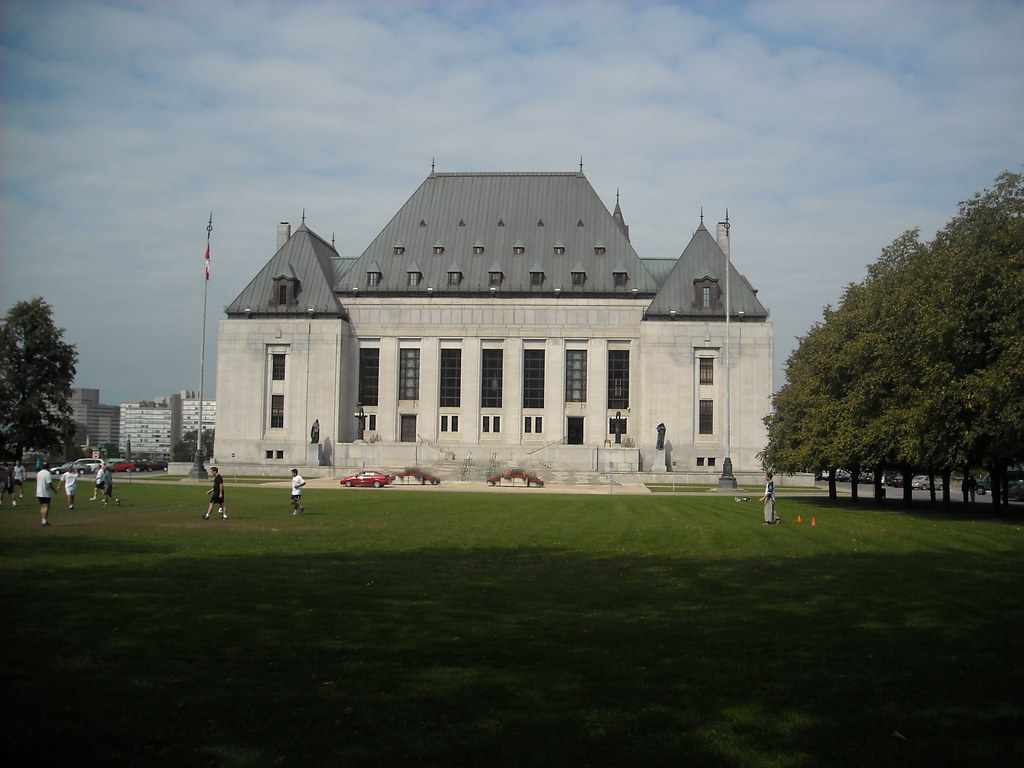
That pesky Supreme court ruling on the Churchill Falls deal

Filed under: Cancon, Economics, Law — Tags: , , , — Nicholas @ 03:00

I use the term “pesky” in the headline to avoid being slagged by one or possibly even both of my Newfoundland and Labrador readers … to curry favour with them, I’d need to escalate from somewhere between “ethically doubtful” and “outrageous”, and even that might not capture the essence of anger and resentment at Quebec’s amazingly great deal long-term on cheap hydro-electric power from the Churchill Falls facility. It is, as Wikipedia says, “the second largest hydroelectric plant in North America, with an installed capacity of 5,428 MW”, and thanks to Quebec financing and astute negotiations, most of that output is sold to Quebec at a very small proportion of today’s open market price. Colby Cosh arches an eyebrow over a Supreme Court justice’s lone vote of dissent on the case:

Churchill Falls generating station, Labrador.
Photo via Wikimedia Commons.

It is my solemn duty to perform one of the important functions of a newspaper columnist: raising one questioning eyebrow. On Friday the Supreme Court issued a judgment in the long battle between Churchill Falls (Labrador) Corp., a subsidiary of Newfoundland and Labrador Hydro, and Hydro-Québec. CFLco is the legal owner of the notorious Churchill Falls Generating Station in the deep interior of Labrador, close to the border with Quebec.

The station was built between 1966 and 1971. Hydro-Québec provided backing when the financing proved difficult for the original owner, an energy exploration consortium called Brinco. This led to the signing of Canada’s most famous lopsided contract: a 1969 deal for Hydro-Québec to receive most of the plant’s output for the next 40 years at a quarter of a cent per kilowatt-hour, followed by 25 more years at one-fifth of a cent. The bargain ends in 2041, at which time CFLco will get full use and disposal of the station’s electricity back.

This has been a heck of a deal for Quebec. It took on the risk of financing and building the station in exchange for receiving the electricity at a low fixed price — one that both sides in the court case agree was reasonable at the time. But it meant that Newfoundland saw no benefit from decades of oil price shocks, from the end of nuke-plant construction in the U.S., or from the increasing market advantage hydroelectricity enjoys while dirtier forms of power generation attract eco-taxation.

It has been maddening for Newfoundland to remain poor while Hydro-Québec grows fat on the profits from a Newfoundland river. Quebec, for its part, has never been completely convinced of the legitimacy of its border with Labrador, and it sees its good fortune as a sort of angelic reward for having to be part of Confederation. The Churchill Falls deal is (quite reasonably) regarded as proof that Quebec’s homegrown industrialists were able to beat resource-exploiting Anglo financiers at their own game. There are thus reasons beyond the bottom line that Quebec has never wanted to renegotiate the Churchill Falls contract. But the bottom line is enough.

October 30, 2018

The plight of Gab

Filed under: Business, Law, Liberty, Media — Tags: , , — Nicholas @ 05:00

Unlike other social media platforms that have hosted (and continue to host) legal-but-“hateful” content, Gab has suffered a de-platforming and is currently scrambling to get the service operational with a new service provider (reported to be a non-US site). On Monday, the Gab team posted the following static page in place of their normal UI:

The Z Man explains:

The question that normal people ask is how this is possible. After all, these companies sign contracts and in theory, we still have courts where contracts can be enforced by impartial judges. While that is a laughable fiction now, the reality is these companies are not bound by standard business agreements. They have been allowed to carve out new law for themselves, forcing their vendors and customers to sign off on what is called an adhesion contract. This gives the tech giants absolute power over everyone else.

An adhesion contract or “standard form contract” is a contract drafted by one party and signed by another party. The second party typically does not have the power to negotiate or modify the terms of the contract. Adhesion contracts are commonly used for things like insurance or rental contracts. When you rent a car or purchase car insurance, you just sign the contract, because you have to in order to rent the car or get insured. Every technology service provider is now basing their relationships on these types of contracts.

It used to be that the courts carefully scrutinized these types of arrangements, so the contract had to adhere to some basic principles. The courts would often use the “doctrine of reasonable expectations” to void all or part of these contracts, when there was lack of notice, unequal bargaining power, or blatant and substantive unfairness. The reason for this should be obvious. When a powerful company has the right to dictate the terms of the contract to their customers, they have all the power in the contractual relationship.

In western jurisprudence, a valid contract is one in which both parties freely engage and have equal opportunities to negotiate. When one party imposes the conditions on the other, that’s not a contract. That’s slavery. In a world where a handful of people control the public space, these types of contract give them arbitrary power over public discourse. If they become vexed with what you say, they can claim you have violated their terms of service and remove you from the internet. Again, the terms are dictated, not negotiated.

October 22, 2018

The right to repair

Filed under: Business, Government, Law, Liberty, Technology — Tags: , , , — Nicholas @ 03:00

Cory Doctorow:

Companies have always tried to corral their customers into behaving in ways that maximize the companies’ profits, even if that’s not best for the customers: forcing you to use “official” printer ink, to buy your printers and terminals from the same company that sold you your mainframe, to get your apps from the company that sold you your phone.

One especially effective profit-maximization strategy is controlling repairs. If a company can force you to use its official repair services, they can set prices for parts and service, and force you to use original manufacturer’s parts, rather than third-party parts or refurbished parts. And, of course, they can refuse to repair a product after a certain number of years: in the absence of a third-party repair option, this means that you have to throw away your product and buy another one from the company.

Though the urge to control customers to maximize profits is as old as business, the digital era has seen an important shift in the tactics used to make business models mandatory. The abuse of laws like Section 1201 of the DMCA (which bans breaking DRM), the Computer Fraud and Abuse Act (which lets companies treat their “license agreements” as though they had the force of law), as well as trade secrecy and monopolistic supply-chain control has literally criminalized many forms of independent repair, and it’s getting worse.

Last year, 18 state level Right to Repair bills were crushed by a big business coalition led by the tech industry. These bills would end companies’ war on independent service by forcing them to supply parts, manuals, and diagnostic codes to independent technicians.

October 20, 2018

QotD: Women and violence

Filed under: Law, Quotations — Tags: , , , — Nicholas @ 01:00

Activists for feminism are continually characterizing the world of women as one of terror, abuse, and uncertainty. For Leitch to take them at their word, applying a tough-on-criminals spin, is an authentic Trump touch. I do not wholly approve of the tactic, but, as much as I think some feminists are attention-hungry zanies, I recognize the kernel of truth in their image of the universe. I’ve never had a close female friend who could not tell of bizarre, creepy, threatening things happening to them — sights and encounters that, to a male with an ordinary upbringing, seem to have wriggled from the corner of a Hieronymus Bosch painting.

[…]

The actual status of women is that they belong to the physically weaker sex. Biology has given male primates greater upper-body strength, stronger grip, and testosterone. Men commit the overwhelming majority of consequential violence everywhere in the world throughout all history. (Men’s rights advocates sometimes argue that women commit just as many violent acts as men, which misses the point by such a wide margin that it is the intellectual equivalent of throwing like a girl.)

Colby Cosh, “I’m with Leitch — give women pepper spray (but keep it from the men)”, National Post, 2016-12-05.

October 18, 2018

Canada legalizes cannabis … then takes the rest of the week off

Filed under: Cancon, Health, Law, Politics — Tags: , — Nicholas @ 03:00

What do you know? Justin Trudeau actually followed through on his promise to legalize marijuana across the country! Of all his election promises, that’s probably the one that most voters expected him to ditch as soon as the votes were counted, yet here we are in the second country in the world to legalize the stuff. So, everyone not here in Canuckistan, we’ll probably be back sometime next week as we’ve got a lot of mellowing to get done…

Oh, you want a blog post? Duuuude, just take another hit.

Oh, okay, here ya go:

An Abacus Data poll released this week suggests Canadians are ready for marijuana legalization even if their governments might not be: Strong majorities of respondents in every age group and in every region said they could support or at least “accept” the framework that goes into effect Oct. 17. Even 54 per cent of Conservative voters said they could support or accept legal weed.

[…]

The resistance continues, certainly. In a special meeting on Tuesday, just days before Ontario’s municipal elections, City Council in Markham, Ont., passed a bylaw restricting marijuana smoking to private residences. It had earlier voted 12-1 in favour of “opting out” of storefront retail, as allowed for under provincial regulations.

“When you’re taking your grandmother down the street for a walk, (we don’t want you) having to be exposed to a number of individuals potentially at a street corner participating in it,” says Mayor Frank Scarpitti.

Richmond, B.C., is another refusenik jurisdiction. Mayor Malcolm Brodie notes the city took a much harsher approach than neighbouring Vancouver to the proliferation of illegal dispensaries, throwing the book at the only one that attempted to open. And he credits the provincial government with listening to municipalities’ concerns and allowing them to go their own ways

Indeed, considering the Reefer Madness-level debate, it seems somewhat remarkable how peacefully this sea change is washing over the country — and it seems the patchwork of provincial and municipal rules, much derided by Conservatives, is partly to credit for that.

A quick run-down of the new rules.

Thanks to time zones, the first legal sale of marijuana happened in Newfoundland:

One of the first customers to buy legal recreational cannabis in Canada says he has no intention of smoking, vaping or otherwise consuming the gram of weed he bought at a store in St. John’s.

Ian Power, who was first in line at one of several stores in the country’s easternmost province that opened just after midnight local time, says he plans to frame his purchase.

Hundreds of customers were lined up around the block at the private store on Water Street, the main commercial drag in the Newfoundland and Labrador capital, by the time the clock struck midnight.

A festive atmosphere broke out, with some customers lighting up on the sidewalk and motorists honking their horns in support as they drove by the crowd.

Cannabis NL expected 22 stores to open on Oct. 17, but not all opted to open in the middle of the night to commemorate the event.

Licensed marijuana producer Canopy Growth Corp. opened the Tweed-branded store in St. John’s at the late hour, while retailer Loblaw Companies Ltd. planned to start selling cannabis at its 10 locations at 9 a.m.

October 14, 2018

Brendan O’Neill: The Tyrannical Idea of “HATE SPEECH”

Filed under: Law, Liberty, Politics — Tags: , , , , — Nicholas @ 02:00

PhilosophyInsights
Published on 27 Aug 2017

Brendan O’Neill is the editor of Spiked Online and a columnist for The Australian and The Big Issue. This is part of a discussion of hate speech at spiked‘s campus-censorship conference, The New Intolerance on Campus.

You can check out the platform of spiked here: http://www.spiked-online.com/


This channel aims at extracting central points of presentations into short clips. The topics cover the problems of leftist ideology and the consequences for society. The aim is to move free speech advocates forward and fight against the culture of SJWs.

If you like the content, subscribe to the channel!

October 11, 2018

It’s all in the spin – “Another ‘human trafficking operation’ that wasn’t”

Filed under: Law, Media, USA — Tags: , , , , , — Nicholas @ 03:00

Elizabeth Nolan Brown on how to pitch a “human trafficking” police sweep that doesn’t actually uncover any human trafficking at all:

One hundred and twenty-three missing Michigan minors were found during a one-day “sex trafficking operation,” the New York Post reported yesterday. Similar statements showed up in other news headlines across national and international news. What the associated articles fail to mention for multiple paragraphs is that only three of the minors are even suspected of having been involved in prostitution.

Officials said the operation — a joint effort of the U.S. Marshals Service, the FBI, Michigan State Police, and multiple local Michigan police departments — identified three “possible sex-trafficking cases” among the 123 minors that were located on September 26, according to a press release.

What’s more, all but four of the “missing children” were not actually missing. In the remaining cases, minors were listed in a police database as missing but had since been found or returned home on their own. “Many were (homeschooled),” Lt. Michael Shaw told The Detroit News. “Some were runaways as well.”

The one-day “rescue” sweep was a long-time in the making, with police beforehand “investigating their whereabouts by visiting last known addresses, friend’s homes and schools.”

Nothing in the U.S. Marshals report on the operation makes mention of any arrested kidnappers, “traffickers,” or other adults involved in endangering or exploiting any of the missing minors that were identified. Which makes sense — very few missing children are actually abducted. And when runaway teens do engage in sex for money, the vast majority do not have “pimps.”

« Newer PostsOlder Posts »

Powered by WordPress