
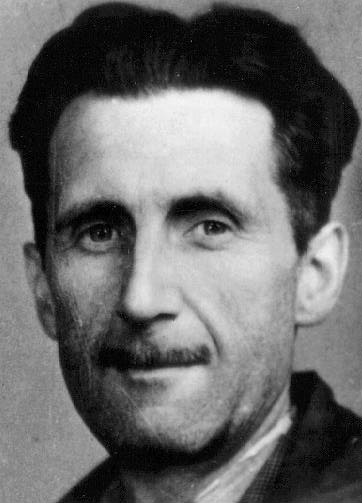
Orwell’s press card portrait, 1943
Mussolini, in “Cassius’s” book, after calling his witnesses, enters the box himself. He sticks to his Machiavellian creed: Might is Right, vae victis! He is guilty of the only crime that matters, the crime of failure, and he admits that his adversaries have a right to kill him — but not, he insists, a right to blame him. Their conduct has been similar to his own, and their moral condemnations are all hypocrisy. But thereafter come the other three witnesses, the Abyssinian, the Spaniard and the Italian, who are morally upon a different plane, since they have never temporized with Fascism nor had a chance to play at power politics; and all three of them demand the death penalty.
Would they demand it in real life? Will any such thing ever happen? It is not very likely, even if the people who have a real right to try Mussolini should somehow get him into their hands. The Tories, of course, though they would shrink from a real inquest into the origins of the war, are not sorry to have the chance of pushing the whole blame onto a few notorious individuals like Mussolini and Hitler. In this way the Darlan-Badoglio manoeuvre is made easier. Mussolini is a good scapegoat while he is at large, though he would be an awkward one in captivity. But how about the common people? Would they kill their tyrants, in cold blood and with the forms of law if they had the chance?
It is a fact that there have been very few such executions in history. At the end of the last war an election was won partly on the slogan “Hang the Kaiser”, and yet if any such thing had been attempted the conscience of the nation would probably have revolted. When tyrants are put to death, it should be by their own subjects; those who are punished by a foreign authority, like Napoleon, are simply made into martyrs and legends.
What is important is not that these political gangsters should be made to suffer, but that they should be made to discredit themselves. Fortunately they do do so in many cases, for to a surprising extent the war-lords in shining armour, the apostles of the martial virtues, tend not to die fighting when the time comes. History is full of ignominious getaways by the great and famous. Napoleon surrendered to the English in order to get protection from the Prussians, the Empress Eugénie fled in a hansom cab with an American dentist, Ludendorff resorted to blue spectacles, one of the more unprintable Roman emperors tried to escape assassination by locking himself in the lavatory, and during the early days of the Spanish Civil War one leading Fascist made his escape from Barcelona, with exquisite fitness, through a sewer.
It is some such exit that one would wish for Mussolini, and if he is left to himself perhaps he will achieve it. Possibly Hitler also. It used to be said of Hitler that when his time came he would never fly or surrender, but would perish in some operatic manner, by suicide at the very least. But that was when Hitler was successful; during the last year, since things began to go wrong, it is difficult to feel that he has behaved with dignity or courage. “Cassius” ends his book with the judge’s summing-up, and leaves the verdict open, seeming to invite a decision from his readers. Well, if it were left to me, my verdict on both Hitler and Mussolini would be: not death, unless in is inflicted in some hurried unspectacular way. If the Germans and Italians feel like giving them a summary court-martial and then a firing-squad, let them do it. Or better still, let the pair of them escape with a suitcaseful of bearer securities and settle down as the accredited bores of some Swiss pension. But no martyrizing, no St Helena business. And, above all, no solemn hypocritical “trial of war criminals”, with all the slow cruel pageantry of the law, which after a lapse of time has so strange a way of focusing a romantic light on the accused and turning a scoundrel into a hero.
George Orwell, “Who are the War Criminals?”, Tribune, 1943-10-22.
July 31, 2019
QotD: Foreshadowing Nuremberg
July 30, 2019
Moira Greyland discusses how she came to write The Last Closet
Tamara Wilhite discusses some of the events that prompted Moira Greyland to write about her mother, Marion Zimmer Bradley and some of the reactions from readers of the book:

The Last Closet was written by Moira Greyland. She’s the daughter of Marion Zimmer Bradley, author of The Mists of Avalon and Walter Breen. It is Marion Bradley’s book from which the book title is drawn. “The Last Closet: The Dark Side of Avalon” is equal parts autobiography and true-crime thriller with a tragic sprinkling of the history of science fiction fandom mixed in.
Moira’s book includes large sections of horrifying personal stories, but she has gone to great length to document what happened. For example, her father’s repeated arrests on pedophilia charges (he died in prison) and her mother’s testimony during such trials are public record. She’s backed up everything she can from external sources.
I had the opportunity to interview Moira, and the transcript is below.
Tamara: Some of the events in the book go back forty years. What prompted you to write the book in 2017?
Moira: In 2014, a blogger named Deirdre Saoirse Moen contacted me. She was protesting Tor book’s publication of a puff piece lauding my mother, which did not mention either my father’s conviction or her court-documented collusion with him.
I only knew Deirdre as a woman from science fiction fandom who had hired me for a harp concert, and I did not realize how famous she was. My responses to her email consisted of a brief assent that my father had indeed done all that he was accused of and convicted for and more, but it also included the new for her information that my mother had been a great deal worse than my father. I also included my two poems “Mother’s Hands” and “They Did Their Best.”
Deirdre was horrified, and reported that she had lost her lunch upon reading my reply. Her blog posts about my mother and my responses were reblogged to 92 countries all over the world. There was furious controversy, mostly consisting of everyone who tried to defend my mother getting shouted down. Some people read my mother’s appallingly callous court testimony and pronounced her guilty from her own words. Other people saw themselves in my poetry, in the flatness and horror so familiar to the trauma patient. Still others recognized things in my mother’s books about incest and sexual abuse which had never quite seemed right to them.
I was astonished at the volume of response, and at the many, many, MANY letters addressed directly to me. Most of the letters included both sympathy for me and my brother, but nearly all contained reports of the letter writer’s own abuse, many containing the words “I never told anyone this before.”
I was asked to fill in the rest of my story, and I did so, in a blog post called “The Story of Moira Greyland,” hosted on the blog of Katy Faust, another child of gays and lesbians as I am. My blog post was nominated for a Hugo in 2015, and I was offered a book contract by Vox Day of Castalia House.
The only concern I had about writing my book was that my late brother Mark was having a very hard time with the unplanned public exposure. He was having flashbacks about our father, and beginning to have a lot more trouble managing his health. The reason that was so problematic for him was that we both identified our mother as being the scary, dangerous one, where our father was comparatively gentle and loving. Having to deal with his history meant that there was no even remotely good parent left for him, even as a matter of memory.
His distress predated the book, though, and I did not think that it would be relieved by my silence.
I was given a year to complete the book, and I beat my deadline. It would do no good to mention the particular kind of hell it was to tell the story, and I credit my beloved late husband with sticking by my side through the entire process. Anyone with a trauma history can imagine that all of my trauma symptoms from flashbacks to ataxia got worse. It became very clear to me while writing exactly why it was that so few people talk about their injuries.
July 25, 2019
In British Columbia, “butthurt” damages can exceed $75,000 under Human Rights legislation
In the Post Millennial, Jordan Schroeder illustrates how BC human rights rules have created a new class of tort:
I would argue that the issue is not with the BC Human Rights Tribunal itself, but with the perverse incentive of litigating for profit that is created by the BC Human Rights Code. The BC Human Rights Code creates this incentive through a type of damages called “injury to dignity, feelings, and self-respect.”
This head of damages is harmful to human rights law in BC. It is unfair to the defendants, and it incentivizes predatory litigation. All of this causes British Columbians to lose trust in the important role that the tribunal can play in redressing wrongs.
Section 37 of the BC Human Rights Code allows the tribunal to make an award of damages to a complainant for “injury to dignity, feelings, and self-respect”. The tribunal is permitted to award any amount for this that it sees fit.
By the admission of the Human Rights Tribunal [PDF], the awards for this type of damages is high and is “trending upwards.” For example, in the Oger v Whatcott case, Whatcott was ordered to pay $35,000 for discriminatory speech against Morgane Oger. Whatcott had made critical comments about Oger based Oger’s transgender identity. In the same case, the tribunal cited $5,000 awards as “lower” awards. Other cases have seen awards of up to $75,000.
Awards for hurt feelings are unique to human rights law. Damages awarded in every other area of law are based on the principle that the award should only make the complainant whole. A complainant should never be better off after receiving the damages award.
For example, consider if a company leased a concert hall to a business that wanted to use the space to put on a production. Imagine that business stood to make $50,000 in profit from a sold-out production.
If the rental was cancelled by the company leasing the concert hall in breach of the contract, that company would have to pay the other party $50,000, representing all of the profit the other party could have made. The other party is not better off after the award. They are only made whole.
In contrast, awards for hurt feelings undoubtedly put the complainant better off than they would have been had the human rights violation not occurred in the first place. It is self-evident that an award in the tens of thousands of dollars outweighs any injury to feelings caused by the discriminatory speech or action.
Why is it a problem to have an award that amounts to more than what the complainant actually lost? Obviously, there is the problem that it saddles a defendant with a massive financial burden that doesn’t reflect the damage that they caused. A woman starting a small business who is ordered to pay a “small” award of $5,000 dollars would likely find it ruinous.
July 24, 2019
Wait, you mean there might be a downside to cannabis legalization?

As a libertarian of long standing, I’m on the record as being in favour of legalizing cannabis since long before it was cool (geeky and perpetually uncool libertarians probably helped keep it from being cool for at least a few years longer). I’m not enthused to hear that we may have been undersold on the risks of cannabis use … not that the government didn’t try telling is it was deadly, deadly poison (they did, repeatedly, and at great length), but they institutionalized the role of the boy who cried wolf, and every illegal narcotic got basically the same description. I’m actually not kidding here: the first health class I got in middle school included a lecture and a pamphlet on the dangers of pot; the second class covered the dangers of cocaine; the third warned against LSD; and so on … but they used a copy/paste to discuss the physical and mental risks of the different drugs, and they all read the same way. All those evil drugs are evil, bad, and rot your brain. Knowing that the pothead (“Hi, Gary!”) at the back of the class hadn’t suddenly had a psychotic break and tried to fly off the top of the school was the first hint that we were being oversold on the real world risks of (some) illegal drug use. The declared fact that some illegal narcotics actually are deadly, deadly poison ran up against the observed fact that a significant majority of people over the age of fifteen had tried cannabis and found it somewhat less scary than advertised.
Along with the beginnings of doubt that the government was being honest with us, and the clear understanding that even if using drugs wasn’t as dangerous as we were told, we shared a growing awareness that being caught with drugs by the police was significantly more dangerous and possibly deadly. Officer Friendly would shoot you down like a mad dog if he thought you were one’o’them drug-crazed hippies. It certainly changed the social dynamics of any interaction with Officer Friendly’s fellow heavily armed co-workers…
In the National Post, Barbara Kay suggests that not all the dangers of cannabis use were mere government propaganda:
Some years ago, in conversation with his wife, a forensic psychiatrist specializing in mentally ill criminals, former New York Times reporter Alex Berenson observed that the perpetrator of a recent violent crime had been high at the time, and had smoked pot regularly all his life. Her response — “Yeah, they all do” — jolted him. The result was his book, Tell Your Children: The Truth About Marijuana, Mental Illness and Violence.
Much of the referenced material in Berenson’s book had not yet been published a decade ago. But more recent studies only confirm what a few intrepid researchers were already warning about then.
Indeed, as I noted in a 2008 column, the head of the Medical research Council in the U.K., Professor Colin Blakemore, who in 1997 had been the moral authority behind a pot-legalization campaign, unequivocally reversed his pot-friendly stance in 2007, stating: “The link between cannabis and psychosis is quite clear now; it wasn’t 10 years ago.”
If you haven’t energy for a whole book, but would invest in 16 pages on the subject, you will be well rewarded by Steven Malanga’s in-depth article, “The Marijuana Delusion,” in City Journal‘s June issue. Here you will find debunked the blithe claim, still received as gospel by progressives and libertarians, that pot is virtually harmless and even therapeutic.
Unlike marijuana, real medications are deeply researched before coming on the market, and may attest to proven benefits, but are obligated to admit potential harms. Is pot a medicinal drug or a placebo? Nobody really knows. One may argue “who cares, as long as it works” (anecdotally I hear that pot works, and also that it doesn’t work), but that isn’t the point, since the legalization movement made medical claims for pot in order to bring the public onside politically. There was no will on the movement’s side to discover even radically fortified pot’s downsides.
The knowledge was out there for those interested. In 1987 a study of nearly 50,000 Swedish military conscripts followed for drug use over 15 years found that frequent pot use in teenhood was linked to a six-fold risk of schizophrenia as compared with non-usage. A 2004 meta-analysis of studies on pot use came to a similar conclusion. These studies, and others, are suggestive that heavy marijuana consumption, particularly in youth, may cause serious mental health problems. Yes, it is possible that the link isn’t entirely causal; people with mental health issues may be more likely to use marijuana heavily. But at the very least, this ought to be an issue of ongoing concern, particularly now that marijuana is legal in Canada and in an increasing number of U.S. states.
July 21, 2019
Debunking the “common wisdom” about the “Scopes Monkey Trial”
Mark Pulliam explains what really caused the “Scopes Monkey Trial” and what was at stake … which doesn’t match up well at all against what little most people will remember about it today:
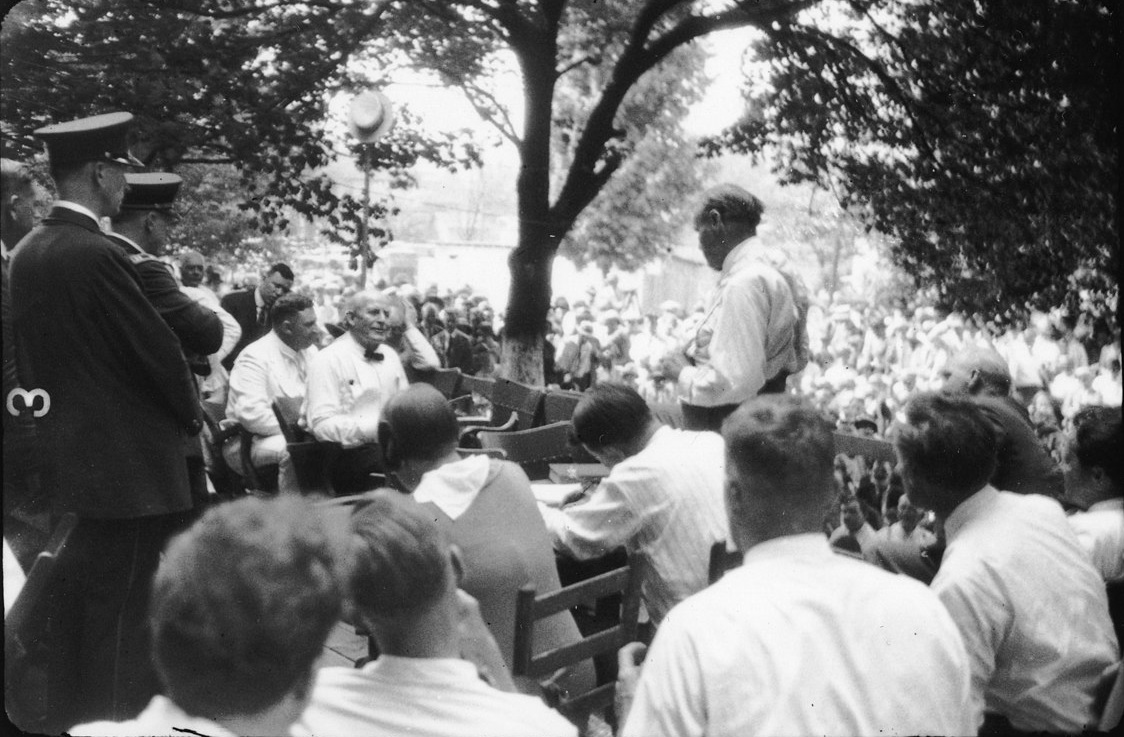
William Jennings Bryan (seated at left) being interrogated by Clarence Darrow, during the trial of the State of Tennessee v. John Thomas Scopes, July 20, 1925. That Monday afternoon, because of the extreme heat, Judge Raulston moved court proceedings outdoors. The session was held on a platform that had been erected at the front of the Rhea County Courthouse to accommodate ministers who wanted to preach during the time of the trial. Defense lawyers for Scopes (John R. Neal, Arthur Garfield Hays, and Dudley Field Malone) are visible seated to the extreme right. One of the men at left, with his back to the photographer, appears to be Scopes. The court reporters are seated at the table.
Photograph by Watson Davis via Wikimedia Commons.
We are again in another contentious period in America where battles over our culture and how we should live together are acrimonious. But there have been many points in our history that indicate we are only re-engaging a form of politics that is quintessentially American. One prominent past episode that occurred in Dayton, Tennessee during the summer of 1925 — the so-called “Scopes Monkey Trial” — has captured the American imagination like few legal proceedings ever have. Noted trial lawyer Clarence Darrow was part of the large legal team representing a 24-year-old substitute high school teacher, John Thomas Scopes, who was accused of violating the state’s Butler Act, which prohibited the teaching of evolution in a state-funded school. The celebrity co-prosecutor was William Jennings Bryan, the three-time Democratic presidential nominee, former Nebraska congressman, and Secretary of State to President Woodrow Wilson. Both Darrow and Bryan were prominent Progressive figures. Bryan, a left-wing evangelical and a fiery orator, is best known for his “Cross of Gold” speech at the 1896 Democratic National Convention.
The trial provided an opportunity for Darrow, whose reputation had been sullied by questionable tactics employed in the defense of radical labor leaders, to vindicate himself before a national audience. Chicago’s WGN radio station broadcast the trial nationwide and hundreds of reporters, some of them from overseas, covered the case. Geoffrey Cowan, author of the exhaustively-researched book The People v. Clarence Darrow, notes that Darrow achieved national notoriety, “won the support of Eastern sophisticates,” and “found new acceptance” as a result of the widely-publicized trial, especially his alleged humiliation of Darrow’s “old hero,” Bryan. This canard, which formed the dramatic crux of the 1960 movie Inherit the Wind, a highly-fictionalized depiction of the trial adapted from the 1955 play written by Jerome Lawrence and Robert E. Lee, is just one aspect of the popular mythology that surrounds the case.
Almost all of the “conventional wisdom” concerning the Scopes trial is false. Contrary to the impression created by Inherit the Wind and other popular accounts (including the sensational reportage of H. L. Mencken of The Baltimore Sun, one of the leading journalists of his day), the trial was not a fundamentalist inquisition, but an ill-conceived publicity stunt by Dayton businessmen who were trying to attract tourists to the small town — to put Dayton on the map. To generate a test case challenging the statute, the American Civil Liberties Union had offered to defend any teacher charged with violating the Butler Act, gratis. Dayton businessmen recruited Scopes to agree to serve as the defendant, even though he was unsure he had actually taught evolution. Nonetheless, Scopes volunteered to be charged. The trial — for a misdemeanor offense — was staged. Celebrity lawyers were solicited to participate for the sole purpose of increasing public interest in the case. The Baltimore Sun paid part of the defense’s expenses because it knew that the spectacle would sell newspapers, and it did. A lot of them.
I think it would be fair to say that H.L. Mencken had a passionate dislike for William Jennings Bryan, even after Bryan’s death a few days later:
It is the national custom to sentimentalize the dead, as it is to sentimentalize men about to be hanged. Perhaps I fall into that weakness here. The Bryan I shall remember is the Bryan of his last weeks on earth — broken, furious, and infinitely pathetic. It was impossible to meet his hatred with hatred to match it. He was winning a battle that would make him forever infamous wherever enlightened men remembered it and him. Even his old enemy, Darrow, was gentle with him at the end. That cross-examination might have been ten times as devastating. It was plain to everyone that the old Berserker Bryan was gone — that all that remained of him was a pair of glaring and horrible eyes.
But what of his life? Did he accomplish any useful thing? Was he, in his day, of any dignity as a man, and of any value to his fellow-men? I doubt it. Bryan, at his best, was simply a magnificent job-seeker. The issues that he bawled about usually meant nothing to him. He was ready to abandon them whenever he could make votes by doing so, and to take up new ones at a moment’s notice. For years he evaded Prohibition as dangerous; then he embraced it as profitable. At the Democratic National Convention last year he was on both sides, and distrusted by both. In his last great battle there was only a baleful and ridiculous malignancy. If he was pathetic, he was also disgusting.
Bryan was a vulgar and common man, a cad undiluted. He was ignorant, bigoted, self-seeking, blatant and dishonest. His career brought him into contact with the first men of his time; he preferred the company of rustic ignoramuses. It was hard to believe, watching him at Dayton, that he had traveled, that he had been received in civilized societies, that he had been a high officer of state. He seemed only a poor clod like those around him, deluded by a childish theology, full of an almost pathological hatred of all learning, all human dignity, all beauty, all fine and noble things. He was a peasant come home to the dung-pile. Imagine a gentleman, and you have imagined everything that he was not.
H/T to “WarEagle82” for the link.
July 17, 2019
QotD: “The United States government [became] the greatest and most potent maker of criminals in any recent century”
For most of the history of the United States, drugs were legal. People could buy opiates and cocaine-based products from their local pharmacy. An opiate-laced brew called Mrs. Winslow’s Soothing Syrup, for example, was particularly popular with housewives. One person who viewed this legal system with skepticism was a Los Angeles doctor named Henry Smith Williams. When a small number of his patients became addicted, he was disgusted, and he came to see them as despicable “weaklings.” So when opiates and cocaine were banned in 1914, he welcomed this first birth-pang of the drug war with glee.
But then he noticed what happened to his addicted patients. They didn’t stop using. Instead, “here were tens of thousands of people, in every walk of life, frantically craving drugs that they could in no legal way secure,” he wrote in one of his books. “They craved the drugs, as a man dying of thirst craves water. They must have the drugs at any hazard, at any cost.”
At the same time, Smith Williams realized that the drug war was “in effect ordering a company of drug smugglers into existence.” Because pharmacists could no longer sell these drugs, the Mafia and other criminal organizations stepped in, selling a vastly inferior product at extortionate prices. In the pharmacies, morphine had cost two or three cents a grain, but the criminal gangs charged a dollar.
The death rate among addicts rose, and those who survived began to behave very differently. An official government study had found that, before the drug war kicked in, three-quarters of self-described addicts had steady and respectable jobs: some 22% were wealthy, while only 6% were poor. They were more sedate as a result of their addiction, but they were rarely out of control or criminal. Yet faced with the need to meet these extortionate new prices, many of the men started to commit property crimes, and many of the women started to steal or prostitute themselves.
So Smith Williams watched as the drug war created two waves of crime: first a wave of violent criminal drug-dealers, and then a wave of criminality among addicts. “The United States government,” Henry wrote in shock, had become “the greatest and most potent maker of criminals in any recent century.”
Johann Hari, “A 1930s California story shows why the war on drugs is a failure”, Los Angeles Times, 2017-06-16.
July 14, 2019
The Epstein scandal is another example of the importance of accurate names
ESR has some concerns about the Epstein case, specifically on the correct terminology to use:
The sage Confucius was once asked what he would do if he was a governor. He said he would “rectify the names” to make words correspond to reality. He understood what General Semantics teaches; if your linguistic map is sufficiently confused, you will misunderstand the territory. And be readily outmaneuvered by those who are less confused.
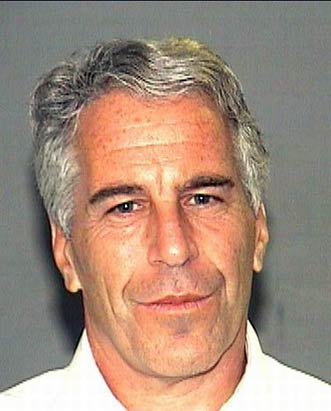
Mug shot of Jeffrey Epstein made available by the Palm Beach County Sheriff’s Department, taken following his indictment for soliciting a prostitute in 2006.
Image via Wikimedia Commons.And that brings us to the Jeffrey Epstein scandal. In particular, the widespread tagging of Epstein as a pedophile.
No, Richard Epstein is not a pedophile. This is important. If conservatives keep misidentifying him as one, I fear some unfortunate consequences.
Pedophiles desire pre-pubertal children. This is not Epstein’s kink; he quite obviously likes his girls to be as young as possible but fully nubile. The correct term for this is “ephebophile”, and being clear about the distinction matters. I’ll explain why.
The Left has a long history of triggering conservatives into self-discrediting moral panics (“Rock and roll is the devil’s music”). It also has a strong internal contingent that would like to normalize pedophilia. I mean the real thing, not Epstein’s creepy ephebophilia.
Homosexual pedophiles have been biding their time in order to get adult-on-adult homosexuality fully normalized as battlespace prep, but you see a few trial balloons go up occasionally in places like Salon. The last round of this was interrupted by the need to take down Milo Yiannopolous, but the internal logic of left-wing sexual liberationism always demands new ways to freak out the normals, and the pedophiles are more than willing to be next up in satisfying that perpetual demand.
Liberals have proven themselves utterly useless at resisting the liberationist ratchet, so I’m not even bothering to address them. Conservatives, if you want to prevent the next turn, don’t give the pedophilia-normalizers maneuvering room. Rectify the names; make the distinctions that matter.
Epstein’s behavior is repulsive because we judge young postpubertal humans to be too psychologically immature to give adult consent, but it’s nowhere near the evil that is the sexual abuse of prepubertal children.
July 13, 2019
Piling on the charges to encourage plea bargaining – modern policing at work
A recent local crime story included the following laundry list of charges for one of the accused:

Shaquille Lovell, 21, of Ritson Road South in Oshawa is charged with careless carry of a prohibited firearm, contravention of storage regulations, unauthorized possession of a firearm, possession of a firearm knowing its possession is unauthorized, possession of a loaded prohibited firearm, and possession of a controlled substance for the purpose of trafficking (cocaine).
He was found to be carrying a prohibited weapon (a handgun) and a controlled substance (cocaine). Those two offences should be more than enough to prosecute with strong chance of conviction. All the rest of the bafflegab charges appear to be piled on to encourage plea bargaining, because they’re literally peripheral to the main criminal activity the accused has been charged with.
Lawyers, especially legal aid lawyers, will encourage the accused to “bargain down” the charges — one of the reasons for so many separate charges being applied — to avoid the cost and delay of a full trial … and the risk of facing the full potential sentence. Even relatively well-to-do middle class people will be more likely to want to avoid a long, drawn-out legal battle because it might well cost them everything they own. Poor people don’t even have that much of an option.
Canadian law enforcement is continuing to follow down the path of the United States, where a 90% conviction rate is considered low. According to Statistics Canada, “In 2013/2014, 63% of all cases completed in adult criminal court resulted in a finding of guilt”, but also “The extent to which plea negotiations are utilized in Canada currently remains unknown.”
July 12, 2019
Mark Steyn urges caution when considering the Epstein case
It may make sense to avoid a rush to judgement, as the way the federal justice system works these days does not encourage a belief in its impartiality or, for that matter, its dedication to the concept of “justice”:
I am wary of saying anything too definitive re the Jeffrey Epstein case, because so much of the reporting is way too trusting of the federal prosecutors’ official narrative. Don’t get me wrong: I take it as read that he’s an industrial-scale pedophile, if only because it seems to be the only thing anybody knows about him – including how he made his billion dollars. He apparently requires three “massages” a day by underage girls. So, upon being informed that Mr Epstein was flying his “Lolita Express” around Africa with Bill Clinton, Kevin Spacey and a softcore porn actress called Chauntae Davies on board, I’m disinclined to accept the official explanation that this was an Aids-relief “humanitarian” mission.
Mug shot of Jeffrey Epstein made available by the Palm Beach County Sheriff’s Department, taken following his indictment for soliciting a prostitute in 2006.
Image via Wikimedia Commons.That said, as longtime readers know, I regard federal justice as appallingly corrupt, and so the sudden revival of Epstein’s prosecution is somewhat more than intriguing. First, and as often with prominent American cases, the details make no sense:
In a memo filed to the court, prosecutors outlined the scope of Epstein’s vast wealth to argue that he has the means to flee the country and escape prosecution, noting that he not only has homes in Manhattan, Palm Beach, New Mexico and Paris — with his Upper East Side townhouse, of which prosecutors are seeking the forfeiture, alone worth $77 million — but also owns a private island in the US Virgin Islands.
He also has three US passports, owns at least 15 vehicles and has access to two private jets, according to the memo.
I can understand how a rich man comes to have fifteen cars, but how pray, does one individual citizen acquire three US passports? And from a government supposedly on “orange alert” these last eighteen years.
Second, Epstein was the beneficiary of a ludicrously lenient federal plea deal a decade ago for exactly the same charges. So this would appear to be “double jeopardy”. Not so fast, say the feds:
It is well-settled in the Second Circuit [appellate court] that a plea agreement in one US Attorney’s office does not bind another unless otherwise stated.
Is that so? Thanks to that litigious loser Cary Katz, I’m more familiar with Second Circuit jurisprudence than I might otherwise wish. But I had no idea of the above. So apparently, when you enter into a plea deal with “the United States” that says things like “the United States, in consultation with and subject to the good faith and approval of Epstein’s counsel, shall select an attorney representative for…” and “if Epstein successfully fulfills all of the terms and conditions of this agreement, the United States also agrees that it will not institute any criminal charges against…”, the words “the United States” only apply to the United States that resides at 27 Ocean View Parkway, Miami Beach and not the United States that resides at 32b Rotting Wharf Lane, The Bronx. So forget double jeopardy; you could have demicentuple jeopardy. Who knew?
One more thing: it seems fairly obvious that Epstein is also a procurer for those whose appetites likewise run to schoolgirls. This is where the manifests of his airplane are at least somewhat inferential. Yet the new indictment is concerned only with “the New York Residence” and “the Palm Beach Residence” — and not the Lolita Express jetting well-heeled buddies to Paedo Island. Is this some cozy arrangement to ensure that Bill Clinton et al are excluded from the case?
July 11, 2019
The genesis of the administrative state during the Great Depression
Leonid Sirota provides some interesting background on the rise of the administrative state during the 1930s:
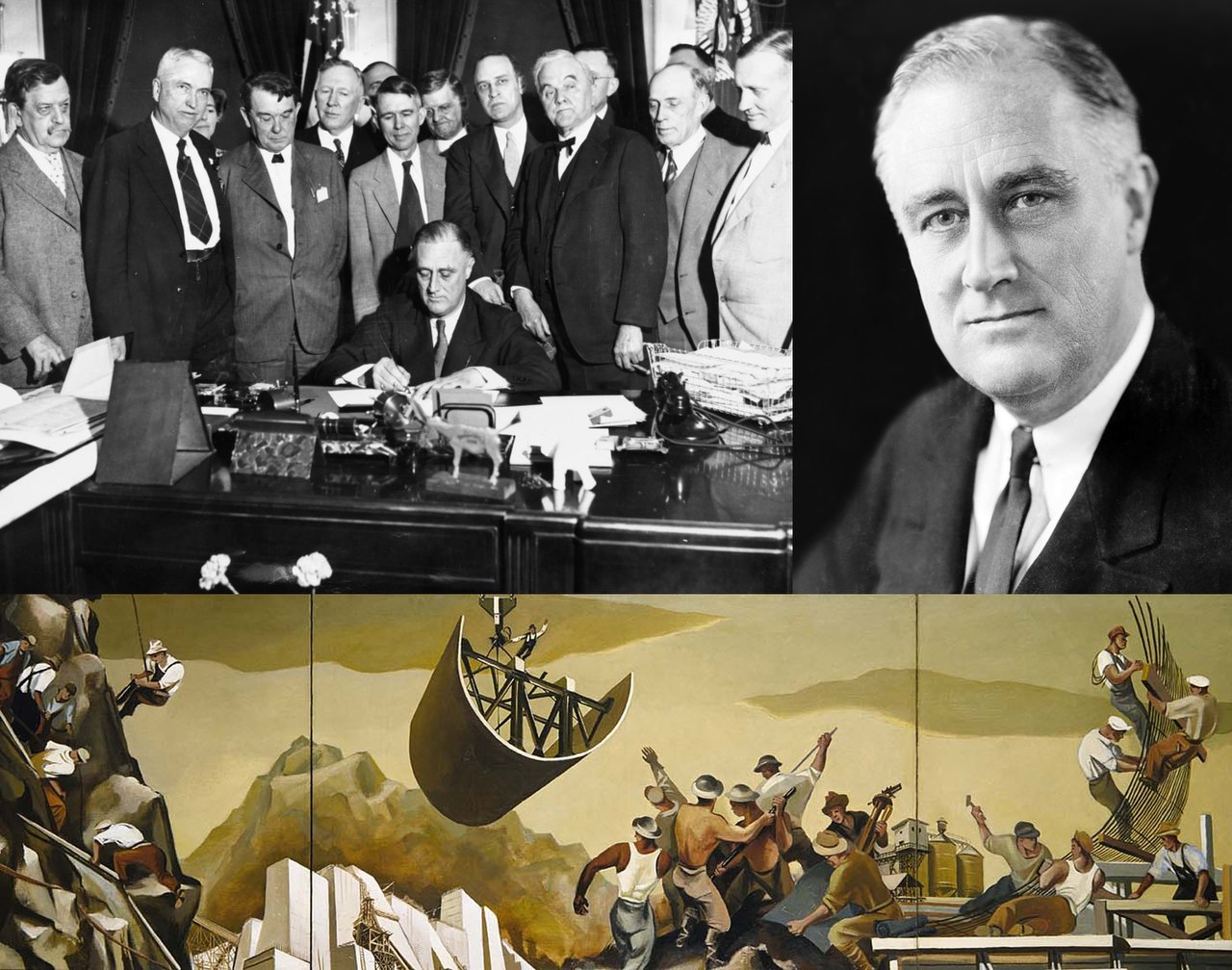
Top left: The Tennessee Valley Authority, part of the New Deal, being signed into law in 1933.
Top right: FDR (President Franklin Delano Roosevelt) was responsible for the New Deal.
Bottom: A public mural from one of the artists employed by the New Deal’s WPA program.
Wikimedia Commons.
To a degree that is, I think, unusual among other areas of the law, administrative law in the United States and, to a lesser extent, in Canada is riven by a conflict about its underlying institution. To be sure there, there are some constitutional lawyers who speak of getting rid of judicial review of legislation and so transferring the constitution to the realm of politics, rather than law, but that’s very much a minority view. Labour unions have their critics, but not so much among labour lawyers. But the administrative state is under attack from within the field of administrative law. It has, of course, its resolute defenders too, some of them going so far as to argue that the administrative state has somehow become a constitutional requirement.
In an interesting article on “The Depravity of the 1930s and the Modern Administrative State” [PDF] recently published in the Notre Dame Law Review, Steven G. Calabresi and Gary Lawson challenge the defenders of the administrative state by pointing out its intellectual origins in what they persuasively argue was
a time, worldwide and in the United States, of truly awful ideas about government, about humanity, and about the fundamental unit of moral worth—ideas which, even in relatively benign forms, have institutional consequences that … should be fiercely resisted.
That time was the 1930s.
Professors Calabresi and Lawson point out that the creation of the administrative state was spearheaded by thinkers ― first the original “progressives” and then New Dealers ― who “fundamentally did not believe that all men are created equal and should democratically govern themselves through representative institutions”. At an extreme, this rejection of the belief in equality led them to embrace eugenics, whose popularity in the United States peaked in the 1930s. But the faith in expertise and “the modern descendants of Platonic philosopher kings, distinguished by their academic pedigrees rather than the metals in their souls” is a less radical manifestation of the same tendency.
The experts, real or supposed ― some of whom “might well be bona fide experts [while] [o]thers might be partisan hacks, incompetent, entirely lacking in judgment beyond their narrow sphere of learning, or some combination thereof” ― would not “serve as wise counselors to autonomous individuals and elected representatives [but] as guardians for servile wards”. According to the “advanced” thinkers of the 1930s, “[o]rdinary people simply could not handle the complexities of modern life, so they needed to be managed by their betters. All for the greater good, of course.” Individual agency was, in any case, discounted: “the basic unit of value was a collective: the nation, the race, or the tribe. Individuals were simply cells in an organic whole rather than ends in themselves.”
H/T to Colby Cosh for the link.
July 10, 2019
Fake news, whacky conspiracy theories, and the arrest of Jeffrey Epstein
In The Week, Matthew Walther uses the Epstein case to illustrate why many so-called “low information voters” tend to believe all sorts of odd things like Pizzagate:
The arrest of the apparent billionaire investor Jeffrey Epstein at a New Jersey airport on Saturday on federal charges for crimes he was accused of during the Bush administration should not be surprising to anyone who has followed the news carefully. He may have escaped in 2008 with a ludicrous one-year stint in a county jail that he was allowed to leave six days a week, but his name has never quite been out of the headlines. Between 2008 and 2015 Epstein reportedly settled more than a dozen lawsuits from Jane Does alleging sexual assault; the youngest of his alleged victims was 14 years old.
Mug shot of Jeffrey Epstein made available by the Palm Beach County Sheriff’s Department, taken following his indictment for soliciting a prostitute in 2006.
Image via Wikimedia Commons.The only question is why did it take this long? Why was the ludicrous deal that gave Epstein and his fellow conspirators immunity in exchange for a slap-on-the-wrist jail sentence ever allowed to go through in the first place?
[…]
We should keep all of this in mind the next time we feel inclined to sneer at so-called “low-information voters,” especially the kookier sort. You know the people I mean. Wackos. Gun nuts. 8channers. Conspiracy theorists in Middle America who watch InfoWars (one of the few journalistic outlets to discuss the issue of pedophilia regularly) and post about QAnon and “spirit cooking” and the lizard people. The news that a globalized cabal of billionaires and politicians and journalists and Hollywood bigwigs might be flying around the world raping teenaged girls will not surprise them in the least because it is what they have long suspected. For the rest of us it is like finding out that the Jersey Devil is real or turning on cable news and finding Anderson Cooper and his panel engaged in a matter-of-fact discussion of Elvis’s residence among the Zixls on the 19th moon of Dazotera.
Among other things, the Epstein case forces us to ask ourselves some uncomfortable questions about the real meaning of “fake” news. There is, or should be, more to being informed than fact-checking formalism. If you have spent the last few years earnestly consuming mainstream left-of-center media in this country you will be under the impression that the United States has fallen under the control of a spray-tanned Mussolini clone who is never more than five minutes away from making birth control illegal. If you watch Fox News and read conservative publications, you no doubt bemoan the fact that Ronald Reagan’s heir is being hamstrung by a bunch of avocado toast-eating feminist witches. Meanwhile, Alex Jones’s audience will tell you that America, like the rest of the world, is ruled by a depraved internationalist elite whose ultimate allegiance is not to countries or political parties or ideologies but to one another. These people believe in nothing. They will safeguard their wealth and privilege at any cost. They will never break rank. And they will commit unspeakable crimes with impunity, while anyone who dares to speculate openly is sued or hounded out of public life as a kook.
July 8, 2019
July 3, 2019
QotD: Elon Musk as a modern-day Ferdinand DeLesseps
I used to love Elon like everyone else. I still think that having four or five billionaires in a space race against each other is finally the world I thought I was going to get growing up reading Heinlein. The Tesla Model S was probably one of the most revolutionary cars of the last 50 years. But he lost me when he committed outright fraud in the Solar City – Tesla deal and since then have only become more skeptical about he and Tesla.
Elon Musk at the 2015 Tesla Motors annual meeting.
Photo by Steve Jurvetson via Wikimedia Commons.I sort of laugh when folks tell me that really smart successful rich people believe in Tesla. You mean like James Murdoch, on the board of Tesla and who also was lost his entire investment in Theranos? Or like Larry Ellison, an adviser and fan of Elizabeth Holmes who invested $1 billion in Tesla just 6 months ago and has already lost 40% of it? The window on this is probably closing, but over the last 10 years if you wanted to get Silicon Valley investors to throw a lot of money at you, find a traditional bricks and mortar business and devise a story in which you take that industry and convert its economics to that of the networked software world (see: Uber, WeWork, Tesla, and even Theranos in some of its strategic pivots).
Or how about true millennials and Elon Musk? Name a wealthy millennial supporter of Elon Musk and Tesla and I can bet you any amount of money they have not looked at Tesla’s balance sheet or cash flow or the details of its global demand trends. They have not thought about its dealership strategy or manufacturing strategy and the cash flow implications of these. They just like what Elon says. It sounds big and visionary. They buy into Elon’s formulation that he is saving the environment and everyone opposed to him is in a cabal with big oil (ignoring the fact that Elon routinely uses his Gulfstream VI to commute distances less than 60 miles). So saying that rich millenials adore Elon is effectively saying that they want to be associated with the same things Elon says he is for — the environment and space travel et al.
Elon Musk is Ferdinand DeLesseps. He is PT Barnum. He is Elizabeth Holmes. He is the pied piper. He is fabulous at spinning visions and making them sound science-y. But he is not Tony Stark. There is a phenomenon with Elon Musk that everyone thinks he is brilliant until they hear him speak about something about which they have domain knowledge, and then they realize he is full of sh*t. For example, no one who knows anything about transportation or physics or basic engineering has thought his Boring Company and Hyperloop make any sense at all. His ideas would have been great cover stories for Popular Mechanics in the 1970’s, wowing 13-year-old boys like me with pictures of mile-long cargo blimps and flying RV’s. He is like a Marvel movie that spouts science that is just believable-enough sounding that it moves the plot along but does not stand up to any scrutiny.
All of this would be harmless if he was not running a public company. I don’t really care about the rich folks who were duped by Elizabeth Holmes, but hundreds of thousands of small millenial investors who have totally bought into the Elon hype are literally putting their last dollar into Tesla, and sometimes borrowing more. Tesla shorts often laugh at these folks on Twitter, calling them “bagholders,” but it is a tragedy. Unless Tesla finds a sugar daddy sucker, and the odds of that are getting longer, I think it is going to end badly for many of these investors.
As a disclosure, I have been short Tesla via puts for a while now. It you really want to understand Elon, the best book I can recommend is The Path Between The Seas about the building of the Panama Canal. First, it is a great book you should read no matter what. And second, Ferdinand DeLesseps is the best analog I can find for Musk.
Warren Meyer, “People Who Express Opinions Outside of their Domain Seldom Have Really Looked into it Much”, Coyote Blog, 2019-05-28.

June 29, 2019
Canada’s inability to deal with Chinese hard ball tactics
The Canadian government complied with a request from the United States government to detain a Chinese national for possible extradition to the US. But this was no ordinary Chinese citizen: it was Meng Wanzhou, the Chief Financial Officer for Huawei, a very big and very well-connected Chinese conglomerate. Ms. Wanzhou is not just a high-ranking executive, but also the daughter of the founder of the company. The Chinese government is more than miffed at Canada’s legal presumption and has been piling on the means of persuasion to get Canada’s notoriously pliable government to just pretend this never happened and to let Ms. Wanzhou proceed on her way. Under normal circumstances, this might well happen, but the US government is now under the control of a man who reputedly makes our Prime Minister lose control of his bladder, so we can’t just be seen to knuckle under to the bullying of the Bad Orange Man, nor can we be seen to knuckle under to the bullying of the PRC, leaving poor Justin Trudeau looking weak and powerless (and, to be fair, he is weak and powerless).
Andrew Coyne suggests that the best way to help a couple of poor Canadians who have been caught up in the inter-governmental shenanigans is to stop talking about some sort of “deal”:

U.S. Department of Justice among others announced 23 criminal charges (Financial Fraud, Money Laundering, Conspiracy to Defraud the United States, Theft of Trade Secret Technology and Sanctions Violations, etc.) against Huawei & its CFO Wanzhou Meng
Image via Wikimedia Commons.
I don’t doubt that behind the scenes government officials are doing everything they can, or think they are. But the pressure to bring the Canadians home is surely less for the conspicuous failure of other Canadians to give a damn.
Indeed, what is striking throughout this standoff is that most of the pressure has come from the other side. It is China, not Canada, that has used trade as a weapon, blocking imports of Canadian meat and canola. It was the Chinese air force that buzzed a Canadian warship in the East China Sea.
It is the departing Chinese ambassador to Canada who has launched one incendiary attack after another on this country, while Canada’s now-former ambassador to China was floating trial balloons about getting the Americans to drop the charges against Meng. It is China’s leaders who refuse to meet ours.
And yet for all of China’s lawlessness, for all its bestial mistreatment of our citizens and baseless attacks on our interests, the most common response in this country is not to demand that China repair its relationship with Canada, but to ask how Canada can mollify China.
June 26, 2019
Social media giants can be publisher or platform, but not both
At Ace of Spades H.Q., Ace explains why Facebook, Google, and the other social media companies have been playing fast and loose with the rules, sometimes using the rules that apply to publishers and sometimes the ones that apply to platforms, depending on their whim:

Only a speaker or publisher of claimed defamatory content can be sued.
Not being a speaker or publisher of a defamatory statement gives you total immunity from suit. You’re just a guy, you had nothing to do with the tort alleged.
Section 230 [of the Community Decency Act] specifically says that “neutral content platforms” shall not be deemed to be the “speaker or publisher” of a claimed defamatory statement made by a third party using their service — hence, the complete immunity from suit. You can’t be sued for something someone else said, obviously.
Now newspapers can be sued for the defamatory remarks of, say, an interview subject. They are publishers of that defamatory statement — they chose to publish it. The interview subject made the statement, but then they chose to publish it themselves, becoming another “speaker” of the defamation.
Now, “neutral content platforms” are never considered “speakers” of third-party defamations (or any third-party crime involving speech, such as offering to sell contraband or conspiring to commit a crime). But a newspaper or media company — or this blog — could be.
The corporate cucks claim that you cannot put restrictions on Google, Facebook, or Twitter as regards their right to censor opinions they disagree with because that constitutes “compelled speech.” You’re compelling them to speak things they do not believe, the cucks’ argument goes.
But… section 230 states that, as a legal matter, they are not considered the “speakers” of any statement made on their “neutral content platforms.”
So which is it? Are they the speakers of these words — in which case, like a newspaper or tv station, they’d have every right to exercise editorial judgment and decide what they wish their company to say — or are they not the speakers of these words, which is their claim whenever someone tries to sue them?
As it stands, they are speakers when it comes to their power to block people from speaking on their platforms — and thus can indulge in the vice of censorship — but not speakers when it comes to people suing them for what other people said on their platforms.
Choose one or the other: Either you are a speaker of other people’s words or you’re not. You can’t forever choose one and then the other when it’s in your interest to have the Clown Nose On or the Clown Nose Off.


