
Published on 22 Jun 2015
Fritz Haber is one of the most famous German scientists. His inventions made it possible to feed an ever growing human population and influence us till this day. But Fritz Haber had a dark side too: His research made the weaponization of gas and the increased production of explosives possible. Find out more about the life of Fritz Haber in our biography.
June 23, 2015
A Genius and A Madman – Fritz Haber I WHO DID WHAT IN WW1?
Comments Off on A Genius and A Madman – Fritz Haber I WHO DID WHAT IN WW1?
Richard Blake reviews ten films set in the Roman empire
Wandering a bit off his usual (Byzantine empire) era, Richard Blake looks at how Hollywood has portrayed Rome in film:
My purpose in this article is to describe and compare and judge ten films set in the Roman Empire. I will apply two criteria. The first, and most obvious, is how these films stand as works of art in their own right — narrative structure, acting, general production values and so forth. The second, and for me almost equally important, is how well they show that the Ancients lived in a moral universe fundamentally different from our own.
Now, for the avoidance of doubt, I will say at once that I have no time for any of the neo-Marxist claims about Antiquity. Karl Polanyi and Moses Finlay were wrong in their belief that the laws of supply and demand have only operated since the eighteenth century. Michel Foucault was more than usually wrong when he denied that the Ancients had any notion of the individual. In all times and places, human nature is the same. All people are motivated by some combination of sex, money, status, power and the fear of death. The laws of Economics apply just as well in Ancient Rome as they do in Modern England.
What I do mean, however, is that these basic motivations showed themselves in often radically different ways. The Ancients were not Christians. They were not universalists. They had no concept of human equality. The establishment of chattel slavery among them normalised attitudes and behaviour that would have been thought outrageous in Ancien Régime Europe, and that every religious denomination would have been mobilised to denounce in the ante bellum American South.
The Ancients lacked technologies and scientific and moral concepts that we have taken for granted for five or six or even eight centuries. A modern secularist has more in common with a twelfth century theologian than with a Greek rationalist. He probably has more in common with a sixth century Bishop than with a pagan philosopher.
One of the main, though seldom noticed, differences between virtually everyone in the past and us is that they lived under the continual shadow of death. I have reached the age of fifty five. I might fall dead tomorrow, but the insurance tables tell me I have a long way yet to go before I need to start thinking hard about the inevitable end of things. I put off begetting children until I was in my forties. I only took up a serious study of the piano last year. Catullus was dead at thirty, Horace and Vergil in their fifties. Constantine the Great was an old and dying man when he was younger than I am now. Shorter time horizons must have an effect on almost every approach to life.
Any fictional recreation must show these differences, and show them without vexing readers or viewers with endless asides. I try to show them in my series of thrillers set in seventh century Byzantium. Without more elaboration, let me see how well they are shown in the ten films I have selected.
Comments Off on Richard Blake reviews ten films set in the Roman empire
June 20, 2015
If World War III had broken out in 1955
Mark Stout looks at what a global nuclear war might have looked like merely ten years after the first nuclear weapons were used to end the Second World War:
Those of us who came of age in the late Cold War imagined that if a nuclear war came it would be The End of Everything. By contrast, those who came of age after the Cold War never thought there’d be a nuclear war at all. With Putin’s military forces on the loose in Ukraine and all around Europe, the chance of war by miscalculation, even a nuclear war is rising. What would such a war look like? With the world situation vastly different from the late Cold War and with nuclear arsenals much smaller, it would probably not be a brief nuclear exchange but something more limited, albeit still horrific.
Perhaps such a war would be like one that the U.S. government imagined in 1955. In June of that year, the government conducted a massive relocation exercise called Operation Alert in cities across the country. A British Pathé newsreel tells the story in breathless shorthand. As part of the exercise, the State Department moved key personnel to an above-ground location at the foot of the Shenandoah Mountains in Front Royal, Virginia that now belongs to the Smithsonian Institution. There, according to records held at the National Archives, they practiced how they would continue to conduct the business of the department in case of World War III.
Among other documents, the Archives holds “Situation Report #1,” issued by the State Department’s intelligence arm on D+1 of the war game. It is an interesting artifact of the time. In 1955 nuclear arsenals on both sides of the Iron Curtain were much smaller than they became later and intercontinental ballistic missiles did not exist. Thus, the Soviet ability to strike the U.S. homeland was also much more limited and the “war” unfolded much more slowly than it would have even ten years later. As a result, the imaginary war of June 1955 combined attributes of World War II as well as the World War III that haunted us in the 1980s.
Comments Off on If World War III had broken out in 1955
ISIS and the endangered archaeological sites of the Middle East
Last month, Michael J. Totten described ISIS as “The Borg of the Middle East”:
ISIS has conquered Syria’s spectacular Roman Empire city of Palmyra, a UNESCO World Heritage site long known affectionately as the “bride of the desert,” and in all likelihood is gearing up to demolish it. We know this because they’ve done it before. ISIS used hammers, bulldozers, and explosives to destroy the ancient Iraqi cities of Hatra and Nimrud near Mosul, and they did it on video.
“These ruins that are behind me,” said an ISIS vandal on YouTube, “they are idols and statues that people in the past used to worship instead of Allah. The Prophet Muhammad took down idols with his bare hands when he went into Mecca. We were ordered by our prophet to take down idols and destroy them, and the companions of the prophet did this after this time, when they conquered countries.”
Muslims have ruled this part of the world for more than 1,000 years. All this time, they’ve been unbothered by the fact that Palmyra, Hatra, and Nimrud include pagan monuments, temples, statues, and inscriptions that predate Islam. Only now are these places doomed to annihilation. ISIS is more belligerently Philistine than any group that has inhabited the region for a millennium. The only modern analogue is the Taliban’s destruction of the ancient Buddhist statues at Bamiyan with anti-aircraft guns, artillery shells and dynamite in March 2001, mere months before their al-Qaida pals attacked New York City and Washington.
This attitude toward history harks back less to the seventh century than to the twentieth, when Pol Pot reset the calendar to Year Zero after the Khmer Rouge seized power in Cambodia, and when Mao Zedong’s Chinese Cultural Revolution murdered millions in the war against everything “old.”
Maamoun Adbulkarim, Syria’s antiquities chief, told Reuters that the army carted hundreds of ancient statues away to safety, but of course the giant Roman columns and the museum itself aren’t going anywhere except, perhaps, underneath the jaws of ISIS bulldozers. “This is the entire world’s battle,” he said.
That’s how bad things are in Syria now. The mass-murderers, war criminals, sectarian gangsters, and state sponsors of international terrorism in Bashar al-Assad’s Arab Socialist Baath Party regime can plausibly tout themselves as the defenders of civilization. In this particular case and in this particular place, they’re right.
Comments Off on ISIS and the endangered archaeological sites of the Middle East
June 19, 2015
Cavalry, Spies and Cossacks I THE GREAT WAR Week 47
Published on 18 Jun 2015
The war seems like a romantic novel this week: In the East the Russians are saved by Cossack Cavalry while August von Mackensen’s artillery is plowing through Galicia. In the meantime, the British discover a German spy ring in London and the French gain a few miles in the west.
Comments Off on Cavalry, Spies and Cossacks I THE GREAT WAR Week 47
June 18, 2015
Six Days in June
Published on 23 Feb 2014
Six Day War – Israeli victory – Documentary
The shooting lasted on six tense days in June 1967, but the Six Day War has never really ended. Every crisis that has ripped through this region in the ensuing decades stems from those six fateful days. On its 40th anniversary, the region remains trapped in conflict and is every bit as explosive as it was in 1967. “Six Day War” chronicles the events of forty years ago with a fresh historical perspective. Beginning with the buildup for the war, and the political and military maneuvering of Israeli Prime Minister Levi Eshkol and Egyptian President Jame Adel Nasser, the film takes us through the six days of fighting, the war with Jordan, the occupation of the West Bank and the annexation of Jerusalem. Featuring stunning archival footage and first-hand accounts of the war from both the Israeli and Arab soldiers who fought it, “Six Day War” explores how these events became the flash point in history that reshaped the regional political landscape, destroyed old systems and brought new forces to the fore.
Comments Off on Six Days in June
June 17, 2015
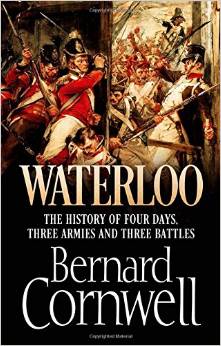
Bernard Cornwell talks about his recent book on Waterloo
Novelist Bernard Cornwell wrote a history of the battle of Waterloo and talks to John J. Miller about the book and the battle it describes here.
Comments Off on Bernard Cornwell talks about his recent book on Waterloo
Africa: Zulu Empire IV – Last Stands and Changing Fortunes – Extra History
Published on 6 Jun 2015
BONUS! Learn about the Boer Wars and what happened in South Africa during World War I thanks to our friends at the Great War Channel!
THE GREAT WAR Special: http://bit.ly/1HQxP9xLord Chelmsford, the British officer who commanded during the Anglo-Zulu War, vastly underestimated the power and aggression of the Zulu people. He split his army into three separate columns and left one of them stationed at Isandlwana while he searched for Zulu armies on the field. Meanwhile 20,000 Zulus were already flanking his force, but because Lord Chelmsford had not even ordered them to fortify the camp, the Zulu force swept through the ranks and destroyed the British army at Isandlwana. A small group of survivors fled to the hospital at Rorke’s Drift where officer James Dalton organized a desperate defense. Cetshwayo’s half-brother, ignoring orders to halt his pursuit, stormed the hospital with his small force and lost disastrously. Despite this, the main Zulu army continued to hand defeats to the British army until finally the British government stepped in to reinforce them with artillery and extra soldiers. Finally, Great Britain succeeded in capturing both the Zulu capitol at Ulundi and King Cetshwayo himself. They divided Zulu territory into 12 small kingdoms that quickly fell into civil war. Out of desperation, they returned Cetshwayo to the throne, but too late: a rival attacked and killed him. His son Dinuzulu allied with the Boers in an attempt to regain power and independence, but the British seized this excuse to finally annex Zulu land for good in 1887.
Comments Off on Africa: Zulu Empire IV – Last Stands and Changing Fortunes – Extra History
June 16, 2015
The Author of All Quiet on The Western Front – Erich Maria Remarque I WHO DID WHAT IN WW1?
Published on 15 Jun 2015
All Quiet On The Western Front is surely the most prominent anti-war book and book about World War 1 of all time. The German author Erich Maria Remarque fought on the Western Front until he got wounded. During his recovery he collected stories from his comrades and started writing the book. Just one year after publication, a movie was made in the US where Remarque later emigrated to.
Comments Off on The Author of All Quiet on The Western Front – Erich Maria Remarque I WHO DID WHAT IN WW1?
Africa: Zulu Empire III – Diamonds in South Africa – Extra History
Published on 30 May 2015
Europe had a presence in South Africa dating back to 1652, but the colonies and the native tribes really began to clash in the 1800s. The conquest of the Netherlands by Napoleon had left the Dutch colonists in a state of limbo, with the British claiming authority over them despite their homeland being ruled by the French. Many of these settlers, known as the Boers, moved inland to escape British oversight and pushed into land owned by the Zulus. Mpande, the new Zulu leader, attempted to keep the peace between the British and the Boers, but the treaties he negotiated on both sides only led to further conflict. Eventually, his son Cetshwayo peacefully took power over the Zulus around the same time that the Europeans discovered diamonds in South Africa. The government of Great Britain took an even greater interest in South Africa, stepping in to try to bribe or force the reluctant natives to work the diamond mines established by European mining firms. Secretary of State Lord Carnarvon, who was responsible for the unification of colonies in Canada, made it his mission to unify the South African colonies and appointed Henry Bartle Frere as his governor and representative. Bartle Frere removed the local Capetown government, who had been largely sympathetic to the native peoples and opposed his harsh unification policies, then issued harsh and intentionally impossible demands against the Zulu. Cetshwayo refused to accept these demands, and thus began the Anglo-Zulu War of 1879.
Comments Off on Africa: Zulu Empire III – Diamonds in South Africa – Extra History
QotD: The Young Adult fiction of Ronald Welch
I’d already been tinkering with the idea of writing a YA story, something for Ranger’s Apprentice fans to move on to.
Commercially, the idea was, “They’re going to read Bernard Cornwell when they are older; let’s take some money off them now.” However, my main motivation was wanting to write something my son could read — the magnum opus my agent was shopping owed too much to the War of the Powers (Am I the only person who remembers that series?). I also wanted to follow in the footsteps of Ronald Welch, the YA writer I read when I was a kid.
Welch was a WWII veteran turned grammar school teacher. He wrote what we would now call YA books about young officers finding their place, and he did it in just about every major conflict involving English combatants from the Horns of Hattin, through Marlborough’s campaigns, to his chronologically last book, Tank Commander, which is an utterly awesome tale of World War One, culminating in the Battle of Cambrai, the first modern tank assault.
We’re not talking trash here. Each book was well researched, the writing is good — he even won a Carnegie Medal for Knight Crusader, which puts him in the same ballpark as Rosemary Sutcliff. As far as I can see, his star faded after his death, not because of his quality as a writer, but because he became unfashionable:
- His books simply have boy cooties. They are about young men learning leadership and responsibility while being shot at and shooting back without qualms … doing their job in adverse circumstances.
- He’s not an anti-imperialist. I don’t think he’s pro-imperialist either. He just tells things as they were with people accepting the ethos of the time. His characters generally show matter-of-fact respect for other cultures, but don’t question their own right to be in Palestine or India or wherever, or question very much at all.
- He’s not anti-war. His fight scenes also go all the way up to 11 on the Conan Scale. I don’t think he likes war, but — having fought in WWII — he sees it as necessary, and the experience itself as worthy of writing about.
This last, bears further examination.
Modern war books aimed at younger people tend towards:
OMG my best friend just got killed. Look at that dying horse. War is Hell. At least I and my friends will (drum roll) Preserve Our Humanity.
Ronald Welch, who pulls absolutely no punches, by the way, is more:
OMG my best friend just got killed. You there, put that dying horse out if its misery. War is Hell. Watch the left flanks chaps and some of us will get to live through it. I said WATCH THE DAMNED LEFT FLANK!!
It’s all about taking responsibility, keeping presence of mind, in just about the most hostile human environment.
Very few young readers will grow up to be soldiers. Many of them, however, will face crappy situations. At work when a project implodes. Socially when people turn on them. In a family when a child is very sick, or when a marriage breaks down or turns abusive…
In all those circumstances, there are points neither for maintaining a personal moral hygiene nor for being sensitive. If everybody is going to get through this thing, somebody has to watch the left flank. That person may well be you.
And that’s the kind of book I wanted to write.
M Harold Page, “Shieldwall: Barbarians! Writing and self-publishing an old school boy’s young officer story set in Attila’s invasion”, Charlie’s Diary, 2015-06-03.
Comments Off on QotD: The Young Adult fiction of Ronald Welch
June 15, 2015
The Key To Success Is Artillery I THE GREAT WAR Week 45
Apologies for presenting this one out of order, but last week was a bit disordered. The next Great War video will be week 47, probably on Friday.
Published on 4 Jun 2015
When Przemysl falls for the 2nd time and when the British and ANZAC troops fail at Gallipoli again, one thing becomes clear: Artillery is the key for future battles. August von Mackensen had used it with great success at the Gorlice-Tarnow-Offensive and the French even diverted one million men to shell factories. Meanwhile German Zeppelins bombed London and the US sent submarines for aid.
Comments Off on The Key To Success Is Artillery I THE GREAT WAR Week 45
The “Kitchen Debates” of 1959
B.K. Marcus explains how ice cream was the secret weapon that won the Cold War:
Richard Nixon stood by a lemon-yellow refrigerator in Moscow and bragged to the Soviet leader: “The American system,” he told Nikita Khrushchev over frosted cupcakes and chocolate layer cake, “is designed to take advantage of new inventions.”
It was the opening day of the American National Exhibition at Sokol’niki Park, and Nixon was representing not just the US government but also the latest products from General Mills, Whirlpool, and General Electric. Assisting him in what would come to be known as the “Kitchen Debates” were attractive American spokesmodels who demonstrated for the Russian crowd the best that capitalism in 1959 had to offer.
[…]
“Don’t you have a machine,” he asked Nixon, “that puts food in the mouth and presses it down? Many things you’ve shown us are interesting but they are not needed in life. They have no useful purpose. They are merely gadgets.”
Khrushchev was displaying the behavior Ludwig von Mises described in The Anti-Capitalistic Mentality. “They castigate the luxury, the stupidity and the moral corruption of the exploiting classes,” Mises wrote of the socialists. “In their eyes everything that is bad and ridiculous is bourgeois, and everything that is good and sublime is proletarian.”
On display that summer in Moscow was American consumer tech at its most bourgeois. The problem with “castigating the luxury,” as Mises pointed out, is that all “innovation is first a luxury of only a few people, until by degrees it comes into the reach of the many.”
It is appropriate that the Kitchen Debate over luxury versus necessity took place among high-end American refrigerators. Refrigeration, as a luxury, is ancient. “There were ice harvests in China before the first millennium BC,” writes Wilson. “Snow was sold in Athens beginning in the fifth century BC. Aristocrats of the seventeenth century spooned desserts from ice bowls, drank wine chilled with snow, and even ate iced creams and water ices. Yet it was only in the nineteenth century in the United States that ice became an industrial commodity.” Only with modern capitalism, in other words, does the luxury reach so rapidly beyond a tiny elite.
“Capitalism,” Mises wrote in Economic Freedom and Interventionism, “is essentially mass production for the satisfaction of the wants of the masses.”
Comments Off on The “Kitchen Debates” of 1959
Africa – Zulu Empire II – The Wrath of Shaka Zulu – Extra History
Published on 23 May 2015
Shaka sought vengeance for Dingiswayo on Zwide and the Ndwandwe. He expanded his control over the Mtethwa and other tribes, then launched his assault on the Ndwandwe. Shaka scored two crushing victories over the course of an eighteen month war, although Zwide escaped both times. Shaka invaded the main Ndwandwe village, capturing Zwide’s mother and burning her to death in place of her son. Shaka had won the war, but the people he pushed out created a ripple of instability across Africa: the Mfecane or the Crushing. Shaka himself became dangerously disturbed when his mother died and he began to take his grief out on his people. His brothers assassinated him to take the throne, leading to a new king: Dingane. Dingane began to treat with the Dutch colonists in South Africa, but what began as a friendly relationship became a betrayal when he turned on them. Dingane attacked their wagon train at the Battle of Bloody River, but the Dutch with their guns held him off. The Dutch then threw their support behind Dingane’s last surviving brother, Mpande, who successfully overthrew him and became the new Zulu king.
Comments Off on Africa – Zulu Empire II – The Wrath of Shaka Zulu – Extra History
June 14, 2015
Belgium’s new Waterloo coin “is not designed to annoy the French”
It is, as the Reg‘s Jennifer Baker puts it, “just a happy side effect”:
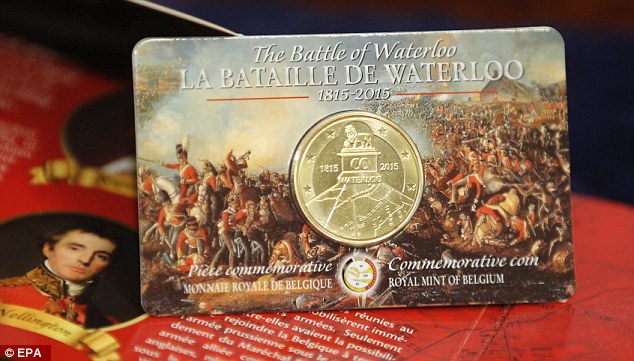
Belgium has taken international trolling to the next level by minting a €2.50 coin to celebrate the Battle of Waterloo.
France had objected to the plan to mint a €2 coin to mark the 200th anniversary of Napoleon’s defeat and Belgium duly scrapped 180,000 coins. France said the battle “has a particular resonance in the collective consciousness that goes beyond a simple military conflict”.
But the plucky Belgies didn’t take the French manoeuvre lying down and unearthed an obscure piece of legislation which allows EU countries to unilaterally mint new coins, provided that they are in an unusual denomination.
The new Belgian coin in its decorative holder. Click to see the original image at the Daily Mail.
Comments Off on Belgium’s new Waterloo coin “is not designed to annoy the French”


