
Published on 19 Sep 2015
THANK YOU FOR 150.000 SUBSCRIBERS!
Our producer David sat down with Indy in his garden for an interview that answers a few questions you all have been dying to ask. Why Stockholm? Why The Great War Channel? Are you a Historian?
September 20, 2015
Interview with Indy Neidell I THE GREAT WAR – Special
Comments Off on Interview with Indy Neidell I THE GREAT WAR – Special
The chastity belt – medieval “security” or renaissance in-joke?
The chastity belt was a device invented to preserve the chastity of Crusader knights as they rode off to defend the Holy Land. The chastity belt was an in-joke in theatre performances from the early fifteenth century onwards. One of these two statements is closer to the truth than the other, as Sarah Laskow explains that most of what you’ve heard about the chastity belt is false:
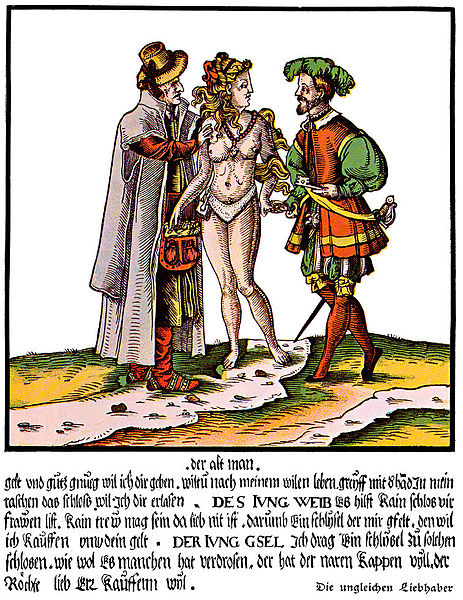
A 16th-century German satirical colored woodcut whose general theme is the uselessness of chastity belts in ensuring the faithfulness of beautiful young wives married to old ugly husbands. The young wife is dipping into the bag of money which her old husband is offering to give her (to encourage her to remain placidly in the chastity belt he has locked on her), but she intends to use it to buy her freedom to enjoy her young handsome lover (who is bringing her a key). (via Wikipedia)
What was the chastity belt? You can picture it; you’ve seen it in many movies and heard references to it across countless cultural forms. There’s even a Seattle band called Chastity Belt. In his 1969 book Everything You Always Wanted to Know About Sex (But Were Afraid to Ask), David R. Reuben described it as an “armored bikini” with a “screen in front to allow urination and an inch of iron between the vagina and temptation.” “The whole business was fastened with a large padlock,” he wrote. With this device, medieval men going off to medieval wars could be assured that their wives would not have sex with anyone else where they were far, far away, for years at a time.
Yes, it sounds simultaneously ridiculous, barbarous and extremely unhygienic, but … medieval men, you know? It was a different time.
This, at least, has been the story that’s been told for hundreds of years. It’s simple, shocking, and, on some level, fun, in that it portrays past people as exceeding backwards and us, by extension, as enlightened and just better. It’s also, mostly likely, very wrong.
“As a medievalist, one day I thought: I cannot stand this anymore,” says Albrecht Classen, a professor in the University of Arizona’s German Studies department. He set out to reveal the true history of chastity belts. “It’s a concise enough research topic that I could cover everything that was ever written about it,” he says, “and in one swoop destroy this myth.”
Here is the truth: Chastity belts, made of metal and used to ensure female fidelity, never really existed.
However, there is a small but thriving trade providing modern day chastity belts to eager BDSM fans, and they’re available in both male and female designs. I nearly described that as “equal opportunity”, but I guess “equal frustration-of-opportunity” is more like it. Feel free to Google image search those if you like, but be prepared for a fair bit of NSFW images if you do.
Comments Off on The chastity belt – medieval “security” or renaissance in-joke?
QotD: German schooling
On our way home we included a German University town, being wishful to obtain an insight into the ways of student life, a curiosity that the courtesy of German friends enabled us to gratify.
The English boy plays till he is fifteen, and works thence till twenty. In Germany it is the child that works; the young man that plays. The German boy goes to school at seven o’clock in the summer, at eight in the winter, and at school he studies. The result is that at sixteen he has a thorough knowledge of the classics and mathematics, knows as much history as any man compelled to belong to a political party is wise in knowing, together with a thorough grounding in modern languages. Therefore his eight College Semesters, extending over four years, are, except for the young man aiming at a professorship, unnecessarily ample. He is not a sportsman, which is a pity, for he should make good one. He plays football a little, bicycles still less; plays French billiards in stuffy cafés more. But generally speaking he, or the majority of him, lays out his time bummeling, beer drinking, and fighting. If he be the son of a wealthy father he joins a Korps — to belong to a crack Korps costs about four hundred pounds a year. If he be a middle-class young man, he enrols himself in a Burschenschaft, or a Landsmannschaft, which is a little cheaper. These companies are again broken up into smaller circles, in which attempt is made to keep to nationality. There are the Swabians, from Swabia; the Frankonians, descendants of the Franks; the Thuringians, and so forth. In practice, of course, this results as all such attempts do result — I believe half our Gordon Highlanders are Cockneys — but the picturesque object is obtained of dividing each University into some dozen or so separate companies of students, each one with its distinctive cap and colours, and, quite as important, its own particular beer hall, into which no other student wearing his colours may come.
The chief work of these student companies is to fight among themselves, or with some rival Korps or Schaft, the celebrated German Mensur.
Jerome K. Jerome, Three Men on the Bummel, 1914.
Comments Off on QotD: German schooling
September 19, 2015
The Gurkhas – Full Documentry
Published on 7 Jun 2013
After great feedbacks from my previous Gurkha videos I decided to upload another one, this time more in depth and informative. Thanks for all the support guys and enjoy 😀
Gurkhas have been part of the British Army for almost 200 years, but who are these fearsome Nepalese fighters?
“Better to die than be a coward” is the motto of the world-famous Nepalese Gurkha soldiers who are an integral part of the British Army.
They still carry into battle their traditional weapon – an 18-inch long curved knife known as the kukri.
In times past, it was said that once a kukri was drawn in battle, it had to “taste blood” – if not, its owner had to cut himself before returning it to its sheath.
Update: Pound-for-pound, the Gurkhas are the baddest of bad-asses you’d never want to meet on a battlefield.
Comments Off on The Gurkhas – Full Documentry
September 18, 2015
The State Of World War 1 – As Reported by A Newspaper 100 Years Ago I THE GREAT WAR – Week 60
Published on 17 Sep 2015
This week Indy dissects a contemporary source from autumn 1915 – the Hobart Mercury newspaper from Australia. You can find the whole newspaper right here: http://trove.nla.gov.au/ndp/del/article/10429329
While the French and British prepare a new offensive on the Western Front, their Entente ally Russia is still suffering in the East when Germany is moving on the last big Russian city of Vilnius. Even though the propaganda says otherwise, the situation for the ANZACs in Gallipoli still looks grim.
Comments Off on The State Of World War 1 – As Reported by A Newspaper 100 Years Ago I THE GREAT WAR – Week 60
Cabinet ministers of yore
In The Walrus, Robert Fulford identifies precisely when Canadian cabinets were neutered:
Over lunch one day in retirement, Lester B. Pearson looked back on the men who had served in his cabinet and quoted Napoleon’s remark that “every French soldier carries a marshal’s baton in his knapsack.”
Pearson wasn’t comparing himself to Napoleon. He was talking about ambition. Just as Napoleon’s troops dreamed of high command, many of Pearson’s ministers saw themselves as future prime ministers. And sure enough, when Pearson retired eight of his ministers announced they would run for Liberal leader—each with his own dedicated following and distinct point of view. One of them was Pierre Trudeau.
No one ever heard Trudeau express nostalgia for the Pearson years. In fact, he seems to have hated every minute of it. He saw no reason for ministers to establish their independence by leaking dissenting opinions to favoured journalists and constituents back home. Such freedom, which Pearson had put up with, didn’t strike Trudeau as democracy in action. It seemed more like chaos.
[…]
This truth is best explained by Trudeau’s inclinations, since hardened into custom. In the spring of 1968, as soon as he became prime minister, he tightened the reins of government power and let it be known that those reins all led to the PMO. In the early years, it was said (and widely believed) that his principal secretary, Marc Lalonde, held daily meetings with the executive assistants of all government ministers, so that Trudeau and his aides could know precisely what each was doing. As time went on, they increasingly did Trudeau’s bidding, which remained the case until he retired in 1984.
Since then, with one exception, no star ministers have blossomed under three long-running prime ministers, Brian Mulroney, Jean Chrétien, and Stephen Harper. That one exception is Paul Martin, Chrétien’s finance minister, whose talents attracted constant publicity and many admirers. As everyone knows, the Chrétien-Martin relationship ended in acrimony — the sort of political finale Trudeau carefully avoided.
Comments Off on Cabinet ministers of yore
September 17, 2015
Europe : The First Crusade – I: The People’s Crusade – Extra History
Published on 8 Aug 2015
In 1095CE, Pope Urban gathered the leaders of the Christian community at the Council of Clermont. Urged on by Emperor Alexius Comnenos of Constantinople, he called for a crusade to retake the Holy Land from the Muslims who occupied Jerusalem. Muslims had occupied the Holy Land for over 400 years, but the timing was politically right for the Pope and the Byzantine Emperor. Pope Urban wanted to re-unite Christendom after the anti-Pope kicked him out of Rome, while Alexius Comnenus wanted to retake the territory he had recently lost in Anatolia from the Seljuq Turks. As incentive, the Pope offered crusaders a plenary indulgence: complete forgiveness for past sins in the eyes of God and the church. It worked too well. While the official armies of the Crusade prepared, a charismatic leader named Peter the Hermit began preaching directly to the people, claiming Jesus had sent him to lead them on Crusade. Walter sans Avoir joined him in France, and a man named Count Emicho of Leiningen emulated him in Germany. Both peasant groups met with and created disaster: Walter Sans Avoir’s group pillaged Belgrade while Count Emicho’s group turned on the local Jewish population as an excuse to slaughter them. Thus the First Crusade began with a disastrous People’s Crusade.
Comments Off on Europe : The First Crusade – I: The People’s Crusade – Extra History
September 15, 2015
Sweden during World War 1 – Balancing Neutrality I THE GREAT WAR Special
Published on 14 Sep 2015
Sweden was neutral during the Great War and like all neutral countries in World War 1 it was affected by the global conflict. Balancing neutrality between the Central Powers and the Entente while also maintaining trade with both sides was not easy – but very profitable. Especially the trade with Germany was very lucrative since it was circumventing the British Naval Blockade. But that was not the only effect the war had on Sweden which became the nation it is today during WW1.
Comments Off on Sweden during World War 1 – Balancing Neutrality I THE GREAT WAR Special
September 11, 2015
September 10, 2015
Rob Paravonian has a thing about Pachelbel
Uploaded on 21 Nov 2006
A comedian rants about how much it sucks to play Pachelbel’s Canon in D on a cello. Recorded live at Penn State, this piece by comedian/musician Rob Paravonian has been a favorite on the Dr. Demento Show.
H/T to Never Yet Melted for the link.
Comments Off on Rob Paravonian has a thing about Pachelbel
September 9, 2015
Byzantine Empire: Justinian and Theodora – Lies – Extra History
Published on 1 Aug 2015
We take a rest in the middle of our Justinian and Theodora series to look back at the story so far and correct a few things! But the errors we made (minarets on the Hagia Sophia!) and the questions viewers have asked us give us the opportunity to expand on many parts of the story that we had to leave out of the series, and we encourage you to perform a full dive into this history to learn about the Hagia Sophia‘s construction, early doctrines of Christianity, and many more details about the life of Belisarius. Plus, James can’t resist the temptation to play Five Degrees of Walpole to see how our infamous meddler from the South Sea Bubble series can be connected to the history of Justinian and Theodora!
Comments Off on Byzantine Empire: Justinian and Theodora – Lies – Extra History
September 8, 2015
The Schlieffen Plan – And Why It Failed I THE GREAT WAR Special feat. AlternateHistoryHub
Published on 7 Sep 2015
“What would have happened if the Schlieffen Plan had succeeded? Find out on AlternateHistoryHub: https://www.youtube.com/watch?v=4jNjJueYnLI
The Schlieffen Plan was the blueprint for Germany’s army to avoid a two-front war with Russia and France. It was supposed to be the solution for a quick victory against arch enemy France by invading Belgium and the Netherlands to circumvent French defenses. Helmut von Moltke adapted the original plan by Alfred von Schlieffen and ultimately failed when the Germans were beaten at the Battle of the Marne. Indy explains the numerous reasons why the Schlieffen Plan was doomed to fail. “
Comments Off on The Schlieffen Plan – And Why It Failed I THE GREAT WAR Special feat. AlternateHistoryHub
Liverpool’s mysterious Williamson Tunnels
On the BBC website, Chris Baraniuk covers what we know about the series of 200-year-old tunnels in Liverpool:
Of all the engineering projects that ever took place in the industrial centre of Liverpool – like the world’s first exclusively steam-powered passenger railway – the building of the Williamson Tunnels in the early 19th Century must be the most mysterious. The patron of the tunnels, tobacco merchant Joseph Williamson, was extraordinarily secretive about their purpose. Even today, no one is sure exactly what they were used for. Nor does anyone know for sure even how many of the tunnels there are, scattered underfoot beneath the Edge Hill district of Liverpool in northwest England.
Meanwhile, for centuries, the tunnels had been buried. They were filled in after locals complained of the smell – apparently the caverns were long used as underground landfills and stuffed with everything from household junk to human waste.
As time went by, the tunnels passed from knowledge to myth.
“A lot of people knew about the tunnels, but that was as far as it went – they just knew about them or heard about them,” explains Les Coe, an early member of the Friends of Williamson Tunnels (FoWT). “It was just left at that. But we decided to look for them.”
[…]
Those who have worked on the tunnels have now developed a new, somewhat more satisfying theory. Bridson points out a series of markings in the sandstone that he says are indicative of quarrying. There are channels to drain rainwater away from the rock while men worked, blocks out of which sandstone could be hewn, and various niches in the walls where rigs were once likely installed to help with extracting the stone, commonly used as a building material.
Bridson believes that before Williamson came along, these pits in the ground already existed. But it was Williamson’s idea to construct arches over them and seal them in. Properties could then be built on top of the reclaimed land – which otherwise would have been practically worthless.
If this was the case, then in terms of land reclamation, Williamson was way ahead of his time, says Bridson. The work may well have hastened the development of an area that, without this innovation, would have been left unused for many years.
Williamson also was enterprising in his design. Simply filling the trenches in would have taken too long in the early 1800s, thanks to the limitations of transport, so Williamson used arches instead. And as Bridson notes, he was doing it years before the great railway tunnels and bridges of England were ever built. The arches “are still standing 200 years on with virtually no maintenance,” he says. “Apart from the ones that have been damaged, they’re still as solid as the day he built them. So he must have known what he was doing.”
H/T to Ghost of a Flea for the link.
Comments Off on Liverpool’s mysterious Williamson Tunnels
September 7, 2015
New Lanark
In The Register, Bill Ray takes a geek’s-eye-view of the town of New Lanark, a key place in the early industrial revolution:
Nestled in the Clyde Valley the village owes its existence to the falls that were harnessed to refine raw cotton sent in from the colonies: a picture-postcard image from a time when Britain was the factory of the world.
But for all its industrial heritage New Lanark is a long way from being a typical “dark satanic” mill, as it marks the end of that time and the dawning of a better age.
Visit the village today and you can see the big machines that kept the empire running. Enormous water wheels; later supplemented by steam engines, connected by belts and ropes to machines which turned raw cotton into usable thread and fabric. However, it’s not industrial history that is celebrated at New Lanark, rather a social revolution, and one driven by one man whose ideas created the working life as we understand it today.
The man was Robert Owen, who, in 1799, bought New Lanark and immediately embarked on his “grand social experiment”. His radical ideas, such as refusing to employ children, providing medical insurance, and educating the workforce, were ridiculed by his competitors who couldn’t see the value in teaching children, let alone adults. But Owen believed that industry should serve the betterment of all men, not just those who owned the factories.
It worked too, rather to the surprise of his peers. New Lanark was a successful mill and profits rose steadily under the beneficent command of Owen. It could be argued, perhaps, that New Lanark would have been even more profitable without the social agenda, but every afternoon at five we should all be grateful for his reforms that made our working lives what they are:
“Eight hours daily labour is enough for any human being, and under proper arrangements sufficient to afford an ample supply of food, raiment and shelter, or the necessaries and comforts of life, and for the remainder of his time, every person is entitled to education, recreation and sleep”
Not that the workers at New Lanark did quite as well as we do; their working day ran ten and a half hours, but once mealtimes had been deducted it was approaching eight and certainly much better than the conditions in other mills around the country.
Comments Off on New Lanark
QotD: The Crusades
So what is the truth about the Crusades? Scholars are still working some of that out. But much can already be said with certainty. For starters, the Crusades to the East were in every way defensive wars. They were a direct response to Muslim aggression — an attempt to turn back or defend against Muslim conquests of Christian lands.
Christians in the eleventh century were not paranoid fanatics. Muslims really were gunning for them. While Muslims can be peaceful, Islam was born in war and grew the same way. From the time of Mohammed, the means of Muslim expansion was always the sword. Muslim thought divides the world into two spheres, the Abode of Islam and the Abode of War. Christianity — and for that matter any other non-Muslim religion — has no abode. Christians and Jews can be tolerated within a Muslim state under Muslim rule. But, in traditional Islam, Christian and Jewish states must be destroyed and their lands conquered. When Mohammed was waging war against Mecca in the seventh century, Christianity was the dominant religion of power and wealth. As the faith of the Roman Empire, it spanned the entire Mediterranean, including the Middle East, where it was born. The Christian world, therefore, was a prime target for the earliest caliphs, and it would remain so for Muslim leaders for the next thousand years.
With enormous energy, the warriors of Islam struck out against the Christians shortly after Mohammed’s death. They were extremely successful. Palestine, Syria, and Egypt — once the most heavily Christian areas in the world — quickly succumbed. By the eighth century, Muslim armies had conquered all of Christian North Africa and Spain. In the eleventh century, the Seljuk Turks conquered Asia Minor (modern Turkey), which had been Christian since the time of St. Paul. The old Roman Empire, known to modern historians as the Byzantine Empire, was reduced to little more than Greece. In desperation, the emperor in Constantinople sent word to the Christians of western Europe asking them to aid their brothers and sisters in the East.
That is what gave birth to the Crusades. They were not the brainchild of an ambitious pope or rapacious knights but a response to more than four centuries of conquests in which Muslims had already captured two-thirds of the old Christian world. At some point, Christianity as a faith and a culture had to defend itself or be subsumed by Islam. The Crusades were that defense.
Thomas F. Madden, “The Real History of the Crusades”, Crisis Magazine, 2002-04-01.
Comments Off on QotD: The Crusades


