
The Great War
Published on 31 Mar 2018The German Tank Museum on YouTube: https://www.youtube.com/daspanzermuseum
Germany only fielded 20-40 armored cars in World War 1, mostly on the Eastern Front. Not much about their operational history is known but they did play an important role in the German Civil War and the Weimar Republic.
April 1, 2018
German Armored Cars in WW1 I THE GREAT WAR On The Road
Comments Off on German Armored Cars in WW1 I THE GREAT WAR On The Road
The Royal Air Force at 100
In The Register, Gareth Corfield notes the amusing detail of the RAF’s birthday happening to fall on April 1st by publishing a couple of days early (so nobody thinks he’s pulling their collective legs):

This Sunday marks the 100th birthday of the Royal Air Force – Britain’s military arm for the skies – as a separate Armed Force in its own right. The RAF has been at the forefront of many technological innovations over the last century, many of which are still in use to this day.
From the earliest days of biplanes (and triplanes), through the invention of radar, the jet engine, vertical takeoff tech, and aircraft designs that were decades ahead of their time.
While traditionally these types of “birthday journalism” articles are published on the actual birthday, we at El Reg still reckon it’s a bit weird that the RAF’s official foundation also takes place on April Fool’s Day, so here it is before smart-arses feel compelled to claim this is some kind of windup.
Going back through the history books, the RAF’s main technological achievements include developments in aerial navigation, aircraft sensing and ground-based control, and, somewhat controversially, the jet engine, though the actual milestones for that one are shared with Germany.
[…]
All in all, the RAF has been an aeronautical force for good, with the service developing the basics for many things that commercial passengers today take for granted. Its technological developments and innovations have contributed to making the world both safer and smaller, as aircraft fly ever faster, building upon the principles established and researched by the Air Force. Even those with grievous injuries have been benefited by the RAF, thanks to the pioneering work of the RAF Institute of Aviation Medicine.
Let’s just hope it manages to shrug off the problem of having its birthday on the same day as April Fool’s Day…
Update: Samizdata relates the tale of the 50th anniversary non-celebration.
Today I would like to note one incident in the RAF’s history, which came at the ‘half-way’ mark, when in 1968, (actually on 5th April) after Harold Wilson’s Labour government decided not to commemorate the RAF’s 50th anniversary with a fly-past, and this did not go down well at all. In fact, it went down so badly that one RAF pilot, the heroic Flight Lieutenant Alan Pollock, threw away his career and very nearly his freedom in the ‘Tower Bridge incident‘, when, in protest at the lack of a commemoration, in his Hawker Hunter jet, he ‘buzzed’ the Houses of Parliament. Then on the spur of the moment, going down the Thames towards the sea, he flew under the top span of Tower Bridge at around 400 mph, and also ‘beat up’ a few airfields inverted, before landing, getting arrested but avoiding a court martial after being demobilised on health grounds by superiors eager to avoid the publicity of a trial, which is a weird echo of a similar ruse used in Viktor Suvorov’s ‘The Liberators’ when a Soviet Army soldier’s conduct presented a bureaucratic embarrassment that could not be concealed from higher authority. The jet only just missed hitting the top span of Tower Bridge with its tail, so no harm was done, however, it was close, there was a double-decker bus on the bridge at the time, and a cyclist on the bridge ripped his trousers dismounting in haste. Flt-Lt Pollock gallantly offered to pay for the trousers, but the cyclist declined.
Wikipedia has more detail on the Hawker Hunter Tower Bridge incident.
Comments Off on The Royal Air Force at 100
March 31, 2018
If anybody could be described as Machiavellian, it’d surely be Machiavelli, right?
At the Foundation for Economic Education, Paul Meany tries to rescue the reputation of Niccolò Machiavelli:
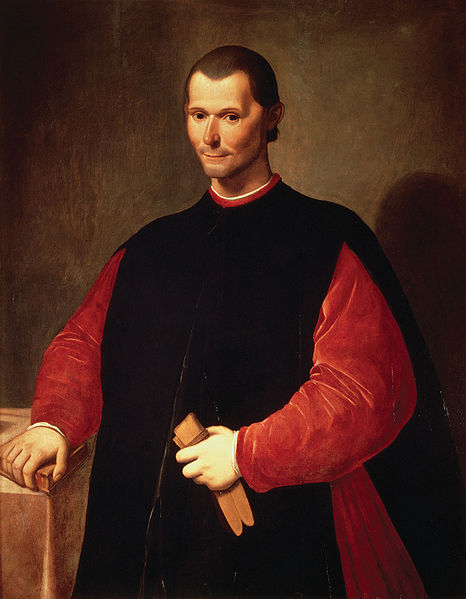
Portrait of Niccolò Machiavelli by Santi di Tito (1536-1603)
Via Wikimedia Commons.If you have ever studied Shakespeare, you might have heard your teacher use the word “Machiavellian” to describe amoral characters such as Iago from Othello or Edmund from King Lear. “Machiavellian” denotes a person or action that disregards morality and is wholly self-serving. The origin of the word derives from the famous Florentine politician and writer Niccoló Machiavelli.
[…]
Published posthumously, The Prince left Machiavelli with an infamous reputation as an amoral, atheistic, and cynical writer. In 1559, the Catholic Church put Machiavelli’s works on the Index of Prohibited Books. In the play The Jew of Malta by Christopher Marlowe, written in 1589, Machiavelli appears in the prologue, boldly exclaiming, “I count religion but a childish toy, and hold there is no sin but ignorance.”
Machiavelli came to be associated with an Elizabethan term, “Old Nick,” used to denote the devil. There is a subject of modern psychology, known as the “dark triad,” which focuses on three malevolent personality traits: narcissism, psychopathy, and Machiavellianism.
However, this deeply negative image of Machiavelli did not always exist. In the 17th and 18th centuries, a more positive view of Machiavelli emerged, with authors such as the Republican James Harrington referring to Machiavelli as “the prince of politicians.” During the Italian Renaissance, humanist Giovanni Battista Busini fondly described Machiavelli as “a most extraordinary lover of liberty.”
This praise might seem confusing; after all, the word “Machiavellian” denotes someone who is cunning and unscrupulous. How could a man so devious and pragmatic be called a lover of liberty? The answer lies with Machiavelli’s other book, known as Discourses on Livy, which presents a very different image of his political beliefs.
[…]
The stark differences between Machiavelli’s Discourses on Livy and The Prince come from the nature of the aims of each book. The Prince aims to refine the conduct of a single prince, while Discourses on Livy offers guidance for the entire citizen body. The Prince was written to address a unique political opportunity that quickly evaporated, whereas Discourses on Livy was written to articulate the principles required by republics that sought longevity, liberty, and prosperity.
To this day, there still remains a huge debate over the intricacies and contradictions that characterize Machiavelli’s writings. Machiavelli was an extremely nuanced and original thinker whose reputation should not exclusively be that of an evil schemer. He argued for a republic whose liberty is safeguarded by the common person, in which free, unhindered debate provides the best course of action, and where compromises between opposing groups create harmony. Discourses on Livy reveals another side of Machiavelli, a man committed to the ideals of freedom through the means of representative government.
Firing the 30-pounder rifled Parrott cannon at Fort Pulaski, GA
Stagecoacher
Published on 21 Jun 2015June 13, 2015. I silenced portions of the video because of wind noise. The actual report was much louder than it sounds in the video. My digital camera could not capture a sound that loud. http://jimjanke.com
Comments Off on Firing the 30-pounder rifled Parrott cannon at Fort Pulaski, GA
March 30, 2018
Havildar Bhanbhagta Gurung’s Knife Wielding WWII Assault
Today I Found Out
Published on 19 Feb 2018In this video:
In March of 2008, the world lost one of the most fearless soldiers to have served during WWII; a man who single-handedly cleared five heavily fortified positions with nothing more than a knife, a few grenades, a rock, and a complete disregard for the bullets flying around him the whole time. This is the story of Bhanbhagta Gurung.
Comments Off on Havildar Bhanbhagta Gurung’s Knife Wielding WWII Assault
QotD: “Progressive” eugenicists
Although their ethics were appalling, “Progressive” eugenicists of the late 19th and early 20th centuries at least got their economic analysis correct: they understood that forcibly raising employers’ cost of employing certain kinds of labor would reduce the quantity of that labor that is employed. This correct economic understanding was at the foundation of these “Progressives’” support for minimum wages; these “Progressives” explicitly wanted to keep people that they regarded as ‘undesirable’ from working.
I say (and believe) that these “Progressives’” ethics were appalling. Yet I’m quite sure that they did not see themselves as monsters. They surely believed themselves to be enlightened, humane, and highly ethical. They believed that they worked for a larger cause – “social reform” – and saw eugenics, minimum wages, and other uses of state force as progressive means of improving humankind through social engineering. One lesson here is that people convinced that they have a mission to improve society by helping forcibly to re-arrange that society so that it conforms to some pre-conceived image are dangerous brutes (if ones that wear suits) whose brutality is hidden from them by their consciously held good intentions and masked from their contemporaries, ironically, by the grand scale (‘society’) upon which they propose to implement their schemes. (If Bill pokes a gun at his neighbor Betty and threatens to shoot Betty if she pays any of her workers less than $7.25 per hour, Bill is rightly recognized as a brute who belongs in prison. Yet if Bill persuades a uniformed and well-armed gang to threaten to shoot, not just Betty, but everyone in the state who employs workers at wages lower than $7.25 per hour, Bill is celebrated as a humane social reformer who belongs in public office. It’s damn bizarre.)
Don Boudreaux, “Quotation of the day…”, Café Hayek, 2016-07-16.
Comments Off on QotD: “Progressive” eugenicists
March 29, 2018
The Forgotten Foundations Part 1 – The History of Sci Fi – Extra Sci Fi – #4
Extra Credits
Published on 27 Mar 2018This week, we explore the obscure authors from the turn of the 20th century whose weird and wacky stories impacted our modern-day sci fi consciousness and inspired works from authors like H.P. Lovecraft and Terry Pratchett.
Update: Fixed broken link. No idea why YouTube changed it.
Comments Off on The Forgotten Foundations Part 1 – The History of Sci Fi – Extra Sci Fi – #4
QotD: The decline of Epicureanism
The philosophy seems to have continued strong into about the 3rd century AD. Thereafter, it went into decline. By the middle of the 6th century, when the Emperor Justinian closed all the philosophical schools in Athens and dispersed the teachers, Epicureanism appears to have been already dead.
The main traditions of thought during the last few centuries of the ancient world were turned away from the everyday world. There were the neoplationists, with their settled belief in a higher reality that could be approached through a combination of mathematics and magic. There were, of course, the Christians, for whom the world is simply a preparation for the better life that is to come.
As said, relating what people think to what is happening around them is not easy. But the last few centuries of the ancient world were ages of great uncertainty. There were epidemic diseases that swept away multitudes without warning and without apparent cause. There were barbarian raids and civil wars. There was catastrophically overextended government to grind the survivors into helplessness and poverty. In this sort of world, teachings of Epicurus about seeking happiness in this life may have lost their attraction.
In one of his more sensible comments on Epicurus, Plutarch writes:
As to the vulgar sort… when they lose their children, wives, or friends, they would rather have them be somewhere and still remain, though in misery, than that they should be quite destroyed, dissolved, and reduced to nothing. And they are pleased when they hear it said of a dying person, that he goes away or departs, and such other words as intimate death to be the soul’s remove and not destruction. …. …. And they are discomposed when they hear it said of any one, he is perished, or he is gone or he is no more…. And therefore it is very plain that with the belief of immortality they [the Epicureans] take away the sweetest and greatest hopes the vulgar sort have.
In a world where life is uncertain and often unpleasant, there will tend to be an emphasis on some happier supernatural future.
There may be nothing sinister in the loss of virtually the whole body of Epicurean writings. Perhaps they were destroyed by a triumphant Church that had room for Plato and Aristotle but none for a naturalist enemy of all that Christianity proclaimed. But there is no reason to suppose any deliberate act of destruction. Papyrus rolls were by their nature delicate things. They were also far more expensive and therefore scarce in number than modern books. In any European climate, a papyrus roll would last for about a century, and then the glue that held it together would perish. Without careful recopying, a work might easily be lost.
The last centuries of the ancient world were mostly ages of depression. There was a shortage of all the means that had so far kept libraries together. Such means as remained were naturally given to recopying works for which there was an active demand. That means Christian theology, those parts of the pagan philosophies that could be reconciled to Christianity, and the greatest products of the pagan high culture. Since, with the exception of Lucretius — whose work largely survived — the works of Epicurus and his followers were in a style remarkable only for its plainness, it is unreasonable to suppose that librarians, forced to choose what to copy and what to leave to die, would take up the 37 volumes of On Nature and not the Ecclesiastical History of Eusebius.
So far as I can tell, whatever works of Epicurus survived were not studied in the Byzantine Empire. In the West, all but his name and whatever is said about him in Cicero vanished for a thousand years.
Sean Gabb, “Epicurus: Father of the Enlightenment”, speaking to the 6/20 Club in London, 2007-09-06.
Comments Off on QotD: The decline of Epicureanism
March 28, 2018
Backs To The Wall – All Eyes On Amiens I THE GREAT WAR Week 192
The Great War
Published on 27 Mar 2018The German Operation Michael continues this week and after some uncertainty, the Germans put their eyes on Amiens. The city is a vital communications and transport hub for the Entente and so Ferdinand Foch decides to mount a defence in front of the city.
Comments Off on Backs To The Wall – All Eyes On Amiens I THE GREAT WAR Week 192
Samuel HaNagid – A Prince of Jews – Extra History
Extra Credits
Published on 11 Jun 2016Forced to flee from his home in Cordoba, Samuel HaNagid made a new name for himself in the kingdom of Granada. He picked his allies carefully and rose to the position of vizier, an unheard of honor for a Jew in a Muslim kingdom. His fame as a poet, a leader, and a patron of Judaic studies spread across the Mediterranean.
Comments Off on Samuel HaNagid – A Prince of Jews – Extra History
March 27, 2018
German WW1 Prototype Tanks Of 1918 I THE GREAT WAR On The Road
The Great War
Published on 26 Mar 2018Get Our New Oberschlesien Tank Poster: http://bit.ly/PanzerOberschlesien
The German Tank Museum: https://www.youtube.com/DasPanzermuseum
While the German Army only fielded 20 A7V tanks during World War 1, they understood the potential of the tank and started working on different designs in the last year of the war. Some designs like the LKII almost got deployed while the Sturmpanzerwagen Oberschlesien or the Krupp-Protze never left the prototype stage.
Comments Off on German WW1 Prototype Tanks Of 1918 I THE GREAT WAR On The Road
Metrics are merely a tool. Like any tool they can be misused.
A big problem with depending on metrics is finding things to count that are actually useful measurements of whatever you’re tracking. A lot of bad management decisions can be traced to poorly chosen metrics. As a general rule, just because something can be measured doesn’t automatically mean that measurement will be useful. Tim Harford reviews a recent book on metrics:
Jerry Z Muller’s latest book is 220 pages long, not including the front matter. The average chapter is 10.18 pages long and contains 17.76 endnotes. There are four cover endorsements and the book weighs 421 grammes. These numbers tell us nothing, of course. If you want to understand the strengths and weaknesses of The Tyranny of Metrics you will need to read it — or trust the opinion of someone who has.
Professor Muller’s argument is that we keep forgetting this obvious point. Rather than rely on the informed judgment of people familiar with the situation, we gather meaningless numbers at great cost. We then use them to guide our actions, predictably causing unintended damage.
A famous example is the obsession, during the Vietnam war, with the “body count” metric embraced by US defence secretary Robert McNamara. The more of the enemy you kill, reasoned McNamara, the closer you are to winning. This was always a dubious idea, but the body count quickly became an informal metric for ranking units and handing out promotions, and was therefore often exaggerated. Counting bodies became a risky military objective in itself.
This episode symbolises the mindless, fruitless drive to count things. But it also shows us why metrics are so often used: McNamara was trying to understand and control a distant situation using the skills of a generalist, not a general. Muller shows that metrics are often used as a substitute for relevant experience, by managers with generic rather than specific expertise.
Muller does not claim that metrics are always useless, but that we expect too much from them as a tool of management. For example, if a group of doctors collect and analyse data on clinical outcomes, they are likely to learn something together. If bonuses and promotions are tied to the numbers, the exercise will teach nobody anything and may end up killing patients. Several studies have found evidence of cardiac surgeons refusing to operate on the sickest patients for fear of lowering their reported success rates.
Comments Off on Metrics are merely a tool. Like any tool they can be misused.
History Buffs: Tora! Tora! Tora!
History Buffs
Published on 21 Jun 2017Tora! Tora! Tora! is a 1970 Japanese-American historical war film that dramatizes the Japanese attack on Pearl Harbor in 1941. The film was directed by Richard Fleischer, Toshio Masuda and Kinji Fukasaku and stars an ensemble cast, including Martin Balsam, Joseph Cotten, Sō Yamamura, E. G. Marshall, James Whitmore and Jason Robards. The title is the Japanese codeword used to indicate that complete surprise had been achieved. “Tora” means “tiger” in Japanese.
Cynical Historian: Pearl Harbor review – https://www.youtube.com/watch?v=oUlwDDeAQNE
Comments Off on History Buffs: Tora! Tora! Tora!
March 26, 2018
Genghis Khan – The Final Conquering Years – Extra History – #6
Extra Credits
Published on 24 Mar 2018Genghis Khan wanted to establish a long-lasting legacy of conquering and growth for the Mongols, but at what cost? Even his own sons fought each other for the throne. Would peace truly last in the lands he had conquered?
Comments Off on Genghis Khan – The Final Conquering Years – Extra History – #6
Kalashnikov vs Sturmgewehr!
Forgotten Weapons
Published on 17 Sep 2016http://jamesdjulia.com/item/3024-394/ (MP-44)
http://jamesdjulia.com/item/3020-394/ (Type 56 AK)The German Sturmgewehr and the Soviet Kalashnikov are widely and rightly considered the two most influential and iconic of the modern military rifles. While the German rifle certainly influenced the Soviet design, the two were designed with different intentions and goals. The Sturmgewehr was an attempt to blend the roles of rifle and light machine gun, while the Kalashnikov was intended to blend the roles of rifle and submachine gun – and yet they both reached largely the same practical reality.
Which do you think was the better system?
Comments Off on Kalashnikov vs Sturmgewehr!


