
… halfway through [our] walk, older son said “you know, this is what we evolved to do. We’re not faster than most of our prey, and we don’t have the claws and teeth to bring them down. What we are is relentless. We would follow herds day and and night, not letting them rest, until the weak and the elderly fell behind, and then we had them. Hunting bands survived this way. This is what they did.”
Which brings us to the long march through the institutions. In a way when the left started its long march through the institutions they were just practicing ancient hunting practices, with Western Civilization as its prey.
Now their long march might or might not come to fruition, but you can’t avoid realizing that for people whose ideas are at best silly and at worst downright harmful, they’ve achieved remarkable success by taking over what they could and grooming their kids to take over more.
It is not their fault that the fields they’ve completely taken over, like academia, literature, art and news reporting are escaping their grasp. Yes, sure, the fact that all these fields are in major crisis IS their fault, or at least the fault of their philosophy which, in contact in reality, doesn’t hold up and tends to make people make decisions (and national policy too!) based on the reality inside their heads, implanted there by the cult of Marx. But the thing is, without new technology to allow us to escape their grasp, we’d be stuck with the crisis AND with leftist control.
However, again, for a philosophy whose proudest achievement is the killing of a hundred million human beings (and that’s lowballing it, as Colonel Kratman says) to take over those many institutions and not to be laughed out of polite (or worse, impolite) society is a testimony to the effectiveness of the long march.
And it has been long. They’ve been at it for close on a hundred years.
Sarah Hoyt, “The Long March”, According to Hoyt, 2015-12-20.
January 13, 2019
January 12, 2019
The role of tyche in the fall of the Roman empire
Williamson Murray posted this review at The Strategy Bridge back in August, but I don’t recall seeing it linked anywhere. He emphasizes the role of tyche both in the small events and the greater flow of history (tyche is a Greek word meaning luck, chance, or random events that change the course of human activity). In his review, he makes it clear that he feels earlier historians have failed to emphasize just how much tyche impacted the Roman world:
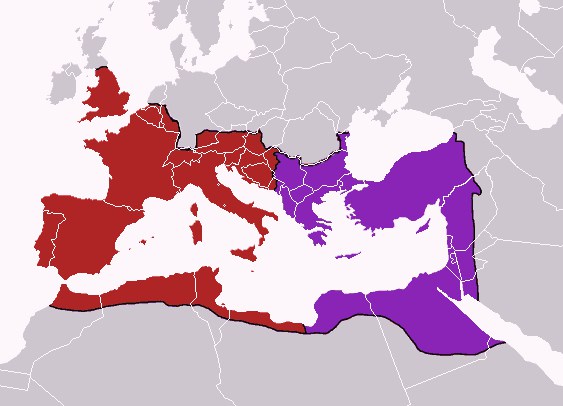
The approximate extent of the Roman empire circa 395AD, when the empire was formally divided into eastern and western zones with joint emperors in Rome and Constantinople.
In The Fate of Rome: Climate, Disease & the End of an Empire, Kyle Harper has presented us with a case study, namely the collapse of the Roman world in the period between the third and sixth centuries CE. Here tyche, in the largest sense, created a perfect storm of disastrous natural events and happenings that brought about the complete collapse of the Western Roman Empire in the fifth century CE, and eventually the ability of the Eastern Roman Empire to control much of the Mediterranean world after the seventh century. These natural events created conditions the Roman world was incapable of understanding, but which nevertheless brought about the collapse of one of the greatest, longest lasting empires in history. What Professor Harper’s book underlines is that the military difficulties that Rome’s generals and soldiers experienced in the period from the third century on were only the surface manifestations of far deeper systemic changes that could not be predicted, but which in combination created a perfect storm. Thus, fate, or more accurately tyche, undermined the best efforts to prevent what turned out to be a disastrous collapse.
The slide to catastrophe began after a period of unparalleled prosperity that had seen the population of Rome grow from approximately 60 million under Emperor Augustus in 33 BC to 75 million in 165 AD. The historian Edward Gibbon would describe the period in the following terms: “If a man were called to fix a period in the history of the world, during which the condition of the human race was most happy and prosperous, he would without hesitation, name” that period. Significantly, archeological and scientific evidence indicates the period from 200 BCE through the mid-point of the second century CE was extraordinarily favorable in terms of its climate for agriculture and the development of an extensive and expansive civilization in the Mediterranean and Western Europe. Combined with the favorable weather was a period of general peace under the empire that, for the most part, removed the generally disastrous role played by war throughout history. Except for one short period of civil wars between the claimants to Nero’s throne (70-71 CE, the year of the three emperors) and the two Jewish rebellions (66-71 CE and 135 CE), Rome fought its wars on the frontiers: the Rhine, the Danube, and Syria.
All that changed in the midst of the rule of the emperor Marcus Aurelius. The traditional narrative suggests that in 165 CE Roman soldiers returning from the campaign against the Parthians in Mesopotamia brought a plague. In fact, the pathogen most probably came through the Red Sea, brought by traders. In the great urban centers of the empire, all closely linked, it found an ideal environment. Given the extent of trade among these urban centers, the smallpox pathogens spread rapidly from urban center to urban center. As Professor Harper points out, “[i]n one sense, the Antonine Plague was a creature of chance, the final unpredictable outcome of countless millennia of evolutionary experimentation. At the same time, the empire — its global connections and fast-moving networks of communications — had created the ecological conditions for the outbreak of history’s first pandemic.” We have no way of knowing how many died, but it was substantial, on the order most probably of what was to occur in the Black Death of the fourteenth century.
Had the Antonine Plague been the only major problem besetting the Romans, the empire would likely have weathered the initial storm without catastrophic results. It was, however, not the only major factor that would affect the long-term health of the empire, based as it was on the slight surpluses that subsistence agriculture produced. Almost concurrently with the Antonine Plague, the weather patterns across the Mediterranean and Europe, reaching into central Asia, began a slow, steady shift that resulted in an average drop in temperature and rainfall. That decline would continue through to the mid-fifth century, which was to see the beginning of an even colder period, what climatologists are now calling the “Late Antique Little Ice Age” — one that was even less favorable to agriculture.
January 11, 2019
Poland Rises in the East I BETWEEN 2 WARS I 1921 Part 2 of 2
TimeGhost History
Published on 10 Jan 2019In 1921 the Second Polish Republic expands to the borders it will have until it is overrun by the Germans and Soviets in September of 1939. Through conquest, popular uprisings, plebiscite, and the Treaty of Versailles Poland incorporates land from her neighboring nations.
Join us on Patreon: https://www.patreon.com/TimeGhostHistory
Hosted by: Indy Neidell
Written and directed by: Spartacus Olsson
Produced by: Astrid Deinhard
Executive Producers: Bodo Rittenauer, Astrid Deinhard, Indy Neidell, Spartacus Olsson
Edited by Wieke Kapteijns
Research by: Kamil SzadkowskiVideo Archive by Screenocean/Reuters http://www.screenocean.com
A TimeGhost chronological documentary produced by OnLion Entertainment GmbH
Battle of Stalingrad (German perspective)
FootageArchive – Videos From The Past
Published on 16 Jan 2014Welcome to FootageArchive! On this channel you’ll find historic and educational videos from the 1900s. Watch, learn, and take a trip back in time as we gain insight into a previous time. Subscribe for more.
Note: this video contains archived public domain / licensed footage. This footage serves documentary purposes on world history and is to be viewed as educational.
January 10, 2019
What Happened to America’s Passenger Trains?! The Truth – from Class to Crap!
American Rail Club
Published on 1 Jul 2017Did America’s once industrious and world-famous passenger rail system fall because of “fair and equal” competition – or did the federal government tax it to death? Did America’s shift from rails to roads come out naturally – or from lobbying from General Motors? We visit two of America’s passenger rail cars from a bygone era to reminisce and then dive into the history and truth behind the decline of America’s passenger railroad system.
QotD: Pacifism
The majority of pacifists either belong to obscure religious sects or are simply humanitarians who object to the taking of life and prefer not to follow their thoughts beyond that point. But there is a minority of intellectual pacifists whose real though unadmitted motive appears to be hatred of western democracy and admiration of totalitarianism. Pacifist propaganda usually boils down to saying that one side is as bad as the other, but if one looks closely at the writings of younger intellectual pacifists, one finds that they do not by any means express impartial disapproval but are directed almost entirely against Britain and the United States. Moreover they do not as a rule condemn violence as such, but only violence used in defence of western countries. The Russians, unlike the British, are not blamed for defending themselves by warlike means, and indeed all pacifist propaganda of this type avoids mention of Russia or China. It is not claimed, again, that the Indians should abjure violence in their struggle against the British. Pacifist literature abounds with equivocal remarks which, if they mean anything, appear to mean that statesmen of the type of Hitler are preferable to those of the type of Churchill, and that violence is perhaps excusable if it is violent enough. After the fall of France, the French pacifists, faced by a real choice which their English colleagues have not had to make, mostly went over to the Nazis, and in England there appears to have been some small overlap of membership between the Peace Pledge Union and the Blackshirts. Pacifist writers have written in praise of Carlyle, one of the intellectual fathers of Fascism. All in all it is difficult not to feel that pacifism, as it appears among a section of the intelligentsia, is secretly inspired by an admiration for power and successful cruelty. The mistake was made of pinning this emotion to Hitler, but it could easily be retransfered.
George Orwell, “Notes on Nationalism”, Polemic, 1945-05.
January 9, 2019
The past is a foreign – and very smelly – place
We moderns tend to take ordinary public health issues for granted, yet the development of adequate sanitation and improvements in personal hygiene have probably contributed more to eliminate disease and expand human lifespan than any number of medicinal innovations. Marian L. Tupy reminds us just how … aromatic … the past was, and why:
Most of us take modern restrooms for granted, but proper sanitation is a relatively modern phenomenon and is still far too rare in the poorest regions of the world.
The need to keep human and animal waste away from human contact may seem obvious today, but for millennia that was not the case. Before the emergence of the germ theory of disease, and the subsequent public health campaigns and construction of adequate sanitation infrastructure in most of the world, people and waste commingled – with catastrophic results.
Countless millions of people got sick or died from diseases such as diarrhoea, ascariasis (a type of intestinal worm infection), cholera, hepatitis, trachoma, polio, schistosomiasis and so on.
In due deference to our ancestors, it has to be noted that some cultures, such as ancient Rome, paid due attention to cleanliness. The Romans built numerous public baths, which were accessible even to the very poor for a nominal fee, and a sophisticated system of sewers that enabled Rome to grow and reach a population of over 1 million people around the start of the first millennium. That feat would not be replicated in Europe until London and Paris in the 19th century.
In general, however, standards of hygiene tended to be very poor. A typical urban dwelling had a cesspit underneath the house or next to it. That’s where human and kitchen waste accumulated and fermented. Inadequate drainage, irregular emptying and heavy rains could make the cesspit overflow and seep into the house. While discouraged by the city authorities, people often emptied their chamber pots into the streets below.
As Johan Norbeg of the Cato Institute wrote in his 2016 book Progress: Ten Reasons to Look Forward to the Future, “When pedestrians heard the shout of ‘Gardyloo!’ they ran for cover. This phrase, taken from the French for ‘Look out for the water,’ was your only warning that someone was about to throw their waste out of the window.”
In rural areas, people lived with their animals, including chickens and cows, and used both animal and human waste to fertilise their crops – an extremely dangerous practice compounded by the fact that people could go throughout much of their lives without ever washing their hands. That led to epidemics of disease as well as other unsavoury consequences.
January 8, 2019
Tank Chats #40 Crusader | The Tank Museum
The Tank Museum
Published on 30 Jun 2017In the 40th Tank Chat, David Fletcher looks at the Second World War Crusader tank.
The first Crusader III was delivered in May 1942. Crusader IIIs were landed first in Algeria on 13 November 1942, but removed from service upon conclusion of the campaign in Tunisia in May 1943. This vehicle probably never left England, as it was held by the School of Tank Technology, before transfer to the Tank Museum in 1949. This vehicle is painted to represent a tank serving in Tunisia.
Support the work of The Tank Museum on Patreon: ► https://www.patreon.com/tankmuseum
Or donate http://tankmuseum.org/support-us/donateTwitter: ► https://twitter.com/TankMuseum
Tiger Tank Blog: ► http://blog.tiger-tank.com/
Tank 100 First World War Centenary Blog: ► http://tank100.com/ #tankmuseum #tanks
QotD: RINOs and other soft conservatives
The RINOs you complain about are RINOs now but they weren’t always. I don’t know how many of you remember the seventies. The right here was kind of like the right in Europe. It assumed that in the end communism would not only win, but DESERVED to win, and what the right disagreed with was the way to get there. It is useful to remember this was a time when William Buckley’s dictum that conservatism was “Standing astride History yelling stop” found deep resonance. Unpack that phrase. It assumes history comes with an arrow, that it’s not going our way, and that at best we can get it to pause.
Those RINOs who, by the way, took immense flack back then were as conservative as anyone dared to be. Because everyone knew in the end the reds won.
Then the wall fell down and we knew what true horrors lurked on the other side.
Individuals process these things fast enough. Well, my generation, at any rate, awakened by Reagan and shown that the win of the dark side was not inevitable, was more pro-freedom than people ten years older than us.
But when we saw the wall fall down, it pushed many of us further into the liberty side of the isle. Not only wasn’t a communist win inevitable, but their vaunted “strengths” like superior planning and better minority integration didn’t exist unless you really wanted to plan for three million size thirty boots for the left foot only, and integration meant grinding the minorities very fine and spreading them in the soil.
However cultures aren’t individuals. Cultures re-orient and process startling events very slowly.
Yeah, those older Republicans are still with us, and they were over 45 when the wall fell, which means they couldn’t reorient anymore. (Studies have been done.)
Sarah Hoyt, “The Long March”, According to Hoyt, 2015-12-20.
January 7, 2019
The Private Army of the British East India Company
Brandon F.
Published on 15 Dec 2018Before the days of the Raj, British India was ruled by a private corporation: The Honourable East India Company. The Company, which began in India as a purely mercantile institution, eventually came to control vast territories across the subcontinent. These wild frontiers and busy cities required garrisons to defend them, and the expansion of Company interests demanded the ability to wage war. To do this, the Company commanded a massive private army. Made up of both European and Indian soldiers, and working in close — if not always frictionless — tandem with H.M.’s regiments, it was a fascinating institution that only came to an end with the massive Sepoy Mutiny of 1857 and the dissolution of Company rule.
In this video, I discuss the organization of this army, and the way in which it related to government forces.
If you would like to support the Channel on Patreon:
https://www.patreon.com/BrandonF
QotD: The lifecycle of the pop music industry
… the music industry, the people involved in the business end of things, is about half the size it was at its peak. A couple of years ago I did a post on the state of music. Per capita music sales have collapsed from their peak 15 years ago. That peak was largely a bubble created by the advent of the compact disc. Everyone went out and repurchased their music collection in the new digital format. A lot of old stuff was remastered for the new format and that boosted sales too.
We are now in a time when selling songs is no longer very profitable. Often, bands will put their new releases on YouTube free of charge. The song itself is a form of marketing for their live shows. In my youth, the opposite was the case. Bands went on tour to promote their latest album. The tickets to the show were often cheaper than the album. Now, anything you want is on-line so trying to monetize the songs has become a lost cause. As a result, the focus is on making money from the live shows.
In many respects, pop music is back to where it was before the great wars of the 20th century. In the 19th century, sheet music was the item of value in the music business. Many of our intellectual property laws, in fact, come from efforts to protect the owners of sheet music. The main source of income for musicians, however, was the live act. They went around performing for customers. It is where the expression “sing for your supper” started. Often musicians were paid, in part, with a meal.
The Z Man, “The Cycle of Life”, The Z Blog, 2017-03-01.
January 6, 2019
The Finns Strike Again and Japan Strikes Back – WW2 – 019 – January 5 1940
World War Two
Published on 5 Jan 2019In Finland the invading Red Army suffers catastrophic casualties, while in China the Nationalists are divided as Japan uses diplomacy to strike back.
Follow WW2 day by day on Instagram @World_war_two_realtime https://www.instagram.com/world_war_t…
Between 2 Wars: https://www.youtube.com/playlist?list…
Join us on Patreon: https://www.patreon.com/TimeGhostHistory
Or join The TimeGhost Army directly at: https://timeghost.tvWritten and Hosted by: Indy Neidell
Produced and Directed by: Spartacus Olsson and Astrid Deinhard
Executive Producers: Bodo Rittenauer, Astrid Deinhard, Indy Neidell, Spartacus Olsson
Research by: Indy Neidell
Edited by: Iryna Dulka
Map animations by: Eastory
Community Manager: Joram AppelColorizations by Spartacus Olsson and Norman Stewart.
Photos of the Winter War are mostly from the Finnish Wartime Photograph Archive (SA-Kuva).
Eastory’s channel: https://www.youtube.com/channel/UCEly…
Archive by Screenocean/Reuters https://www.screenocean.comA TimeGhost chronological documentary produced by OnLion Entertainment GmbH
WW2 Ball Turret with twin .50 cals at the Big Sandy Shoot
Gunscom
Published on 7 Dec 2018One of the highlights at this fall’s Big Sandy Shoot was a vintage WW2 ball turret with twin .50 cals that spectators could shoot.
Although it’s not uncommon to see unique and rare guns and military vehicles at the event, the fully functioning ball turret garnered a lot of attention.
Taigh Ramey, president of Vintage Aircraft, towed the Sperry A2 ball turret all the way from Stockton, California to the shoot, which takes place every April and October just outside of the town of Wikieup, Arizona.
Sperry A2 ball turrets were commonly mounted underneath either a Boeing B-17 Flying Fortress or the Consolidated B-24 Liberator. They were used to defend the bomber against aircraft attacking from below.
Ramey found the turret in a surplus shop many years ago. It took him 15 years to convince the owner to sell it, and he’s sure glad he did. Ramey fixes up and maintains vintage aircraft for the Stockton Field Aviation Museum. The ball turret has proven to be very popular with visitors.
The turret was new ‘old stock’ from the 1940’s, so it never saw service. Despite having sat on a storage skid for half a century, Ramey says he brought it back to his shop, put hydraulic fluid, fired it up, and the turret ran like a charm.
Rumored to have inspired the inside of the cockpit of the Millennium Falcon from the Star Wars films, the Sperry turret was operated by the gunner inside using two hand controls that operated two Vickers hydraulic units. It could rotate 360 degrees and tilt up up and down. Atop two control handles were fire buttons that engaged two .50 caliber light-barrel Browning AN/M2 machine guns. The guns fired 850 rounds per minute, and each gun was fed by a 500 round box of ammunition. The guns could not be reloaded in flight, so gunners had to be careful.
Contrary to popular myth, ball turrets were not always manned by tiny people. People up to six foot could fit inside comfortably. Gunners sat in a fetal-type position, and aimed the guns using a Reflector sight in front of a small circular window between their legs.
Statistically, the ball turret was one of the safest crew positions during WWII as ball turret gunners had the lowest loss rate.
Ramey was at the Big Sandy Shoot not only to live fire the turret, something he’d never done before, but also to promote Bomber Camp. It is a two-day event held on May 29 and 30 of every year at the Stockton Metropolitan Airport in California. Participants get a chance to step back in time to train for a bombing mission, and then to fly it for real.
Participants learn how to use original bomber sights and compensate for height, distance and wind. Gunnery classes familiarize them with the ball turret and other aircraft mounted guns, all of which can be fired in flight using airsoft propane ‘blanks’.
The grande finale is a flying mission in which dummy cement bombs are dropped from high altitudes on targets from a B-24 or B17 aircraft. Bomber Camp offers a once in a lifetime experience to gain a greater appreciation for the men and women of the “greatest generation”. Enrollment is tax deductible.
QotD: English racism
The old-style contemptuous attitude towards ‘natives’ has been much weakened in England, and various pseudo-scientific theories emphasising the superiority of the white race have been abandoned. Among the intelligentsia, colour feeling only occurs in the transposed form, that is, as a belief in the innate superiority of the coloured races. This is now increasingly common among English intellectuals, probably resulting more often from masochism and sexual frustration than from contact with the Oriental and Negro nationalist movements. Even among those who do not feel strongly on the colour question, snobbery and imitation have a powerful influence. Almost any English intellectual would be scandalised by the claim that the white races are superior to the coloured, whereas the opposite claim would seem to him unexceptionable even if he disagreed with it. Nationalistic attachment to the coloured races is usually mixed up with the belief that their sex lives are superior, and there is a large underground mythology about the sexual prowess of Negroes.
George Orwell, “Notes on Nationalism”, Polemic, 1945-05.
January 5, 2019
QotD: Nasser’s anti-American success, funded by the USA
If you’re familiar with the history of the region, you already know that Nasser aligned Egypt with the Soviet Union anyway and whipped up the Arab world into an anti-American frenzy. Ike’s gamble failed. Nasser’s heart was with Moscow all along. He cleverly used Eisenhower as a tool for his own ambitions and planned to stab the United States in the front from the very beginning.
One of Nasser’s deceptions should be familiar to anyone who has followed the painful ins and outs of botched Arab-Israeli peacemaking. Over and over again, Nasser used a strategy Doran calls “dangle and delay.” He repeatedly dangled the tantalizing idea of peace between Egypt and Israel in front of Eisenhower’s eyes, only to delay moving forward for one bogus reason after another. He never planned to make peace with Israel or even to engage in serious talks.
Nasser did, however, participate in theatrical arms negotiations with Washington that he knew would never go anywhere.
Eisenhower wanted to equip the Egyptian army. Nasser wasn’t stupid, though. He knew that Ike would attach strings to the deal. Egypt’s soldiers would need to be trained by Americans, and they’d be reliant on Americans for spare and replacement parts. Nasser really wanted to be armed by and tied to the Soviet Union, but had to pretend otherwise lest Eisenhower side with Britain, France, and Israel. So Nasser slowly sabotaged talks with the United States in such a way that made Washington seem unreasonable. That way, when he turned to the Soviet Union for weapons, he could half-plausibly say he had no choice.
Nasser did such a good job pretending to be pro-American that he convinced the United States to give him a world-class broadcasting network that allowed him to speak to the entire Arab world over the radio. Washington expected him to use his radio addresses to rally the Arab world behind America against the Russians. Instead, he used it to blast the United States with virulently anti-American propaganda and to undermine the West’s Arab allies. “Nasser,” Doran writes, “was the first revolutionary leader in the postwar Middle East to exploit the technology in order to call over the heads of the monarchs to the man on the street. Suddenly the Hashemite monarchy [in Iraq and Jordan] found itself sitting atop volcanoes.”
Nasser strode the Arab world like a colossus after his American-made victory in the Suez Crisis, and he became more brazenly anti-American as he gathered strength. Conning Ike was no longer possible, but Nasser didn’t need the United States anymore anyway.
Michael J. Totten, “We Are Still Living With Eisenhower’s Biggest Mistake”, The Tower Magazine, 2017-02.


