
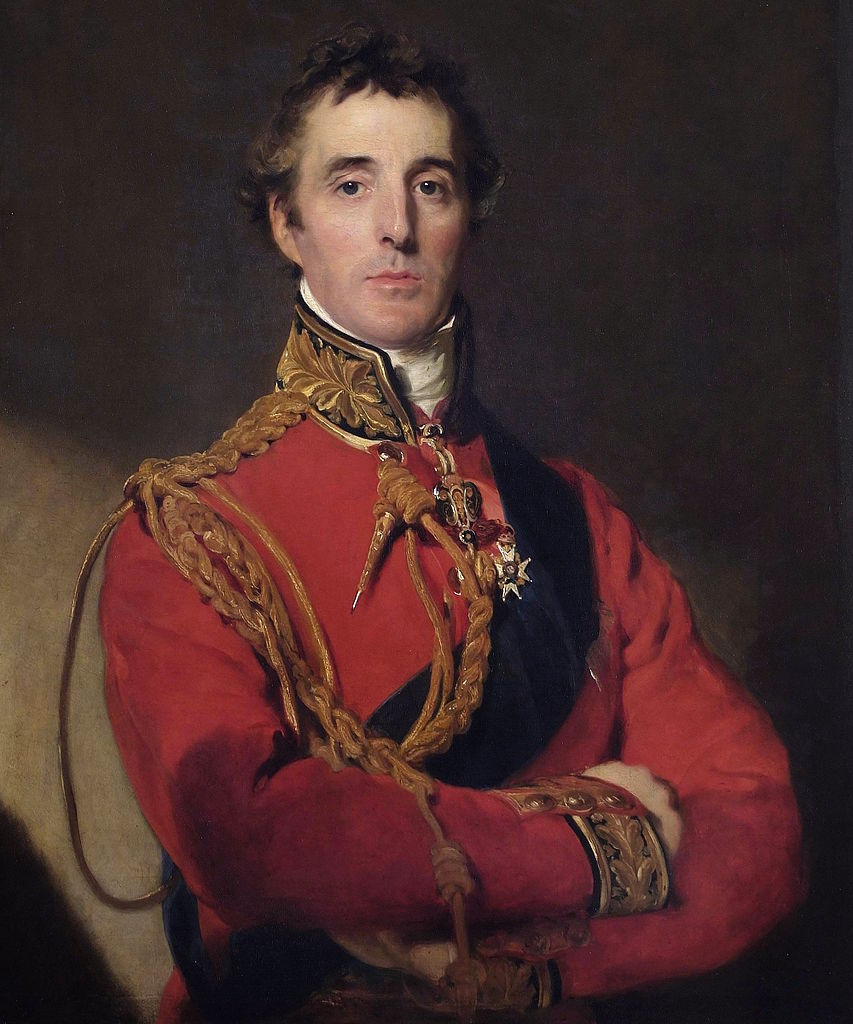
Arthur Wellesley, 1st Duke of Wellington (1769–1852) by Thomas Lawrence, circa 1815-1816.
Wikimedia Commons.The phrase “duke it out”, meaning “fight”, appears to derive ultimately from a nickname of one of the Great Captains, the Duke of Wellington (1769-1852).
It seems that the Duke had a rather prominent nose, so distinctive, in fact, that his troops often referred to him as “Old Nosey”. So the word “duke” soon became a synonym for “nose” in working class English slang, attested during Wellington’s own lifetime. That, in turn, led to the rise of the threat “bust your duke”, meaning “punch your nose”, and thus to “duke buster” as slang for “fist”, which was soon shortened to “duke”.
By further evolution, the phrase “put up your dukes” developed as an invitation to fight and “duke it out” became slang for “fight”.
While some etymologists apparently do not agree with this derivation, it’s worth noting that there is in London a mini-monument to the ducal proboscis, suggesting how notable it was.
Al Nofi, “Al Nofi’s CIC, Issue 472”, Strategy Page, 2019-06-01.
July 29, 2019
QotD: Put up your dukes!
July 28, 2019
Joan of Arc – Thy Kingdom Come – Extra History – #4
Extra Credits
Published on 27 Jul 2019Join us on Patreon! http://bit.ly/EHPatreon
City after city surrendered to Joan of Arc without a fight. Her mission was complete… or was it?
No Deal… Herr Hitler! – WW2 – 048 – July 27 1940
World War Two
Published on 27 Jul 2019Hitler searches for ways to force Britain out of the war, but the British sit safely behind their cliffs, their channel and their Royal Navy. Engaging the navy and invading Britain would require a major air-superiority. As a result, the Germans plan to knock the British out of the skies. This is the Battle of Britain.
Join us on Patreon: https://www.patreon.com/TimeGhostHistory
Or join The TimeGhost Army directly at: https://timeghost.tvFollow WW2 day by day on Instagram @World_war_two_realtime https://www.instagram.com/world_war_t…
Join our Discord Server: https://discord.gg/D6D2aYN.
Between 2 Wars: https://www.youtube.com/playlist?list…
Source list: http://bit.ly/WW2sourcesWritten and Hosted by: Indy Neidell
Produced and Directed by: Spartacus Olsson and Astrid Deinhard
Executive Producers: Bodo Rittenauer, Astrid Deinhard, Indy Neidell, Spartacus Olsson
Creative Producer: Joram Appel
Post-Production Director: Wieke Kapteijns
Research by: Indy Neidell
Edited by: Iryna Dulka
Map animations: EastoryColorisations by Norman Stewart and Julius Jääskeläinen https://www.facebook.com/JJcolorization/
Eastory’s channel: https://www.youtube.com/channel/UCEly…
Archive by Screenocean/Reuters https://www.screenocean.com.A TimeGhost chronological documentary produced by OnLion Entertainment GmbH.
From the comments:
World War Two
1 week ago (edited)
World War Two is a very complex topic, and even with one or more videos a week, there is a lot of information or context that we don’t get to cover on this channel. That’s why are doing series on the interwar years (1919-1939) called “Between Two Wars” on our TimeGhost History channel. We’re currently in 1929, and we’ll be making generally two thematic episodes for each year of the interwar period. If you want to understand what led up to this massive and destructive conflict, do make sure to check the channel out here: https://www.youtube.com/channel/UCLfMmOriSyPbd5JhHpnj4NgCheers,
Joram

Sea Lion: Why not just invade the UK in 1940?
Military History Visualized
Published on 13 Oct 2017Quite often people remark Hitler should just have finished off the UK before attacking the Soviet Union. Well, there are many problems with that assumption.
»» SUPPORT MHV ««
» patreon – https://www.patreon.com/mhv
» paypal donation – https://www.paypal.com/cgi-bin/webscr…Military History Visualized provides a series of short narrative and visual presentations like documentaries based on academic literature or sometimes primary sources. Videos are intended as introduction to military history, but also contain a lot of details for history buffs. Since the aim is to keep the episodes short and comprehensive some details are often cut.

QotD: Anglo-Italian relations, 1922-1940
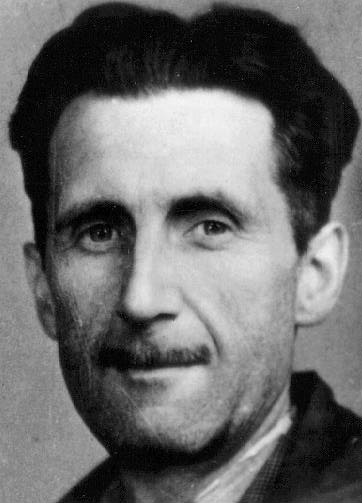
Orwell’s press card portrait, 1943
The history of British relations with Mussolini illustrated the structural weakness of a capitalist state. Granting that power politics are not moral, to attempt to buy Italy out of the Axis — and clearly this idea underlay British policy from 1934 onwards — was a natural strategic move. But it was not a move which Baldwin, Chamberlain and the rest of them were capable of carrying out. It could only have been done by being so strong that Mussolini would not dare to side with Hitler. This was impossible, because an economy ruled by the profit motive is simply not equal to rearming on a modern scale. Britain only began to arm when the Germans were in Calais. Before that, fairly large sums had, indeed, been voted for armaments, but they slid peaceably into the pockets of the shareholders and the weapons did not appear. Since they had no real intention of curtailing their own privileges, it was inevitable that the British ruling class should carry out every policy half-heartedly and blind themselves to the coming danger. But the moral collapse which this entailed was something new in British politics. In the nineteenth and early twentieth centuries, British politicians might be hypocritical, but hypocrisy implies a moral code. It was something new when Tory M.P.s cheered the news that British ships had been bombed by Italian aeroplanes, or when members of the House of Lords lent themselves to organized libel campaigns against the Basque children who had been brought here as refugees.
When one thinks of the lies and betrayals of those years, the cynical abandonment of one ally after another, the imbecile optimism of the Tory press, the flat refusal to believe that the dictators meant war, even when they shouted it from the house-tops, the inability of the moneyed class to see anything wrong whatever in concentration camps, ghettos, massacres and undeclared wars, one is driven to feel that moral decadence played its part as well as mere stupidity. By 1937 or thereabouts it was not possible to be in doubt about the nature of the Fascist régimes. But the lords of property had decided that Fascism was on their side and they were willing to swallow the most stinking evils so long as their property remained secure. In their clumsy way they were playing the game of Machiavelli, of “political realism”, of “anything is right which advances the cause of the Party” — the Party in this case, of course, being the Conservative Party.
All this “Cassius” brings out, but he does shirk its corollary. Throughout his book it is implied that only Tories are immoral. “Yet there is still another England,” he says. “This other England detested Fascism from the day of its birth… this was the England of the Left, the England of Labour.” True, but only part of the truth. The actual behaviour of the Left has been more honourable than its theories. It has fought against Fascism, but its representative thinkers have entered just as deeply as their opponents into the evil world of “realism” and power politics.
“Realism” (it used to be called dishonesty) is part of the general political atmosphere of our time. It is a sign of the weakness of “Cassius”s position that one could compile a quite similar book entitled The Trial of Winston Churchill, or The Trial of Chiang Kai-shek, or even The Trial of Ramsay MacDonald. In each case you would find the leaders of the Left contradicting themselves almost as grossly as the Tory leader quoted by “Cassius”. For the Left has also been willing to shut its eyes to a great deal and to accept some very doubtful allies. We laugh now to hear the Tories abusing Mussolini when they were flattering him five years ago, but who would have foretold in 1927 that the Left would one day take Chiang Kai-shek to its bosom? Who would have foretold just after the General Strike that ten years later Winston Churchill would be the darling of the Daily Worker? In the years 1935-9, when almost any ally against Fascism seemed acceptable, left-wingers found themselves praising Mustapha Kemal and then developing tenderness for Carol of Rumania.
George Orwell, “Who are the War Criminals?”, Tribune, 1943-10-22.
July 27, 2019
The US Economy is About to Crash Hard | Between 2 Wars | 1929 Part 1 of 3
TimeGhost History
Published on 25 Jul 2019In 1929 it’s been nothing but growth for the US economy for years, at least if you judge by the New York Stock Exchange. But all that glitters is not gold, and when the gilding comes off this bubble it sinks like a lead ballon.
Join us on Patreon: https://www.patreon.com/TimeGhostHistory
Hosted by: Indy Neidell
Written by: Francis van Berkel
Produced and directed by: Spartacus Olsson and Astrid Deinhard
Executive Producers: Bodo Rittenauer, Astrid Deinhard, Indy Neidell, Spartacus Olsson
Creative Producer: Joram Appel
Post Production Director: Wieke Kapteijns
Edited by: Daniel Weiss
Sound Mix by: Iryna DulkaArchive by: Reuters/Screenocean http://www.screenocean.com
A TimeGhost chronological documentary produced by OnLion Entertainment GmbH
From the comments:
TimeGhost History
3 hours ago (edited)
Now… ladies and gents – this is not a video about 2019 and we are not making any political statements. We know that some of you love making parallels between the present day and historical events. Although we can learn from history, try to remember that the circumstances were very different. Others among you feel it appropriate to extend partisan conflicts backwards and make out our videos, or events in the videos as partisan statements or issues. First of all we simply don’t do that, we just relate the events and the circumstances as factually as possible with the best possible sources. Second of all it is pointless to look for the 2019 partisan left/right divide according to party lines in events that happened 90 years ago. There’s just no comparison as both reality, and political parties have gone through so much change that the members of the same party, from today and then would probably disagree so vehemently on so many points the they would not even understand each other. So please, try your best to not go off on partisan rants, as it distracts form the actual historical issues at hand

Life and Death in Herculaneum (Prof. Wallace-Hadrill)
Cardo Maximus
Published on 20 Jun 2013
July 26, 2019
“Attero Dominatus” – The Battle of Berlin – Sabaton History 025 [Official]
Sabaton History
Published on 25 Jul 2019The Sabaton song “Attero Dominatus” is about the Soviet advance on Berlin in the last months of World War Two. As the Soviets approach Berlin, two commanders, General Zhukov and General Konev, try their best to be the one to take the centre of the German capital. Meanwhile, thousands of Germans are raped or murdered by the Soviets in retaliation to the atrocities that the Germans committed in the east.
Support Sabaton History on Patreon: https://www.patreon.com/sabatonhistory
Listen to Attero Dominatus (where “Attero Dominatus” is featured):
CD: http://bit.ly/AtteroDominatusStore
Spotify: http://bit.ly/AtteroDominatusSpotify
Apple Music: http://bit.ly/AtteroDominatusAppleMusic
iTunes: http://bit.ly/AtteroDominatusiTunes
Amazon: http://bit.ly/AtteroDominatusAmzn
Google Play: http://bit.ly/AtteroDominatusGooglePlayCheck out the official videoclip for “Attero Dominatus” here: https://www.youtube.com/watch?v=eNlRq…
Listen to Sabaton on Spotify: http://smarturl.it/SabatonSpotify
Official Sabaton Merchandise Shop: http://bit.ly/SabatonOfficialShopHosted by: Indy Neidell
Written by: Markus Linke and Indy Neidell
Directed by: Astrid Deinhard and Wieke Kapteijns
Produced by: Pär Sundström, Astrid Deinhard and Spartacus Olsson
Creative Producer: Joram Appel
Executive Producers: Pär Sundström, Joakim Broden, Tomas Sunmo, Indy Neidell, Astrid Deinhard, and Spartacus Olsson
Maps by: Eastory
Edited by: Iryna Dulka
Sound Editing by: Marek KaminskiEastory YouTube Channel: https://www.youtube.com/channel/UCEly…
Archive by: Reuters/Screenocean https://www.screenocean.com
Music by Sabaton.An OnLion Entertainment GmbH and Raging Beaver Publishing AB co-Production.
Sources:
Colored portrait of W. Wenck by Ruffneck88
Ministry of Defence of the Russian Federation
Photos of Helmuth Weidling from ww2gallery on Flickr© Raging Beaver Publishing AB, 2019 – all rights reserved.

How Does it Work: Blow Forward
Forgotten Weapons
Published on 28 May 2019http://www.patreon.com/ForgottenWeapons
Cool Forgotten Weapons merch! http://shop.bbtv.com/collections/forg…
The blow forward system has only been used on three commercially-produced firearms: the Schwarzlose 1908, Hino-Komuro, and Mannlicher 1894 (The SIG AK-53 uses a forward barrel movement, but in conjunction with a locked breech). It offers a simple system with a theoretical extra margin of safety because the side cannot come backward off the gun, but at the cost of substantially increased felt recoil. Once the blowback system was out of patent protection, there was no convincing reason to use the blow forward mechanism.
Contact:
Forgotten Weapons
PO Box 87647
Tucson, AZ 85754

QotD: Preparing for war
A nation that does not prepare for all the forms of war should then renounce the use of war in national policy. A people that does not prepare to fight should then be morally prepared to surrender. To fail to prepare soldiers and citizens for limited, bloody ground action, and then to engage in it, is folly verging on the criminal.
T.R. Fehrenbach, This Kind of War: A Study in Unpreparedness, 1963.
July 25, 2019
YouTube’s secret fight against history documentaries
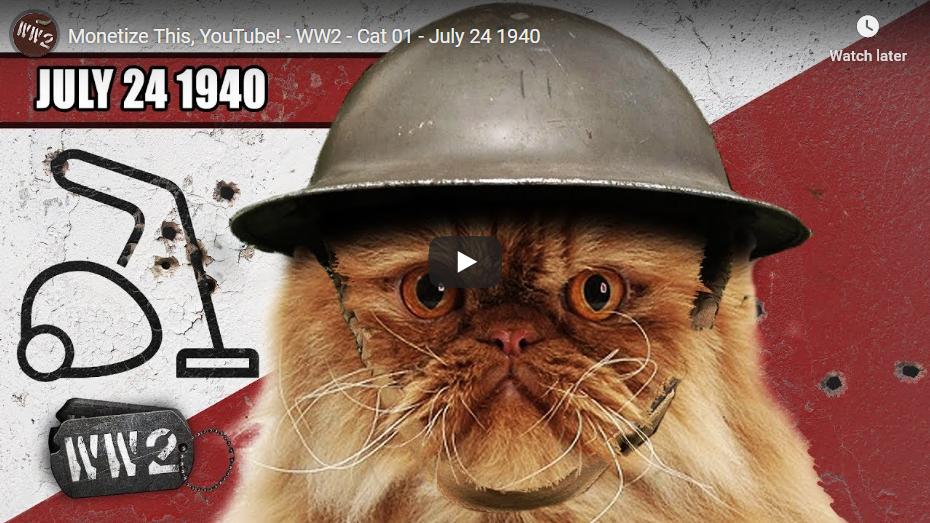
The good folks at TimeGhost have been struggling with YouTube’s monetization and recommendation mechanisms for some time. A number of TimeGhost’s WW2 documentary videos have been demonetized over the last year, and the team noticed that every demonetized video had significantly fewer viewers than those that were not demonetized. They did some analysis and submitted the results to YouTube, showing that the demonetized videos were also being restricted from showing up on the automated recommendation lists that users see, which largely accounted for the lower viewership for their demonetized videos, but YouTube denied that there was any connection between these things … that demonetized videos are just as likely to be recommended as the ones that are not demonetized, and that TimeGhost’s analysis was just wrong. YouTube sent the TimeGhost team a set of guidelines for how to ensure that the videos they post were considered acceptable to advertisers and would not be subject to demonetization (and the stealth omission from recommendation lists). Here’s the first video from TimeGhost, implementing those guidelines:
This is how they explained the situation in the comments:
World War Two
3 hours ago (edited)
Now, to begin with – this is not about that we need YouTube’s ad money, at our viewership levels that money is not near enough to finance our content anyway. We have a fantastic community in the TimeGhost Army that support us financially, and make our shows possible, for which we are eternally grateful. This is also not about politics – nothing in our data indicates that YouTube is choosing what to monetize based on political considerations. However, indirectly this is about money, but even more importantly about our self-appointed mandate to share education about our common past. You see, when YouTube labels content as “not suitable for some, or most advertisers” they also recommend it less – in fact almost only under our own videos. This means that we don’t reach new viewers with those videos, this in turn means that our community grows less, or not at all.When we sent the data proving that (data from YouTube no less), they at first denied that there was a connection between monetization and recommendation. We sent them more data showing conclusively that this is a false statement. Their response then was to say that maybe there is a connection between things that impact monetization and things that impact recommendation. They also sent us a list of things we should do to become “more advertiser friendly” – the list states among other things that content dealing with war, political controversies, terrorism, or death is not suitable for advertisers. That in effect means more or less the better part of human history and all of WW2.
We emphatically object to this interpretation of what is acceptable for advertisers – our kind of content has been attached to advertising for decades in main stream media, historical magazines and websites dealing with exactly the same things we do, receives advertising from major brands. Furthermore less recommendation means less viewers, which means that our content gets less support and thus risks becoming financially impossible – that is censorship by drip. Therefore we also vehemently protest this policy that in effect restricts the access to educational content, with high academic standards covering topics that are essential parts of human history. Events and phenomena that need to be widely understood in order for the world to learn from our past mistakes.
Last but not least we want to point out one more time – we do not have any indication whatsoever that we are being targeted for political reasons. We cover topics covering both right wing and left wing politics, we do not make judgement ourselves, instead we leave it up to you to decide positively or negatively depending on your opinion. We cover these topics factually, with completeness, and unbiased. The portion of our videos that have been deemed unsuitable to advertisers include political themes that cover the entire spectrum from Naziism to Marxism. Notably, and from the educational perspective troubling is that videos covering crimes against humanity such as the Holocaust or war crimes by the Soviet Union are almost always demonetized.
Please share this video to raise the awareness of what we find to be irresponsible behavior by a corporation that holds a virtual monopoly on free to access ad financed online video. Thank you.
QotD: Ice ages as evolutionary drivers
What you see when the puffins arrive in the spring is a product of this history. The Atlantic, for the past 2.74 million years has been a place of coming and going, unsettled at the deepest of levels, a system always ready to flip from relatively beneficent to deeply unaccommodating. Life does not have the time here to develop the mass of differentiated variety it has within the security of the Pacific.
[…]
The result is that now in the North Atlantic there is relatively little local variation. Species have evolved to cope with the variability and have wide ranges across the latitudes. The Pacific is a mosaic of local land-based varieties; the Atlantic the exclusive realm of the ocean travellers, birds which have distance embedded in their way of being.
Adam Nicholson, The Seabird’s Cry: The Lives and Loves of Puffins, Gannets and Other Ocean Voyagers, 2017.
July 24, 2019
QotD: The failure of the Republican cause in the Spanish Civil War
Orwell’s press card portrait, 1943
The backbone of the resistance against Franco was the Spanish working class, especially the urban trade union members. In the long run — it is important to remember that it is only in the long run — the working class remains the most reliable enemy of Fascism, simply because the working-class stands to gain most by a decent reconstruction of society. Unlike other classes or categories, it can’t be permanently bribed.
To say this is not to idealize the working class. In the long struggle that has followed the Russian Revolution it is the manual workers who have been defeated, and it is impossible not to feel that it was their own fault. Time after time, in country after country, the organized working-class movements have been crushed by open, illegal violence, and their comrades abroad, linked to them in theoretical solidarity, have simply looked on and done nothing; and underneath this, secret cause of many betrayals, has lain the fact that between white and coloured workers there is not even lip-service to solidarity. Who can believe in the class-conscious international proletariat after the events of the past ten years? To the British working class the massacre of their comrades in Vienna, Berlin, Madrid, or wherever it might be seemed less interesting and less important than yesterday’s football match. Yet this does not alter the fact that the working class will go on struggling against Fascism after the others have caved in. One feature of the Nazi conquest of France was the astonishing defections among the intelligentsia, including some of the left-wing political intelligentsia. The intelligentsia are the people who squeal loudest against Fascism, and yet a respectable proportion of them collapse into defeatism when the pinch comes. They are far-sighted enough to see the odds against them, and moreoever they can be bribed — for it is evident that the Nazis think it worth while to bribe intellectuals. With the working class it is the other way about. Too ignorant to see through the trick that is being played on them, they easily swallow the promises of Fascism, yet sooner or later they always take up the struggle again. They must do so, because in their own bodies they always discover that the promises of Fascism cannot be fulfilled. To win over the working class permanently, the Fascists would have to raise the general standard of living, which they are unable and probably unwilling to do. The struggle of the working class is like the growth of a plant. The plant is blind and stupid, but it knows enough to keep pushing upwards towards the light, and it will do this in the face of endless discouragements. What are the workers struggling for? Simply for the decent life which they are more and more aware is now technically possible. Their consciousness of this aim ebbs and flows. In Spain, for a while, people were acting consciously, moving towards a goal which they wanted to reach and believed they could reach. It accounted for the curiously buoyant feeling that life in Government Spain had during the early months of the war. The common people knew in their bones that the Republic was their friend and Franco was their enemy. They knew that they were in the right, because they were fighting for something which the world owed them and was able to give them.
One has to remember this to see the Spanish war in its true perspective. When one thinks of the cruelty, squalor, and futility of War — and in this particular case of the intrigues, the persecutions, the lies and the misunderstandings — there is always the temptation to say: “One side is as bad as the other. I am neutral”. In practice, however, one cannot be neutral, and there is hardly such a thing as a war in which it makes no difference who wins. Nearly always one stands more or less for progress, the other side more or less for reaction. The hatred which the Spanish Republic excited in millionaires, dukes, cardinals, play-boys, Blimps, and what-not would in itself be enough to show one how the land lay. In essence it was a class war. If it had been won, the cause of the common people everywhere would have been strengthened. It was lost, and the dividend-drawers all over the world rubbed their hands. That was the real issue; all else was froth on its surface.
George Orwell, “Looking back on the Spanish War”, New Road, 1943 (republished in England, Your England and Other Essays, 1953).
July 23, 2019
How Does It Work: Direct Gas Impingement
Forgotten Weapons
Published on 21 May 2019Interested in small arms history? Make sure to pre-order a copy of my book, Chassepot to FAMAS: French Military Rifles 1866 – 2016:
https://www.kickstarter.com/projects/…
Direct gas impingement is an operating system that has been used only in a few production guns (all of them rifles). It is extremely simple, although perhaps not well suited to adjustability. It is also not the operating system of the AR series of rifles – we will cover those in a separate video.
http://www.patreon.com/ForgottenWeapons
Cool Forgotten Weapons merch! http://shop.bbtv.com/collections/forg…
Contact:
Forgotten Weapons
PO Box 87647
Tucson, AZ 85754

QotD: Science of the ancient Greeks
The problem with all this is not just that the scholars of the Mouseion were rather more interested in the textual variants of Pindar’s paianes than studying physics, but also a common modern misunderstanding about the nature of Greek “science”. Many modern people, including modern scientists, hear about the Greeks discussing motion or “atoms” or doing geometry to measure the circumference of the Earth or the distance to the Sun and assume that they were doing “science” in the modern sense of the word. Historians also sometimes refer to Greek natural philosophy as “science” and popularisations of the history of science draw simplistic direct lines between things like Greek discussions of “atoms” and modern atomic theory. But this obscures the fact that Greek proto-science was, while a distant lineal ancestor of the modern sciences, very unlike them in many important respects. At best, it was a highly rational attempt at understanding fundamental precepts of the physical and natural world. But it used induction and common sense more than measurement and experiment. There were exceptions (mainly in geometry and its related field, astronomy), but the Greeks were usually not interested in empirical measurement and so were usually even less interested in genuine experiments. Most Greek proto-science was a highly abstract and philosophical affair, based on some observations, but without modern ideas of carefully designed and repeatable experiments with calibrated measurement and attendant mathematics. Most of their “science” was done by sitting around, thinking and talking about concepts, not by actually dropping weights from towers – though they did do thought experiments which sometimes led to correct conclusions and sometimes did not. Their “science” was not our science.
This means that a Greek conversation about “atoms” was largely an abstract and metaphysical exercise about the philosophical nature of a thing and how many times it could be divided conceptually and what this may mean; the word comes from the Greek ἄτομος meaning “unhewn, uncut, indivisible”. No Greek philosopher walked away from such a conversation and decided to try to build some equipment to explore the physical nature of atomic structure and would probably have considered such an idea absurd. Nor would they have taken the step of considering that different forms of matter, liquid or gas were made up of different combinations of atoms and so decide to experiment with these substances to understand this better, since this was completely contrary to their (erroneous) conception of the “Four Elements” of Earth, Air, Water and Fire. The nature of Greek thought did allow them to draw useful and often correct conclusions about the physical universe, but it also set up barriers to the true scientific method that they simply did not and could not cross.
This was one of the reasons there was no direct link between their proto-scientific “science” and technology. Natural philosophy was, as the term would suggest, the preserve of philosophers. In a world where most of the population had to be devoted to agricultural production and most of the rest often barely got by, sitting around and talking about abstractions like “atoms” was a rich man’s luxury. Most philosophers either came from the upper class (though maybe its lower echelons in many cases) or had rich patrons or both, which meant most philosophers had little interest in making or inventing things: that was generally the preserve of lowly mechanics and slaves. Again, there were exceptions to this – Archimedes seems to have had some interest in the engineering applications of his ideas, even if most of the inventions attributed to him are probably legends. On the whole, however, lofty Greek philosophers didn’t think to soil their hands with something as lowly as inventing and making things.
Tim O’Neill, “The Great Myths 5: The Destruction Of The Great Library Of Alexandria”, History for Atheists, 2017-07-02.


