Quotulatiousness

May 28, 2020

QotD: The decline and fall of the British aristocracy

Filed under: Britain, History, Quotations — Tags: , , , — Nicholas @ 01:00

Therein you have a microcosm of modern British aristocracy. A class system that used to distribute power and responsibility has collapsed into a source of therapeutic validation for the fragile individualism of its members. False merit thrives between narrow horizons — and few are narrower than the blue bloods of England. Enabling these delusions are the hangers-on who crowd Britain’s husks of aristocracy. It takes celebrities, journalists, and photographers to clothe their naked imperium and validate their feelings of uniqueness. And what does the intelligentsia get in return for this courtship? The answer, of course, is nothing. Because if Britain’s nobs know one thing, it is that they owe the world nothing. They have kept their noblesse but eschewed their oblige. In its place has come venality and codependence: rugged individualism without the actual ruggedness.

The historical way-markers to this implosion are well-documented. The First World War delivered a demographic and psychological blow of unprecedented proportion. Yet the next generation laughed into the void. The Roaring Twenties were a whirl of parties and bankruptcies. Only with the aid of married American fortunes did a carapace of their old values remain intact. The ’60s dissolved what remained of those values in a fug of dope and good tail. Those who didn’t succumb to the new addictions succumbed to old ones they could no longer afford. Titans of the British military like Sir David Stirling — cofounder of the SAS and a descendant of Charles II — gambled away their estates at the hands of unscrupulous Mayfair casino-owners who pretended to be their friends. The aristos were co-opted for their charm — read: money — by a new milieu that promoted the glamour of sexual and social transgression. Blinded by their inherited feelings of self-worth, they never realized they were being used by people who despised them. As a result, nowhere was Britain’s postwar political direction — dubbed “The Management of Decline” — internalized as effectively as among the people who had once driven its ascent.

[…]

How could a species that once steered Britain to greatness now claim the Darwin Award in every passing decade? The simple reason is that British aristocrats are the only people on earth among whom stupidity is not only accepted but prized. As the ultimate proof against meritocracy, it is the ultimate badge of honor. As Stendhal wrote in Le Rouge et Le Noir, “It is not doing something well or badly that is the crime: but doing it at all.”

“Bunky Mortimer III”, “Class Rejects: A Guide to the British Aristocracy”, Taki’s Magazine, 2018-03-02.

May 27, 2020

The Battle to Crack Enigma – The real story of ‘The Imitation Game’ – WW2 Special

World War Two
Published 26 May 2020

For the British, breaking the Germans’ seemingly unbreakable codes is one of the most vital battles of the war. If they fail, there is litte to stop the German U-Boats hunting down Allied shipping in the Atlantic.

Join us on Patreon: https://www.patreon.com/TimeGhostHistory
Or join The TimeGhost Army directly at: https://timeghost.tv

Follow WW2 day by day on Instagram @World_war_two_realtime https://www.instagram.com/world_war_t…
Between 2 Wars: https://www.youtube.com/playlist?list…
Source list: http://bit.ly/WW2sources

Hosted by: Indy Neidell
Written by: Francis van Berkel
Director: Astrid Deinhard
Producers: Astrid Deinhard and Spartacus Olsson
Executive Producers: Astrid Deinhard, Indy Neidell, Spartacus Olsson, Bodo Rittenauer
Creative Producer: Joram Appel
Post-Production Director: Wieke Kapteijns
Research by: Francis van Berkel
Edited by: Mikołaj Cackowski
Sound design: Marek Kamiński
Map animations: Eastory (https://www.youtube.com/c/eastory)

Colorizations by:
Jaris Almazani (Artistic Man), https://instagram.com/artistic.man?ig…
Norman Stewart, https://oldtimesincolor.blogspot.com/
Carlos Ortega Pereira, BlauColorizations, https://www.instagram.com/blaucoloriz…

Sources:
Bundesarchiv
Narodowe Archiwum Cyfrowe
IWM D 23310, A 13709, A 23513
Picture of Enigma G model, courtesy Austin Mills https://flic.kr/p/2bQ9Q
reconstructed bombe machine at Bletchley Park, courtesy Gerald Massey
Picture of Enigma M4 model displayed at Bletchley Park, courtesy Magnus Manske
Picture of John Herivel, courtesy GCHQ
From the Noun Project: Letter by Mochammad Kafi, Desk by monkik, Phone by libertetstudio, person by Adrien Coquet, Letter by Bonegolem, Table by Creative Stall, documents by Johannes Hirsekorn, sitting at desk by IYIKON, Paper by James Kopina

Soundtracks from the Epidemic Sound:
Reynard Seidel – “Deflection”
Johannes Bornlof – “The Inspector 4”
Phoenix Tail – “At the Front”
Johannes Bornlof – “Deviation In Time”
Gunnar Johnsen – “Not Safe Yet”
Hakan Eriksson – “Epic Adventure Theme 3”
Howard Harper-Barnes – “London”

Archive by Screenocean/Reuters https://www.screenocean.com.

A TimeGhost chronological documentary produced by OnLion Entertainment GmbH.

From the comments:

World War Two
4 hours ago (edited)
Hopefully you’re all staying safe in these difficult times. We’re still marching on so that we can keep all of you entertained when you’re stuck at home. But we can only continue doing so thanks to your ongoing support. Ad revenue has dropped significantly because of COVID, and we rely on your support now more than ever. If you can, please support us on www.patreon.com/timeghosthistory or https://timeghost.tv.

Please let us know what other specials you’d like to see. And if you would like to know something about a smaller topic, make sure to submit that as a question for our Q&A series, Out of the Foxholes. You can do that right here: https://community.timeghost.tv/c/Out-of-the-Foxholes-Qs.

Cheers,
Francis

American passenger trains before Amtrak

Filed under: Business, Government, History, Railways, USA — Tags: , , , , — Nicholas @ 03:00

George Hamlin reflects on the state of the US passenger rail system before the formation of Amtrak in 1971:

… non-commuter U.S. passenger trains can be said to have been under siege essentially for my entire lifetime, beginning not long after the end of World War II. Many railroads spent large sums to re-equip with streamlined lightweight equipment after the war, only to see what was originally couched as an investment turn into essentially a drain on their companies’ treasuries.

And the “rewards” for this? Passengers decamped to the rapidly-expanding airlines, and their personal automobiles. The decisive blow came in 1956, with the passage of the Federal Aid Highway Act, which led to the Interstate Highway System.

Quoting from Joe Welsh’s Pennsy Streamliners, The Blue Ribbon Fleet (page 138), “Referring to the challenge, [PRR President] Symes wrote ‘There is such a thing as planning an orderly retreat in the face of superior forces.’ Clearly, the bugle had been sounded.”

In 1958, an Interstate Commerce Commission Hearing Examiner predicted that there would be no intercity passenger trains by 1970; he only missed by four months, effectively (and didn’t count on the Southern Railway, Rio Grande and Rock Island shying away from the government’s largesse). In 1959, TRAINS magazine devoted an entire issue to what was now clearly a crisis; the cover bore the legend “Who Shot the Passenger Train?”, complete with simulated bullet hole.

The 1960s in the U.S. could well be described as the “train-off” decade from a transportation history perspective; get, and read, Fred Frailey’s Twilight of the Great Trains, for a blow-by-blow analysis. The 1970s quickly produced the Penn Central bankruptcy, which proved to be the catalyst for government intervention; less than a year later, Amtrak was on the scene.

And since, it has frequently found itself in a “Perils of Pauline” existence, ranging from lack of funding to buy equipment, in many cases, to several bouts of route eliminations, to micro-management by politicians that don’t seem to be willing to provide consistent operational funding so that the company can make reasonable plans.

PRR E8A 5803 with Train 72, The Red Bird, passing the Hartsdale, Indiana tower and crossing the NYC and EJ&E on November 26, 1965.
Photo from the Roger Puta collection via Wikimedia Commons.

Webley 1913 Semiauto Pistol: History and Disassembly

Filed under: Britain, History, Military, Weapons, WW1 — Tags: , , , — Nicholas @ 02:00

Forgotten Weapons
Published 25 May 2017

William Whiting and the Webley company had high hopes for their self-loading pistols being adopted by the British military — but they never got the success they were hoping for.

After the poor performance of the Webley 1904 (https://www.youtube.com/watch?v=-hT38…) at trials, William Whiting decided to make sure his next attempt would be fully developed before he put it in the hands of the military. He did very well at that too, as the gun which would become the Model 1913 Webley did very well from its very first military tests. The Royal Navy was, in fact, quite enthusiastic about it, although the Army was not. The Navy would ultimately adopt the gun and purchase about 8,000 of them during World War One, while the Army acquired just a couple hundred and preferred to stick to its revolvers.

Thanks to Mike Carrick of Arms Heritage magazine for loaning me these pistols to bring to you!

Cool Forgotten Weapons merchandise! http://shop.bbtv.com/collections/forg...

http://www.patreon.com/ForgottenWeapons

If you enjoy Forgotten Weapons, check out its sister channel, InRangeTV! http://www.youtube.com/InRangeTVShow

May 26, 2020

“No more pencils, no more books…”

Filed under: Britain, Education, History — Tags: , , , , , , — Nicholas @ 03:00

In the latest edition of the Libertarian Enterprise, Sean Gabb considers the demands from the British government to quickly re-open the schools over the concerns of the educational unions and administrations:

The latest turn in an increasingly dull coverage of the Coronavirus panic is a proposed reopening of the schools. The Government wants them open as soon as possible for at least some of their students. The teaching unions are bleating that no one should go back until their members can be sure of not catching anything. The headmasters are worried about compliance with the social distancing rules. As a conservative of sorts, I think I am supposed to side with the Government and the pro-Conservative journalists — denouncing the teachers as a pack of idlers where not cowards, and insisting that those factories of essential skills must be set back in full production before the summer holidays. Of course, my settled view as a libertarian is that the teaching unions deserve all the support I have never so far given them. The schools must remain closed until no one is in any danger of so much as an attack of hay fever. The schools have been largely closed since the end of March. The longer they stay largely closed, the better. Best of all if they never reopen — or never reopen as they have been since attendance was made compulsory at the end of the nineteenth century.

I quote John Stuart Mill on compulsory schooling:

    A general State education is a mere contrivance for moulding people to be exactly like one another: and as the mould in which it casts them is that which pleases the predominant power in the government, whether this be a monarch, a priesthood, an aristocracy, or the majority of the existing generation; in proportion as it is efficient and successful, it establishes a despotism over the mind, leading by natural tendency to one over the body.
    (On Liberty, 1859, Chapter 5, “Applications.”)

This has always been the case in some degree. The spread of state schooling in England after 1870, and particularly after it was made compulsory in 1880, and then extended in 1902, is probably inseparable from the nationalist hysteria that drove our participation in the Great War. It also may explain the perverse belief, general until the 1970s, in the unique goodness and honesty of our ruling class. This being said, reasonable patriotism is to be encouraged; and, compared with others, our ruling class was not until recently so bad. A further point is that compulsory state schooling used to be reasonably effective at giving the mass of people a basic education. By 1960, most people were literate and numerate. They could spell and write grammatical prose. They had some exposure to the English classics, and the means of exploring these to greater depth if they wished. They had some understanding of history and the sciences. You can tell much about the quality of a people by examining what is read and watched. Looking at the popular arts in England during much of the twentieth century explains why this passage in On Liberty was less often discussed than his arguments for freedom of speech. Mill was right in the abstract. He could be shown to be right in certain particulars. But the evils of compulsory state schooling were mostly potential.

All this, however, is in the past. Since about 1980, schooling of all kinds has been made into a concerted means of indoctrination. The cultural leftists have captured both the classrooms and the curriculum. I will not elaborate on this claim. Some will argue over terminology, some over the merits of the capture, but hardly anyone denies the broad fact. One of the main functions of modern schooling is to bring about and to protect a radical departure from the old intellectual culture of this country.

Much of this departure has been achieved by preaching in the classroom. But it is supplemented by a growing bureaucracy of surveillance. The teachers themselves are watched, and they can be punished for dissenting from the established discourse. There is, for example, the Government’s Prevent strategy, which applies to the whole state machinery. Its purpose is to identify and root out anyone defined as a “political extremist.” Anyone identified as such is effectively banned from working with children and young people, and probably in the state sector as a whole.

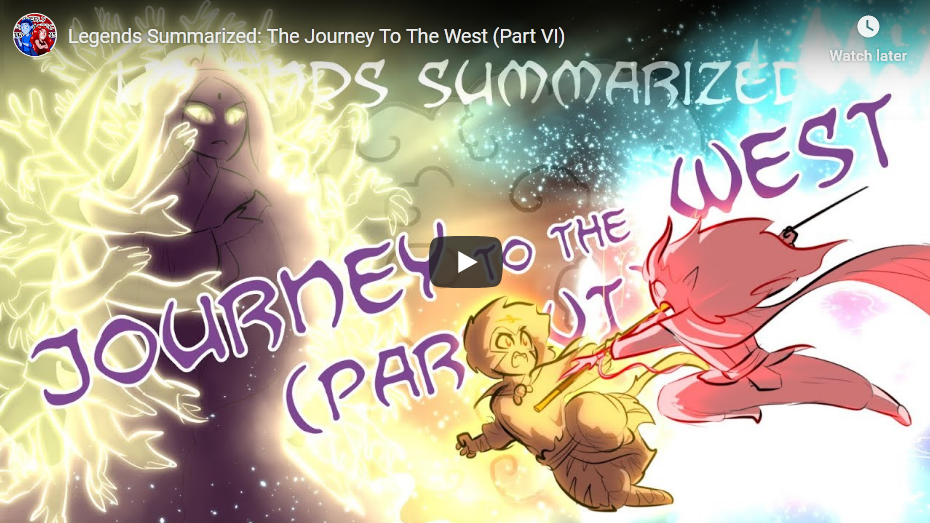
Legends Summarized: The Journey To The West (Part III)

Filed under: Books, China, History, Humour, Religion — Tags: , , , , — Nicholas @ 02:00

Overly Sarcastic Productions
Published 13 Apr 2016

At last! The saga continues, as our troupe of compadres grows from three to five and the story can REALLY get started!

In case you were wondering, this ISN’T the only origin of the five-man-band archetype, although it certainly accounts for a lot of the associated tropes. The Mahabharata is another classic example, with the five Pandava brothers filling out the classic roles very well.

HEADS UP! We have a twitter now! Find us at https://twitter.com/OSPyoutube for all your dorky book-humor needs!

QotD: Our sister Dominions on the other side of the world

Filed under: Australia, Cancon, History, Quotations — Tags: — Nicholas @ 01:00

I used to write from time to time about how strange it is that we Canadians don’t pay more attention to politics in Australia, our nearest sibling as a historic Dominion of the British crown. But this has changed a bit in the last few years. Editors have learned that Australia’s rough-and-tumble party politics and leadership “spills” make terrific entertainment. Canadian election reformers praying for proportional representation have given Oz more attention as a teaching example. Australia gets more column-inches, or at least koala GIFs, than it once did.

But, of course, the real joke here is on New Zealand. It’s the Dominion too easily forgotten for someone like me to remember to point out how forgotten it is.

What’s interesting about this is that, over the past 40 years or so, New Zealand has probably exercised a more significant political influence on Canada than Australia ever did. New Zealand’s 1980s neoliberal revolution, led by Finance Minister Roger Douglas, helped teach politicians everywhere (and especially in Alberta) tactics for deregulating, privatizing, lowering marginal tax rates, and generally blowing the dust off of planned economies.

Colby Cosh, “An ounce of Canadianity for a less-radical junior Dominion”, National Post, 2018-02-27.

May 25, 2020

The Problem With Civil War Reenactors

Filed under: History, Humour, Military, USA — Tags: , , , — Nicholas @ 04:00

Atun-Shei Films
Published 6 Feb 2019

A former Gettysburg tour guide and confirmed farb talks smack about folks who take the hobby way too seriously.

Support Atun-Shei Films on Patreon ► https://www.patreon.com/atunsheifilms

#AmericanCivilWar #Reenactment #History

Watch our film ALIEN, BABY! free with Prime ► http://a.co/d/3QjqOWv
Reddit ► https://www.reddit.com/r/atunsheifilms
Twitter ► https://twitter.com/alienbabymovie
Instagram ► https://www.instagram.com/atunsheifilms
Merch ► https://atun-sheifilms.bandcamp.com

Thoreau would clearly support ending mandatory lockdowns

Filed under: Government, History, Law, Liberty, USA — Tags: , , , — Nicholas @ 03:00

In an article discussing civil disobedience in the face of unreasonable government action, Lawrence W. Reed recalls the opinions of noted civil disobedience supporter Henry David Thoreau:

Daguerreotype of Thoreau in 1856 by B. D. Maxham.
Image via Wikimedia Commons.

History is full of stories of people who practiced peaceful resistance in defense of sound principles in the face of official stupidity and oppression. Sometimes it has been the best way, if not the only one, to get bad policies changed.

One hundred and seventy years ago, a famous American figure wrote,

    Must the citizen ever for a moment, or in the least degree, resign his conscience to the legislator? Why has every man a conscience then? I think that we should be men first, and subjects afterward.

That figure was Henry David Thoreau. Born in Concord, Massachusetts in 1817, he was an eminent philosopher, poet and essayist. His best-known works are his book Walden: Life in the Woods and his essay, “Civil Disobedience”. The latter proved influential far beyond his time and place, shaping the thoughts and actions of eminent dissidents the world over. As we ponder the civil disobedience rising in reaction to coronavirus policies, now is a perfect time to give Thoreau’s essay another look. Toward that end, I offer some excerpts below.

One last thing before I do that: I want readers to know that, speaking strictly for myself, I endorse the re-opening of houses of worship (and many other things, for that matter), whether the government officially allows it or not. If that perspective makes life a little uncomfortable for the power-hungry at this time, so be it. The additional articles listed below reflect my reasoning.

Now, to Henry David Thoreau:

  • “Under a government which imprisons any unjustly, the true place for a just man is also a prison…, the only house in a slave state in which a free man can abide with honor.”
  • “If the injustice is part of the necessary friction of the machine of government, let it go, let it go; perchance it will wear smooth — certainly the machine will wear out. If the injustice has a spring, or a pulley, or a rope, or a crank, exclusively for itself, then perhaps you may consider whether the remedy will not be worse than the evil; but if it is of such a nature that it requires you to be the agent of injustice to another, then I say, break the law. Let your life be a counter-friction to stop the machine. What I have to do is to see, at any rate, that I do not lend myself to the wrong which I condemn.”
  • “I am as desirous of being a good neighbor as I am of being a bad subject.”
  • “If a thousand [citizens] were not to pay their tax-bills this year, that would not be a violent and bloody measure, as it would be to pay them, and enable the State to commit violence and shed innocent blood. This is, in fact, the definition of a peaceable revolution, if any such is possible.”
  • “The only obligation which I have a right to assume is to do at any time what I think right.”
  • “I saw that the State was half-witted, that it was timid as a lone woman with her silver spoons, and that it did not know its friends from its foes, and I lost all my remaining respect for it, and pitied it.”

Thanks for listening. See you in church

May 24, 2020

Invasion of Crete: a Bloody Mess – WW2 – 091 – May 23 1941

World War Two
Published 23 May 2020

Operation Mercury commences as fallschirmjäger airborne troops land on the Greek island of Crete. A bloody and messy battle follows as it turns out to be costly in more ways than one.

Join us on Patreon: https://www.patreon.com/TimeGhostHistory
Or join The TimeGhost Army directly at: https://timeghost.tv

Follow WW2 day by day on Instagram @World_war_two_realtime https://www.instagram.com/world_war_t…
Between 2 Wars: https://www.youtube.com/playlist?list…
Source list: http://bit.ly/WW2sources

Written and Hosted by: Indy Neidell
Director: Astrid Deinhard
Producers: Astrid Deinhard and Spartacus Olsson
Executive Producers: Astrid Deinhard, Indy Neidell, Spartacus Olsson, Bodo Rittenauer
Creative Producer: Joram Appel
Post-Production Director: Wieke Kapteijns
Edited by: Iryna Dulka
Sound design: Marek Kamiński
Map animations: Eastory (https://www.youtube.com/c/eastory)

Colorizations by:
– Julius Jääskeläinen – https://www.facebook.com/JJcolorization/
– Dememorabilia – https://www.instagram.com/dememorabilia/
– Norman Stewart – https://oldtimesincolor.blogspot.com/
– Jaris Almazani (Artistic Man), https://instagram.com/artistic.man?ig…
– Carlos Ortega Pereira, BlauColorizations, https://www.instagram.com/blaucoloriz…

Sources:
– Imperial War Museum: A 28473, E 3064E, A 4154, A 4153, A 4149, A 4144, E 3066E, E 3023E, A 4156, E 6066
– Archives municipales de Brest
– Museums Victoria
– Bundesarchiv, CC-BY-SA 3.0: Bild_141-0816, Bild_183-L04232, Bild_101I-166-0527-10A, Bild 101I-166-0527-22 / Weixler, Franz Peter, Bild_183-L19019, Bild 146-1977-115-04, Bild 141-0823, Bild_101I-166-0512-39, Bild_146-1981-159-22, Bild_146-1980-090-34, E 3022E

Archive by Screenocean/Reuters https://www.screenocean.com.

A TimeGhost chronological documentary produced by OnLion Entertainment GmbH.

May 23, 2020

Failed Assassinations — History Hijinks

Overly Sarcastic Productions
Published 22 May 2020

If videogames have taught me anything, it’s that an assassin can solve a lot of problems. But sometimes plans fall apart, and sometimes it’s for the absolute DUMBEST reasons.

SOURCES & Further Reading: A History of Venice by Norwich, Rebellion by Ackroyd, The Poison King by Mayor.

This video was edited by Sophia Ricciardi AKA “Indigo”. https://www.sophiakricci.com/
Our content is intended for teenage audiences and up.

PATREON: https://www.Patreon.com/OSP

DISCORD: https://discord.gg/h3AqJPe

MERCH LINKS: https://www.redbubble.com/people/OSPY…

OUR WEBSITE: https://www.OverlySarcasticProductions.com
Find us on Twitter https://www.Twitter.com/OSPYouTube
Find us on Reddit https://www.Reddit.com/r/OSP/

“System Mauser” – The Very First C96 Pistols

Filed under: Germany, History, Military, Weapons — Tags: , , , — Nicholas @ 02:00

Forgotten Weapons
Published 12 Feb 2020

http://www.patreon.com/ForgottenWeapons

https://www.floatplane.com/channel/Fo…

Cool Forgotten Weapons merch! http://shop.bbtv.com/collections/forg…

The very first group of C96 pistols made — about 200 in total — are called “System Mauser” pistols. They have this hand-engraved on the top of the barrel, and have a number of other very early features that would quickly change. Most of these changes involve lightening the gun, but they also have a distinctive stepped barrel and a holster/stock that opened to the left; the opposite of all the later standard holsters.

Contact:
Forgotten Weapons
6281 N. Oracle #36270
Tucson, AZ 85740

May 22, 2020

Wehrmacht Wages, Argentina in WW2, and Otto von Habsburg – WW2 – OOTF 012

Filed under: Americas, Europe, Germany, History, Military, WW2 — Tags: , , , — Nicholas @ 06:00

World War Two
Published 21 May 2020

You’re just an average German doing your work when suddenly you’re called up for service and asked to put your life on the line for your country. But how does your country repay you? Find out today as we take a look at the regular German soldier’s salary, the political turmoil in Argentina during the war and the former powerhouse of Europe: the mighty Habsburg dynasty.

Join us on Patreon: https://www.patreon.com/TimeGhostHistory
Or join The TimeGhost Army directly at: https://timeghost.tv

Follow WW2 day by day on Instagram @World_war_two_realtime https://www.instagram.com/world_war_t…
Between 2 Wars: https://www.youtube.com/playlist?list…
Source list: http://bit.ly/WW2sources

Hosted by: Indy Neidell
Written by: Isabel Wilson and Sietse Kenter
Director: Astrid Deinhard
Producers: Astrid Deinhard and Spartacus Olsson
Executive Producers: Astrid Deinhard, Indy Neidell, Spartacus Olsson, Bodo Rittenauer
Creative Producer: Joram Appel
Post-Production Director: Wieke Kapteijns
Research by: Isabel Wilson and Sietse Kenter
Edited by: Mikołaj Cackowski
Sound design: Marek Kamiński
Map animations: Eastory (https://www.youtube.com/c/eastory)

Colorizations by:
Carlos Ortega Pereira, BlauColorizations – https://www.instagram.com/blaucoloriz…
Norman Stewart – https://oldtimesincolor.blogspot.com/
Adrien Fillon – https://www.instagram.com/adrien.colo…

Sources:
Bundesarchiv
IWM CH 11432
Wehrmacht Private, Sergeant and Colonel insignia, courtesy Skjolbro, Wikimedia Commons
Wehrmacht General and Gefreiter insignia, courtesy F l a n k e r, Wikimedia Commons
Otto von Habsburg with his son Georg in European Parliament , courtesy Ferenc Csomafáy
Portrait of Otto von Habsburg, courtesy Oliver Mark

Soundtracks from the Epidemic Sound:
Max Anson – “Ancient Saga”
Johannes Bornlof – “Deviation In Time”
Johannes Bornlof – “The Inspector 4”

Archive by Screenocean/Reuters https://www.screenocean.com.

A TimeGhost chronological documentary produced by OnLion Entertainment GmbH.

“Angels Calling” Pt. 2 – Guns, Gas and Steel – Sabaton History 068 [Official]

Filed under: Britain, Europe, France, Germany, History, Media, Military, WW1 — Tags: , , , , — Nicholas @ 04:00

Sabaton History
Published 21 May 2020

The shadow of trench warfare is a long one. In fact the soldiers at the front did not just rely on their guns and grenades alone, but on a wartime industry to keep them fighting. Everything had to be produced in the millions. Not only rifles, cartridges and shells, but boots, helmets, spades and everything else that was used on a daily basis. The Great War was a war that thrived on a nation-wide war-economy, the likes of which had never been seen or tried before.

We would like to thank the World of Tanks team for their contribution and help with the video filming. If you’re not yet a World of Tanks player, join the game and get your hands on cool in-game stuff for free via the link: https://redir.wargaming.net/w7fwclmx/…

Support Sabaton History on Patreon: https://www.patreon.com/sabatonhistory

Listen to “Angels Calling” on the album Attero Dominatus:
CD: http://bit.ly/AtteroDominatusStore
Spotify: http://bit.ly/AtteroDominatusSpotify
Apple Music: http://bit.ly/AtteroDominatusAppleMusic
iTunes: http://bit.ly/AtteroDominatusiTunes
Amazon: http://bit.ly/AtteroDominatusAmzn
Google Play: http://bit.ly/AtteroDominatusGooglePlay
Drücken Sie zum Aktivieren des Screenreaders ⌘+Wahltaste+Z. Informationen zu Tastaturkürzeln erhalten Sie, indem Sie ⌘Schrägstrich drücken.

Watch the Official Video of “Angels Calling” here:
https://www.youtube.com/watch?v=JyZ8w…

Check out the trailer for Sabaton’s new album The Great War right here: https://www.youtube.com/watch?v=HCZP1…

Listen to Sabaton on Spotify: http://smarturl.it/SabatonSpotify
Official Sabaton Merchandise Shop: http://bit.ly/SabatonOfficialShop

Hosted by: Indy Neidell
Written by: Markus Linke and Indy Neidell
Directed by: Astrid Deinhard and Wieke Kapteijns
Produced by: Pär Sundström, Astrid Deinhard and Spartacus Olsson
Creative Producer: Joram Appel
Executive Producers: Pär Sundström, Joakim Broden, Tomas Sunmo, Indy Neidell, Astrid Deinhard, and Spartacus Olsson
Post-Production Director: Wieke Kapteijns
Edited by: Karolina Dołęga
Sound Editing by: Marek Kaminski
Maps by: Eastory – https://www.youtube.com/c/eastory

Archive by: Reuters/Screenocean https://www.screenocean.com
Music by Sabaton.

Sources:
Imperial War Museum: (E(AUS) 1497),(Q 87945), (HU_91107), (Q 109611), (IWM Q 3001), (Q 69229), (Q 14945), (Q 5855), (Q 110355), (Q30009), (Q 9340), (Q 10450), (Q 70680)
Bundesarchive
National Archives NARA
Library of Scotland
Internet Archive Book Images
Bulgarian Archive State Agency
The icons from Noun Project by: Creative Mania, Chanut is Industries, Ben Davis, Vichanon Chaimsuk, Assyifa Art, chiccabubble, Nociconist, Vectors Marke, lastspark, faisal, Nun, Setyo Ari Wibowo, Mohamad Arif Prasetyo, Nibras@design,Creative Stall, Bruno Bosse, ghufronagustian, Karla Design,Gan Khoon Lay, Eucalyp, Anton, Marta Botter, Iconic, Daniel Turner, Naufal Hudallah, Phạm Thanh Lộc, Ruben Vh, Vectorstall, Icon Lauk, Mahmure Alp, Luke Anthony, Deemak Daksina, Sergey Krivoy, Andrejs Kirma, Rflor, Andrejs Kirma, Shovel by David, ProSymbols, Jake Dunham, noSimon Child, Wonmo Kang, Nubaia Karim Barsha, Nikita Kozin, Dolly Holmes, Collicon, Made by Made & Graphic Enginer
Flag of Spain recreated by HansenBCN and SanchoPanzaXXI

An OnLion Entertainment GmbH and Raging Beaver Publishing AB co-Production.

© Raging Beaver Publishing AB, 2019 – all rights reserved.

First War of Scottish Independence | 3 Minute History

Filed under: Britain, France, History, Military — Tags: , , — Nicholas @ 02:00

Jabzy
Published 22 Jun 2015

The First Scottish War of Independence

« Newer PostsOlder Posts »

Powered by WordPress