Quotulatiousness

June 27, 2021

The Tragic End of HMS Barham – 25 November, 1941

Filed under: Britain, History, Military, WW2 — Tags: , , , , — Nicholas @ 02:00

The Northern Historian
Published 5 Mar 2021

On the 25th of November 1941, the Royal Navy’s 1st Battle Squadron consisting of HMS Queen Elizabeth, HMS Valiant and HMS Barham along with eight destroyers were on a hunt in the central Mediterranean looking for Italian convoys.
Also on the hunt was a German U-Boat and their paths were on a collision course. A collision that would send HMS Barham to the floor of the Mediterranean Sea along with over 800 of her crew.

HMS Barham had begun her service with the Royal Navy during World War 1 and played a role during the Battle of Jutland.

Following World War 1, HMS Barham had several refits and operated in the Atlantic Fleet and the Mediterranean Fleet during the inter-war years.

During World War 2, HMS Barham took part in the the Battle of Dakar before taking part in escort convoys in the Mediterranean.

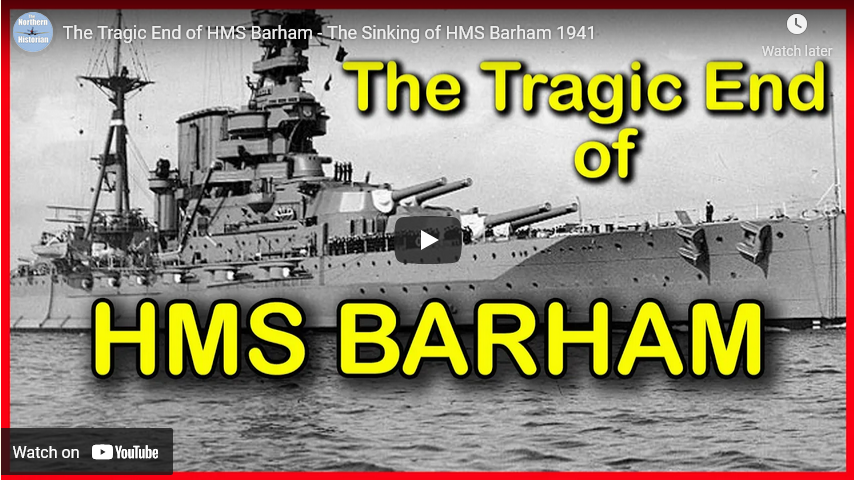
In November of 1941, during an escort mission, HMS Barham was attacked by U Boat U-331 under the command of Hans-Diedrich von Tiesenhausen.

The attack caused a huge explosion in her magazine and rapidly sank, killing over 800 men.

QotD: Being right at the wrong time

Filed under: History, Politics, Quotations, Russia — Tags: , , — Nicholas @ 01:00

There is a curious phenomenon in Western intellectual life, namely that of being right at the wrong time. To be right at the wrong time is far, far worse than having been wrong for decades on end. In the estimation of many intellectuals, to be right at the wrong time is the worst possible social faux pas; like telling an off-colour joke at the throning of a bishop. In short, it is in unforgivable bad taste.

There was never a good time, for example, to be anti-communist. Those who early warned of the dangers of bolshevism were regarded as lacking in compassion for the suffering of the masses under tsarism, as well as lacking the necessary imagination to “build” a better world. Then came the phase of denial of the crimes of communism, when to base one’s anti-communism on such phenomena as organised famine and the murder of millions was regarded as the malicious acceptance of ideologically-inspired lies and calumnies. When finally the catastrophic failure of communism could no longer be disguised, and all the supposed lies were acknowledged to have been true, to be anti-communist became tasteless in a different way: it was harping on pointlessly about what everyone had always known to be the case. The only good anti-communist was a mute anti-communist.

Anthony Daniels, “Authoritarianism in Cement and Steel”, Quadrant, 2018-11-04.

June 26, 2021

It Wasn’t the Square Windows – The de Havilland Comet Crashes – Aircrash Minority Report

Filed under: Britain, History, Technology — Tags: , , , — Nicholas @ 02:00

Robert DuHamel
Published 13 Aug 2019

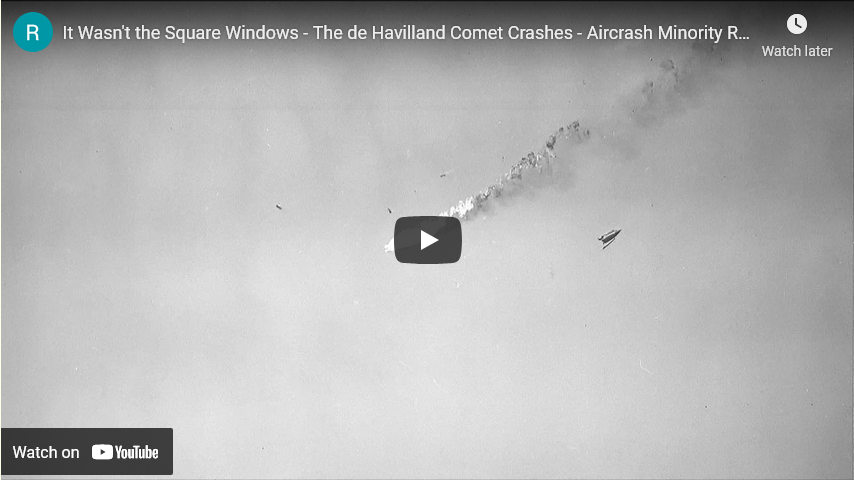
You’ve heard about it. You’ve read about it. You’ve watched the television documentaries. The de Havilland Comet. Two mysterious crashes in the Mediterranean near Rome. 56 people dead. The planes exploded in mid-air when their pressure cabins ruptured at the corners of the square windows. A hard lesson learned about pressurized airliners, square windows, and metal fatigue. But you haven’t heard the whole story. Find out what really happened in this first video in the series Aircrash Minority Report.

Thumbnail: a Convair XF2Y-1 Sea Dart breaking up after exceeding the stress limit of the airframe. The crashes of the de Havilland Comets would look similar.

References:

FAA Lessons Learned: de Havilland DH-106 Comet: https://lessonslearned.faa.gov/ll_mai…​

Failure-Analysis-Case-Studies-II – David R. H. Jones: https://vietnamwcm.files.wordpress.co…

QotD: Surfing the waves of resentment as a political career

Those who, for political reasons, keep past oppression or crime constantly before the mind of the descendants of the victims (that is to say, descendants of the victim group, not necessarily of the individual victims) help to foment and foster a deep mistrust or resentment that is no longer justified, but which can lead people in effect to cut off their noses to spite their faces.

This is to the great advantage of political entrepreneurs who surf resentment as surfers ride waves in Hawaii; and such resentment, the most damaging of all emotions, can easily become a self-reinforcing loop. It is not that past oppression or crime should be forgotten, much less denied, but that past achievements and change for the better must also be recognised, lest oppression and crime come to occupy minds entirely and distort decisions.

It is the same with injustice. It is important to oppose injustice, but just as important not to see it everywhere. To ascribe everything that you think undesirable to injustice may blind you to its real causes.

Theodore Dalrymple, “History and Self-Perpetuating Resentment”, The Iconoclast, 2021-03-20.

June 25, 2021

The Birth of the Manhattan Project – WW2 Special

Filed under: Britain, Germany, History, Military, Science, USA, WW2 — Tags: , , , , , — Nicholas @ 04:00

World War Two
Published 24 Jun 2021

When nuclear fission was discovered, scientists theorized it could be used in an atomic bomb. Thus, the American Army sets up one of the biggest research projects in history: The Manhattan Project.
(more…)

L4: The Bren in 7.62mm NATO

Filed under: Britain, History, Military, Weapons — Tags: , , , , , — Nicholas @ 02:00

Forgotten Weapons
Published 10 Mar 2021

http://www.patreon.com/ForgottenWeapons​

https://www.floatplane.com/channel/Fo…​

Cool Forgotten Weapons merch! http://shop.bbtv.com/collections/forg…​

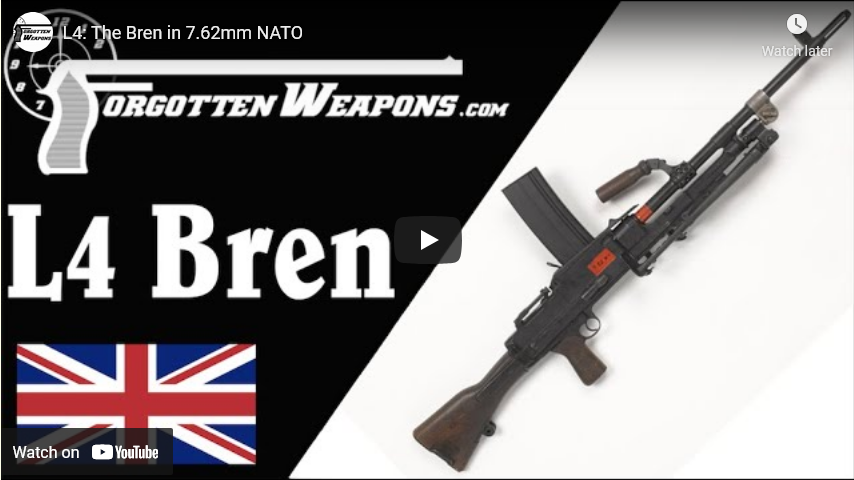
When the British military transitioned from the .303 British cartridge to 7.62mm NATO in the 1950s, it replaced the Enfield rifles with the new L1A1 SLR (the FAL) but retained the Bren gun as a support weapon. The Bren was updated to use 7.62mm, in a process more complicated than most people would think. Ultimately, only a few thousand L4 series Brens were made, as they were rather quickly supplanted by the FN MAG as a belt-fed support weapon.

The four different patterns of L4 are:
L4A1 – the initial pattern, without magazine supports
L4A2 – the Bren MkIII in 7.62mm with magazine supports
L4A3 – the Bren MkII in 7.62mm with magazine supports
L4A4 – the A2 and A3 patterns with chrome-lined barrels

Contact:
Forgotten Weapons
6281 N. Oracle 36270
Tucson, AZ 85740

June 24, 2021

First Arab-Israeli War 1948 – Political Background – COLD WAR

The Cold War
Published 31 Aug 2019

Our series on the history of the Cold War period continues with a documentary explaining the political background of the First Arab-Israeli War of 1948.

To learn about the military events of this conflict, go to the Kings and Generals channel

Consider supporting us on Patreon: https://www.patreon.com/thecoldwar

The Founder | Based on a True Story

Filed under: Business, Food, History, Media, USA — Tags: , , , , , — Nicholas @ 02:00

The Cynical Historian
Published 27 Jul 2017

This one is a contender for best historical film of 2016. The Founder is an amazing movie about the beginning of the McDonald’s food chain. Seriously, more films should take cues from this.
————————————————————
references:
http://www.historyvshollywood.com/ree…​

http://time.com/money/4602541/the-fou…​

http://content.time.com/time/magazine…​

https://www.bustle.com/p/how-accurate…​

https://www.washingtonpost.com/entert…​

https://www.theatlantic.com/entertain…​

https://www.nytimes.com/2016/05/20/bu…​

http://www.abc.net.au/news/2016-11-24…​

http://www.cbsnews.com/news/the-real-…​

https://en.wikipedia.org/wiki/Ray_Kroc​
https://en.wikipedia.org/wiki/Richard…​
————————————————————
contribute to my Patreon:
https://www.patreon.com/CynicalHistorian​

LET’S CONNECT:
https://twitter.com/Cynical_History​
————————————————————
Wiki:
The Founder is a 2016 American biographical drama film directed by John Lee Hancock and written by Robert Siegel. The film stars Michael Keaton as businessman Ray Kroc, and portrays the story of his creation of the McDonald’s fast food chain. Nick Offerman and John Carroll Lynch co-star as McDonald’s founders Richard and Maurice McDonald.

The film premiered at Arclight Hollywood on December 7, 2016 and was released in the United States on January 20, 2017, by The Weinstein Company. It grossed $23 million worldwide and received generally positive reviews from critics, with praise for Keaton’s performance.
————————————————————
Hashtags: #History​ #TheFounder​ #McDonalds​ #Review​ #BasedOnATrueStory​ #RayKroc

QotD: The fantasy world of Canadian geopolitical posturing

Filed under: Cancon, China, Government, History, Quotations, USA — Tags: , — Nicholas @ 01:00

There are two basic things you need to know about Canada’s position in the world. The first is that we are bordered on three sides by ocean. The second is that we are bordered on the fourth side by the United States. That is a simple geopolitical reality whether we like it or not — and Canadians have expended a great deal of energy over the past half century or so making it clear just how much we dislike it.

Yet for all the reflexive anti-Americanism that has been the meat and mead of Canadian nationalism, Canada’s leadership class has usually been pretty good about understanding who is in charge. Over the course of the 20th century, from the Ogdensburg agreement of 1940 and the post-war establishment of NORAD to the Free Trade Agreement of 1988, we cemented that reality with a defence and economic alliance.

Paradoxically, what this continental defence and economic security arrangement has given us is the opportunity to let our internationalist pretensions run wild. One of the weirdest things about Canada is the extent to which we like to frame our place in the world in a-geographic terms. We imagine that we are as threatened as anyone by the mix of post-Cold War failed states, opportunistic terrorism, regional authoritarianism, and humanitarian disasters. By the same token, we like to presume that we are as well-positioned as any other country to do something about all of this.

As the dean of Canadian defence policy Kim Nossal points out in a recent paper, this a-geographic security fantasy is reflected in the official defence reviews that Canadian governments have released since the 1990s. Or take, for example, the 2017 Liberal policy statement, entitled Strong, Secure, Engaged, which rejects the idea that Canada’s privileged geographic location mitigates these global threats for us. As Nossal concludes, when you look at how Canadian governments actually talk about our security situation, you get little sense that, thanks to the Americans, Canada occupies “one of the safest spaces in contemporary global politics.”

You can see the logical leaps, then.

Once you’ve convinced yourself that Canada’s security is disconnected from the geographical imperative of the American security guarantee, it’s only a few steps to the conclusion that who we choose as our global strategic partner is actually a meaningful choice. And if it is true, as China’s president Xi Jinping has claimed, that the East is on the rise and the West is in decline, then why not throw your lot in with the new big dog on the block?

Andrew Potter, “Hedging our bets with China was a mistake”, The Line, 2021-03-23.

June 23, 2021

The RAF and Luftwaffe Bombers of Western Europe – WW2 Special

Filed under: Britain, Germany, History, Military, Weapons, WW2 — Tags: , , — Nicholas @ 04:00

World War Two
PUblished 22 Jun 2021

What aircraft are being sent out by commanders like Hermann Göring and Arthur Harris to blitz and firebomb enemy cities? Watch the video to learn the specs of the Handley Page Halifax, Avro Lancaster, Junkers Ju-88, Dornier Do-17, Dornier Do-217, and Heinkel He-111 as they fly in their respective 1,000 Bomber Raids and Baedeker Blitz.
(more…)

Tank Chats #112 | Churchill Mk I and II | The Tank Museum

Filed under: Britain, History, Military, Weapons, WW2 — Tags: , , — Nicholas @ 02:00

The Tank Museum
Published 4 Dec 2020

Tank Museum Historian David Fletcher discusses the British Second World War Churchill Mark I, the very first Churchill, as well as its successor, the Mark II. This chat also covers the development of the A20 prototype and how this became the production Mark I variant. The Churchill displayed is actually a Mark II made to look like a Mark I, and is the oldest surviving Churchill in the UK.
(more…)

QotD: Churchill’s support for Stalin

Filed under: Britain, History, Military, Quotations, Russia, WW2 — Tags: , , , , , — Nicholas @ 01:00

Churchill threw all of his support behind Stalin’s armies despite Stalin’s alliance with Hitler during the first 21 months of the war — the USSR having invaded the same number of countries as Nazi Germany (seven), having supplied the German Wehrmacht as it invaded France and the Low Countries, and having literally fueled the Luftwaffe as it bombed London in 1940.

This support was more than rhetorical. In a gesture of astonishing (and short-sighted) selflessness, Churchill responded to news of Nazi Germany’s invasion of the Soviet Union by sending Stalin 200 brand-new Hawker Hurricane pursuit planes which had been pledged to defend Singapore against Japanese attack. Churchill then “re-gifted” Stalin 200 Tomahawk fighters and 300 Douglas A-20 Havoc bombers from Britain’s own Lend-Lease consignments, and shipped Stalin 2,000 tonnes of processed aluminum for Soviet warplane factories, despite it being desperately needed at home.

Even more striking was Churchill’s decision to ship Stalin nearly 600 tanks, which helped tip the balance in the Battle of Moscow in December 1941. Churchill even agreed to strip Cairo command of hundreds more tanks in 1942, routing them to Stalin’s USSR via Iran to bail out the Red Army at Stalingrad, which left Egypt vulnerable to Rommel’s Afrika Korps.

Churchill doubled down on his pro-Soviet policies even in areas where Britain had her own clients, such as Yugoslavia. Despite hosting the Yugoslav exile government in London, by September 1943, Churchill abandoned that government’s commander on the ground and threw his full support behind Stalin’s man, Josip Broz (“Tito”). Bamboozled by a Soviet smear campaign against Colonel Draža Mihailovic, Churchill cut off Mihailovic’s Chetniks and shipped Tito more than 100 times more war materiel over the next nine months than Mihailovic had received in the previous two years.

Sean McMeekin, “Churchill’s enigma: the real riddle is why he cozied up to Stalin”, Spectator, 2021-03-21.

June 22, 2021

History Summarized: The Athenian Temple at Sounio

Filed under: Architecture, Europe, Greece, History, Humour, Religion — Tags: , , — Nicholas @ 02:00

Overly Sarcastic Productions
Published 29 Sep 2017

On my summer vacation, I had the distinct pleasure of visiting Cape Sounio, at the southern tip of Attica at sunset, and I have to say it was one of the most historically exciting moments of my life. For all I myself have said about the Athenian empire, seeing the view from this temple made everything click into place and feel tangibly real for the first time ever (even my 10+ trips to the Parthenon over the course of my childhood didn’t do that). So uh … here’s 7 minutes of me gushing about it under the thin guise of persuasive historical argumentation.

PATREON: www.patreon.com/user?u=4664797

MERCH LINKS:
Shirts – https://overlysarcasticproducts.threa…​
All the other stuff – http://www.cafepress.com/OverlySarcas…​

Find us on Twitter @OSPYouTube!

QotD: The “Stringbag”, formally known as the Fairey Swordfish

Filed under: Britain, History, Military, Quotations, Weapons, WW2 — Tags: , , — Nicholas @ 01:00

The British torpedo bomber [of 1939] was the Fairey Swordfish (138mph, 2 x .303mg, 1,600lbs torpedo or bombs — later rockets, 1,030 miles range). A slow but reliable biplane, with more lift and range than the [American Douglas TBD] Devastator, and more combat survivability than the [Japanese Yokosuka B4Y] “Jean”. (It frequently astounded even the crews how much damage a Swordfish could absorb and keep flying. Ragged anti-aircraft holes in the wings and tail and fuselage, lines of tracer holes across various surfaces, broken struts, cut control cables, the Swordfish would absorb them all and make it home.) Nevertheless the Swordfish was quickly proved to be a deathtrap for daylight operations against an enemy with fighter cover, and was scheduled for replacement by a more modern torpedo bomber for combat ops. Yet, amazingly, the Swordfish was the only allied pre-war naval carrier aircraft still in production when the war ended.

There are three reasons for this feat. The first is that the British were early adaptors of night operations, and performed successful Swordfish strikes (such as the amazingly successful strike at the Port of Taranto which crippled or sank several major warships – becoming the Japanese model for Pearl Harbor), and successful night attacks at sea once the second innovation came in. This was the development of airborne radar, which was first operational on Swordfish operating on British carriers six months before Pearl Harbor. The British were to hold this unique ability to use radar for carrier aircraft operations for a couple of years before the Americans deployed similar concepts in 1943. They were to hold their unique advantage of night-time strikes also. (Both the Japanese and Americans lost many pilots over the next few years in strikes that failed to get home before dark!) So the Swordfish could soldier on under the cover of night, and continued to be useful as a strike aircraft long after its use in daytime had been demonstrated to be suicidal by the easy slaughter of those attempting to attack the Scharnhorst and Gneisenau during the Channel Dash in 1941.

The third, and unexpected reason, why the Swordfish was still in production at the end of the war, was that its unrivalled flying characteristics made it the only aircraft capable of surviving operations from small escort carriers operating in the Arctic Circle in bad weather. Whereas more modern, higher speed aircraft, like the Hurricane, Wildcat and Avenger could work from escort carriers in calmer seas, none of those would even consider operations under the sort of conditions that a Swordfish could easily manage. So the venerable old bus continued to serve successfully purely in an anti-submarine role until the final days of the war. This was not because there weren’t many better aircraft available, but simply because no other aircraft available could do the job as well. An example of a World War Two aircraft still having a (slightly reduced) role, long after being technically obsolete — see the many inadequate fighters that lived on as very successful night fighters. (Though the fact that “modern” B-52s are scheduled to still be operational 80 or 90 years after their initial deployment shows that new roles are always possible for reliable old aircraft, even when their technology is fifty years out of date.)

Nigel Davies, “Comparing naval aircraft of World War II”, rethinking history, 2010-12-20.

June 21, 2021

“The public are getting a little bit fed up of virtue-signalling police officers when they’d really rather we just locked up burglars”

Filed under: Britain, History, Law, Politics — Tags: , , , — Nicholas @ 05:00

Gawain Towler on the sudden, unexpected — and undoubtedly unwelcome to self-appointed guardians of the official narrative — appearance of what sounds surprisingly like common sense from a top police officer in Britain:

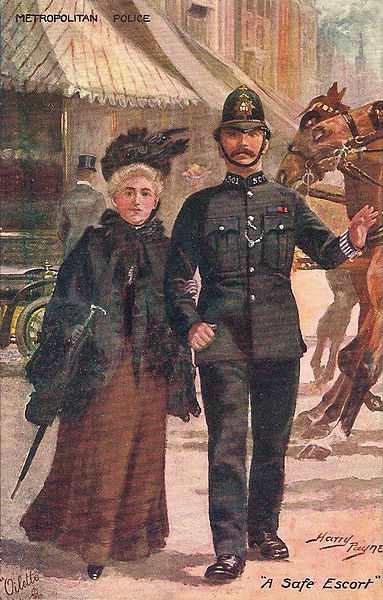
“A Safe Escort” by Harry Payne (1858-1927), first published in August 1911 but possibly painted a few years earlier. From the back of the card: “Among the hundred and one duties of the London Policeman he is here depicted as a kindly protector, halting the traffic as he escorts a Lady across the congested streets. This is essentially a London incident, and has no parallel in any other Police Force in the world.”
Photo of the Tuck’s Oilette by Leonard Bentley via Wikimedia Commons.

Has Robert Peel been reincarnated as the Chief Constable for Manchester?

“But officer, if you are not on your knee, and wearing a rainbow lanyard, how do we know that you are on the side of the oppressed, the intersectional, the poor, downtrodden graduates of minor universities?”

“I’m sorry madam, may I call you madam? I am on the side of the law.”

The promotion of Stephen Watson as the new Chief Constable for Manchester comes as a shaft of light cutting through the murk of muddled thinking. He has said two things that will resonate with millions and will cause consternation amongst thousands:

    I would probably kneel before the Queen, God and Mrs Watson, that’s it … The public are getting a little bit fed up of virtue-signalling police officers when they’d really rather we just locked up burglars.

It sounds like the first blast of the trumpet, but not only does it strike an astonishingly different note than the honky tonk tunes played by other constabularies. Stentorian and self confident it also marks a huge departure in that he makes a very public statement that he would kneel before God. A very courageous statement in the current climate in itself. But it is his approach to policing that strikes the eye.

One almost feels that as was once the case, each new officer in the Manchester Metropolitan Area will be issued with Sir Robert Peel’s 1829 Nine Principles of Policing. It is worth our while looking at those principles and deciding whether or not to accept that they should remain at the core of policing, or be junked as impossibly dated.

What is clearly apparent is that Peel’s principles are at heart about consent. Famously it described the police as merely the citizens in uniform, or that “the police are the public and that the public are the police, the police being only members of the public who are paid to give full time attention to duties which are incumbent on every citizen in the interests of community welfare and existence”.

Underlying this basic thought is an understanding that the police rely, entirely on the goodwill of the populace, if they wish to carry out their basic duties. In order to fulfil their functions and duties they are “dependent on public approval of their existence, actions and behaviour and on their ability to secure and maintain public respect”.

« Newer Posts — Older Posts »

Powered by WordPress