Drachinifel
Published 19 Dec 2018Today we look at the development of warships from 1815 to 1860.
Want to support the channel? – https://www.patreon.com/Drachinifel
Want to talk about ships? https://discord.gg/TYu88mt


Drachinifel
Published 19 Dec 2018Today we look at the development of warships from 1815 to 1860.
Want to support the channel? – https://www.patreon.com/Drachinifel
Want to talk about ships? https://discord.gg/TYu88mt
… 19th-century history, particularly the years from the 1848 revolutions to the outbreak of the First World War in 1914. The key was Bismarck, the Prussian minister-president who unified Germany. If you want to learn about Bismarck, you will probably pick up a book by some historian of international relations, such as A.J.P. Taylor. That’s the right place to start. But it means you can read a lot about Bismarck before finding out about the time in May 1866 when a guy shot him.
Ferdinand Cohen-Blind, a Badenese student of pan-German sentiments, waylaid Bismarck with a pistol on the Unter den Linden. He fired five rounds. None missed. Three merely grazed his midsection, and two ricocheted off his ribs. He went home and ate a big lunch before letting himself be examined by a doctor.
But even the books that condescend to mention this triviality may not tell you about the other time a guy shot Bismarck: A young Catholic tried to kill him in July 1874, during the anti-Catholic Kulturkampf Bismarck had engineered, but only managed to score his right hand with a bullet.
The point is not that Bismarck was particularly hated, although he was. The point is that this period of European (and American) history was crawling with young, often solitary male terrorists, most of whom showed signs of mental disorder when caught and tried, and most of whom were attached to some prevailing utopian cause. They tended to be anarchists, nationalists or socialists, but the distinctions are not always clear, and were not thought particularly important. The 19th-century mind identified these young men as congenital conspirators. It emphasized what they had in common: social maladjustment, mania, an overwhelming sense of mission and, usually, a prior record of minor crimes.
[…]
Bismarck was not much of a democrat, but his example is instructive. He was so phlegmatic about being shot that he obtained both of the guns he had been shot with. He kept them in his desk, ready for use against a third guy with the same bright idea.
Colby Cosh, “Those old terrorist tendencies”, Maclean’s, 2014-12-07.
World War Two
Published 10 Jun 2021Carl Gustaf Mannerheim is a national hero after his service in everything from the Finnish Civil War to the Winter War. But did he plan a war of aggression with Nazi Germany against the Soviet Union? And if so, did Hitler and Stalin even give him any choice in the matter?
(more…)
In the latest edition of It Bears Mentioning, John McWhorter considers the Princeton University classics department decision to get rid of the requirement for students to read classic texts in the original languages:
“USA – New Jersey – Princeton” by Harshil.Shah is licensed under CC BY-ND 2.0


I have written recently about the Princeton classics department’s decision to eliminate the requirement that students engaging closely with Latin and Greek texts be able to … read them in Latin and Greek. The new idea is that the department will attract more majors by opening up to ideas from students who may be full of beans but just not inclined to tackle complex, ancient languages. And sub rosa, the idea is clearly – as we can see from words in the official statement like underrepresented, perspectives, and experiences – that of especial interest will be black students, especially in light of today’s racial reckoning which the department openly acknowledges was the primary spur for this change.
My disappointment with this decision is because it is part of a tradition of arguments that we do black people a favor by exempting them from certain kinds of faceless, put-up-or-shut-up challenges to entry. Back in the aughts, the classic example was brilliant, fierce black lawyers confidently arguing that because black firefighter applicants don’t do as well on the entrance exams required for the job, the exams are racist and should be eliminated. More recently there has been the idea that if black kids are rare at top-ranked public schools in New York City like Stuyvesant because few excel on the standardized test one must ace to be admitted, then the solution is to eliminate the test as “racist”. The Princeton decision is a variation: to get black kids into classics, it’s supposedly immoral to expect them to master the intricacies of Latin and Greek, languages which I suppose we can see as foreign, “white” to them as well. Rather, they must be admitted in shining expectation that their class comments will be bracingly “diverse” in good old English.
My Atlantic colleague Graeme Wood is more sanguine about the Princeton decision. He argues sagely that a certain kind of student happens to enjoy working their way through languages like Latin as a kind of puzzle (I openly admit being that type), but that there are others who don’t go in for that particular task and yet are itching and well-equipped to engage and analyze classical texts regardless. Graeme notes that we do not consider it an educational tragedy that specialists in English history are not required to be able to read Old English. (Although I wonder if this analogy would hold if the idea were someone specializing in England of the first millennium, where all of the relevant linguistic matter was in Old English [and Latin].)
I can go with him here to an extent. On the one hand, as I have argued here, to engage work only in translation is, of course, to lose a lot. Yet, in making that argument here, I was referring to my own reading War and Peace in English, as I myself was not inclined to hack through it in Russian (although my being black was not the reason for this disinclination [couldn’t help it!]). The question is how important we consider that loss to be.
Having no facility in languages myself, I’m more sympathetic to the students’ viewpoint than I might otherwise be, but depending on someone else’s translation of the text being studied has unexpected risks, as Sarah Hoyt explained from her own translation studies:
The discussion […] reminded me of when I was sixteen and embarked on a class called “Techniques of Translation”.
Although I had studied French and English and German, the translations I’d done so far were of the “I took the pen of my neighbor” variety. I thought the class would teach me to smooth out the sentence to “I took my neighbor’s pen” and that would be that.
I was wrong. Oh, it taught that also, but that was a minor portion of it. The class mostly hinged on the moral, ethical and — most of all — professional dilemmas of being a translator. I know any number of you are translators, formal or informal, but any number of you are also not. So, for the ones who are not, let me break the news with my usual gentleness:
There is no such thing as translation.
The French have a proverb “to translate is to betray a little” — or at least that’s the closest meaning in English. It’s fairly close to the true meaning, but slightly askew, of course. Every language is slightly askew to other languages.
The idea that there exists in every language a word that is exactly the equivalent of other languages is sort of like assuming that aliens will — of course — live in houses, go to school, ride buses, understand Rebecca Black’s “Friday”. [This was originally written in 2011.]
Language is how we organize our thoughts, and each word, no matter how simple, carries with it the cultural freight and experience of the specific language. Oh, “mother” will generally mean “the one who gave birth to” — except for some tribal, insular cultures where it might mean “the one who calls me by her name” or “my father’s principal wife” — but the “feel” behind it will be different, depending on the images associated with “mother” in the culture.
So, when you translate, you’re actually performing a function as a bridge. Translation is not the straightforward affair it seems to be but a dialogue between the original language and the language you translate into. If you’re lucky, you meet halfway. Sometimes that’s not possible, and you feel really guilty about “lying” to the people receiving the translation. When on top of language you need to integrate different cultures and living systems (which you do when translating anything even an ad) you feel even more guilty, because you’re going to betray, no matter how much you try. At one point, a while back, I had my dad on one phone, my husband on the other, and I was doing rapid-fire translation about a relatively straight forward matter. And even that caused me pangs in conscience, because my dad simply doesn’t understand how things are done here. I had to approach his experience and explain our experience in a way he wouldn’t think I was insane or explaining badly. That meant a thousand minor lies.
The Tank Museum
Published 13 Nov 2020Join David Willey as he discusses the T-72, a Soviet era main battle tank which first entered production in 1971. The T-72’s service life has proven to be extremely successful. With about 20,000 produced, it has seen service with over 40 countries, and thanks to refurbishment, is still in service to this very day.
With thanks to RecoMonkey for additional images https://www.recomonkey.com/
(more…)
Lofty Pursuits
Published 25 Feb 2021Jake makes Irish Cream green shamrock hard candy for St. Patrick’s day. We discuss the history of the weird flavor and how it has become a tradition even though it was invented in the 1970’s
A great article about the history of Irish Cream
https://www.irishtimes.com/culture/bo…Buy our candy: http://www.pd.net
Listen to our podcast: http://loftypursuits.libsyn.com/website
Join our Patreon at https://www.patreon.com/LoftyPursuits

These people don’t see that if you encourage totalitarian methods, the time may come when they will be used against you instead of for you. Make a habit of imprisoning Fascists without trial, and perhaps the process won’t stop at Fascists. Soon after the suppressed Daily Worker had been reinstated, I was lecturing to a workingmen’s college in South London. The audience were working-class and lower-middle class intellectuals — the same sort of audience that one used to meet at Left Book Club branches. The lecture had touched on the freedom of the press, and at the end, to my astonishment, several questioners stood up and asked me: Did I not think that the lifting of the ban on the Daily Worker was a great mistake? When asked why, they said that it was a paper of doubtful loyalty and ought not to be tolerated in war time. I found myself defending the Daily Worker, which has gone out of its way to libel me more than once. But where had these people learned this essentially totalitarian outlook? Pretty certainly they had learned it from the Communists themselves! Tolerance and decency are deeply rooted in England, but they are not indestructible, and they have to be kept alive partly by conscious effort. The result of preaching totalitarian doctrines is to weaken the instinct by means of which free peoples know what is or is not dangerous. The case of Mosley illustrates this. In 1940 it was perfectly right to intern Mosley, whether or not he had committed any technical crime. We were fighting for our lives and could not allow a possible quisling to go free. To keep him shut up, without trial, in 1943 was an outrage. The general failure to see this was a bad symptom, though it is true that the agitation against Mosley’s release was partly factitious and partly a rationalisation of other discontents. But how much of the present slide towards Fascist ways of thought is traceable to the “anti-Fascism” of the past ten years and the unscrupulousness it has entailed?
George Orwell, Unpublished Preface to Animal Farm, 1945.
World War Two
Published 8 Jun 2021All belligerents are working hard to develop a powerful nuclear super-weapon. The Americans wonder how far along the Germans are, and send in their spies.
(more…)
Forgotten Weapons
Published 25 Feb 2021http://www.patreon.com/ForgottenWeapons
https://www.floatplane.com/channel/Fo…
Cool Forgotten Weapons merch! http://shop.bbtv.com/collections/forg…
The very early production MkI Bren light machine guns were made with two dovetail brackets on the left side of the receiver. The rear one was for the standard rear sight, and the front one was to accommodate two types of optical sights. A mounting for the No.32 telescopic sight (the same one used on the No4(T) sniper rifle) was planned, but never produced. What was made in small numbers by the Plessey company was a “fixed line sight”. This was really more like a surveyor’s tool than a traditional sight, and it used the same optical element as the Vickers dial sight that was introduced alongside it in 1939. The purpose was to allow a tripod-mounted Bren to be set up with specific limits to its field of fire, and then for the gun to be removed, used on the bipod elsewhere, and returned to the tripod and confirm the field of fire, especially in the dark. This is a somewhat technically complex task, but not one that was actually needed very much for the Bren. As a result, production and use of the fixed line sights was very limited, and the sights are extremely rare today. The mounting bracket on the Bren receiver was rather quickly dropped from production as an unnecessary waste of machining time.
Contact:
Forgotten Weapons
6281 N. Oracle #36270
Tucson, AZ 85740

World War Two
Published 7 Jun 2021We left off last time with several burning behemoths. Watch today to see the action that follows, not just on the high seas, but also in Alaska. We also turn to Washington DC and Tokyo and follow the reaction to the Battle of Midway there. The Japanese one may surprise you.
(more…)
Overly Sarcastic Productions
Published 3 Feb 2017This video was commissioned by our loyal Patron Karl Erik L. Hoftaniska! To become our Patron and get access to sweet rewards, hop on over to PATREON.COM/OSP
I must say, I was pleasantly surprised about the things I learned about Egypt in the process of making this video. The feeling of learning cool new things never gets old.
Coming soon in Blue’s History Summarized line-up will be the next part of his Abrahamic Religion series: Judaism!
In the meantime, WOO EGYPT!Have a question about anything mentioned or not mentioned? Leave a comment! Blue will do his best to answer.
PATREON: www.patreon.com/user?u=4664797
MERCH LINKS:
Shirts – https://overlysarcasticproducts.threa…
All the other stuff – http://www.cafepress.com/OverlySarcas…Find us on Twitter @OSPYouTube!

- That no one was to be put to death, save for some reason (except the Common People).
- That everyone should be free (except the Common People).
- That everything should be of the same weight and measure throughout the Realm (except the Common People).
- That the Courts should be stationary, instead of following a very tiresome medieval official known as the King’s Person all over the country.
- That “no person should be fined to his utter ruin” (except the King’s Person).
- That the Barons should not be tried except by a special jury of other Barons who would understand.
Magna Charter was therefore the chief cause of Democracy in England, and thus a Good Thing for everyone (except the Common People).
After this King John hadn’t a leg to stand on and was therefore known as `John Lackshanks’.
W.C. Sellar & R.J. Yeatman, 1066 And All That, 1930.
The latest of the reader-contributed book reviews at Scott Alexander’s Astral Codex Ten looks at Where is my Flying Car? by J. Storrs Hall:

What went wrong in the 1970s? Since then, growth and productivity have slowed, average wages are stagnant, visible progress in the world of “atoms” has practically stopped — the Great Stagnation. About the only thing that has gone well are computers. How is it that we went from the typewriter to the smartphone, but we’re still using practically the same cars and airplanes?
Where is my Flying Car? by J. Storrs Hall, is an attempt to answer that question. His answer is: the Great Stagnation was caused by energy usage flatlining, which was caused by our failure to switch to nuclear energy, which was caused by excessive regulation, which was caused by “green fundamentalism”.
Three hundred years ago, we burned wood for energy. Then there was coal and the steam engine, which gave us the Industrial Revolution. Then there was oil and gas, giving us cars and airplanes. Then there should have been nuclear fission and nanotech, letting you fit a lifetime’s worth of energy in your pocket. Instead, we still drive much the same cars and airplanes, and climate change threatens to boil the Earth.
I initially thought the title was a metaphor — the “flying car” as a standin for all the missing technological progress in the world of “atoms” — but in fact much of the book is devoted to the particular question of flying cars. So look at the issue from the lens of transportation:
Hans Rosling was a world health economist and an indefatigable campaigner for a deeper understanding of the world’s state of development. He is famous for his TED talks and the Gapminder web site. He classifies the wealthiness of the world’s population into four levels:
1. Barefoot. Unable even to afford shoes, they must walk everywhere they go. Income $1 per day. One billion people are at Level 1.
2. Bicycle (and shoes). The $4 per day they make doesn’t sound like much to you and me but it is a huge step up from Level 1. There are three billion people at level 2.
3. The two billion people at Level 3 make $16 a day; a motorbike is within their reach.
4. At $64 per day, the one billion people at Level 4 own a car.
The miracle of the Industrial Revolution is now easily stated: In 1800, 85% of the world’s population was at Level 1. Today, only 9% is. Over the past half century, the bulk of humanity moved up out of Level 1 to erase the rich-poor gap and make the world wealth distribution roughly bell-shaped. The average American moved from Level 2 in 1800, to level 3 in 1900, to Level 4 in 2000. We can state the Great Stagnation story nearly as simply: There is no level 5.
Level 5, in transportation, is a flying car. Flying cars are to airplanes as cars are to trains. Airplanes are fast, but getting to the airport, waiting for your flight, and getting to your final destination is a big hassle. Imagine if you had to bike to a train station to get anywhere (not such a leap of imagination for me in New York City! But it wouldn’t work in the suburbs). What if you had one vehicle that could drive on the road and fly in the sky at hundreds of miles an hour?
Before reading this book, I thought flying cars were just technologically infeasible, because flying takes too much energy. But Hall says we can and have built them ever since the 1930s. They got interrupted by the Great Depression (people were too poor to buy private airplanes), then WWII (airplanes were directed towards the war effort, not the market), then regulation mostly killed the private aviation industry. But technical feasibility was never the problem.
Hall spends a huge fraction of the book on pretty detailed technical discussion of flying cars. For example: the key technical issue is takeoff and landing, and there is a tough tradeoff between convenient takeoff/landing and airspeed (and cost, and ease of operation). It’s interesting reading. But let’s return to the larger issue of nuclear power.
World War Two
Published 6 Jun 2021Midway isn’t the only fight right now. Germany is trying to crack the mighty fortress of Sevastopol and take the whole Crimea. In North Africa, Rommel is routing the Allies, but in Malta the arrival of ever more fighter planes bodes well for the Allies.
(more…)
The weekly wrap-up post at The Line considers the recent revelation of possibly hundreds of unmarked graves of First Nations children at the site of a former Catholic-run residential school in BC. Despite being Canadian, my interest in Canadian history centres mostly on economic, naval, and military aspects, but I was certainly aware that the residential school system was a black mark on Canada’s historical dealings with First Nations and that the general outline of events — if not the gruesome details — had been known for many years. The first time I found out about it was in middle school, through what we’d now call a “Young Adult” novel about a young First Nations boy escaping from the residential school he’d been sent to and his attempts to travel hundreds of miles to get home. I read it in the early 70s and it may have been published up to a decade before then (I no longer remember the author’s name or the title of the book, unfortunately).
If I, as a schoolchild, knew something of this fifty years ago, why have people younger than me been shocked and appalled to be hearing about this widespread tragedy for the first time now?
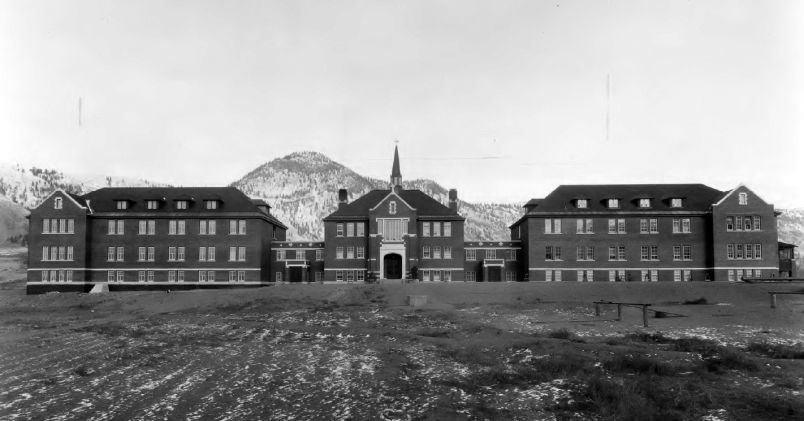
Kamloops Indian Residential School, 1930.
Photo from Archives Deschâtelets-NDC, Richelieu via Wikimedia Commons.
We like to start our dispatches with something pithy or casual, but it’s been a heavy week. The discovery of what appears to be a burial site containing the bodies of more than 200 children at the site of a former residential school in B.C. has shaken Canadians. Of course it has. There are two outrages here — the outrageous reality of the generations of combined abuses inflicted on Indigenous Canadians, of which the residential school system was but a part. Also, the outrage that most Canadians are only learning about this now.
Your Line editors are not experts on Indigenous affairs or history, but we dare say we’re better read than most on Canadian history in a general sense. We do not say this in any way with snark or derision, but to our fellow Canadians — this should not be surprising to you. The Catholics who ran most of these schools under the sanction of the state had a long history of trying to save souls at the expense of the bodies in which they inhabited. Religious institutions were slow to recognize and stop the spread of disease in their own institutions. Most disturbingly, their ideology glorified, even sanctified, physical suffering. It still does.
Mass graves have been uncovered in Ireland, at the site of Catholic-run homes once devoted to the care of unwed mothers and children. “Saint” Mother Teresa’s hospitals in India were altars to the needless suffering of impoverished people who could not afford to die in peace and dignity. Her hospitals were dirty, poorly run facilities where children were reportedly tied to beds, and terminal patients were given little more than aspirin.
One of the great lessons of history that we consistently fail to accept is that many of our most evil actions are rooted not in self-evidently evil impulses, but rather in our desire to “save” others. Hubris and paternalism, these are the sins we cannot seem to shake. Residential schools, Catholic or otherwise, were the disastrous result of marrying a poisonous and righteous ideology with the authority and resources of a centralized state.
The Truth and Reconciliation report laid out much of this in detail in its final report in 2015, which also spelled out that graves like the ones we’re now mourning in Kamloops are likely to be far more prevalent and common than we now understand. Everyone here deserves the truth.
Update: I’m delighted to see that David Warren continues to improve from his recent health issues and he has rather a different view on Canada’s residential school system and its place in the lives of the First Nations children who attended the schools:
Ryerson was also a figure in the development of Canada’s “residential schools”, which took Indians from (mostly) dysfunctional homes and gave them an education with priests, nuns, and respectable Protestants. Not all denizens of an orphanage are happy, and by attaching the word “colonialism”, and giving simplified accounts, full of libels, “progressive” Canadian politicians have made this period of Canadian history into a scandal. Those who know better have been silenced.
Some years ago I tried to defend the “residential schools”, more or less alone in the Canadian “meejah”. I received many, many letters from former students of them, who said their memories were happy. They had been inspired by teachers of real Christian faith and conviction, and had been equipped with the rudiments of sound learning. “They saved my life,” was a frequent comment.
I could understand the residential schools because I am familiar with Canadian education before it was taken over by barbaric hordes; and also because I am myself partly a product of “British colonial” private schools in Asia, decades ago. They were brutal towards their boys, sometimes. I was myself beaten, and their teachers were sometimes tyrannical.
As a young man I thought this was the way of the world. Now that I am old, I look back on the teaching I received with great pride. It was vastly better than what I would receive in a Canadian high school; and that was much better than what we get today.



Powered by WordPress