
I think it is worth stressing here, even in our age of massive mergers and (at least, before the pandemic) huge corporate profits, just how vast the gap in resources is between large states and the largest companies. The largest company by raw revenue in the world is Walmart; its gross revenue (before expenses) is around $525bn. Which sounds like a lot! Except that the tax revenue of its parent country, the United States, was $3.46 trillion (in 2019). Moreover, companies have to go through all sorts of expenses to generate that revenue (states, of course, have to go about collecting taxes, but that’s far cheaper; the IRS’s operating budget is $11.3bn, generating a staggering 300-fold return on investment); Walmart’s net income after the expenses of making that money is “only” $14.88bn. If Walmart focused every last penny of those returns into building a private army then after a few years of build-up, it might be able to retain a military force roughly on par with … the Netherlands ($12.1bn); the military behemoth that is Canada ($22.2bn US) would still be solidly out of reach. And that’s the largest company in the world!
And that data point brings us to our last point – and the one I think is most relevantly applicable for speculative fiction megacorporations – historical megacorporations (by which I mean “true” megacorps that took on major state functions over considerable territory, which is almost always what is meant in speculative fiction) are products of imperialism, produced by imperial states with limited state capacity “outsourcing” key functions of imperial rule to private entities. And that explains why it seems that, historically, megacorporations don’t dominate the states that spawn them: they are almost always products and administrative arms of those states and thus still strongly subordinate to them.
I think that incorporating that historical reality might actually create storytelling opportunities if authors are willing to break out of the (I think quite less plausible) paradigm of megacorporations dominating the largest and most powerful communities that appear so often in science fiction. What if, instead of a corporate-dominated Earth (or even a corp-dominated Near-Future USA), you set a story in a near-future developing country which finds itself under the heel of a megacorporation that is essentially an arm of a foreign government, much like the EIC and VOC? Of course that would mean leavening the anti-capitalist message implicit in the dystopian megacorporation with an equally skeptical take about the utility of state power (it has always struck me that while speculative fiction has spent decades warning about the dangers of capitalist-corporate-power, the destructive potential of state power continues to utterly dwarf the damage companies do. Which is not to say that corporations do no damage of course, only that they have orders of magnitude less capability – and proven track record – to do damage compared to strong states).
(And as an aside, I know you can make an argument that Cyberpunk 2077 does actually adopt this megacorporation-as-colonialism framing, but that’s simply not how the characters in the game world think about or describe Arasoka – the biggest megacorp – which, in any event, appears to have effectively absorbed its home-state anyway. Arasoka isn’t an agent of the Japanese government, it is rather a global state in its own right and according to the lore has effectively controlled its home government for almost a century by the time of the game.)
In any event, it seems worth noting that the megacorporation is not some strange entity that might emerge in the far future with some sort of odd and unpredictable structure, but instead is a historical model of imperial governance that has existed in the past and (one may quibble here with definitions) continues to exist in the present. And, frankly, the historical version of this unusual institution is both quite different from the dystopian warnings of speculative fiction, but also – I think – rather more interesting.
Bret Devereaux, “Fireside Friday: January 1, 2021”, A Collection of Unmitigated Pedantry, 2021-01-01.
September 17, 2024
QotD: “Megacorporations” in history and fiction
September 15, 2024
The Occupation of Japan Begins – a WW2 Epilogue Special
World War Two
Published 14 Sep 2024The war is over and the occupation of Japan has begun. The country has largely been destroyed by Allied bombs, and shall be rebuilt, physically, economically, and even governmentally. But what will the new government be? What shall become of the Emperor? Who is to actually do the occupation? Today we look at all this and more.
(more…)
September 12, 2024
QotD: The collapse of early civilizations in Mesopotamia
Robert Adams, whose knowledge of the early Mesopotamian states is unsurpassed, expresses some astonishment at the Third Dynasty of Ur (Ur III), in which five kings succeeded one another over a hundred-year period. Though it too collapsed afterward, it represented something of a record of stability.
Scott thinks of these collapses not as disasters or mysteries but as the expected order of things. It is a minor miracle that some guy in a palace can get everyone to stay on his fields and work for him and pay him taxes, and no surprise when this situation stops holding. These collapses rarely involved great loss of life. They could just be a simple transition from “a bunch of farming towns pay taxes to the state center” to “a bunch of farming towns are no longer paying taxes to the state center”. The great world cultures of the time – Egypt, Sumeria, China, whereever – kept chugging along whether or not there was a king in the middle collecting taxes from them. Scott warns against the bias of archaeologists who – deprived of the great monuments and libraries of cuneiform tablets that only a powerful king could produce – curse the resulting interregnum as a dark age or disaster. Probably most people were better off during these times.
Scott Alexander, “Book Review: Against The Grain“, Slate Star Codex, 2019-10-15.
September 7, 2024
What is Jagmeet Singh’s actual plan here?
In The Line, Jen Gerson outlines the NDP leader’s options now that the Confidence and Supply Agreement has been “ripped up”:
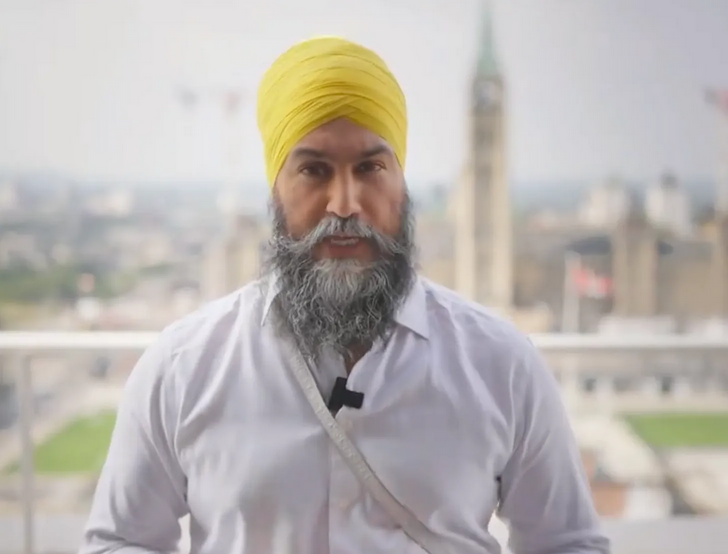
Federal NDP leader Jagmeet Singh announces the end of the Confidence and Supply Agreement.
Screencap from the NDP official video via The Line,
… I’m starting to consider the possibility that Jagmeet Singh is bad at politics.
I mean, think about this.
We at The Line have long pointed out that CASA was a bad deal for the NDP. It earned the party only a few piecemeal spending concessions like two-treatment Pharmacare and a half-baked dental program. It’s the Liberals who will, and have, taken full credit for both.
Meanwhile, Singh has lost all credibility as a government critic. What blows he can level at the Liberals are fatally undermined by the fact that he’s supported them for years. If the Liberals are complacent in enabling corporate greed, then Singh is demonstrably an enabler of a government that is “too weak, too selfish and too beholden to corporate interest to fight for people”?
I realize that nobody in Liberal-land is going to take this advice seriously, but I’m going to offer it anyway. On its current trajectory, Canada is heading toward a two-party system. Either the Liberals are going to eat the NDP, or the NDP is going to eat the Liberals. Until Wednesday, I put my money on the latter. Now, I’m not so sure.
If the Liberals maintain any existential instinct at all, they’d call Singh’s bluff. Drop the writ on a party that’s demonstrably unprepared to fight the battle it’s proclaimed. Eat the left, and survive to fight on another day. The meal is right there for the taking.
Singh’s big announcement about “ripping up” CASA — meep meep — gains him absolutely nothing. What additional leverage can he expect to acquire in a post-CASA parliament that he didn’t already possess?
Perhaps Wednesday’s announcement was merely a gambit to soothe internal problems, or distance himself from the Liberals. Okay, fine. This might be a viable strategy if it buys Singh a few months to trash Trudeau and raise funds off the effort while frantically trying to wash off the stinky stain of hypocrisy.
But what’s going to happen when the Liberals face their next confidence motion, presumably as soon as the Conservatives can arrange one? What happens at the next one, and the next one after that?
What credibility can Singh possibly hope to maintain if he votes for the Liberals, again? How in the world is the NDP seriously going to claim to have ripped up CASA while effectively acting as if it is in a CASA? The NDP cannot credibly distance itself from the sitting government while spending the next year propping up said government again and again and again in successive confidence motions. Especially after such a brazen display of pulling out of the deal.
No. They’re going to have to pull the trigger, and soon. Obviously. Clearly.
Singh sees this.
Right?
September 5, 2024
QotD: Common misunderstandings about the title of “Dictator” in the Roman Republic
The nearest equivalent to this I can think of would be if Olaf Scholz suddenly announced that he was reviving the position of Deutscher Kaiser (German Emperor) for himself, except without the legal structure of that title (e.g. the Prussian crown acting as the permanent president of a federation of monarchs) or the constitutional limits it used to have. We would rightly regard that as a new office, using the title of the old one.
This point is often missed in teaching Roman history because Roman history is very long and so gets very compressed in a classroom environment. Even in a college course focused entirely on the history of Rome, the gap between the end of the old dictatorship and the start of the new one might just be a couple of weeks, so it is easy for students to accept the new dictators as direct continuations of the old ones, unless the instructor goes out of their way to stress the century-long discontinuity. This is, of course, all the more true if the treatment is in a broader European History (or “Western Civ”) course or in a High school World History course – which might be able to give the Roman Republic as a whole only a week of class time, if even that much. In that kind of compressed space, everything gets mushed together. Which in turn leads to a popular view of the Roman dictatorship that this office was always a time-bomb, ready to inevitably “go off” as soon as it fell into the hands of someone suitably ambitious, because the differences and chronological gap between the old, customary dictatorship and the new irregular one are blurred out of vision by the speed of the treatment.
Just as a side note, this is generally a problem with the Roman Republic. Popular treatments of how the Republic worked – much less pop-culture representations of it – are almost always badly flawed […] The opening minutes, for instance, of the Crash Course video on the Romans is a series of clear errors, one after another, in describing how the Republic functioned as a matter of law and practice. If for some reason you want to not be wrong about the structure of Roman government, the book to read – though it is more than a bit dry and quite pricey – is A. Lintott, The Constitution of the Roman Republic (1999). I keep thinking that, as a future series, I might take a look at the basic structures of Greek and Roman civic government (“How to Polis, 101″ and “How to Res Publica, 101″) – especially if I can talk a colleague into providing a companion treatment of medieval Italian commune government – both as a historical exercise but also for the world builders out there who want to design more realistic-feeling fictional pre-modern governments that aren’t vassalage/manorialism systems.
Bret Devereaux, “Collections: The Roman Dictatorship: How Did It Work? Did It Work?”, A Collection of Unmitigated Pedantry, 2022-03-18.
September 3, 2024
Second Amendment case involving switchblades in Massachusetts
J.D. Tuccille summarizes a (surprising) court decision in Massachusetts which struck down a state law banning switchblade knives:
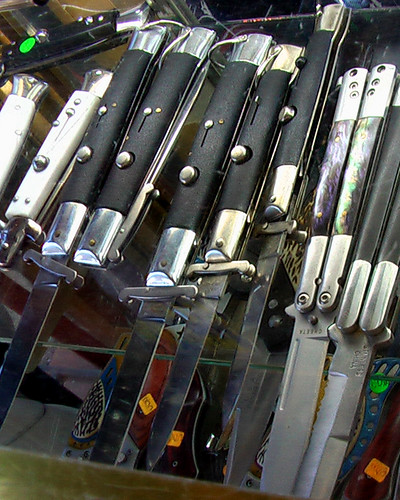
“IMGA0174_tijuana” by gregor_y is licensed under CC BY-SA 2.0 

 .
.
The Second Amendment to the United States Constitution undisputedly protects the individual right to own and carry firearms for self-defense, sport, and other uses. But the amendment actually says nothing about guns; it refers to “the right of the people to keep and bear Arms”, of which firearms are just one example of what dictionaries define as “a means (such as a weapon) of offense or defense”. In Massachusetts, last week, that resulted in a decision by the state’s highest court striking down a law against switchblade knives.
Protected by the Second Amendment
“We conclude switchblades are not ‘dangerous and unusual’ weapons falling outside the protection of the Second Amendment,” wrote Justice Serge Georges Jr. for the court in an opinion in Commonwealth v. Canjura that drew heavily on two landmark U.S. Supreme Court cases: Bruen (2022) and Heller (2008). The decision found the state’s ban on switchblade knives unconstitutional and dismissed charges against the defendant.
The case involved a 2020 dispute between David E. Canjura and his girlfriend, during which Boston police officers found a switchblade knife on Canjura while searching him. As is often noted, “everything is illegal in Massachusetts” and “a switch knife, or any knife having an automatic spring release device” is only one of a long list of weapons proscribed under state law. Canjura was accordingly charged.
Such absolute prohibitions on arms aren’t permitted in the wake of the Heller decision, so Canjura and his public defender, Kaitlyn Gerber, challenged the ban on switchblades, citing the federal decisions. They also relied on Jorge Ramirez v. Commonwealth (2018) in which the Massachusetts Supreme Judicial Court overturned a similar prohibition on stun guns on Second Amendment grounds.
“We now conclude that stun guns are ‘arms’ within the protection of the Second Amendment. Therefore, under the Second Amendment, the possession of stun guns may be regulated, but not absolutely banned,” the court found in that case.
Canjura required similar analysis based on the same earlier decisions, this time with Ramirez in the mix.
The Second Amendment Protects All “Bearable Arms”
Citing Heller, Justice Georges pointed out, “the Second Amendment extends, prima facie, to all instruments that constitute bearable arms, even those that were not in existence at the time of the founding”. Importantly, though, knives and other bladed weapons have a long history, extending back well before the birth of the country.
“A review of the history of the American colonies reveals that knives were ubiquitous among colonists, who used them to defend their lives, obtain or produce food, and fashion articles from raw materials,” commented Georges. Folding knives, in particular, grew in popularity to the point they became “almost universal”. The court saw no significant difference between the many types of folding knives used over the centuries and spring-assisted varieties developed somewhat more recently, finding “the most apt historical analogue of a modern-day switchblade is the folding pocketknife”.
September 2, 2024
“Queering Nuclear Weapons” … no, don’t laugh because it isn’t funny
At Postcards From Barsoom, John Carter looks into what at first seemed like a less-than-brilliant headline from The Babylon Bee, but is actually a much more serious concern:
Nuclear security is, I’m sure you do not need to be convinced, a deeply serious matter. Ever since we cracked the atom over Hiroshima our civilization has been walking a tightrope over an abyss. A single misstep could mean annihilation – hundreds of millions dead within minutes, billions within days. Doubtless there would be some survivors, but it’s doubtful that industrial civilization would survive. We’ve come within a hair’s breadth of this a few times, not only in the Cuban Missile Crisis, but on other occasions, when radar mulfunctions or computer glitches left launch officers in the USA and the former USSR unsure whether or not to press the big red buttons they were entrusted with. Fortunately for everyone, they didn’t. If they had, none of us would be here.
Nuclear power plants can be almost equally dangerous. We saw the consequences of mismanagement in the 80s, with Chernobyl. Political officers who had no idea what they were doing covered up one screw-up after another. The results horrified a continent and poisoned the good name of the nuclear energy to this day.
Nuclear security, of civilian infrastructure and especially of the strategic weapons reserve, is the kind of thing that you want deeply serious men in charge of. The kinds of guys who wear impeccable grey suits, didn’t laugh because they don’t think your joke is funny, and have multiple degrees in military history and nuclear physics.
[…]
And now, here we are again. The Department of Energy’s new Special Assistant for National Nuclear Security Administration, one Sneha Nair, is also the author of an article titled Queering nuclear weapons: How LGBTQ+ inclusion strengthens security and reshapes disarmament.
The National Nuclear Security Administration is a semi-autonomous alphabet agency responsible, as its name implies, for maintaining the security and efficacy of the USA’s nuclear weapons stockpile. Its remit also includes preventing the proliferation of WMDs, overseeing the provision of nuclear propulsion for the US Navy, and responding to radiological emergencies.
These are not small things to be responsible for, and one of their newly appointed senior administrators is apparently obsessed with painting rainbows on the warheads.
Let’s have a look at her.
Unlike Brinton, Nair doesn’t obviously look like a spiteful mutant. No aposematic hair colouring, no facial piercings, no obvious tattoos, nor any other obvious signs of mental illness. Her Xitter account doesn’t even proclaim her pronouns.
So unlike Brinton, there’s no obvious evidence that she’s a sexual deviant. By all appearances, she’s merely another overly earnest head girl, looking to burnish her virtue via demonstrative allyship.
Most of the media coverage was just lol’ing at the woke absurdity of the title of Nair’s article – what could adult diapers, dildos, bugchasing, and Monkeypox possibly have to do with preventing the fiery nuclear annihilation of the human species? Aside, that is, from keeping the observably mentally ill as far from the big red button as possible? What fresh madness is this? But we’re all inured to the regime’s infinite absurdity, these days, so after having a sensibly cynical chuckle we all moved on. I shrugged and moved on myself, until a few days ago when Stelios Panagiotou of Podcast of the Lotus Eaters took the time to actually read Nair’s work. What he found wasn’t lolcow fodder. It was deeply sinister.


There’s no limit to how progressive politicians want to control your life
In the National Post a couple of days ago, Carson Jerema provided many examples of how the Canadian federal government — despite failing and fumbling so many of its existing responsibilities — still wants to increase control over the daily lives of Canadians:
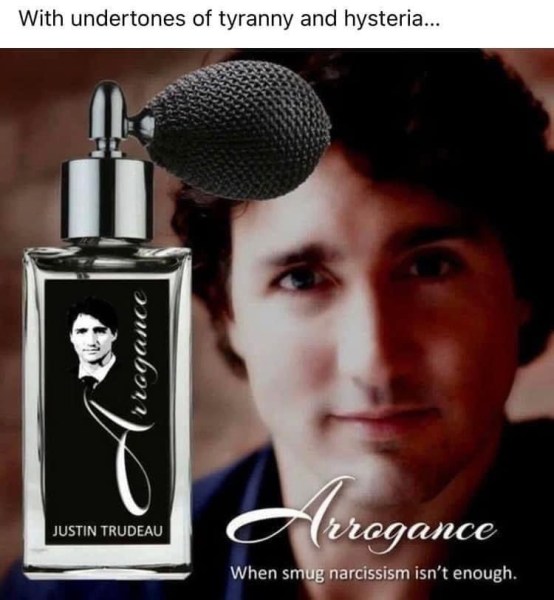
After a decade or so, progressives are on the defensive in Canada and elsewhere because regular people, as in those who are not activist weirdos, are tired of the agenda to control every aspect of our lives. Point this out to a progressive, and they will deny that anyone’s life is being interfered with and claim only some far-right monster would think otherwise. They can’t believe there are people out there who share a different view. They don’t understand how this could be.
But progressive governments are trying to control our lives in ways big and small, and in ways that range from subtle to a punch in the face.
In Canada, the federal government’s environmental policies are the most obvious example of this interference. The Liberals have banned plastic straws and plastic bags; even compostable bags are banned in grocery stores because they resemble plastic. Such bans are pointless irritants that make shopping more expensive, and life slightly less enjoyable as paper straws dissolve in one’s drink. People might dismiss these concerns as simply minor inconveniences, but this is how most people experience government policy, by being forced to replace their bag of plastic bags that they were already reusing, with more expensive, less useful options.
Next up, the Liberals are exploring options to bring in environmental regulations for clothing. The cost of clothes has actually gone down in recent years, so leave it to Ottawa to look for ways to bring the cost back up and to limit options.
There is also the plan to essentially force Canadians to purchase electric vehicles, that nobody would otherwise want, through government mandates to phase out the sale of gas-powered cars and trucks.
On a larger scale, the government is attempting to restrict the kind of work people do, specifically work in the oil and gas industry, through steep emissions targets, which will close off lucrative job opportunities in western oilfields. It will also limit the kinds of fuels people will be able to use to heat their homes.
There are also policies that the Canadian government hasn’t implemented, but which green activists have endorsed, such as the banning of gas stoves and the ludicrous suggestion from some academics that “climate lockdowns” be implemented to help cut emissions.
It is possible to be supportive of all these policies, despite their paternalistic and job-killing nature, but pretending that no one is trying to, or that no one wants to, interfere with our liberty is not a credible position to take.
September 1, 2024
Explaining everything on Canadian money
J.J. McCullough
Published May 19, 2024Who’s on it? What’s the history? How is it going to change?
(more…)
QotD: “Yellow China” versus “Blue China”
The first is the polarity between North and South or, if you want to sound pretentious, between “Yellow China” and “Blue China”. “Yellow” represents the sandy but fertile yellow loess soil of the North China Plain and the Yellow River valley, heartland of traditional Chinese civilization. But “yellow” is also the ripe ears of grain that grow in that soil, because the North is a land fed by wheat rather than rice. “Yellow” also, by extension, refers to the mass irrigation projects required to make the arid North bloom, to the taxation and slave labor required to dredge and maintain the canals and water conduits, to the sophisticated and officious bureaucracy that made it all happen. And since there is no despotism so perfect as a hydraulic empire, “yellow” is absolute monarchy, centralization, and militarism. But “yellow” is also the military virtues — plain-spokenness, honesty, physical courage, stubbornness, and directness — the traditional stereotypes of the Chinese Northerner.
Far away, across the wide blue expanse of the Yangtze, lay the wild and untamed South. A land of rugged mountains and dense rainforest, both of them inhabited by tribes that the waves of migrating Chinese settlers viewed as both physically and spiritually corrosive. So those intrepid colonists built their cities by the water — clinging to the river systems and to the thousands of bays and inlets that crinkle the Southern Chinese coast into a fractal puzzle of land and sea. And thus they became “blue”.
“Blue” are the blue waters of the ocean and the doorways to non-Chinese societies, blue also is the culture of entrepreneurship, industry, trade, and cunning that spread from those rocky harbors first across Asia and then across the world. The Chinese diaspora that runs the economies of Southeast Asia and populates the Chinatowns in the West is predominately made up of “blue” peoples — the Cantonese, the Hakka, the Teochew, the Hokkien. “Blue” is independent initiative and innovation, because beyond the mountains the Emperor’s power is greatly attenuated. But “blue” is also corruption of every sort — the financial corruption of opportunistic merchants and unscrupulous magistrates, and the spiritual corruption of the jungle tribes and other non-Chinese influences. “Blue” is pirates and freebooters who made their lairs amidst the countless straits and islands and seaside caves. “Blue” is also unfettered sensuality — opium came to China via the great blue door, and more than one Qing emperor took a grand tour of the South for the purpose of sampling its brothels (considered to be of vastly higher quality).2
If you know nothing else about the geography of China, know that this is the primary distinction: North and South, yellow and blue.3 But this neglected period, the “time of division” after the collapse of the Jin, is when that distinction really started. Settlement of the South began under the Han Dynasty in the first couple centuries AD, but it was still very much a sparsely-populated frontier. What changed in the Middle Ages was that after the collapse of central authority and the invasion of the North by nomadic barbarians, a vast swathe of the intelligentsia, literati, and military aristocracy of the North fled across the Yangtze and set up a capital-in-exile. For the first time the South became really “Chinese”, but the society that emerged was a hybrid one that retained a Southern inflection.
It wasn’t just courtiers and generals and poets who fled to the South: millions and millions of ordinary peasants did too, which finally displaced the jungle tribes, and also altered the balance of power between North and South. For the first time in Chinese history, the South had more population, more wealth, and an arguably better claim to dynastic legitimacy. So when the North emerged from its period of anarchy and foreign domination and looked to reassert its traditional supremacy, the South said: “no”. The Southern dynasties, chief among them the Chen Dynasty,4 were able to maintain an uneasy military stalemate for almost two hundred years, thanks to the formidable natural barrier of the Yangtze River, and to the fact that Southerners were better versed in naval warfare and thus able to prevent any amphibious operations on the part of the North.
This only ended when the founder of the Sui Dynasty learned to fight like a Southerner, and assembled a massive naval force in the Sichuan basin, then floated it down the Yangtze gorges destroying everything in his path. The backbone of this force were massive ships which “had five decks, were capable of accommodating 800 men, and were outfitted with six 50-foot-long, spike-bearing booms that could be dropped from the vertical to damage enemy vessels or pin them in positions where they would be raked by close-range missile fire.” After breaking Southern control of the great river, the Sui founder assembled an invasion force of over half a million men and crushed the Southern armies, burned their capital city to the ground, and forcibly returned the entire aristocracy to the North.
John Psmith, “REVIEW: Medieval Chinese Warfare, 300-900 by David A. Graff”, Mr. and Mrs. Psmith’s Bookshelf, 2023-06-05.
1. The Chinese Middle Ages and the European Middle Ages aren’t actually contemporaneous — “Medieval China” generally denotes a period just before and after the fall of the Western Roman Empire.
2. “Blue” China is also the origin of a different sort of disordered sensuality — the culinary sort. Almost from the dawn of Chinese history, Northerners have been horrified by the gusto with which Southerners will eat anything. Scorpions, animal brains and eyeballs, you name it, Southerners are constantly upping the ante with each other. Northerners have also generally been horrified by the sadism that attends some Southern culinary traditions, with many animals being eaten alive, or partially alive, or after prolonged and deliberate torture. One usually unstated Northern view is that a lot of these customs were picked up from the jungle tribes that lurk in the Chinese imaginarium like the decadent ancestor in an H.P. Lovecraft story.
3. Confusingly, in the context of modern Hong Kong politics, “yellow” and “blue” represent the pro-sovereignty and pro-China factions respectively. This split is almost totally orthogonal to the one I’m talking about in this book review, and to the extent they aren’t orthogonal, the sign is flipped.
4. “Chen” is the most quintessentially Southern surname, but I’ve never been able to figure out whether that came before or after it was the name of the most famous Southern dynasty.
August 31, 2024
Britain’s police double down on “non-crime hate incidents” as a tool of repression
Andrew Doyle admits he was over-optimistic by predicting that the British police forces’ use of “non-crime hate incidents” — after court judgments and Home Office instructions to stop using them — would not last for much longer. That was in 2022:

“Metropolitan Police London England” by William Mewes is marked with CC0 1.0  .
.
I have a tendency to be over-optimistic. In my 2022 book The New Puritans, I wrote about “non-crime hate incidents” and how they were still being recorded by police, in spite of the Court of Appeal’s ruling that they were “plainly an interference with freedom of expression” and direct instructions from the Home Office that the police must stop this illiberal and unethical practice. However, I concluded that ultimately “it seems unlikely that ‘non-crime hate incidents’ will last for much longer”.
Of course I was wrong, because I had not counted on just how authoritarian a new Labour government might be. It was bad enough that the Education Secretary Bridget Phillipson scotched the Higher Education (Freedom of Speech) Act just one day before parliament went into recess — presumably to avoid having to debate the matter — but now the Home Secretary Yvette Cooper has reversed the Conservatives’ pledge to limit the recording of “non-crime”. Labour is bringing back this absurd policy, and has convinced itself that this is somehow a progressive measure.
It should go without saying that the police have no business recording “non-crime”, particularly when such records are based on accusations alone (that is to say, the “perception” of the “victim” is what counts, rather than actual evidence of hatred). The Tory government should have eliminated the entire practice in its entirety, but instead decided that such “incidents” ought to stay on record if there was a “real risk of escalation causing significant harm or a criminal offence”. The science fiction writer Philip K. Dick had a phrase for this: “pre-crime”.
So let’s leave aside the woefully inadequate restrictions put in place by the Tories. Let’s also leave aside the obvious point that hatred, along with all other emotions, will never be eradicated through legislation and that the state is wasting its time trying to alter human nature. Let’s focus instead on why the Labour government is so determined to control the speech and thought of its citizens.
How does it help anyone for the name of the schoolboy who accidentally scuffed a copy of the Koran at a school in Wakefield to be on police records? His “non-crime” was duly recorded after the event, but why? Does the government really suppose that this child is one step away from torching a mosque? Even if he had deliberately scuffed the Koran, what has this to do with the police? I don’t much approve of defacing books, but vandalism of one’s own property is a matter for individual conscience.
Of course, Labour will say that the recent riots have proven the necessity for cracking down on the private thoughts of citizens. In truth, these acts of violence are being exploited to justify further authoritarian policies. We have seen how quick our politicians are to seize upon these moments to advance their own goals. The murder of Sir David Amess had precisely nothing to do with social media, and yet politicians immediately began to argue that his death was evidence of the need to curb free speech online. This was grotesque opportunism from a political class that does not trust the public.
August 30, 2024
Experts are concerned that criticism of experts will weaken their role in our political system
In the National Post, Geoff Russ dares to imply that the experts are not the divinely inspired superior beings with unfailing wisdom about any and all issues:

So-called “experts” have weakened Canada’s political discourse far more than Pierre Poilievre ever has. Journalist and author Stephen Maher recently penned a column in the Globe & Mail titled, “By slamming experts, Pierre Poilievre and his staff are degrading political debate”.
Maher is an even-handed journalist, and his column should not be written off as the scribblings of a Liberal partisan. What his column misses is how the term “expert” has been abused, and the degree to which “experts” have thoroughly discredited themselves in recent years.
Poilievre’s criticisms of the “experts” would not resonate if they lived up to the title bestowed upon them.
For example, the Doug Ford government’s decision to close 10 safe injection sites after implementing a ban on such facilities located near schools and child-care centres. The closures were lamented by “experts” trotted out by the CBC as putting peoples’ lives at risk.
The safe injection sites slated to be shut down are near schools and daycares, and there is demonstrable proof that crime rises near these sites wherever they are located.
Derek Finkle recently wrote that the critiques of the closures levelled by selected “experts” failed to note how community members had been threatened with rape, arson, and murder since the injection site in his Toronto neighbourhood had been opened.
These are reasonable grounds for a government to reconsider whether they should allow drug-use, supervised or not, to proliferate in neighbourhoods where families reside.
For all their alleged expertise, many “experts” seem unwilling to actually investigate what is happening on the ground, and often give plainly bad advice altogether, and this goes back decades.
The “experts” failed to predict the 2008 financial crisis, they said the risk to Canadians from the coronavirus was low in early 2020, and they failed to prevent runaway inflation after the worst of it had subsided.
Was it not the “experts” who asserted that arming and funding of Ukraine prior to Vladimir Putin’s invasion in 2022 was a bad idea? After the invasion began, was it not the “experts” who confidently predicted Putin’s army would conquer the whole of Ukraine in a matter of days, and not be bogged down in a years-long conflict that would reshape global trade?
The truth is that we live in a worse-off world because of the advice and predictions of “experts”.
Two-Tier Keir’s “mask off” moment(s)
Millennial Woes presents a disturbingly long summary of British Prime Minister Keir Starmer’s responses to popular non-violent protests:

The situation in Britain now is so perverse that, if you could convey it to people from a century ago, I think they, after getting over the disbelief and astonishment and accepting that this really was true, would assume it could not possibly have come about by chance. Whatever their complaints about the Britain of 1900, they wouldn’t have believed it capable — on its own — of the degeneration we have seen. They would insist that it must have been wickedly subverted, every failsafe removed, and entire systems of governance, culture and morality repurposed, made to achieve the opposite of their purported function.
I hardly need list the symptoms of this, but for the sake of posterity …
- The control nexus (of which the government is merely one node) ships massive numbers of unassimilable foreigners into the country against the repeatedly expressed wishes of the natives, and in clear violation of their best interests.
- Natives who complain about this are hounded, doxed, demonised, made unemployable, and often imprisoned.
- Their children are systematically indoctrinated by fiction media to accept their dispossession. They are encouraged to despise the “bigoted” attitudes of their parents and grandparents, and to loathe their nation’s history. The boys are encouraged to idolise non-native men. The girls are encouraged to race-mix with them.
- Teachers deliver the same indoctrination in the classroom — in every classroom. You won’t be allowed to become a teacher unless you voice enthusiasm for such things. Alternative views have been eradicated from the classroom and the lecture hall.
- Natives are systematically disadvantaged in numerous sectors of education and employment.
- Natives are demonised in fiction and news media while non-natives are made to look wonderful.
- The mass sexual abuse of native children by non-natives is systematically down-played by news media, who shift discussion to false “equivalents”.
- Natives’ history is systematically distorted in education and fiction media.
- The very existence of the natives, as a group, and their ownership of their homeland, are systematically denied by education, fiction media, news media, and phoney “science”.
- The police do whatever they are told to do, kneeling for the participants in one riot, hunting down the participants in a different riot.
- Judges pass obviously outrageous prison sentences upon certain people, for blatantly political reasons. These people are denied bail and pressured to plead guilty for fear of sentences even more outrageous. All of this is to send a message to other people: “don’t dare complain or the same will happen to you”.
- The media rushes to concoct fake narratives about events, to keep the public misinformed.
- A so-called “charity”, which is heavily linked to the government and the civil service, seeks to indoctrinate the young and ruin the lives of “troublemakers”, and actively aids the government in concocting fake narratives in order to control public thought and direct events.
- Fake news from such Establishment agents is forgiven, fake news from the Establishment’s enemies is answered with threats of prosecution.
- The media “memory hole” stories of appalling violence by non-natives, explain away such incidents with talk of mental illness, tell natives “don’t look back in anger”, and at all costs defend the suicidal ideologies that make such incidents possible.
- The prisons are emptied of rapists, child molesters and murderers so that troublesome natives can be assigned their cells. They are placed alongside non-natives who might well be violent to them, and journalists gloat about it.
- The slaughtering of three little girls by a non-native is dismissed by the Prime Minister, who says “it doesn’t matter” that the rioting was a response to this outrageous crime, which was enabled by the outrageous government policies that the natives have been complaining about for decades. Their shock, their trauma, their resentment, their dignity, their pain… “doesn’t matter”. This is in stark contrast with how he reacted to Black people rioting several years before.
- The natives’ freedom of speech is continually undermined, one government after another actively seeking to erode it further.
- Not one single organisation is fighting for the wellbeing, rights or interests of the natives.
- Any political party that would do anything about any of this is refused the right to stand in elections, debanked, demonised and, in most cases, destroyed.
Any one of these examples would, in itself, be cause for great alarm. The whole lot together indicate a society that is not just largely, not just fundamentally, but wholly opposed to the continued existence of its native population. To underline: British society is actively perpetrating the destruction of the native British people.
It has been said that the ruthless authoritarian response of the fledgling Starmer government to this summer’s (White) riots is a “mask off” moment for the Labour Party. Others have called it a “mask off” moment for the British Establishment, which transcends the particular party in office. Indeed, things that didn’t happen under the Conservatives have suddenly happened under Labour; things that one would more neatly associate with the former have instead happened under the latter. That can only mean either that the Labour Party has utterly lost its sense of itself, or that the particular party in office simply doesn’t matter, because the Establishment abides.
I think, in fact, all of these statements are true. It has been a “mask off” moment for the Labour Party, and for Keir Starmer himself, and for the Establishment which enables and directs them. The Labour Party has lost its sense of itself — or, to put it less romantically, has been completely repurposed. And the Establishment does abide; no matter which party is in office, things only ever evolve in one direction. And after all, while Starmer’s behaviour casts a bad light on him, he is only Prime Minister in the first place because the Establishment wanted him, not someone who might have reacted to these riots in a different manner. (Boris Johnson is good at stoking war abroad, but not so willing to stoke it at home.)
But in the end it doesn’t really matter. We don’t need to pin the blame on Starmer, Labour, the British Establishment or Davos; they are all one and the same miasma. Yes, the Conservative Party might have reacted differently to the riots, so to some extent we can blame Labour’s ideology or Starmer’s personality, but the pendulum is kept swinging for a reason. One empty suit is shifted out, another is shifted in. Each one might be enthusiastically on-board with the agenda or compelled to go along with it, this being the only variance. And thus the Establishment abides, always getting what it wants against the wishes of the natives, and always degrading and dispossessing them.
August 29, 2024
Pavel Durov’s arrest isn’t for a clear crime, it’s for allowing everyone access to encrypted communications services
J.D. Tuccille explains the real reason the French government arrested Pavel Durov, the CEO of Telegram:

It’s appropriate that, days after the French government arrested Pavel Durov, CEO of the encrypted messaging app Telegram, for failing to monitor and restrict communications as demanded by officials in Paris, Meta CEO Mark Zuckerberg confirmed that his company, which owns Facebook, was subjected to censorship pressures by U.S. officials. Durov’s arrest, then, stands as less of a one-off than as part of a concerted effort by governments, including those of nominally free countries, to control speech.
“Telegram chief executive Pavel Durov is expected to appear in court Sunday after being arrested by French police at an airport near Paris for alleged offences related to his popular messaging app,” reported France24.
A separate story noted claims by Paris prosecutors that he was detained for “running an online platform that allows illicit transactions, child pornography, drug trafficking and fraud, as well as the refusal to communicate information to authorities, money laundering and providing cryptographic services to criminals”.
Freedom for Everybody or for Nobody
Durov’s alleged crime is offering encrypted communications services to everybody, including those who engage in illegality or just anger the powers that be. But secure communications are a feature, not a bug, for most people who live in a world in which “global freedom declined for the 18th consecutive year in 2023”, according to Freedom House. Fighting authoritarian regimes requires means of exchanging information that are resistant to penetration by various repressive police agencies.
“Telegram, and other encrypted messaging services, are crucial for those intending to organise protests in countries where there is a severe crackdown on free speech. Myanmar, Belarus and Hong Kong have all seen people relying on the services,” Index on Censorship noted in 2021.
And if bad people occasionally use encrypted apps such as Telegram, they use phones and postal services, too. The qualities that make communications systems useful to those battling authoritarianism are also helpful to those with less benign intentions. There’s no way to offer security to one group without offering it to everybody.
As I commented on a post on MeWe the other day, “Somehow the governments of the west are engaged in a competition to see who can be the most repressive. Canada and New Zealand had the early lead, but Australia, Britain, Germany, and France have all recently moved ahead in the standings. I’m not sure what the prizes might be, but I strongly suspect “a bloody revolution” is one of them (if not all of them).”
August 28, 2024
H.R. McMaster dishes on Trump’s first term in office
In Reason, Liz Wolfe covers some of the head-scratchers former National Security Advisor H.R. McMaster revealed about working for Donald Trump:

Donald Trump addresses a rally in Nashville, TN in March 2017.
Photo released by the Office of the President of the United States via Wikimedia Commons.
What might a second Trump White House be like? In his new book, At War with Ourselves: My Tour of Duty in the Trump White House, Lt. Gen. H.R. McMaster, who served as national security adviser to Donald Trump (for one year), characterizes Oval Office meetings as “exercises in competitive sycophancy” where advisers would greet him with lines like “your instincts are always right” or “no one has ever been treated so badly by the press”.
Trump, meanwhile, would come up with crazy concepts, and float them: “Why don’t we just bomb the drugs?” (Also: “Why don’t we take out the whole North Korean Army during one of their parades?”)
This is one man’s account, of course. McMaster’s word should not be taken as gospel, and some of his frustration might stem from his dismissal, or his foreign-policy prescriptions being at times ignored by his boss. But it’s a somewhat revealing look behind the curtain at policy-setting in a White House helmed by an especially mercurial commander in chief, who “enjoyed and contributed to interpersonal drama in the White House and across the administration”.
It also shows how quickly Trump fantasies have percolated through the Republican Party, namely the “let’s just bomb Mexico to get rid of the cartels” line, which Trump has been toying with since roughly 2019 (or possibly more like 2017, after he chatted with Rodrigo Duterte, former president of the Philippines, who had promised to kill 100,000 drug traffickers during his first six months as president). A few years prior, in 2015, he had suggested that Mexico was sending rapist and drug-traffickers across the southern border, and that we’d need to build a wall between the two countries, but it wasn’t until nine American citizens were killed in Mexico that Trump trotted out the idea of declaring cartels foreign terrorist organizations and using military might to eradicate them.
Trump’s line from 2019 has now become standard fare, notes The Economist: The Republican primary debates included lots of tough talk on Mexico, specifically on the bombing front, with Florida Gov. Ron DeSantis claiming he’d send special forces down there on Day One. Right-wing think tanks have embraced the messaging, with articles headlined “It’s Time to Wage War on Transnational Drug Cartels”. Taking cues from other members of her party, Georgia Rep. Marjorie Taylor Greene asked why “we’re fighting a war in Ukraine, and we’re not bombing the Mexican cartels”. Whether it’s economic protectionism (10 percent across-the-board tariffs, with 60 percent tariffs imposed on Chinese imports) or Mexico-bombing, Trump has near-magical abilities to get other members of his party to accept something previously regarded as absurd.


