
I just don’t get it — why the obsession with streetcars? Why pay zillions of dollars to create what is essentially a bus line on rails, a bus line that costs orders of magnitude more per passenger to operate and is completely inflexible. It can never be rerouted or moved or easily shut down if changes in demand warrant. And, unlike with heavy rail on dedicated tracks, there is not even a gain in mobility since the streetcars have to wallow through traffic and intersections like everyone else.
What we see over and over again is that by consuming 10-100x more resources per passenger, rail systems starve other parts of the transit system of money and eventually lead to less, rather than more, total ridership (even in Portland, by the way).
Warren Meyer, “I Can’t Understand the Obsession with Streetcars”, Coyote Blog, 2014-10-23.
November 8, 2014
QotD: The light rail obsession among municipal politicians
November 6, 2014
The US midterm elections show one thing clearly
The one thing that is apparent from the results of the US federal mid-term elections is that — despite what voters tell pollsters and reporters — they’re absolutely in love with their current federal representatives:
I see that Americans are well satisfied with their politicians: over 95 percent of incumbents re-elected. Perhaps I should be more gentle in my criticism of a system that can bring such torpor and contentment, and is not so unlike monarchy after all.
For note, that in this fast-changing world, some things do not change; that some jobs stay safe, from year to year and decade to decade.
One wonders why politicians go to the trouble of awarding themselves such extravagant pensions, when they could just leave their names on the ballot, indefinitely. Retirements cost the taxpayer money: for now, instead of the one politician, we must in effect pay for two. With term limits, who knows how many we must keep, in the style to which they have become accustomed?
November 1, 2014
Let’s ditch that outdated relic called Daylight Saving Time
In the Wall Street Journal, Jo Craven McGinty examines the pro and con equation for Daylight Saving Time. The US government, of course, says it saves electricity by their measurement:
The historic reason for observing daylight-saving time — which ends at 2 a.m. on Sunday when clocks revert to standard time — is to conserve energy, by pushing sunlight forward into the evening, reducing the need for electric lights.
The U.S. government has found the strategy works. But two academic studies published in peer-reviewed journals rebut the idea, and one even concludes the policy increases demand for electricity.
The most recent government study, by the Department of Energy, tested whether expanding daylight-saving time by four weeks in 2007 reduced the use of electricity, as intended.
The study examined the additional weeks of daylight-saving time using data provided by 67 utilities accounting for two-thirds of U.S. electricity consumption. It compared average daily use in 2006, when there was no daylight saving, with the same period in 2007 when the extension took effect and found a reduction in electricity use of 0.5% in the spring and 0.38% in the fall.
However, non-government studies don’t agree:
The study, which was published in the Review of Economics and Statistics, examined residential data only, but the researchers didn’t believe commercial use would alter their findings.
“Big-box stores don’t turn on or off lights based on whether it’s light outside or dark,” Mr. Kotchen said. “In a commercial building, the lights are on when people are working no matter what.”
Rather than conserving electricity, the study found that daylight-saving time increased demand for electricity. Conditions may vary in other parts of the country, but the study concluded that Indiana is representative of much of the country.
That doesn’t mean daylight-saving time has never worked since its introduction during World War I. But, said Mr. Kotchen, “the world has changed. Lighting is a small amount of energy and electricity use in households. The big things are heating and cooling, particularly as air conditioning has become more prevalent. We’re fooling ourselves to continue calling it an energy policy given the studies that show it doesn’t save energy.”
H/T to Terence Corcoran for the link.
October 31, 2014
US government’s no-fly list at an all-time high
In The Atlantic, Conor Friedersdorf talks about the travesty that is the US government’s no-fly list:
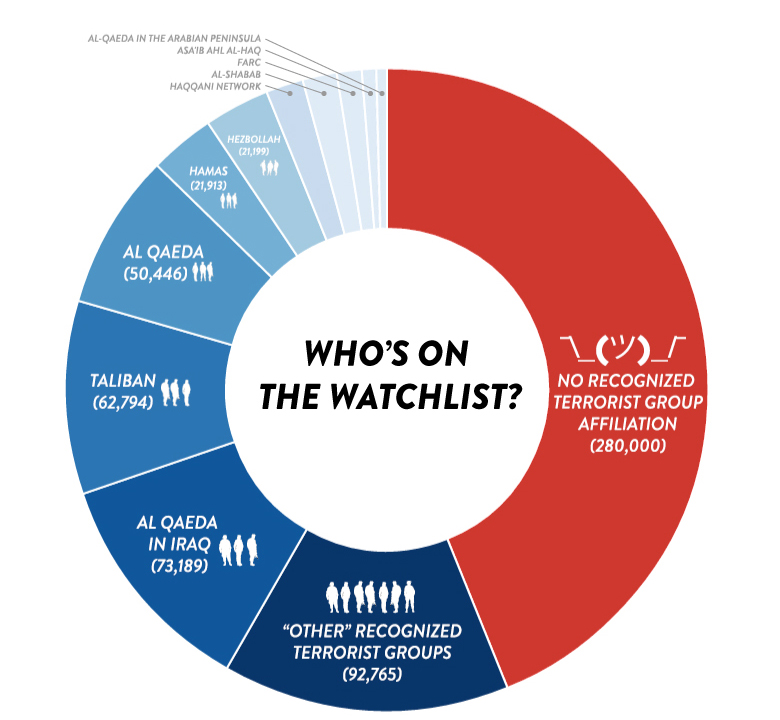
An image accompanying the scoop starkly illustrated an out-of-control watchlist. (The Intercept)
Months ago, The Intercept reported that “nearly half of the people on the U.S. government’s database of terrorist suspects are not connected to any known terrorist group.” Citing classified documents, Jeremy Scahill and Ryan Devereaux went on to report that “Obama has boosted the number of people on the no fly list more than ten-fold, to an all-time high of 47,000 — surpassing the number of people barred from flying under George W. Bush.” Several experts were quoted questioning the effectiveness of a watch list so expansive, echoing concerns expressed by the Associated Press the previous month as well as the ACLU.
The Intercept article offered a long overdue look at one of the most troubling parts of the War on Terrorism. Being labeled a suspected terrorist can roil or destroy a person’s life — yet Team Obama kept adding people to the list using opaque standards that were never subject to democratic debate. Americans were denied due process. Innocent people were also put on a no-fly list with no clear way to get off.
As the ACLU put it, “The uncontroversial contention that Osama bin Laden and a handful of other known terrorists should not be allowed on an aircraft is being used to create a monster that goes far beyond what ordinary Americans think of when they think about a ‘terrorist watch list.’ If the government is going to rely on these kinds of lists, they need checks and balances to ensure that innocent people are protected.” The status quo made the War on Terror resemble a Franz Kafka novel.
October 28, 2014
Civil service pensions
In City Magazine, Steven Malanga looks at Canada’s civil service pension problems, which may not be quite as bad as some US state problems, but are still going to be a source of conflict going forward:
Governments throughout the country are grappling with as much as $300 billion in unfunded government-worker retirement debt. In a country of just 38.5 million people, that’s a pension problem roughly equivalent to the one that California faces. And it’s widely shared.
Municipalities throughout Quebec, for instance, owe some $4 billion in retirement promises that have yet to be funded, prompting the province’s new Liberal government to demand this summer that workers pay more to bolster the system. A new report on the finances of Ontario’s government-owned utilities revealed their pensions to be unsustainable without deep subsidies from Canadian electricity customers. For every dollar that workers contribute toward their retirement, government-owned utilities now spend on average about four dollars, raised through electric bills—though the cost is even higher at some operations. The news is even bleaker at the federal level, where Canada faces more than $200 billion in total retirement debt for public workers, when the cost of future health-care promises made to public-sector workers is combined with pension commitments. One big problem is pension debt at Canada Post, whose budget is so strained that the federal government gave the mail service a four-year reprieve on making payments into its pension system, even though it’s already severely underfunded.
At the heart of Canada’s pension woes are some of the same forces that have helped rack up several trillion dollars in state and local pension liabilities in the United States. For years, Canadian governments have provided generous pensions at low costs to employees. Workers could earn full benefits while retiring in their mid-fifties, even as they lived longer. Politicians relied on optimistic assumptions about stock-market returns to justify those benefits. Governments were quick to grant additional benefits to politically powerful employee groups, but they underfunded pensions when budgets got tight.
October 25, 2014
Harper government to restore part of the military budget?
In the Edmonton Leader-Post, Michael Den Tandt reported last week on the chances of the Canadian Armed Forces getting back at least some of the most recent budget cuts, in light of the increasing deployment tempo in Europe and the Middle East:
Even as the Harper Conservatives have deployed CF-18 fighter jets to Eastern Europe, and now to Kuwait to join the air war against Islamic State, also known as ISIL or ISIS, the Canadian Forces have seen their funding slashed. But that may be about to change, as the government considers adding back part or all of the $3.1 billion removed from the military’s piggy bank in last February’s budget.
Friday, it was reported here that Prime Minister Stephen Harper personally intervened recently to settle a dispute between Treasury Board, led by Tony Clement, and the Defence Department, led by Rob Nicholson, over a pending $800-million sole-sourced purchase of next-generation Sea Sparrow naval missiles from U.S.-based Raytheon Co.
Concerns that the acquisition under the U.S. government’s Foreign Military Sales program would tilt the scales in favour of the Raytheon-Lockheed-Martin group in a burgeoning transatlantic competition for up to $18 billion in subcontracts on DND’s new Canadian Surface Combatant fleet, were overruled. As were, apparently, any worries about the optics of making another large military purchase, a la F-35, without opening the process up to competing bids.
October 19, 2014
Brace yourselves for Beer Store price hikes
In the Toronto Star, Rob Ferguson details the provincial government’s new-hatched plans to pry more money out of consumers (by way of the Beer Store monopoly):
Premier Kathleen Wynne says she won’t shrink from a battle with The Beer Store as her government thirsts for a bigger cut of sales despite brewers’ warnings it would mean higher prices for suds lovers.
The comments came Saturday as Wynne commented in detail for the first time on recommendations from a blue-ribbon panel on squeezing more money from publicly owned agencies and the distribution system for beer, wine and spirits.
“They’ve laid out some challenging ideas for us and I’m absolutely willing take those on,” Wynne said of the panel headed by TD Bank chair Ed Clark.
“Will it be easy, will it be a path that is without any challenges? No it won’t be but that’s not a problem from my perspective. That’s exactly why it needs to be taken on,” she added after a 22-minute speech to party members in this border city for a strategy session and victory party after winning a majority in the June 12 election.
Clark’s recommendations Friday were a timely distraction for Wynne with the legislature starting its fall session Monday and her Liberals under fire for a bailout of the mostly vacant MaRS office tower across from Queen’s Park, with taxpayers on the hook for hefty interest payments.
The government already taxes beer at 44%. I guess they think that’s too little.
October 5, 2014
Protest locations in Hong Kong
In The Atlantic, Bourree Lam looks at where the Hong Kong protests tend to be located:
Hong Kong’s “umbrella revolution” — an anticipated protest movement with unanticipated mass turnout — is currently spreading across an island slightly bigger than Manhattan.
The Occupy Central with Love and Peace (OCLP) campaign, whose main demands are the resignation of Chief Executive CY Leung and true democracy for Hong Kong, announced months ago that it planned to shut down Hong Kong’s Central District — the city’s financial hub, which also houses government offices (including the Legislative Council’s buildings and the chief executive’s residence) and a luxury-shopping strip featuring a city block-wide Louis Vuitton store (by night it’s where tourist and locals go drinking and clubbing, especially in the Lan Kwai Fong area). Beginning with British colonial rule in 1841, the district has gradually become the main artery of Hong Kong’s business and social life.
But the protest movement, of which the OCLP is now just one part, has expanded in the last few days to the districts of Admiralty, Causeway Bay, and Mongkok — some of the city’s most bustling commercial sectors. On Tuesday, the protests encompassed the areas of Tsim Sha Tsui and Wan Chai. And, in a twist on the ‘Occupy’ movement in the United States, the demonstrations haven’t been confined to public squares; they’ve also spread to intersections, forcing road closures. Protesters, for instance, are currently holding their positions on Connaught Road Central, a major six-lane throughway that connects four districts on the island.
[…]
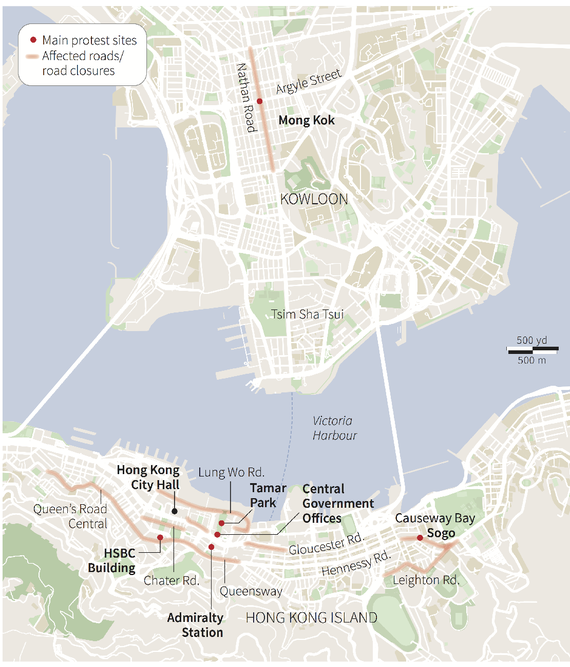
Update: Zachary Keck is quite pessimistic on the chances for success.
As covered extensively in The Diplomat, tens of thousands of protesters have taken to the streets of Hong Kong demanding democratic reforms. Specifically, the protesters want free and fair elections and universal suffrage to select the city’s government, which Beijing promised as part of the condition for the U.K. handing back the city to mainland China.
Sadly, Occupy Central is doomed to fail. The Chinese government will not accept the protesters’ demands.
Beijing has already made it clear that it views free and fair elections in Hong Kong to be a threat to one-party rule in the country. At most, it will allow Hongkongers to select one of the candidates that it pre-approves. It has also deemed Occupy Central illegal. In other words, the Chinese Communist Party views the issue as one of its “core interests,” and it hasn’t stayed in power this long by compromising on issues that it views as threats to its survival.
[…]
The massive protests that have swept through Hong Kong in recent days have only made it more urgent that the CCP hold the line on the issue. The Party can ill afford an example of mass demonstrations forcing it to compromise on an issue deemed to be of core importance. Before the protests, it was possible the CCP might have assessed that free and fair elections in Hong Kong would not threaten one-Party rule on the mainland because of the “one country, two systems” mantra. However, the Party giving in on a core issue because of mass protests would, without question, set a dangerous precedent for the CCP’s grip on power in mainland China. It therefore will not be done.
This isn’t to say that a violent crackdown is coming. Indeed, as is almost always the case, the CCP will want the local government on the frontlines in handling the protesters, while Beijing directs things from behind the scenes. As Steve Hess has pointed out in The Diplomat, using local governments as scapegoats has long been an effective tool of the CCP. If it means the restoration of stability, that could very well mean the end of CY Leung’s career. It’s also possible some sort of “compromise” will be worked out that allows the protesters to claim some sort of victory without compromising the CCP’s ability to maintain a large degree of control over the chief executive of Hong Kong.
October 2, 2014
On national defence, don’t listen to Harper’s words – watch his actions
At The 3Ds Blog, Jack Granatstein explains why the Canadian Forces are once again being starved of funding:
A few years ago I wrote that no government since that of Louis St Laurent in the 1950s had done more to improve the defence of Canada than Stephen Harper’s Conservatives. The St Laurent Liberals built up the armed forces to deal with the war in Korea and with the defence of North America and western Europe in the face of Soviet expansionism. At its peak, the defence budget took more than seven percent of Canada’s Gross Domestic Product, and the army, navy, and air force had as many as 120,000 men and women in the regular forces.
No one could expect any government in this century to spend on that scale, but the Conservative government did treat defence well in its first years in power. The commitment to the Afghan War, never very popular, was handled capably, and the troops received everything they needed — helicopters, new artillery, upgraded armoured personnel carriers, and tanks, not to mention new transport aircraft. The number of regulars rose slowly and slightly toward 65,000, and the government presented a schematic Canada First Defence Policy in 2008 that listed a range of objectives and equipment acquisitions. The budget projections were colossal, almost $500 billions to be spent over the next 20 years.
But that was then, this is now:
The result was that the defence budget was cut, in substantial part because deficit reduction and a budget surplus were more important than “toys for the boys.” From a peak of $21 billion in 2009-10, the defence budget in this fiscal year is $18.2 billion, about a 13 percent reduction in dollars made worse by inflation. The percentage of GDP spent on defence is now hovering at one percent, the lowest since the 1930s. In 2009, it was 1.3 percent. Making matters even worse, the Department of National Defence somehow cannot spend all the money it gets, returning almost $10 billion to the Treasury since 2006.
Despite Harper’s tough talk on the international stage, his government’s active neglect of the needs of the armed forces means we can’t back up his pugnacious rhetoric with any serious military effort: a frigate in the Black Sea, four CF-18s in the Baltic, a couple of transport aircraft shuttling supplies into Erbil, and a small special forces contingent helping the Kurds … and that’s about our current limit for overseas deployment. The Royal Canadian Air Force is still waiting for new helicopters (after more than 20 years of stop-go-stop procurement disasters) and a decision on replacing the CF-18. The Royal Canadian Navy just announced the immediate retirement of four ships, with no replacements available for years (if ever), and the Canadian Army is struggling to maintain equipment and keep up training schedules due to budget constraints.
And, as Granatstein points out, if the Liberals or NDP win the next federal election, the situation will get worse, not better, as neither party sees the military as any kind of priority — quite the opposite.
Update: Speaking of cheeseparing “economies”, here’s the Department of National Defence’s most recent “saving”.
National Defence slashed its annual order of ammunition this year to save money — a revelation that raised fresh questions Wednesday about just how prepared Canada is to do battle with militants in the Middle East, Murray Brewster of the Canadian Press writes.
More from his article:
The 38 per cent cut was large enough to cause other government departments, Public Works and Industry Canada in particular, to sit up and take stock of the impact, internal documents obtained by The Canadian Press show.
One such document, a memo to Public Works Minister Diane Finley dated Feb. 5, 2014, indicates her department tried to convince defence officials to either abandon the cut or at least spread it out over a couple of years.
Defence officials said that would be impossible, because “they would not allow the department to meet its financial targets.”
As a result, the 2014 ammunition budget was reduced to $94 million from $153 million.
During the early phases of the Afghan war, National Defence was caught similarly flat-footed and had to rush an order through General Dynamic Ordnance, particularly for artillery shells.
The memo surfaced on the same day Prime Minister Stephen Harper told the House of Commons that the cost of deploying special forces to northern Iraq is being taken out of the department’s current budget.
September 26, 2014
QotD: English regional governance
It is an attractive idea to bring back the traditional counties of England. It is also an attractive idea to dig up the body of the man who abolished them, Edward Heath, and stick his head on a pike, but that won’t happen either. The counties are just too small.
So if we are to have petty kingdoms, let them at least be kingdoms. Men have loved the Kingdom of Mercia. Men have died for the Kingdom of East Anglia — notably at the hands of men of Mercia, but there you go. Men of all the ancient nations of the Saxon have followed the greatest of the Kings of Wessex to glorious victory against the Vikings. Divide and conquer that, Eurocrats! Also it would serve the Vikings right for subjecting me to all those irritating pictorial instructions.
Natalie Solent, “Restore the Heptarchy!”, Samizdata, 2014-09-20.
September 25, 2014
QotD: Why useless university degrees are created
The typical understanding of a useless degree is of a credential whose market value is close to zero. In that sense this isn’t quite economically useless. There is a market for people wielding this pseudo-intellectual nonsense. It’s not a real market admittedly but it’s a market nonetheless. There is, however, only a single market maker: The Government.
The job prospects go beyond employment directly by the state, they extend into the quasi-government sector, what is sometimes politely referred to as the wider public service. There is a whole eco-system of NGOs, quasi-governmental organizations and ad hoc committees that thrive upon the government teat. Since their work has no objective value, and the criteria for employment is vague at the best of times, hiring managers fall back upon a tried and true screening methodology: A piece of paper issued by a government backed institution.
So for those of you following along at home: A government financed body creates make work. In order to handle that made-up work new workers are hired. Those workers have certificates in make work from government financed educational bodies. This is the great circle of statist BS that spins around our the modern world without beginning or end. There is precious little justice in that.
Richard Anderson, “The Justice Makers”, Gods of the Copybook Headings, 2014-09-19.
September 22, 2014
Here’s a Senate reform that would vastly improve the institution
At Gods of the Copybook Headings, Richard Anderson proposes a brilliant reform to a Canadian institution that has never actually had a function — the Senate.
I’ve often argued that the appointment of Senators should be done through a national lottery. All Canadian citizens would be eligible to buy a $10 ticket into what would be called The Red Chamber Sweepstakes. Each April 1st a draw would be held for 20 Senators. The 20 lucky winners would get an appointment to the upper house lasting no more than five years. If the politically correct crowd complained you could screen the winners by region and ethno-cultural background. If done properly the whole Senate could become self-financing.
Now tell me gentle readers what would be wrong with this simple idea? Would the quality of Senators decline? Nope. Would the process be more corrupt that it is at the moment? Other way around I should think. Would it generate tremendous and positive interest in the Senate? Yes. It would also mean doing away with a pricey communications budget. There would be no need to rationalize the conduct or purpose of the Senatorial class. We know how they got there and we know what they’re made of. Heck the whole exercise could be spun as an act of democratic enfranchisement. Ordinary people, not party hacks, deciding on the great questions of the day. Or at least pretending to do so.
There are those, of course, who would object and say that holding a national Senate lottery would be an embarrassing travesty for the nation. Yes it would be. But given the state of Canadian politics what else is new?
September 17, 2014
Creating jobs, good. Creating subsidized jobs, not so good.
Gregg Easterbrook on the difference between ordinary jobs and government subsidized job creation:
Elon Musk Recharges His Bank Account: Tesla’s agreement with Nevada to build a battery factory is expected to create about 6,000 jobs in exchange for $1.25 billion in tax favors. That’s about $208,000 per job. More jobs are always good. But typical Nevada residents with a median household income of $54,000 per year will be taxed to create very expensive jobs for others. Volkswagen is expanding its manufacturing in Tennessee, which is good. But the state has agreed to about $300 million in subsidies for the expansion, which will create about 2,000 jobs — that’s $150,000 per new job, much of the money coming from Tennessee residents who can only dream of autoworkers’ wages. The median household income in Tennessee is $44,140, about a third of the tax subsidies per new Volkswagen job. The Tesla handout was approved by the Democratic state legislature of Nevada; Tennessee’s Republican-controlled state government approved the Volkswagen corporate welfare deal.
At least it’s a bargain compared to federally subsidized solar jobs. A Nevada solar project — state that is home to Senate Majority Leader Harry Reid, President Barack Obama’s closest ally on Capitol Hill — cost $10.8 million in subsidies per job created. Local public interest groups noticed the extreme subsidy while the national media did not.
This cheeky website monitors giveaways state by state.
September 16, 2014
When the “best nutrition advice” is a big, fat lie
Rob Lyons charts the way our governments and healthcare experts got onboard the anti-fat dietary express, to our long-lasting dietary harm:
… in recent years, the advice to eat a low-fat diet has increasingly been called into question. Despite cutting down on fatty foods, the populations of many Western countries have become fatter. If heart-disease mortality has maintained a steady decline, cases of type-2 diabetes have shot up in recent years. Maybe these changes were in spite of the advice to avoid fat. Maybe they were caused by that advice.
The most notable figure in providing the intellectual ammunition to challenge existing health advice has been the US science writer, Gary Taubes. His 2007 book, Good Calories, Bad Calories, became a bestseller, despite containing long discussions on some fairly complex issues to do with biochemistry, nutrition and medicine. The book’s success triggered a heated debate about what really makes us fat and causes chronic disease.
The move to first discussing and then actively encouraging a low-fat diet was largely due to the work of Dr. Ancel Keys, who is to the low-fat diet movement what Karl Marx is to Communism. His energy, drive, and political savvy helped get the US government and the majority of health experts onboard and pushing his advice. A significant problem with this is that Keys’ advocacy was not statistically backed by even his own data. He drew strong conclusions from tiny, unrepresentative samples, yet managed to persuade most doubters that he was right. A more statistically rigorous analysis might well show that the obesity crisis has actually been driven by the crusading health advisors who have been pushing the low-fat diet all this time … or, as I termed it, “our Woody Allen moment“.
Rob Lyons discussed this with Nina Teicholz, author of the book The Big Fat Surprise:
Once the politically astute Keys had packed the nutrition committee of the AHA and got its backing for the advice to avoid saturated fat, the war on meat and dairy could begin. But a major turning point came in 1977 when the Senate Select Committee on Nutrition, led by Democratic senator George McGovern, held hearings on the issue. The result was a set of guidelines, Dietary Goals for the United States [PDF], which promoted the consumption of ‘complex’ carbohydrates, and reductions in the consumption of fat in general and saturated fat in particular.
By 1980, this report had been worked up into government-backed guidelines — around the same time that obesity appears to have taken off in the US. The McGovern Report inspired all the familiar diet advice around the world that we’ve had ever since, and led to major changes in what food manufacturers offered. Out went fat, though unsaturated fat and hydrogenated oils were deemed less bad than saturated fat, so vegetable oils and margarines became more popular. In came more carbohydrate and more sugar, to give those cardboard-like low-fat ‘treats’ some modicum of flavour.
Yet two recent reviews of the evidence around saturated fat — one led by Ronald Krauss, the other by Rajiv Chowdhury — suggest that saturated fat is not the villain it has been painted as. (The latter paper, in particular, sparked outrage.) As for fat in general, Teicholz tells me: ‘There was no effort until very late in the game to provide evidence for the low-fat diet. It was just assumed that that was reasonable because of the caloric benefit you would see from restricting fat.’
Teicholz also debunks the wonderful reputation of the Mediterranean Diet (“a rose-tinted version of reality tailored to the anti-meat prejudices of American researchers”), points out the role of the olive oil industry in pushing the diet (“Swooning researchers were literally wined and dined into going along with promoting the benefits of olive oil”), and points out that we can’t even blame most of the obesity problem on “Big Food”:
Which leads us to an important third point made by Teicholz: that the blame for our current dietary problems cannot solely, or even mainly, be placed at the door of big food corporations. Teicholz writes about how she discovered that ‘the mistakes of nutrition science could not be primarily pinned on the nefarious interests of Big Food. The source of our misguided dietary advice was in some ways more disturbing, since it seems to have been driven by experts at some of our most trusted institutions working towards what they believed to be the public good.’ Once public-health bureaucracies enshrined the dogma that fat is bad for us, ‘the normally self-correcting mechanism of science, which involves constantly challenging one’s own beliefs, was disabled’.
The war on dietary fat is a terrifying example of what happens when politics and bureaucracy mixes with science: provisional conclusions become laws of nature; resources are piled into the official position, creating material as well as intellectual reasons to continue to support it; and any criticism is suppressed or dismissed. As the war on sugar gets into full swing, a reading of The Big Fat Surprise might provide some much-needed humility.
September 4, 2014
The very essence of government is a monopoly on violence
Matt Ridley on how governments came about historically and how ISIS is trying to do exactly the same thing:
Nobody seems to agree whether Islamic State is best described as a gang of criminals, a terrorist organisation or a religious movement. It clearly has a bit of all three. But don’t forget that it aspires, for better or worse, to be a government. A brutal, bigoted and murderous government, its appeal is at least partly that it seems capable of imposing its version of “order” on the territory it controls, however briefly. It reminds us that the origin and defining characteristic of all government is that it is an organisation with a monopoly on violence.
The deal implicit in being governed is at root a simple one: we allow the people who govern us to have an exclusive right to commit violence, so long as they direct it at other countries and at criminals. In almost every nation, if you go back far enough, government began as a group of thugs who, as Pope Gregory VII put it in 1081, “raised themselves up above their fellows by pride, plunder, treachery, murder — in short by every kind of crime”.
Was Canute, or William the Conqueror, or Oliver Cromwell really much different from the Islamic State? They got to the top by violence and then violently dealt with anybody who rebelled. The American writer Albert Jay Nock in 1939 observed: “The idea that the state originated to serve any kind of social purpose is completely unhistorical. It originated in conquest and confiscation — that is to say, in crime … No state known to history originated in any other manner, or for any other purpose.”
Henry VII, the monarch who managed, after a century of gang warfare, to establish a monopolistic central government in England, funded his administration largely by extorting money from rich merchants with the threat of violence. That is to say, he ran a protection racket as blatant as any mafia don or IRA commander: pay up or lose your kneecaps.


