Quotulatiousness

April 1, 2022

Sarah Hoyt on the “Irrational Regime Hypothesis”

Sarah Hoyt on finding ways to make sense of the irrational-to-us actions of western governments since the start of the Wuhan Coronavirus pandemic:

I have the same need to make sense, to see “reason” out of things that don’t seem to. And I can’t stand it when something doesn’t FIT. If you want to drive me insane, you do something completely out of character for which there is no rational explanation. I’ll obsess over it for years, whether it’s in my favor or not.

This is why I knew the covidiocy was a sham of some sort. Not only weren’t the homeless dying like flies; the third world, despite some reports, also weren’t dying like flies. And the big cities in the US were encouraging homeless to crowd and congregate while everyone else was locked up. It didn’t add, unless the whole thing were a sham perpetrated by several groups for several related goals. (A prospiracy more than a conspiracy. I could expound on the cross-purpose goals I’ve uncovered so far, but that’s another post, right?)

In the same way, this whole “We really are in a shadow war with Putin! The cold war is back! Putin is crazy! He’s invading the Ukraine for funsies! Putin is invading because we crowded him! Biolabs in Ukraine!!!!!!” But at the same time β€” to give Trump his due β€” Putin, in this head to head (supposed) context, hasn’t dumped the contents of Biden’s laptop (of course they have it. I mean our FBI has it, and they are rapidly approaching status of enemy, domestic) into our national discourse. (I mean, it would complete disorganize us, and lose us whatever international prestige we still have, such as it is.) Or Putin could have dumped all the other Kompromat I’m sure they have on the not-very-bright and not particularly stealthy Biden crime family. Why hasn’t he?

And Biden, despite his continuous gaffes that take us to the brink of nuclear exchange, at least in theory, is STILL USING PUTIN TO BROKER THE SUICIDAL IRAN DEAL. And hasn’t opened up the Keystone pipeline and started authorizing drilling, which would sink Putin and possibly save the Democratic party. (Yes, Greens, but seriously. It’s either a war and an emergency or it’s not.)

This morning, this thread hit my mailbox from three separate sources (and if you’re not following Trent Telenko on Twitter, create a burner account to do so. I’m going to need to do it, since I refuse to log in to my real account (I just use it to echo my blogs) and Twitter is getting pushy about logging in. It’s worth dipping a toe into the sewer for the man’s insights, honest).

You should go and read the whole thing, but until you do, let me quote a bit, so you get what we’re talking about. Again, the thread is here:

    Alright, this is the promised thread🧡explaining the “Irrational Regime Hypothesis.”
    This is a national/institutional behavior template.
    Warning: once you see this template. You cannot unsee it.

    The basic concept is that for certain unstable regimes (or even stable ones with no effective means of resolving internal disputes peacefully, particularly the succession of power) domestic power games are far more important than anything foreign, and that foreigners are

    … only symbols to use in domestic factional fights.
    The need to show ideological purity & resolve – “virtue signaling” in modern terms – as a means of achieving power inside the ruling in-group becomes more important than objective reality
    Only the internal power matters

    … as outside reality is merely a symbol to be used in the internal power game.

    The ruling Imperial Japanese military faction of 1931 – 1945 was a classic example of this irrational regime hypothesis.

    Trent Telenko, on twitter

And suddenly the back of my mind clicked. Not conspiracy, which is hard on this scale β€” Not kabuki which didn’t feel quite right β€” but like the Covidiocy? Prospiracy. “We’re all going this way because we think it fits our goals.”

Now I want you to consider that it’s not one, but two irrational regimes, we’re dealing with.

This has been bothering the heck out of me, because it smells like they’re cooperating, only that’s not QUITE the right pattern.

None of this makes sense, unless you have TWO irrational regimes (Ours and Russia’s. China is too, but it’s another ball of wax. China doesn’t really believe other nations are real, anyway. They’re just Barbarians and China is all-under-heaven, so this is all much of a muchness on that front.) that are using each other as scarecrows to quiet the opposition at home.

March 30, 2022

Combat Boots Save Lives – WW2 Special

Filed under: Britain, Germany, History, Japan, Military, Russia, USA, WW2 — Tags: , , , , — Nicholas @ 04:00

World War Two
Published 29 Mar 2022

Boots on the ground! Despite all the mobility provided by tanks, trucks and planes, the infantryman had to rely on his own two feet above all else. To march, run and fight, soldiers needed sturdy and comfortable footwear. Choosing between ankle-boots, service-shoes and jackboots, the warring nations were looking for the perfect combat-boot for their soldiers.
(more…)

“It was as if millions of voices suddenly cried out in cringe …”

Filed under: Books, Europe, History, Media, Politics, Russia, USA — Tags: , , , , , — Nicholas @ 03:00

Ed West on recent events concerning the fighting in Ukraine:

Emperor PALPUTIN
Image by “usernameau” at funnyjunk.com

“Let me make this perfectly clear. Putin is Emperor Palpatine. The Ukrainian people and all those who stand up for democracy around the world and here in America are Rey Skywalker, Jyn Erso, and the Rebel alliance. Pick your side.”

Put like that, I think I’m with Putin.

This tweet, by former George Bush strategist Matthew Dowd, attracted much amusing scorn at the start of the war between Russia and Ukraine. It was as if millions of voices suddenly cried out in cringe …

American political commentary has for some time been dominated by pop culture references, in particular those two great modern fables, Star Wars and Harry Potter, which have replaced the classics as the source of communal knowledge. I’m not convinced that children’s books or films aimed at selling toys, enjoyable though they are, have that much to offer in the way of deep wisdom, compared to more ancient texts; I may be a declinist, but it is not commented on enough that America’s most-praised public intellectual didn’t know who St Augustine was.

These epic children’s stories serve as modern-day myths for a reason, drawing so heavily on older narratives and archetypes. Star Wars creator George Lucas studied anthropology and borrowed heroic narratives from around the world for his story; it also drew on historical folk memories of recent and ancient conflicts, in particular the Second World War, which has become the modern West’s origin story, its epic struggle between God and the Devil.

The most recent Lucas trilogy featured a plucky band of rebels in an existential struggle with a great empire (a story that drew heavily on … previous Star Wars films). In this tale of good and evil there was on one side a band of allies from every race on earth, and on the other a group joined by ethnic descent, a dynamic true to life and seen in countless wars and conquests since the Bronze Age. It’s the story of the Old Testament, the Persian Wars, and of such modern conflicts as the Vietnam War.

Yet of course Star Wars performed a role reversal to suit the sympathies of modern American audiences. For in reality, it is empires which are multi-cultural, and plucky rebels who tend to be linked by blood β€” whether it was ancient Greeks fighting off a Persian army of Medes, Babylonians, Egyptians and Sumerians, or Vietnamese nationalists in combat with French, Senegalese and North African troops.

So it is today in Ukraine, a rebel nation fighting off conquest by a neighbour 50 times its size. Ukraine’s position on the cultural fault lines of Europe has left it a multicultural inheritance, even after the depredations of Hitler and Stalin. Its heroic president Volodymyr Zelenskyy is a member of a 40,000-strong Jewish population, vastly reduced by the horrors of the early 20th century, but still surviving; indeed for three months in 2019 Ukraine had a Jewish president and prime minister, a first outside of Israel and quite an achievement for a supposedly “Nazi” state. There are also Tartars, although many were cut off by Russia’s annexation of the Crimea, having only been allowed back from their central Asian exile in the 1980s. There are Romanians, and, of course, a substantial Russian minority.

Yet these groups are relatively small in number, and Ukraine still has the composition of a typical European nation-state, built around a dominant ethnic group enjoying a super-majority.

Russia, in contrast, is home to around 50 ethnic groups, including β€” just the European ethnicities with more than half a million people β€” the Tatars, Bashkir, Chuvash, Mordvins and Udmurts, the latter known for having the reddest hair in the world (their homeland is an eastern outpost in this red hair map of Europe.)

March 28, 2022

QotD: The evolution of tanks through World War 2

Filed under: Germany, History, Military, Quotations, Russia, Technology, USA, Weapons, WW2 — Tags: , , , — Nicholas @ 01:00

One interesting thing about tank evolution that never gets mentioned in America is just how good the Soviets were at making tanks. The Germans are always assumed to have been the great tank builders, followed by the Americans, but it was the Russians who dominated the field in the tank game. Russian tanks were fast, powerful and easy to operate by their crews. Most important, they were reliable in all weather. The Russians assumed they would be fighting in horrible conditions and built a tank for it.

The Germans, in contrast, made one error after another when it came to tank design and tank building. They were obsessed with coming up with the biggest, most powerful tank, rather than making lots of good enough tanks. The result was lots of innovative designs, but most were failures and there was never enough of them. The Panzer IV was a very good tank with a platform that was flexible, but the Germans kept trying to come up with a super tank, rather than make lots of these. That was a costly error.

The American tank, which was used by the British, was not a great tank, but they were cheap and reliable, which meant there were loads of them. It was also a flexible platform for all sorts of other uses. The Sherman tank was about using the two advantages the Americans had over the Germans. One was more industry and the other was more soldiers. The plan was to beat the Germans with volume. While it would take five Sherman tanks to take out a German tank, that was math that worked in favor of the Americans.

This conflict between the perfect and the good enough showed up in many places during the war. The Germans seemed to look at the whole thing as an engineering project. The first step was to accept the restraints and then solve for the variables. The Russian and American view was always to limit the constraints and thereby increase the number of possible right answers. The Germans had much better human capital, but their opponents always had many more choices. They also had numbers, which counts for a lot.

The Z Man, “Tanking It”, The Z Blog, 2019-03-01.

March 27, 2022

American Army Finally Does Something Right – WW2 – 187 – March 26, 1943

World War Two
Published 26 Mar 2021

The British are attacking the Mareth Line in North Africa while the Americans hit the Axis flank, but the Allies are withdrawing in Burma. It’s the Germans who are pulling back in the USSR, though, and there is another attempt from within German Command to assassinate Adolf Hitler.
(more…)

The zombie Russian empire under Tsar Vladimir I

Filed under: Europe, History, Military, Russia — Tags: , , , , , — Nicholas @ 03:00

In the most recent Weekly Dish, Andrew Sullivan looks at the quasi-Imperial goals of Vladimir Putin:

Imperial Standard of the Emperor of Russia, used from 1858 to 1917.
Image by Trajan 117 via Wikimedia Commons.

    “The huge iceberg Russia, frozen by the Putin regime, cracked after the events in Crimea; it has split from the European world, and sailed off into the unknown,” – Vladimir Sorokin, New York Review of Books, 2017.

The greatest mistake liberals make when assessing reactionaryism is to underestimate it. There is a profound, mesmerizing allure β€” intensified by disillusion with the shallows of modernity β€” to the idea of recovering some great meaning from decades or centuries gone by, to resurrect and resuscitate it, to blast away all the incoherence and instability of post-modern life into a new collective, ancient meaning.

Even when it’s based on bullshit. You’d be amazed how vacuous slogans about returning to a mythical past β€” “Make America Great Again!”, “Take Back Control!” β€” can move public opinion dramatically in even the most successful modern democracies. That’s one reason it’s self-defeating for liberals to press for maximal change in as many things as possible. National identity, fused often with ethnic heritage, has not disappeared in the human psyche β€” as so many hoped or predicted. It has been reborn in new and strange forms. Now is the time of monsters, so to speak. Best not to summon up too many.

This, it seems to me, is what many of us have missed about the newly visible monster of post-Communist Russia. It would be hard to conjure up a period of post-modern bewilderment more vividly than Russia in the post-Soviet 1990s. A vast empire collapsed overnight; an entire totalitarian system, long since discredited but still acting as some kind of social glue and cultural meaning, unraveled in chaos and confusion.

Take away a totalitarian ideology in an instant, and a huge vacuum of meaning will open up, to be filled by something else. We once understood this. When Nazi Germany collapsed in total military defeat, the West immediately arrived to reconstruct the society from the bottom up. We de-Nazified West Germany; we created a new constitution; we invested massively with the Marshall Plan, doing more for our previous foe than we did for a devastated ally like Britain. We filled the gap. Ditto post-1945 Japan.

But we left post-1991 Russia flailing, offering it shock therapy for freer markets, insisting that a democratic nation-state could be built β€” tada! β€” on the ruins of the Evil Empire. We expected it to be reconstructed even as many of its Soviet functionaries remained in place, and without the searing experience of consciousness-changing national defeat. What followed in Russia was a grasping for coherence, in the midst of national humiliation. It was more like Germany after 1918 than 1945. It is no surprise that this was a near-perfect moment for reactionism to stake its claim.

It came, like all reactionary movements, not from some continuous, existing tradition waiting to be tweaked or deepened, but from intellectuals, making shit up. They created a near-absurd mythology they rescued from the 19th and early 20th centuries β€” packed with pseudo-science and pseudo-history. Russia was not just a nation-state, they argued; it was a “civilization-state”, a whole way of being, straddling half the globe and wrapping countless other nations and cultures into Mother Russia’s spiritual bosom. Russians were genetically different β€” infused with what the reactionary theorist Lev Gumilev called “passionarity” β€” a kind of preternatural energy or will to power. They belonged to a new order β€” “Eurasia” β€” which would balance the Atlantic powers of the US and the UK, and help govern the rest of the world.

March 25, 2022

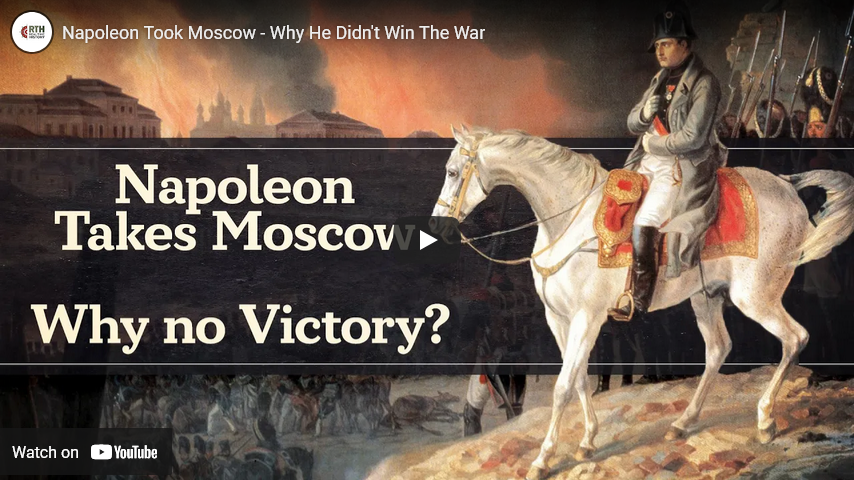
All-Out War Against Napoleon – The Grand Manifesto of Alexander I

Filed under: Europe, France, History, Military, Russia — Tags: , , , , , — Nicholas @ 04:00

Real Time History
Published 24 Mar 2022

Get Nebula and CuriosityStream in a great bundle deal: https://curiositystream.com/realtimeh…

In the beginning of Napoleon’s invasion of Russia, the Russian Tsar Alexander I was under pressure to rally his people. A month into the campaign he declared the The Patriotic War (ΠžΡ‚Π΅Ρ‡Π΅ΡΡ‚Π²Π΅Π½Π½Π°Ρ Π²ΠΎΠΉΠ½Π°) to fight back Napoleon — who was already having serious supply issues and a deteriorating logistics network.

Β» SUPPORT US ON PATREON
https://patreon.com/realtimehistory

Β» THANK YOU TO OUR CO-PRODUCERS
John Ozment, James Darcangelo, Jacob Carter Landt, Thomas Brendan, Kurt Gillies, Scott Deederly, John Belland, Adam Smith, Taylor Allen, Rustem Sharipov, Christoph Wolf, Simen RΓΈste, Marcus Bondura, Ramon Rijkhoek, Theodore Patrick Shannon, Philip Schoffman, Avi Woolf,

Β» SOURCES
Boudon, Jacques-Olivier. NapolΓ©on et la campagne de Russie en 1812. 2021.
Chandler, David. The Campaigns of Napoleon, Volume 1. New York 1966.
Clausewitz, Carl von. Hinterlassene Werke des Generals Carl von Clausewitz über Krieg und Kriegsführung. Siebenter Band, Der Feldzug von 1812 in Rußland, der Feldzug von 1813 bis zum Waffenstillstand und der Feldzug von 1814 in Frankreich. Berlin 1835.
Geschichte der Kriege in Europa seit dem Jahre 1792 als Folgen der StaatsverΓ€nderung in Frankreich unter KΓΆnig Ludwig XVI., neunter Teil, 1. Band. Berlin 1839.
Hartwich, Julius von. 1812. Der Feldzug in Kurland. Nach den TagebΓΌchern und Briefen des Leutnants Julius v. Hartwich. Berlin 1910.
Holzhausen, Paul. Die Deutschen in Russland 1812. Leben und Leiden auf der Moskauer Heerfahrt. Berlin 1912.
Lieven, Dominic. Russia Against Napoleon. 2010.
Mikaberidze, Alexander. “The Lion of the Russian Army”: Life and Military Career of General Prince Peter Bagration 1765-1812. PhD Dissertation, 2003.
Rey, Marie-Pierre. L’effroyable tragΓ©die: une nouvelle histoire de la campagne de Russie. 2012.
Robson, Martin. A History of the Royal Navy: the Napoleonic Wars. 2014.
Tagebuch des Kâniglich Preußischen Armeekorps unter Befehl des General-Leutnants von Yorck im Feldzug von 1812. Berlin 1823.
Zamoyski, Adam. 1812: Napoleon’s Fatal March on Moscow. 2005.
БСзотосный Π’. М. Россия Π² наполСоновских Π²ΠΎΠΉΠ½Π°Ρ… 1805–1815 Π³Π³. (Москва: ΠŸΠΎΠ»ΠΈΡ‚ΠΈΡ‡Π΅ΡΠΊΠ°Ρ энциклопСдия, 2014)
ΠžΡ‚Π΅Ρ‡Π΅ΡΡ‚Π²Π΅Π½Π½Π°Ρ Π²ΠΎΠΉΠ½Π° 1812 Π³ΠΎΠ΄Π°. ЭнциклопСдия (Москва: РОББПЭН, 2004)

Β» OUR STORE
Website: https://realtimehistory.net

Β»CREDITS
Presented by: Jesse Alexander
Written by: Jesse Alexander
Director: Toni Steller & Florian Wittig
Director of Photography: Toni Steller
Sound: Above Zero
Editing: Toni Steller
Motion Design: Toni Steller
Mixing, Mastering & Sound Design: http://above-zero.com
Digital Maps: Canadian Research and Mapping Association (CRMA)
Research by: Sofia Shiogorova, Jesse Alexander
Fact checking: Florian Wittig

Channel Design: Simon Buckmaster

Contains licensed material by getty images
Maps: MapTiler/OpenStreetMap Contributors & GEOlayers3
All rights reserved – Real Time History GmbH 2022
Jordan Peterson — noted collector of early Soviet art

Filed under: Cancon, History, Media, Russia — Tags: , , — Nicholas @ 03:00

Jordan Peterson is probably the second-most polarizing living Canadian — after Justin the Lesser, of course — but his collection of early Soviet art and propaganda posters is perhaps one of the more surprising things about him:

“Mother Russia” by topsafari is licensed under CC BY-NC-ND 2.0

I’ve been in homes that have displayed unusual artwork, including one house decorated in African-themed pieces that many would consider pornographic. But I don’t believe I’ve ever seen anything quite as unusual and unique as the art in Jordan Peterson’s home.

To be clear, I’ve never actually visited Peterson’s house. But his home and its artwork are described in some detail by Norman Doidge, who wrote the foreword to Peterson’s best-selling book 12 Rules for Life.

Doidge met Peterson in 2004 at a gathering hosted by mutual friends, a pair of Polish emigres who came of age during the days of the Soviet empire. At the time, Peterson was a professor at the University of Toronto, and he and Doidge β€” a psychiatrist and psychoanalyst β€” soon became friends. (Apart from their scientific interests, it seems the men shared a passion for the great books, particularly “soulful Russian novels”.)

Doidge visited Peterson on more than one occasion, and he describes the Peterson house as “the most fascinating and shocking middle-class home I had seen.” Among the fascinations was an impressive collection of unusual artwork.

“They had art, some carved masks, and abstract portraits, but they were overwhelmed by a huge collection of original Socialist Realist paintings of Lenin and the early Communists commissioned by the USSR,” writes Doidge. “Paintings lionizing the Soviet revolutionary spirit completely filled every single wall, the ceilings, even the bathrooms.”

Books and art can tell you a great deal about people, as I said, but one must be careful to not draw the wrong conclusions. Which invites an important question: Why was Peterson’s home covered in Soviet era artwork?

One might assume that Peterson was a socialist. Yet, this is not the case. Or maybe, one might guess, Peterson began gobbling up Soviet propaganda pieces following the fall of the Soviet Union simply as investment. (I wish I had possessed the foresight to buy up a bunch of vintage Soviet art following the fall of the Soviet empire; alas, I was only 12.) Perhaps, but this wouldn’t explain why it’s displayed throughout his home.

Fortunately, Doidge offers us an answer.

“The paintings were not there because Jordan had any totalitarian sympathies, but because he wanted to remind himself of something he knew he and everyone else would rather forget: that over a hundred million people were murdered in the name of utopia,” Doidge writes.

March 22, 2022

Russia’s historical expansionism

Filed under: Europe, History, Russia — Tags: , , , — Nicholas @ 05:00

Arthur Chrenkoff notes some plot points from his second novel, written in 2010, and the headlines from Ukraine over the last few weeks:

Russian expansion in Eurasia between 1533 and 1896.
Map originally from the Marxist Internet Archive via Wikimedia Commons.

Twelve years ago I wrote my second novel. The action took place in an Eastern European magic kingdom, superimposed in another dimension over what is, in this world, western Ukraine, south-east Poland, eastern Slovakia, and reaching down perhaps as far as the north-eastern corner of Hungary and the northern border of Romania. I named the kingdom after two historical regions, partly overlapping, by which this borderland of ethnicities and states had once been known. Last together as part of the Austro-Hungarian Empire, five independent nations now share the tectonic fault zone between Russia and the Orthodox Slavdom in the east and the Catholic Central Europe to the west.

One of the plots of the novel – titled Ruthenia & Galicia – revolved around the attempts by Russia to blackmail sections of the kingdom’s political establishment and destroy the country if unsuccessful.

If the plot sounds vaguely familiar today, I hasten to add I’m not claiming any prophetic abilities. While in 2010 Ukraine was largely at peace, two years prior Vladimir Putin briefly invaded Georgia in order to detach from it two separatist regions. In any case, the main point is that over the past five centuries, ever since overthrowing the Tartar yoke and consolidating under Ivan the Terrible, Russia has been an imperialist and expansionist power, which has repeatedly and consistently invaded, absorbed and dominated its many neighbours. Sadly, there is not much that is unusual about the current conflict in Ukraine; mid-17th century Poles, Ukrainians (to the extent there existed then any ethnic consciousness among the region’s peasantry), Cossacks and Muscovites would have been intimately familiar with the issues at stake.

Forget for a moment the Bidens, “globalists”, NATO, the “decadent West” and all other attempts to blame one’s own side first for, in effect, “provoking” Russia, and ask yourself why all of Russia’s regional neighbours, from Finland, through the Baltic states, Poland, Czechia, Slovakia, Rumania and beyond (Hungry and Serbia being two exceptions, the former contemporary political, the latter historical) are so fiercely opposed to Russia’s military actions and so supportive of Ukraine’s resistance against Putin’s aggression. Most of the historical Poland (which prior to WW2 included western Belarus and western Ukraine) had been, with small breaks, dominated, occupied and colonised by Russia (either as the centre of the empire or of the Soviet Union) for well over three centuries. Ditto for the Baltic states. Finland used to be a Russian vassal before WW1, fought Russia twice (in 1939-40 and 1941-44) and after the war had lent its very name to the concept of forced pro-Russian neutrality. Other parts of Central, Eastern and Southern Europe had only experienced Russian domination post-1945, as member states of the Warsaw Pact. Hungary and Czechoslovakia were at the receiving end of military interventions directed by Moscow; Poland almost was. Foreign policy realists like John Mearsheimer might argue for the unchanging reality of power politics in human history – from which point of view, a great power like Russia needs and will get a friendly or neutral buffer zone – but the states, which have the geographical and historical misfortune to exist within such buffer zone are by now well and truly over having to live in perpetual shadow and/or under the jackboot of an imperial power with delusions about its civilisational mission.

From that point of view, the challenge is not “de-Nazification” of Ukraine, whatever that means apart from being another example of Russia’s historical tendency, now also assumed by the Western left, of smearing everyone and everything it doesn’t like as Nazi (the Azov Battalion, whose heritage harks back to the Ukrainian collaboration with Hitler against Stalin, is a real problem – in an ideal world the Azov men and the pro-Russian Chechens would all kill each other – but as propagandictically exaggerated as attempts to portray the American right as a whole as white supremacists, bigots, extremists and terrorists). The true challenge is de-imperialising Russia.

This is perhaps a Sisyphean task. Former imperialist powers like Germany and Japan are now normal countries, liberal democracies, successful and prosperous economies and generally good international citizens. Arguably the reason for that can be traced to their unequivocal military defeat in WW2, large scale devastation and subsequent occupation, which forced a traumatic psychological reset. After “year zero”, the past was consigned to history and new society were born.

This has not happened in Russia. In fact, Russia today is much more reminiscent of Germany in the 1930s than Germany in the 1960s. Like the Imperial Wilhelmine Germany, Russia had lost the war – the cold one – without suffering a crushing military defeat or the indignity of foreign occupation. What the Versailles Peace was for the inter-war Germany, the dissolution of the Soviet Union has been for Russia – a disadvantageous and humiliating settlement, which resulted in imperial dissolution and has left millions of Russian speakers scattered beyond the borders of the Fatherland/Motherland. The newly independent states are illegitimate – both the Nazi Germany and the Soviet Union considered Poland a “bastard creation of Versailles”, just as Russian nationalists nowadays see the former Soviet republics and satellites as artificial entities that are rightfully Russia’s. If there are temperamental similarities between the Weimer Germany and Yeltsin’s Russia, Putin himself resembles Hitler circa 1938. Let us hope and pray he never graduates to 1939 and beyond (though some would argue that the invasion of Ukraine is worryingly analogous to the invasion of Poland at the start of WW2). For the international community, Russia of the past two and a bit decades represents the worst of all worlds: humiliated enough to be resentful but undefeated enough to remain unrepentant. Hence Putin can claim the fall of the Soviet Union to be the greatest tragedy of the 20th century (as opposed to both world wars or communism) and agitate for the de facto recreation of the Russian, if not the Soviet, empire.

Imperial Germany’s crushing military defeat (from the “Black Day of the German Army” through the Hundred Days to the Armistice) at the hands of the British, French, American, Canadian, and Australian forces on the western front … but stopped near the German border. The provisional government after the fall of the monarchy signed the armistice because the German army had been decisively defeated and was dissolving in the face of Allied pressure. Because the fighting didn’t penetrate into Germany proper — as it did in 1944-45 — this significantly helped solidify the myth that the Germany army had been “stabbed in the back” by the civilian government, which was so helpful to the Nazis during their rise to power.

March 21, 2022

M44 Submachine Gun: Finland Copies the Soviet PPS-43

Forgotten Weapons
Published 17 Nov 2021

http://www.patreon.com/ForgottenWeapons

https://www.floatplane.com/channel/Fo…

Cool Forgotten Weapons merch! http://shop.forgottenweapons.com

The kp/31 Suomi submachine gun in Finnish service was an outstanding weapon, but it was slow and expensive to manufacture. When Finnish forces began capturing Soviet PPS-42 and PPS-43 submachine guns from the Soviets in the Continuation War, it was very quickly decided that Finland should copy the design. This was a far simpler, far cheaper stamped sheet-metal design that was not as refined as the Suomi, but much more efficient to make.

The Sudayev design was changed only minimally; primarily to fit the Finnish cartridge (9x19mm Parabellum) and magazines. The guns were originally designed to use the 50-round quad-stack boxes and 71/72 round drums of the Suomi, but also used the Swedish Carl Gustaf m/45 magazine that was adopted by Finland after WW2.

Two companies were approached to produce the M44; Tikkakoski and Ammus Oy. Ammus was unable to source raw materials for the project, and only Tikka put the guns into production. Marshal Mannerheim initially wanted 50,000, but the order was reduced to 20,000 — of which only 10,000 were actually made, due to limited material availability before the end of the war led to production ending. Another 400 were assembled from remaining parts after the war.

In the 1950s, a plan was begun to resume M44 production in order to completely replace the Suomi in Finnish inventory. However, this plan was interrupted when Sam Cummings of InterArms made a deal to trade Finland about 75,000 surplus Sten guns for Finland’s supply of 7.35mm Carcano rifle (received as aid from Italy during the war) along with a melange of old machine guns. This was a sufficient quantity of Stens to handle the duties of the Suomi, and so the Sten went into Finnish service and M44 production was never resumed.

Those Carcano rifles were in turn imported into the United States, and this is why the majority of 7.35mm Carcano here bear Finnish “SA” property stamps. The same is true for the significant number of Chauchat automatic rifles in the US with Finnish property marks, which were also part of the deal.

Contact:
Forgotten Weapons
6281 N. Oracle 36270
Tucson, AZ 85740

March 20, 2022

Kharkov Falls Once Again – WW2 – 186 – March 19, 1943

World War Two
Published 19 Mar 2022

The British are attacking the Mareth Line in North Africa while the Americans hit the Axis flank, but the Allies are withdrawing in Burma. It’s the Germans who are pulling back in the USSR, though, and there is another attempt from within German command to assassinate Adolf Hitler.
(more…)

March 18, 2022

A Sign of Things to Come – Napoleon’s First Defeat in Russia 1812

Filed under: Europe, France, History, Military, Russia — Tags: , , — Nicholas @ 06:00

Real Time History
Published 17 Mar 2022

Β» SUPPORT US ON PATREON
https://patreon.com/realtimehistory

The Battle of Mir in 1812 was the first battle of Napoleon’s invasion of Russia. Polish Uhlans ride right into a trap set by Platov’s Cossacks and under the Russian summer sun a cavalry skirmish ensues.

Β» THANK YOU TO OUR CO-PRODUCERS
John Ozment, James Darcangelo, Jacob Carter Landt, Thomas Brendan, Kurt Gillies, Scott Deederly, John Belland, Adam Smith, Taylor Allen, Rustem Sharipov, Christoph Wolf, Simen RΓΈste, Marcus Bondura, Ramon Rijkhoek, Theodore Patrick Shannon, Philip Schoffman, Avi Woolf,

Β» SOURCES
Boudon, Jacques-Olivier. NapolΓ©on et la campagne de Russie en 1812. 2021.

Chandler, David. The Campaigns of Napoleon. 1978.

Dujil, Nicolas. “Les armΓ©es russes en 1812”, in Rey, Marie-Pierre and Thierry Lentz, eds. 1812, la campagne de Russie. 2012.

Kagan Frederick. Russia’s Wars with Napoleon 1805-1815. The Military History of Tsarist Russia (NY.: Palgrave, 2002).

Lieven, Dominic. Russia Against Napoleon. 2010.

Mikaberidze, Alexander. “The Lion of the Russian Army”: Life and Military Career of General Prince

Peter Bagration 1765-1812. PhD Dissertation, 2003.

Rey, Marie-Pierre. L’effroyable tragΓ©die : une nouvelle histoire de la campagne de Russie. 2012.

Zamoyski, Adam. 1812: Napoleon’s Fatal March on Moscow. 2005.

[Other Russian-language sources listed on the YouTube description]

Β» OUR STORE
Website: https://realtimehistory.net

Β»CREDITS
Presented by: Jesse Alexander
Written by: Jesse Alexander
Director: Toni Steller & Florian Wittig
Director of Photography: Toni Steller
Sound: Above Zero
Editing: Toni Steller
Motion Design: Toni Steller
Mixing, Mastering & Sound Design: http://above-zero.com
Digital Maps: Canadian Research and Mapping Association (CRMA)
Research by: Sofia Shirogorova, Jesse Alexander
Fact checking: Florian Wittig

Channel Design: Simon Buckmaster

Contains licensed material by getty images
Maps: MapTiler/OpenStreetMap Contributors & GEOlayers3
All rights reserved – Real Time History GmbH 2022
March 16, 2022

Two weeks into the Russian-Ukrainian War

Filed under: Europe, Russia — Tags: , , , — Nicholas @ 03:00

As you’ve probably noticed, I don’t post a lot of information about the progress of the Russian attack into Ukraine, not because it isn’t an incredibly dangerous and volatile situation but because the signal-to-noise ratio of available public source intelligence is lower than I ever expected (and I didn’t have high expectations to start with). My sympathies are largely with the Ukrainian civilians who have been caught up in a maelstrom of violence and my appreciation of abilities and achievements of the individual Ukrainian defenders has increased a great deal as this conflict continues. What Russian planners (and Putin himself) clearly expected to be a “short, victorious war” is turning out to be a much more difficult, much more costly struggle. Western politicians and diplomats have not covered themselves with glory and the western media have been shown to be inadequate to the task of providing anything like objective coverage of the war. American politicians grandstanding about imposing a “no fly zone” over Ukraine really need to be chased down by the white-coated orderlies with nets and gently brought back into the mental health facilities they clearly just escaped from: a no-fly zone is tantamount to a declaration of war, and a war between Russia and the US/NATO would very quickly go full-on nuclear. The only winners so far have been the official and volunteer propagandists for the Ukrainian government, who have overwhelmed the mainstream media and social media with their very persuasive tales and mediagenic stories.

Of course, it doesn’t help that Ukraine largely uses Russian-made equipment, so photos and videos of damaged tanks, smoking remnants of trucks and armoured personnel carriers, and other telegenic “news” can be presented as either side’s defeat in this or that skirmish. Kurt Schlichter wonders if we can have some “real talk” about Ukraine:

Time to get real. Ukraine is an equal opportunity crisis because it provides politicians of both parties a chance to be wrong, although it allows the Democrats the opportunity to do what they do best and be much, much more wrong. For the Republicans, it lets them indulge the desire of some to return to a time when America could focus its moral firepower – if not its firepower firepower – upon a readily-identifiable baddie like it did during the Cold War or the War on Terror. For the left, it allows them to create a moral panic to replace COVID, which, naturally, requires that we Americans “sacrifice” even more of our freedom and money.

From the perspective of someone who actually trained Ukrainian troops in Ukraine, commanded US forces, and attended the US Army War College – though it’s kind of the Chico State of war colleges – the whole way our elite is approaching the crisis is an epic clusterfark. Don’t believe anything anyone tells you – and certainly, sanity check whatever I’m telling you, too – most of these insta-experts on intra-Slavic conflict know absolutely squat-ski. Moreover, their remarkably dumb observations and credulous acceptance of conventional wisdom, which has proven long on conventional and short on wisdom, are being presented without any kind of strategic context. They don’t know where this crisis came from and certainly have no clear notion of where they want it to go beyond the vague and unhelpful idea that they want Putin (which they use interchangeably with Russia) to “lose” without knowing what that even means.

[…]

The expectation was that the Russian forces would smash through, surround the Ukrainian forces pinned down facing the Russians in the occupied regions to the east, and isolate the main cities. I did not expect them to go into the cities immediately since Russians 1) generally bypass hard defenses; 2) they have bad experiences with city fighting (Stalingrad, Grozny); and 3) that would not necessarily be necessary. It would not be necessary if the idea was to neutralize the main Ukrainian combat formations and force the government in the cities to capitulate, then have the West pressure the Ukrainians to accept a ceasefire and “peace” that recognized Russian gains and ended the idea of Ukrainian allying with the West. In fact, that is pretty much what the Russian “peace plan” consists of. But that did not work for a couple of reasons.

First, the Russians did not fight as well as expected. You should always treat the enemy as if it is the best possible enemy. We did in the Gulf. We prepared to fight elite Republican Guard divisions of highly trained and motivated soldiers using top-shelf Soviet equipment and tactics. None of that was so; we crushed an entire national army in 100 hours.

The Russians are poorly-led, with very weak synchronization among maneuver forces and fires. Their plan is okay – in fact, you look at a map, and it’s obvious what they would do. But their gear is badly-maintained, and their troops are unsuited to the task of supporting a rapid advance. Look at all the evidently intact gear simply abandoned by the side of the road. Lots of it looks like it broke down (note all the flat tires). Much of it seems to have run out of gas. And, of course, lots of stuff had been blasted apart.

That’s the second part of the equation – the Ukrainians fought back hard. If you are a Lord of the Rings nerd, think of the Ukrainians as the dwarves. Not super-sophisticated but tough and ready to fight, and also often drunk.

March 13, 2022

Rommel Leaves Africa – WW2 – 185 – March 12, 1943

Filed under: Africa, Germany, History, Military, Pacific, Russia, USA, WW2 — Tags: , , , , , — Nicholas @ 04:00

World War Two
Published 12 Mar 2022

Erwin Rommel loses his command and leaves Tunisia, while change in American command there puts George Patton in charge. On the ground the Axis lose the Battle of Medenine, but in the Soviet Union, Axis forces are on the move and heading for Kharkov.
(more…)

March 12, 2022

So much for all that “end of history” hopefulness

Filed under: Europe, History, Military, Russia — Tags: , , — Nicholas @ 10:40

I admit I never bothered to read Fukuyama’s The End of History and the Last Man, because I strongly disagreed with the notion — whether advanced by the author or imputed by critics and reviewers — that there ever could be an “end” to history, as long as there are still human beings around. Russia’s latest invasion of Ukraine seems to have also broken the spell for many other westerners, as Jen Gerson points out:

Screen capture of a 1990 CBC report on the first McDonald’s in Moscow.

[After recounting the tale of the very first McDonald’s to open in Moscow in 1990] by all accounts, Russians went wild for McDonald’s β€” as did much of the world β€” and hundreds have since opened, including one within walking distance of the Red Square. Nothing could better symbolize the end of the bad, old Soviet era than this. A Russia that is peaceful, prosperous and at least a little open to the West was one in which a worker from the Kremlin could grab an American hamburger at lunch.

At least, they once could.

McDonald’s this week was one of several Western companies to announce that it was temporarily halting operations in Russia in response to its invasion of Ukraine. Coca-Cola, Starbucks, KFC, Pizza Hut, Ikea, Shell, BP, Exxon, credit card companies, accounting firms, even airline companies are cutting Russia off, to greater or lesser extents.

I pick on McDonald’s because that chain became so ubiquitous that it has served as a kind of foreign policy truism: For a generation, it was said that no two countries that possessed a McDonald’s had ever gone to war. And so, it was assumed, this would likely remain the case. We’re not talking about skirmishes or civil wars, or local incursions or proxy wars, mind you. But the general theory largely held: as economies globalized and became more interdependent, the costs of one country truly going to war with another would grow so insurmountable that it would soon be unthinkable. Shared prosperity would reduce the need for wars of resources; meanwhile, the more economically interdependent nations became, the more self-defeating and even suicidal the prospect would grow. Economic liberalization and globalization would therefore undoubtedly bolster the long peace. For a generation this has, mostly, held true.

It is this same logic that has underpinned Europe’s growing dependence on Russia’s oil market, for example. After all, no one would risk β€” well β€” what Russia is now risking. It is certainly not in that country’s best interest to retreat into a hermit kingdom, to suffer incredible privations, and to revert to a quality of life akin to what its people knew in the ’50s. And for what? Glory? Honour? Territorial expansion? What, does Russia need more land?

This is why the war in Ukraine has caught Westerners off guard, and shook countries that once existed in the Soviet sphere of influence.

History was supposed to be over, when the Western democracies reached their ideal end-state of civilizational evolution. War β€” true, grand, civilizational war β€” was far too costly to seriously contemplate. So we allowed our military capacity to atrophy and our strategic dependencies on hostile nations grew.

With hindsight we can see the glaring flaw in the logic adopted by some of the world’s most powerful people. Those wingnuts and lunatics who warned about the danger of making ourselves more dependent on Putin proved correct. Note how quickly Canada’s safe, reliable, democratic oil supply is enjoying a rebrand. Shared prosperity is no panacea to war.

« Newer PostsOlder Posts »

Powered by WordPress