
World War Two
Published 27 Jul 2022Being allies does little to discourage Moscow from recruiting double agents in the British establishment. The most famous of them all, Kim Philby and the Cambridge Five, penetrate deep into MI5, MI6, and Bletchley Park. With friends like the NKVD, who needs enemies?
(more…)
July 28, 2022
The Posh Brits Betraying Their Country – WW2 – Spies & Ties 20
Comments Off on The Posh Brits Betraying Their Country – WW2 – Spies & Ties 20
July 25, 2022
Stalin, Hitler, and Churchill – Architects of Death – WAH 070 – July 24, 1943
Comments Off on Stalin, Hitler, and Churchill – Architects of Death – WAH 070 – July 24, 1943
July 24, 2022
After a Victory at Kursk, The Soviets Attack Everywhere – WW2 – 204 – July 23, 1943
World War Two
Published 23 Jul 2022The Allied invasion of Italy powers on and puts the future of a key axis power at play. In the USSR, the Soviets have learnt to deal with German offensives, as the Wehrmacht struggles to make a dent.
(more…)
Comments Off on After a Victory at Kursk, The Soviets Attack Everywhere – WW2 – 204 – July 23, 1943
QotD: British armour from BAOR to the first Gulf War
During the Cold War there was a clear threat in the form of the Soviet 3rd Shock Army, which was lined up, facing off against BAOR [British Army of the Rhine] units. It made an enormous amount of sense to contribute to a NATO operation to deter Moscow from chancing their luck, and ensure that they could not force the border and take over Western Germany.
To that end generations of British soldiers were stationed there training for a war that they hoped would never come. To this day there are still serving Cold War veterans who even into the late 1980s knew where they would deploy to, and the likely exact spot in the field or woods where they would dig their trenches and realistically be killed.
This force though was essentially a static one, designed to operate defensively and underpinned by an enormous static logistical and support network stretching from the Inner German Border all the way back to Antwerp and then the UK. The British Army was able to sustain armour in large numbers in part because it had the threat to face, the space to operate and the support network in place to enable this to occur. To this day the subject of how well supported BAOR was through the extensive rear communications zone efforts, and the widespread workshops (such as in Belgium) designed to repair and support UK units is not widely known or told, but deserves much greater recognition.
This matters because when people look back to the size of the British Army in 1990 and look at how many tanks we had then compared to now, they forget that the Army’s MBT capability was essentially a static garrison force waiting to conduct a defensive campaign against a peer threat where it expected to take heavy losses and probably operate very quickly in an NBC environment. It was not intended to be a deployable force capable of operating across the planet on an enduring basis.
This is why when people talk about how many tanks were deployed in 1991 to the Gulf War (some 220 Challenger 1’s were deployed) they forget that this was the first time since Suez that the UK had operated heavy armour overseas. It took many months to get this force into place, and it came at the cost of gutting the operational capability of the remaining BAOR units, who found their logistical support chains hammered in order to support the forces assigned to GRANBY.
The harsh, and perhaps slightly uncomfortable reality for the UK is that OP GRANBY required nearly 6 months of build up at the cost of gutting wider armoured warfare capability – proving that away from home, having 900 tanks is irrelevant if you are operating outside normal parameters and are having to effectively cannibalise or mothball most of them to keep 220 in the Gulf.
By contrast OP TELIC saw over 100 tanks deployed, but a significantly shorter lead in time for the deployment – testament to the significant investments made in the intervening period in logistical capabilities.
Sir Humphrey, “Tanks for nothing — Why it does not matter if the British Army has fewer tanks than Cambodia”, Thin Pinstriped Line, 2019-04-24.
Comments Off on QotD: British armour from BAOR to the first Gulf War
July 22, 2022
Why Did The First World War Break Out? (July Crisis 1914)
[My 2014 series on “The Origins of World War I” can be read here. Although I’d read a fair bit of history on the period, once I began researching the period, even I was surprised at how many different contributing causes there were.]
The Great War
Published 15 Jul 2022The assassination of Archduke Franz Ferdinand and his wife in Sarajevo on the 28th of June 1914 kicked off a crisis among the European Powers. Tensions that built up in the decades before erupted and in early August 1914 the world was at war. But what happened in these fateful July weeks 1914?
(more…)
Comments Off on Why Did The First World War Break Out? (July Crisis 1914)
July 21, 2022
Prime Minister Look-At-My-Socks shocked to discover that betraying an ally has consequences
In The Line, Andrew Potter outlines why the Ukrainian government is unhappy with Prime Minister Photo-Op’s decision to break the sanctions on Russia as a favour to Germany:
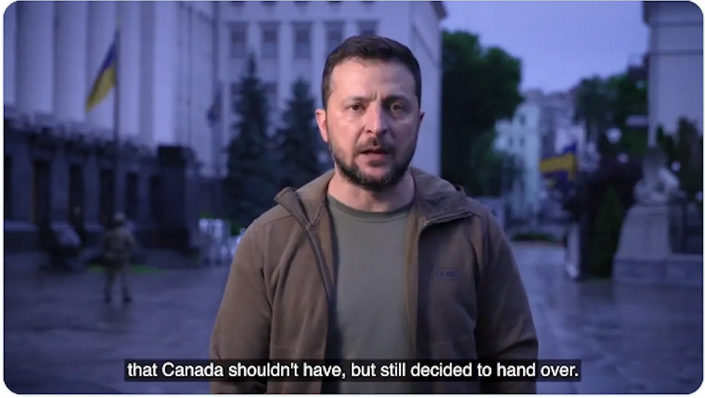
Well, one thing is for certain: There isn’t going to be a “Justin Trudeau Lane” anywhere in Ukraine any time soon.
In case you missed the drama last week, Trudeau found himself on Ukraine president Volodymyr Zelenskyy’s shit list after Canada announced, on July 9, that it would allow Siemens to return to Germany up to six gas turbines for the Nord Stream 1 pipeline that were being repaired in Montreal. Russia was threatening to shut down the pipeline and cut off the flow of gas to Germany, which is facing a very serious energy crisis.
In response, a furious Zelenskyy summoned Canada’s ambassador to Ukraine for what one presumes was a solid chewing out, after which the Ukrainian president posted a video in which he lit into Trudeau for “an absolutely unacceptable exception to the sanctions regime against Russia”. As Zelenskyy put it, the problem isn’t just that Canada handed some turbines back to Russia, via Germany. It is that it was a direct response to blackmail by Russia. And if Canada is willing to bend when its sanctions become politically uncomfortable, what is to stop other countries from carving out their own exceptions to their own sanctions, when it suits? Furthermore, Zelenskyy added, it isn’t like this is going to stop Russia from shutting down the supply of gas to Europe — the turbines were always just a pretext, an opportunity to cause strife and stir dissension amongst the countries allied with Ukraine against Russia.
Trudeau — who spent the weekend flipping pancakes at the Calgary Stampede — must have woken up on the Monday wondering what had gotten into his old buddy in Kyiv. After all, hadn’t Trudeau, along with other members of his cabinet, made it clear through their many, many tweets on the subject that Canada stood by Ukraine? Hadn’t Canada sent enough money, arms and humanitarian aid to Ukraine? Hadn’t Trudeau himself paid a visit to Kyiv in May, to re-open our embassy and to underscore just how seriously Zelenskyy should understand Canada’s commitment?
[…]
Ultimately, the problem here is a serious failure by Canada to manage Ukrainian expectations, brought about by the profound mismatch between the level of our rhetoric and the clear limits of our commitment. For Ukrainians, there is a moral clarity to the Russian invasion of Ukraine that, from a Western perspective, has not been present in any other conflict since the Second World War. Zelenskyy assumed that Canadians saw that. He assumed that if Ukrainians were going to be slaughtered, the least we could do would be to stick to our principles, even if it meant asking the population to suffer economic harms and the government to manage genuine political discomfort.
He assumed wrong.
Five months into their war for survival against the genocidal Russian regime, the Ukrainians have learned something important about Canadians: When it comes to our foreign affairs, we don’t mean what we say. When we say we stand with a country, that we fully support them, that we will help defend them or hold their enemies to account, there’s always a “but” or an “until” or an “unless”. We will stand with you, unless it’s politically difficult. We will help you, but not if it means genuine sacrifice. We will support you, until the costs get too high. Then, all bets are off.
The bigger point is this: Canada doesn’t do moral clarity anymore. Whether it is our business dealings with China, our arms sales to Saudi Arabia, or sending a diplomat to a garden party at the Russian embassy in Ottawa, we are always and everywhere hedging our bets, fudging our principles, letting down our allies.
July 18, 2022
Russian Invasion of Finland – The Winter War 1939-40
Mark Felton Productions
Published 24 Mar 2022Find out why Russia invaded neutral Finland in late 1939, and how the outnumbered and outgunned Finns managed to defend their country for 3 months until making peace with Stalin.
(more…)
Comments Off on Russian Invasion of Finland – The Winter War 1939-40
July 17, 2022
Who Let the Dogs Out?! – The Invasion of Sicily – WW2 – 203 – July 16, 1943
World War Two
Published 16 Jul 2022The Allies have begun their fight to take back Western Europe with Operation Husky. That’s not the only news though. They are also trying to extend their foothold in the Solomons, and Germany and the USSR continue smashing into one another at Kursk.
(more…)
Comments Off on Who Let the Dogs Out?! – The Invasion of Sicily – WW2 – 203 – July 16, 1943
QotD: When “the revolution” is in danger, resort to whatever will energize the masses
The problem with that, of course, is that Revolutionary France immediately found herself at war with the rest of Europe. Europe’s crowned heads have rarely been brainiacs, but again, anyone marginally saner than Robespierre saw immediately where the Declaration of the Rights of Man and Citizen was heading. They did the smart thing and invaded, which put the Enlightened in a real bind — war being the third most un-Enlightened thing ever. But they’d rather be hypocrites than dead, the Enlightened, so they had to knock together a new set of national symbols on the fly, ones men would fight and die for (absolutely no one was willing to bleed for “Reason”; whaddaya know).
To their credit, they did a hell of a job. La Marseillaise, Lady Liberty, La patrie en danger! … good stuff. It was part of Napoleon’s singular genius that he could turn these Roman Republic-inspired symbols into first his “consulship”, then his emperorship, but it didn’t have to go that way; Revolutionary France might’ve held out had the Littlest Corporal been killed in action. The important thing here is to note how effective such explicitly nationalist, indeed rabidly jingoist, symbols are, even when pushed by guys who not five minutes ago were proclaiming the Brotherhood of Man.
The Soviets did the same thing, and for the same reasons — look how fast “Workers of the world, unite!” became first the Molotov-Ribbentrop Pact, then the Great Patriotic War for the Fatherland – but they, too, went through an incredibly fecund period of inventing unifying symbols. Even though History has passed few clearer judgments than she has on Communism, you have to admit that as a symbol, the Soviet hammer-and-sickle is world class.
Severian, “Repost: National Symbols”, Founding Questions, 2021-10-27.
Comments Off on QotD: When “the revolution” is in danger, resort to whatever will energize the masses
July 14, 2022
Prokhorovka: An Avalanche of Armor – WW2 – 202 B – July 13, 1943
World War Two
Published 13 Jul 2022As dawn broke on 12th July 1943, the spearheads of the German II SS Panzer Corps and the Soviet 5th Guards Tank Army were shuffling into their positions. The battle of Zitadelle was entering a pivotal moment. Would the elite of the German Panzers finally achieve a breakthrough into open country? Or would the might of the Soviet Tank Army break them in a pre-emptive attack? The battle and fate of Operation Zitadelle was to be decided in front of a small village called Prokhorovka.
Special thanks to Jason Shafer, pattygman46 and QuinnTheSpin for their support during this episode’s premiere
(more…)
Comments Off on Prokhorovka: An Avalanche of Armor – WW2 – 202 B – July 13, 1943
July 13, 2022
The Irish Fighting for Britain, Mexico’s Role in the War, and Chuikov in Uranus – WW2 – OOTF 27
World War Two
Published 12 Jul 2022How many Irishmen are fighting for Britain and why? And what did Chuikov do during Operation Uranus? And what role has Mexico played in the fighting so far? Find out the answers to these fascinating questions in our latest edition of Out of the Foxholes!
(more…)
July 12, 2022
Kursk, When Titans Clash – 202 – July 9, 1943
World War Two
Published 10 Jul 2022Adolf Hitler launches his huge summer offensive in the USSR, Operation Citadel, known as the Battle of Kursk. Men in the millions clash. The Allies’ New Georgia campaign continues in the Solomons, both on land and with fighting at sea this week, and the preliminary actions begin for the Allied invasion of Sicily, scheduled to go off tomorrow.
(more…)
Comments Off on Kursk, When Titans Clash – 202 – July 9, 1943
July 11, 2022
Troop Deployments for the Battle of Kursk – WW2 Special
World War Two
Published 9 Jul 2022Over the last few weeks entire cities-worth of troops along with all the logistical support needed to support them have gathered in and around the Kursk salient. Here’s how they’ve been deployed, and where they could go from here.
(more…)
Comments Off on Troop Deployments for the Battle of Kursk – WW2 Special
July 8, 2022
The Russian way of war
In First Things, George Weigel identifies what we’ve learned about the Russian “way of war” from the ongoing conflict with Ukraine:
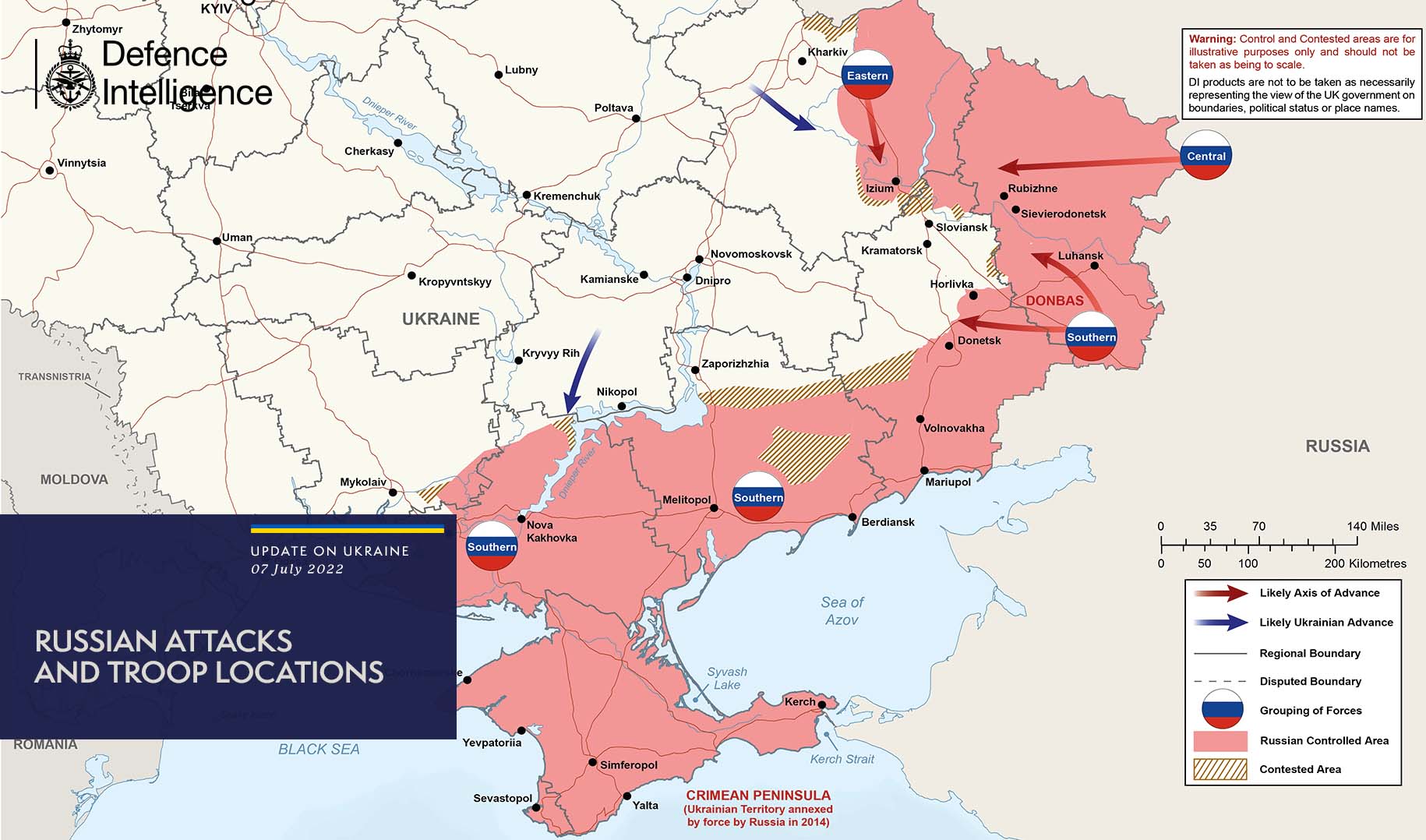
Four and a half months after Russia invaded Ukraine on the Orwellian pretext of displacing a “Nazi” regime — a regime that enjoys a democratic legitimacy absent from Russia for two decades — what have we learned about, and from, the Russian way of war?
We have learned that the Russian way of war is inept strategically, tactically, and logistically: an army using inferior equipment, bereft of competent non-commissioned officers, and replete with ill-trained draftees; an army that relies on brute force to bludgeon its way toward its objectives. We have learned that the Russian way of war willfully obliterates cities and deliberately destroys economic infrastructure. We have learned that the Russian way of war targets hospitals and schools, cultural and educational institutions, churches, synagogues, and mosques in an attempt to eradicate a culture and a nation that Russian president Vladimir Putin insists has no right to exist, save as a Russian vassal. Thus the twenty-first-century Russian way of war breathes the spirit of eighteenth-century imperialism, with President Putin comparing himself to that quintessential Russian imperialist, Peter the Great, and telling schoolchildren asked to name Russia’s borders in a geography bee that “the borders of Russia never end”.
We have learned that the Russian way of war is insensible to casualty rates, its own army’s and Ukraine’s. We have learned that the Russian way of war includes abandoning the Russian dead or disposing of their remains in mobile cremation units, so that body bags don’t flood the home front and raise questions about the wisdom of Putin and his generals. We have learned that the Russian way of war includes the humiliation, torture, and probable execution of prisoners of war. We have learned that the Geneva Conventions on the humane treatment of POWs mean no more to the Russian military and its political masters than does the Fifth Commandment.
We have learned that the Russian way of war includes the use of cluster munitions and unguided missiles specifically forbidden by international law. Thus the Russian way of war systematically violates the two in bello (war-fighting) principles of the just war tradition: proportionality of means (no more force than necessary to achieve a legitimate military objective) and discrimination (non-combatant immunity). We have learned that the Russian way of war features widespread rape, gross theft, and the summary execution of civilians, as well as kidnapping civilians in Russian-occupied territories, relocating them, and attempting to coerce them into renouncing their Ukrainian allegiance.
We have learned that the Russian way of war includes illegal blockades of Ukrainian ports to prevent grain shipments, thus threatening starvation in Third World countries. We have learned that the Russian way of war includes energy blackmail, threats of nuclear-weapons use, and blatant bullying of other countries, including Lithuania and Kazakhstan.
Comments Off on The Russian way of war
July 3, 2022
Tougher than Guadalcanal: New Georgia – 201 – July 2, 1943
World War Two
Published 2 Jul 2022The Allies begin the next phase of their Solomon Islands offensives, the invasion of New Georgia, even as the regional fighting continues on New Guinea. Adolf Hitler schedules his summer Kursk offensive for July 5th, and the Allied invasion of Sicily is set for July 10th.
(more…)
Comments Off on Tougher than Guadalcanal: New Georgia – 201 – July 2, 1943


