
When leftists look at the private sector, they see tips of icebergs – for every businessperson caught gouging the consumer, they insist there are a thousand under the surface waiting to trap the unwary. Whereas a libertarian like myself sees the mirror image – the odd bad civil servant caught is not a rotten apple as they claim, but the tip of another large iceberg.
Surely we have seen enough to know that large organisations like the government and their crony capitalists in the corporate sector are deeply resistant to independent investigations, whistleblowers and all other genuine threats to their status?
Whereas those that battle away in the competitive private sector don’t even get the chance to be that corrupt – they either treat their customers and employees well, or they crumble into dust like the costumed retards in the entertainment industry are doing so reliably these days, those beloved of progressive dunces the world over.
There are few cover-ups in the world of dogwalking and fishmongering – these people do a good job or they get told to piss off by their customers. But in the public sector and the corporate world that depend upon it …?
When we catch a corrupt civil servant or corporate lackey, we are seeing the Tip of An Iceberg. But when we catch a corrupt landscape gardener or carpenter, we are finding a Rotten Apple.
My claim is that terrible government officials and corrupt crony capitalists are the both the tips of icebergs, so the cries from Left and Right about rotten applies need to go away. Those that work in the public sector or depend upon their relationship with it, are routinely terrible and usually without consequence.
Alex Noble, “Corruption In The Coercive And Voluntary Sectors: Rotten Apples? Or The Tips of Icebergs?”, Continental Telegraph, 2019-12-02.
July 16, 2024
QotD: Corruption and crony capitalism
July 15, 2024
Revisiting the “official” story of Srebrenica
Niccolo Soldo’s weekly roundup includes a look at the differences between the story the media told us about the Srebrenica massacre and what has come to light since then:
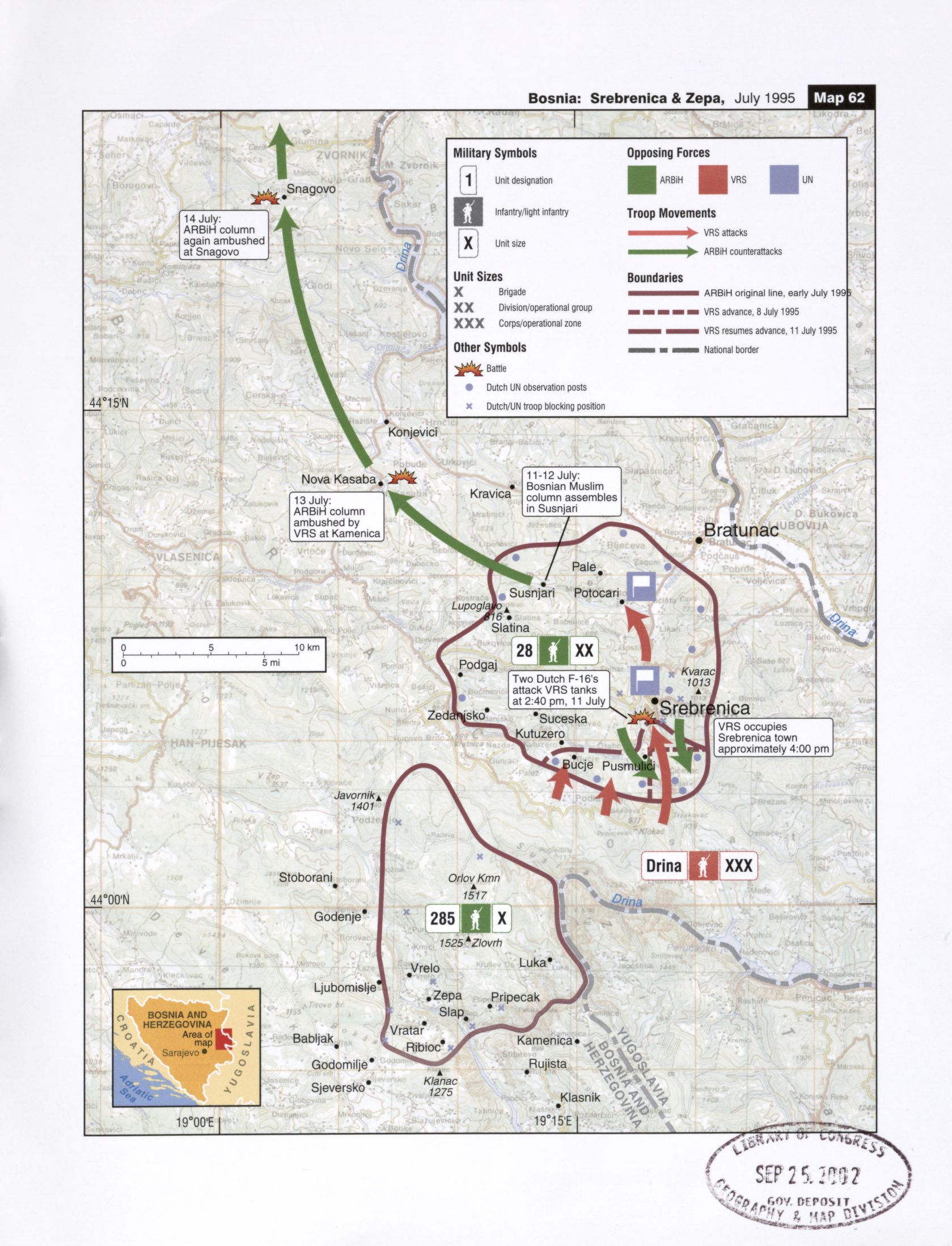
Map of military operations on July, 1995 against the town of Srebrenica.
Map 61 from Balkan Battlegrounds: A Military History of the Yugoslav Conflict; Map Case (2002) via Wikimedia Commons.
29 years ago this week, Bosnian Serb forces of the VRS managed to seize the town of Srebrenica in Eastern Bosnia, on the border with Serbia. A massacre of Bosnian Muslim males ensued shortly thereafter, and the narrative of genocide sprung forth quickly from it, giving cause to NATO’s intervention in that conflict.
Did a massacre occur? Certainly. Some 2,000 Bosnian Muslim males were summarily executed by Bosnian Serb forces around Srebrenica shortly after the UN-designated “safe haven” fell to the Serbs. Some 8,000 Bosnian Muslims lost their lives in the immediate aftermath of the fall of Srebrenica, but the narrative of “genocide” whereby all 8,000 were executed is simply not true as per John Schindler, the then-Technical Director for the Balkans Division of the NSA:
Twenty-nine years ago today, the Bosnian Serb Army captured Srebrenica, an isolated town in Bosnia’s east that was jam-packed with Bosnian Muslims, most of them refugees. This small offensive, involving only a couple of battalions of Bosnian Serb troops, soon became the biggest story in the world. What happened around Srebrenica in mid-July 1995 permanently changed the West’s approach to war-making and diplomacy.
The essential facts of the Srebrenica massacre are not in dispute. The town was a United Nations “safe area” but U.N. peacekeepers there, an understrength Dutch battalion, failed to protect anyone. Over the week following Srebrenica’s quick fall, some 8,000 Bosnian Muslims, almost all male, a mix of civilians and military personnel, were killed by Bosnian Serb forces. About 2,000 disarmed Bosnian Muslim prisoners of war were executed soon after the town’s capture. The rest died in the days that followed, all over eastern Bosnia.
As the world learned the extent of the massacre, by far the biggest atrocity in the Bosnian War that had raged since the spring of 1992, Western anger mounted. Six weeks later, President Bill Clinton ordered the Pentagon to bomb the Bosnian Serbs in Operation Deliberate Force, the first major military action in NATO’s history. By the year’s end, the war was concluded by American-led diplomacy.
Here are Schindler’s conclusions:
That for three years, Srebrenica, supposedly a U.N. “safe area,” served as a staging base for Bosnian Muslim attacks into Serb territory. The Muslim military’s 28th Division regularly attacked out of Srebrenica. Bosnian Serbs claim they lost over 3,000 people, civilian and military, to those attacks.
That the Bosnian Muslim commander at Srebrenica, Naser Oric, was a thug who tortured and killed Serb civilians (he showed Western journalists footage of his troops decapitating Serb prisoners), as well as fellow Muslims he disliked. Mysteriously, Oric fled Srebrenica three months before the town’s fall, leaving his troops to die.
That most of the Bosnian Muslim dead, some three-quarters of them, died not at Srebrenica but during an attempted breakout by troops of the 28th Division to reach their own lines around Tuzla. They showed little communications discipline, and Bosnian Serb forces called down their artillery on them, columns of Muslim military and civilians together, slaughtering them. This doesn’t meet any standard definition of genocide.
That the Muslims were flying weapons into the “safe area” by helicopter in the months before the Bosnian Serb offensive. (Controversially, the Pentagon knew this was happening but pretended it didn’t.) The Serbs repeatedly protested to the U.N. about this violation, to no avail. This was the reason for the offensive to take the town.
There’s also convincing evidence that the Muslim leadership in Sarajevo knew Srebrenica would be attacked and allowed it to fall. Their leader, Alija Izetbegovic, stated that if Srebrenica fell, the Serbs would massacre Muslims as payback, and America would intervene on the Muslim side in the war. He was right.
Some of you may not like what John has to say here about Gaza and how it relates to Srebrenica:
This isn’t merely a historical matter. What happened in Bosnia is being repeated today in Gaza. Western journalists uncritically accept Muslim claims about war crimes and “genocide” to smear a Western state that’s at war with radical Islam.
Here the strange ideological affinity between jihadists and the Western Left plays a role, as it did during the Bosnian War as well. No claims of war crimes, which possess great political value on the world stage, should be accepted without independent confirmation. Srebrenica should have taught Western elites this essential truth, but it didn’t.
On a personal note, I like to bring up Srebrenica to Serbs as an example of how media shapes narratives that are often very remote from the truth in the hope that they understand what I am saying in a wider context.
Fun fact: Srebrenica translates into “Silverton”, as it was a significant silver mining town during the late Medieval era, with imported Saxons running the show.
July 14, 2024
Japan’s New Defense plan, 100 million dead – WW2 – Week 307 – July 13, 1945
World War Two
Published 13 Jul 2024Japan is aware that soon enough the Allies will invade the Home Islands, and they will mobilize absolutely everything and everyone they can for their defense plan, “The Glorious Death of the 100 Million”. In the meantime, Allied carrier forces keep hitting them, the Australian advance on Borneo continues, the Chinese advance on Guilin continues, the Allied rebuilding of Okinawa continues, and American preparations are nearly complete for a test detonation of an atomic bomb.
(more…)
Britain’s First Naval Defeat in 100 years – Coronel 1914
Historigraph
Published Sep 26, 2020
QotD: Method acting
Mark Steyn, “Charlie and the Chocolate Factory”, The Spectator, 2005-07-30.
July 13, 2024
The BBC – the Biased Broadcasting Corporation
Like Canada’s CBC, the BBC considers itself to be more than just a TV, Radio, and online broadcaster. From its founding in the early 1920s, the BBC has taken upon itself the role of teacher, moral example, and moulder of public opinion. The BBC has always been more progressive in most senses than the British public (as the CBC has been in Canada), but over the last few decades, the BBC has been hurtling leftward on gender issues faster than ever before:

Complaints about BBC impartiality are nothing new. The state broadcaster has a kind of constitution in the form of its Royal Charter, by which it is required to maintain due impartiality in its news reporting and when it comes to controversial subjects. But does it succeed?
In holding politicians from the left and the right to account in its reporting, accusations of bias are always likely to occur. Some people claim the BBC is inherently left-leaning, others claim it is inherently right-leaning. It really depends on your perspective. For my part, I believe that BBC does a generally good job — with a few notable lapses — when it comes to political impartiality.
However, where I think it clearly fails is in regard to its ideological impartiality. When it comes to the ideology of Critical Social Justice, what has become known colloquially as the “woke” movement, the BBC in my view clearly suffers from an extreme bias. This explains why so many people no longer trust its reporting.
I know from personal anecdotes from employees at the BBC that there is a kind of internal struggle going on to overcome the problem, but nobody I have yet spoken to denies that the organisation is ideologically captured. And we can all see it for ourselves. You might have seen the educational film by the BBC called Identity – Understanding Sexual and Gender Identities, aimed at 9 to 12 year-olds, which claimed that there are “over 100 gender identities”.
Where is the balance there? Why is the BBC making pseudo-religious proclamations to children as though they were uncontested fact?
[…]
But perhaps most damning of all is the question of the WPATH Files. In March of this year, a series of internal documents and videos from the World Professional Association for Transgender Health were leaked to journalist Michael Shellenberger. As Mia Hughes’s report for the Environmental Progress think tank revealed, these leaks showed that members of the world’s leading global authority in gender treatment were engaging in medical malpractice.
There are messages proving that surgeons and therapists are aware that a significant proportion of young people referred to gender clinicians suffer from mental health problems. They reveal that some specialists associated with WPATH are proceeding with treatment in the knowledge that no consent has been secured from either the children or those directly responsible for their wellbeing. They have also withheld from patients details of potential lifelong complications, or continued down this path knowing that the children do not understand the implications. And the WPATH Standards of Care are the go-to policies for gender treatment throughout the world, and have been influential in our own NHS.
[…]
And yet if you search for the WPATH Files on the BBC News website, what do you find? Precisely nothing.

Did you blink and miss Gender Empathy Gap Day?
Don’t worry, unlike so, so many other formal days (or months, or seasons …) in the calendar devoted to this or that or the other real and imagined causes, celebrations, or acknowledgements, Gender Empathy Gap Day isn’t observed anywhere:
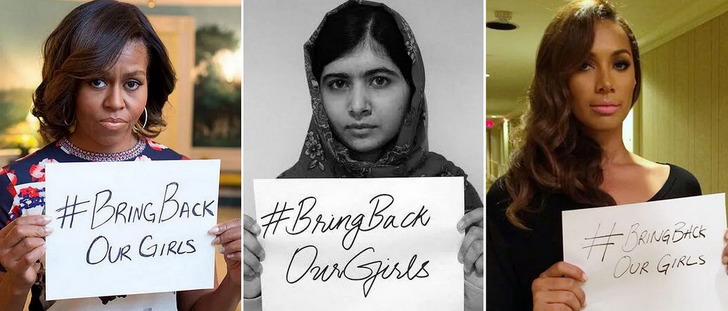
Remember these examples of virtue signalling? Can you imagine them doing the same for boys or young men?
Image from The Fiamengo File.
Few people have heard of Gender Empathy Gap Day, a day inaugurated in Germany in 2018 to raise awareness about our societies’ remarkable indifference to the suffering of men and boys. Not surprisingly, it has no official status in any country.
Most people, if asked, will insist that it is women and girls who suffer. We expect men and boys to apologize for their advantages and educate themselves about issues affecting women and girls. Animus against men is socially acceptable, even approved. “I bathe in male tears” is a popular feminist slogan, and university professors write mainstream opinion pieces with unironic titles like “Why Can’t We Hate Men?”
The Gender Empathy Gap Day doesn’t advocate a contest over which sex has it worse. It does advocate recognition of our collective inability or unwillingness to see the full humanity of men.
Academic researchers Alice Eagly and Antonio Mladinic have compiled data showing that both females and males tend to have more positive associations with women than with men. Researchers have also confirmed a much higher in-group bias amongst women, meaning that women feel more empathy towards other women than towards men, while men also feel more empathy for women.
Whether it’s homelessness (61% male), homicide (78% male victims), suicide (79% male), workplace fatalities (93% male), prison incarceration (93% male), or a host of other issues, men and boys do suffer. Yet according to the research of Dr. Tania Reynolds, we tend to associate agency with maleness and the capacity for victimhood with femaleness, seeing men and boys as active doers rather than as sufferers deserving concern.
As a result, we are tolerant of harsh punishments for male criminal offenders, but not for women. In 2012, Sonja Starr, a professor of Law, published the results of her study of discrepancies in criminal sentencing that showed a very large gender gap in the punishment of women for the same crimes committed by men. Starr’s extensive study found an average 63% sentencing gap that harshly disadvantaged men. She also discovered that “Female arrestees are […] significantly likelier to avoid charges and convictions entirely, and twice as likely to avoid incarceration if convicted”.
The gap in punishment results because we all — including prosecutors, judges, and juries — incline to the belief that women who commit crimes were led into their law-breaking by others, usually men, and had limited choices because of poverty, childhood abuse, mental illness, or addiction. We hesitate to deprive young children of the care of their mothers, while we are content to see fathers behind bars. As Starr points out, however, male offenders have also “suffered serious hardships, have mental health or addiction issues, have minor children, and/or have ‘followed’ others onto a criminal path”.
Author Glen Poole has noted that such indifference to male difficulties is built right into the stories our society tells about itself. He points out that when a large number of men are killed — whether in war, accident, or natural disaster — mainstream news sources report on people killed, making the sex of the victims invisible. It is not news when men and boys die.
When women or girls are killed or harmed, they are rarely if ever referred to as people. Their suffering is news.
The real story of Henry Hook, VC – Zulu
The History Chap
Published Nov 23, 2023Henry Hook, VC, 1850-1905. Zulu — the Battle of Rorke’s Drift.
Henry Hook was one of 11 defenders at the mission station at Rorke’s Drift (battle of Rorke’s Drift, Anglo-Zulu War 1879) who were awarded the Victoria Cross. Controversially, his character was misrepresented in the 1963 film Zulu. His character, played by James Booth (1927-2005), was depicted as an insubordinate barrack-room lawyer, a drunk and a malingerer. This was far from the truth.
Hook was actually a model soldier, who was teetotal, and who would serve as a regular and volunteer for over 40 years. His family were upset by the film, although contrary to popular stories, there is no evidence that Henry Hook’s daughters walked out of the [movie’s] premiere.
Nevertheless, in this video I aim to share his real story. Not just of his service in the army (and at Rorke’s Drift) but of a humble man from Gloucestershire, who returned home to find his wife had run off with another man, who found love for a second time and who worked in the British Museum.
Where is Henry Hook buried? Henry Hook’s grave can be found at St. Andrew’s church in the hamlet of Churcham, Gloucestershire. it is about five miles west of Gloucester.
0:00 Introduction
1:26 Early Life
3:10 Rorke’s Drift
3:56 Zulu
5:00 Defending The Hospital
7:45 Assegai wound
9:47 Making Tea
10:23 Victoria Cross
11:07 After Rorke’s Drift
13:11 Failing Health
15:10 The History Chap
(more…)
July 12, 2024
The British prison system is over-capacity, and Starmer’s new government has a plan
As Ed West points out, the new Labour government’s plan is to move in a different direction than most Britons were hoping:
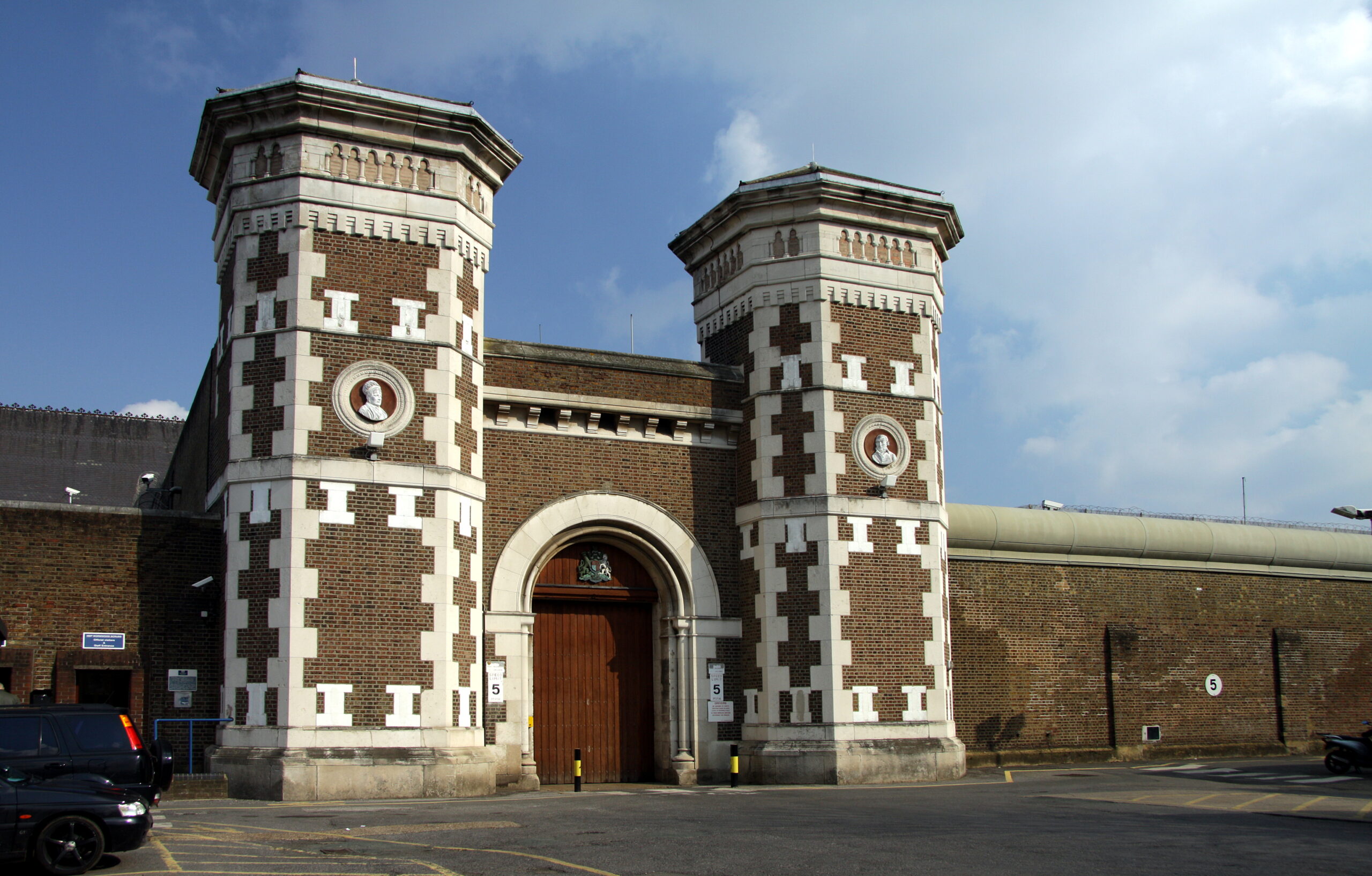
“Main gate to the HM Prison Wormwood Scrubs in spring 2013” by Chmee2 is licensed under CC BY-SA 3.0 

 .
.
Britain’s prisons are desperately overcrowded and morale among staff at an all-time low, following years of underfunding by the Conservative government and the inability of the state to build new jails against local opposition.
Now the incoming prime minister says that we have too many prisoners, while new prison minister James Timpson believes the British justice system is “addicted to punishment”, stating that only a third of inmates should be in jail.
The justice secretary, meanwhile, is considering “lowering the automatic release point for prisoners to less than 50 per cent through their sentence”. While currently prisoners serve half their sentences, or two-thirds for some sexual, violent or terror-related offences, the government plans to push the automatic release point to 40 per cent of their terms for those serving less than 4 years, benefitting 40,000 inmates — but not necessarily benefitting the rest of us.
This would be a very unwise move. The majority of prisoners are inside for sexual or other violent crimes, and even restricting early releases to those serving under four years would set free some very dangerous individuals, while previous amnesties of this type have led to huge increases in crime.
The idea that Britain “is addicted to punishment” jars with the sentences regularly handed out even for the most horrendous crimes, and the way that incorrigible criminals are allowed to offend again. This is the subject of a Twitter thread which I began six years ago, in order to highlight how the common belief in the punitive state was mistaken.
As an illustration, and bear in mind that their “sentences” are often twice what they actually served, here are a few cases:
A man who killed his wife in 1981, who was released after a few years and went on to strangle a girlfriend 12 years later, was subsequently freed — and ended up killing a third woman.
There was serial rapist Milton Brown, who was sentenced to 21 years for raping three women – one of whom took her own life – and was released early, only to rape again.
Or Joshua Carney, 28, freed on licence from prison and who just five days later brutally raped a mother and her 14-year-old daughter. He was allowed out despite 47 previous convictions, and now having been convicted of “13 charges including rape, attempted rape, actual bodily harm and theft” he is still eligible for parole in 10 years. Doesn’t sound like a country addicted to punishment.
There was John Harding, who treated a woman “like a rag-doll” when he beat and threatened to kill her after she told him she didn’t want a relationship. Despite terrorising his victim, including wrapping a sheet around her neck, and being in breach of a 30-month community order for a number of offences, including assault and threatening to kill another woman, and having other convictions for theft and criminal damage, he received a sentence of 21 months. As a result, in 2023, Harding was free to rape two women. Now convicted of rape, actual bodily harm, false imprisonment, strangulation and threats to kill, his sentence of 15 years means he could be out in 10.
If you believe that criminals only behave that way because of “systemic racism” or “poverty” or some other form of impersonal forces, you’ll likely also believe that punishment therefore serves no useful purpose and be in favour of all sorts of alternatives. At least until you or someone close to you is a victim of violent crime …
They’ll confidently claim they’re merely “anti-Zionist“
James Pew on the disturbing rise of antisemitism in all western nations that got turbocharged by the October 7 atrocities by Hamas terrorists against Israeli civilians on the Gaza border:
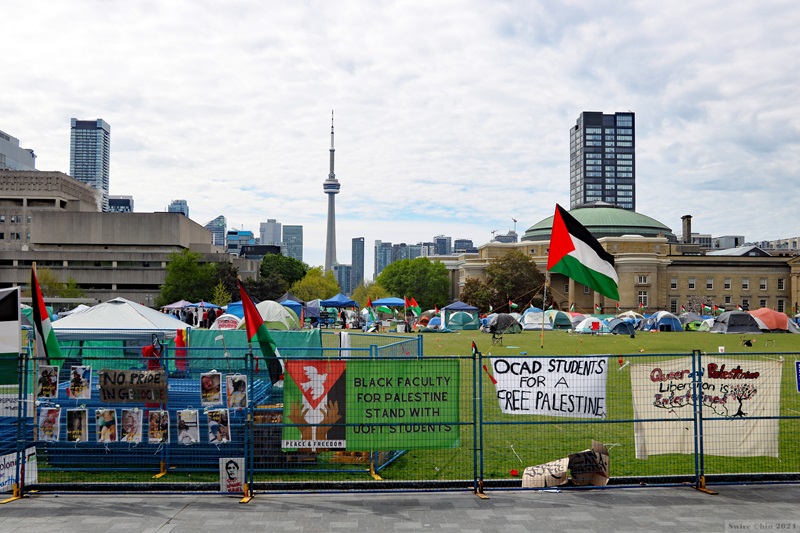
“Student encampments – UofT – Camping at the university” by Can Pac Swire is licensed under CC BY-SA 2.0 .
Jew hatred in this country, and around the world, is something I completely miscalculated. Like so many others, including many Jewish people, I naively thought that antisemitism was a thing of the past. Or at least, it was something that had been greatly diminished to the extent that it ceased to be much of a problem. Tragically, I was wrong about this.
The global expansion of Islamo-fascism and the mixing of pro-Jihadism with leftist critical social justice activism, is something I also, similarly, underestimated.
When I think of October 7th I am overcome with disgust and sadness. The world should be aligned with Israel, and aggressively opposed to Palestine/Hamas (Hamastinians) and the corrupt United Nations Relief and Workers Agency (UNRWA). That in many cases it appears to be the other way around, that many political leaders, media, and insufferable celebrities support Hamas’ terrorist aspirations, their evil nonsensical movement to wipe Israel off the face of the planet, is something that is incomprehensible to me.
In one of the late Rex Murphy’s final National Post columns, he proclaimed that “Hatred of Israel is the great moral disorder of our time”. Placing the blame for the “red-ignorant core” of the post-October 7th rise in antisemitism on “woke campuses”, Rex wrote the following concerning the legitimacy of the state of Israel:
Dear Israel is but a spit of earth on a huge globe. Three years after six million Jews were put to torture, humiliation, whippings, rape, medical experiment, starvation, and vile death, was it not surely time — time for all the nations of the Earth who had reached some moral understanding of life and government — to allow Jewish people time to rest, time to mourn, time to see what and who might be left of them.
While I’m the first to admit that no nation, including Israel, is beyond criticism, I feel there is both a time and place, and an appropriate proportionality that should be reflected in a fair critical analysis of any nation. When Douglas Murray made the point at the recent Munk debate that no serious person ever questions the legitimacy of the nation of Pakistan — a nation founded in a way similar to Israel — like they question and challenge the legitimacy of Israel, so-called anti-Zionists claimed that the audiences’ embrace of Murray’s logic was simply evidence of their Islamophobia.
Murray expanded on his Pakistan/Israel comparison by asking the audience to imagine someone who feels that Pakistan is not legitimate and therefore should not exist at all. Imagine also, that this person holds no antipathy directed at the Pakistani people. Preposterous! Yet the anti-Zionists ask us to believe this in regards to Israel. The anti-Zionist will look you straight in the eyes, and with all the sincerity in the world, express their belief that Israel should not exist, and absurdly, implore this does not mean they hate Jews (the majority of Israelis). Why in the case of an analogy where Pakistan is at stake, is it so clear which position is the correct and moral one? Alternatively, why are such questions involving Israel so difficult to answer?
In Canada, the increase in antisemitism has been going on for years. Record levels of antisemitism were recorded in 2021, with dramatic increases in Quebec and British Columbia.1 B’nai Brith Canada reported the number of antisemitic incidents across the nation more than doubled from 2022 to 2023, now reaching an unprecedented high.2
In February of 2024, Global Media reported that “Homes, businesses, schools, places of worship, neighbourhoods and institutions have all been targeted in what community leaders are calling an unparalleled spike in hate crimes against Jews”. And the Toronto Police warned the following month that “56% of reported hate crimes in 2024 have targeted Jewish people”.3
None of this distracts Canadian Islamists, like Younus Kathrada, from what they feel are the important social issues. Kathrada has been known to the government’s Integrated Terrorism Assessment Centre since at least 2020.4 He preaches to his Islamic followers in British Columbia, “I want our children to understand this well: the non-Muslims are the enemies of Allah, therefore they are your enemies”.5
July 11, 2024
In Germany, flying your national flag in June is considered a “grave offence against the human dignity” of the LGBT community
For reasons that I hope I don’t need to go into in any depth, displays of patriotism in Germany are viewed with deep suspicion by progressives and the various state and national government agencies. Even doing something like displaying the German national flag in any context other than a football match can draw official condemnation:
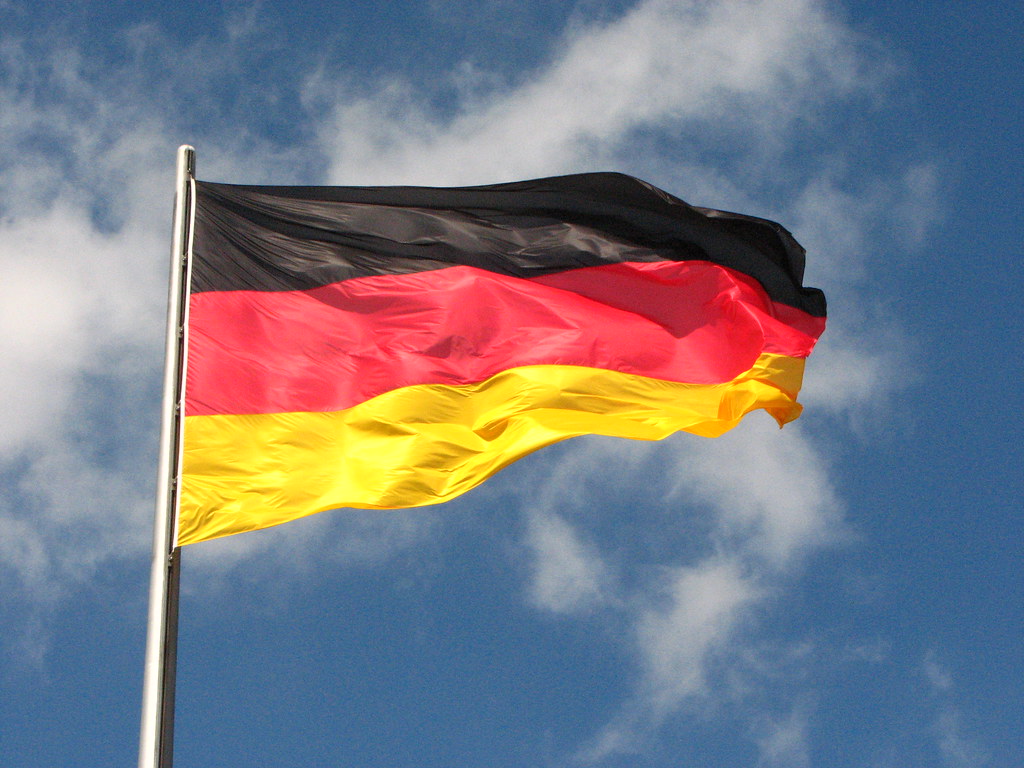
Many readers may not know about the German Stolzmonat, but I promise the backstory is worth it, so please bear with me.
As all of you do know, via some opaque imperial decree, every June across the Western world has become the monstrosity known as “Pride Month”. It is an occasion for the raucous celebration of every sexual minority and deviant proclivity imaginable. There are rainbow flags, lewd street parades, bizarre political speeches and all manner of astroturfed queer activism. I’m told that the festivities were massively scaled back this year in the Anglosphere, perhaps because they are awkward for elections, but on the Continent all such trends arrive very late and we had nothing but the usual excesses.
The eager flying of the rainbow colours is especially obnoxious in Germany, where the display of one’s national flag – except perhaps in a sports context – is discouraged and politically suspect. Some Germans have therefore responded to the perennial irritation of Pride Month by declaring June to be “Stolzmonat” instead. “Stolzmonat” is merely the German translation of “Pride Month”, but our clever cultural hackers have appropriated the term to indicate not gay but national pride. Those who celebrate Stolzmonat do not conduct any lavish public events and they give no speeches. Most of them simply change their social media profile pictures to present the colours black, red and gold. Now and again they also tweet the hashtag #Stolzmonat.
It’s primarily a German act of social media protest, but anybody can participate:
Enough people observe Stolzmonat to cause the corresponding hashtag to rise to the top of Twitter trends now and again. This has given the Rainbow Brigade indigestion, and as there is precious little division between the Rainbow Brigade and the German state, the domestic intelligence services of Lower Saxony have decided it is time to issue an ex cathedra condemnation of Stolzmonat – eight days after it ended. […] Below I translate this ridiculous woman’s statement. As you read, please remember that this is not just some random trans activist, but a functionary of the Lower Saxony Office for the Protection of the Constitution – an agency endowed with considerable powers to surveil and harass ordinary Germans for their alleged intellectual offences against “democracy” and the constitution:
Stop scrolling! We’re here to tell you all you need to know about the new right-wing campaign “Stolzmonat“. “Stolzmonat” is actually just the German translation of “Pride Month”. That’s what members of our queer community [1] say; they want to make the term “Stolzmonat” into what it should actually be – an expression of diversity, tolerance and strengthening of the rights of queer people.
Last year, the hashtag Stolzmonat temporarily landed at number one in the X-Trends – albeit as a polemical term of the extreme right wing. This year, the New Right in particular called for participation in Stolzmonat. The LGBTQIA+ community [2] is among the archetypal enemies of the right-wing extremist scene. In addition to discrimination against queer people, nationalism – that is to say, exaggerated national pride with simultaneous devaluation of other nations and the rejection of the values of liberal democracy – are core elements of Stolzmonat. They appropriate the German flag as a symbol for this campaign and associate it with the aforementioned elements. The new right use Queer hostility to associate themselves with existing prejudices in society and to activate ideologically like-minded people to participate in Stolzmonat. This is intended to create the impression of a large counter-movement to Pride Month. They use the hashtag and the German flag instead of the rainbow flag in their profile pictures. One of their messages: queer people are not a part of Germany. Right-wing extremists are thus pursuing a metapolitical approach [3] to exert influence on the pre-political sphere [4] and thus lay the foundation for anti-democratic positions.
There are so many dumb statements floating in this verbal morass that I don’t know where to begin. So just briefly: 1) The alphabet soup community is not “among the archetypal enemies of the right-wing extremist scene”. Pride Month has, however, became a deeply ridiculous and shallow cultural celebration of a great many things that are wrong with our society and a lot of people are extremely tired of it. 2) “Nationalism” in no way entails the “devaluation of other nations”, nor does it require the “rejection of the values of liberal democracy”. Liberal democracy grew up alongside nationalism, after all, and the Stolzmonat organisers explicitly encourage non-Germans to display their own national colours during Stolzmonat. 3) It is obviously not the point of Stolzmonat to argue that “queer people are not a part of Germany”.

“If -“, by Rudyard Kipling
Lindybeige
Published Jul 10, 2024A poem with an excellent popularity-to-title-length ratio.
The timeless classic. A father talks to his son about how to be a good man. If any son ever lived up to all the virtues described, he would certainly be impressive.
If you can keep your head when all about you
Are losing theirs and blaming it on you,
If you can trust yourself when all men doubt you,
But make allowance for their doubting too;
If you can wait and not be tired by waiting,
Or being lied about, don’t deal in lies,
Or being hated, don’t give way to hating,
And yet don’t look too good, nor talk too wise:If you can dream — and not make dreams your master;
If you can think — and not make thoughts your aim;
If you can meet with Triumph and Disaster
And treat those two impostors just the same;
If you can bear to hear the truth you’ve spoken
Twisted by knaves to make a trap for fools,
Or watch the things you gave your life to, broken,
And stoop and build ’em up with worn-out tools:If you can make one heap of all your winnings
And risk it on one turn of pitch-and-toss,
And lose, and start again at your beginnings
And never breathe a word about your loss;
If you can force your heart and nerve and sinew
To serve your turn long after they are gone,
And so hold on when there is nothing in you
Except the Will which says to them: “Hold on!”If you can talk with crowds and keep your virtue,
Or walk with Kings — nor lose the common touch,
If neither foes nor loving friends can hurt you,
If all men count with you, but none too much;
If you can fill the unforgiving minute
With sixty seconds’ worth of distance run,
Yours is the Earth and everything that’s in it,
And—which is more — you’ll be a Man, my son!
On immigration, progressives are following Brecht’s advice to “dissolve the people and elect another”
In the US, Canada, Britain, and most of western Europe the tide of immigration (legal and illegal) never seems to ebb, despite clear indications from the electorates that they’ve had enough. But perhaps progressives in each country are merely taking Bertolt Brecht’s advice for times when the people have forfeited the government’s confidence:

The problem extends far, far beyond merely glutting the labor market and lowering our wage scale, however. See, I’ve explained above why many Republicans go along with the Amnesty Express. But what about the Democrats? What’s in it for them, especially since Big Labor – whose members stand to lose a great deal because of the depression of wage levels – makes up such a prominent part of the Democrat coalition?
What the Democrats stand to win is permanent political power.
See, unlike previous waves of immigration, we are making no effort whatsoever to assimilate current immigrants to our culture and society. Instead, immigrants tend to cluster in indigestible lumps, maintaining their own cultures, languages, and ways from “the old country”. This is doubly true of illegal immigrants, who have managed to turn large swathes of many of our cities into small-scale replicas of Mexico and Morocco. This is even more troublesome because practically all of these immigrants come from places whose histories and traditions are grossly incompatible with our own. These folks don’t know about the idea of protecting life, liberty, and property through a rule of law system, so consequently they don’t CARE about such a system. They’re just here to get jobs or get welfare, for the most part.
In essence, when you import millions of people from socialistic and/or primitive Global South countries, you will end up with a socialistic, primitive Global South country of your own. And that’s what the Democrats are counting on. This is essentially what has been happening with the millions of people coming across our southern border from all over the world.
If the Democrats can get all of the 30-60 million illegals in America amnestied so that they can stay here and start their “path to citizenship”, and can bring in millions more through the various visa processes, then the Democrats are setting themselves up to be able to gain total control in about two decades – which is how long it will take for the children of all these immigrants to join the pool of voters with their parents. Further, they don’t seem to even want to have to wait that long, considering how they are opposing a bill currently before the Congress that would crack down on voting by illegal immigrants. Essentially, the Democrats – who have been unable to convince the current set of American voters to consistently elect them – want to replace us with a new set of voters, one which will vote overwhelmingly for the Democrats every election, up until we reach the point where there aren’t any more elections.
This is why I say that immigration is more important even than abortion or these other issues that people on the Right are so concerned about. Think about it. With 100 million newly-minted Democrat voters, the Democrats will be able to gain permanent control of all branches of government, at all levels, in nearly all of the states. What that means is that they will get to push through their policies at will. That means no more pro-life restrictions on infanticide. No more gun rights. No more religious liberty. No more rollback of the gay agenda. No more tax cuts or spending rollbacks. No more economic liberty. Kiss private property goodbye. THAT’S what the Democrats want – and the only way for them to get it to convince enough idiots in this country to give it to them via immigration, both legal and illegal.
So while conservatives are clawing each other’s eyes out because one candidate or the other isn’t as pro-life as they want them to be, the Democrats are setting up the playing field to replace the current American electorate with a new one from the Third World, complete with all the third world values of corruption and socialism that come with them.
Of course, for “Democrats”, read “Liberals” in Canada, “Labour” in the UK, and so on. The party labels change, but the basic beliefs are remarkably consistent across the western world (and Rishi Sunak’s just-ousted Conservatives were just as committed to open borders and mass immigration as Keir Starmer’s new Labour government).
Wittmann’s Tiger Rampage | Villers-Bocage, June 1944
The Tank Museum
Published Mar 30, 2024In the space of 15 minutes, Michael Wittmann took a single Tiger tank and stopped a major British advance, destroying 10 tanks, 10 halftracks, 8 Bren carriers, 1 scout car and a six-pounder anti-tank gun in the process. An eye-catching achievement … But was this a victory handed on a plate?
John Delaney outlines Wittmann’s audacious and decisive action at Villers Bocage against the British Desert Rats, examining its military significance. It’s become the stuff of legend. It was a gift to Nazi propagandists, who wasted no time in championing the achievements of their “tank ace”. For the British, it was an embarrassing blow to military prestige.
Wittmann got lucky. But luck runs out eventually …
00:00 | Introduction
00:42 | Arrival into Villers-Bocage
03:08 | Wittmann’s Rampage Begins
04:51 | Rampaging Through the Village
11:56 | Wittmann’s Luck Runs Out
14:09 | Was Wittmann Really a Tank Ace?
16:54 | ConclusionThis video features archive footage courtesy of British Pathé.
#tankmuseum #tankactions #johndelaney #michaelwittmann #tigertank
July 10, 2024
The Korean War – Never Fear, MacArthur’s Here! – Week 003 – July 9, 1950
The Korean War by Indy Neidell
Published 9 Jul 2024American troops have arrived in Korea and engage the KPA — the forces of the North — in the field this week for the first time. It does not go well for them. In fact, it’s hard to imagine it going worse. The Americans are outnumbered and outgunned and are routed. In fact, the KPA are advancing all over the country, though they are taking heavy casualties themselves.
(more…)


