
Rag ‘n’ Bone Brown
Published on 12 May 2018In this video I cut open one of Ikea’s Linnmon shelves to find out what’s inside.
June 25, 2018
What’s inside Ikea’s “wood” ?
Comments Off on What’s inside Ikea’s “wood” ?
June 24, 2018
Proper Model Making – a rant against the decline of good model shops
Lindybeige
Published on 1 Jun 2018A bit of a rant about how youngsters these days are making fewer models. The setting is Helsinki’s Mallikauppa.
Support me on Patreon: https://www.patreon.com/LindybeigeMy source for the information about Charles Lutman were a newspaper article and word of mouth from his grandson.
Many thanks to the shop for letting me shoot this. Here is its website: https://www.mallikauppa.fi
Lindybeige: a channel of archaeology, ancient and medieval warfare, rants, swing dance, travelogues, evolution, and whatever else occurs to me to make.
Comments Off on Proper Model Making – a rant against the decline of good model shops
June 23, 2018
QotD: The protectionist two-step, Alberta craft-beer variant
Economic protectionism has two classic rationales. Sometimes, as in the case of Alberta’s clumsy attempt at an interprovincial tariff on craft beer, it is undertaken in the name of defending small, emerging “infant industries” that a government wishes to give time to establish themselves in its territory. And sometimes, as in the case of Canadian dairy supply management, it is done to defend “strategic” industries that have existed forever and that allegedly create an irreplaceable quantity of employment and profits.
Give yourself a gold star if you spotted that these canonical pretexts for trade barriers are contradictory. The inherent promise of protection for “infant industries” is that they will grow up and leave the nest. But, oops: by the time they reach adulthood, they may have become too “strategic” to expose to market forces. Heads, the favoured firms win; tails, the consumer loses.
Of course, on the level of fine detail, the arguments for trade barriers are manifold and complicated. (If you get into a quarrel about dairy, and take the free-trade side, you will find them being changed by your interlocutor every 30 seconds.) Alberta’s program for supporting small brewers has an unclear, touchy-feely small-is-beautiful justification. By design, the tariff applies only to businesses that have no intention of attaining industrial scale. It’s right there in the term “craft brewing,” isn’t it? Whatever the esthetic merits of craft beer, this is surely the deliberate encouragement of what the urbane left likes to calls “precarious” jobs that could be flung into disarray by a bad season, a shift in fashions, or a supply problem.
And, also, it’s illegal.
Colby Cosh, “A court refuses to swallow Alberta’s thinly disguised craft-beer tariff”, National Post, 2018-06-22.
Comments Off on QotD: The protectionist two-step, Alberta craft-beer variant
June 21, 2018
Buying quality used hand tools
I didn’t agree with everything Steve rants about here, but he does make some good points:
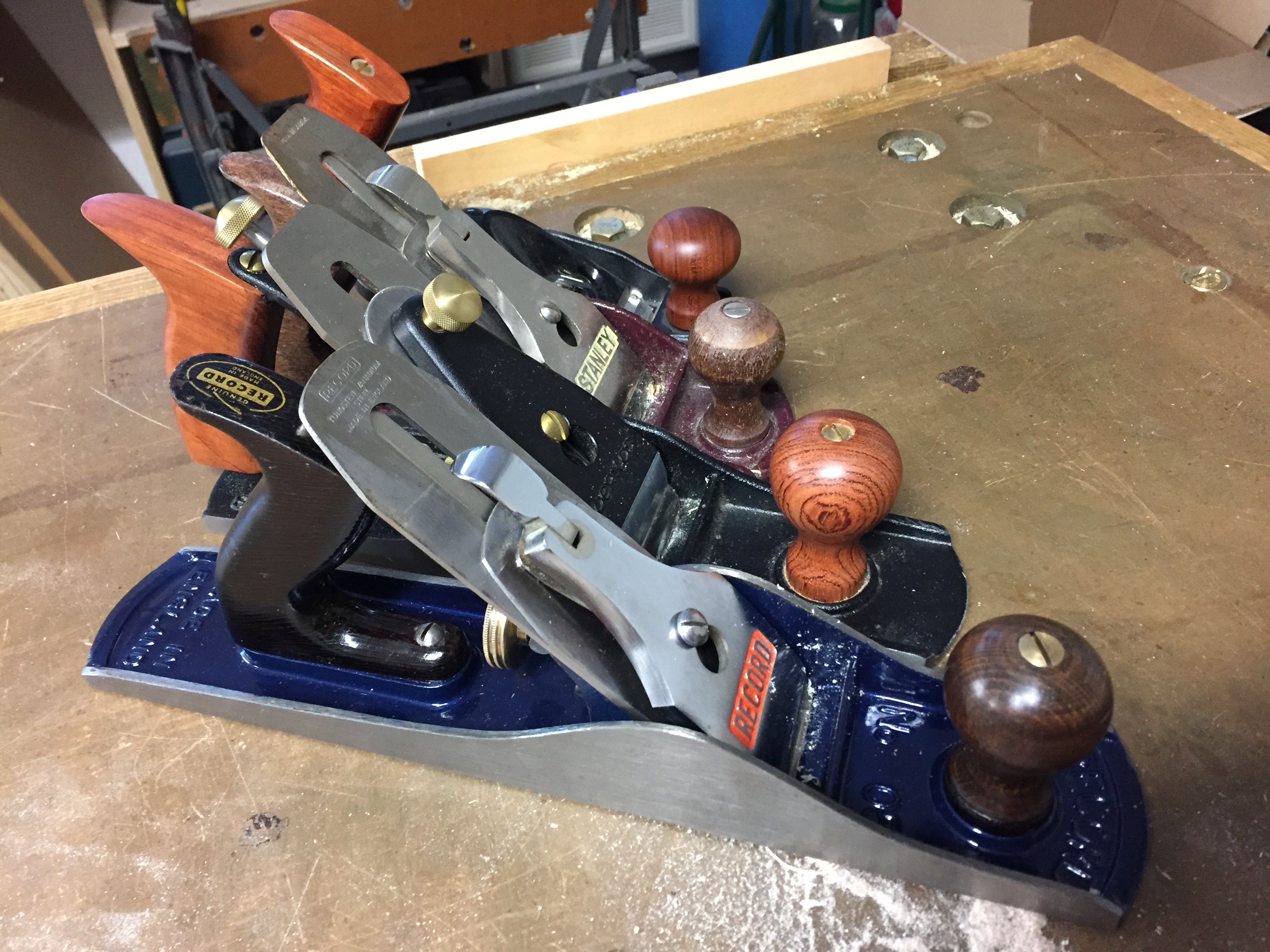
A small selection of bench planes: front to back, a jack plane, a junior Jack, a (garbage grade) #4 smoother, and a #3-equivalent smoother.
I’ve decided to punish humanity with a tool rant.
Back when I still had a real Internet connection, I put a video up on Youtube. In the video, I fixed up a $15 Harbor Freight wood plane, just to see if I could make it work. I got it to function, but I wouldn’t suggest anyone else try it.
A commenter said I should buy planes at garage sales. That set me off. The bag of pet peeves ruptured, and now I must rant.
Garage sales are only good for three types of people: mentally ill hoarders who buy crap, young people who live in poverty, and professional shoppers who snap up the best merchandise and put it on Ebay and Etsy.
That’s it. I will explain.
Say you’re 45 years old, and you decide you want a hand plane collection. To do woodworking well, you really need 4 or 5 planes, and you’re better off with a dozen. Different planes do different things well. Block planes are good for tight spaces and breaking corners. Jointing planes are good for jointing, obviously. Smoothing planes are good for, well, smoothing. Rabbet planes make rabbets. You can’t buy one plane and make it do everything. You’re going to need a bunch of planes.
You’ve already blown it by reaching 45 without collecting any planes. Now you have to catch up. Say you start going to garage sales.
Look at the paper or the web. There are no promising sales this week. Probably. Most of the time, the sales you read about look really bad. Action figures with missing arms and spit all over them, plus things like lamps with torn shades. IKEA furniture that ought to be burned. Maybe you’ll see a good sale in a couple of weeks. You may find 10 sales a year that are worth leaving the house for.
When you go to these sales, 9 of them will turn out to be losers. The other one will have one or two decent items.
To get those items, you will have to get up before the sun rises and do some driving. If you show up an hour after the sales start, the things you want will be gone. Tools go fast. Every city now has a fleet of professional shoppers who raid garage sales as early as possible and take all the good stuff. If you’re not there at the start, you’re dead. And what if you have two promising sales on the same day? You can get to one early enough to score, but you’ll be late for the other one
If you get the items you want, they probably won’t really be the items you want. By that I mean you won’t be able to choose brands and models. Want to collect a set of Stanley type 13 planes? Forget it. You’ll have to take a type 11, a 1990 plane from Home Depot, a Craftsman … whatever happens to be available. You will eventually get items that do what you want, but you’ll have to settle.
If you insist on good tools, you’ll have your woodworking shop equipped in about 20 years. During those years, you will have had to struggle without important tools. You will have had to forgo a lot of projects. You will become farsighted. You may get cataracts. You may get arthritis in your hands. You may need new hips. You’ll feel less like getting things done. The TV and the shuffleboard court will beckon.
You’ll miss out on the fun you would have had if you had bought your tools as early as possible.
You may drop dead, and then other people will buy your tools at your wife’s garage sale.
Comments Off on Buying quality used hand tools
June 20, 2018
Do You Have a Right To Repair Your Phone? The Fight Between Big Tech and Consumers
ReasonTV
Published on 18 Jun 2018Eric Lundgren got 15 months in prison for selling pirated Microsoft software that the tech giant gives away for free. His case cuts to the heart of a major battle going on in the tech industry today: Companies are trying to preserve aspects of U.S. copyright law that give them enormous power over the products we own.
Reason is the planet’s leading source of news, politics, and culture from a libertarian perspective. Go to reason.com for a point of view you won’t get from legacy media and old left-right opinion magazines.
Comments Off on Do You Have a Right To Repair Your Phone? The Fight Between Big Tech and Consumers
June 17, 2018
Conrad Black – Trump’s not bluffing
In the National Post (but linked from his personal website), Conrad Black warns of the danger of assuming that Trump is just blustering on his trade threats:
Justin Trudeau struck just the right Canadian note of our gentle nature but refusal “to be pushed around,” and he predictably will reap the short-term reward for standing up for the country opposite the ideal American bogeyman, the blustering billionaire president who has been a Garry Trudeau caricature of the Ugly American for 25 years. (It is a very incomplete picture, like most caricatures, but it works for Trump and he often cultivates it.) The boycotts of American goods and holidays will be a bonus to Canada economically and the anti-Trump American media will be along within two weeks to lionize doughty Canada like “Gallant little Belgium” in 1914 and “Plucky Israel” in 1947, and it will strengthen Canada’s always fragile self-regard opposite the United States.
On the other hand, Trump isn’t just a blowhard; all his career he has known how to go for the jugular and his reference to 270-per-cent Canadian tariffs on butter is a valid complaint that threatens to tear the scab off this egregious payoff to the comparatively small number of Quebec dairy farmers who mainly profit from it. The same issue was hammered hard by Martha Hall Findlay when she ran for the federal Liberal leadership in 2013 and by Maxime Bernier when he ran narrowly behind Andrew Scheer for the Conservative federal leadership last year. The issue died down after their unsuccessful campaigns, but if Donald Trump is incited to hammer that theme, he will roil the domestic Canadian political waters and English-French relations in the country generally.
Presumably our trade negotiators will not become so intoxicated by the prime minister’s peppy talk and spontaneous popular boycotts of the U.S. that they forget the correlation of forces. An aroused American administration could do serious damage to Canada’s standard of living, and it could be a tempting tactic to expedite more important negotiations with Mexico and the principal Asian and European powers. The United States is now enjoying three times as great a rate of economic growth as Canada (4.8 to 1.5 per cent), has lower tax rates, 11 times as great an economy, and more unfilled jobs than unemployed people.
Behind the peeling façades of Norman Rockwell and Walt Disney, the United States is a monster, and not always an amiable monster. If Canadians are blinded by their visceral dislike of Donald Trump, as the antithesis of Canadian criteria for likeable public figures, they will be exposed to the ruthless pursuit of the national interest that in his own career propelled him from technical insolvency to immense wealth and celebrity and then, against all odds, to control of a great political party and to the headship of the most powerful country in the world. If these talks blow up, the U.S. doesn’t have to settle for WTO rules; it can impose outright protectionist measures. Justin Trudeau has been agile, and the country has responded admirably. But Canadian policy-makers must understand that they are playing for almost mortal stakes with potentially dangerous protagonists who have no sense of fair play and no interest in what Canada thinks of them.
Comments Off on Conrad Black – Trump’s not bluffing
June 11, 2018
Jay Currie says it’s time to light the Bat Signal for … Brian Mulroney?
I find it hard to believe that things have gotten to the point that anyone, let alone Jay Currie, is looking to former PM Brian Mulroney to pull Justin’s chestnuts out of the Trumpian fire:
In Canada, more specifically Ontario, the destruction of the auto industry would be a full scale, all hands on deck, disaster. Realistically, the auto sector is Ontario’s largest private sector employer and the largest manufacturing sector. Being priced out of the US market would kill tens of thousands of well-paid jobs.
Trump has taken the measure of Trudeau and his tiny, annoying, Minister of External Affairs, Chrystia Freeland and concluded they are featherweights. Which means that Canada is potentially screwed because Trump has no faith in our leadership. You don’t call people dishonest publicly if you plan to do business with them.
It is unlikely that Trudeau will be aware of just how badly he has failed for a few days. The Canadian media are heavily invested in a narrative which has Justin standing up to the big, bad, Trump. Trudeau’s tone-deaf advisors are, no doubt, revelling in the fact they got lots of “gender” language into the communique.
It will take a few days for the more sober side of the media to realize what peril Trudeau has put us in. And a few more for the geniuses in the PMO to figure out that Trump is not playing the same game as they are.
When they do figure it out the question will arise, “What the fuck do we do now?”
As I am quite sure Butz and his posse read this blog I have a simple suggestion.
Normally, I would have suggested they get in touch with Simon Reisman who negotiated both the Auto-Pact and NAFTA. Alas, Reisman is dead.
Second best by a long shot? Brian Mulroney. A man I have next to no time for but who a) managed to get Canadians onboard for NAFTA, b) was a quite successful Canadian Prime Minister, c) is wired into both Trump World and broad swaths of corporate America.
If Trudeau could get Mulroney to do it Mulroney would be going into the US with a serious, well thought out, everything on the table, pitch. Likely starting with first principles – no tariffs, no subsidies, no non-tariff barriers. Be prepared to dump dairy and end transhipment of Chinese steel. And pitch it to the Trump people as the template for the deals which could be made with the EU, Japan, India and so on. (China is a whole other thing.)
The key point here is that Canada has to move, and move quickly, away from the finger-wagging politics of gender inclusion and climate change to a hard-nosed business approach to getting the best deal we can with an America which is now willing to put its own interests first.
Comments Off on Jay Currie says it’s time to light the Bat Signal for … Brian Mulroney?
June 8, 2018
QotD: The cult of Steve Jobs
Have you noticed how programs and apps and websites have taken to “improving” by taking away functions you liked and used every day?
Now, everybody thinks they know what you want better than you do. With the extra added side benefit of “molding” your actions to conform to what they think is preferable.
Again, Jobs was very, very good at actually determining what people really wanted, versus what they held onto simply because it was familiar. He killed the floppy disk drive. He veered away from power-on buttons. He got lots of changes through that seemed huge at the time, but in hindsight are natural.
And because of his precedent, in addition to (at least) fifty-plus years of marketing “wisdom” that treats customers as mindless sheep, everybody now treats you, the user, as a “moist robot” who does not think, but merely needs the proper stimulus to behave the way they want you to.
Steve Jobs was the outlyingest outlier there is: He was a jerk, but he actually was a genius, and he actually did want to change the world, and he actually was very good at figuring out what people would want before they even knew they wanted it.
The foundation on which the Cult of Jobs was built was, wonder of wonders, actually pretty solid.
I would bet that not one single emulator of his has the same solid basis on which to stand. They all learned how to imitate him, to give the impression of integrity as it is currently misunderstood, thanks in part to Jobs’s antics. But I would be surprised if any copied his substance. Because genius cannot be faked. Only the appearance of it can.
D. Jason Fleming, “The Steve Jobs Myth”, According to Hoyt, 2016-09-12.
Comments Off on QotD: The cult of Steve Jobs
June 7, 2018
QotD: Profit and loss
It is necessary for people, most especially politicians and those who campaign for them, to understand that economics is not an optional aspect of our universe. We really do have scarce resources and we really do want to optimise our allocation of those resources. One implication of this is that activities which make losses should not happen. And if an activity starts to make losses then we want that activity to stop happening. This is because a loss is the universe’s method of telling us the alternative uses of those scarce resources would be a better use of those scarce resources.
That is, if we use some thing (whatever, labour, capital, land, buildings, electricity, just whatever) and pay market price for it and then make a profit from selling what we create from using it then we have added value. Profit is the value of the output over and above the value of those inputs in their alternative uses. Losses, equally obviously, mean that we are subtracting value from those inputs. Or, as we can also put this, losses make us all poorer in aggregate, profits make us all richer in aggregate.
For, as it shouldn’t be necessary to point out, that gross domestic product, GDP, that everyone likes to talk about is just the aggregate value added in the economy. Something which profits increase and losses reduce.
Tim Worstall, “Things That Make Losses Are Things That Stop Happening – Aetna Edition”, Forbes.com, 2016-08-17.
Comments Off on QotD: Profit and loss
June 4, 2018
L. Neil Smith on his time in the salt mines of the Star Wars universe
Around the time I picked up my first L. Neil Smith novel (Tom Paine Maru), I saw his name on a couple of Star Wars tie-in novels. I didn’t buy them, as I’ve rarely found tie-in work to be worth much unless you’re a huge fan of the larger franchise. By the time I’d gotten around to reading Tom Paine Maru and rushed back to buy all the rest of Smith’s available works, the Star Wars books had gone. I haven’t seen any of them in my travels since then. In the latest Libertarian Enterprise, Smith explains how the books came to be:
In 1983, I was chosen (or condemned — it depends how you look at these things), by Del Rey Books, a division of Random House, and Lucasfilm Ltd., to write three little ”exploitation” novels about the Star Wars character Lando Calrissian, specifically because I wasn’t Brian Daley, author of three similar books about another Star Wars character, Han Solo.
“Lando Calrissian, meet Londo Mollari. Lando, Londo. Londo, Lando … ”
The late Brian Daley was one of the kindest, gentlest, most generous men I’ve ever known, a colleague to be proud of, and it was bewildering trying to figure out why the movie company had told the book publisher, when arranging for the second set of books, “Anybody but Brian Daley!”
Brian loved Millennium Falcon. He was like a little kid when he got invited to go out to Hollywood and was most excited that he got to clamber around inside the set. But it turned out that he had accidentally and unknowingly allowed himself to become associated with the losing faction in some kind of petty internal corporate feud and found himself rendered persona non grata.
My editor at Del Rey obligingly brought my name up. I was extremely reluctant to write in anybody else’s corpus, but I needed the money very badly — around that time I’d spent two weeks with nothing in the house to eat but a bag of shredded coconut. When requested, my editor sent LucasFilm a “sample” of my work — a copy of my highly-political libertarian first novel, The Probability Broach. I’d love to have been there, a fly on the wall, when they saw it. Remember Beaker, from Muppet Labs, with a shock of bright red hair, a big red nose, great big eyes, whimpering and terrified of every known phenomenon? It must have been a lot like that.
In any case, LucasFilm freaked out, and, hypocritically asked that Brian be brought back into the project as my co-author, apparently to temper my politically incorrect passions. My editor told me later that he blew up dramatically, and told them “These are authors we’re dealing with here, not Hollywood writers, they don’t write by committee!” They backed down eventually, but I had to promise I would write no politics in the books — which, given the attitude they were displaying, I interpreted to mean as much politics as I could possibly squeeze in before they squealed.
I was told to write about Lando but leave all other Star Wars characters and other things alone (I did end up using mynocks). I told them I would have the spaceship, or I would give the project a miss. Brian started calling us “the Brotherhood of the Falcon”. My editor advised me to politely decline any invitations to come to Hollywood, and stay out of company politics, which I gladly did. I invented a number of animals for the books but was told that only animals made up by George Lucas could be capitalized.
In the beginning, they gave me sixteen weeks to write three books which I regarded as tough, but doable. “But wait! We have to approve your outlines first!” And by the time they finished — altering my arch-villain Rokur Gepta to something other than a “Dark Lord of Sith” and making other insignificant changes, I had nine weeks left. For two and a half months, I got up each morning and wrote. My cute little fiancee came home for lunch and then I wrote. We had supper and I wrote. Then I collapsed and started the whole thing over the next day. Forget anything resembling a real life. This was just before word processors came along, and I did the whole thing in one draft, as Robert Heinlein advised, on a Sperry-Remington knock-off of an IBM Selectric II. It took a long, long time to recover my health.
Comments Off on L. Neil Smith on his time in the salt mines of the Star Wars universe
June 2, 2018
YouTube Won’t Host Our Homemade Gun Video. So We Posted It on PornHub Instead.
ReasonTV
Published on 31 May 2018Reason has a new video out today explaining how to put together a homemade handgun using some very simple tools and parts you can buy online. But you won’t find it on our YouTube channel.
_____After the March for Our Lives rally, YouTube announced that it would no longer allow users to post videos that contain “instructions on manufacturing a firearm.”
Our video and its accompanying article are part of a package of stories in Reason‘s “Burn After Reading” issue. It includes a bunch of how-to’s, including how to bake pot brownies, how to use bitcoin anonymously, how to pick the lock on handcuffs, and how to hire an escort.
The whole issue is a celebration of free speech and our way of documenting how utterly futile of all kinds of prohibitions can be.
We made a video showing how easy it is to DIY a Glock because we wanted to show how the First Amendment reinforces the Second Amendment. If a bunch of journalists can build a handgun in their kitchen, we can assume it’ll be pretty hard to keep guns out of the hands of motivated criminals.
If YouTube prevents us from uploading the video, have they violated our First Amendment rights?
“YouTube of old days was this amazing thing that has become the digital library of Alexandria on the Internet,” says Karl Kasarda, the co-host of InRangeTV, a weekly YouTube show about guns. The show used to survive on ad revenue, until YouTube started de-monetizing certain forms of content. Once YouTube made it impossible for Kasarda to make money on its platform, he started posting his content to other places, including PornHub.
Last October Prager University, a conservative video production shop, sued YouTube, saying it had restricted the audience for content and alleging that the company was “unlawfully censoring its educational videos and discriminating against its right to freedom of speech.”
But here’s the thing: YouTube is a private platform. There is nothing in the First Amendment (or the Second) that requires them to host our gun video. Reason can turn down articles for any cause that we choose. We can do it because we don’t like the color of the author’s hair, or because we don’t like the font she used in her pitch email. We wouldn’t be violating a single constitutional right by doing so.
We wish YouTube would run our video. It’s awesome. But equally awesome is YouTube’s right — our right — not to run content we don’t like.
Karl Kasarda is correct that YouTube is the closest thing we have to the Library of Alexandria. It still doesn’t mean they have to carry our video.
YouTube is hardly the first to test this principle. In 1972, a teachers union president who was running for state legislature sued The Miami Herald, insisting it run an editorial he had written after he was attacked in its pages. The Supreme Court correctly ruled that ordering a newspaper to print an editorial violates the First Amendment. After all, a newspaper is “more than a passive receptacle.”
Prager University argued that YouTube isn’t entitled to the same editorial discretion as The Miami Herald because it advertises itself as a “platform for free expression” that’s “committed to fostering a community where everyone’s voice can be heard.” A federal judge, thankfully, dismissed the Prager lawsuit, rejecting the company’s argument that YouTube is comparable to a “government entity” and thus must be open-access. A slew of other judges have arrived at the same conclusion.
YouTube deserves the same editorial latitude those judges gave to The Miami Herald in the 1970s and that Reason enjoys today.
And that’s one of the things our new gun video is celebrating. If YouTube doesn’t want to post it to their site, its loss. We’ll just post it to another platform. That’s what the free and open internet is all about. So if you want to see our video, you can watch it here at Reason.com — or head over to PornHub and see how to make your very own unregistered firearm.
Links:
https://reason.com/archives/2018/05/31/how-to-legally-make-your-own-o
https://www.pornhub.com/view_video.php?viewkey=ph5b0460dc60380Edited by Todd Krainin. Narrated by Katherine Mangu-Ward. Written by Jim Epstein and Katherine Mangu-Ward. Cameras by Meredith Bragg.
Comments Off on YouTube Won’t Host Our Homemade Gun Video. So We Posted It on PornHub Instead.
May 28, 2018
QotD: Correcting mistakes in private and public enterprises
… government cannot do just one thing, and some of the repercussions of what it chooses to do will be, as it were, mistakes in the perspective of the public even if the initial action were not. But the public’s dissatisfaction with these adverse outcomes can make itself known only via the politically charged process of complaint to authorities, petition for redress of grievance, lobbying, payoffs to public officials, and all the rest of the endlessly complex apparatus for the operation of the government’s political and bureaucratic setup. One is lucky to get any constructive response at all from the government, whose effective control is apt to be in the hands of entrenched politicians, bureaucrats, and private-sector cronies in the various iron triangles that pervade the state at large. If one does succeed in getting a constructive response, it is likely to come forth only after years of expensive and time-consuming delays.
This lack of an effective feedback-incentive mechanism is among the greatest flaws of all government activities. Markets, in contrast, are certainly not perfect relative to the model criteria economists have devised to evaluate them, but they are undoubtedly superior in the operation of their feedback information and response to mistakes. To remove an activity from the market and place in under government control is to ensure that henceforth mistakes, whether they arise from bad judgement, corruption, or ignorance, will not elicit a proper or timely response. In the government realm, mistakes and the slow, counter-productive responses, like doomed lovers, sink together slowly in the quicksand of bad actions being made ever worse by ill-fated reactions.
Robert Higgs, “Dealing with Mistakes: Government Action versus Private Action”, The Beacon, 2016-08-17.
Comments Off on QotD: Correcting mistakes in private and public enterprises
May 23, 2018
May 21, 2018
Work in high tech? You’ll instantly recognize this office
Alistair Dabbs on the utterly interchangeable (except for the bogs) modern high tech office suite:
As an itinerant freelancer, my work takes me to a variety of tech-savvy business premises. And while small companies each have their own style of office layout, every larger organisation from mid-size to corporate looks almost exactly the same as another.
Except for the toilets. You can learn a lot about a business by its bogs.
So as I turn up for an on-site booking and sit for a short while in a reception space that has been arranged identically to those depicted in every business furniture catalogue ever printed, later to stride through yet another open-plan office of the same old rows of grey desks and the same old blue carpet tiles, I am overwhelmed by the tedium of déjà vu.
So on arriving at the designated meeting room – always featuring a frosted glass wall, a boardroom-style table with a faux teak effect surface and luxury adjustable chairs that refuse to be adjusted unless you violently bounce up and down on them like an over-excited child on a Space Hopper – I drop my things in the corner furthest from the door and enquire about using the washroom facilities.
As I am given verbal directions for the nearest toilet, I make a cursory check under the table which has been designed for up to 20 persons and confirm, yes, there are just TWO power sockets, as per usual, and no extension cable of any description. A quick glance behind the massively undersized TV at the end of the room reveals another six wall sockets that are, as I confidently expected, all occupied by plugs already – one for the TV and the other five for various components of the impossibly complicated video conferencing system that no one knows how to use, least of all the IT department that had lobbied strongly against its purchase in the first place.
So far, so identical. Now let’s find out what this place is really like.
[…]
Unlike this particular unfortunate, I return from the grunting rooms this day refreshed and with a spring in my step. My face smarts invigoratingly with aftershave and creamy odours waft from my gesticulating soft palms – vanilla from the left, coconut from the right.
Back in the meeting room, I am soon brought back to Earth and my surroundings merge into the amorphous generic semblance of every other office building in the western world.
A large cupboard that does not match the rest of the furniture has been installed in the most awkward place to squeeze past; it is locked but almost certainly contains nothing but a layer of dust, a torn corner from a Post-It note and a single paperclip. The aircon has just two settings: Arctic or Sahara. Everyone is forced to use a Guest Wi-Fi login whose permissions have been devised by a recent graduate of a free Cyber Security MOOC to prevent access to personal emails, cloud drives and the internet in general. A ceiling light flickers every two minutes. Halfway into the meeting, the room begins to vibrate to the intense scream of a workman’s drill on the other side of a wall, and continues for the next six hours.
I could be anywhere.
Comments Off on Work in high tech? You’ll instantly recognize this office
QotD: The key difference between private and public enterprise is effective feedback
State bureaucracies are notoriously inept in reacting constructively to their own mistakes. For example, they continuously seek to increase their budgets, staffs, and authority, even when their projects have proven counter-productive or disastrous. It’s almost as if they promote their institutional objectives best by fouling up their programs, then coming back to their funding sources to explain that they cannot succeed unless they receive more resources to do so. Thus do public agencies pour money and effort down the rat hole for years on end, wasting the public’s money every step of the way. The feedback system in this case is obviously perverse so far as serving the public interest is concerned.
Such perversity is practically guaranteed in government operations because government operates outside the realm of private property rights, the price system, and the profit-and-loss accounting that constitute a feedback system in the market realm. In the market, money-losing projects do not persist indefinitely. Their owners and managers eventually decide against throwing good money after bad and close the unprofitable operations. Owners who refuse to read and respond correctly to the clear message transmitted by profits and losses suffer reductions of their own wealth, which serves as a powerful incentive to act correctly and to rectify the mistakes they have made before even more wealth goes down the drain.
Robert Higgs, “Dealing with Mistakes: Government Action versus Private Action”, The Beacon, 2016-08-17.
Comments Off on QotD: The key difference between private and public enterprise is effective feedback


