
Merchants are a bit of a break from the people we have so far discussed in that they, by definition, live in the realm of the market (in the economic sense, although often also in a physical sense). […] so much of the world of our farmers and even our millers and bakers was governed by non-market interactions: horizontal and vertical social ties that carried expectations that weren’t quite transactional and certainly not monetized. By contrast, merchants work with transactions and tend to be the first group in any society to attempt to monetize their operations once money becomes available. I find students are often quick to feel identity with the merchant class, because these folks are more likely to travel, more likely to use money, more likely to employ or be employed in wage-labor; they feel more like modern people.
It thus tends to come as something of a surprise that with stunning consistency, the merchant class tended to be at best cordially disliked and at worst despised by the broader community (although not typically to the point of suffering legal disability, as did some other jobs; see S. Bond, Trade and Taboo: Disreputable Professions in the Roman Mediterranean (2016) for this in Rome). This often strikes students as strange, both because we tend to think rather better of our own modern merchants but also because the image they have of the merchant class certainly looks elite.
For the farmers who need to sell their crops (for reasons we will get to in a moment) and purchase the things they need that they cannot produce, the merchant feels like an adversary: always pushing his prices to his best advantage. We expect this, but remember that our pre-modern farmers are just not that exposed to market interactions; most of their relationships are reciprocal, not transactional – the horizontal relationships we discussed before. The merchant’s “money-grubbing” feels like a betrayal of trust in a society where you banquet your neighbors in the good years so they’ll help you in the bad years. The necessary function of a merchant is to transgress the “rules” of village interactions which – and this resounds from the sources – the farmers tend to understand as being “cheated”.
At the same time, while most merchant types are humble, the high-risk and potentially high-reward involved in trade meant that some merchants (again, a small number) could become very rich. That, as you might imagine, did not go over well for the traditionally wealthy in these societies, the large landholders. Again, the values here often strike modern readers as topsy-turvy compared to our own, but to the elite large landholders (who dominate the literary and political culture of their societies), the morally correct way to earn great wealth is to inherit it (or capture it in war). The morally correct way to hold that wealth is with large landed estates. Anything else is morally suspect, and so the idea that a successful merchant could – by a process that again, strikes the large landholder, just like the small farmer, as “cheating” – leap-frog the social pyramid and skip to the top, without putting in the work at either having distinguished wealthy ancestors or tremendous military success was an open insult to elite values. Often laws were put in place to limit the ability of wealthy non-aristocrats (likely merchants or successful artisans) from displaying their wealth (sumptuary laws) so as to keep them from competing with the aristocrats; at Rome, senators were forbidden from owning ships with much the same logic (Roman senators being clever, they still invested in trade through proxies while at the same time disapproving of the activity in public politics).
[…] As far as elites were concerned, merchants didn’t seem to produce anything (the theory of comparative advantage which explains how merchants produce value without producing things by moving things to where they are most valued would have to wait until 1776 to be mentioned and the early 1800s to be properly explained) and so the only explanation for their wealth was that they made it by deception and trickery, distorting the “real” value of things (this faulty assumption that the “real value” of things is inherent in them, or a product of their production, rather than their use value to an end user or consumer, does not go away in the modern period).
Merchants also – almost by definition being foreigners in their communities – often suffered as members of “middleman minorities“, where certain tasks, particularly banking, commerce and tax collection are – for the reasons just discussed above – outsourced to foreigners or ethnic minorities who then tend to face violence and discrimination because of the power and prominence those tasks give them in society. Disdain for merchants was thus often packaged with ethnic hatred or racism – anyone exposed to the tropes of European or Near Eastern antisemitism (or more precisely, anti-Jewish sentiment) is familiar with this toxic brew, but the same tropes were applied to other middlemen minorities engaged in trade – Chinese people in much of South East Asia, Armenians in Turkey, Parsis in India and on and on. Violence against these groups was always self-destructive (in addition to being abhorrent on its face) – the economic services they provided were valuable to the broader society in ways that the broader society did not understand.
Bret Devereaux, “Collections: Bread, How Did They Make It? Part IV: Markets, Merchants and the Tax Man”, A Collection of Unmitigated Pedantry, 2020-08-21.
July 5, 2023
QotD: The role of merchants in pre-modern societies
July 4, 2023
It’s not “bullying” for corporations to act in their own (and their shareholders’) best interests
The weekly round-up from The Line editors wasn’t happy reading for fans of the Canadian mainstream media:
The Canadian government approached this as if it was “Big Tech” who were reaping all the rewards … when in fact it was the Canadian media companies getting most of the benefit from the arrangement. No wonder “Big Tech” chose to take their bat and ball and go home.
There are two major items up for consideration, and we’ll deal with each in turn. The first is a proposed merger between Postmedia and the Torstar/Metroland newspapers. The second, and most significant, news item, is that following on Meta/Facebook’s decision to stop featuring news on its feeds, Google is promising to drop the Google News Showcase feature, and to stop surfacing Canadian news links on its search feeds. All of this is in response to C-18, the Online News Act.
This law is trying to force Facebook and Google to compensate news organizations for the links that appear on their platforms; so the companies reacted in an entirely predictable way after the bill received Royal Assent last week — they announced they are going to absent themselves from the scope of the bill by no longer providing those links.
The government, its supporters, and many in the media itself reacted to this announcement with the same inane bluster that has come to dominate the conversation around this byzantine and poorly conceived bill. The Liberals promised to stand up to “Big Tech”; and the media organizations that pinned their survival on milking this new revenue stream are now accusing Google et al. of “bullying”. We at The Line don’t consider this rhetoric to be rational or in good faith. We are annoyed — we are horrified — by these companies’ decisions, but we understand them.
Both Facebook and Google made it clear that C-18 was untenable from a business point of view; they both warned that they would consider pulling news links in response. From Big Tech’s perspective, the decision-making tree is real simple here: does the revenue generated by news outweigh the potential uncapped financial liability that C-18 would present? Further, would complying with C-18 in Canada present a greater risk to the company globally if the bill were replicated in larger media markets? Or are the companies better off to withdraw from a low-priority market pour encourager les autres. We can scream about the evils of Big Tech all we want, but ultimately, these are just math conversations.
No one ought to be surprised that the math didn’t go our way. But almost everyone was. Because — and there’s no nice way to say this — this country’s media industry is both painfully parochial and embarrassingly self-important. For people whose job it is to understand and explain the world to Canadians, it often astonishes us at how incompetent we are at understanding and explaining that world to ourselves. Canadian journalists have an unshakeable faith in our vocation; we genuinely believe that our work is a vital service to democracy. Therefore the fruits of that labour — the news content — must be valuable to the digital platforms that we now depend upon to distribute it. This is why many in the industry were so unshakeably convinced that Facebook and Google were bluffing during the course of C-18. Incredibly, many seem to remain convinced that Big Tech will capitulate to their demands for capital, even now. To quote this old gem: “It is difficult to get a man to understand something, when his salary depends on his not understanding it”.
The flaw in this reasoning ought to be apparent, yet the industry lacks the digital savvy to understand the risk it is courting. “What about Bing, amiright?” Denial and self-importance are now sucking Canadian journalism straight into the maw of an existential crisis. To lose Facebook is a major set back; to lose Google is death.
The thing our colleagues and peers need to come to terms with is that Canadian journalism just isn’t that important in the global scheme of things. Facebook and Google aren’t out to get us — they are indifferent to us. Canadian news comprises a small and un-lucrative segment of even Canadian traffic flows. And Canada is a mid-tier market, at best. Optics aside, global tech oligopolies simply don’t lose very much by cutting us off. Facebook and Google are in the business of advertising, not journalism. They share neither our self regard, nor our democratic mandate; as a result, there is no internally coherent reason for them to take losses in order to save our industry. We just don’t matter to them.
On her Substack, Tasha Kheiriddin doesn’t blame Google for the impending destruction of what’s left of mainstream Canadian media:
The funeral has begun. The pyres are lit; the mourners are weeping. RIP, Canadian media industry, we hardly knew ye. Between mergers, acquisitions, closures, and layoffs, you didn’t stand a chance. And then came Bill C-18.
The legislation, passed last week, compels internet behemoths Meta and Google to compensate Canadian news outlets in exchange for featuring links to their content. Bill C-18 is modeled on an Australian law that saw the two tech giants enter into financial arrangements with media outlets in that country. Here in Canada, the Parliamentary Budget Office estimates similar deals could produce annual revenues of $329 million, a juicy sum for the cash-strapped news business.
Instead, Meta and Google announced that they would no longer include Canadian news links. Rather than reap a profit, Canadian media companies now face the prospect of far fewer eyeballs on screens – and the decimation of their ad revenue. Meta also cut its funding to CN2i, the Coopérative nationale de l’information indépendante, which supports six print publications, including La Presse, further damaging media companies’ bottom line.
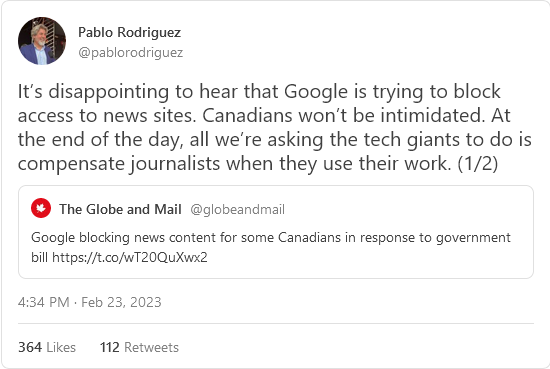
Cue the sound of “Taps” and political outrage. Heritage Minister Pablo Rodriguez had this to say:
Big tech would rather spend money to change their platforms to block Canadians from accessing good quality and local news instead of paying their fair share to news organizations … This shows how deeply irresponsible and out of touch they are, especially when they make billions of dollars off of Canadian users.
No, this shows how deeply out of touch the government is with the business model of these companies – and with internet technology in general.
July 1, 2023
The Trudeau plan to eliminate Canada from the internet is going great!
Wait, you mean that wasn’t the plan? It must have been, if you judge the plan by the amazing results:

The damage caused by the government’s Bill C-18 continues to grow as Meta has started to cancel its existing agreements with Canadian publishers. The move should not as a surprise since any deals that involve facilitating access to news content would bring the company into the legislative framework and mandate payments for links. Indeed, Meta said earlier this week that its 18 existing deals “did not have much of a future“. When this is coupled with a reported “impasse” between the government and Google over its approach to Bill C-18, the risks to the Canadian media sector look increasingly dire.
This was entirely foreseeable, yet Canadian Heritage Minister Pablo Rodriguez never seemed to take the risks seriously. It raises the question of whether the government developed estimates of the cost of its legislation if Meta and Google chose to comply by stopping news sharing or linking. While there were estimates for the benefits of new deals that ran into the hundreds of millions of dollars, did it conduct a risk assessment of the economic costs that would come from Internet companies exiting the news market in Canada?
There are obviously costs that extend far beyond the economics that include reduced access to news, increased prominence of low quality news sources, harm to the Canadian Internet, and the reputational damage to a government that handled this about as incompetently as possible. But from a pure economic perspective, the risks were always understated as they extended beyond just the value of increased traffic to publishers from the links they were themselves posting. Both Google and Meta have deals with Canadian publishers reportedly worth millions of dollars. As Meta’s step to begin cancelling deals suggests, those agreements are unlikely to survive the decision to exit news in Canada.
And of course, Google doesn’t want to set any kind of precedent by accepting a shakedown from any two-bit hoodlum country like Canada:
The worst case scenario for Canadian Heritage Minister Pablo Rodriguez, the Canadian news sector, and the Canadian public has come to pass: Google has announced that it will block news links in Canada in response to the mandated payment for links approach established in Bill C-18. The decision, which the company says will be implemented before the law takes effect, will cover search, Google News, and Google Discover. The decision – which government seemingly tried to avoid with last minute discussions with Google executives after it became apparent that the risks of exit were real – will have lasting and enormously damaging consequences for Canadians and represents a remarkable own-goal by Rodriguez who has managed to take millions away from the news sector and left everyone in a far worse position than if he had done nothing at all.
If you’re in any way interested in Canadian government … machinations … when it comes to digital policy, you really should be following Michael Geist‘s reporting. He’s been doing a great job and deserves the support.
June 30, 2023
The Coolest ”’Country”’ Flag You Need To Know
CGP Grey
Published 28 Mar 2023
(more…)
June 29, 2023
When “flashy” became “constantly flashing”, the user experience got significantly worse
Scott Alexander on the irritating advance of meaningless flashing elements on so many web pages where they serve no real purpose, but successfully generate anger in their users:
Everyone hates flashing banner ads, but maybe they’re a necessary evil. Creators want money, advertisers demand a certain level of visibility for their ad buys, maybe sites are willing to eat the cost in user goodwill. Fine. But what’s everyone else’s excuse?
A few days ago I needed to look up an obscure point of Jewish law, as you do, and found this Jewish law website:
The background toggles every few seconds between a picture of a rabbi and a picture of … a different rabbi? There’s no conceivable benefit to this and it makes it almost impossible to concentrate on the text.
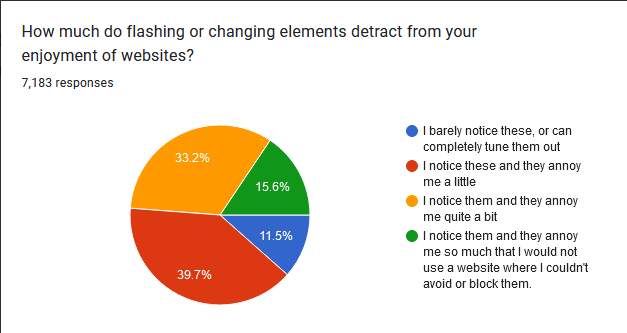
I used to think I must be the only person who worried about this; maybe it was a weird OCD thing. But I asked about it on the ACX survey …
… and 88% of people find them at least a little annoying! 16% of people go all the way, and say they wouldn’t use a website that has them!
Yet websites have been adding them to more and more parts of the user experience. Most aren’t as blatant as the Jewish law site, but they’re still there.

June 25, 2023
Canada’s DeLorean – Bricklin SV-1
Ruairidh MacVeigh
Published 5 Sept 2020This week, it’s back to cars, and today we look at the history of a motoring scandal that took place 10 years before DeLorean and his DMC-12, but followed nearly the same notes; a rushed design, shady business practices, an inexperienced workforce in an impoverished part of the world, etc.
The Bricklin SV-1 may have looked good on paper, but in reality it was a severely flawed design that was ahead of its time in many aspects, but highly primitive in others.
(more…)
June 24, 2023
Canada’s Online News Act already impacting news delivery for smaller outlets
A local site I use regularly has already begun to feel the negative effects of the federal government’s Online News Act (aka Bill C-18):

Durham Radio News (DRN) doesn’t normally post editorial content, but when local news is being attacked we refuse to stay silent.
Bill C-18 is now law and will have a very negative impact on local independent newsrooms such as DRN.
The bill forces major tech companies such as Google and Meta to pay news outlets for content.
The vast majority of referrals to our DRN site come from Facebook and Google.
Both platforms have been instrumental in growing our audience.
Despite multiple warnings from Meta and Google that they would block news, the Liberal government proceeded with Bill C-18.
It’s now law and in a statement Meta says news will no longer be available on Facebook and Instagram.
Google is expected to follow suit.
Both tech giants have publicly said they don’t make much money off links to news stories so it doesn’t make financial sense for them to pay news providers.
Prime Minister Justin Trudeau called their threats to remove news a bullying tactic and said it will not work with his government.
It really appears the Liberals thought they were bluffing, we now know they were not.
DRN has been trying to get our voices heard for months on the negative impact this bill would have on our business.
We were drowned out by larger media outlets who would stand to benefit from this bill.
We will not be naming other outlets and we don’t begrudge the financial help they are already receiving.
Meta provides funding through fellowships with some media partners, and it is these outlets that became greedy and were asking for more.
For them it doesn’t matter if they get kicked off social media platforms.
For us it will make a huge impact.
“… every time I see some fine new supercluster-aspirational buzzword-laden legislative boondoggle coming from our federal government I know that my life is going to get worse in some minor, petty, and yet measurable way”
Jen Gerson is irked by the federal government’s latest petty diktat to “save the planet” from single-use plastic bags that bans the use of bags that are not made of plastic:

Those who follow my work will know that I am an unreformed Calgary evangelist. I like this city for a lot of reasons, but one of them is that I’m a member of the Calgary CO-OP, a chain of local grocery stores. For those who are lucky enough to enjoy something like this, a co-op offers particular advantages over their conventional counterparts; we get a small share of the profits that the chain earns every year, for example. The stores stock local produce, meats, grain, and processed foods from Calgary-based suppliers, and from nearby farms. CO-OP also provides a number of top-notch house brand supplies. National chains are simply not as nimble, nor as local. They can’t be.
But I admit that one of the things I enjoy most about CO-OP is its green grocery bags. When stores across Canada began to phase out the use of single-use plastic bags, I was despondent. The environmental rationale for the ban was thin, but mostly I was annoyed because I’m chronically disorganized and can never remember to bring reusable bags.
So when CO-OP replaced plastic bags with a fully compostable alternative, I was delighted. Granted, we would have to pay a small fee to purchase these bags, but the per-unit cost was actually less than what we would normally spend on a box of Glad compost-bin liners. So it all evened out.
To make matters even better, unlike paper straws, the compostable bags are superior to their plastic alternatives. CO-OP advertises this point on their site: “They are stronger than a plastic checkout bag. You can carry a medium-size turkey or three bottles of wine with no problem.”
I can also attest to this. The bags are an absolute win for everybody involved.
So when I discovered on Thursday that Ottawa plans to ban these items, considering them a “single-use plastic”, I lost my goddamn mind.
Not only will this represent a small inconvenience for me and my family, but it is also one of the laziest, most idiotic decisions issued from this remote, non-responsive federal government I have yet to encounter.
The bags do not contain plastic.
Let me say that again, because apparently the sound of western voices doesn’t quite travel all the way to the the slower bureaucrats in the back: “THE BAGS DO NOT CONTAIN PLASTIC”. You fucking muppets.
[…]
Look, Ottawa, are you there? Are any of you listening, or am I just screaming into the void? For the sake of the entire country, I hope, I pray that there is somebody with an IQ above 92 capable of not just reading this desperate missive, but of really, truly understanding it.
This shit — this, right here.
This. Shit.
This is why we hate you.
This is why we fucking hate you.
Nobody outside the Toronto-Ottawa-Montreal triangle sees a headline like “New Initiative from Ottawa!” and thinks: “Oh, how exciting. I’m so keen to see what grand notion those crafty MPs in Ottawa have cooked up now! Come, Maude, let us settle ourselves before the The National at Six so we can understand how our fine federal government is working to make our lives better.”
Nobody does that. Because every time I see some fine new supercluster-aspirational buzzword-laden legislative boondoggle coming from our federal government I know that my life is going to get worse in some minor, petty, and yet measurable way.
June 21, 2023
QotD: Working online
[…]
For lots of people, the office was their only social outlet. Coffee breaks, water cooler chatter, happy hours … for lots of people, that was pretty much it, socially. “Work/life balance” was always a joke, because all your friends are work friends, so even if you’re “socializing” and not “working”, it’s with the same people from the office, talking about office stuff. And the longer you stayed in the same job, the higher up the corporate ladder you got, the more specialized your position, the worse it got – your rookie customer service reps still had buddies from college to hang out with, but junior managers tended to hang out exclusively with other junior managers, etc. The “professions”, of course, are famously clannish — the only ways to talk to a lawyer or doctor are to hire one, or be one.
Severian, “More Scattered Thoughts”, Rotten Chestnuts, 2020-10-13.
June 12, 2023
“The more recent four or five years at Indigo have been a disastrophe”
In the latest SHuSH newsletter, Ken Whyte outlines the rise and fall of Canada’s biggest bookstore chain that stopped trying to be a bookstore chain and now appears to be looking for a new identity to assume in the wake of several board resignations and the announced resignation of Heather Reisman, the founder and public face of the chain:

“Indigo Books and Music” by Open Grid Scheduler / Grid Engine is licensed under CC0 1.0

Indigo opened its first bookstore in Burlington in 1997 and quickly expanded across the country in competition with the Chapters chain, which it bought in 2001. Heather’s husband, Gerry Schwartz, provided much of the financing in these years. Gerry is the controlling shareholder of Onex, a private equity firm that now has about $50 billion in assets under management.
Influential in Ottawa, the Schwartz-Reismans managed to convince the federal government to approve Indigo’s purchase of Chapters and also keep the US book chain Borders from moving north into Canada — a double play that cleared the field of meaningful competition and wouldn’t have happened in a country with serious antitrust enforcement.
Heather, as Indigo CEO, cast herself as the queen of Canadian literature, making personal selections of books to her customers, hosting book launches, interviewing celebrity authors, etc.
From a financial perspective, Indigo took about five years to get rolling after the Chapters acquisition. It looked steady through the late aughts and into the teens when Amazon showed up in force. Indigo’s share price caved. Unable to convince Ottawa to push Amazon back across the border, Heather adopted a new strategy, backing out of books and recasting Indigo as a general merchandiser selling cheeseboards, candles, blankets, and a lot of other crap to thirtyish women. “We built a wonderful connection with our customers in the book business,” she famously said. “Then, organically, certain products became less relevant and others were opportunities.” This charmed investors, if not the book community, and Indigo’s share price hit a high of $20 a share in 2018. By then, books, as a share of revenue, had fallen from 80 percent of revenue to below 60 percent (they are now 46 percent).
The more recent four or five years at Indigo have been a disastrophe. With its eighty-eight superstores and eighty-five small-format stores, the company lost $37 million in 2019, $185 million in 2020, and $57 million in 2021. Things looked somewhat better in 2022 with a $3 million profit, but its first three quarters of 2023 (Indigo has a March 28 year-end) resulted in an $8 million loss and its fourth quarter featured one of the most spectacular cyberhacks in Canadian commercial history. The company’s website was breached and its employment records held for ransom, resulting in a ten-day blackout for all of the company’s payment systems and a month-long outage in online sales. The share price is now $2.00 or one tenth the 2018 high.
ANALYSIS AND IRRESPONSIBLE SPECULATION
Given everything Indigo has been through over the last several years, and especially the last several months, it’s not surprising that Heather wants to pack it in. She’s seventy-four and super wealthy. There’s nothing but a desperately hard slog ahead for her money-losing company. Why stay?
Still, this has the feel of something that blew up at a board meeting, or in advance of a board meeting. It’s highly irregular for a company to lose almost half its directors in a single day. If these changes had been approached in conventional fashion, there would have been more in the way of messaging and positioning, especially regarding Heather. For all intents and purposes, she is Indigo. It wouldn’t exist without her. They ought to be throwing her a retirement parade and presenting her with a golden cheeseboard. Instead, all she’s getting, for now, are a few cliches in a terse press release.
It’s also weird that this all happened days before we get the company’s year-end results (they were out by this time last year). My guess is that the board got a preview, that the picture is ugly, that there are big changes afoot, and that the directors were nudged out as the start of a major retrenchment or given the option of sticking around for a bloodbath and chose instead to exit.
June 11, 2023
Ask Ian: Why So Few Reproduction Historic Guns?
Forgotten Weapons
Published 22 Feb 2023From Paul on Patreon:
“I’ve always thought there were a lot of older guns that deserve to be reproduced, many of which could be really simple to manufacture. PSA is planning the release of their StG44 repro which is exciting. But why don’t we see this sort of thing more often. I suppose not everyone in the firearms community is going to want this sort of thing, but I think there are a lot of guns that would sell well enough to justify their reproduction.”Fundamentally, we don’t see more reproduction firearms because they are actually a lot harder and more expensive to make than people would think, and the market for them is smaller than people would think. Re-engineering old firearms for new production is a really substantial project, and the original data required rarely exists. The guns must be cheap enough and reliable enough to attract modern buyers, which will often require compromises on authenticity — which immediately reduces the already-small pool of potential buyers.
(more…)
June 9, 2023
Putting an end to “stakeholder” capitalism
The Streetwise Professor explains what “stakeholder capitalism” is and why it needs to be staked through the heart to save western economies:
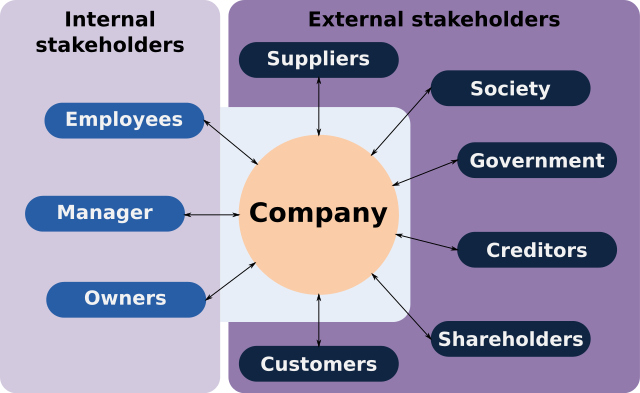
A graphic from Wikipedia showing typical internal and external stakeholders.
At its root, stakeholder capitalism represents a rejection – and usually an explicit one – of shareholder wealth maximization as the sole objective and duty of a corporation’s management. Instead, managers are empowered and encouraged to pursue a variety of agendas that do not promote and are usually inimical to maximizing value to shareholders. These agendas are usually broadly social in nature intended to benefit various non-shareholder groups, some of which may be very narrow (transsexuals) or others which may be all encompassing (all inhabitants of planet earth, human and non-human).
This system, such as it is, founders on two very fundamental problems: the Knowledge Problem and Agency problems.
The Knowledge Problem is that no single agent possesses the information required to achieve any goal – even if universally accepted. For example, even if reducing the risk of global temperature increases was broadly agreed upon as a goal, the information required to determine how to do so efficiently is vast as to be unknowable. What are the benefits of a reduction in global temperature by X degrees? The whole panic about global warming stems from its alleged impact on every aspect of life on earth – who can possibly understand anything so complex? And there are trade-offs: reducing temperature involves cost. The cost varies by the mix of measures adopted – the number of components of the mix is also vast, and evaluating costs is again beyond the capabilities of any human, no matter how smart, how informed, and how lavishly equipped with computational power. (Daron Acemoğlu, take heed).
[…]
Agency problems exist when due to information asymmetries or other considerations, agents may act in their own interests and to the detriment of the interests of their principals. In a simple example, the owner of a QuickieMart may not be able to monitor whether his late-shift employee is sufficiently diligent in preventing shoplifting, or exerts appropriate effort in cleaning the restrooms and so on. In the corporate world, the agency problem is one of incentives. The executives of a corporation with myriad shareholders may have considerable freedom to pursue their own interests using the shareholders’ money because any individual shareholder has little incentive to monitor and police the manager: other shareholders benefit from, and thus can free ride on, any individual’s efforts. So managers can, and often do, get away with extravagant waste of the resources owned by others placed in their control.
This agency problem is one of the costs of public corporations with diffuse ownership: this form of organization survives because the benefits of diversification (i.e., better allocation of risk) outweigh these costs. But agency costs exist, and increasing the scope of managerial discretion to, say, saving the world or achieving social justice inevitably increases these costs: with such increased scope, executives have more ways to waste shareholder wealth – and may even get rewarded for it through, say, glowing publicity and other non-pecuniary rewards (like ego gratification – “Look! I’m saving the world! Aren’t I wonderful?”)
H/T to Tim Worstall for the link.
June 4, 2023
The peasant consumers are threatening to storm the ESG castle
Jon Militmore on the threat to the corporate world of ESG-guided action posed by mere “consumers” with their “choices”:
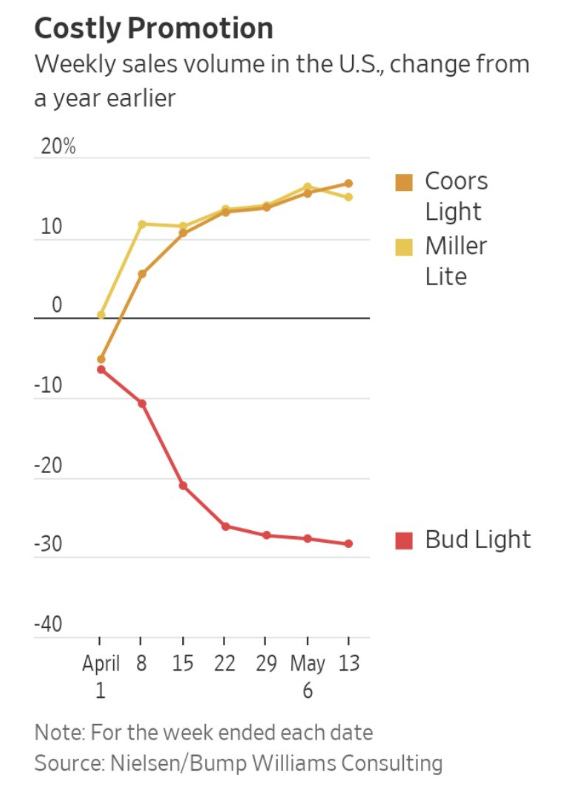
The Wall Street Journal ran a deep dive article last month exploring “how Bud Light blew it”, but it somehow missed the most important part of the story.
As most people already know, the world’s most popular light lager has seen a collapse in sales following a boycott prompted by a March Madness ad campaign featuring transgender influencer Dylan Mulvaney. The Journal‘s chart depicting the fall in Bud Light sales speaks for itself, and the company’s delayed and tepid response to the uproar only seemed to make matters worse.
This isn’t Anheuser-Busch’s first foray into controversial social issues.
The Journal‘s Jennifer Maloney points out that the company has been engaging in social equity-themed advertising for years, including a 2021 Michelob Ultra ad featuring transgender track star Cecé Telfer and a 2022 Bud Light Canada campaign for Pride Month displaying various pronouns.
What Maloney fails to mention in her article is why beer companies — not just Bud Light — are suddenly courting controversial social issues such as nonbinary gender, transgenderism, and third-wave feminism.
The answer is simple: The rise of environmental, social, and corporate governance as the dominant strain of “stakeholder capitalism” has incentivized corporations to curry favor with ESG rating firms, even if it means alienating their consumers.
Unlike traditional capitalism, which seeks to maximize profits by serving consumers, the ESG model seeks to “improve” capitalism by considering other stakeholders besides investors and consumers. Publicly traded corporations are graded on how well they achieve socially desirable metrics, such as combating climate change, advancing diversity and inclusion, and creating a more “equitable” society.
What was intended to be a kinder, gentler form of capitalism has morphed into a kind of economic fascism that places the arbitrary interests of a small cabal of people — asset managers, bureaucrats, global financiers — ahead of consumers.
As the Austrian economist Ludwig von Mises pointed out, consumers are the true bosses in a capitalist system. They ultimately decide what products are created and purchased, who becomes wealthy, and who becomes poor.
As the Bud Light fiasco shows, ESG places consumers in the back seat. The social equity campaigns are not designed to appeal to Bud Light consumers, but to the ESG rating agencies, which have the power to downgrade companies that fail to dance to their tune.
June 2, 2023
A potential sign of resistance?
Severian on the odd phenomena of people who’ve begun to discover they didn’t need to accept the ever-more-woke products of the entertainment industry and, more recently, major retailers and brewers:

Bud Light’s latest brand ambassador, Dylan Mulvaney
The Third Law of SJW — “SJWs always double down” — is really going to get tested with these things [woke reboots/remakes of popular TV shows, movies, etc.], but we need to hope they keep the faith. We want them to double, triple, quadruple down. The material basis of Clown World is the assumption that people simply can’t live without iCrap. As I noted, lots of people did indeed seem to enjoy the Covid lockdowns, and they weren’t all aspiring Laptop Class leftoids, either. Lots of moms found out that they rather enjoyed spending time with their kids, rather than putting in an extra twenty hours a week down at the law firm. Lots of suburban dads found a new sense of accomplishment doing little projects around the house.
In other words, people found out that not only could they just “make do”, they actually kinda enjoyed “making do”. Lots of them went right back to their old ways the minute they could, of course, but not all of them … and now, #Woke Capital is basically doing the job for us. They’re daring us to not go to the movies, the same way Fox News is daring us to cut the cord entirely (they figure that hey, we get $x a month from the cable subscription fee regardless of whether anyone watches or not, so why not give in to our natural inclinations and become MSNBC Lite?).
They’re daring us to cut the cord, throw the Pocket Moloch in the nearest lake, and get what we need from local sources — including entertainment. And who knows what might happen if we start actually talking to our neighbors? If, as with the lockdowns, the guy who lives down the street ceases to be “the dude with the green Honda” and becomes Bob, a real person?
Challenge accepted, motherfuckers.
May 18, 2023
How the Tabasco Factory Makes 700,000 Bottles of Hot Sauce Per Day — Dan Does
Eater
Published 4 Dec 2019On this episode of Cult Following, host Daniel Geneen heads to the McIlhenny factory on Avery Island, Louisiana, where the world’s supply of Tabasco sauce is made. Follow along as Daniel learns about the 150-year-old family-run business, and the Tabasco-making process, from pepper to barrel to bottle.
(more…)


