
Train of Thought
Published 5 May 2023In today’s video, we take a look at the American Orient Express, an attempt made by several businesses to replicate the charm and appeal of the real deal that just kept running into bad luck.
(more…)
August 5, 2023
The rotten luck of the American Orient Express
Comments Off on The rotten luck of the American Orient Express
August 2, 2023
How Shipping Containers Took Over the World (then broke it)
Calum
Published 5 Oct 2022The humble shipping container changed our society — it made International shipping cheaper, economies larger and the world much, much smaller. But what did the shipping container replace, how did it take over shipping and where has our dependance on these simple metal boxes led us?
(more…)
Comments Off on How Shipping Containers Took Over the World (then broke it)
July 29, 2023
The brief – but vastly profitable – heyday of Parys Mountain
In the latest Age of Invention newsletter, Anton Howes discusses the engine behind the meteoric rise of Britain’s “Copper King”, Thomas Williams:

Parys Mine Shaft. View down a shaft at Parys Mine.
Photo by Stephen Elwyn Roddick – CC BY-SA 2.0
At the time More visited, Thomas Williams had only just begun his rapid rise to power. He was already a major industrialist and grown stupendously wealthy. When More asked about his stables, Williams apparently could not even estimate how many he possessed to the nearest ten. But Williams not yet even master of the mountain.
Nonetheless, the mining was well underway. The closest port, Amlwch, was already connected to the mountain by a new road that had been built for the Parys Mine Company’s sole use. Having not long ago been a village of just six houses, Amlwch had turned into a bustling port.
The mine itself was a source of fascination. “This differs from any mine I had ever seen or perhaps is anywhere else to be found, for the ore here instead of being met with in veins is collected into one great mass, so that it is dug in quarries and brought out in carts without any shafts being sunk”. Instead, the miners hollowed out the mountain itself, forming vast caverns that they supported by simply leaving vast columns of the ore untouched. He noted at least four or five of these caverns with ceilings forty feet high, with columns of yellow ore: “the whole seemed like the ruins of some magnificent building whose pillars had been of massy brass.”
It’s a fascinating insight into what Parys would have very briefly looked like, because today there is so little of the mountain left. Indeed, some of the caverns More got to see were already collapsing, with the rubble then needing to be sorted. He describes how one such piece of rubble — a two-ton chunk of ore — had to be bored, the cavity rammed with gunpowder and sealed with stones, and then exploded. “They are continually blowing up parts of the mine”, he noted, and was informed that the part of the mine he was visiting alone got through 10-12 tons of gunpowder per year. The mountain was disintegrating, punctuated by the occasional boom.
And as though that were not dramatic enough, the whole place smelled like hell. When More visited there were some seventy vast kilns upon the mountain for calcining the ore, burning off its sulphur. Each kiln held some 2,000 tons of ore, and when ignited with a little dried vegetation or coal it was so sulphurous that it took four months of furious burning for the ore to be sufficiently calcined. He noted that one had to keep to the windward side of the kilns, as “the fumes arising from them are very disagreeable and destroy all vegetables for a considerable distance around them.”
Comments Off on The brief – but vastly profitable – heyday of Parys Mountain
July 28, 2023
QotD: “Stakeholder” Capitalism
Like many things faddish and ephemeral — disco, Pet Rocks, feathered hair, taking Michel Foucault seriously as an intellectual — the 1970s gave birth to the concept of stakeholder capitalism, one of the most unfortunate yet enduring of the bad ideas that polyester decade bequeathed us. At its essence, stakeholder capitalism is Marxian capitalism run through a lens of business ethics. It is the attempt to maintain authoritarian control over capitalism by displacing the Invisible Hand with a Velvet Glove, then using that glove, which hides an iron fist, to pound the world into adopting values that both assert and maintain its worldview. It is Theory applied to markets, marketing, wealth creation and management, and an overall globalized ethos of required and policed “virtue”, with the end goal being — as it always is under the discourses of Cultural Marxist thought — power: who has it, who controls it, and who uses it for their own ends most effectively and ruthlessly.
Of course, nobody participating in the push to replace shareholder capitalism with stakeholder capitalism would describe it this way. But then, euphemism and branding are each crucial tools in the Marxist’s verbal toolbox. So when you ask a stakeholder capitalist to describe stakeholder capitalism, what you ordinarily hear is that, as a business ethic, it combines the “sustainability” shareholder capitalism supposedly lacks with the “inclusivity” we’re not supposed to recognize is merely stultifying, policed conformity, the yield being a Woke capitalism that replaces production and consumption with “sharing and caring,” taking it out of the realm of the invisible and mechanical, as Adam Smith would have it, and placing it into the realm of values, where it can be used to shape the Greater Good the Marxist pretends he cares about. It’s fascism with a smiley face.
In the stakeholder capitalist system, investors aren’t — or at least, they shouldn’t be — solely interested in profits driven by production and consumption. And this is because to the stakeholder capitalist, itself a euphemism for collectivist corporatist, “it is well proven that our current form of Capitalism is inherently unsustainable because it requires endless growth on a planet with finite resources.”
Of course, none of this is “well proven” — the history of shareholder capitalism suggests the opposite, in fact, as innovation has led to the production of more and more out of less and less — but whether this is or isn’t the material case is incidental to those who are working on this inorganic worldwide paradigm shift commonly known as The Great Reset.
Because the move toward a “caring and sharing” worldwide economy, especially one that we’re told will be both sustainable and inclusive, requires those who care, those who share, and — most importantly, and at the very heart of the turn — those who get to determine what is cared about, who must do the sharing, and how most effectively to police the excesses that the ruling elite determine aren’t sustainable, while slowly dissolving the idea of the individual and his will to make way for an inclusive collective required to run the machinery of the self-installed Elect. It’s a global system of neo-Feudalism dressed in the finery of familiar values that have been deconstructed and re-signified, often without their consumers even aware that the values they reference — which were once commonly understood and largely shared by the civil society — are now their precise inverse: “tolerance”, thus, becomes the violent rejection of intolerance, as they define it; free speech is separated from “hate speech”, as they adjudicate it; individualism is but a controlling fiction maintained by the white male power structure that must be replaced by an ordered and value-determined collection of identity markers that construct you, while simultaneously acknowledging that there is no “you” beyond this assembly of discourses that assign your being its social situatedness, then places you within a collective of those with similar — though never identical — constructions. Once here, you are graded on the intersectional scale. Your relative worth and power come down to not to the content of your character, but rather to the collection and arrangement of your victimization tokens.
Jeff Goldstein, “Maybe I’ll be there to shake your hand, maybe I’ll be there to stakeholder capitalist the land”, protein wisdom reborn!, 2023-04-26.
Comments Off on QotD: “Stakeholder” Capitalism
July 22, 2023
“… no-one has a ‘right’ to a bank account …”
Unlike in Canada, where the extra-legal debanking of an unknown number of what Justin Trudeau described as a “small fringe minority … holding unacceptable views” had all the bien-pensants in and out of the legacy media nodding along, British opinion is not so friendly toward the extra-legal debanking of Nigel Farage and his family and friends:

An acquaintance of mine on Facebook, a hardline capitalist (so he says) made a comment that no-one has a “right” to a bank account, as they don’t have “rights” (those inverted commas are doing a lot of work here) to healthcare, education, paid-for holidays, etc. He was, of course, writing about the Nigel Farage/Coutts saga that has seen the CEO of NatWest, Coutts’ parent firm (39% owned by the taxpayer) issue a sort-of apology to the former UKIP leader.
[…]
When a person is “debanked” today, they can have a problem opening an account anywhere else if the bank asks them why they left a bank in the past. As a result, we have almost a sort of “cartel” system operating.
In time, hopefully, competition will swing back, and some of the nonsense going on will disappear. In the meantime, while I agree with you that the idea of having a “right” to a bank account is as bogus as many of the other “rights” that people talk about today, the fact that banking is such an embedded form of life in a modern economy means this issue hits hard in a way that, say, isn’t the case if you are banned from a pizza restaurant or candy store for holding the “wrong” views. Of course, it may be that the Farage case might encourage a firm to go out of its way to court business from those who have been targeted. Let’s hope so. For example, a bank could, without incurring wrath from the “woke” or regulators, say something like “Banking is all we do. No politics. No agendas. Just finance.”
And as I have said before, the outrageous Nigel Farage case, and that of others, surely demonstrates that a central bank digital currency idea must be resisted. This would be the end of any financial autonomy at all.
As you’d expect, Brendan O’Neill isn’t a fan of this latest attempt to make certain political viewpoints effectively illegal:

So there you have it. Nigel Farage really was given the boot from the prestigious private bank Coutts because of his political views. Because he is very pro-Brexit, is fond of Donald Trump and has been critical of Black Lives Matter. Because, in the words of an extraordinary internal dossier compiled by Coutts, his views “do not align’ with the bank’s values”. For the past fortnight the chattering classes have been chortling over Farage’s claim that Coutts was persecuting him for his political beliefs. How dumb – worse, how complacent in the face of corporate tyranny – those people look now.
Last month, Farage went public about the closure of his Coutts account. I’ve been given the heave-ho for political reasons, he said. He also said that nine other banks have since rejected his custom. Now he has published a dossier that was distributed at a meeting of Coutts’ “reputational risk committee” on 17 November 2022. It is a truly chilling read. It runs to 36 pages. There is a strong case for “exiting” Farage from the bank, it says, because his publicly stated views are “at odds with our position as an inclusive organisation”. The Stasi once compiled dossiers on dissident activists and artists whose views ran counter to those of the GDR regime. Now Coutts seems to be doing similar on customers who dare to bristle against the regime of woke.
The dossier basically finds Farage guilty of wrongthink. It highlights his renegade views not only on Brexit and Trump but also on Net Zero and even on King Charles – he has had the audacity to criticise His Majesty. Like dissidents in East Germany, his friendships are held against him, too. His links with Trump and tennis champ Novak Djokovic make him suspect, apparently. The dossier quotes the Independent‘s description of Farage’s visit to Djokovic’s trophy room in Belgrade, during which he criticised Australia’s expulsion of Djokovic for failing to get vaccinated against Covid, as “the spineless, chaotic behaviour of a chancer”.
[…]
The Farage / Coutts story is important because it highlights what a huge threat woke capitalism poses to freedom and fairness. Let’s be clear about what has happened here: a man has been economically unpersoned for having the supposedly wrong views. He’s been blacklisted for being a little too dissenting on the big issues of the day. And it’s happening to others, too – including people who do not have access to the same media platforms as Farage and thus have little leeway to protest against their expulsion from economic life by unelected, unaccountable banks and businesses. We acquiesce to this capitalist policing of thought at our peril. It is surely time for the government to act and clip the wings of banks and companies that believe they have the right to penalise citizens for the contents of their conscience. It might be Farage today, it could be you tomorrow.
Theodore Dalrymple sees it as a sign of the rise of woke totalitarianism:
It isn’t a question of whether Mr. Farage is always right or sometimes horribly wrong; when the bank says that it “uncovered” something that he said, as if he had recorded saying it by secret microphones, it makes itself ridiculous. Not even his worst enemies, or perhaps his best friends, would accuse him of hiding his light under a bushel.
The question is whether it’s the role of a bank to examine its clients’ views and deny them service if those views don’t accord with those of the chief executive, as if the latter were indisputably true and from which it were heresy to dissent. Is a bank an inquisition?
The chief executive of the parent bank, Alison Rose, said soon after her appointment that “tackling climate change would be a central pillar” of her work, and on the occasion of the so-called Pride month last year said that “our focus on diversity, equity and inclusion is integral to our purpose of championing the potential of people, families, and businesses”. This year, the company headquarters were covered in the rainbow colors of the LGBT flag, with lettering the height of humans declaring the “Championing the power of Pride”. Under her leadership, staff may “identify” as women and men on alternate days, should they so wish.
Of course, when she said that “diversity” and “inclusion” was “integral to our purpose”, she was using these terms in a strictly technical sense to mean “everyone who thinks as I do and has a fair bit of money”. The diversity “integral” to the “purpose” of Coutts doesn’t include those persons with less than $1 million to deposit, who even in these days of currency depreciation remain a small minority. People bank with Coutts because it’s exclusive, not inclusive.
The chief executive, however, is safely within what we might call the Coutts Community, because she was paid about $5.2 million last year. The prospect of being barred from the bank will no doubt inhibit anyone who banks with her banks from suggesting in public that she’s paid too much.
Comments Off on “… no-one has a ‘right’ to a bank account …”
July 20, 2023
QotD: Advertising to a semi-captive audience
The ads overflow from the convention itself to the city outside. For about two blocks in any direction, normal ads and billboards have been replaced with psychiatry-themed ones, until they finally peter off and segue into the usual startup advertisements around Market Street.
Scott Alexander, “The APA Meeting: A Photo-Essay”, Slate Star Codex, 2019-05-22.
Comments Off on QotD: Advertising to a semi-captive audience
July 18, 2023
At some point we moved from “therapy for serious issues” to “it’s totally normal for everyone you know to be in therapy”
In occasional conversations with younger folks (mainly Millennials and GenZ’ers), it’s surprising how often the topic of “therapy” comes up. Everyone I talk to under the age of 40 seems to be in therapy for this or that … when did that change? I’m no iron man (ask any of my friends), but it would never have occurred to me to seek counselling for what appeared to be the ordinary kind of issues that everyone else was dealing with. Friends and acquaintances who did were almost always struggling with some out-of-the-ordinary concern and certainly weren’t eager to discuss the course of their sessions as part of casual chit-chat. Freddie de Boer seems to share some of my discomfort on this topic:
Ladies, is your man engaging in the method of quasi-scientific self-improvement that’s currently mandated by high-status urbanites aged 21-45? If not, run, girl.
Before you go worrying or lecturing over my title here, let me say my personal life has never been better, really. But my total alienation from what I take to be my culture and its various attitudes and assumptions just grows and grows. Every day, it seems, there’s a fresh horror, and nowhere does it smack me in the face more than with mental health.
The above advertisement, which I think premiered in 2022, takes the medical tool of therapy and renders it a bit of dating-market gamesmanship, something bros just have to get on board with in order to hook up with high-value gals. I don’t expect a 30-second advertisement to reflect the reality that therapy is a frequently-adversarial process, that it’s at times uncomfortable by design, that it only works for certain kinds of problems, or that there are times when it can actually exacerbate them. And while I certainly do hold it against them for contributing to the corrosive “everybody should be in therapy” attitude — which is little different from believing that everybody should be on antibiotics — I also know that a for-profit therapy company is going to be pushing that line. (A macro-problem with for-profit medicine lies in the fact that the financial incentive is always to go on treating a medical problem forever without curing it.) What really gets to me is how a therapy company is going out of its way to make therapy appear so trivial, how the characters appear deliberately portrayed as unserious people and therapy so unapologetically represented as just a dating-market football. The commercial is somehow both grandiose about therapy’s purpose and dismissive about therapy’s actual use.
I don’t know how it is that we’ve simultaneously spent so much time validating and honoring people who struggle with their mental health and at the same time made mental health as a topic so frivolous.
I appreciated this conversation about TV therapy from The New Yorker. In it, Inkoo Kang says “I feel like there’s this idea that therapy is easy. And then you actually go to therapy, and you’re, like, ‘Oh, this is actually the worst’. That particular realization is very rarely dramatized.” I would argue that if therapy never feels like the worst, then you probably aren’t getting as much as you could out of the therapeutic process. Part of what makes finding and sticking with a therapist so difficult is that it’s close to impossible to divide your sense of what you want from a therapist from a broader understanding of what you need from a therapist. Are you sure you don’t like your current therapist because you’re “just not vibing with them”? Are you sure you want to fire your therapist because they seem “toxic”? Or is it because you signed up for therapy expecting it to be a constant exercise in validating everything you think and say and instead you’re one of the lucky few with a therapist who actually does their job and sometimes calls you on your bullshit? Of course, some therapists really aren’t very good, or more commonly, you can be a receptive patient and the therapist can be a competent practitioner but you have communication styles that just don’t gel. These things can be very difficult to parse on your own, which is why I always tell people to give it more time than they think they need. But either way, nothing is served by this effort to make therapy just another elite checklist item that shows you’re an enlightened person, except maybe Betterhelp’s share price.

Comments Off on At some point we moved from “therapy for serious issues” to “it’s totally normal for everyone you know to be in therapy”
July 12, 2023
“[E]lite colleges are machines for laundering privilege”
Scott Alexander ponders the reasons our elite universities operate as they do:
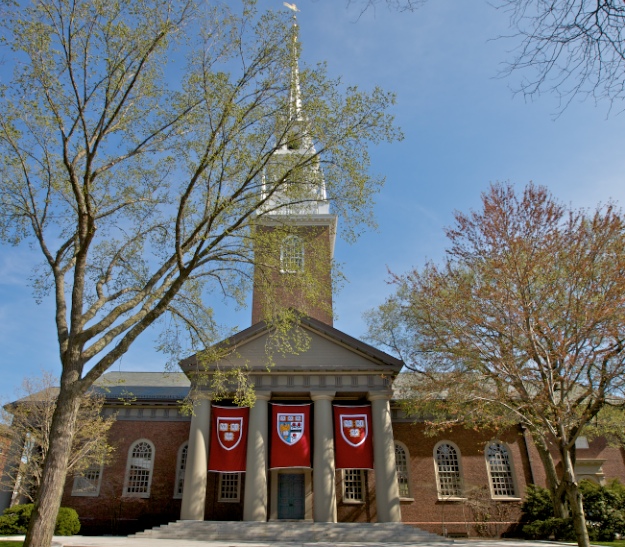
Harvard University Memorial Church.
Photo by Crimson400 via Wikimedia Commons.
We could think of “the best college” as a self-fulfilling prophecy; for whatever reason, one college has gotten a reputation as the one whose signal is most valuable. Everyone naturally tries to get in there; if they fail, they go to the college with the next-best reputation, and so on. The system is stable; the “best” college will keep its reputation (since it gets the best students) and the best students will always want to go to the best college. If, as Matt’s son suggests, all the Ivies started accepting the worst students instead, an Ivy degree would soon become a signal that you’re bad, and employers would stop respecting it.
I heard a fascinating variation of this hypothesis from Matt Christman of Chapo Trap House: elite colleges are machines for laundering privilege.
That is: Harvard accepts (let’s say) 75% smart/talented people, and 25% rich/powerful people. This is a good deal for both sides. The smart people get to network with elites, which is the first step to becoming elite themselves. And the rich people get mixed in so thoroughly with a pool of smart/talented people that everyone assumes they must be smart/talented themselves. After all, they have a degree from Harvard!
The most blatant form of this obfuscation: suppose you own a very successful family business. You can leave your son your fortune, you can leave him the business, you can leave him your mansion, but you can’t (directly) leave him an aura of having deserved all these things. What you can do is make a $10 million donation to Harvard in exchange for them accepting your son. Your son gets a Harvard degree, a universally-recognized sign of being a highly meritorious person. Then when you leave him the business, everyone will agree he deserves it. Who said anything about nepotism? Leaving a Harvard graduate in control of your business is an excellent decision!
This happens a little, but I think it mostly isn’t this obvious. More often the transactions are for abstract goods: prestige, associations, favors. The Maharaja of Whereverstan sends his daughter to Harvard so that she appears meritorious. In exchange, Harvard gets the credibility boost of being the place the Maharaja of Whereverstan sent his daughter. And Harvard’s other students get the advantage of networking with the Princess Of Whereverstan. Twenty years later, when one of them is an oil executive and Whereverstan is handing out oil contracts, she puts in a word with her old college buddy the Princess and gets the deal. It’s obvious what the oil executive has gotten out of this, but what does the Princess get? I think she gets the right to say she went to Harvard, an honor which is known to go mostly to the meritorious.
People ask why Harvard admissions can still be bribed or influenced by the rich or well-connected. This is the wrong question: the right question is why they ever give spots based on merit at all. The answer is: otherwise the scheme wouldn’t work. The point of a money-laundering operation is to take in both fairly-earned and dirty money, then mix them together so thoroughly that nobody can tell which is which. Likewise, the point of a privilege-laundering operation is to take in both fairly-earned and dirty privilege, then stamp both with a Harvard degree. “Fairly-earned privilege” means all the brilliant talented ambitious youngsters admitted on the basis of their SAT scores and grades and impressive accomplishments; “dirty privilege” means the kids of various old-money aristocrats, foreign potentates, and ordinary super-rich people. Colleges mix them together, with advantages for both groups.
Is this good or bad? It’s good insofar as it provides a justification for making some elite positions dependent on merit and accessible to anyone, but bad insofar as it helps defend and obfuscate the ones that aren’t. It’s good if you think it’s good for all the elites (meritocratic and otherwise) to know each other and be on the same page; it’s bad if you don’t want them to be (maybe because it helps them oppress people more efficiently).
I expect that without such a system the elites would do their own thing without any concession to merit whatsoever – so maybe it beats the alternative.
July 11, 2023
What is a HUMP Yard?
V12 Productions
Published 24 Oct 2022Hump yards are amazing pieces of engineering that allow railroads to use gravity to sort cars and build trains. Of course, not all railroad equipment can be humped.
(more…)
Comments Off on What is a HUMP Yard?
July 10, 2023
“De-banking” is the financial world’s version of cancelling someone
At the Free Life blog, Alan Bickley considers the recently reported rash of prominent (and not-so-prominent) critics of the British government being refused service by their banks and further refused permission to open new accounts with any other chartered bank. Being “cancelled” by social media companies is bad, but being “de-banked” in a modern economy is worse than being declared a “non-person” by a totalitarian regime:
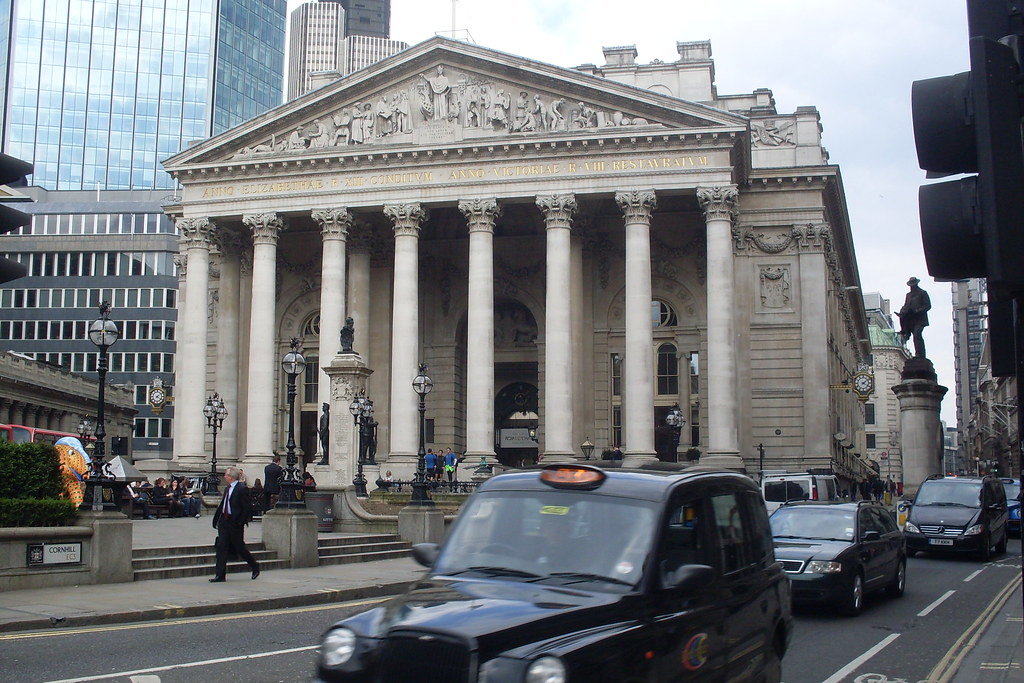
“The bank of England. London.”by Demetrio Neri_1959 is licensed under CC BY-NC-SA 2.0


In the past month, we have heard that various rich and well-connected people have had their bank accounts closed, seemingly because of their dissident political opinions. The same has happened to other people who are much poorer and without connections. Twenty years ago, the same happened to the British National Party. There is a simple libertarian response to this.
No one has the right to coerced association with anyone else. If someone comes to me and asks me to provide him with services, I have an absolute right to say yes or no. If I am uncharitable enough to dislike the colour of his face or what he does in bed, so much the worse. I may lose valuable business. But it is my time, and it is my choice. If anyone starts a whine about the horrors of discrimination, he should be ignored. We have an absolute right to discriminate against others for any reason whatever.
This being said, the position becomes less clear when state power of some kind is involved. Banks in this country require a licence from the State to operate. This protects them from open competition. It also gives them access to services and information from the State that are not given to other persons or businesses. If a bank finds itself in serious financial difficulties, it has at least a greater chance than other large businesses of being saved by the State – by a coordination of support by others or by direct financial help. The State has also made it illegal for many transactions to be made in cash. If I try to buy a car with £20,000 in cash, the car dealership is obliged to refuse my business, or to make so many enquiries that accepting my business is too much trouble. In effect, anyone who wants to spend more than a few thousand pounds in cash is obliged by various actual and shadow laws to use a bank account.
So we have privileged corporations and an effective legal obligation for people to do business with them. This entirely changes the libertarian indifference to commercial discrimination. The banks are a privileged oligopoly. The banks compete for custom among a public that is free to choose one bank rather than another, but that is compelled to choose some bank. For this reason, since the relevant laws will not be repealed, it is legitimate to demand another law to offset some of the effects of the others. Banks should be legally obliged to accept the business of any person or group of persons without question. Limitations on what services are provided must be justified on the grounds of previous financial misconduct as reasonably defined. For example, it should be permitted for a bank to refuse an overdraft to someone who is or has recently been bankrupt, or whose spending habits are obviously reckless. Perhaps it should be permitted for a bank to refuse to lend money for purposes it regards as scandalous as well as commercially unviable. Therefore, a representative of the White Persons’ Supremacy Foundation, or the Vladimir Putin Appreciation Society, should be able to walk into any bank and open an account – with no questions asked. If an account is refused, there should be a legal obligation on the bank to provide a full explanation of the refusal. If the refusal is not made on valid commercial grounds, there should be a right of appeal before a tribunal which does not award costs, and this tribunal should have the power to grant punitive damages against any bank found to be discriminating on any grounds but the validly commercial.
The refusal of banking services is only the beginning of a new and sophisticated totalitarianism. What the banks can do can also be done by supermarkets, by Internet service providers, by hotel chains, by airlines and railway companies, and by utility providers. There is indeed a good case for insisting on a law forbidding any organisation that has the privilege of limited liability from any but obviously commercial discrimination.
Comments Off on “De-banking” is the financial world’s version of cancelling someone
July 9, 2023
“… corporations sit in the late adopter phase of the marketing curve”
Elizabeth Nickson reminds us that the mass media corporate messaging is trailing edge, not leading edge:
Now everything is filtered through a warped looking glass, a Mad Hatter tea party of nonsense, run by the grimmest socialist operatives who ever lived, backed by buckets and wheelbarrows of stupid corporatist/fascist money. They are running a demoralization program on us.
It’s not working.
Never forget that corporations sit in the late adopter phase of the marketing curve, which is to say the lifeless part, the raking-in-the-money-from-stupid-women part. Women too, as a class, are part of the late adopter curve, because as Jordan Peterson once pointed out, women instinctively see humans as helpless babies needing protection and SAFETY FIRST. We are easily manipulated by our compassion, as is clear from the fact that only women and those who want to be, support the left now. The left traffics faux compassion and it is a killer drug. Included of course are beta males, hornswoggled by mommy, the wet diaper babies of Antifa and BLM. And of course, the paid operatives of the stinking cabal, the truly horrid public sector unions, the vicious thugs at AFL-CIO and the humanity-hating environmental movement.
The people the left cultivated so carefully over several generations have all fled to populism and eventually their vicious operatives won’t even be able to steal the votes they need. How big is it? Imagine 2000 Trump rallies. And then ten times that. And then quadruple it. Double and double and double again. And they are having the best time, more fun than you can imagine, working away in obscurity, asserting their human right to determine their own future.
[…]
Normals have turned, all of them. They are not available to the Trudeaus, Macrons and Rishi Sunaks of the world. They are wised up. Some of them know more than me about the filth at the heart of “environmentalism” and I know a lot. They are not Russian serfs or Chinese peasants. There is no way they are going to be corralled in 15 minute cities. They are going to bring the house down.
They/we are the people that Richard Haas, when resigning from the Council of Foreign Relations, a nest of nasty neo-liberal, neo-con oppressors if there ever was one, warned against when he said the greatest threat facing the world is American populists. Sure, buddy.
One of the those dreadful people (as they call us) is Kevin Fernandes82 on Instagram. Probably not his real name, but he is not aiming for public recognition. What he does, methodically, every day many times, is chronicle the slow crumbling of the old regime. I am using a lot of his reporting and as he shows, we are beating the pants off them every single day.
Their jobs are untenable. People are resigning from every safe berth in the world or being fired from plush jobs because the world the neo-liberal hegemon has created is counter-rational, so chaotic, it is unstable. It is unstable because we know it is stupid. We are opposed. And our opposition is slowly slowly bringing it down.
This is long. You don’t have to read it all to get the point, but give it to the despairing, keep it for when you despair. All these wins happened in the last two weeks. People, judges and administrators and politicians within the system, are starting to dance to the populist tune. Many of the worst are running as fast as they can.
We are the future.
Time to start thinking about what we want the new world to look like.
Herewith:
The Sound of Freedom has outsold the new Indiana Jones film, on 2,000 fewer screens and with no PR, against the full force of the Hollywood machine.
The Dutch government has reportedly fallen over asylum policy. Farms confiscation is wildly unpopular. Mark Rutte, architect of the prosecution of farmers has resigned.
The decoupling of the BRICS from the dollar means the death of the neo-liberal hegemon. Mark Wauk and Tom Luongo do a neat job of wrapping up this particular mess. As they say: there are no neo-liberals in a multi-polar, decoupled world.
The BRICS are set to introduce a new currency backed by gold, against the US backed dollar which depreciates in value every day because of inflation caused by choking energy supply and crazed overspending by governments.
EU laws that let banks shut accounts over political views to be scrapped.
Federal judge in Louisiana prohibits DHS, FBI and DOJ from working with Big Tech to censor posts.

The list goes on for quite a lot longer…
Comments Off on “… corporations sit in the late adopter phase of the marketing curve”
Grain Elevator
NFB
Published 30 Sept 2015This documentary short is a visual portrait of “Prairie Sentinels”, the vertical grain elevators that once dotted the Canadian Prairies. Surveying an old diesel elevator’s day-to-day operations, this film is a simple, honest vignette on the distinctive wooden structures that would eventually become a symbol of the Prairie provinces.
(more…)
Comments Off on Grain Elevator
July 8, 2023
Iowa votes to re-impose child labour in ways that violate federal labour laws
Chris Bray covers the breathless excitement of national media covering recent changes to Iowa labour laws:
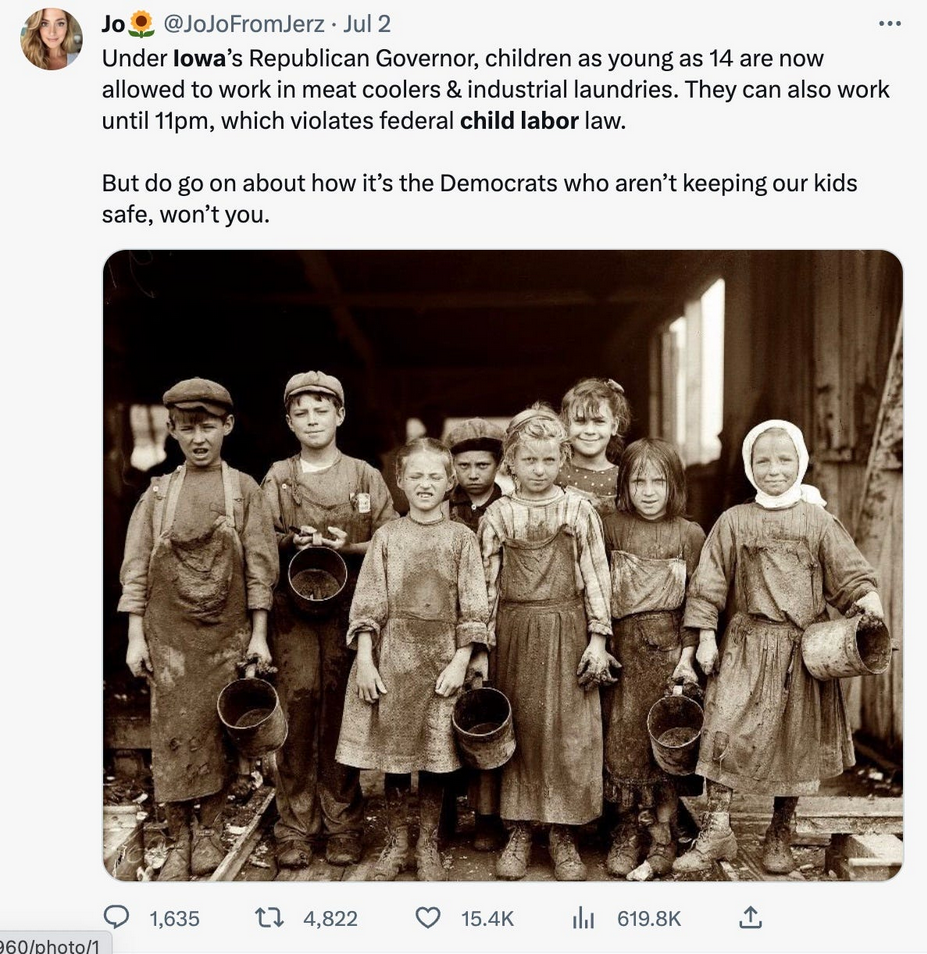
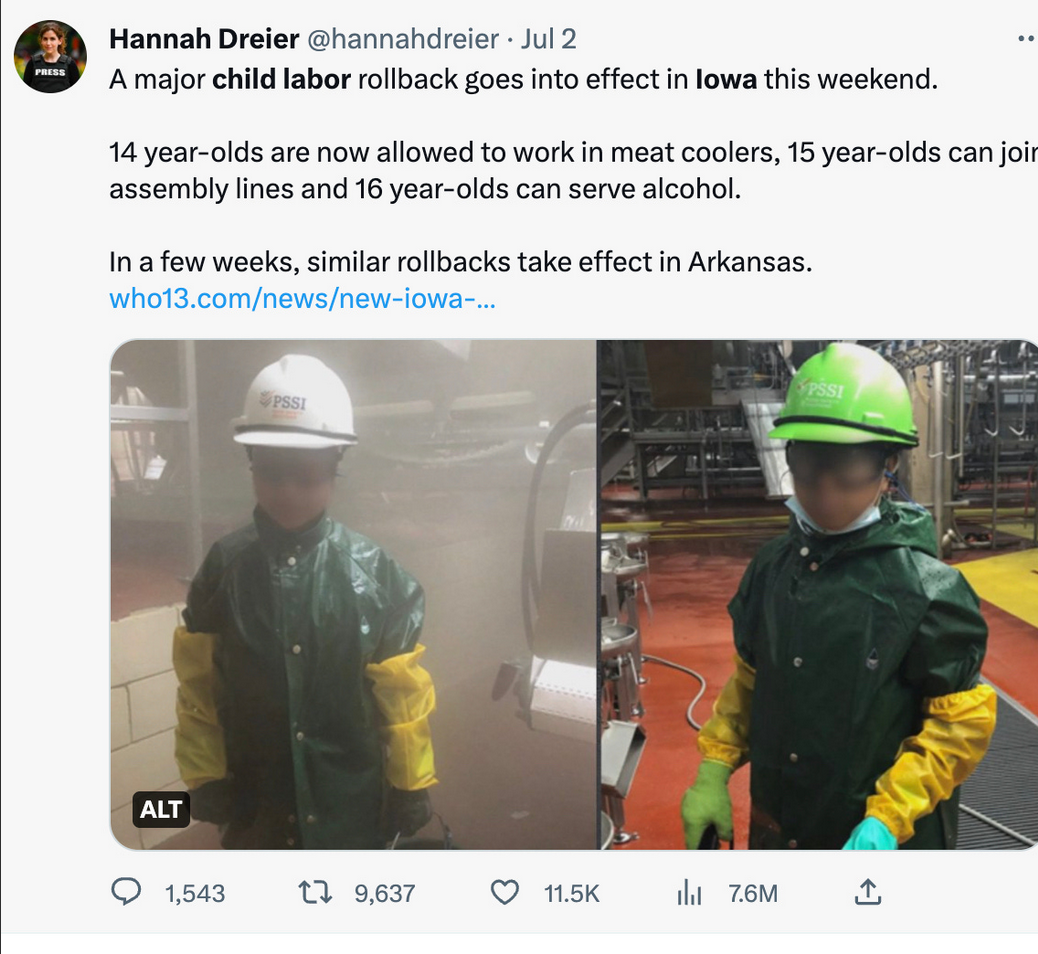
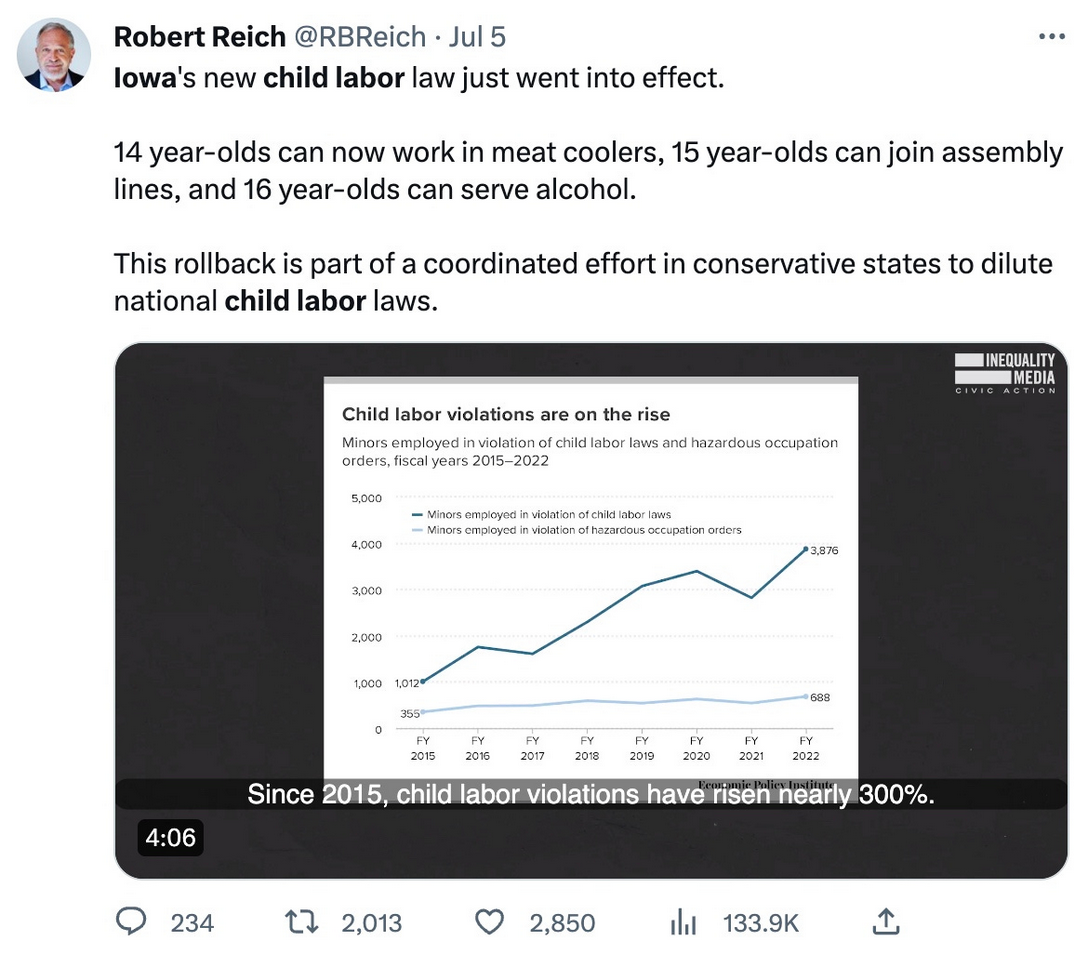
Suddenly, though, this message is all over social media:
These messages are not exactly false, and not entirely true. They take note of a real development, but strip away all the limits and caveats to fake up the creation of a 21st-century Upton Sinclair novel. But the effects of this successful legislation — this is where it gets complicated.
Start here (or here) with Iowa Senate File 542: signed into law in May, took effect on July 1. A bunch of the first-glance shocking details are more complicated than the outrage-farming Twitter takes suggest: 16 year-olds can serve alcohol in restaurants, with at least two adults to supervise, but not in bars; 15 year-olds can work on assembly lines in school-based work training programs, with parental permission; teenagers can work until 11 p.m. in the summer, but not during the school year. Allowing a 16 year-old coffee shop waitress to bring you a beer strikes me as … not the end of the world?
But all of those details aside, the new Iowa law expands child labor (while ending some earlier measures allowing even younger workers to do a few jobs like migrant farm labor), and will, in fact, put 14 year-olds to work in what will look a great deal like adult settings. So red state legislatures are expanding child labor at the moment they’re banning gender mutila— uh, gender-affirming medical care for teenagers, and making that latter choice on the highly defensible grounds that teenagers lack the maturity to make decisions like that. So a 15 year-old working in a factory lacks the maturity to make adult decisions, is where we end up when we put all of this together.
Comments Off on Iowa votes to re-impose child labour in ways that violate federal labour laws
July 7, 2023
Justin Trudeau says that Canada is merely defending itself from the “attack” by Facebook
Prime Minister Justin Trudeau has never faced a situation he couldn’t get histrionic about:
The government escalated the battle over Bill C-18 yesterday, announcing that it was suspending advertising on Meta’s Facebook and Instagram platforms due the company’s decision to comply with the bill by blocking news sharing and its reluctance to engage in further negotiations on the issue. While the ad ban applies to federal government advertising, Liberal party officials confirmed they plan to continue political advertising on the social networks, suggesting that principled opposition ends when there might be a political cost involved. At issue is roughly $11 million in annual advertising by the federal government, a sum that pales in comparison to the Parliamentary Budget Officer’s estimate of at least $100 million in payments in Canada for news links from Meta alone.
In addition to raising the economic cost to Meta for stopping news sharing, Prime Minister Justin Trudeau increased the rhetoric, describing Canada as having been “attacked” by Meta and likening the government’s fight over the bill to defending democracy in Ukraine or during the Second World War [at 13:30]:
Facebook decided that Canada was a small country, small enough that they could reject our asks. They made the wrong choice by deciding to attack Canada. We want to defend democracy. This is what we’re doing across the world, such as supporting Ukraine. This is what we did during the Second World War. This is what we’re doing every single day in the United Nations.
There are strongly held views on both sides of the Bill C-18 debate, but the suggestion that stopping sharing news links on a social network is in any way comparable to World War 2 is embarrassingly hyperbolic and gives the sense of a government that has lost perspective on the issue. Canadian Heritage Minister Pablo Rodriguez has repeatedly described the manner of compliance with Bill C-18 as a business choice for the Internet companies, yet the Prime Minister now calls that choice an attack on the country.
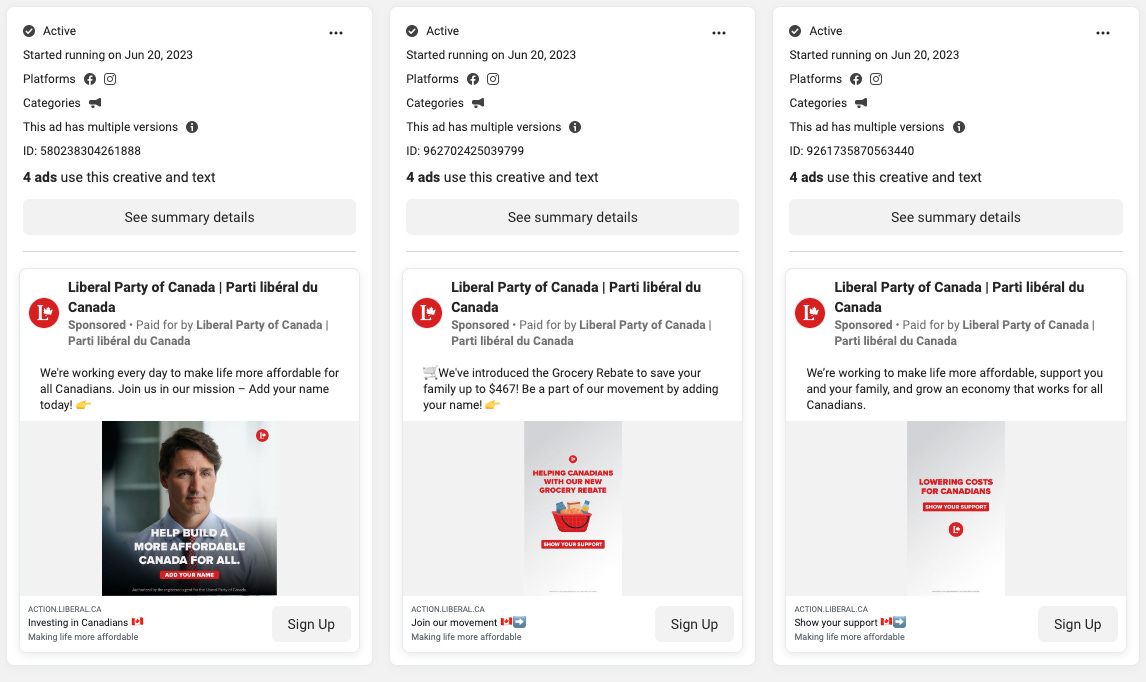
If it were truly comparable to a world war, then surely the Liberal Party (joined by the NDP) would not continue to advertise on the platform. Yet since the 2021 election call, the party alone has run approximately 11,000 ads on Facebook and Instagram. That is separate from individual MPs, who have also run hundreds of ads. The Meta Ad Library provides ample evidence of how reliant the party has been on social media. For example, since the start of the year, Anna Gainey ran over 500 ads as part of her by-election campaign in Quebec. David Hilderley, who was a candidate in the Oxford by-election, ran approximately 180 ads on Facebook during the same timeframe.
Comments Off on Justin Trudeau says that Canada is merely defending itself from the “attack” by Facebook
July 5, 2023
QotD: The role of merchants in pre-modern societies
It thus tends to come as something of a surprise that with stunning consistency, the merchant class tended to be at best cordially disliked and at worst despised by the broader community (although not typically to the point of suffering legal disability, as did some other jobs; see S. Bond, Trade and Taboo: Disreputable Professions in the Roman Mediterranean (2016) for this in Rome). This often strikes students as strange, both because we tend to think rather better of our own modern merchants but also because the image they have of the merchant class certainly looks elite.
For the farmers who need to sell their crops (for reasons we will get to in a moment) and purchase the things they need that they cannot produce, the merchant feels like an adversary: always pushing his prices to his best advantage. We expect this, but remember that our pre-modern farmers are just not that exposed to market interactions; most of their relationships are reciprocal, not transactional – the horizontal relationships we discussed before. The merchant’s “money-grubbing” feels like a betrayal of trust in a society where you banquet your neighbors in the good years so they’ll help you in the bad years. The necessary function of a merchant is to transgress the “rules” of village interactions which – and this resounds from the sources – the farmers tend to understand as being “cheated”.
At the same time, while most merchant types are humble, the high-risk and potentially high-reward involved in trade meant that some merchants (again, a small number) could become very rich. That, as you might imagine, did not go over well for the traditionally wealthy in these societies, the large landholders. Again, the values here often strike modern readers as topsy-turvy compared to our own, but to the elite large landholders (who dominate the literary and political culture of their societies), the morally correct way to earn great wealth is to inherit it (or capture it in war). The morally correct way to hold that wealth is with large landed estates. Anything else is morally suspect, and so the idea that a successful merchant could – by a process that again, strikes the large landholder, just like the small farmer, as “cheating” – leap-frog the social pyramid and skip to the top, without putting in the work at either having distinguished wealthy ancestors or tremendous military success was an open insult to elite values. Often laws were put in place to limit the ability of wealthy non-aristocrats (likely merchants or successful artisans) from displaying their wealth (sumptuary laws) so as to keep them from competing with the aristocrats; at Rome, senators were forbidden from owning ships with much the same logic (Roman senators being clever, they still invested in trade through proxies while at the same time disapproving of the activity in public politics).
[…] As far as elites were concerned, merchants didn’t seem to produce anything (the theory of comparative advantage which explains how merchants produce value without producing things by moving things to where they are most valued would have to wait until 1776 to be mentioned and the early 1800s to be properly explained) and so the only explanation for their wealth was that they made it by deception and trickery, distorting the “real” value of things (this faulty assumption that the “real value” of things is inherent in them, or a product of their production, rather than their use value to an end user or consumer, does not go away in the modern period).
Merchants also – almost by definition being foreigners in their communities – often suffered as members of “middleman minorities“, where certain tasks, particularly banking, commerce and tax collection are – for the reasons just discussed above – outsourced to foreigners or ethnic minorities who then tend to face violence and discrimination because of the power and prominence those tasks give them in society. Disdain for merchants was thus often packaged with ethnic hatred or racism – anyone exposed to the tropes of European or Near Eastern antisemitism (or more precisely, anti-Jewish sentiment) is familiar with this toxic brew, but the same tropes were applied to other middlemen minorities engaged in trade – Chinese people in much of South East Asia, Armenians in Turkey, Parsis in India and on and on. Violence against these groups was always self-destructive (in addition to being abhorrent on its face) – the economic services they provided were valuable to the broader society in ways that the broader society did not understand.
Bret Devereaux, “Collections: Bread, How Did They Make It? Part IV: Markets, Merchants and the Tax Man”, A Collection of Unmitigated Pedantry, 2020-08-21.
Comments Off on QotD: The role of merchants in pre-modern societies


