There’s a whole other piece to be written about organic spices, but the short version is that demanding organic spices is never going to be good for the farmers growing them. The U.S. standards for organic products amounts to ridiculously expensive and oftentimes unnecessary practices for small farmers who just don’t have the resources to do it. There are plenty of ways to arrive at ethical treatment of animals and land that are not part of our complicated organic laws. And that’s not to mention the people who demand organic products but will also freak out at the sight of a bug or won’t buy something that’s even a little bit misshapen or with a tiny brown spot on it. You can have pesticides or you can have pests.
Caitlin PenzeyMoog, “Salt grinders are bullshit, and other lessons from growing up in the spice trade”, The A.V. Club, 2017-04-06.
March 30, 2019
QotD: Organic spices are a racket
March 8, 2019
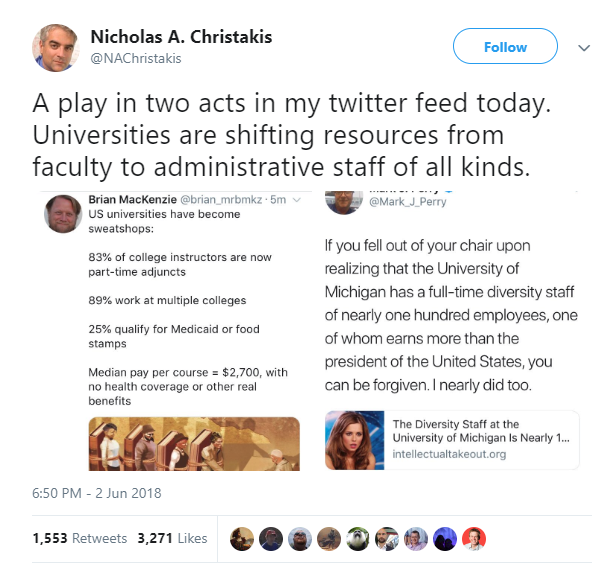
Education schools and the bloat of university administration
Remember the old joke:
Those who can, do.
Those who can’t, teach.
Those who can’t teach, teach gym educational studies.
As far as higher education is concerned, the joke is on us:
Though I didn’t realize it at the time, those were my first encounters with an alternate curriculum that was being promoted on many campuses, a curriculum whose guiding principles seemed to be: 1) anything that could be construed as bigotry and hatred should be construed as bigotry and hatred; and 2) any such instance of bigotry and hatred should be considered part of an epidemic. These principles were being advanced primarily, though not exclusively, by college administrators, whose ranks had grown so remarkably since the early 1990s.
Everyone knows about the kudzu-like growth of the administrative bureaucracy in higher education over the past three decades. What most don’t know is that at many colleges, the majority of administrators directly involved in the lives of students — in dorms, conduct hearings, bias-response teams, freshmen “orientation” programs, and the like — got their graduate degrees from education schools.
Ed schools, such as Teachers College at Columbia, or Penn’s Graduate School of Education, have trained and certified most of the nation’s public-school teachers and administrators for the past half-century. But in the past 20 years especially, ed schools have been offering advanced degrees in things like “educational leadership,” “higher education management,” and just “higher education” to aspiring college administrators. And this influx of ed school trained bureaucrats has played a decisive role in pushing an already left-leaning academy so far in the direction of ideological fundamentalism that even liberal progressives are sounding the alarm.
To anyone acquainted with the history and quality of American ed schools, this should come as no surprise. Education schools have long been notorious for two mutually reinforcing characteristics: ideological orthodoxy and low academic standards. As early as 1969, Theodore Sizer and Walter Powell hoped that “ruthless honesty” would do some good when they complained that at far too many ed schools, the prevailing climate was “hardly conducive to open inquiry.” “Study, reflection, debate, careful reading, even, yes, serious thinking, is often conspicuous by its absence,” they continued. “Un-intellectualism — not anti-intellectualism, as this assumes malice — is all too prevalent.” Sizer and Powell ought to have known: At the time they were dean and associate dean, respectively, of the Harvard Graduate School of Education.
More than three decades later, a comprehensive, four-year study of ed schools headed by a former president of Teachers College, Arthur Levine, found that the majority of educational-administration programs “range from inadequate to appalling, even at some of the country’s leading universities.” Though there were notable exceptions, programs for teaching were described as being, in the main, weak and mediocre. Education researchers seemed unable to achieve even “minimum agreement” about “acceptable research practice,” with the result that there are “no base standards and no quality floor.” Even among ed school faculty members and deans, the study found a broad and despairing recognition that ed school training was frequently “subjective, obscure, faddish, … inbred, and politically correct.”
February 7, 2019
Cultural nationalism versus cultural imperialism at the CBC
Andrew Coyne reflects on the odd musings of CBC president Catherine Tait:
“There was a time,” Catherine Tait was saying, “when cultural imperialism was absolutely accepted.”
The CBC president was musing, at an industry conference in Ottawa last week, about the heyday of the British and French Empires, when if “you were the viceroy of India you would feel that you were doing only good for the people of India.” Or, “if you were in French Africa, you would think ‘I’m educating them, I’m bringing their resources to the world, and I’m helping them.’ ”
The comments have since come back to bite her, not because many people have a kind word for imperialism these days but because she was comparing those colonial empires, which invaded and conquered territory by force of arms, to the “new empire” of Netflix. As more than one commentator has objected, none of the six million Canadians who subscribe to Netflix was made to do so at the point of a gun.
Neither is it evident what comparable “damage” is done by a service that gives willing viewers in this country access to well-made television programs from around the world. It was, in short, an altogether silly line of argument.
And yet it seems wrong to heap such particular scorn on Tait. For in truth she was only giving voice to the sort of thinking typical of her generation and class: middle-aged cultural bureaucrat/subsidized private producer, of a kind found in particular abundance in the Montreal-Toronto corridor. The same defensive attitudes, what is more, have for decades formed the foundation of much government policy on culture, even if they are largely incomprehensible to a generation raised on Netflix and YouTube.
There was a time, that is, when cultural nationalism was absolutely accepted — when it was taken as a given among the educated classes that it was the responsibility of government to protect and defend Canadian culture, if necessary from Canadians themselves. Hence the whole apparatus of CanCon, most of which is still with us today.
January 28, 2019
QotD: Inequality in academia
We’ve heard a lot about the problem of inequality in America over recent years. But most of that talk has ignored one of the very worst pockets of inequality in American society. I speak, of course, of the American university system and its treatment of adjunct professors and graduate students.
Academics seem to think that the business world is a feudal environment characterized by huge status differentials and abusive treatment of underlings. They think that because, to be honest, that’s a pretty good characterization of … the modern university, where serfs in the form of adjunct professors toil in the vineyards.
Glenn Reynolds, “Trump should pity the poor PhD: New president should target worker exploitation at American universities”, USA Today, 2017-02-16.
January 25, 2019
Putting the federal cabinet on a radical diet
Earlier this week, Ted Campbell suggested that one (of many) problems Justin Trudeau faces is the sheer size of his cabinet: there are limits to the number of people who can be successfully managed to achieve an organization’s goals by a single person. This is the reason most armies limit the size of their smallest tactical units to at most ten soldiers … much more than that, and the average leader is unable to maintain direct control without delegating sub-groups to subordinates. Running a federal government is a much more complicated task than running an infantry section. He begins by praising what he feels was the best cabinet in federal history:
A friend and regular interlocutor, reacting to a comment I made about a week ago, suggesting that the Trudeau cabinet is still too large, challenged me to look at the “ideal” cabinet. Now, it is certainly no secret that I think the “best” government Canada ever had, in modern times, say during the past century, was a Liberal one, led by Louis St Laurent. It was firmly grounded in liberal political philosophy that was shared, and broadly accepted, by most Canadians; the St Laurent cabinet was determined to govern for the people, for each person, not just to govern the people; it was economically bold but, at the same time, fiscally prudent; it believed, firmly, in a principled foreign policy and a strong enough military to give it the muscle it would need, from time to time; it advanced increasingly progressive social policies, step-by-step, but always in moderation; it was about as competent and as honest as almost any government was ever going to be … bearing in mind that governments are composed of men and women much like us.
This was the St Laurent cabinet:
There is some doubt about the date of this picture; one Government of Canada source says 1948 and another says 1953; the few familiar faces around the table, Douglas Abbott, Brooke Claxton, Brigadier Milton Gregg VC, C.D. Howe and Lester B. Pearson all served throughout that entire period. What is not in doubt is that the cabinet was much smaller than what we see today: fewer than 20 members. Today’s cabinet has over 35 members.
The problems of large cabinets are grounded in two realities: more and more complex issues, especially social issues, and more choices. Louis St. Laurent had between 245 and 265 MPs in the whole House of Commons and he governed with between 118 and 191 Liberal MPs on the government side. Justin Trudeau has a bigger problem: any modern majority government has 170+ members and Canadians are much better informed (or at least aware) of what government might do for (and to) them. He, like every prime minister before him, responds to the challenge by giving every group a voice. The outcome is a larger and larger cabinet. It’s not Justin Trudeau’s fault, it wasn’t Pierre Trudeau’s fault, either.
The correct answer, in my opinion, is a two tier cabinet: senior and junior ministers or an “inner” and “full” cabinet.
January 23, 2019
QotD: Regulation doesn’t scale well
A nation state is, with certain exceptions such as Kiribati, a very large entity. A modern “nanny state” is conducted on a scale beyond anyone’s comprehension. The single measure that might be good for a given town in, say, West Virginia, cannot possibly be good for another in Idaho, and adds debilitating paperwork at both ends. Meanwhile, the scale of the regulation is so great, that small family operators right across the country, lacking huge resources for lobbying and propaganda, will inevitably be scrood. For the truth is big guvmint and big bidnis interface only with each other.
David Warren, “The no-brainer chronicles”, Essays in Idleness, 2017-02-16.
January 5, 2019
Leave the Strand Alone! Iconic Bookstore Owner Pleads With NYC: Don’t Landmark My Property
ReasonTV
Published on 4 Jan 2019Leave the Strand Alone! Iconic Bookstore Owner Pleads With NYC: Don’t Landmark My Property
More from the article at Reason:
If New York City moves ahead with a proposal to landmark the home of the Strand Book Store, it would be putting a “bureaucratic noose” around the business, says owner Nancy Bass Wyden. “The Strand survived through my dad and grandfather’s very hard work,” Wyden says, and now the city wants to “take a piece of it.”
Opened by her grandfather, Benjamin Bass, in 1927, the Strand is New York City’s last great bookstore — a four-story literary emporium crammed with 18 miles of merchandise stuffed into towering bookcases arranged along narrow passageways. It’s the last survivor of the world-famous Booksellers Row, a commercial district comprised of about 40 secondhand dealers along Fourth Avenue below Union Square.
On December 4, 2018, the New York City Landmarks Preservation Commission held a public hearing on a proposal to designate the building that’s home to the Strand as a historic site. If the structure is landmarked, Wyden would need to get permission from the city before renovating the interior or altering the facade.
“It would be very difficult to be commercially nimble if we’re landmarked,” Wyden tells Reason. “We’d have to get approvals through a whole committee and bureaucracy that do not know how to run a bookstore.”
Wyden’s outrage derives in part from her family’s decades of struggle to keep the business alive.
The Strand survived, she says, because of “my grandfather and my dad’s very hard work and their passion … Both worked most of their lives six days a week” and they “hardly took vacations.”
January 4, 2019
QotD: The modern C.V.
Take that ghastly soul-destroying document, the curriculum vitae. It is as inherently inflationary as clipping the coinage or fiat money. A friend of mine, whom I knew to be competent and conscientious, consistently failed to be appointed to positions for which he was eminently qualified. My wife, who knew the ways of modern appointment committees, asked to see the curriculum vitae he was supplying with his applications for the jobs.
She was horrified: He would never get a job with such a curriculum, it was far too old-fashioned. It gave merely his formal qualifications and the positions he had previously held, with references. No, no, said my wife to him, what you need is to boast. You have to make out that your piddling research might be chosen very soon for a Nobel Prize, that your occasional good deeds were as at great a personal sacrifice as those of Mother Teresa, and that you are a person whose outside interests are carried out at levels equal to the professional; in other words that you are multitalented, multivalent, and quite out of the ordinary. Moreover, your ambition must be to save the world, to be a pioneer and a path-breaker, not merely to do your best in the circumstances. You must be grandiose, not modest.
Of course, every other applicant would be similarly boastful, and so, like star architects trying to outdo each other in the outlandish nature of their buildings, my friend’s boasts had to be preposterous, quite out of keeping with his admirable character. But once he had swallowed the bitter pill of realism, he was appointed at once. We all have to be Barons Munchausen now.
Theodore Dalrymple, “The Merits of Nepotism and Boasting”, Taki’s Magazine, 2018-12-08.
December 31, 2018
7 Things You Should Know About Free Speech in Schools: Free Speech Rules (Episode 1)
ReasonTV
Published on 13 Dec 2018Watch the first episode of Free Speech Rules, a new video series on free speech and the law. The first episode looks at the seven things you should know about how the First Amendment is applied in schools, from black armbands to ‘Bong Hits 4 Jesus.’
——————–
Subscribe to our YouTube channel: http://youtube.com/reasontv
Follow us on Twitter: https://twitter.com/reason
Subscribe to our podcast at Apple Podcasts: https://goo.gl/az3a7aReason is the planet’s leading source of news, politics, and culture from a libertarian perspective. Go to reason.com for a point of view you won’t get from legacy media and old left-right opinion magazines.
—————-Watch the first episode of Free Speech Rules, a new video series on free speech and the law that’s written by Eugene Volokh, the Gary T. Schwartz Distinguished Professor of Law at UCLA, and the co-founder of the Volokh Conspiracy, which is hosted at Reason.com.
The first episode looks at the seven things you should know about how the First Amendment is applied in schools:
1) Political and religious speech is mostly protected.
Students, from first grade to twelfth, can’t be punished based on their political or religious speech. As the Supreme Court ruled in Tinker v. Des Moines Independent Community School District: “It can hardly be argued that either students or teachers shed their constitutional rights to freedom of speech or expression at the schoolhouse gates.”2) Disruptive speech is not protected.
Schools can punish speech that “materially disrupts schoolwork” — for instance, because it prompts fights.3) Vulgar or sexual speech is not protected.
Schools can also punish students for using vulgarities or sexual innuendos.4) Praising drugs is not protected.
Schools can punish speech that seems to praise drug use, and probably also alcohol use and other crimes, at least when the speech doesn’t seem political.5) Official school newspapers are the school’s own speech.
Courts see the newspaper as the school’s own speech, even if students are the ones who write it.6) This only applies to public schools.
Under the so-called “state action doctrine,” the First Amendment doesn’t limit private schools, even those that get tax breaks or government funds.7) California is different. Some states, like California, have passed laws that provide more protection to students.
Written by Eugene Volokh, a First Amendment law professor at UCLA.
Produced and edited by Austin Bragg, who is not. This is not legal advice.
If this were legal advice, it would be followed by a bill.
Please use responsibly.
December 30, 2018
The US federal government “shutdown”
One of the things you quickly notice when there’s a public service cutback is that the cutbacks are always directed to the parts of that organization that interact with the public. The idea being that if the public are seriously inconvenienced by lack of service — I mean more than they ordinarily are, anyway — they’ll raise an outcry and the politicians will be forced to rollback the cuts. This is standard practice because, as a rule, it works fairly well. The current US federal government “shutdown” is a bit of an outlier here, because very few members of the public interact with federal employees between Christmas and New Year, and the ones that they do encounter are (mostly) still on the job. Even those who are not on the job due to the shutdown will eventually be paid for the time they didn’t work, so there are few monetary savings happening: probably the reverse, as the government will be racking up charges for services they’ve contracted for but won’t use during the disruption, and there may well be penalty clauses written into the contracts.
Colby Cosh discusses the oddity of American government shutdown kabuki theatre:
As occasionally happens, the U.S. government is now “shut down” as a consequence of a conflict over budget appropriations between the president and the Congress. Except, of course, it isn’t anything of the sort. Otherwise we Canadians would be meeting with other functioning states to decide what pieces of the United States to break off for ourselves, the way European powers used to do with Poland from time to time. (Newspaper ethics forbid me from publishing a web address for my $29.95 “Make Maine Canada Again” hats.)
The “essential” parts of the U.S. federal government, including the bits that guarantee the territorial integrity of the country, always keep on trucking through these “shutdowns.” (The National Guard is sometimes affected, but on this occasion the Guard has been taken care of by a spending bill that passed in October.) Social Security and Medicare roll on unimpeded. The functions of government that get held up are the ones whose delay or abandonment cause inconvenience — albeit serious, economically harmful inconvenience — rather than anarchy.
If you grow curious about these American “shutdowns,” perhaps because they did not happen before 1981 and do not really happen anywhere else, you discover that this kabuki-like feature is not really a coincidence. As much as Congress and the president may fight very earnestly over things like border walls, they have a common interest in the overall health of the state.
The U.S. Constitution says that “No Money shall be drawn from the Treasury, but in Consequence of Appropriations made by Law.” This is a shared element of America’s legal DNA and the British Empire’s: U.S. government shutdowns are, in a weird way, a distant echo of early-modern money struggles betwixt King and Parliament. Westminster-style governments, however, have evolved so as to minimize the possibility of ugly standoffs between the executive and the legislature. The U.S., not so much.
December 29, 2018
English public health officials angling to ban most restaurant meals due to excess calorie counts
The bureaucrats at Public Health England (PHE) apparently want the English to go back to those gloriously hungry days of rationing during and after the Second World War, at least based on their diktats on the allowable limits for calories in purchased meals:
The idea of the government controlling the number of calories in meals is so outlandish that few people have taken it seriously, despite PHE explicitly stating that this is what they are working on. They have been busy setting calorie limits for almost every food product available in shops, cafés, pubs and restaurants. The plan was to publish them in the spring but Laura Donnelly at the Telegraph has got hold of them and has leaked them today.
They are astonishing, not only because they are so low but because they are so comically precise. Sandwiches and main meal salads will be capped at 550 calories, ready meals will be capped at 544 calories and main courses in restaurants will be capped at 951 calories. Vol-au-vents or onion bhajis will be capped at 134 calories and salad dressing capped at 145 calories. The spurious precision of these numbers is presumably meant to imply that they have been worked out scientifically. They haven’t, of course (why is OK to have a 900 calorie lunch in a restaurant but not OK to have a 600 calorie microwave dinner?). There is no way of working out how much energy a single meal should contain. The concept is ludicrous.
But the detailed proposals have infuriated manufacturers – who say they are far too complex and confusing to be workable.
No kidding.
These are not legal limits. Not yet. The plan is for the bureaucrats at PHE to ‘work with’ the food industry to magically remove calories from their products without destroying flavour. PHE have no knowledge to bring to the table so their part in the ‘partnership’ amounts to setting targets, issuing threats and naming and shaming businesses.
Some of the companies will attempt to play along, mainly by reducing portion sizes, but it is a doomed enterprise. The government initially planed to use the threat of advertising restrictions to make the companies play ball, but it has already capitulated to the ‘public health’ lobby on this, so the only thing left is to threaten them with mandatory calorie limits.
If that happens, it will mean an effective prohibition on many of Britain’s best loved dishes. Steak and kidney pudding far exceeds the 951 calorie limit for out-of-home food, as does ham, egg and chips, the all day breakfast, fish and chips, and beer and ale pie (based on Wetherspoons’ nutritional information). So does a normal Christmas dinner.
As for foreign cuisine, you can kiss goodbye to kebabs, curries, pizzas and Chinese food. But it’s a treat, you say! Tough luck. No exceptions.
December 27, 2018
QotD: The deep state
The deep state is no myth but a sodden, intertwined mass of bloated, self-replicating bureaucracy that constitutes the real power in Washington and that stubbornly outlasts every administration. As government programs have incrementally multiplied, so has their regulatory apparatus, with its intrusive byzantine minutiae. Recently tagged as a source of anti-Trump conspiracy among embedded Democrats, the deep state is probably equally populated by Republicans and apolitical functionaries of Bartleby the Scrivener blandness. Its spreading sclerotic mass is wasteful, redundant, and ultimately tyrannical.
I have been trying for decades to get my fellow Democrats to realize how unchecked bureaucracy, in government or academe, is inherently authoritarian and illiberal. A persistent characteristic of civilizations in decline throughout history has been their self-strangling by slow, swollen, and stupid bureaucracies. The current atrocity of crippling student debt in the US is a direct product of an unholy alliance between college administrations and federal bureaucrats — a scandal that ballooned over two decades with barely a word of protest from our putative academic leftists, lost in their post-structuralist fantasies. Political correctness was not created by administrators, but it is ever-expanding campus bureaucracies that have constructed and currently enforce the oppressively rule-ridden regime of college life.
In the modern world, so wondrously but perilously interconnected, a principle of periodic reduction of bureaucracy should be built into every social organism. Freedom cannot survive otherwise.
Camille Paglia, “Hillary wants Trump to win again”, Spectator USA, 2018-12-04.
December 25, 2018
QotD repost: Sir Humphrey’s bureaucratic holiday wishes
Sir Humphrey: I wonder if I might crave your momentary indulgence in order to discharge a by no means disagreeable obligation which has, over the years, become more or less established practice in government service as we approach the terminal period of the year — calendar, of course, not financial — in fact, not to put too fine a point on it, Week Fifty-One — and submit to you, with all appropriate deference, for your consideration at a convenient juncture, a sincere and sanguine expectation — indeed confidence — indeed one might go so far as to say hope — that the aforementioned period may be, at the end of the day, when all relevant factors have been taken into consideration, susceptible to being deemed to be such as to merit a final verdict of having been by no means unsatisfactory in its overall outcome and, in the final analysis, to give grounds for being judged, on mature reflection, to have been conducive to generating a degree of gratification which will be seen in retrospect to have been significantly higher than the general average.
Jim Hacker: Are you trying to say “Happy Christmas,” Humphrey?
Sir Humphrey: Yes, Minister.
December 24, 2018
Repost – Hey Kids! Did you get your paperwork in on time?
If you hurry, you can just get your Santa’s Visit Application in before the deadline tonight!

December 20, 2018
Repost – Happy holiday travels!

H/T to Economicrot. Many many more at the link.