
“Changing the world” or even “changing the world of science fiction” was never my goal, fortunately. “Not getting my utilities cut off for nonpayment of bills” was. That, happily, turned out to be a more feasible aim.
It is the nature of the book market that one cannot be financially successful without also being well-known, one’s name being one’s brand-name, more or less. Which is felt to be the means and which the end will vary from writer to writer, natch. And whether one really needs “rich and famous” or if “self-supporting and well-known in my field” will do. Beware those moving goalposts, which can always make one feel artificially bad.
“How high is up?” is one of those dangerous questions that each writer must answer for themselves. Setting goals unrealistically high guarantees frustration, too low risks not challenging oneself to do as well as one otherwise might. (As a rule of thumb, it is also better to focus on what you can do, and not on other people’s non-controllable responses. “Finish a book” is controllable, “sell a book” less so, “become a bestseller or win an award” still less so. Unhappy is the writer who boards this train wrong way round.)
As for time, it passes at exactly the same rate for everyone, regardless of how one chooses to apportion it. It’s all choices and tradeoffs. Some prices might really be too high, some rewards too meager; only the person who is leading that life can decide.
That said, when I contemplate the ever-upthrusting mountain range of reading matter in the world, effectively infinitely more than I could ever read in my remaining lifetime, I do sometimes wonder why on earth I’m trying to make more, yeah — if that were my only motivation. Except that writing is in itself an intrinsic pleasure for me, if a weird one — I sometimes wonder if writing fiction ought to be classified as a dissociative disorder. So I would likely still be making up stories even if no one else wanted them, only with less social approval.
Lois McMaster Bujold, “Ask the Author: Lois McMaster Bujold”, Goodreads, 2015-04-21.
September 1, 2017
QotD: Writing as a profession
August 31, 2017
“… as if millions of future lit-crit students suddenly cried out in terror and were suddenly silenced”
The late Sir Terry Pratchett hatched a cunning plan to thwart the inchoate plans of uncounted would-be literary ghouls:
A hard drive containing the unfinished books of Terry Pratchett has been destroyed by a steamroller, in fulfilment of the late author’s last wishes.
The works were crushed by a vintage John Fowler & Co steamroller at the Great Dorset Steam Fair, ahead of the opening of a new exhibition about the author’s life and work. It is thought up to 10 incomplete novels were flattened.
Friend Neil Gaiman, with whom Pratchett cowrote Good Omens, had revealed in 2015 that Pratchett had instructed that he wanted “whatever he was working on at the time of his death to be taken out along with his computers, to be put in the middle of a road and for a steamroller to steamroll over them all”.
Pratchett’s former assistant Rob Wilkins tweeted that he was “about to fulfil [his] obligation to Terry”.
The hard drive will go on display as part of a major exhibition about the author’s life and work, Terry Pratchett: HisWorld, which opens at the Salisbury Museum in September.
About to fulfill my obligation to Terry @SalisburyMuseum @Wiltshire_flo pic.twitter.com/B0xr3V5Cbg
— Terry Pratchett (@terryandrob) August 25, 2017
There goes the browsing history… Many thanks to @steamfair. Soon to be on display at @SalisburyMuseum in September https://t.co/Di8tvTO4Hi pic.twitter.com/onGGWLDYL4
— Terry Pratchett (@terryandrob) August 25, 2017
August 25, 2017
August 24, 2017
Heinlein’s “Crazy Years”
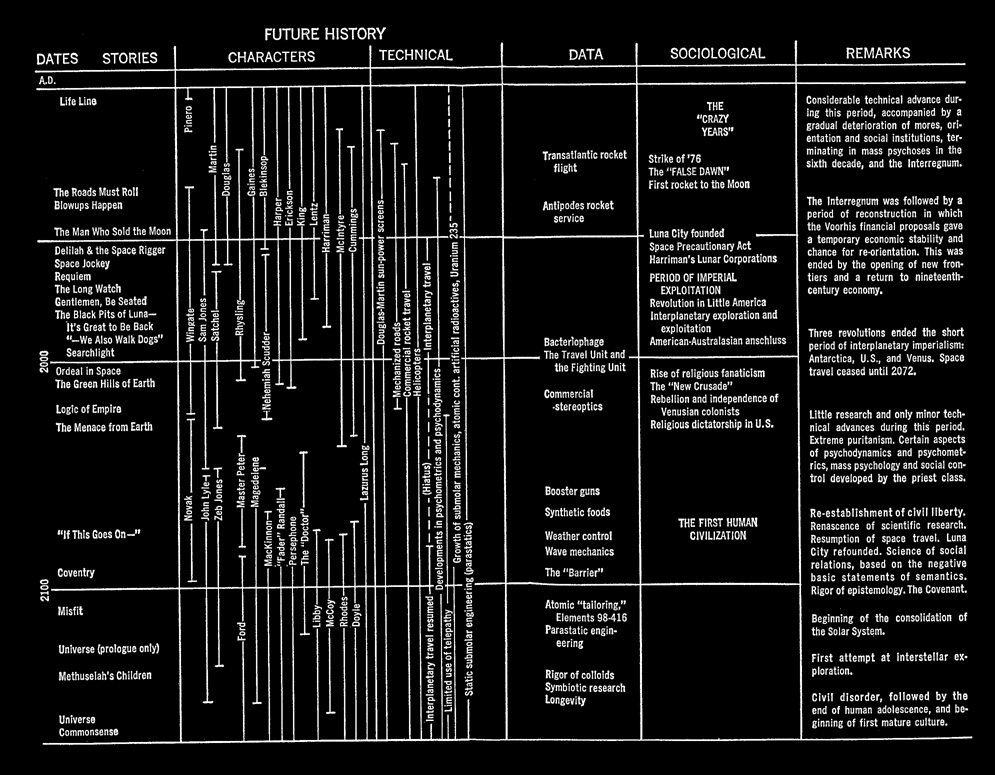
In his recent USA Today column, Glenn “Instapundit” Reynolds gives a shout-out to Robert A. Heinlein’s pre-WW2-era “Future History” timeline which included a segment presciently called “The Crazy Years”:
Very early in his writing career, about 1940, science fiction writer Robert Heinlein outlined a “future history” around which much of his writing would revolve, extending from the mid-twentieth century to the 24th century. Much of what he outlined hasn’t come to pass, but he nailed it in one respect: We live in the “Crazy Years.”
The Crazy Years, in Heinlein’s timeline, were when rapid changes in technology, together with the disruption those changes caused in mores and economics, caused society to, well, go crazy. They ran from the last couple of decades of the 20th Century into the first couple of decades of the 21st. In some of his novels set in that era — Time Enough for Love, for example — he includes random assortments of headlines that may have seemed crazy enough back then, but that seem downright tame today.
I’m not the first to make this connection — science fiction writers John C. Wright and Sarah Hoyt have remarked on it, and as Hoyt notes, “these are the Crazy Years” has become something of a stock joke among Heinlein fans.
But what does that mean? As Wright observes — invoking not only Heinlein but his contemporary A.E. Van Vogt, “craziness” comes when beliefs don’t match facts:
“Craziness can be measured by maladaptive behavior. The behavior the society uses to solve one kind of problem, when applied to an incorrect category, disorients it. When this happens the whole society, even if some members are aware of the disorientation, cannot reach the correct conclusion, or react in a fashion that preserves society from harm. As if society were a dolphin that called itself a fish: when it suffered the sensation of drowning, it would dive. But a dolphin is a mammal, a member of a different category of being. When dolphins are low on air, they surface, rather than dive. Putting yourself in the wrong category leads to the wrong behavior.”
QotD: Reader demands
Readers often ask for more of the same, but I think in many cases that’s not what they mean; what they are really saying is, “Give me a story that will make me feel the way that one did!” Which may actually be quite a different thing, but is much harder to articulate.
(Or, for all those fractal follow-ups, there’s always Fanficwoman. To the rescue!)
Lois McMaster Bujold, “Ask the Author: Lois McMaster Bujold”, Goodreads, 2015-04-21.
August 22, 2017
QotD: Writing about the past
If you’re writing in the past — or even if you are just living in the present — you should have an idea of how the past was different, and the factors that shaped that.
If you assume the past was just like the present only less “enlightened” you’re presupposing history comes with an arrow, and that today is of course more “advanced” than the past. While this is true of science — of course — it’s not always true of what was inside people’s heads. In many ways because even the poorest of us struggle less than in the Middle Ages, it’s become easier to develop mental habits of laziness and other “rich person” vices. What you think is enlightenment might be considered sheer nonsense by your descendants. For instance the enlightened thing at one time (even Heinlein has a whiff of it) was genetic culling. Now we’re finding that what we know about genes isn’t that straightforward. Throw in epigenetics and someone with a gene to be a “moron” can turn out to be a genius. More, even overtly bad disease genes are linked to genes we need and can’t survive without. BUT the enlightened opinion in the early twentieth century was to improve humanity and save human suffering by culling out the sick and the lame and the “inferior races.” (No, Hitler didn’t invent that.)
Some of our concepts (and I’m not going to name any because it’s a fight I don’t need, but I’m sure you can think of some) will prove just as monstrous to our descendants.
If you don’t have a sense of that, you don’t have a sense of the past, which unfortunately means you don’t have a sense of the present.
If you think that there is an objective way to end poverty or stop drug use, or whatever, and it’s ONLY your way, and even your opponents think your way is right and are being villainous and “evil” by opposing it you not only shouldn’t be writing historical fiction, you definitely shouldn’t be voting. You should find the nearest kindergarten and use it as a safe space.
Because out here in the real adult world, the past and the present and complicated places, with different modes of arranging life that worked with the circumstances at that time, even if they now set our teeth (or our hair) on edge.
If you can’t accept your ancestors were different from you, thought differently and responded to different necessities, you have no business preaching multiculturalism.
Because what makes a culture different is not the hairstyles, the dresses or what they ate, but how one must live to survive. And yes, some cultures are factually worse than others at providing their people with the necessities (or the luxuries) of life. Arguably most past cultures were (barring our finding some atlantian high-developed scientific culture we’ve heard nothing about.)
That doesn’t give you the right to to stomp your feet and rewrite the past to justify your boorish self-regard in the present.
Your ancestors were both more and less enlightened than you in ways you can’t even understand, and your superimposing your beliefs on them is the act of a mental midget standing on the shoulders of giants and peeing down.
Sarah A. Hoyt, “What Has Gone Before Us”, According to Hoyt, 2015-08-03.
August 21, 2017
QotD: The (long-running) decline of written science fiction
The problem with the Rabbits is not that left-wing politics is dessicating and poisoning their fiction. While I have made the case elsewhere that SF is libertarian at its core, it nevertheless remains possible to write left-wing message SF that is readable, enjoyable, and of high quality – Iain Banks’s Culture novels leap to mind as recent examples, and we can refer back to vintage classics such as Pohl & Kornbluth’s The Space Merchants for confirmation. Nor, I think, is the failure of Rabbit fiction to engage most SF fans and potential fans mainly down to its politics; I think the Evil League is prone to overestimate the popular appeal of their particular positions here.
No, I judge that what is dessicating and poisoning the Rabbit version of SF is something distinct from left-wing political slant but co-morbid with it: colonization by English majors and the rise of literary status envy as a significant shaping force in the field.
This is a development that’s easy to mistake for a political one because of the accidental fact that most university humanities departments have, over the last sixty years or so, become extreme-left political monocultures. But, in the language of epidemiology, I believe the politics is a marker for the actual disease rather than the pathogen itself. And it’s no use to fight the marker organism rather than the actual pathogen.
Literary status envy is the condition of people who think that all genre fiction would be improved by adopting the devices and priorities of late 19th- and then 20th-century literary fiction. Such people prize the “novel of character” and stylistic sophistication above all else. They have almost no interest in ideas outside of esthetic theory and a very narrow range of socio-political criticism. They think competent characters and happy endings are jejune, unsophisticated, artistically uninteresting. They love them some angst.
People like this are toxic to SF, because the lit-fic agenda clashes badly with the deep norms of SF. Many honestly think they can fix science fiction by raising its standards of characterization and prose quality, but wind up doing tremendous iatrogenic damage because they don’t realize that fixating on those things (rather than the goals of affirming rational knowability and inducing a sense of conceptual breakthrough) produces not better SF but a bad imitation of literary fiction that is much worse SF.
Eric S. Raymond, “SF and the damaging effects of literary status envy”, Armed and Dangerous, 2014-07-30.
August 17, 2017
QotD: Can you describe romance novels as “pretty people behaving stupidly”?
I’ve been learning about the romance genre recently. I have no intrinsic interest in it at all, but I have an intelligent friend who plows through romances the way I read SF, and we’ve been discussing the conventions and structural features of the genre. Along the way I’ve learned that romance fans use an acronym TSTL which expands to “Too Stupid To Live”, describing a class of bad romance in which the plot turns on one or both leads exhibiting less claim to sophont status than the average bowl of clam dip.
My wife and I have parts in an upcoming live-action roleplaying game set in early 16th-century Venice. As preparation, she suggested we watch a movie called Dangerous Beauty set in the period. I couldn’t stand more than about 20 minutes of it. “It’s just,” I commented later “pretty people behaving stupidly.”
On reflection, I’ve discovered that PPBS describes a great deal of both the fiction and nonfiction I can’t stand. It’s a more general category that includes not just TSTL, but celebrity gossip magazines, almost every “romantic comedy” ever made, and a large percentage of the top-rated TV shows (especially, of course, the soap operas).
Eric S. Raymond, “Pretty People Behaving Stupidly”, Armed and Dangerous, 2005-08-29.
August 9, 2017
Lois McMaster Bujold’s latest novella is out in ebook format
Any book by Lois McMaster Bujold is an automatic buy for me, but with her current “Penric” series, I have to wait until it appears in hardcover (the first two were published by Subterranean Press, and I expect they’ll eventually get this one into print as well).
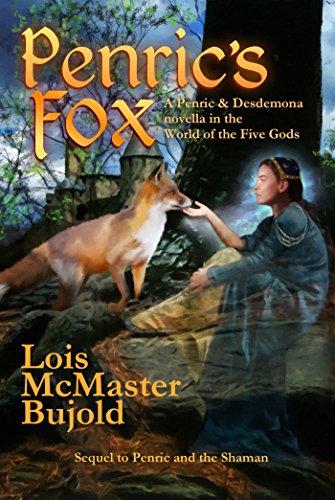
Penric’s Fox: a Penric & Desdemona novella in the World of the Five Gods. Book 3.
Some eight months after the events of Penric and the Shaman, Learned Penric, sorcerer and scholar, travels to Easthome, the capital of the Weald. There he again meets his friends Shaman Inglis and Locator Oswyl. When the body of a sorceress is found in the woods, Oswyl draws him into another investigation; they must all work together to uncover a mystery mixing magic, murder and the strange realities of Temple demons.
Penric and the Shaman was a 2017 Hugo Award nominee in the novella category.
For those of you who are all up-to-date and twenty-first-centurying like there’s no tomorrow, you can get the Kindle version here.
August 6, 2017
QotD: Confessions of a book-hoarder
Well, tomorrow I’d bring up stuff from the basement. So the next day I go downstairs to the utility room. The floor’s wet. The rug is sopping. I open the freezer, and discover that I’d locked the freezer door before closing it. The door had been open all night. Dead meat, droopy brats, sloshy ice cream — and water everywhere. The utility room was full of boxes from the storage room — we’d just had some shelves installed, and I’d moved out crates I’ve hauled around since my dorm room days. Books. Hundreds of books.
I felt the sides of the boxes to see if they’d wicked up the horrid slurry from the fridge — were they ruined? Would I have to throw out all these old, venerable friends? Everything I read and saved from 1976 to 1997 — were they lost to me forever?
They were dry.
You cannot imagine my disappointment.
This was the perfect opportunity to be rid of these mummified albatrosses forever. Friends, let’s be honest: Books are a curse. We’d all love to have a library with shelves stretching up to heaven, a ladder on rollers that lets you access the 17th level, where you keep the minor Polish poets and the monographs on eighth-century Chinese mandarins. But you end up with boxes of books in the basement, and you cannot part with them. Simply throwing them away feels sinful — hey, why not build a time machine and go back to Nazi-land and burn them, dude? You could sell them, but there’s something depressing about getting $7 for 70 pounds of paperbacks. It’s like auctioning your kid’s baby pictures on eBay and getting a high bid of a buck-fifty. The last time I divested my excess books I dumped them off on a Goodwill dock in the middle of the night, and I felt like someone pushing the family dog out of the car on a country road. The books will find a good home. I’m sure there’s a farmer around here they can live with.
James Lileks, Star Tribune, 2004-07-11.
August 4, 2017
Harry Potter and the Economic Segregation of Muggles
Published on 3 Aug 2017
Harry Potter contains a ton of incredible lessons about society, authoritarianism, and the power of love and individualism in the face of people who would exclude others based on group identity. But something people don’t think about as much are some of the economic lessons that we can draw from a world segregated into wizards and muggles.
On this episode of Out of Frame, we take a look at what the world might look like if magic and non-magic people were actually allowed to trade and interact with each other without the Ministry of Magic obliviating and arresting people for it.
For a transcript of this episode and more engaging content, visit:
www.FEE.org
QotD: Shakespeare’s sonnets
The Sonnets were published late in Shakespeare’s career (1609) — by a clever and unscrupulous man. His name was Thomas Thorpe. He ran what was for the times a unique publishing business, playing games with “copyright” that were often unconscionable but, usually, this side of the law. He owned neither a printing press, nor a bookstall — two things that defined contemporary booksellers — subcontracting everything in his slippery way. Indeed, I would go beyond other observers, and describe him as a blackguard; and I think Will Shakespeare would agree with me. Though Shakespeare would add, “A witty and diverting blackguard.”
He collected these sonnets, quite certainly by Shakespeare, but written at much different times and for quite various occasions, from whatever well-oiled sources. Thorpe had a fine poetic ear, and knew what he was doing. He arranged the collection he’d amassed in the sequence we have inherited — 154 sonnets that seem to read consecutively, with “A Lover’s Complaint” tacked on as their envoi — then sold them as if this had been the author’s intention.
We have sonnets not later than 1591, interspersed with others 1607 or later. In one case (Sonnet 145), we have what I think is a love poem Shakespeare wrote about age eighteen, to a girl he was wooing: one Anne Hathaway. (She was twenty-seven.) It is crawling with puns, for instance on her name, and stylistically naïve, but has been placed within the “Dark Lady” sonnets (127 to 152) in a mildly plausible way. It hardly belongs there.
Indeed, once one sees this it becomes apparent, surveying the whole course, that there is rather more than one “Dark Lady” in the Sonnets, and that like most red-blooded men, our Will noticed quite a number of interesting women over his years. But Thorpe has folded them all into one for dramatic effect.
David Warren, “Dark gentleman of the Sonnets”, Essays in Idleness, 2015-05-11.
July 30, 2017
“… sooner or later, and usually sooner, the British will be blamed”
In Pragati, Alex Tabarrok reviews Shashi Tharoor’s 2016 book history of the British Raj, An Era Of Darkness:
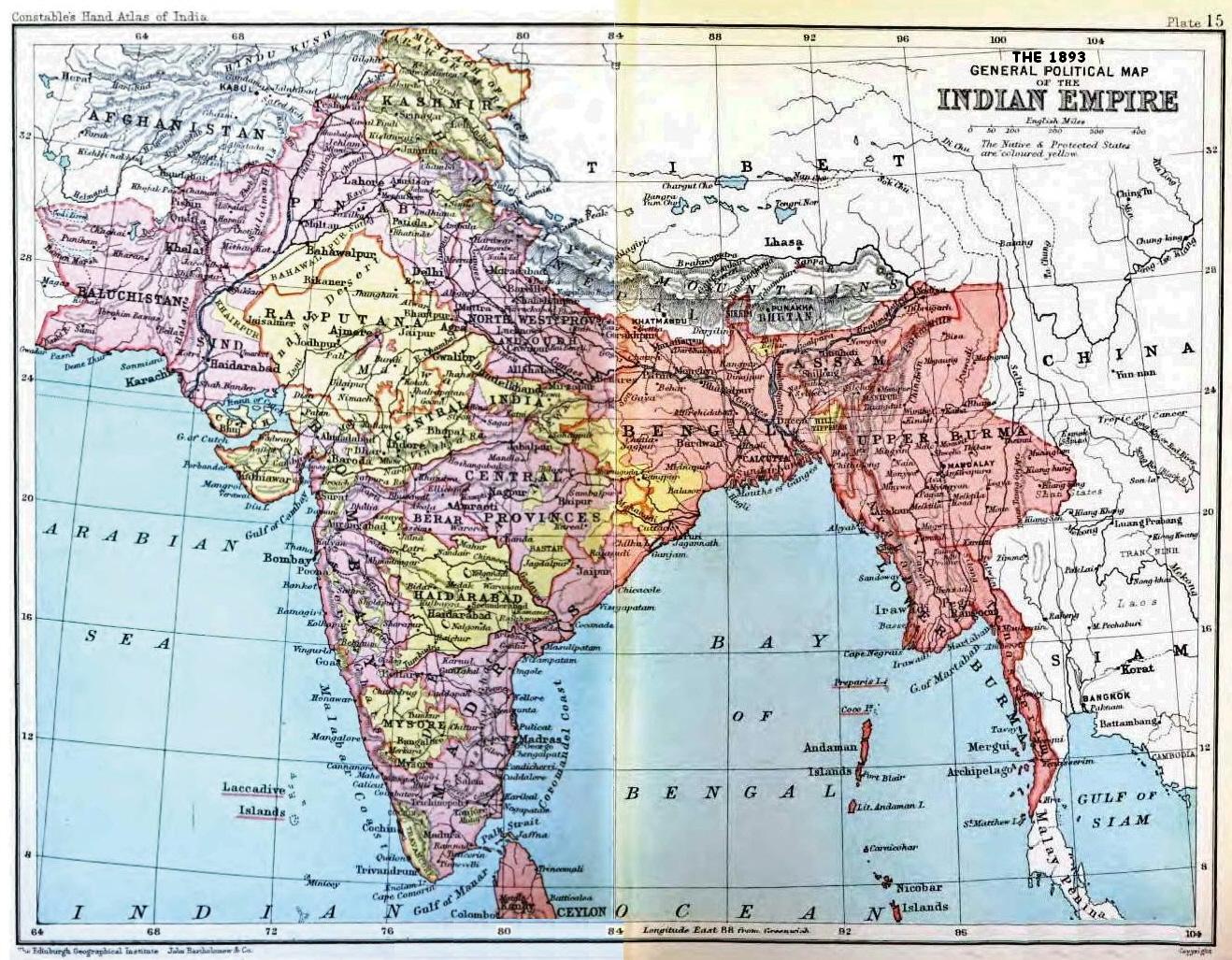
“Political Map of the Indian Empire” from Constable’s Hand Atlas of India, 1893.
(via Wikimedia)
At sophisticated dinner parties in Delhi, Calcutta, or Chennai, whenever the discussion turns to politics, one can be sure that sooner or later, and usually sooner, the British will be blamed. It’s a fine parlor game, and clever players can usually find a way to cast blame for whichever side of the debate they favor. Is India’s traditional family falling apart due to internet porn? Blame the British! Are the laws against homosexuality too strong? Blame the British! The British are an easy target because much of what they did was reprehensible. But blaming British imperialism for contemporary Indian problems is also an easy way to let India’s political class off the hook.
An excellent case against the British comes from Shashi Tharoor, bestselling author, former Under-Secretary-General at the United Nations, and current member of the Indian parliament, in his 2016 book An Era of Darkness: The British Empire in India (also published this year under the title Inglorious Empire[UK title]).
Tharoor makes three claims:
- The British empire in India, from the seizure of Bengal by the East India Company in 1757 until the end of British government rule in 1947, was cruel, rapacious, and racist.
- India would be much better off today had it not been for British rule.
- Britain’s success and the Industrial Revolution were due to British depredation of India.
The first claim is true, the second uncertain, the third false.
The first claim is the heart of Tharoor’s book: the British empire in India was cruel, rapacious and racist. All true. But who would expect otherwise? Power corrupts and absolute power corrupts absolutely. The theft, the famines, the massacres, the formal and casual racism, the utter hypocrisy of suppressing independence while using hundreds of thousands of Indian soldiers to fight for democracy and freedom in two World Wars — on all this Tharoor stands on solid ground. The ground is solid in part because it has been well-trod. Tharoor brings the case against the East India Company and Britain, initiated by Edmund Burke (1774-1785) and continued by the likes of Indian nationalist Dadabhai Naoroji [PDF] (1901) and American historian Will Durant (1930), to its conclusion and climax with the Indian independence movement. In this, Tharoor is entirely successful and his work deserves to be widely read.
In his eagerness to blame Britain, however, Tharoor reaches for every possible argument in ways that are sometimes misleading and sometimes absurd.
July 24, 2017
QotD: Salvador Dali, in his own words
Here, then, are some of the episodes in Dali’s life, from his earliest years onward. Which of them are true and which are imaginary hardly matters: the point is that this is the kind of thing that Dali would have liked to do.
When he is six years old there is some excitement over the appearance of Halley’s comet:
Suddenly one of my father’s office clerks appeared in the drawing-room doorway and announced that the comet could be seen from the terrace… While crossing the hall I caught sight of my little three-year-old sister crawling unobtrusively through a doorway. I stopped, hesitated a second, then gave her a terrible kick in the head as though it had been a ball, and continued running, carried away with a ‘delirious joy’ induced by this savage act. But my father, who was behind me, caught me and led me down in to his office, where I remained as a punishment till dinner-time.
A year earlier than this Dali had ‘suddenly, as most of my ideas occur,’ flung another little boy off a suspension bridge. Several other incidents of the same kind are recorded, including (this was when he was twenty-nine years old) knocking down and trampling on a girl ‘until they had to tear her, bleeding, out of my reach.’
When he is about five he gets hold of a wounded bat which he puts into a tin pail. Next morning he finds that the bat is almost dead and is covered with ants which are devouring it. He puts it in his mouth, ants and all, and bites it almost in half.
When he is an adolescent a girl falls desperately in love with him. He kisses and caresses her so as to excite her as much as possible, but refuses to go further. He resolves to keep this up for five years (he calls it his ‘five-year plan’), enjoying her humiliation and the sense of power it gives him. He frequently tells her that at the end of the five years he will desert her, and when the time comes he does so.
Till well into adult life he keeps up the practice of masturbation, and likes to do this, apparently, in front of a looking-glass. For ordinary purposes he is impotent, it appears, till the age of thirty or so. When he first meets his future wife, Gala, he is greatly tempted to push her off a precipice. He is aware that there is something that she wants him to do to her, and after their first kiss the confession is made:
I threw back Gala’s head, pulling it by the hair, and trembling with complete hysteria, I commanded:
‘Now tell me what you want me to do with you! But tell me slowly, looking me in the eye, with the crudest, the most ferociously erotic words that can make both of us feel the greatest shame!’
Then Gala, transforming the last glimmer of her expression of pleasure into the hard light of her own tyranny, answered:
‘I want you to kill me!’He is somewhat disappointed by this demand, since it is merely what he wanted to do already. He contemplates throwing her off the bell-tower of the Cathedral of Toledo, but refrains from doing so.
During the Spanish Civil War he astutely avoids taking sides, and makes a trip to Italy. He feels himself more and more drawn towards the aristocracy, frequents smart salons, finds himself wealthy patrons, and is photographed with the plump Vicomte de Noailles, whom he describes as his ‘Maecenas.’ When the European War approaches he has one preoccupation only: how to find a place which has good cookery and from which he can make a quick bolt if danger comes too near. He fixes on Bordeaux, and duly flees to Spain during the Battle of France. He stays in Spain long enough to pick up a few anti-red atrocity stories, then makes for America. The story ends in a blaze of respectability. Dali, at thirty-seven, has become a devoted husband, is cured of his aberrations, or some of them, and is completely reconciled to the Catholic Church. He is also, one gathers, making a good deal of money.
George Orwell, “Benefit of Clergy: Some Notes on Salvador Dali”, Saturday Book for 1944, 1944.
July 21, 2017
QotD: Anachronistic “Regency” romances
Which brings us to a discussion about romances, yesterday. Like apparently most people who read Regencies I’ve become aware of a tendency for them to read more and more like modern romances than like something set in that time.
Someone nailed it for me by pointing out that female characters have been getting more modern. For instance, they will do things like not want to marry UNTIL they have sexual experience, so they’ll be engaged and go out to find someone to sleep with them: in a time without either contraceptives or antibiotics and in a time when a unwed pregnancy would ruin not only the woman but all her relatives.
Or they rebel against being the one who was supposed to marry to make the family fortunes. I’m not saying a woman might not wish to marry someone else rather than make the family fortunes, but it would present in her own mind not as resentment to lifting the family out of debt, but as “I’m madly in love with the stable boy.” or whatever. And if a woman was thoroughly opposed to [being] married, it often manifested (at least in Catholic countries, granted, not England) as a “vocation.” What it didn’t manifest as was “I want to pursue a career.” Women married, or if they were unmarried stayed around the house helping with the nephews and the running of the house. If they had the means they might set up household with a companion. But only the poor worked, (even for men “having to” work was a downcheck on status.) If you were a governess or a nurse, it wasn’t for a “career” but because you were desperate.
Oh, and please save me from all the women running philanthropic organizations. While there were of course a number of these run by women, it wasn’t every other woman as seems to be in today’s regency romances. And charities for unmarried mothers would be very heavy on the preaching and getting them to give the baby up for adoption. Not telling them they’ve done nothing wrong and “affirming” their choices. Again, no contraceptives, no antibiotics. Sex and its consequences were serious business PARTICULARLY for women who make more of an investment in reproduction.
Sarah A. Hoyt, “What Has Gone Before Us”, According to Hoyt, 2015-08-03.


