
Call from the project manager on a big, glossy, high-end coffee-table book I recently proofread …
Project Manager: Oh. My. God! We can’t possibly implement all these changes! There’s just red EVERYwhere.
Me: They’re not changes, they’re corrections.
PM: But it’ll take days.
Me: Yes, and because there are so many I suggest you get someone to read it again.
PM: But we go to print on Friiiiiday *wail*
Me: Maybe the editor should look at it again then. Who’s the editor?
PM: The author. And me.
Me: No, who’s the E-D-I-T-O-R?
PM: No, seriously, the author and me.
Me: No frikkin’ kidding. (Okay, that was under my breath…)
Publish Cape Town, Facebook, 2014-06-26.
June 28, 2014
QotD: The dangers of self-publishing
Comments Off on QotD: The dangers of self-publishing
June 26, 2014
The second volume of Patterson’s biography of Robert Heinlein
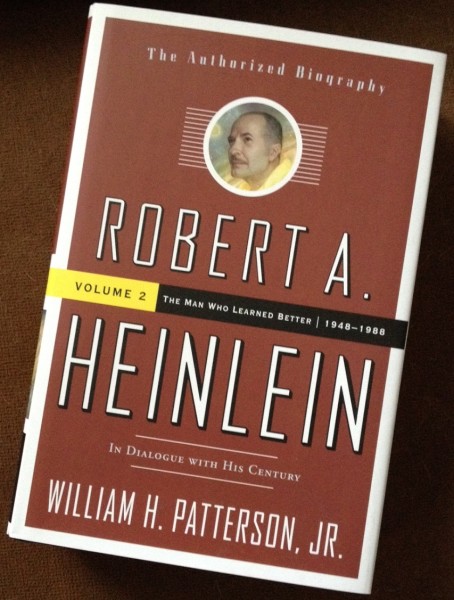 In the Washington Post, Michael Dirda reviews the second (and final) volume of William Patterson’s Robert A. Heinlein: In Dialogue With His Century.
Robert Anson Heinlein (1907-1988) possessed an astonishing gift for fast-paced narrative, an exceptionally engaging voice and a willingness to boldly go where no writer had gone before. In “— All You Zombies—” a transgendered time traveler impregnates his younger self and thus becomes his own father and mother. The protagonist of Tunnel in the Sky is black, and the action contains hints of interracial sex, not the usual thing in a 1955 young adult book. While Starship Troopers (1959) championed the military virtues of service and sacrifice, Stranger in a Strange Land (1961) became a bible for the flower generation, blurring sex and religion and launching the vogue word “grok.”
Heinlein’s finest work in the short story was produced in the late 1930s and early ’40s, mainly for the legendary editor of Astounding, John W. Campbell. But by 1948, when this volume opens, “The Roads Must Roll,” “By His Bootstraps, “Gulf” and “Requiem” are behind him. The onetime pulp writer has broken into the Saturday Evening Post and Boy’s Life, married his third (and last) wife, Virginia, and settled in Colorado Springs, where he designs and builds a state-of-the-art automated house. Apart from his occasional involvement with Hollywood, as in scripting Destination Moon, he will devote the rest of his career mainly to novels.
[…]
Like his fascinating but long-winded first volume, the second half of Patterson’s biography is difficult to judge fairly. Packed with facts both trivial and significant, relying heavily on the possibly skewed memories of the author’s widow, and utterly reverent throughout, volume two emphasizes Heinlein the husband, traveler, independent businessman and political activist. Above all, the book celebrates the intense civilization of two that Heinlein and his wife created. There is almost nothing in the way of literary comment or criticism.
Though Heinlein can do no wrong in his biographer’s eyes, if you use yours to look in Patterson’s voluminous endnotes, you will occasionally find confirmation that the writer could be casually cruel as well as admirably generous, at once true to his beliefs and unpleasantly narrow-minded and inflexible about them. Today we would call Heinlein’s convictions libertarian, his personal philosophy grounded in absolute freedom, individual responsibility and an almost religiously inflected patriotism. Heinlein could thus be a confirmed nudist and member of several Sunshine Clubs as well as a grass-roots Barry Goldwater Republican.
For the record, I loved this volume even more than I loved the first one. But Dirda’s comments are fair: Patterson worked hard to present Heinlein in as positive a light as possible, so it’s not unreasonable to suspect that the great man’s character quirks could make him difficult and awkward to deal with at times (to be kind). In the last post, I talked about the adolescent Heinlein as being “probably a pretty toxic individual” and that aspect of his character can still be discerned in the recounting of his later years.
Comments Off on The second volume of Patterson’s biography of Robert Heinlein
June 22, 2014
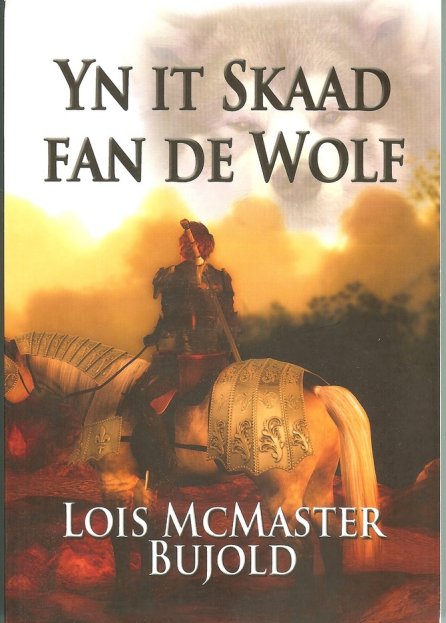
A Frisian translation of Lois McMaster Bujold’s The Hallowed Hunt
Lois McMaster Bujold posted an image to her Goodreads page, showing the cover of a new translation of The Hallowed Hunt into a language I didn’t think was still spoken:
She also posted a letter from the translator, which discusses some of the problems inherent in translating a fantasy novel into a language which only really became a written language quite recently:
Originally (we’re talking the early Middle Ages here), Frisian was the language closest related to English, but after more than a millennium of being heavily influenced by Dutch and German, this is no longer the case. Over the centuries, Dutch, German and the Low Saxon dialects of the eastern Netherlands and northern Germany have made such inroads into the original Frisian language area (once stretching all along the North Sea coast from what is now Belgium to Denmark), that it has crumbled into several small — or smallish — enclaves, which are still shrinking or at least remain under constant pressure. In the outside world, the term “Frisian” is generally used as if it were a monolithic language, but in fact there are three different Frisian languages, which are mutually quite incomprehensible and have been so for a long time.
• North Frisian is spoken in northern Germany, in an area along the North Sea coast and on the nearby islands directly south of the Danish border, by about 10,000 people.
• East Frisian was once spoken in the German coastal area adjacent to the Dutch border, but has gone extinct there, except for one small inland area, Saterland, which was originally surrounded by almost impassable peat bogs. Saterlandic, or Saterland Frisian, is still spoken today, by some 2,200 people.
• In the Dutch province of Friesland, Frisian is still spoken as a first language by about 350,000 people (out of a total provincial population of c.630,000). It has official status equal to Dutch, here, and some 110,000 inhabitants of the province speak it as a second language. There are a lot of Frisians who for the sake of (better) employment have moved away from Friesland, bringing the total number of native Frisian speakers in the Netherlands to c.450,000. From this point, I will refer to this language, my native tongue, as “Frisian”, which is the name we have for it (Frysk), but FYI, in English it is often called “West Frisian” (a somewhat confusing name, since in the Netherlands, that is what we call a Dutch dialect spoken in northern tip of the province of North Holland).
Today, Frisian is a minority language used by about 3% of the total Dutch population, and although a lot of things have changed for the better since the beginning of the 20th century, when the Frisian language movement first emerged, we still have to fight for our rights more often than not. To give you an impression of the situation we have to deal with, a 1994 survey showed that of the total number of inhabitants of Friesland (now c.630,000), 94% can understand Frisian, 74% can speak it, 65% can read it, and 17% can write it. (These are still the most recent numbers available; I’ve read that they’re in the process of doing a follow-up survey, but apparently the results aren’t in yet.)
On the subject of literary translations, it should be understood that this is a relatively new phenomenon for the Frisian language. The Bible was not published in Frisian until 1943, and Shakespeare’s entire oeuvre appeared in our language in eight big omnibus editions between 1955 and 1976 (although some plays, like Hamlet and A Midsummer Night’s Dream, had already been published separately in the twenties and thirties).
For any native Frisian readers who’d like to read this excellent book in your own language, you can buy the translation here.
Comments Off on A Frisian translation of Lois McMaster Bujold’s The Hallowed Hunt
June 5, 2014
A visual history of pin-up magazines
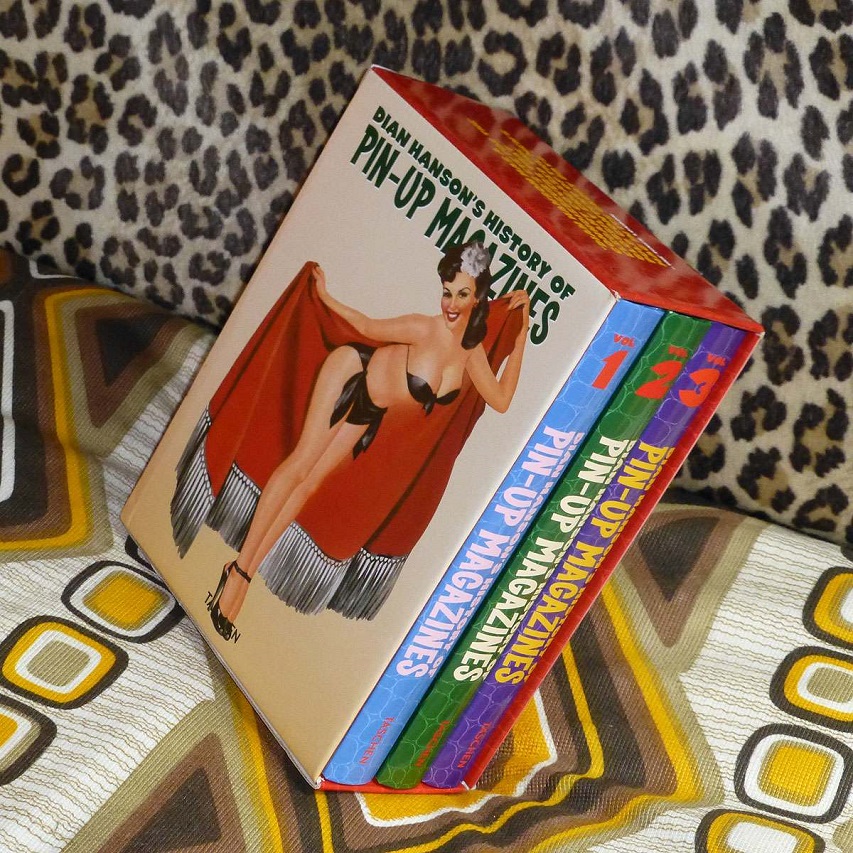
A review of a new three-volume history of the girly magazine:
Taschen delivers as only Taschen can with Dian Hanson’s History of Pin-Up Magazines, a comprehensive three-volume boxed set chronicling seven decades in over 832 munificently illustrated pages, tipping the scales at nearly seven hardbound pounds. Although each volume is ram-packed with a bevy of sepia sweethearts, hand-tinted honeys, and Kodachrome cuties squeezed between dozens of lurid full-page vintage magazine covers, the accompanying text is so compelling that you’re apt to actually read these books too. And there’s a lot to learn about the history of pin-up magazines, more than you’d ever imagine, and this set leaves no stone unturned and no skirt unlifted. From the suggestive early illustrations of the post-Victorian era to the first bare breasts, the intriguing sources that fueled the fires of popular fetish trends, and the many ways in which publishers tried to legitimize the viewing of nude women while gingerly dancing around obscenity laws, we watch this breed of pulp morph and reinvent with fiction or humor, and later the marriage of crime and flesh. We see the influence on pin-up culture in the wake of the First World War and with the advent of World War II and the rise of patriotica. We follow the path of the bifurcated girl, to eugenics, the role of burlesque, and the legalization of pubic hair. We venture under-the-counter, witness the death of the digest and the pairing of highbrow literature and airbrushed beauties. Hanson even treats us to a peek into the lesser-known black men’s magazine genre, and the contributions made by erotic fiction and Hollywood movie studios.
Comments Off on A visual history of pin-up magazines
June 4, 2014
Piketty’s book as revealed truth
Sean Collins says “thou shalt not doubt St. Thomas”:
The Piketty-FT debate should be seen for the arcane technical dispute that it is, but instead many claimed that it was a Big Deal, a decisive political debate for our times. This overblown reaction highlights how Pikettymania has got out of control. Your attitude to Piketty’s Capital – a 700-page tome that many have not read – has become a badge indicating that you are right-on (or not) when it comes to inequality.
Pikettymania took flight when the left hailed him as extraordinary, a hero, and claimed his book would utterly transform the policy discussion towards questioning capitalism. Liberal economist Paul Krugman considers Capital ‘the most important economics book of the year – and maybe the decade’. Even those who disagree with the content feel obliged to claim the book is exceptional; for example, Lawrence Summers, a top economist in the Clinton and Obama administrations, says it is a ‘Nobel Prize-worthy contribution’, even though he finds Piketty’s theory to be wrong.
[…]
When the Great Man himself responded to the FT, his annoyance at having to deal with someone raising questions about his awesome work was clear. ‘Ridiculous’ and ‘dishonest’ was how he initially described the FT’s findings. In his full reply, he says the FT’s points were ‘criticism for the sake of criticism’ — in other words, this wasn’t a genuine search for the truth. In response to a number of the FT’s specific charges, Piketty says that he often had to adjust the data because of their inadequacies, and he applied his best judgment. He admits that in a few cases he could have been more explicit in describing his adjustments.
Such a response may lead to more questions, but not from his loyal supporters, who were busy celebrating Piketty’s ‘victory’ over the FT. ‘Piketty’s devastating point-by-point rebuttal’, says Robert Kuttner, shows that Giles ‘made a fool of himself’. Economist and New York Times contributor Justin Wolfers tweeted, ‘Debate’s over folks’ — providing further evidence for Joel Kotkin’s theory of the spread of a ‘debate is over’ syndrome among the modern left, which seeks to impose a stifling conformity on a variety of issues (from climate change to the causes of poverty and the definition of marriage, among others). Krugman concluded that the FT-Piketty debate showed the persistence of inequality ‘deniers’ — the same term of abuse thrown at today’s heretics who dare to question climate-change orthodoxy.
This anti-intellectual ‘nothing to see here, folks’ approach is wrong; more, not less, debate should be encouraged. Piketty’s data is fair game, but there’s much more to his argument that should be questioned, too. Even if Piketty’s figures are perfect, he still cannot explain why inequality changes over time, nor back up his predictions for the future. Moreover — as I pointed out in my review of his book — we should challenge the elite’s obsession with the lives of the rich and famous, which distracts from a proper discussion about economic growth and increasing living standards for all.
Comments Off on Piketty’s book as revealed truth
June 2, 2014
Amazon, Barnes & Noble, Random Penguin and other publishing Monopoly players
A quite contrarian take on the upheavals in the publishing world by Hugh Howey:
A similar game is being played in the book industry today, as it has been played in many other industries. Here at BEA, I’m hearing a lot about monopolies. (And monopsonies, for those who prefer to quibble semantically rather than understand what is meant and forge ahead in productive conversation.) Practically everyone here at the book expo believes that Amazon has gotten too big, that they wield a disproportionate amount of power, and that they must be reigned in or defeated.
I am told, without exaggeration and in all seriousness, that Amazon wants to “crush their competition.” I hear that they want to “put everyone else out of business.” Two things are true, both of which make these statements ridiculous: The first is that Amazon most certainly doesn’t want all of their competitors to go out of business, because then they’d be the only game in town and the government would have no choice but to break them up. The second is that of course they are acting as if they want to put their competitors out of business. That’s how you improve your business practices. You try to out-do your competition.
Unless … you don’t understand at all what it means to compete. Which I think explains the righteous indignation. But I’ll get to that in a minute.
[…]
Ironically, the biggest losers in this shift have been yesterday’s villains. The massive brick and mortar discounters — who once were blamed for literature’s downfall, who sold “loss leaders,” who roughed up publishers in negotiations — have become the bulwark behind which all legacy hopes now hunker. Little explored is the possibility that Amazon is helping independent bookstores by clearing out these former predators.
When it comes to discounting and selection, B&N can’t compete with Amazon. When it comes to book browsing, Amazon can’t compete with curated independent bookstores. If you line the three sales models up from small indie stores to big discounters to Amazon, you’ll see that neighbors compete with and harm one another. Concurrent with the shuttering of Borders and the shrinking of B&N, we are also seeing a rise of indie shops. Coincidence? Or are we heading toward a future where Amazon and indie bookstores coexist because they provide two very different shopping experiences and fulfill quite separate needs?
Best estimates give Amazon roughly half of the book market. With the shutter of Borders, B&N now has a more disproportionate control of brick and mortar shelfspace than Amazon does of online book sales. This is especially powerful as the rest of the smaller bookstores have less leverage for bargaining with publishers. Who is the monopoly?
Comments Off on Amazon, Barnes & Noble, Random Penguin and other publishing Monopoly players
May 31, 2014
Shock, horror! Ezra Levant’s publisher took government grants!
In the Globe and Mail, Simon Houpt looks at the rise and rise of Ezra Levant and finishes with what he clearly thinks is a “gotcha” moment:
… for a man who seems to have studied his American forebears so extensively, he has failed utterly to learn how to mimic the persuasive charms of a Bill O’Reilly or the wackadoodle authenticity of a Glenn Beck. He has a genuinely nasty streak that flares up in his attacks – on the Roma people, for example – that have landed him in hot water with the Canadian Broadcast Standards Council.
He seems less interested in free speech than in listening to his own speech. Perhaps fatally, he has no visible sense of humour about himself.
In Groundswell, he has great fun mocking one of his favourite targets: Hollywood stars, whom he accuses of gross hypocrisy for promoting environmental causes while flying around in private jets. He points to Matt Damon’s anti-fracking drama Promised Land, which was backed in part by financing from the United Arab Emirates. And he mocks Josh Fox, the director of the anti-fracking documentaries Gasland and Gasland 2, for being a one-time New York-based actor.
Yet there is more than enough hypocrisy to go around: Levant is a critic of government support whose books have been published by a company that took plenty of government money until a recent change in ownership precluded the practice; a free-marketeer who works for a network that spent months last year trying to convince regulators to let it extract a monthly payment from every TV subscriber in the land.
At one point in Groundswell, Levant suggests activists are primarily driven by the salaries they receive. It’s a worldview that is so breathtakingly cynical that we’re left to wonder if Levant himself would blithely change his position for a fatter paycheque. If true, what kind of free-speech champion is that?
As far as the publisher collecting government money … most of the Canadian publishing business does that. It’s an unusual publishing company that manages to avoid suckling at that particular teat. Sun TV’s campaign for a better placement in cable TV packages certainly didn’t show the company in a good light, but the regulators have deliberately created a two-class system for cable, with the favoured channels required in each cable offering (a subsidy-by-another-name) and the disfavoured ones excluded. Sun TV could have taken the high road, but they’d have gone out of business for no purpose, and it wouldn’t have changed the system at all. (Full disclosure: I don’t watch Sun TV, although I have read a couple of Levant’s books.)
Comments Off on Shock, horror! Ezra Levant’s publisher took government grants!
May 30, 2014
New book exposes the Koch brothers
Nick Gillespie in the Daily Beast, recommending that everyone read the new exposé by Mother Jones senior editor Daniel Schulman. But not for the reasons you’d expect:
As a libertarian, I’m always slow to tell people what they should do. But if you care about politics and the ultimately far more powerful cultural direction of these United States, the new book by Daniel Schulman, Sons of Wichita: How the Koch Brothers Became America’s Most Powerful and Private Dynasty is mandatory reading.
Written by a senior editor for the lefty magazine Mother Jones, the book is hugely revelatory, though not in a way that will please or flatter the conspiracy theories of Democrats, liberals, and progressives who vilify the Kansas-raised billionaires Charles and David Koch for fun and profit. Sons of Wichita chronicles the post-World War II transformation of a mid-size oil-and-ranching family business into the second-largest privately held company in the United States. From a straight business angle, it’s riveting and illuminating not just about how Koch Industries — makers of “energy, food, building and agricultural materials…and…products [that] intersect every day with the lives of every American” — evolved over the past 60 years but also how the larger U.S. economy changed and globalized.
But what’s far more interesting — and important to contemporary America — is the way in which Schulman documents the absolute seriousness with which Charles and David have always taken specifically libertarian ideas and their signal role in helping to create a “freedom movement” to counter what they have long seen as a more effective mix of educational, activist, and intellectual groups on the broadly defined left. By treating the Koch brothers’ activities in critical but fair terms, Sons of Wichita points to what I like to think of as Libertarianism 3.0, a political and cultural development that, if successful, will not only frustrate the left but fundamentally alter the right by creating fusion between forces of social tolerance and fiscal responsibility.
Comments Off on New book exposes the Koch brothers
May 28, 2014
The “servant problem” of post-Victorian England
Before the widespread availability of electricity, no middle class household in England could get by without at least one servant. Even as modern labour-saving appliances (along with proper plumbing) started to take their place in the home, servants were still deemed an essential part of being middle- or upper-class. It may account for some of the fascination with TV shows like Downton Abbey or the earlier Upstairs, Downstairs to modern audiences — they give at least a bit of a glimpse into a very different domestic world. At Bookforum, Daphne Merkin reviews a books that look at the “servant problem”:
Servants is chockablock with incredulous-making details about the exploitative conditions in which household help lived and worked (these included cramped, chilly, and spartan sleeping quarters, endless hours, and the overriding assumption of inferiority), as well as anecdotes of supreme helplessness on the part of the coddled rich, such as the following: “Lord Curzon, whose intellect was regarded as one of the glories of the Empire, was so baffled by the challenge of opening a window in the bedroom of the country house in which he was staying (no servants being available so late at night), that he simply picked up a log from the grate and smashed the glass.” Even after World War II, when homes had begun to be wired for electricity despite the gentry’s insistence on the vulgarity of such improvements and the ideal of the 1950s self-contained (and servantless) housewife was hoving into view, so otherwise gifted a chap as Winston Churchill was unable, according to his valet John Gibson, to dress himself without assistance: “He was social gentry … He sat there like a dummy and you dressed him.” As easy as it is to snicker at such colossal ineptitude on the part of the cultural elite, it is also intriguing to consider how this kind of infantilizing treatment might have facilitated their performance in demanding grown-up roles — like someone playing with rubber ducks in the bath before going out to lead men in a military campaign.
Servants takes the reader from the days of Welbeck Abbey, the home of the eccentric and reclusive Duke of Portland, where upper servants had their own underservants to wait on them, to the gradual erosion of the older forms of domestic service and on up through the new world of do-it-yourself home comforts as devised by technology and a greater show of equality between employer and servant. This world, ushered in with the 1950s, shunned the “badge of servitude” that was conveyed by uniforms, surreal daily routines (whether it meant Ladyships who couldn’t sleep with creases on a pillowcase or Ladyships who insisted on cutting their boiled eggs with a letter opener), and a feudal attitude that took no more cognizance of domestics than it did of the furniture. “It was in the best houses considered quite unnecessary (in fact poor form),” Lethbridge notes, “for servants to knock before entering a room. This was partly because they lived in such everyday familiarity with the family that there was nothing to hide from them and partly because … their presence made no difference whatsoever to whatever was being said or going on.”
[…]
There’s much to think about in both these books — not least the particularly British style of treating domestics, both less casually sadistic and less casually amorous than, say, white Americans’ attitude toward black slaves. Indeed, I suspect that one of the reasons American audiences delight in the travails and triumphs of the gaggle of domestics on Downton Abbey is out of a sense of superiority that the “servant problem” in such acute, institutionalized form isn’t ours. Much as we may envy them all that pampering, we also like to look down our noses at it as going against the democratic and independent Yankee ethos. To this point it’s worth noting that Betty Friedan in The Feminine Mystique referred precisely to “the servant problem” as one of the besetting woes of the upper-middle-class housewives she was looking to liberate, and that our habit of befriending those who clean our kitchens and bathrooms and look after our children can’t disguise the fact that we value their hourly labor less than we value a twenty-minute haircut and that we live largely in ignorance of their thoughts and feelings.
Comments Off on The “servant problem” of post-Victorian England
May 25, 2014
A hit, a palpable hit
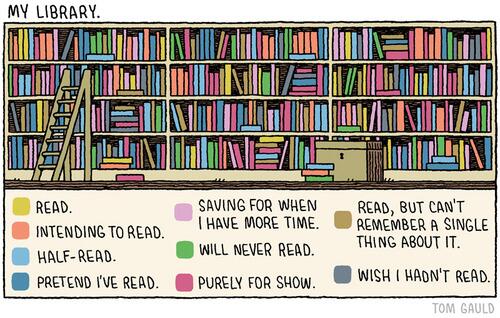
I’ve never met Tom Gauld, but he seems to know far too much about me…
Comments Off on A hit, a palpable hit
May 24, 2014
Piketty’s Charge
The book that everyone has been so enthusiastic about (well, everyone who supports vastly increased taxes and a much larger government anyway) may rely for much of its power on faulty data:
FT economics editor Chris Giles says he has found serious errors in data used by Thomas Piketty in his best seller Capitalism in the 21st Century, about growing inequality in the Western world.
“Some issues concern sourcing and definitional problems,” Giles writes. “Some numbers appear simply to be constructed out of thin air.”
Correcting for the errors revealed fundamentally different conclusions about rising inequality, Giles said.
“Two of Capital in the 21st Century’s central findings – that wealth inequality has begun to rise over the past 30 years and that the US obviously has a more unequal distribution of wealth than Europe – no longer seem to hold,” he writes.
He continues:
For example, once the FT cleaned up and simplified the data, the European numbers do not show any tendency towards rising wealth inequality after 1970. An independent specialist in measuring inequality shared the FT’s concerns.
Update, 25 May: The concern is not just “fat fingered” data transcription errors, but deliberate falsification of data.
But while the two Harvard professors’ errors seemed to have been unintended, Giles levels a more serious critique: that Piketty actively manipulated his data.
His most damning claim: Piketty altered U.K. data to show that wealth distribution there is worse off than it appears to be.
Piketty says the share of income going to the top 10% never fell lower than 60%, and since the end of the 1970s has returned to 70%, a level not seen in 70 years.
But the data Piketty himself cites shows the top 10% share of wealth is no greater than 50%, and may be as low as 42%.
Giles writes: “This appears to be the result of swapping between data sources, not following the source notes, misinterpreting the more recent data and exaggerating increases in wealth inequality.”
[…]
In a follow-up video on FT.com, Giles shows another example: Piketty appears to have added random numbers to certain formula to bend the data toward his hypothesis. “A 2 is added because the number wasn’t high enough — it didn’t seem to fit what he wanted to show in his charts, so he just added 2 to it,” Giles says. “There was quite a lot of this sort of thing in his spreadsheets.”
Update, 27 May. Nate Silver warns that we should be skeptical of both Piketty and his critics:
Science is messy, and the social sciences are messier than the hard sciences. Research findings based on relatively new and novel data sets (like Piketty’s) are subject to one set of problems — the data itself will have been less well scrutinized and is more likely to contain errors, small and large. Research on well-worn datasets are subject to another. Such data is probably in better shape, but if researchers are coming to some new and novel conclusions from it, that may reflect some flaw in their interpretation or analysis.
The closest thing to a solution is to remain appropriately skeptical, perhaps especially when the research finding is agreeable to you. A lot of apparently damning critiques prove to be less so when you assume from the start that data analysis and empirical research, like other forms of intellectual endeavor, are not free from human error. Nonetheless, once the dust settles, it seems likely that both Piketty and Giles will have moved us toward an improved understanding of wealth inequality and its implications.
Comments Off on Piketty’s Charge
May 22, 2014
Trigger warnings and the closing of the western mind
Tiffany Jenkins says that the rising demand for trigger warnings are like a loaded gun pointed at the head of literature:
In Reading Lolita in Tehran: A Memoir in Books, the Iranian author and professor Azar Nafisi recalls how, when living in the Islamic Republic of Iran, she secretly brought together seven female students in her living room every Thursday morning so they could read and discuss forbidden classic works of Western literature. These books were considered ‘anti-revolutionary’ and ‘morally harmful’ by the Iranian authorities. Nafisi and the girls put themselves at risk so they could enter the worlds created by writers that included Vladimir Nabokov, Henry James, Jane Austen and F Scott Fitzgerald.
Nafisi’s passion for literature and her defiance of the authorities is inspiring, as is the determination of the girls who attended her class, but Reading Lolita in Tehran is an upsetting read. Books – ideas – are powerful, of course, and deal with difficult and sometimes questionable ideas, but they are not so powerful that we should be prevented from studying them, and it makes me angry to think that those wonderful, if tragic and complicated, worlds of Jay Gatsby and Daisy Buchanan, Humbert Humbert and Dolores Haze, are not available to everyone in many parts of the world. All because those books are considered immoral, and because women, especially, are deemed too susceptible to negative influences.
[…]
One thing a novel never is is simple. That’s why we read them, because they are challenging and thoughtful. You don’t read The Great Gatsby or any other book to learn about whether it is good or bad to betray your husband, or long after a lost love, or make loads or money, or to hit your mistress, or commit suicide, you read to explore how complicated, and human, these desires, wishes and acts are. And there is no such thing as the ‘last word’ when it comes to a novel. The ongoing conversation between readers and writers shouldn’t be curtailed, or deemed too difficult a task for us. What we know or think is never complete or final.
As someone who has taught many students, I can say that most lecturers have faith in their students and know how to help students with issues navigate difficult material. What the students calling for trigger warnings fail to realise is that these are issues that will never be addressed by a warning sticker.
This is a generation of students, it would seem, that does not want university to be a place of free thought, of experimentation, and of reading the best that has been known and thought. This is a generation that sees knowledge as dangerous and themselves as incapable of dealing with it, who seem to want to erase from the world any written words that address complexity, difficulty, nastiness, or the depth of human feeling. These students don’t want to be disturbed, stretched or challenged, and nor do they want others to be. It is a generation that just wants to be sheltered from the world, from one another and even themselves. These are students who, if they are not careful, will find that members of their classes are forced to organise private reading groups in their own homes in order to experience a world of literature that is being denied to them.
May 20, 2014
Charles Stross on heroic archetypes in fiction
Charles Stross doesn’t typically write stories with traditional hero characters, and he explains why, before digging deeper into the likely origins of the stereotype:
I will confess that I find it difficult to write fictional heroes with a straight face. After all, we are all the heroes of our internal narrative (even those of us who others see as villains: nobody wakes up in the morning, twirls their moustache, and thinks, how can I most effectively act to further the cause of EVIL™ today?). And people who might consider themselves virtuous or heroic within their own framework, may be villains when seen from the outside: it’s a common vice of fascists (who seem addicted to heroic imagery — it’s a very romantic form of political poison, after all, the appeal to the clean and manly virtue of cold steel in subordination to the will of the State), and also of paternalist authoritarians.
[…] it seems pretty damn clear that the superhero archetypes hail back to the polytheistic religions of yore, to the Greek, Roman, Norse, and Egyptian pantheons and their litany of family feuds and bad-tempered bickering. (And is it just me or are half the biggest plots in
superheropre-monotheist mythology the punch-line to the God-Father (or occasionally one of his more troublesome sons) failing to keep his cock to himself, and the other half due to a jealous squabble between goddesses that escalates into a nuclear grudge-fest until suddenly Trojan Wars break out?)We have this in common with our 5000-years-dead ancestors: we’re human beings, and our neural architecture hasn’t changed that much since the development of language and culture (unless you believe Julian Jaynes — and I don’t). We still have the same repertoire of emotional reactions. We still have a dismaying tendency to think it’s all about us, for any value of “it” you care to choose. We fall for a whole slew of common cognitive biases, including a complex of interacting heuristics that make us highly vulnerable to supernatural beliefs and religions. (The intentional stance per Dennett means we ascribe actions to intentionality; confirmation bias leads us to assume intentionality to natural events because this is something that’s been bred into us throughout the many millions of years of predator/prey arms races that weeded out those of our ancestors who weren’t fast enough to correlate signs such as lion prints at the nearby watering hole with other signs like Cousin Ugg going missing and realize there was a connection. So our ancestors looked on as lightning zapped another unfortunate Cousin Ugg, felt instinctively that there had to be a reason, and decided there was a Lightning God somewhere and he’d gotten mad at our tribe.)
We have other biases. We look at people with good skin and bilaterally symmetrical features (traits indicative of good health) and we see them as beautiful (hey, again: we’re the end product of endless generations of organisms that did best when they forged reproductive partnerships with other organisms that were in good health), so obviously they’ve been blessed by the gods. And the gods bless those who are virtuous, because virtue (by definition) is what the gods bless you for. So beauty comes to be equated with good; and this plays itself out in our fictions, where our heroes and favoured protagonists are mostly handsome or pretty and the villains are ugly as sin …
Comments Off on Charles Stross on heroic archetypes in fiction
May 17, 2014
The genesis of George MacDonald Fraser’s Flashman
In the Telegraph, Harry Mount has the story of how George MacDonald Fraser came to create his most memorable fictional character, Harry Flashman:
“I had written what might be called an introductory chapter about this boozy old veteran pouring out his soul on Mafeking Night to some anonymous listener; I think, but I’m not sure, that I called the veteran Flashman, having in mind Thomas Hughes’s character. Anyway, I discarded the introduction, which wasn’t good, and it has probably been destroyed, unless it’s in a trunk somewhere,” MacDonald Fraser wrote in the unpublished account.
“‘How did you get the idea?’ is a question I have been asked ad nauseam, and the answer is that I don’t know. I read Tom Brown’s Schooldays as a child, and possibly on later occasions; I found Flashman the most striking character in the book, and suspect that Hughes did, too — and probably wrote Flashman out of the story because he realised that, if he didn’t, the deplorable lout would take over the book.”
“Possibly it was simply boyhood recollection that prompted it. I certainly don’t remember thinking, ‘Flashman – eureka!’ Anyway, somewhere around April ’66, when I was 41 years old, I sat down to write Flashman, working in the kitchen after I came home from work in the small hours.”
“I began where Hughes had left off, in the style of a memoir; since I knew from internal evidence in Tom Brown the date of Flashman’s expulsion from Rugby, and, since I had determined that he was the kind of rotter whose career was bound to lie in the army, various plot points suggested themselves at once — Lord Cardigan, the First Afghan War, etc. But I had no idea, when I started, of any coherent storyline: Flashman would be a cad and a coward, but I would just plunge ahead and see where my imagination took me.”
Fraser’s Flashman and the following books will tell you more about British history in the Victorian era than you’d learn in a proper history undergrad program, but no university course could be as entertaining as Flashman’s recounting of episodes in his own career. One of the books (and in my opinion the weakest) was turned into a movie, but it didn’t do well enough at the box office, so no more were made. I doubt that a modern movie could be made, as Flashman has all the vices of “his” era, most of which are now so politically incorrect that no studio would dare touch them.
Comments Off on The genesis of George MacDonald Fraser’s Flashman
May 8, 2014
George Orwell was a socialist, despite what many right-wingers piously believe
I’m not sure how you could characterize the great George Orwell as anything other than a socialist, unless you’ve never actually read any of his works:
One wonders whether the confusion stems from what [Krystal Ball] thinks she knows about Orwell’s politics? Contrary to the devout wishes of many conservatives, it remains an indisputable fact that George Orwell was a socialist. He was not “confused” about his politics. He was not a “capitalist in waiting.” He was not merely “living in another time.” He was a socialist, and he believed that, “wholeheartedly applied as a world system,” socialism could solve humanity’s problem. By contrast, he was wholly appalled by capitalism, which he described as a “racket” and which he believed led inexorably to “dole queues, the scramble for markets and war.” Abandoning a comfortable upbringing that had included an education at Eton and a stint as an imperial policeman in Burma, Orwell not only went out into the streets to discover how the other half lived but went so far as to risk his life for the cause, fighting for the Workers’ Party of Marxist Unification against Franco in the Spanish Civil War. (He was shot by a sniper, but survived.)Orwell’s press card portrait, 1943
When the Right seized upon 1984 (which his publisher quipped to his irritation might be worth “a cool million votes to the Conservative party”), Orwell reacted with controlled anger, explaining in a letter that was published in Life magazine that,
my novel Nineteen Eighty-Four is not intended as an attack on socialism, or on the British Labor party, but as a show-up of the perversions to which a centralized economy is liable, and which have already been partly realized in Communism and fascism.
So far, so clear.
And yet, admirably, he never lost his independence of mind, writing in the very next line of his explanation that,
I do not believe that the kind of society I describe necessarily will arrive, but I believe (allowing of course for the fact that the book is a satire) that something resembling it could arrive. I believe also that totalitarian ideas have taken root in the minds of intellectuals everywhere, and I have tried to draw these ideas out to their logical consequences.
This fear came to preoccupy him — and to the exclusion of almost everything else. “Every line of serious work that I have written since 1936,” he explained in Why I Write, “has been written, directly or indirectly, against totalitarianism and for democratic Socialism, as I understand it.”
How he understood it was changing by the day. “Collectivism,” he warned in a 1944 book review, “leads to concentration camps, leader worship and war.” More important, perhaps, he admitted that this might always be so, suggesting that “there is no way out of this unless a planned economy can somehow be combined with the freedom of the intellect, which can only happen if the concept of right and wrong is restored to politics.” Like Wilde before him, he held that freedom of the intellect to be indispensable. The question: Could socialism accommodate it?
It is de rigeur these days to cast Orwell as being merely an anti-totalitarian socialist — a “democratic socialist,” if you will — and, in doing so to parrot the graduate student’s favorite assurance that, because Marxism has never been tried in any sufficiently developed country, its critics are condemning merely its “excesses.” Certainly, Orwell did not believe that the Soviet Union was in any meaningful way a “socialist” state: “Nothing,” he charged, “has contributed so much to the corruption of the original idea of socialism as the belief that Russia is a socialist country and that every act of its rulers must be excused, if not imitated.” But, dearly as he hoped it could be realized, he also never quite managed to convince himself that his form of socialism was possible either — let alone that it could coexist with the English liberties he so sharply championed. For Orwell, it was not simply a matter of distinguishing between the “good” and “bad” Left, but worrying whether the former would lead always to the latter — a concern that the British literary classes, which indulged Stalin’s horrors to an unimaginable degree, did little to assuage.

Comments Off on George Orwell was a socialist, despite what many right-wingers piously believe


