
World War Two
Published 22 Oct 2022A conference in Moscow lays out some postwar plans of the Allies, but the war has to be won first. The Allies fight their way across both the Dnieper and Volturno Rivers, but the going looks like it’s going to be tougher after the crossings. Meanwhile, in the South Seas the Japanese change plans in the face of Allied advances over there.
(more…)
October 23, 2022
Stalin Agrees to the United Nations – WW2 – 217 – October 22, 1943
Comments Off on Stalin Agrees to the United Nations – WW2 – 217 – October 22, 1943
October 21, 2022
Britain’s Royal Spy – WW2 – Spies & Ties 24
World War Two
Published 20 Oct 2022SOE agents come from all walks of life but very few can claim to be royalty. Few except Noor Inayat Khan. She’s been sent as a radio operator to France, arriving right in the middle of a German crackdown on the resistance. Now she is the sole link between London and Paris.
(more…)
Comments Off on Britain’s Royal Spy – WW2 – Spies & Ties 24
October 16, 2022
Zaporizhzhia! – WW2 – 216 – October 15, 1943
World War Two
Published 15 Oct 2022The Allies begin an aerial bombing campaign against the Japanese base at Rabaul. It has big success, though Allied bombing in Europe this week achieves big failure. The Allied advance in Italy is slowing down to a crawl, but in the USSR the advance across the Dnieper continues, specifically at the Zaporozhe bridgehead.
(more…)
Comments Off on Zaporizhzhia! – WW2 – 216 – October 15, 1943
October 14, 2022
That time that H.G. Wells fell afoul of Muslim sentiments
In the New English Review, Esmerelda Weatherwax recounts an incident from the 1930s where Muslim protestors took to the streets of London in reaction to a recent Hindustani translation of H.G. Wells’ A Short History of the World:
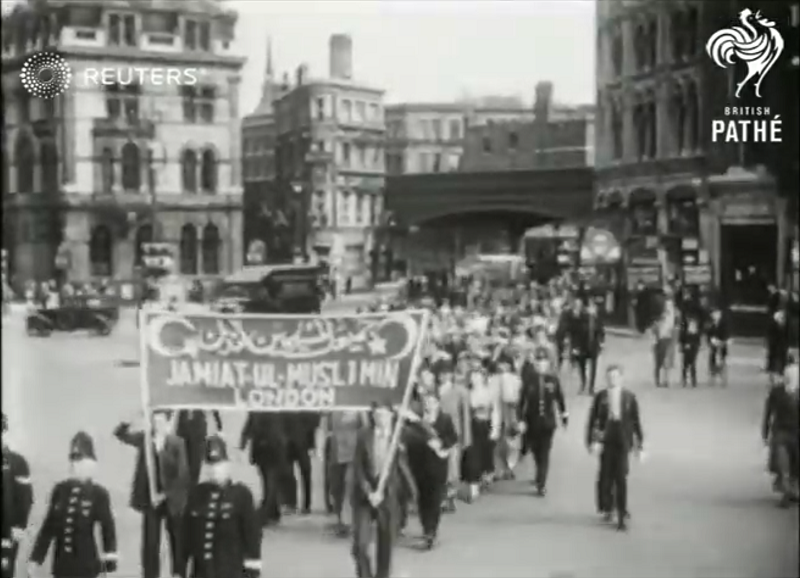
Screen capture of the 1938 Muslim protest march in London from a British Pathé newsreel – https://www.youtube.com/watch?v=ADausiEe4pM
… my husband was at the Museum of London and spotted a very brief mention of this protest in 1938 on a list of 20th century London events. I did some research.
The book they objected to was HG Wells’ A Short History of the World. This was originally published in 1922 but in 1938 an abridged version was tranlated into Hindustani and published in India. His observations about the Prophet Mohammed did not find favour with Indian Muslims (and as you know pre-partition the area called India covered what is now Pakistan and Bangladesh). There were protest meetings in Calcutta and Mumbai (then transliterated as Bombay) and the consignments of the books that WH Smith the booksellers sent to Hyderabad mysteriously never arrived. Investigation showed that the Sind government banned its import. Protests spread to east Africa and were reported in Nairobi and Mombasa.
The paragraphs concerned said “He seems to have been a man compounded of very considerable vanity, greed, cunning, self-deception, and quite sincere religious passion”. Wells concludes, not unfavourably, that “when the manifest defects of Muhammad’s life and writing have been allowed for, there remains in Islam, this faith he imposed upon the Arabs, much power and inspiration”.
There had been a number of Muslims living in east London for some years, sailors who came through the docks, retired servants, some professional men and in 1934 they formed a charitable association for the promotion of Islam called Jamiat-ul-Muslimin; they met on Fridays at a hall in Commercial Road.
On Friday 12th August 1938 a copy of A Short History of the World was, as apparently reported in the Manchester Guardian the following day “ceremoniously burned”. The main Nazi book burnings were over 5 years previously but I can’t but be reminded of them. I can’t access the Guardian on-line archive for 1938 as I don’t have a subscription, but I have no reason to doubt what they reported.
A few days later Dr Mohammed Buksh of Jamiat-ul-Muslimin attended upon Sir Feroz Khan Noon, the high commissioner for India. Sir Feroz tried to explain that in Britain we could (or could then) freely criticise Christianity, the Royal family and government as a right. He reminded Dr Buksh that Muslims were “a very small minority in England, and it would do them no good to try and be mischievous in this country, no matter how genuine their grievances were”.
Comments Off on That time that H.G. Wells fell afoul of Muslim sentiments
October 13, 2022
The Nazis’ Justification for the Genocide – October 9, 1943 – WAH 081
World War Two
Published 12 Oct 2022This week the Nazis go on the record about their genocide of the Jews. Meanwhile the Jews in Denmark are coming closer to safety, and the Roman Jews are again at peril.
(more…)
Comments Off on The Nazis’ Justification for the Genocide – October 9, 1943 – WAH 081
October 10, 2022
Chinese Warlords and the Royal Canadian Navy – WW2 – OOTF 028
World War Two
Published 9 Oct 2022In today’s episode of Out of the Foxholes, we discuss the role of Chinese warlords played in the war against Japan, while also shining a bit more light on the Canadian Navy and its impact on WW2.
(more…)
Comments Off on Chinese Warlords and the Royal Canadian Navy – WW2 – OOTF 028
Look at Life — Trouble Shooters (1964)
PauliosVids
Published 20 Nov 2018
From the comments:
David Mills
1 year ago
We never wore berets but jungle hats. This is an honest attempt to illustrate their role but so obviously, painfully stage managed. In reality, it was a hot, sweaty, stinking environment with constant tensions. Contacts were few and far between. Going into the IBAN long houses and chatting with the headman (Kampong Ketua) was fascinating, useful and, for the short period, relaxing. Between June 1965 and Aug 1982 I had four tours in the area. Learning Malay was essential and welcomed by the indigenous population.Iolis
1 year ago
The late Paddy Ashdown at 6.36. Later in life he would becone leader of Britain’s Liberal Democrat Party. He sadly died on 22 December 2018.
Comments Off on Look at Life — Trouble Shooters (1964)
October 9, 2022
Could the Soviets Cut Off Crimea? – WW2 – 215 – October 8, 1943
World War Two
Published 8 Oct 2022The Germans booby-trapped Naples when they evacuated last week and local civilians now pay the price. In the Mediterranean, Kos falls to the Germans while Corsica is liberated by the French. There is action all along the Dnieper in the USSR, and the Australians advance in New Guinea, and the Japanese evacuate Vella Lavella in the Solomons.
(more…)
Comments Off on Could the Soviets Cut Off Crimea? – WW2 – 215 – October 8, 1943
October 2, 2022
Smolensk and Naples Liberated! Both in ruins – WW2 – 214 – October 1, 1943
World War Two
Published 1 Oct 2022Major prizes are taken by the Allies this week on two fronts — Naples in Italy and Smolensk in the USSR, but they are advancing all over the Eastern Front, across the Italian peninsula, and in the South Seas, but the enemy is leaving a trail of destruction as he pulls back.
(more…)
Comments Off on Smolensk and Naples Liberated! Both in ruins – WW2 – 214 – October 1, 1943
QotD: US intelligence failures in the Tet Offensive
[In The Tet Offensive: Intelligence Failure in War, James] Wirtz argues that Tet was not an intelligence failure in the sense that “the Allies” (his term) had no idea it was coming. US analysts had lots of information indicating a pending attack — indeed, sometimes too much information. Nor was it a complete failure to analyze the available information — lots of US analysts were in the ballpark about the size, direction, and even timing of the attack, and one analyst, Joseph Hovey, produced a report that predicted the whole thing with astonishing accuracy. Rather — and this is my term, not Wirtz’s — it was a failure of narrative.
By summer 1967, MACV (for convenience) had convinced itself that the North Vietnamese no longer had the resources to win the war militarily, and they knew it. This conclusion was based in large part on metrics coming in from field commanders. Specifically, MACV argued that by mid-1967, the Communists had passed what they, MACV, termed the “inflection point” — the North Vietnamese were losing more forces than they could replace, which led to a significant decrease in NVA / VC fighting capacity, plummeting morale, etc.
At no point, it seemed, did they question this assumption, or the bases of this assumption, the key to which was: Kill ratio. We all know how that goes, no need to get into the weeds, but note that everything hinges on the North Vietnamese not only losing the war, but knowing themselves to be losing.
[…]
So, too, with ever-increasing reports that the Viet Cong were going to launch major attacks on South Vietnamese cities. Since US analysts assumed the VC didn’t have the forces for that, these reports were dismissed as propaganda.
Finally, the assumption that the NVA knew themselves to be losing was seemingly confirmed with the siege of the big US firebase at Khe Sanh. It shared a similar geography with Dien Bien Phu, and when some of the same units that had participated in the original battle showed up to take on the Marines, US analysts concluded that the Communists, desperate for a psychological victory, were trying to make another Dien Bien Phu out of Khe Sanh.
At most, US analysts reasoned, Khe Sahn was another Battle of the Bulge — a last-ditch “saving throw”-type attack by an almost-beaten enemy. Much like German forces in the Ardennes, then, the North Vietnamese would attack the Americans, because they were the strongest part of the Allies, and therefore the most immediate military threat.
In fact, almost the exact opposite was true, pretty much all the way down the line. The NVA’s plan was to attack ARVN (the South Vietnamese Army) because they were the weakest, and would be even weaker during Tet, when half of them would be on furlough. But ARVN wasn’t out on the perimeter and along the DMZ. They were in the cities. The whole point of the attack on Khe Sanh (and of a whole series of skirmishes called “the border battles”) was to keep US forces out on the perimeter and away from the cities.
It worked spectacularly, too — even as Tet was unfolding, Gen. Westmoreland assumed it was a diversion, to draw American troops away from Khe Sanh. Half the country had been overrun before Westy began to think maybe Khe Sanh wasn’t the target after all; he only really believed it when the NVA broke off the siege and withdrew.
It was Narrative uber alles.
Severian, “Book Rec: Tet, Intelligence Failure”, Founding Questions, 2022-06-30.
Comments Off on QotD: US intelligence failures in the Tet Offensive
October 1, 2022
American Empire, question mark
An interview with Niall Ferguson in the Dartmouth Review by Lintaro Donovan revisits Ferguson’s 2005 book Colossus in light of what has happened during the nearly two decades since it was published:
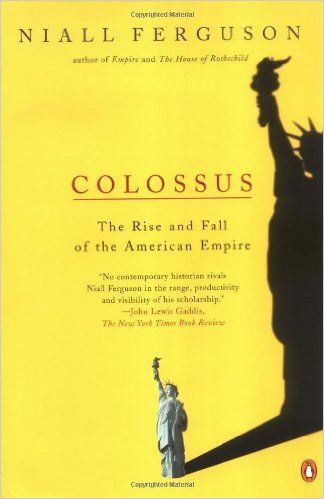
TDR: In your 2005 book Colossus: The Rise and Fall of the American Empire, you advance the thesis that the United States is an empire in denial and that such denial will be our undoing, both domestically and abroad. Does that thesis still hold in the world of 2022?
NF: I think it has withstood quite well the test of nearly 20 years. If you recall, the analysis was that the United States was trying essentially an imperial enterprise in Afghanistan and Iraq and that there were three deficits that were going to make it fail. There was the manpower deficit, because people really did not want to spend that much time in Afghanistan and Iraq – hence the short tours of duty. There was the fiscal deficit, which was already obviously a problem and has only gotten worse. And then there was the attention deficit. The prediction was that the US [BREAK] public would become disillusioned with these endeavors just as it became disillusioned with Vietnam. And if anything, the surprising thing is how long it took to get out of Afghanistan.
I wouldn’t have predicted it would be 2021. I expected it sooner than that. But I think that the overall framing of the US as an empire-in-denial works because it’s so deeply rooted in the way Americans think about themselves and the language that their leaders use. What was odd was that some neo-conservatives back then really were willing to say, “We’re an empire now”.
Of course, it kind of blew them up politically so that they’re now an irrelevant bunch of never-Trumpers. So I feel that book stood up remarkably well to the test of time. I’d stick by it.
TDR: What I’m hearing from your answer is that our denial is sort of endemic to what Americans are and that there were issues that were already present before the invasion of Iraq. Do you think that there’s any personality in American public life today who might be able to get us out of our denial and fix these issues that you’re talking about?
NF: No, because I think, if anything, the kind of aversion to empire has grown on both the left and the right. And so you have different versions of it.
Those wings, the progressive wing of the Democratic Party and the Trumpian wing of the Republican Party, are much stronger than they were then. I don’t think we are going to see any revival until the US suffers the kind of attack that it suffered at Pearl Harbor or 9/11.
Until there’s a punch landed, what will happen is that the US will try to exercise power through indirect means like sanctions or getting Ukrainians to fight Russians or arming the Taiwanese. And, in that sense, I think we’ve reverted to a Cold War playbook without calling it a cold war.
The problem is that we aren’t as far ahead [of China] economically and technologically as we were relative to the Soviet Union. If you’re doing a cold war with China, you have to reckon with quite a formidable antagonist, but that I think is where we are.
It’s amazing how far there is now a bipartisan consensus that China’s the problem. The continuities from the Trump to Biden Administration are very striking in that respect. I don’t see that changing until something bad happens, whether it’s a showdown over Taiwan that the US actually loses, or the collapse of Ukraine, which I guess is a conceivable if now unlikely scenario, or another terrorist attack, though I think that’s not especially likely these days.
The other thing to watch out for is the Middle East. Basically, as in the Cold War, you’ve got the potential for a crisis to happen. The problem for the US is that it’s quite overstretched. If there’s a crisis in Eastern Europe and a crisis in the Far East, say Taiwan, and one in the Middle East, then the US is going to be completely unable to respond to all of those.
It’s already in the position that it can’t give Stinger and Javelin missiles to the Taiwanese, because they’ve already been given to the Ukrainians and we can’t actually make that many new ones. It feels like we are doing Cold War but with quite a bit more overstretch than was true certainly in the 1980s.
Comments Off on American Empire, question mark
September 25, 2022
Red Army Reaches the Dnieper – WW2 – 213 – September 24, 1943
World War Two
Published 24 Sep 2022Benito Mussolini proclaims a new fascist republic in Italy, but this time it is a full puppet state to Germany. There is scattered fighting around Italy and the Dodecanese — including a massacre of Italian POWs, but the big Allied advances this week are the Australians in New Guinea and the Soviets retaking their own territory. They take ground, in fact, from near Smolensk all the way south to the Sea of Azov.
(more…)
Comments Off on Red Army Reaches the Dnieper – WW2 – 213 – September 24, 1943
September 21, 2022
QotD: Why postwar western economic and humanitarian “interventions” almost always failed
Prior to the Cold War, America’s interference in other countries’ internal affairs was practically nonexistent outside of the Caribbean where America’s preoccupation was with the stability in the region. What went on in Egypt, Thailand, Argentina, or Greece was none of our business, nor did we frankly care. However, having just survived the cataclysm of WWII, and the realization that Communism was a danger bent on world domination, and that each country that became Communist made that possibility much more likely changed that laissez faire attitude 180 degrees. Whereas NATO was formed for the purpose of deterring a military attack on Western Europe by the Soviet Union (the generals mentally fighting the last war as is always the case, not realizing that the war now was ideological and propagandistic rather than military), diplomats began to question how to best combat Communist insurgencies in the Third World. The arrived (wrong) conclusion was that the reason a country became Communist was because the dirt-poor people were so desperate that they became Marxists in order to improve their lives, so if the West helped poor countries economically Communists could not gain a foothold. As such, they ignored the fact that most Communist movements are organized and headed not by poor people, but by a cadre of power-hungry middle-class intellectuals.
As has been mentioned, the first approach was with foreign aid. The second was with military intervention, in Korea, Vietnam, Santo Domingo, Grenada, and Lebanon. Although such interventions were mostly successful, they carried a heavy price as American blood was spilled in foreign countries. America’s supposed allies hardly helped at all, including the citizens of the countries (Korea and Vietnam) that themselves were in danger of being conquered by Communist forces.
Armando Simón, “Schlimmbesserung“, New English Review, 2022-06-16.
Comments Off on QotD: Why postwar western economic and humanitarian “interventions” almost always failed
September 19, 2022
Albania – Hitler’s Latest Ally? – WAH 078 – September 18, 1943
World War Two
Published 18 Sep 2022The German Nazi Genocide of the Jews surpasses four million deaths, while the Soviet Union and US step up oppression against some their own citizens.
(more…)
Comments Off on Albania – Hitler’s Latest Ally? – WAH 078 – September 18, 1943
September 18, 2022
Jailbreak! Mussolini on the Loose Again! – WW2 – 212 – September 17, 1943
World War Two
Published 17 Sep 2022
(more…)
Comments Off on Jailbreak! Mussolini on the Loose Again! – WW2 – 212 – September 17, 1943


